Analytic electromagnetic signatures of compact pentaquark structure: A multi-current QCD light-cone sum rules analysis of the P_(psi s)^(Λ) states
Pith reviewed 2026-06-25 23:26 UTC · model grok-4.3
The pith
Light-cone sum rules on four currents fix light-quark magnetic moment ratio at exactly -2 for compact pentaquarks, with charm contribution vanishing in one case.
A machine-rendered reading of the paper's core claim, the machinery that carries it, and where it could break.
Core claim
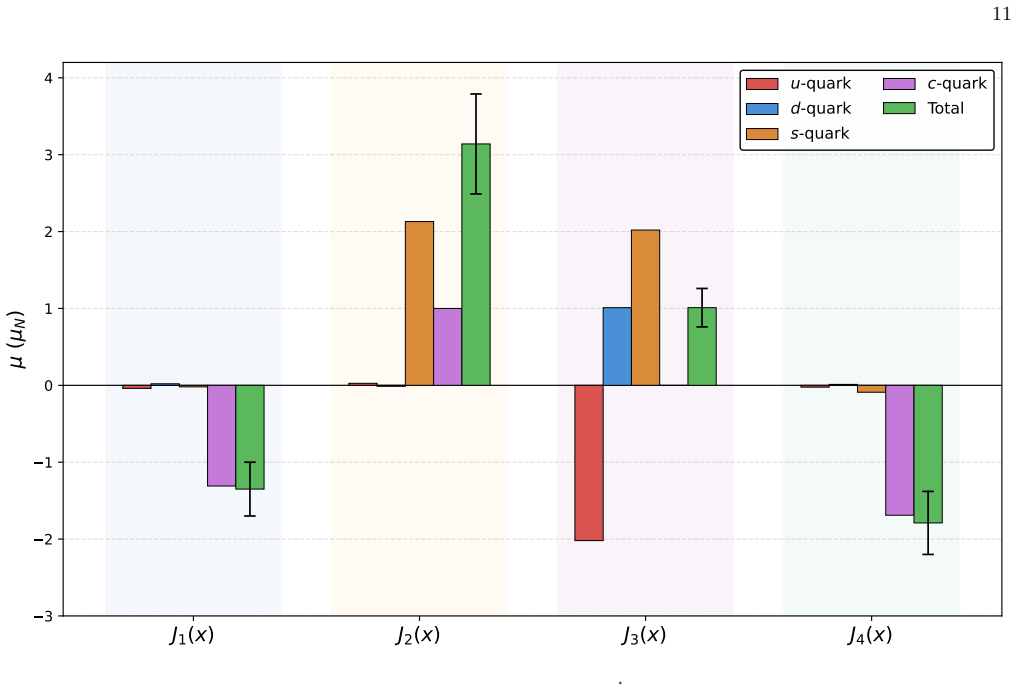
The central claim is that the light-quark contributions satisfy μ_u/μ_d = e_u/e_d = -2 in all four currents J1(x)-J4(x) because they share a common Lorentz-color kernel, while for the J3(x) current the charm contribution vanishes identically from the Dirac structure of the anti-charm coupling. The total moments extracted via LCSR are μ_J1 = -1.35 μ_N, μ_J2 = 3.14 μ_N, μ_J3 = 1.01 μ_N and μ_J4 = -1.79 μ_N. These values remain valid independent of which current is assigned to which observed P_ψs^Λ state and exceed the magnitudes expected from quark models or heavy pentaquark chiral perturbation theory.
What carries the argument
The four diquark-diquark-antiquark interpolating currents J1(x) to J4(x) with J^P = 1/2^- together with the LCSR correlation functions that enforce the algebraic flavor relations.
If this is right
- The two signatures remain valid independent of any specific state-to-current pairing.
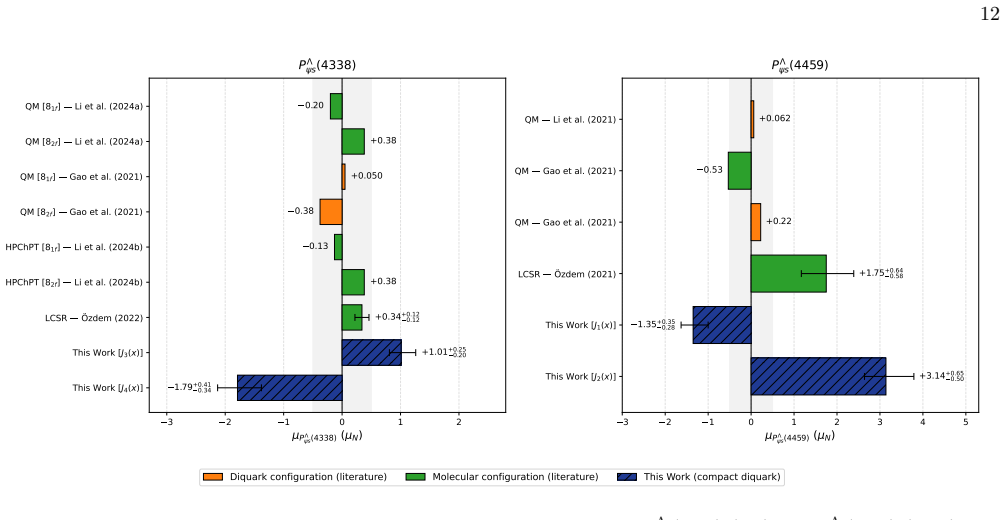
- The extracted magnitudes lie in the range 1-3 nuclear magnetons and exceed quark-model and heavy pentaquark chiral perturbation theory expectations of less than 0.5 nuclear magnetons.
- The same LCSR procedure applied to prior molecular analyses produces a light-quark ratio of -1/2 rather than -2, supplying an internal contrast at the flavor-decomposed level.
- The predictions accommodate either the P_ψs^Λ(4338) or P_ψs^Λ(4459) state within the quoted uncertainties.
Where Pith is reading between the lines
- Confirmation of the fixed ratios would motivate direct experimental searches for electromagnetic moments of pentaquarks as a structure diagnostic.
- The algebraic relations could be checked in lattice QCD calculations of the same matrix elements.
- Similar multi-current analyses might be applied to other exotic hadrons to extract comparable flavor signatures.
Load-bearing premise
The four chosen interpolating currents accurately represent the compact diquark-diquark-antiquark structure of the physical states and the LCSR correlation functions capture the electromagnetic matrix elements without dominant higher-twist or continuum contamination.
What would settle it
An experimental measurement of pentaquark magnetic moments in which the light-quark ratio deviates from -2 or the charm contribution for the J3 current is nonzero would falsify the compact-structure signatures.
Figures
read the original abstract
Probing the internal organization of hidden-charm pentaquarks -- including the spin-color correlations that distinguish compact diquark-diquark-antiquark configurations from loosely bound hadronic molecules -- requires observables beyond mass spectroscopy. We argue that multi-current QCD light-cone sum rules (LCSR) provide a diagnostic framework through exact analytic relations among flavor-sector contributions enforced by the algebra of the interpolating currents. We identify two such signatures: (i) the light-quark contributions satisfy $\mu_{u}/\mu_{d}=e_{u}/e_{d}=-2$ in all four currents considered, reflecting a common Lorentz-color kernel; and (ii) for the $J_{3}(x)$ current the charm contribution vanishes identically, $\mu_{c}=0$, from the Dirac structure of the anti-charm coupling rather than the pseudoscalar charm-diquark embedding alone. Using four diquark-diquark-antiquark currents $J_{1}(x)$-$J_{4}(x)$ with $J^{P}=\tfrac{1}{2}^{-}$, we obtain $\mu_{J_{1}}=-1.35^{+0.35}_{-0.28}\,\mu_{N}$, $\mu_{J_{2}}=3.14^{+0.65}_{-0.50}\,\mu_{N}$, $\mu_{J_{3}}=1.01^{+0.25}_{-0.20}\,\mu_{N}$, $\mu_{J_{4}}=-1.79^{+0.41}_{-0.34}\,\mu_{N}$. These predictions are paired with the $P_{\psi s}^{\Lambda}(4338)$ and $P_{\psi s}^{\Lambda}(4459)$ on mass grounds as a working hypothesis, since the $\pm 0.11~\text{GeV}$ uncertainties accommodate either state within $1\sigma$ of all four currents. The magnitudes $|\mu|\sim 1$-$3\,\mu_{N}$ lie above quark-model and heavy pentaquark chiral perturbation theory expectations ($|\mu|\lesssim 0.5\,\mu_{N}$). Applying the same procedure to two previous molecular LCSR analyses yields $\mu_{u}/\mu_{d}=-1/2$ rather than $-2$, providing an LCSR-internal contrast at the flavor-decomposed level even when total magnitudes are comparable. The two signatures are immune to the state-to-current pairing and offer falsifiable tests of the compact picture.
Editorial analysis
A structured set of objections, weighed in public.
Referee Report
Summary. The paper applies multi-current QCD light-cone sum rules to four diquark-diquark-antiquark interpolating currents J1(x)–J4(x) with J^P=1/2^- for the hidden-charm pentaquarks P_ψs^Λ. It identifies two exact analytic signatures enforced by the Dirac and color algebra of the currents: μ_u/μ_d = e_u/e_d = −2 for light-quark contributions in all four currents, and μ_c=0 identically for the J3 current from its anti-charm Dirac structure. Numerical total magnetic moments are extracted as μ_J1=−1.35^{+0.35}_{-0.28} μ_N, μ_J2=3.14^{+0.65}_{-0.50} μ_N, μ_J3=1.01^{+0.25}_{-0.20} μ_N, μ_J4=−1.79^{+0.41}_{-0.34} μ_N. These are paired with the observed P_ψs^Λ(4338) and P_ψs^Λ(4459) on mass-overlap grounds (within 1σ) as a working hypothesis, and the same procedure applied to prior molecular currents yields the contrasting ratio −1/2. The signatures are presented as independent of LCSR auxiliary parameters and of the state-to-current assignment.
Significance. If the algebraic derivations hold, the work supplies parameter-free, falsifiable electromagnetic diagnostics that distinguish compact diquark-diquark-antiquark structure from molecular configurations at the flavor-decomposed level. Credit is due for the exact analytic relations (μ_u/μ_d=−2 and μ_c=0) that follow directly from current algebra without reliance on Borel mass or continuum threshold, and for the explicit LCSR-internal contrast with molecular currents. The predicted magnitudes |μ|∼1–3 μ_N lie outside the range of quark-model and heavy-pentaquark χPT expectations (≲0.5 μ_N), offering a concrete test once electromagnetic data become available.
minor comments (3)
- [§3] §3, after Eq. (12): the statement that the signatures are 'immune to the state-to-current pairing' is correct for the ratios, but the text should explicitly note that the numerical total moments still carry the standard LCSR systematic uncertainties from the auxiliary parameters even though the ratios do not.
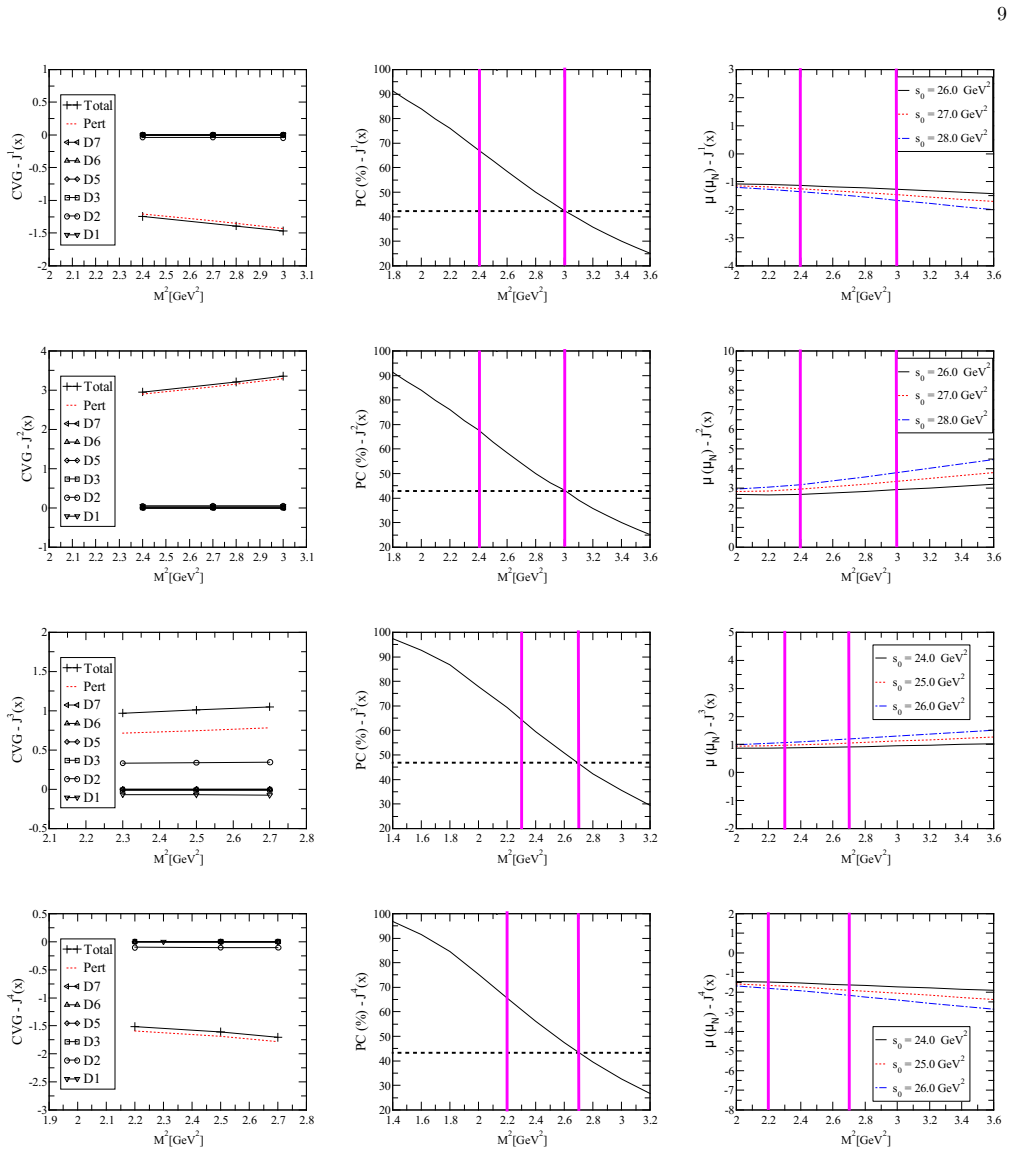
- [Table 1] Table 1: the caption should clarify whether the quoted uncertainties on the total moments already incorporate variation of the Borel window and continuum threshold or represent only the central-value result.
- [Abstract] Abstract and §4: the ±0.11 GeV mass uncertainty used for the 1σ overlap with P_ψs^Λ(4338) and (4459) is stated without reference; a brief footnote citing the experimental source would improve traceability.
Simulated Author's Rebuttal
We thank the referee for the careful reading of our manuscript and the positive assessment of the analytic signatures and their potential as falsifiable diagnostics. The recommendation for minor revision is noted. No specific major comments were enumerated in the report, so we provide no point-by-point responses below.
Circularity Check
No significant circularity detected
full rationale
The paper's central analytic signatures (μ_u/μ_d = e_u/e_d = −2 across currents and μ_c = 0 for J3) are presented as direct algebraic consequences of the Dirac-color structure in the explicitly defined interpolating currents J1(x)–J4(x). These relations follow from the current definitions themselves rather than from any fitted parameters, LCSR auxiliary choices, or self-citations. The numerical total moments carry standard LCSR uncertainties, but the flavor-decomposed ratios and vanishing term remain independent of those inputs. No step matches the enumerated circularity patterns; the derivation chain is self-contained against the current algebra and external benchmarks.
Axiom & Free-Parameter Ledger
free parameters (2)
- Borel mass parameter
- Continuum threshold
axioms (2)
- domain assumption Validity of light-cone operator product expansion and quark-hadron duality for the electromagnetic correlation functions built from the four currents.
- domain assumption The physical P_ψs^Λ states can be represented by the compact diquark-diquark-antiquark currents J1-J4.
Reference graph
Works this paper leans on
-
[1]
For further details regarding this procedure, see [71]
This choice ensures that the single dispersion approximation effectively suppresses contributions from higher resonances and the continuum. For further details regarding this procedure, see [71]. Appendix B: Photon Distribution Amplitudes For completeness, we present in this appendix the explicit forms of the non-perturbative matrix elements that appear o...
-
[2]
Gell-Mann, A Schematic Model of Baryons and Mesons, Phys
M. Gell-Mann, A Schematic Model of Baryons and Mesons, Phys. Lett. 8 (1964) 214–215.doi:10.1016/S0031-9163(64) 92001-3
-
[3]
S. K. Choi, et al., Observation of a narrow charmonium-like state in exclusiveB± →K±π+π−J/ψdecays, Phys. Rev. Lett. 91 (2003) 262001.arXiv:hep-ex/0309032,doi:10.1103/PhysRevLett.91.262001
work page internal anchor Pith review Pith/arXiv arXiv doi:10.1103/physrevlett.91.262001 2003
-
[4]
R. Aaij, et al., Observation ofJ/ψpResonances Consistent with Pentaquark States inΛ0 b→J/ψK−pDecays, Phys. Rev. Lett. 115 (2015) 072001.arXiv:1507.03414,doi:10.1103/PhysRevLett.115.072001
work page internal anchor Pith review Pith/arXiv arXiv doi:10.1103/physrevlett.115.072001 2015
-
[5]
R. Aaij, et al., Observation of a narrow pentaquark state,Pc(4312)+, and of two-peak structure of thePc(4450)+, Phys. Rev. Lett. 122 (22) (2019) 222001.arXiv:1904.03947,doi:10.1103/PhysRevLett.122.222001
work page internal anchor Pith review Pith/arXiv arXiv doi:10.1103/physrevlett.122.222001 2019
-
[6]
R. Aaij, et al., Evidence of aJ/ψΛstructure and observation of excitedΞ− states in theΞ− b →J/ψΛK− decay, Sci. Bull. 66 (2021) 1278–1287.arXiv:2012.10380,doi:10.1016/j.scib.2021.02.030
-
[7]
Adachi, et al., Search for Pcs(4459) and Pcs(4338) in Upsilon(1S,2S) inclusive decays at Belle, Phys
I. Adachi, et al., Search for Pcs(4459) and Pcs(4338) in Upsilon(1S,2S) inclusive decays at Belle, Phys. Rev. Lett. 135 (4) (2025) 041901.arXiv:2502.09951,doi:10.1103/pf8m-6j69
-
[8]
Aaij, et al., Evidence for a new structure in theJ/ψpandJ/ψ¯psystems inB0 s →J/ψp¯pdecays, Phys
R. Aaij, et al., Evidence for a new structure in theJ/ψpandJ/ψ¯psystems inB0 s →J/ψp¯pdecays, Phys. Rev. Lett. 128 (6) (2022) 062001.arXiv:2108.04720,doi:10.1103/PhysRevLett.128.062001
-
[9]
R. Aaij, et al., Observation of a J/ψΛResonance Consistent with a Strange Pentaquark Candidate in B-→J/ψΛp¯Decays, Phys. Rev. Lett. 131 (3) (2023) 031901.arXiv:2210.10346,doi:10.1103/PhysRevLett.131.031901
-
[10]
M.-Z. Liu, Y.-W. Pan, Z.-W. Liu, T.-W. Wu, J.-X. Lu, L.-S. Geng, Three ways to decipher the nature of exotic hadrons: Multiplets, three-body hadronic molecules, and correlation functions, Phys. Rept. 1108 (2025) 1–108.arXiv:2404.06399, doi:10.1016/j.physrep.2024.12.001
-
[11]
L. Meng, B. Wang, G.-J. Wang, S.-L. Zhu, Chiral perturbation theory for heavy hadrons and chiral effective field theory for heavy hadronic molecules, Phys. Rept. 1019 (2023) 1–149.arXiv:2204.08716,doi:10.1016/j.physrep.2023.04.003
-
[12]
H.-X. Chen, W. Chen, X. Liu, Y.-R. Liu, S.-L. Zhu, An updated review of the new hadron states, Rept. Prog. Phys. 86 (2) (2023) 026201.arXiv:2204.02649,doi:10.1088/1361-6633/aca3b6
-
[13]
Four-Quark Hadrons: an Updated Review
A. Esposito, A. L. Guerrieri, F. Piccinini, A. Pilloni, A. D. Polosa, Four-Quark Hadrons: an Updated Review, Int. J. Mod. Phys. A 30 (2015) 1530002.arXiv:1411.5997,doi:10.1142/S0217751X15300021
work page internal anchor Pith review Pith/arXiv arXiv doi:10.1142/s0217751x15300021 2015
-
[14]
A. Esposito, A. Pilloni, A. D. Polosa, Multiquark Resonances, Phys. Rept. 668 (2017) 1–97.arXiv:1611.07920,doi: 10.1016/j.physrep.2016.11.002
work page internal anchor Pith review Pith/arXiv arXiv doi:10.1016/j.physrep.2016.11.002 2017
-
[15]
S. L. Olsen, T. Skwarnicki, D. Zieminska, Nonstandard heavy mesons and baryons: Experimental evidence, Rev. Mod. Phys. 90 (1) (2018) 015003.arXiv:1708.04012,doi:10.1103/RevModPhys.90.015003
work page internal anchor Pith review Pith/arXiv arXiv doi:10.1103/revmodphys.90.015003 2018
-
[16]
R. F. Lebed, R. E. Mitchell, E. S. Swanson, Heavy-Quark QCD Exotica, Prog. Part. Nucl. Phys. 93 (2017) 143–194. arXiv:1610.04528,doi:10.1016/j.ppnp.2016.11.003
work page internal anchor Pith review Pith/arXiv arXiv doi:10.1016/j.ppnp.2016.11.003 2017
-
[17]
New Charmonium States in QCD Sum Rules: a Concise Review
M. Nielsen, F. S. Navarra, S. H. Lee, New Charmonium States in QCD Sum Rules: A Concise Review, Phys. Rept. 497 (2010) 41–83.arXiv:0911.1958,doi:10.1016/j.physrep.2010.07.005
work page internal anchor Pith review Pith/arXiv arXiv doi:10.1016/j.physrep.2010.07.005 2010
-
[19]
S. Agaev, K. Azizi, H. Sundu, Four-quark exotic mesons, Turk. J. Phys. 44 (2) (2020) 95–173.arXiv:2004.12079, doi:10.3906/fiz-2003-15
-
[20]
H.-X. Chen, W. Chen, X. Liu, S.-L. Zhu, The hidden-charm pentaquark and tetraquark states, Phys. Rept. 639 (2016) 1–121.arXiv:1601.02092,doi:10.1016/j.physrep.2016.05.004
work page internal anchor Pith review Pith/arXiv arXiv doi:10.1016/j.physrep.2016.05.004 2016
-
[21]
A. Ali, J. S. Lange, S. Stone, Exotics: Heavy Pentaquarks and Tetraquarks, Prog. Part. Nucl. Phys. 97 (2017) 123–198. arXiv:1706.00610,doi:10.1016/j.ppnp.2017.08.003
work page internal anchor Pith review Pith/arXiv arXiv doi:10.1016/j.ppnp.2017.08.003 2017
-
[22]
F.-K. Guo, C. Hanhart, U.-G. Meißner, Q. Wang, Q. Zhao, B.-S. Zou, Hadronic molecules, Rev. Mod. Phys. 90 (1) (2018) 015004, [Erratum: Rev.Mod.Phys. 94, 029901 (2022)].arXiv:1705.00141,doi:10.1103/RevModPhys.90.015004
work page internal anchor Pith review Pith/arXiv arXiv doi:10.1103/revmodphys.90.015004 2018
-
[23]
Pentaquark and Tetraquark states
Y.-R. Liu, H.-X. Chen, W. Chen, X. Liu, S.-L. Zhu, Pentaquark and Tetraquark states, Prog. Part. Nucl. Phys. 107 (2019) 237–320.arXiv:1903.11976,doi:10.1016/j.ppnp.2019.04.003
work page internal anchor Pith review Pith/arXiv arXiv doi:10.1016/j.ppnp.2019.04.003 2019
-
[24]
G. Yang, J. Ping, J. Segovia, Tetra- and penta-quark structures in the constituent quark model, Symmetry 12 (11) (2020) 1869.arXiv:2009.00238,doi:10.3390/sym12111869. 21
-
[25]
X.-K. Dong, F.-K. Guo, B.-S. Zou, A survey of heavy-antiheavy hadronic molecules, Progr. Phys. 41 (2021) 65–93.arXiv: 2101.01021,doi:10.13725/j.cnki.pip.2021.02.001
-
[26]
X.-K. Dong, F.-K. Guo, B.-S. Zou, A survey of heavy–heavy hadronic molecules, Commun. Theor. Phys. 73 (12) (2021) 125201.arXiv:2108.02673,doi:10.1088/1572-9494/ac27a2
-
[27]
U. Özdem, Electromagnetic tomography of spin-3 2 hidden-charm strange pentaquarks, JHEP 02 (2026) 207.arXiv: 2510.26893,doi:10.1007/JHEP02(2026)207
-
[28]
Özdem, Shedding light on the nature of the Pcs(4459) pentaquark state, Phys
U. Özdem, Shedding light on the nature of the Pcs(4459) pentaquark state, Phys. Rev. D 111 (7) (2025) 074038.arXiv: 2411.11442,doi:10.1103/PhysRevD.111.074038
-
[29]
U. Özdem, Elucidating the nature of hidden-charm pentaquark states with spin-32 through their electromagnetic form factors, Phys. Lett. B 851 (2024) 138551.arXiv:2402.03802,doi:10.1016/j.physletb.2024.138551
-
[30]
Özdem, Electromagnetic properties of D¯(∗)Ξc’, D¯(∗)Λc, D¯s(∗)Λc and D¯s(∗)Ξc pentaquarks, Phys
U. Özdem, Electromagnetic properties of D¯(∗)Ξc’, D¯(∗)Λc, D¯s(∗)Λc and D¯s(∗)Ξc pentaquarks, Phys. Lett. B 846 (2023) 138267.arXiv:2303.10649,doi:10.1016/j.physletb.2023.138267
-
[31]
Özdem, Investigation of magnetic moment of Pcs(4338) and Pcs(4459) pentaquark states, Phys
U. Özdem, Investigation of magnetic moment of Pcs(4338) and Pcs(4459) pentaquark states, Phys. Lett. B 836 (2023) 137635.arXiv:2208.07684,doi:10.1016/j.physletb.2022.137635
-
[32]
G.-J. Wang, R. Chen, L. Ma, X. Liu, S.-L. Zhu, Magnetic moments of the hidden-charm pentaquark states, Phys. Rev. D 94 (9) (2016) 094018.arXiv:1605.01337,doi:10.1103/PhysRevD.94.094018
work page internal anchor Pith review Pith/arXiv arXiv doi:10.1103/physrevd.94.094018 2016
-
[33]
Hidden charm pentaquarks: mass spectrum, magnetic moments, and photocouplings
E. Ortiz-Pacheco, R. Bijker, C. Fernández-Ramírez, Hidden charm pentaquarks: mass spectrum, magnetic moments, and photocouplings, J. Phys. G 46 (6) (2019) 065104.arXiv:1808.10512,doi:10.1088/1361-6471/ab096d
work page internal anchor Pith review Pith/arXiv arXiv doi:10.1088/1361-6471/ab096d 2019
-
[34]
Y.-J. Xu, Y.-L. Liu, M.-Q. Huang, The magnetic moment ofPc(4312)as a ¯DΣc molecular state, Eur. Phys. J. C 81 (5) (2021) 421.arXiv:2008.07937,doi:10.1140/epjc/s10052-021-09211-8
-
[35]
Electromagnetic multipole moments of the $P_c^+(4380)$ pentaquark in light-cone QCD
U. Özdem, K. Azizi, Electromagnetic multipole moments of theP+ c (4380)pentaquark in light-cone QCD, Eur. Phys. J. C 78 (5) (2018) 379.arXiv:1803.06831,doi:10.1140/epjc/s10052-018-5873-2
work page internal anchor Pith review Pith/arXiv arXiv doi:10.1140/epjc/s10052-018-5873-2 2018
-
[36]
U. Özdem, Magnetic dipole moments of the hidden-charm pentaquark states:Pc(4440),P c(4457)andP cs(4459), Eur. Phys. J. C 81 (4) (2021) 277.arXiv:2102.01996,doi:10.1140/epjc/s10052-021-09070-3
-
[37]
M.-W. Li, Z.-W. Liu, Z.-F. Sun, R. Chen, Magnetic moments and transition magnetic moments of Pc and Pcs states, Phys. Rev. D 104 (5) (2021) 054016.arXiv:2106.15053,doi:10.1103/PhysRevD.104.054016
-
[38]
F. Gao, H.-S. Li, Magnetic moments of hidden-charm strange pentaquark states*, Chin. Phys. C 46 (12) (2022) 123111. arXiv:2112.01823,doi:10.1088/1674-1137/ac8651
-
[39]
F. Guo, H.-S. Li, Analysis of the hidden-charm pentaquark states based on magnetic moment and transition magnetic moment, Eur. Phys. J. C 84 (4) (2024) 392.arXiv:2304.10981,doi:10.1140/epjc/s10052-024-12699-5
-
[40]
F.-L. Wang, S.-Q. Luo, H.-Y. Zhou, Z.-W. Liu, X. Liu, Exploring the electromagnetic properties of theΞc(’,*)D¯s* and Ωc(*)D¯s*molecularstates, Phys.Rev.D108(3)(2023)034006.arXiv:2210.02809,doi:10.1103/PhysRevD.108.034006
-
[41]
F.-L. Wang, H.-Y. Zhou, Z.-W. Liu, X. Liu, What can we learn from the electromagnetic properties of hidden-charm molecular pentaquarks with single strangeness?, Phys. Rev. D 106 (5) (2022) 054020.arXiv:2208.10756,doi:10.1103/ PhysRevD.106.054020
arXiv 2022
-
[42]
U. Özdem, Analysis of the isospin eigenstate¯DΣc, ¯D∗Σc, and ¯DΣ ∗ c pentaquarks by their electromagnetic properties, Eur. Phys. J. C 84 (8) (2024) 769.arXiv:2401.12678,doi:10.1140/epjc/s10052-024-13124-7
-
[43]
H.-S. Li, F. Guo, Y.-D. Lei, F. Gao, Magnetic moments and axial charges of the octet hidden-charm molecular pentaquark family, Phys. Rev. D 109 (9) (2024) 094027.arXiv:2401.14767,doi:10.1103/PhysRevD.109.094027
-
[44]
Li, Molecular pentaquark magnetic moments in heavy pentaquark chiral perturbation theory, Phys
H.-S. Li, Molecular pentaquark magnetic moments in heavy pentaquark chiral perturbation theory, Phys. Rev. D 109 (11) (2024) 114039.arXiv:2401.14759,doi:10.1103/PhysRevD.109.114039
-
[45]
H. Mutuk, X.-W. Kang, Unveiling the structure of hidden-bottom strange pentaquarks via magnetic moments, Phys. Lett. B 855 (2024) 138772.arXiv:2405.07066,doi:10.1016/j.physletb.2024.138772
-
[46]
Mutuk, Magnetic moments of hidden-bottom pentaquark states, Eur
H. Mutuk, Magnetic moments of hidden-bottom pentaquark states, Eur. Phys. J. C 84 (8) (2024) 874.arXiv:2403.16616, doi:10.1140/epjc/s10052-024-13263-x
-
[47]
Mutuk, Magnetic moments of hidden-charm pentaquarks in the diquark–diquark–antiquark scheme, Chin
H. Mutuk, Magnetic moments of hidden-charm pentaquarks in the diquark–diquark–antiquark scheme, Chin. J. Phys. 97 (2025) 1406–1414.arXiv:2411.16486,doi:10.1016/j.cjph.2025.07.030
-
[48]
Özdem, Insight into the nature of thePc(4457)and related pentaquarks, Eur
U. Özdem, Insight into the nature of thePc(4457)and related pentaquarks, Eur. Phys. J. C 85 (6) (2025) 624.arXiv: 2409.09449,doi:10.1140/epjc/s10052-025-14323-6
-
[49]
Quasi-local photon surfaces in general spherically symmetric spacetimes.Eur
U. Özdem, Probing the electromagnetic structure of thePc(4337)+ pentaquark: insights from a diquark–diquark–antiquark picture forJ P = 1 2 − and 3 2 − states, Eur. Phys. J. C 85 (6) (2025) 704.arXiv:2506.04345,doi:10.1140/epjc/ s10052-025-14439-9
-
[50]
S.-H.Zhu, F.-L.Wang, X.Liu, ElectromagneticcharacteristicsasprobesintotheinnerstructuresofthepredictedΞ (′,∗) c D(∗) s molecular states, Eur. Phys. J. C 86 (4) (2026) 385.arXiv:2510.18492,doi:10.1140/epjc/s10052-026-15552-z
work page internal anchor Pith review Pith/arXiv arXiv doi:10.1140/epjc/s10052-026-15552-z 2026
-
[51]
Özdem, Hidden-charm pentaquarks: electromagnetic structure in a diquark–diquark–antiquark model, Eur
U. Özdem, Hidden-charm pentaquarks: electromagnetic structure in a diquark–diquark–antiquark model, Eur. Phys. J. C 86 (4) (2026) 359.arXiv:2603.19151,doi:10.1140/epjc/s10052-026-15591-6
-
[52]
U. Özdem, Electromagnetic form factors: A window into theDΛc,D ∗Λc, andDΛ ∗ c molecular structure (11 2025).arXiv: 2511.16052
Pith/arXiv arXiv 2025
-
[53]
Mutuk, X.-W
H. Mutuk, X.-W. Kang, Magnetic moments of open bottom–charm molecular pentaquark octets (3 2026).arXiv:2603. 27657
2026
-
[54]
V. L. Chernyak, I. R. Zhitnitsky, B meson exclusive decays into baryons, Nucl. Phys. B 345 (1990) 137–172.doi: 10.1016/0550-3213(90)90612-H
-
[55]
V. M. Braun, I. E. Filyanov, QCD Sum Rules in Exclusive Kinematics and Pion Wave Function, Z. Phys. C 44 (1989) 157. 22 doi:10.1007/BF01548594
-
[56]
I. I. Balitsky, V. M. Braun, A. V. Kolesnichenko, Radiative Decay Sigma+ —>p gamma in Quantum Chromodynamics, Nucl. Phys. B 312 (1989) 509–550.doi:10.1016/0550-3213(89)90570-1
-
[57]
P. Ball, V. M. Braun, N. Kivel, Photon distribution amplitudes in QCD, Nucl. Phys. B 649 (2003) 263–296.arXiv: hep-ph/0207307,doi:10.1016/S0550-3213(02)01017-9
work page internal anchor Pith review Pith/arXiv arXiv doi:10.1016/s0550-3213(02)01017-9 2003
-
[58]
V. A. Novikov, M. A. Shifman, A. I. Vainshtein, V. I. Zakharov, Calculations in External Fields in Quantum Chromody- namics. Technical Review, Fortsch. Phys. 32 (1984) 585
1984
-
[59]
B. L. Ioffe, A. V. Smilga, Nucleon Magnetic Moments and Magnetic Properties of Vacuum in QCD, Nucl. Phys. B 232 (1984) 109–142.doi:10.1016/0550-3213(84)90364-X
-
[60]
D. B. Leinweber, R. M. Woloshyn, T. Draper, Electromagnetic structure of octet baryons, Phys. Rev. D 43 (1991) 1659– 1678.doi:10.1103/PhysRevD.43.1659
-
[61]
Analysis of the scalar and axial-vector heavy diquark states with QCD sum rules
Z.-G. Wang, Analysis of the scalar and axial-vector heavy diquark states with QCD sum rules, Eur. Phys. J. C 71 (2011) 1524.arXiv:1008.4449,doi:10.1140/epjc/s10052-010-1524-y
work page internal anchor Pith review Pith/arXiv arXiv doi:10.1140/epjc/s10052-010-1524-y 2011
-
[62]
R. T. Kleiv, T. G. Steele, A. Zhang, I. Blokland, Heavy-light diquark masses from QCD sum rules and constituent diquark models of tetraquarks, Phys. Rev. D 87 (12) (2013) 125018.arXiv:1304.7816,doi:10.1103/PhysRevD.87.125018
work page internal anchor Pith review Pith/arXiv arXiv doi:10.1103/physrevd.87.125018 2013
-
[63]
Z.-G. Wang, Q. Xin, Analysis of the hidden-charm pentaquark candidates in theJ/ψΛmass spectrum via the QCD sum rules, Eur. Phys. J. C 86 (5) (2026) 472.arXiv:2508.17373,doi:10.1140/epjc/s10052-026-15680-6
work page internal anchor Pith review Pith/arXiv arXiv doi:10.1140/epjc/s10052-026-15680-6 2026
-
[64]
I. I. Balitsky, V. M. Braun, Evolution Equations for QCD String Operators, Nucl. Phys. B 311 (1989) 541–584.doi: 10.1016/0550-3213(89)90168-5
-
[65]
V. M. Belyaev, B. Y. Blok, CHARMED BARYONS IN QUANTUM CHROMODYNAMICS, Z. Phys. C 30 (1986) 151. doi:10.1007/BF01560689
-
[66]
Quark condensate for various heavy flavors
D. Antonov, J. E. F. T. Ribeiro, Quark condensate for various heavy flavors, Eur. Phys. J. C 72 (2012) 2179.arXiv: 1209.0408,doi:10.1140/epjc/s10052-012-2179-7
work page internal anchor Pith review Pith/arXiv arXiv doi:10.1140/epjc/s10052-012-2179-7 2012
-
[67]
Navaset al.[Particle Data Group], Phys
S. Navas, et al., Review of particle physics, Phys. Rev. D 110 (3) (2024) 030001.doi:10.1103/PhysRevD.110.030001
-
[68]
B. L. Ioffe, QCD at low energies, Prog. Part. Nucl. Phys. 56 (2006) 232–277.arXiv:hep-ph/0502148,doi:10.1016/j. ppnp.2005.05.001
work page internal anchor Pith review Pith/arXiv arXiv doi:10.1016/j 2006
-
[69]
Narison, mc,b, < αsG2 >andα s from Heavy Quarkonia, Nucl
S. Narison, mc,b, < αsG2 >andα s from Heavy Quarkonia, Nucl. Part. Phys. Proc. 300-302 (2018) 153–164.doi: 10.1016/j.nuclphysbps.2018.12.026
-
[70]
J. Rohrwild, Determination of the magnetic susceptibility of the quark condensate using radiative heavy meson decays, JHEP 09 (2007) 073.arXiv:0708.1405,doi:10.1088/1126-6708/2007/09/073
work page internal anchor Pith review Pith/arXiv arXiv doi:10.1088/1126-6708/2007/09/073 2007
-
[71]
U. Özdem, Investigating the underlying structure of vector hidden-charm tetraquark states via their electromagnetic characteristics, Phys. Rev. D 111 (5) (2025) 054009.arXiv:2412.06447,doi:10.1103/PhysRevD.111.054009
-
[72]
U. Özdem, Unveiling the underlying structure of axial-vector bottom-charm tetraquarks in the light of their magnetic moments, JHEP 05 (2024) 301.arXiv:2403.16191,doi:10.1007/JHEP05(2024)301
-
[73]
U. Özdem, K. Azizi, Electromagnetic properties of vector doubly charmed tetraquark states, Phys. Rev. D 109 (11) (2024) 114019.arXiv:2401.04798,doi:10.1103/PhysRevD.109.114019
-
[74]
K. Azizi, U. Özdem, Exploring the magnetic dipole moments ofTQQqs andTQQss states in the framework of QCD light-cone sum rules, JHEP 03 (2023) 166.arXiv:2301.07713,doi:10.1007/JHEP03(2023)166
-
[75]
U. Özdem, Deciphering the nature ofPΣ ψspentaquarks in the light of their electromagnetic multipole moments (4 2026). arXiv:2604.12533
Pith/arXiv arXiv 2026
discussion (0)
Sign in with ORCID, Apple, or X to comment. Anyone can read and Pith papers without signing in.