The dependence of Circumgalactic Medium properties on halo assembly histories in the IllustrisTNG simulations
Pith reviewed 2026-06-25 23:29 UTC · model grok-4.3
The pith
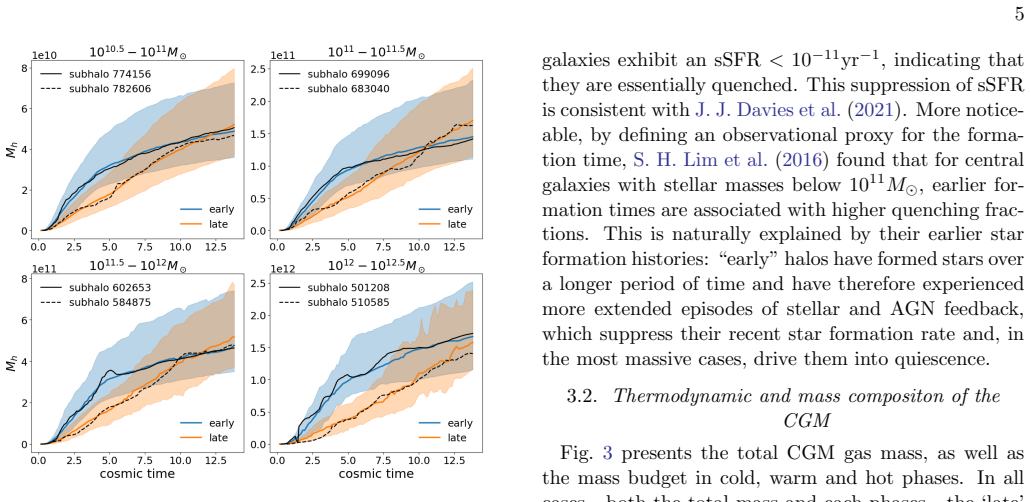
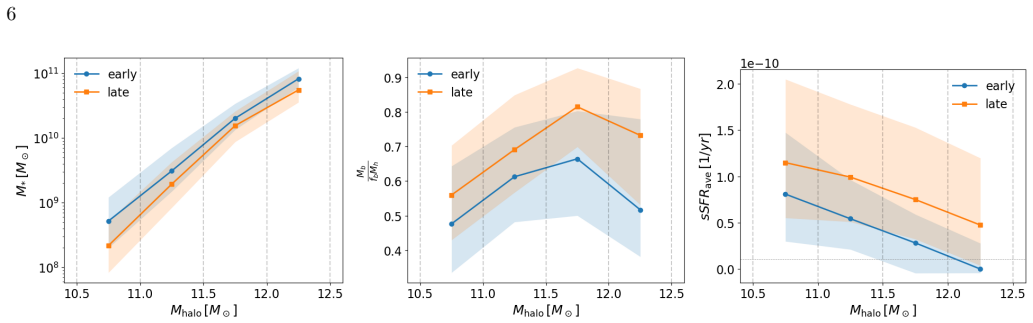
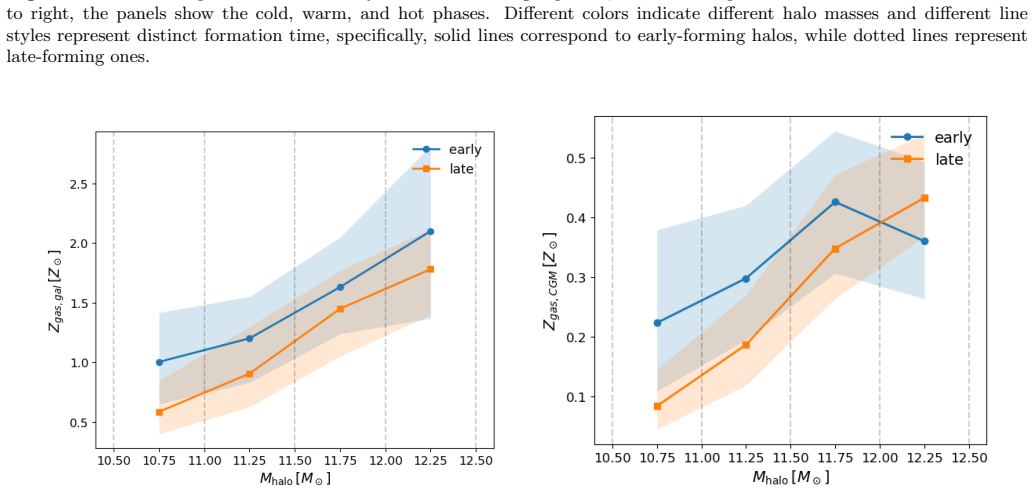
Early-forming halos host galaxies with higher stellar mass and metallicity but lower CGM gas mass and star formation rates at z=0.
A machine-rendered reading of the paper's core claim, the machinery that carries it, and where it could break.
Core claim
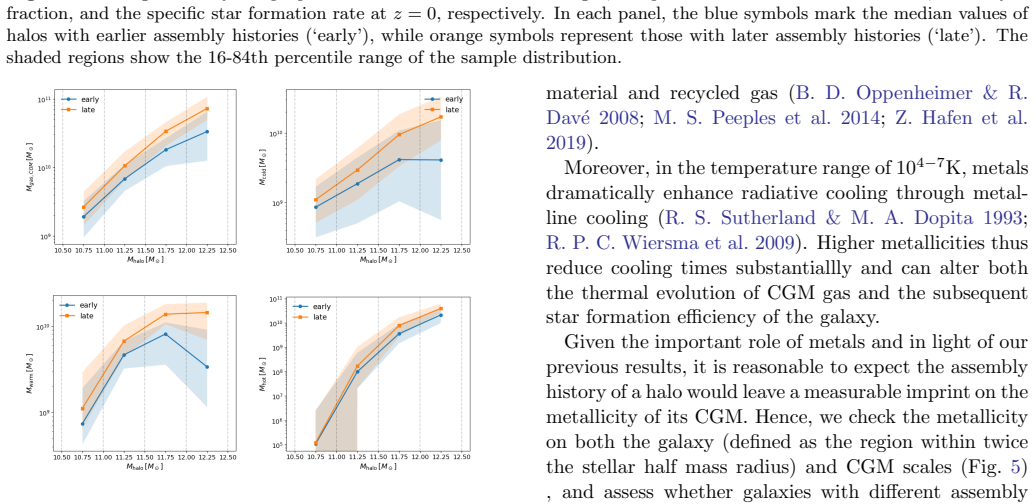
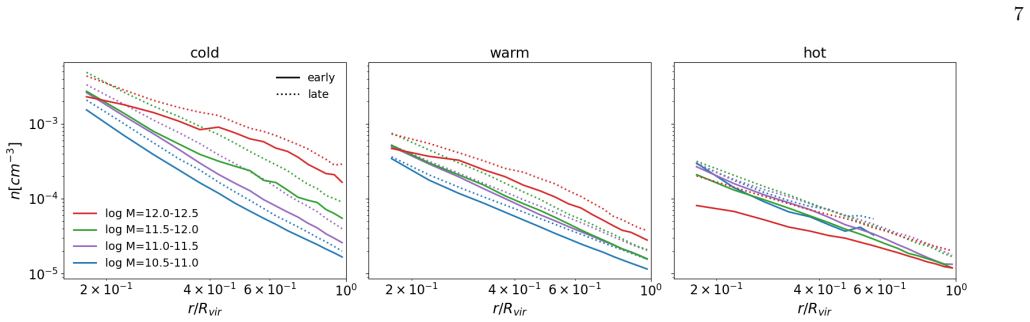
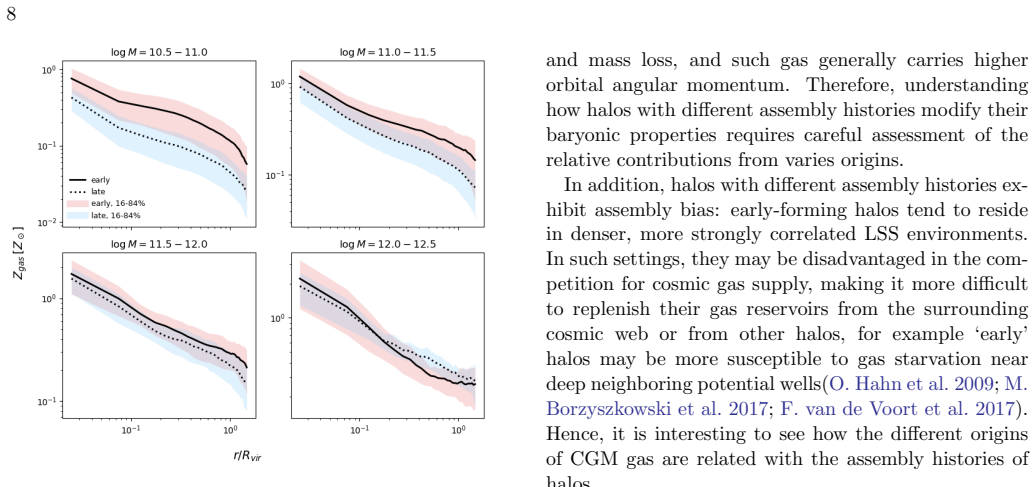
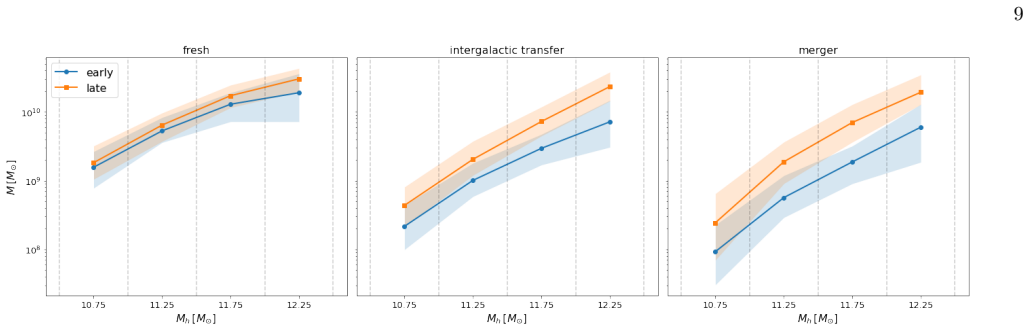
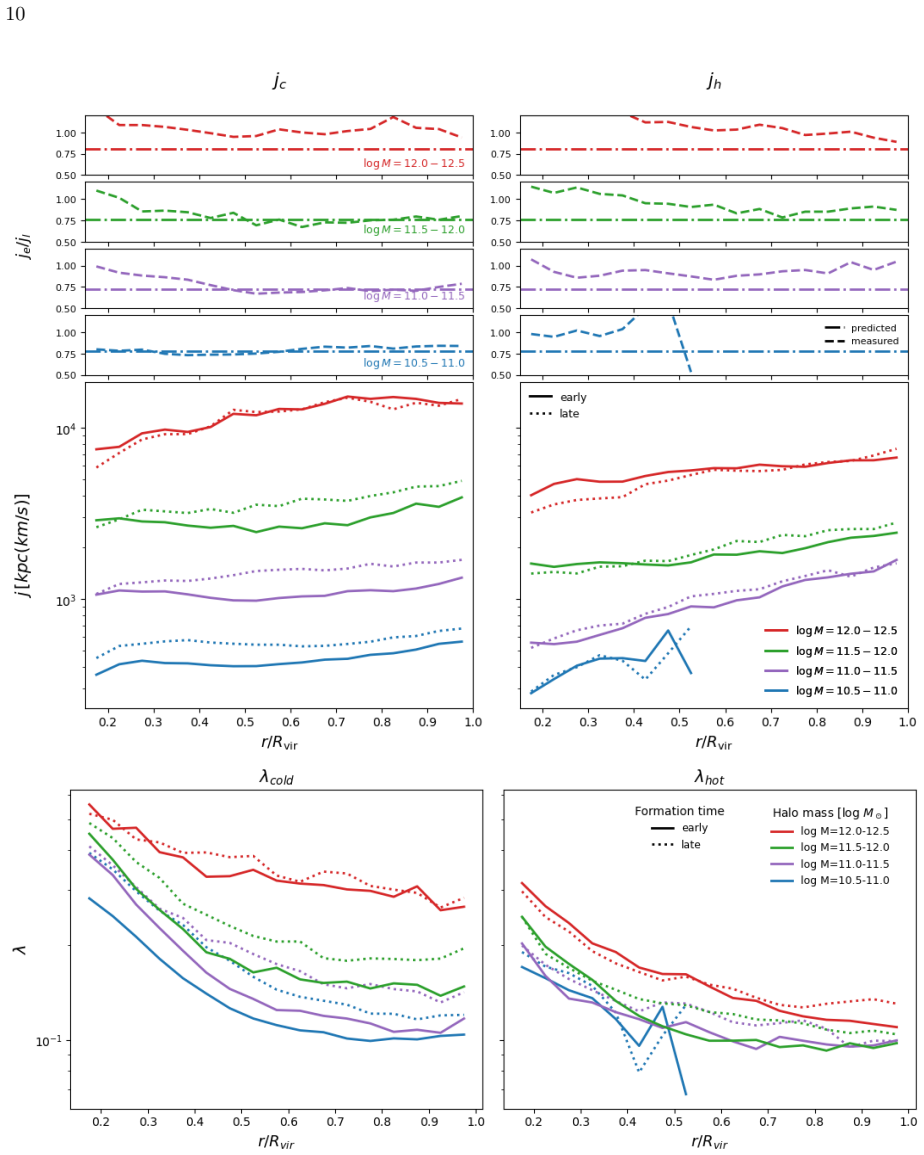
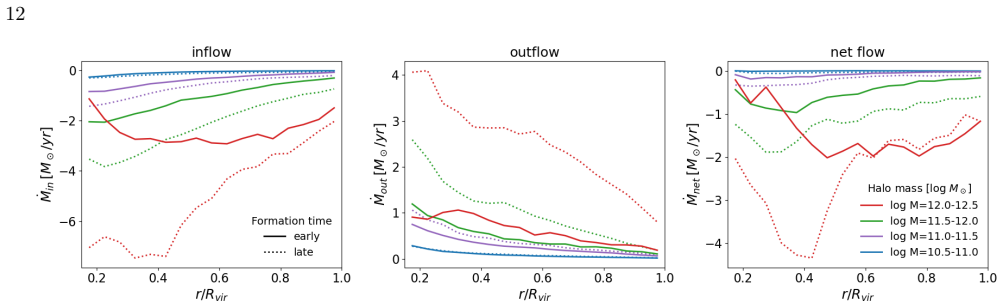
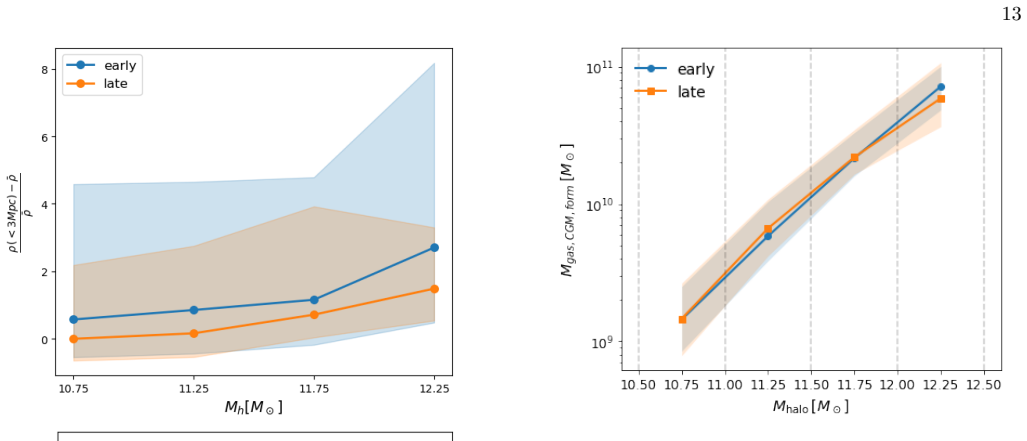
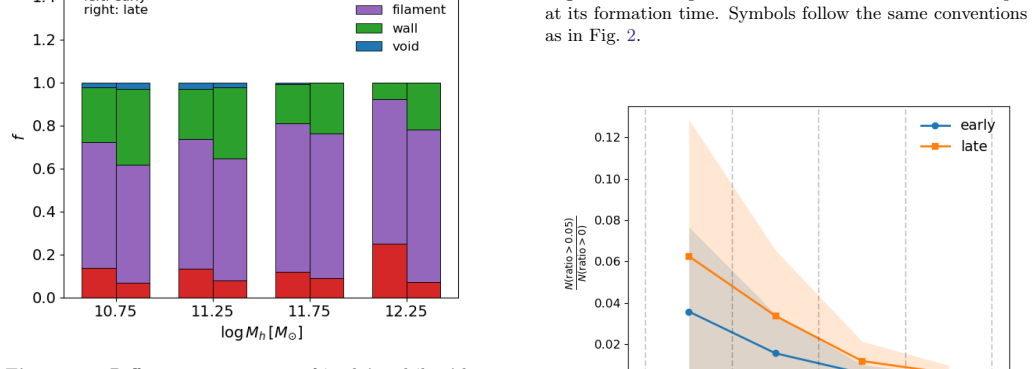
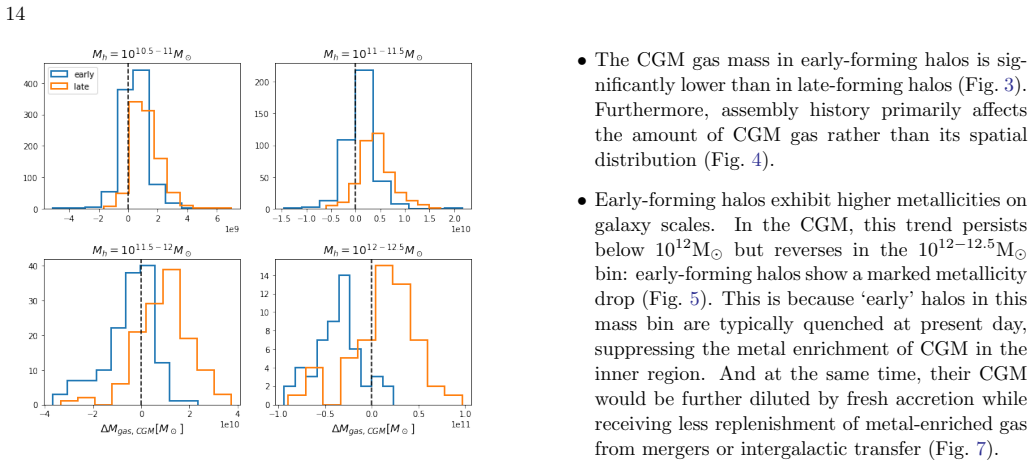
Halos classified as early-forming exhibit galaxies with higher stellar mass and metallicity, lower CGM gas mass, and lower sSFR at z=0. Early-forming halos below 10^12 solar masses show higher CGM gas-phase metallicities, but the trend reverses in the 10^12-12.5 bin. Fresh accretion into the CGM is insensitive to assembly history while late-forming systems experience more wet mergers. CGM gas masses are similar at the formation time, so the observed differences arise afterward. In lower-mass halos the cold CGM gas in late-forming systems carries higher specific angular momentum and greater rotational support.
What carries the argument
Halo formation time, defined as the epoch when a halo reaches half its z=0 mass, used to divide populations into early- and late-forming.
If this is right
- Early-forming halos contain galaxies that have converted more gas into stars by z=0.
- Late-forming halos retain larger CGM gas reservoirs and sustain higher specific star formation rates.
- CGM metallicity is higher around early-forming halos below 10^12 solar masses but lower in the 10^12-12.5 range.
- Differences in CGM gas properties emerge after the formation time through post-assembly processes.
- Late-forming lower-mass halos show cold CGM gas with higher specific angular momentum and stronger rotational support.
Where Pith is reading between the lines
- The mass-dependent reversal in CGM metallicity may indicate a shift in the balance between enrichment and dilution processes around group-scale halos.
- Accounting for halo assembly history could reduce scatter when comparing CGM observations across different galaxy samples.
- The kinematic differences suggest assembly history influences how angular momentum is delivered to the CGM in lower-mass systems.
- Proxies for formation time in observations, such as galaxy color or concentration, could be tested against these simulation trends.
Load-bearing premise
That the half-mass formation time cleanly separates assembly-history effects from correlated factors such as environment or merger timing.
What would settle it
A direct measurement showing no difference in present-day stellar mass or CGM gas mass between early- and late-forming halos of the same mass would falsify the claimed dependence.
Figures
read the original abstract
While halo mass is the dominant factor shaping the embedded galaxies, the properties of the circumgalactic medium (CGM) also depend on halo assembly history. To investigate this, we calculate the formation times for TNG50 halos with masses between $10^{10.5}$ and $10^{12.5} M_\odot$, classifying them into `early-' and `late-forming' populations. It is found that across all mass bins, early-formed halos generally host galaxies with higher stellar mass and higher metallicity, with lower CGM gas mass and lower specific star formation rate (sSFR) at $z\sim0$. For the CGM metallicity, `early' halos with masses below $10^{12}\mathrm{M_\odot}$ show systematically higher gas phase metallicities, whereas in the $10^{12-12.5}\mathrm{M_\odot}$ bin the trend reverses. When examining the origins of the CGM gas, it is found that fresh accretion is insensitive to assembly history, whereas the `late' galaxies experience more wet mergers. These differences in gas properties arise from processes after the formation time, given that the CGM gas masses show no significant differences at formation time. Finally, our analysis of CGM kinematics shows that for halos below $10^{12}\mathrm{M_\odot}$, the cold gas in late-forming halos carries higher specific angular momentum and simply has a higher degree of rotational support, while the same properties in the $10^{12-12.5}\mathrm{M_\odot}$ bin shows no significant dependence on assembly history.
Editorial analysis
A structured set of objections, weighed in public.
Referee Report
Summary. The paper uses the IllustrisTNG50 simulation to examine how circumgalactic medium (CGM) and galaxy properties depend on halo assembly history. Halos in the mass range 10^{10.5}–10^{12.5} M_⊙ are classified as early- or late-forming based on the redshift when they reach half their z=0 mass. The central claim is that early-forming halos host galaxies with higher stellar mass and metallicity but lower CGM gas mass and sSFR at z=0; CGM metallicity trends reverse above 10^{12} M_⊙. Differences are attributed to post-formation processes, with late-forming halos experiencing more wet mergers while fresh accretion is insensitive to assembly history. Kinematic differences in cold CGM gas are reported only below 10^{12} M_⊙.
Significance. If the reported trends are robust to environment and formation-time definition, the work would demonstrate that assembly history imprints on CGM properties beyond halo mass, with implications for models of gas accretion, mergers, and feedback. The paper receives credit for tracing CGM gas origins directly in the simulation (fresh accretion vs. wet mergers) and for noting that CGM mass differences are absent at formation time, which supports a post-formation origin.
major comments (3)
- [Methods / abstract] The classification into early- and late-forming populations (abstract and methods) relies on the half-mass formation time without reported tests of robustness to alternative definitions (e.g., 20% or 80% mass assembly time). This is load-bearing for the central claim that differences arise from assembly history.
- [Results / discussion of origins] No control or regression for local environment (density, tidal field, or neighbor count) is described despite the known correlation between formation time and environment within mass bins. This leaves open the possibility that reported CGM and metallicity differences (including the reversal at 10^{12}–10^{12.5} M_⊙) trace external factors rather than internal assembly, as noted in the stress-test concern.
- [Abstract / Results] The abstract and results sections provide no sample sizes per mass bin, no error estimation or bootstrap uncertainties on the reported trends, and no assessment of selection biases in the mass bins. This prevents quantitative evaluation of the strength of the early/late differences.
minor comments (1)
- [Abstract] Notation for mass bins (e.g., 10^{12-12.5} M_⊙) should be standardized to 10^{12}–10^{12.5} M_⊙ for clarity.
Simulated Author's Rebuttal
We thank the referee for the constructive report and the recognition of the paper's contributions in tracing CGM gas origins. We address each major comment below, agreeing where revisions are needed to strengthen the manuscript.
read point-by-point responses
-
Referee: [Methods / abstract] The classification into early- and late-forming populations (abstract and methods) relies on the half-mass formation time without reported tests of robustness to alternative definitions (e.g., 20% or 80% mass assembly time). This is load-bearing for the central claim that differences arise from assembly history.
Authors: The half-mass formation time is the conventional definition used throughout the assembly bias literature, but we agree that explicit robustness checks would strengthen the central claim. In the revised manuscript we will add a dedicated subsection presenting the key trends (stellar mass, CGM gas mass, metallicity, sSFR) recomputed with 20 % and 80 % mass assembly times; we expect the qualitative early/late differences and the metallicity reversal to persist, but will report any quantitative changes. revision: yes
-
Referee: [Results / discussion of origins] No control or regression for local environment (density, tidal field, or neighbor count) is described despite the known correlation between formation time and environment within mass bins. This leaves open the possibility that reported CGM and metallicity differences (including the reversal at 10^{12}–10^{12.5} M_⊙) trace external factors rather than internal assembly, as noted in the stress-test concern.
Authors: We acknowledge the well-known correlation between formation time and environment. Our analysis is performed in narrow halo-mass bins, which already mitigates much of the mass-driven environmental variation, and the absence of CGM-mass differences at the formation redshift supports a post-formation origin. Nevertheless, a direct environmental control was not performed. In revision we will add a short discussion quantifying the typical environmental differences between early- and late-forming halos in our sample and will test whether the reported trends remain after a simple density-matched subsampling; if the trends weaken, we will state this limitation explicitly. revision: partial
-
Referee: [Abstract / Results] The abstract and results sections provide no sample sizes per mass bin, no error estimation or bootstrap uncertainties on the reported trends, and no assessment of selection biases in the mass bins. This prevents quantitative evaluation of the strength of the early/late differences.
Authors: We agree that sample sizes, uncertainties, and bias assessment are required for quantitative interpretation. The revised manuscript will report the number of early- and late-forming halos in each of the three mass bins, add bootstrap or jackknife error estimates to all median trends shown in the figures, and include a brief paragraph discussing possible selection biases arising from the TNG50 volume and the mass-bin boundaries. revision: yes
Circularity Check
No circularity: direct simulation population comparisons
full rationale
The paper defines halo formation time as the redshift when M_halo(z) first reaches 0.5 * M_halo(z=0), splits the TNG50 sample into early/late populations within fixed z=0 mass bins, and reports measured differences in stellar mass, metallicity, CGM gas mass, sSFR, merger rates, and kinematics. These are empirical statistics extracted from the simulation snapshots; no equations, fitted parameters, or self-citations reduce the reported trends to the inputs by construction. The classification is a conventional definition and does not presuppose the CGM differences it is used to test. The analysis is therefore self-contained against the simulation data.
Axiom & Free-Parameter Ledger
free parameters (2)
- Halo mass range
- Formation-time definition
axioms (1)
- domain assumption The IllustrisTNG subgrid physics produce CGM properties representative enough of the real universe to support conclusions about assembly-history dependence.
Reference graph
Works this paper leans on
-
[1]
Alpaslan, M., & Tinker, J. L. 2021, MNRAS, 505, 5403, doi: 10.1093/mnras/stab1591 Angl´ es-Alc´ azar, D., Faucher-Gigu` ere, C.-A., Kereˇ s, D., et al. 2017, MNRAS, 470, 4698, doi: 10.1093/mnras/stx1517 Aragon Calvo, M. A., Neyrinck, M. C., & Silk, J. 2019, The Open Journal of Astrophysics, 2, 7, doi: 10.21105/astro.1697.07881
-
[2]
2023, MNRAS, 524, 4091, doi: 10.1093/mnras/stad2152
Barbani, F., Pascale, R., Marinacci, F., et al. 2023, MNRAS, 524, 4091, doi: 10.1093/mnras/stad2152
-
[3]
Birnboim, Y., & Dekel, A. 2003, MNRAS, 345, 349, doi: 10.1046/j.1365-8711.2003.06955.x
-
[4]
Bordoloi, R., Prochaska, J. X., Tumlinson, J., et al. 2018, ApJ, 864, 132, doi: 10.3847/1538-4357/aad8ac
-
[5]
2017, MNRAS, 469, 594, doi: 10.1093/mnras/stx873
Garaldi, E. 2017, MNRAS, 469, 594, doi: 10.1093/mnras/stx873
-
[6]
Bullock, J. S., Dekel, A., Kolatt, T. S., et al. 2001, ApJ, 555, 240, doi: 10.1086/321477
-
[7]
Burchett, J. N., Tripp, T. M., Bordoloi, R., et al. 2016, ApJ, 832, 124, doi: 10.3847/0004-637X/832/2/124
-
[8]
COLIBRE: calibrating subgrid feedback in cosmological simulations that include a cold gas phase
Chaikin, E., Schaye, J., Schaller, M., et al. 2025, arXiv e-prints, arXiv:2509.04067, doi: 10.48550/arXiv.2509.04067
work page internal anchor Pith review Pith/arXiv arXiv doi:10.48550/arxiv.2509.04067 2025
-
[9]
Cooksey, K. L., Thom, C., Prochaska, J. X., & Chen, H.-W. 2010, ApJ, 708, 868, doi: 10.1088/0004-637X/708/1/868
-
[10]
Davies, J. J., Crain, R. A., McCarthy, I. G., et al. 2019, MNRAS, 485, 3783, doi: 10.1093/mnras/stz635
-
[11]
Davies, J. J., Crain, R. A., Oppenheimer, B. D., & Schaye, J. 2020, MNRAS, 491, 4462, doi: 10.1093/mnras/stz3201
-
[12]
Monthly Notices of the Royal Astronomical Society , author =
Davies, J. J., Crain, R. A., & Pontzen, A. 2021, MNRAS, 501, 236, doi: 10.1093/mnras/staa3643 de S´ a-Freitas, C., Gon¸ calves, T. S., de Carvalho, R. R., et al. 2022, MNRAS, 509, 3889, doi: 10.1093/mnras/stab3230
-
[13]
Dekel, A., & Birnboim, Y. 2006, MNRAS, 368, 2, doi: 10.1111/j.1365-2966.2006.10145.x Faucher-Gigu` ere, C.-A., & Oh, S. P. 2023, ARA&A, 61, 131, doi: 10.1146/annurev-astro-052920-125203
-
[14]
Fielding, D., Quataert, E., McCourt, M., & Thompson, T. A. 2017, MNRAS, 466, 3810, doi: 10.1093/mnras/stw3326
-
[15]
Ford, A. B., Werk, J. K., Dav´ e, R., et al. 2016, MNRAS, 459, 1745, doi: 10.1093/mnras/stw595
-
[16]
Genel, S. 2025, MNRAS, 537, 3543, doi: 10.1093/mnras/staf255
-
[17]
Fujita, Y. 2004, PASJ, 56, 29, doi: 10.1093/pasj/56.1.29 16 Gal´ arraga-Espinosa, D., Garaldi, E., & Kauffmann, G. 2023, A&A, 671, A160, doi: 10.1051/0004-6361/202244935
-
[18]
Gao, L., Springel, V., & White, S. D. M. 2005, MNRAS, 363, L66, doi: 10.1111/j.1745-3933.2005.00084.x
-
[19]
Following the Flow: Tracer Particles in Astrophysical Fluid Simulations , shorttitle =
Genel, S., Vogelsberger, M., Nelson, D., et al. 2013, MNRAS, 435, 1426, doi: 10.1093/mnras/stt1383
-
[20]
Grand, R. J. J., G´ omez, F. A., Marinacci, F., et al. 2017, MNRAS, 467, 179, doi: 10.1093/mnras/stx071
-
[21]
Green, J. C., Froning, C. S., Osterman, S., et al. 2012, ApJ, 744, 60, doi: 10.1088/0004-637X/744/1/6010.1086/141956
-
[22]
Gronke, M., & Oh, S. P. 2018, MNRAS, 480, L111, doi: 10.1093/mnrasl/sly131
-
[24]
Dutton, A. A. 2017b, MNRAS, 464, 2796, doi: 10.1093/mnras/stw2539
-
[25]
2017, MNRAS, 469, 2292, doi: 10.1093/mnras/stx952
Hafen, Z., Faucher-Gigu` ere, C.-A., Angl´ es-Alc´ azar, D., et al. 2017, MNRAS, 469, 2292, doi: 10.1093/mnras/stx952
-
[26]
2019, MNRAS, 488, 1248, doi: 10.1093/mnras/stz1773
Hafen, Z., Faucher-Gigu` ere, C.-A., Angl´ es-Alc´ azar, D., et al. 2019, MNRAS, 488, 1248, doi: 10.1093/mnras/stz1773
-
[27]
Hahn, O., Porciani, C., Dekel, A., & Carollo, C. M. 2009, MNRAS, 398, 1742, doi: 10.1111/j.1365-2966.2009.15271.x
-
[28]
FIRE-2 Simulations: Physics versus Numerics in Galaxy Formation
Hopkins, P. F., Wetzel, A., Kereˇ s, D., et al. 2018, MNRAS, 480, 800, doi: 10.1093/mnras/sty1690
work page internal anchor Pith review doi:10.1093/mnras/sty1690 2018
-
[29]
Hummels, C. B., Bryan, G. L., Smith, B. D., & Turk, M. J. 2013, MNRAS, 430, 1548, doi: 10.1093/mnras/sts702
-
[30]
2001, A&A, 365, L1, doi: 10.1051/0004-6361:20000036 Kereˇ s, D., Katz, N., Weinberg, D
Jansen, F., Lumb, D., Altieri, B., et al. 2001, A&A, 365, L1, doi: 10.1051/0004-6361:20000036 Kereˇ s, D., Katz, N., Weinberg, D. H., & Dav´ e, R. 2005, MNRAS, 363, 2, doi: 10.1111/j.1365-2966.2005.09451.x
-
[31]
Lehner, N., O’Meara, J. M., Fox, A. J., et al. 2014, ApJ, 788, 119, doi: 10.1088/0004-637X/788/2/119
-
[32]
Lehner, N., Howk, J. C., Tripp, T. M., et al. 2013, ApJ, 770, 138, doi: 10.1088/0004-637X/770/2/138
-
[33]
Lehner, N., Berek, S. C., Howk, J. C., et al. 2020, ApJ, 900, 9, doi: 10.3847/1538-4357/aba49c
-
[34]
2020, Astronomische Nachrichten, 341, 177, doi: 10.1002/asna.202023775
Li, J.-T. 2020, Astronomische Nachrichten, 341, 177, doi: 10.1002/asna.202023775
-
[35]
Liang, C. J., & Chen, H.-W. 2014, MNRAS, 445, 2061, doi: 10.1093/mnras/stu1901
-
[36]
Lim, S. H., Mo, H. J., Wang, H., & Yang, X. 2016, MNRAS, 455, 499, doi: 10.1093/mnras/stv2282
-
[37]
L., Li, Y., Li, M., & Fielding, D
Lochhaas, C., Bryan, G. L., Li, Y., Li, M., & Fielding, D. 2020, MNRAS, 493, 1461, doi: 10.1093/mnras/staa358
-
[38]
2022, MNRAS, 509, 2707, doi: 10.1093/mnras/stab3169
Lu, S., Xu, D., Wang, S., et al. 2022, MNRAS, 509, 2707, doi: 10.1093/mnras/stab3169
-
[39]
First results from the IllustrisTNG simulations: radio haloes and magnetic fields
Marinacci, F., Vogelsberger, M., Pakmor, R., et al. 2018, MNRAS, 480, 5113, doi: 10.1093/mnras/sty2206
work page internal anchor Pith review doi:10.1093/mnras/sty2206 2018
-
[40]
The Galaxy Evolution Explorer: A Space Ultraviolet Survey Mission
Martin, D. C., Fanson, J., Schiminovich, D., et al. 2005, ApJL, 619, L1, doi: 10.1086/426387
work page internal anchor Pith review doi:10.1086/426387 2005
-
[41]
Mitchell, P. D., Schaye, J., Bower, R. G., & Crain, R. A. 2020, MNRAS, 494, 3971, doi: 10.1093/mnras/staa938
-
[42]
D., Chaves-Montero, J., Artale, M
Montero-Dorta, A. D., Chaves-Montero, J., Artale, M. C., & Favole, G. 2021, MNRAS, 508, 940, doi: 10.1093/mnras/stab2556
-
[43]
Morell, D. F., Ribeiro, A. L. B., de Carvalho, R. R., et al. 2020, MNRAS, 494, 3317, doi: 10.1093/mnras/staa881
-
[44]
2025, ApJ, 990, 98, doi: 10.3847/1538-4357/addf46
Morgan, J., Bailin, J., & Anderson, A. 2025, ApJ, 990, 98, doi: 10.3847/1538-4357/addf46
-
[45]
L., Kere s D., Faucher-Gigu \`e re C.-A., Hopkins P
Muratov, A. L., Kereˇ s, D., Faucher-Gigu` ere, C.-A., et al. 2015, MNRAS, 454, 2691, doi: 10.1093/mnras/stv2126
-
[46]
Naiman, J. P., Pillepich, A., Springel, V., et al. 2018, MNRAS, 477, 1206, doi: 10.1093/mnras/sty618
work page internal anchor Pith review doi:10.1093/mnras/sty618 2018
-
[47]
2015a, MNRAS, 448, 59, doi: 10.1093/mnras/stv017
Nelson, D., Genel, S., Vogelsberger, M., et al. 2015a, MNRAS, 448, 59, doi: 10.1093/mnras/stv017
-
[48]
2013, MNRAS, 429, 3353, doi: 10.1093/mnras/sts595
Nelson, D., Vogelsberger, M., Genel, S., et al. 2013, MNRAS, 429, 3353, doi: 10.1093/mnras/sts595
-
[49]
Nelson, D., Pillepich, A., Genel, S., et al. 2015b, Astronomy and Computing, 13, 12, doi: 10.1016/j.ascom.2015.09.003
-
[50]
2018a, MNRAS, 477, 450, doi: 10.1093/mnras/sty656
Nelson, D., Kauffmann, G., Pillepich, A., et al. 2018a, MNRAS, 477, 450, doi: 10.1093/mnras/sty656
-
[51]
Nelson, D., Pillepich, A., Springel, V., et al. 2018b, MNRAS, 475, 624, doi: 10.1093/mnras/stx3040
work page internal anchor Pith review doi:10.1093/mnras/stx3040
-
[52]
Nelson, D., Pillepich, A., Springel, V., et al. 2019, MNRAS, 490, 3234, doi: 10.1093/mnras/stz2306
work page internal anchor Pith review doi:10.1093/mnras/stz2306 2019
-
[53]
2020, MNRAS, 498, 2391, doi: 10.1093/mnras/staa2419
Nelson, D., Sharma, P., Pillepich, A., et al. 2020, MNRAS, 498, 2391, doi: 10.1093/mnras/staa2419
-
[54]
Oppenheimer, B. D. 2018, MNRAS, 480, 2963, doi: 10.1093/mnras/sty1918
-
[55]
Monthly Notices of the Royal Astronomical Society , author =
Oppenheimer, B. D., & Dav´ e, R. 2008, MNRAS, 387, 577, doi: 10.1111/j.1365-2966.2008.13280.x
-
[56]
MNRAS412(3), 1913–1925 (2011) https://doi.org/10.1111/j.1365-2966.2010
Oppenheimer, B. D., Dav´ e, R., Kereˇ s, D., et al. 2010, MNRAS, 406, 2325, doi: 10.1111/j.1365-2966.2010.16872.x
-
[57]
D., Segers, M., Schaye, J., Richings, A
Oppenheimer, B. D., Segers, M., Schaye, J., Richings, A. J., & Crain, R. A. 2018, MNRAS, 474, 4740, doi: 10.1093/mnras/stx2967
-
[58]
Oppenheimer, B. D., Davies, J. J., Crain, R. A., et al. 2020, MNRAS, 491, 2939, doi: 10.1093/mnras/stz3124
-
[59]
Peeples, M. S., Werk, J. K., Tumlinson, J., et al. 2014, ApJ, 786, 54, doi: 10.1088/0004-637X/786/1/54
-
[60]
Monthly Notices of the Royal Astronomical Society , author =
Pillepich, A., Springel, V., Nelson, D., et al. 2018a, MNRAS, 473, 4077, doi: 10.1093/mnras/stx2656 17
work page internal anchor Pith review doi:10.1093/mnras/stx2656
-
[61]
Pillepich, A., Nelson, D., Hernquist, L., et al. 2018b, MNRAS, 475, 648, doi: 10.1093/mnras/stx3112
work page internal anchor Pith review doi:10.1093/mnras/stx3112
-
[62]
Pillepich, A., Nelson, D., Springel, V., et al. 2019, MNRAS, 490, 3196, doi: 10.1093/mnras/stz2338
-
[63]
Predehl, P., Andritschke, R., Arefiev, V., et al. 2021, A&A, 647, A1, doi: 10.1051/0004-6361/202039313
-
[64]
2011, ApJ, 740, 91, doi: 10.1088/0004-637X/740/2/91
Cooksey, K. 2011, ApJ, 740, 91, doi: 10.1088/0004-637X/740/2/91
-
[65]
Prochaska, J. X., Werk, J. K., Worseck, G., et al. 2017, ApJ, 837, 169, doi: 10.3847/1538-4357/aa6007
-
[66]
2023a, MNRAS, 518, 5754, doi: 10.1093/mnras/stac3524
Ramesh, R., Nelson, D., & Pillepich, A. 2023a, MNRAS, 518, 5754, doi: 10.1093/mnras/stac3524
-
[67]
2023b, MNRAS, 522, 1535, doi: 10.1093/mnras/stad951
Ramesh, R., Nelson, D., & Pillepich, A. 2023b, MNRAS, 522, 1535, doi: 10.1093/mnras/stad951
-
[68]
Monthly Notices of the Royal Astronomical Society446, 521–554 (Jan 2015)
Schaye, J., Crain, R. A., Bower, R. G., et al. 2015, MNRAS, 446, 521, doi: 10.1093/mnras/stu2058
-
[69]
The COLIBRE project: cosmological hydrodynamical simulations of galaxy formation and evolution
Schaye, J., Chaikin, E., Schaller, M., et al. 2025, arXiv e-prints, arXiv:2508.21126, doi: 10.48550/arXiv.2508.21126
work page internal anchor Pith review Pith/arXiv arXiv doi:10.48550/arxiv.2508.21126 2025
-
[70]
Clustering of luminous red galaxies
Springel, V. 2010, MNRAS, 401, 791, doi: 10.1111/j.1365-2966.2009.15715.x
-
[71]
Springel, V., Pakmor, R., Pillepich, A., et al. 2018, MNRAS, 475, 676, doi: 10.1093/mnras/stx3304
-
[72]
2019, MNRAS, 488, 2549, doi: 10.1093/mnras/stz1859
Stern, J., Fielding, D., Faucher-Gigu` ere, C.-A., & Quataert, E. 2019, MNRAS, 488, 2549, doi: 10.1093/mnras/stz1859
-
[73]
2020, MNRAS, 492, 6042, doi: 10.1093/mnras/staa198
Stern, J., Fielding, D., Faucher-Gigu` ere, C.-A., & Quataert, E. 2020, MNRAS, 492, 6042, doi: 10.1093/mnras/staa198
-
[74]
2016, MNRAS, 458, 1510, doi: 10.1093/mnras/stw332
Leauthaud, A. 2016, MNRAS, 458, 1510, doi: 10.1093/mnras/stw332
-
[75]
2015, MNRAS, 448, 895, doi: 10.1093/mnras/stu2762
Suresh, J., Bird, S., Vogelsberger, M., et al. 2015, MNRAS, 448, 895, doi: 10.1093/mnras/stu2762
-
[76]
Sutherland, R. S., & Dopita, M. A. 1993, ApJS, 88, 253, doi: 10.1086/191823
-
[77]
Tojeiro, R., Eardley, E., Peacock, J. A., et al. 2017, MNRAS, 470, 3720, doi: 10.1093/mnras/stx1466
-
[78]
2020, MNRAS, 494, 549, doi: 10.1093/mnras/staa685
Truong, N., Pillepich, A., Werner, N., et al. 2020, MNRAS, 494, 549, doi: 10.1093/mnras/staa685
-
[79]
Tumlinson, J., Peeples, M. S., & Werk, J. K. 2017, ARA&A, 55, 389, doi: 10.1146/annurev-astro-091916-055240
work page internal anchor Pith review doi:10.1146/annurev-astro-091916-055240 2017
-
[80]
Tumlinson, J., Thom, C., Werk, J. K., et al. 2011, Science, 334, 948, doi: 10.1126/science.1209840
-
[81]
Tumlinson, J., Thom, C., Werk, J. K., et al. 2013, ApJ, 777, 59, doi: 10.1088/0004-637X/777/1/59 van de Voort, F., Bah´ e, Y. M., Bower, R. G., et al. 2017, MNRAS, 466, 3460, doi: 10.1093/mnras/stw3356
discussion (0)
Sign in with ORCID, Apple, or X to comment. Anyone can read and Pith papers without signing in.