The impact of artificial intelligence on enterprise software user roles
Pith reviewed 2026-06-25 20:10 UTC · model grok-4.3
The pith
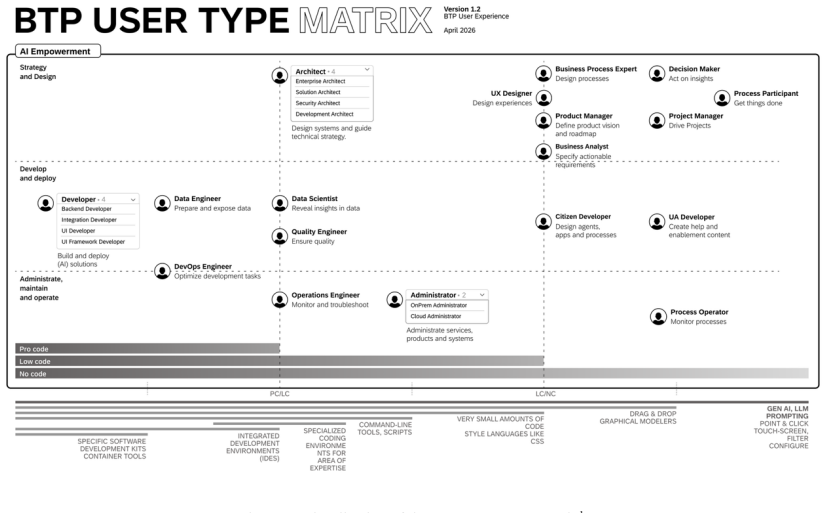
AI is automating operational tasks in enterprise software development while expanding human-AI collaboration and reliance on agentic systems, which requires updating existing role frameworks such as the BTP User Type Matrix.
A machine-rendered reading of the paper's core claim, the machinery that carries it, and where it could break.
Core claim
The results reveal substantial shifts in day-to-day tasks and roles in the development domain, characterized by increasing automation of operational tasks, expanding human-AI collaboration, and growing reliance on agentic AI systems. The study further identifies significant implications for existing user-role frameworks, such as the BTP User Type Matrix, which requires adaptation as the workforce is undergoing significant role specific changes.
What carries the argument
The BTP User Type Matrix, an existing role taxonomy whose adaptation is required to accommodate AI-driven changes in tasks, responsibilities, and human-AI collaboration patterns.
If this is right
- Existing user-role frameworks require adaptation to reflect the new division of labor.
- New governance and oversight functions become necessary in enterprise software teams.
- Design approaches for AI-native enterprise software systems must be revised.
- The workforce undergoes significant role-specific changes that affect daily responsibilities.
Where Pith is reading between the lines
- Similar patterns of role change may appear in other enterprise platforms that adopt comparable AI tools.
- Organizations may need new training programs focused on overseeing and collaborating with agentic AI.
- The observed trends suggest that role taxonomies in general will need periodic revision as AI capabilities advance.
Load-bearing premise
The views expressed by the 20 interviewed experts and 24 workshop participants accurately represent the broader population of BTP users and that the qualitative themes generalize beyond this single platform and sample.
What would settle it
A large-scale survey or observational study of BTP users that finds no measurable increase in automation of operational tasks or shift toward agentic AI collaboration would undermine the central claim.
Figures
read the original abstract
Artificial Intelligence (AI) is rapidly reshaping the nature of work in software development, transforming user roles, workflows, and collaboration patterns across enterprise platforms. This qualitative study investigates how AI alters professional responsibilities within the context of SAP's Business Technology Platform (BTP), combining expert interviews (n=20) and a participatory workshop (n=24). The results reveal substantial shifts in day-to-day tasks and roles in the development domain, characterized by increasing automation of operational tasks, expanding human-AI collaboration, and growing reliance on agentic AI systems. The study further identifies significant implications for existing user-role frameworks, such as the BTP User Type Matrix, which requires adaptation as the workforce is undergoing significant role specific changes. Collectively, these findings highlight a workforce landscape in transition and underscore the need for revised role taxonomies, new governance and oversight functions, and updated design approaches for AI-native enterprise software systems.
Editorial analysis
A structured set of objections, weighed in public.
Referee Report
Summary. The paper reports a qualitative study of AI's effects on user roles in SAP Business Technology Platform (BTP) development, drawing on 20 expert interviews and a participatory workshop with 24 participants. It claims substantial shifts in day-to-day tasks, including automation of operational work, expanded human-AI collaboration, and increased reliance on agentic AI systems, with consequent implications for existing frameworks such as the BTP User Type Matrix that require adaptation.
Significance. The topic is timely for software engineering. If the themes are shown to be robust and transferable, the work could usefully inform revisions to role taxonomies and governance practices in AI-native enterprise platforms. The current manuscript, however, supplies insufficient methodological detail to allow readers to assess the strength or scope of those themes.
major comments (2)
- [Abstract/Methods] Abstract and (presumed) Methods section: the study reports n=20 interviews and n=24 workshop participants but supplies no information on sampling frame, interview protocol, coding scheme, inter-rater reliability, or saturation criteria. These omissions leave the central claims of 'substantial shifts' and 'requires adaptation' only weakly anchored.
- [Results/Discussion] Results and Discussion: statements about implications 'across enterprise platforms' and a 'workforce landscape in transition' rest on a single-platform (SAP BTP) convenience sample of 44 individuals. Without explicit transferability arguments or cross-platform comparison data, the generalization from this sample to broader enterprise software user roles is not supported.
minor comments (1)
- [Abstract] The abstract would benefit from a single sentence stating the primary data-analysis approach (e.g., thematic analysis) to orient readers before the findings are presented.
Simulated Author's Rebuttal
We thank the referee for their constructive feedback, which highlights important areas for improving methodological transparency and the scope of our claims. We address each major comment below.
read point-by-point responses
-
Referee: [Abstract/Methods] Abstract and (presumed) Methods section: the study reports n=20 interviews and n=24 workshop participants but supplies no information on sampling frame, interview protocol, coding scheme, inter-rater reliability, or saturation criteria. These omissions leave the central claims of 'substantial shifts' and 'requires adaptation' only weakly anchored.
Authors: We agree that additional methodological detail is needed to allow readers to evaluate the study. In the revised manuscript we will expand the Methods section to describe the sampling frame and participant recruitment, the semi-structured interview protocol, the thematic coding approach and scheme, any inter-rater reliability procedures employed, and the saturation criteria applied during analysis. revision: yes
-
Referee: [Results/Discussion] Results and Discussion: statements about implications 'across enterprise platforms' and a 'workforce landscape in transition' rest on a single-platform (SAP BTP) convenience sample of 44 individuals. Without explicit transferability arguments or cross-platform comparison data, the generalization from this sample to broader enterprise software user roles is not supported.
Authors: The study is explicitly situated within the SAP BTP context. We will revise the abstract, results, and discussion to qualify the scope of the findings more precisely, add an explicit transferability subsection that articulates the platform characteristics that may support analogous role shifts elsewhere, and remove or soften language that implies broader generalization without supporting evidence. revision: partial
Circularity Check
No circularity: empirical qualitative study with no derivations or fitted predictions
full rationale
The paper reports results from 20 expert interviews and a 24-participant workshop on AI impacts in SAP BTP. It contains no equations, no parameter fitting, no predictions derived from models, and no self-citation chains used to justify central claims. All load-bearing statements are grounded in the collected qualitative data rather than reducing to inputs by construction. This matches the default expectation for non-circular empirical work.
Axiom & Free-Parameter Ledger
axioms (1)
- domain assumption Expert interviews and participatory workshops produce valid and generalizable descriptions of role changes induced by AI.
Reference graph
Works this paper leans on
-
[1]
GenAI activities
demonstrate that AI use is concentrated primarily in the development and testing phases, as reflected by the frequency of tool utilization. Across these stages, developers perceive improvements in efficiency, code quality, and team collaboration enabled by AI [26]. According to Ulfsness et al. [2024], working with existing code—Including refactoring or si...
2024
-
[2]
User Type
indicate that developers increasingly transition toward full-stack roles as capabilities increase, especially in more junior roles. For example, developers who previously focused on backend development only were now coding UIs. Also, as AI increases capabilities, the cross-role collaboration is impacted, too. For instance, backend developers were able to ...
2025
-
[3]
Retrieved March 26, 2026 from https://kpmg.com/xx/en/our-insights/ai-and-technology/global-tech-report.html
KPMG. Retrieved March 26, 2026 from https://kpmg.com/xx/en/our-insights/ai-and-technology/global-tech-report.html
2026
-
[4]
McKinsey & Company
The economic potential of generative AI: The next productivity frontier. McKinsey & Company. Retrieved March 26, 2026 from https://www.mckinsey.com/capabilities/tech-and-ai/our-insights/the-economic-potential-of-generative-ai-the-next-productivity-frontier
2026
-
[5]
In Generative AI for Effective Software Development
Transforming software development with generative AI: Empirical insights on collaboration and workflow. In Generative AI for Effective Software Development. Springer, Cham, 219–234. https://doi.org/10.1007/978-3-031-55642-5_10
-
[6]
Anthropic
How AI is transforming work at Anthropic. Anthropic. Retrieved March 26, 2026 from https://www.anthropic.com/research/how-ai-is-transforming-work-at-anthropic
2026
-
[7]
Proceedings of the ACM on Programming Languages 7, OOPSLA1, (2023), 85-111
Grounded Copilot: How programmers interact with code-generating models. Proceedings of the ACM on Programming Languages 7, OOPSLA1, (2023), 85-111. https://doi.org/10.1145/3586039
-
[8]
An empirical evaluation of GitHub Copilot’s code suggestions. In Proceedings of the 19th IEEE/ACM International Conference on Mining Software Repositories (MSR ’22). ACM, New York, NY, USA, 1–5. https://doi.org/10.1145/3524842.3528470
-
[9]
Oxford University Press, Oxford, UK
Human-Centered AI. Oxford University Press, Oxford, UK. https://doi.org/10.1093/oso/9780192845290.001.0001
-
[10]
Weisz, Jessica He, Michael Muller, Gabriela Hoefer, Rachel Miles, and Werner Geyer
Design principles for generative AI applications. In Proceedings of the 2024 CHI Conference on Human Factors in Computing Systems (CHI ’24). New York, NY, USA, Article 378, 1–22. ACM, 1–22. https://doi.org/10.1145/3613904.3642466
-
[11]
Information & Management 57, 2 (2020), Article 103174
Machines as teammates: A research agenda on AI in team collaboration. Information & Management 57, 2 (2020), Article 103174
2020
-
[12]
Guidelines for human-AI interaction. In Proceedings of the 2019 CHI Conference on Human Factors in Computing Systems (CHI ’19). ACM, New York, NY, USA, 13 pages. https://doi.org/10.1145/3290605.3300233
-
[13]
Developing trustworthy Artificial Intelligence: insights from research on interpersonal, human-automation, and human-AI trust. Front. Psychol. 15, Article 1382693 (2024). https://doi.org/10.3389/fpsyg.2024.1382693
-
[14]
In Proceedings of the Canadian Conference on Artificial Intelligence
AI transparency in a real-world context: what we can learn from past examples of algorithmic and statistical decision-making. In Proceedings of the Canadian Conference on Artificial Intelligence. (Canadian AI '22). May 30 - June 3, Toronto, Ontario. Canadian Artificial Intelligence Association, Article 2022L21. https://doi.org/10.21428/594757db.59056afd
-
[15]
Wiley Interdisciplinary Reviews
Causability and explainability of artificial intelligence in medicine. Wiley Interdisciplinary Reviews. Data Mining and Knowledge Discovery. 9, 4 (Jul 2019), e1312. https://doi.org/10.1002/widm.1312
-
[16]
IEEE Transactions on Systems, Man, and Cybernetics—Part A: Systems and Humans 41, 4 (2011), 662–667
Adaptive automation, level of automation, allocation authority, supervisory control, and adaptive control: Distinctions and modes of adaptation. IEEE Transactions on Systems, Man, and Cybernetics—Part A: Systems and Humans 41, 4 (2011), 662–667. https://doi.org/10.1109/TSMCA.2010.2093888
-
[17]
In Proceedings of the 20th Congress of the International Ergonomics Association (IEA 2018), Advances in Intelligent Systems and Computing, Vol
Theoretical Considerations and Development of a Questionnaire to Measure Trust in Automation. In Proceedings of the 20th Congress of the International Ergonomics Association (IEA 2018), Advances in Intelligent Systems and Computing, Vol
2018
-
[18]
https://doi.org/10.1007/978-3-319-96074-6_2
Springer, Cham, 13–30. https://doi.org/10.1007/978-3-319-96074-6_2
-
[19]
Retrieved from https://arxiv.org/abs/2512.14012
arXiv:2512.14012. Retrieved from https://arxiv.org/abs/2512.14012
-
[20]
Assessing the Quality and Security of AI-Generated Code: A Quantitative Analysis. arXiv:2508.14727. Retrieved from https://arxiv.org/abs/2508.14727
-
[21]
IEEE Transactions on Dependable and Secure Computing 23, 3 (May–June 2026), 7300–7314
Security and quality in LLM-generated code: A multi-language, multi-model analysis. IEEE Transactions on Dependable and Secure Computing 23, 3 (May–June 2026), 7300–7314. https://doi.org/10.1109/TDSC.2026.3672745
-
[22]
Security weaknesses of copilot-generated code in GitHub projects: An empirical study,
Security weaknesses of Copilot-generated code in GitHub projects: An empirical study. ACM Transactions on Software Engineering and Methodology 34, 8 (October 2025), Article 218, 1–34. https://doi.org/10.1145/3716848
-
[23]
The EU Artificial Intelligence Act
European Commission. The EU Artificial Intelligence Act. Retrieved May 12, 2026 from https://artificialintelligenceact.eu/
2026
-
[24]
ISO, Geneva, Switzerland
ISO/IEC 42001:2023 Information technology — Artificial intelligence — Management system (1st ed.). ISO, Geneva, Switzerland. Retrieved from https://www.iso.org/standard/81230.html
2023
-
[25]
The programmer’s assistant: Conversational interaction with a large language model for software development. In Proceedings of the 28th International Conference on Intelligent User Interfaces (IUI ’23). Association for Computing Machinery, New York, NY, USA. 491–514. https://doi.org/10.1145/3581641.3584037
-
[26]
Retrieved March 30, 2026 from https://claude5.ai/news/developer-survey-2026-ai-coding-73-percent-daily
Developer Survey 2026: AI coding tool adoption hits 73%. Retrieved March 30, 2026 from https://claude5.ai/news/developer-survey-2026-ai-coding-73-percent-daily
2026
-
[27]
International Journal of Advanced Computer Science and Applications 15, 12 (Dec
Leveraging Large Language Models for Automated Bug Fixing. International Journal of Advanced Computer Science and Applications 15, 12 (Dec. 2024), 444–456. https://doi.org/10.14569/IJACSA.2024.0151247
-
[28]
AI Driven Innovations in Software Engineering: A Review of Current Practices and Future Directions. Appl. Sci. 15, 3 (Jan. 2025), Article
2025
-
[29]
https://doi.org/10.3390/app15031344
-
[30]
The Impact of AI on Developer Productivity: Evidence from GitHub Copilot. arXiv:2302.06590. Retrieved from https://arxiv.org/abs/2302.06590
-
[31]
Retrieved March 26, 2026 from https://github.blog/news-insights/octoverse/octoverse-2024/
GitHub Blog. Retrieved March 26, 2026 from https://github.blog/news-insights/octoverse/octoverse-2024/
2026
-
[32]
AI will not replace software engineers. Gartner. Retrieved March 26, 2026 from https://github.com/resources/whitepapers/gartner-ai-will-not-replace-software-engineers
2026
-
[33]
Management Science 72, 3 (Mar
The Effects of Generative AI on High Skilled Work: Evidence from Three Field Experiments with Software Developers. Management Science 72, 3 (Mar. 2026), Article
2026
-
[34]
https://doi.org/10.1287/mnsc.2025.00535
-
[35]
Exploring AI Integration in Software Development: Case Studies and Insights. In Proceedings of the IEEE National Aerospace and Electronics Conference (NAECON ’24), July 15–18, 2024, Dayton, OH, USA. Institute of Electrical and Electronics Engineers, New York, NY, USA, 375–380. https://doi.org/10.1109/NAECON61878.2024.10670347
-
[36]
Automated Software Engineering 31, 1 (March 2024), Article
Future of software development with generative AI. Automated Software Engineering 31, 1 (March 2024), Article
2024
-
[37]
https://doi.org/10.1007/s10515-024-00426-z?urlappend=%3Futm_source%3Dresearchgate.net%26utm_medium%3Darticle
-
[38]
Prompt engineering as a new 21st century skill. Front. Educ. 9 (November 2024), Article 1366434. https://doi.org/10.3389/feduc.2024.1366434
-
[39]
A Prompt Pattern Catalog to Enhance Prompt Engineering with ChatGPT
A Prompt Pattern Catalog to Enhance Prompt Engineering with ChatGPT. arXiv:2302.11382 [cs.SE]. Retrieved from https://arxiv.org/abs/2302.11382. https://doi.org/10.48550/arXiv.2302.11382
work page internal anchor Pith review Pith/arXiv arXiv doi:10.48550/arxiv.2302.11382
-
[40]
Automation bias: a systematic review of frequency, effect mediators, and mitigators. J. Am. Med. Inform. Assoc. 19, 1 (Jan. 2012), 121–127. https://doi.org/10.1136/amiajnl-2011-000089
-
[41]
Proceedings of the ACM on Human Computer Interaction 8, CSCW1 (Apr
Empirically Understanding the Potential Impacts and Process of Social Influence in Human AI Teams. Proceedings of the ACM on Human Computer Interaction 8, CSCW1 (Apr. 2024), Article 49, 1–32. https://doi.org/10.1145/3637326
-
[42]
Behavioral Sciences 15, 5 (May 2025), Article
Effects of Employee‑Artificial Intelligence (AI) Collaboration on Counterproductive Work Behaviors (CWBs): Leader Emotional Support as a Moderator. Behavioral Sciences 15, 5 (May 2025), Article
2025
-
[43]
https://doi.org/10.3390/bs15050696
-
[44]
IBM. n.d. The future of Artificial Intelligence. IBM. Retrieved March 26, 2026 from https://www.ibm.com/think/insights/artificial-intelligence-future
2026
-
[45]
IBM. n.d. watsonx. IBM. Retrieved March 26, 2026 from https://www.ibm.com/de-de/products/watsonx
2026
-
[46]
McKinsey & Company
The top trends in tech. McKinsey & Company. Retrieved March 26, 2026 from https://www.mckinsey.com/capabilities/tech-and-ai/our-insights/the-top-trends-in-tech
2026
-
[47]
McKinsey & Company
Why agents are the next frontier of generative AI. McKinsey & Company. Retrieved March 26, 2026 from https://www.mckinsey.com/capabilities/tech-and-ai/our-insights/why-agents-are-the-next-frontier-of-generative-ai
2026
-
[48]
Microsoft. n.d. Microsoft Azure. Microsoft. Retrieved March 26, 2026 from https://azure.microsoft.com/de-de
2026
-
[49]
Salesforce. n.d. Agentforce Observability. Salesforce. Retrieved March 26, 2026 from https://www.salesforce.com/agentforce/observability/
2026
-
[50]
SAP. n.d. AI in SAP BTP | SAP Business AI. Retrieved March 26, 2026 from https://www.sap.com/products/technology-platform/ai.html
2026
-
[51]
Retrieved May 12, 2026 from https://www.sap.com/topics/events/sapphire/innovation-news-guide-2026#joule-work
SAP Sapphire 2026 Innovation News Guide. Retrieved May 12, 2026 from https://www.sap.com/topics/events/sapphire/innovation-news-guide-2026#joule-work
2026
-
[52]
ACM Transactions on Information and System Security 2, 1 (Feb
The ARBAC97 Model for Role Based Administration of Roles. ACM Transactions on Information and System Security 2, 1 (Feb. 1999), 105–135. https://doi.org/10.1145/300830.300839
-
[53]
Psychologische Diagnostik (6th ed.). Springer, Berlin, Heidelberg. https://doi.org/10.1007/978-3-662-61643-7
-
[54]
Invulnerability Bias in Perceptions of Artificial Intelligence’s Future Impact on Employment. Scientific Reports 15, 1 (Aug. 2025), Article 28698. https://doi.org/10.1038/s41598-025-14698-2
-
[55]
Journal of Vocational Behavior 155 (Dec
How Future Work Self Salience Shapes the Effects of Interacting with Artificial Intelligence. Journal of Vocational Behavior 155 (Dec. 2024), Article 104054, 1–21. https://doi.org/10.1016/j.jvb.2024.104054
-
[56]
Using thematic analysis in psychology. Qualitative Research in Psychology 3, 2 (January 2006), 77–101. https://doi.org/10.1191/1478088706qp063oa
-
[57]
Anthropic. n.d. Careers at Anthropic. Retrieved April 1, 2026 from https://www.anthropic.com/careers
2026
-
[58]
Google DeepMind. n.d. Careers at Google DeepMind. Retrieved April 1, 2026 from https://deepmind.google/careers/
2026
-
[59]
The AI Roles Continuum: Blurring the Boundary Between Research and Engineering. arXiv:2601.06087 [cs.CY] (Dec. 2025). Retrieved from https://arxiv.org/abs/2601.06087. https://doi.org/10.48550/arXiv.2601.06087
-
[60]
Journal of Marketing Research 12, 3 (August 1975), 265–275
The importance of halo effects in multi-attribute attitude models. Journal of Marketing Research 12, 3 (August 1975), 265–275. https://doi.org/10.2307/3151224
-
[61]
Quantitative User Experience Research: Informing Product Decisions by Understanding Users at Scale (1st). Apress, Berkeley, CA. https://doi.org/10.1007/978-1-4842-9268-6
discussion (0)
Sign in with ORCID, Apple, or X to comment. Anyone can read and Pith papers without signing in.