REVIEW 3 major objections 46 references
Routing attention features into an auxiliary point-tracking head during training improves motion fidelity and cross-view consistency in camera-conditioned video diffusion models.
Reviewed by Pith at T0; open to challenge. T0 means a machine referee read the full paper against a public rubric. the ladder, T0–T4 →
MVTrack4Gen uses multi-view point tracking as geometric and motion supervision for camera-conditioning-only novel-view video diffusion models to improve consistency.
T0 review reviewed 2026-06-25 challenge →
load-bearing objection MVTrack4Gen adds a multi-view point tracking auxiliary head to camera-conditioned video diffusion models to target attention-layer correspondences for geometric consistency, but the abstract supplies no metrics or ablations to confirm the mechanism works as claimed. the 3 major comments →
MVTrack4Gen: Multi-View Point Tracking as Geometric Supervision for 4D Video Generation
The pith
A machine-rendered reading of the paper's core claim, the machinery that carries it, and where it could break.
The reading
Core claim
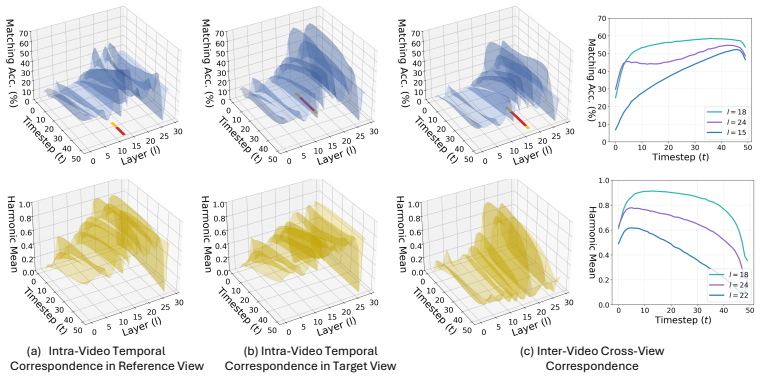
MVTrack4Gen demonstrates that specific attention layers in camera-conditioning-only novel-view video diffusion models encode strong correspondence cues between geometrically corresponding locations across views and over time; misalignment of these cues produces motion inconsistency, and explicitly strengthening them via an auxiliary multi-view tracking head trained with a point-tracking objective improves both reference motion fidelity and cross-view geometric consistency.
What carries the argument
An auxiliary multi-view tracking head attached to selected attention layers, trained jointly with a point-tracking objective that penalizes misalignment of query-key features at corresponding 3D locations.
Load-bearing premise
The assumption that specific attention layers encode strong correspondence cues whose misalignment directly causes motion inconsistency, and that an auxiliary tracking head can strengthen them without harming visual quality.
What would settle it
Train the same base diffusion model with and without the auxiliary tracking head on identical data, then compare point-tracking error and cross-view geometric consistency metrics on held-out reference videos.
If this is right
- Existing camera-conditioning diffusion models gain better reference motion adherence without switching to explicit 3D representations.
- Cross-view geometric consistency improves to state-of-the-art levels on diverse benchmarks.
- Camera accuracy remains competitive while geometric and motion metrics advance.
- The method works by strengthening correspondences already latent in attention layers rather than adding new 3D modules.
Where Pith is reading between the lines
- The same attention-layer routing idea could be tested on other temporal or multi-view generative tasks where correspondence drift appears.
- If the tracking head generalizes, it might reduce the need for separate optical-flow or depth estimators in video pipelines.
- Longer sequences or faster motions could reveal whether the learned correspondences remain stable beyond the training horizon.
Editorial analysis
A structured set of objections, weighed in public.
Referee Report
Summary. The paper proposes MVTrack4Gen, a motion-aware training framework for camera-conditioning-only novel-view video diffusion models. It uses multi-view point tracking as auxiliary geometric and motion supervision, based on the observation that specific attention layers encode correspondence cues whose misalignment causes motion inconsistency. By routing features to an auxiliary tracking head and jointly optimizing a point-tracking objective, the method claims to improve motion fidelity to the reference view and cross-view geometric consistency, achieving state-of-the-art geometric consistency and competitive camera accuracy across benchmarks.
Significance. If the results and mechanistic claims hold, the work would demonstrate a practical way to inject explicit geometric supervision into diffusion-based 4D video generation without explicit 3D reconstruction pipelines, potentially improving consistency for dynamic scenes where off-the-shelf reconstruction fails. The approach of leveraging attention-layer correspondences for auxiliary objectives could generalize to other video synthesis tasks.
major comments (3)
- [Abstract] Abstract (and the key finding paragraph): the claim that misalignment of query-key correspondences in specific attention layers is the direct cause of motion inconsistency, and that the auxiliary multi-view tracking head measurably strengthens those correspondences, is presented without any quantitative before/after alignment metric on the attention maps themselves or any ablation that isolates the tracking loss from generic regularization effects.
- [Abstract] The central evaluation claim of 'state-of-the-art geometric consistency' is stated without reference to specific quantitative metrics, baselines, or error analysis in the provided abstract; the soundness of the performance gains cannot be assessed from the available text.
- [Abstract] The assumption that routing features to the auxiliary tracking head strengthens the hypothesized correspondence mechanism (rather than providing incidental benefit) remains unverified by direct measurement; an ablation or attention-map analysis isolating this effect is required for the architectural intervention to be load-bearing.
Simulated Author's Rebuttal
We thank the referee for the constructive feedback on the abstract claims and the need for stronger mechanistic evidence. We address each major comment below and indicate the revisions we will make.
read point-by-point responses
-
Referee: [Abstract] Abstract (and the key finding paragraph): the claim that misalignment of query-key correspondences in specific attention layers is the direct cause of motion inconsistency, and that the auxiliary multi-view tracking head measurably strengthens those correspondences, is presented without any quantitative before/after alignment metric on the attention maps themselves or any ablation that isolates the tracking loss from generic regularization effects.
Authors: The manuscript supports the observation with qualitative attention visualizations in Section 3.2 and Figure 3. We agree that quantitative before/after alignment metrics on the attention maps and an ablation isolating the tracking loss from generic regularization would strengthen the claim. We will add these quantitative metrics and a controlled ablation in the revised manuscript. revision: yes
-
Referee: [Abstract] The central evaluation claim of 'state-of-the-art geometric consistency' is stated without reference to specific quantitative metrics, baselines, or error analysis in the provided abstract; the soundness of the performance gains cannot be assessed from the available text.
Authors: The abstract summarizes the contribution at a high level. Specific quantitative metrics, baselines, and error analysis appear in Section 4, Tables 1–3, and the associated figures of the full manuscript. We will revise the abstract to reference the key metrics and performance gains explicitly. revision: yes
-
Referee: [Abstract] The assumption that routing features to the auxiliary tracking head strengthens the hypothesized correspondence mechanism (rather than providing incidental benefit) remains unverified by direct measurement; an ablation or attention-map analysis isolating this effect is required for the architectural intervention to be load-bearing.
Authors: Section 4.3 already contains ablations demonstrating the contribution of the tracking objective. To directly verify the effect on correspondence strength, we will add attention-map analysis comparing query-key alignment with and without the auxiliary head in the revision. revision: yes
Circularity Check
No significant circularity; auxiliary objective is independent addition
full rationale
The paper's central claim rests on an empirical observation about attention-layer correspondences followed by the introduction of an auxiliary multi-view tracking head and point-tracking loss. No equations, fitted parameters, or self-citations are presented that reduce the geometric-consistency gains to a definitional identity or to a prior result by the same authors. The training intervention is described as an additive supervision signal whose benefit is measured on external benchmarks, leaving the derivation self-contained.
Axiom & Free-Parameter Ledger
Cite this review
Pith. "Pith review of MVTrack4Gen: Multi-View Point Tracking as Geometric Supervision for 4D Video Generation." pith.science (2026). https://pith.science/paper/3OEWWSMY
@misc{pith2026260626087,
  author       = {Pith},
  title        = {Pith review of: MVTrack4Gen: Multi-View Point Tracking as Geometric Supervision for 4D Video Generation},
  year         = {2026},
  howpublished = {\url{https://pith.science/paper/3OEWWSMY}},
  note         = {Machine review of arXiv:2606.26087}
}
read the original abstract
Synthesizing a novel-view video from a monocular reference video along a target camera trajectory requires both geometric consistency and motion fidelity with respect to the reference video. Existing methods based on explicit 3D representations are limited by the accuracy of off-the-shelf reconstruction modules, which often produce inaccurate geometry for dynamic objects in monocular videos. In contrast, camera-conditioning-only methods can achieve high visual quality but often struggle to preserve geometric and motion consistency. In this work, we introduce MVTrack4Gen (Multi-View point Tracking for Novel-View Generation), a motion-aware training framework that leverages multi-view point tracking as an additional geometric and motion supervision signal for camera-conditioning-only novel-view video diffusion models. Our key finding is that specific attention layers encode strong correspondence cues, where query features attend to key features at geometrically corresponding locations across views and over time, and the misalignment of these correspondences causes motion inconsistency. Based on this observation, we route these features into an auxiliary multi-view tracking head and jointly train the diffusion model with a point-tracking objective. By explicitly strengthening these motion-aware correspondences, MVTrack4Gen improves existing models to better follow the motion in the reference view and maintain cross-view geometric consistency. Across diverse benchmarks, our method achieves state-of-the-art geometric consistency and competitive camera accuracy.
Figures




Reference graph
Works this paper leans on
-
[1]
Cosmos World Foundation Model Platform for Physical AI
Niket Agarwal, Arslan Ali, Maciej Bala, Yogesh Balaji, Erik Barker, Tiffany Cai, Prithvijit Chattopadhyay, Yongxin Chen, Yin Cui, Yifan Ding, et al. Cosmos world foundation model platform for physical ai.arXiv preprint arXiv:2501.03575, 2025
work page internal anchor Pith review Pith/arXiv arXiv 2025
-
[2]
Met3r: Measuring multi-view consistency in generated images
Mohammad Asim, Christopher Wewer, Thomas Wimmer, Bernt Schiele, and Jan Eric Lenssen. Met3r: Measuring multi-view consistency in generated images. InProceedings of the IEEE/CVF Conference on Computer Vision and Pattern Recognition, pages 6034–6044, 2025
2025
-
[3]
Recammaster: Camera-controlled generative rendering from a single video
Jianhong Bai, Menghan Xia, Xiao Fu, Xintao Wang, Lianrui Mu, Jinwen Cao, Zuozhu Liu, Haoji Hu, Xiang Bai, Pengfei Wan, et al. Recammaster: Camera-controlled generative rendering from a single video. InProceedings of the IEEE/CVF International Conference on Computer Vision, pages 14834–14844, 2025
2025
-
[4]
Syncammaster: Synchronizing multi-camera video generation from diverse viewpoints
Jianhong Bai, Menghan Xia, Xintao Wang, Ziyang Yuan, Zuozhu Liu, Haoji Hu, Pengfei Wan, and Di Zhang. Syncammaster: Synchronizing multi-camera video generation from diverse viewpoints. In International Conference on Learning Representations, volume 2025, pages 58038–58060, 2025
2025
-
[5]
Lumiere: A space-time diffusion model for video generation
Omer Bar-Tal, Hila Chefer, Omer Tov, Charles Herrmann, Roni Paiss, Shiran Zada, Ariel Ephrat, Junhwa Hur, Guanghui Liu, Amit Raj, et al. Lumiere: A space-time diffusion model for video generation. In SIGGRAPH Asia 2024 Conference Papers, pages 1–11, 2024
2024
-
[6]
Gs-dit: Advancing video generation with dynamic 3d gaussian fields through efficient dense 3d point tracking
Weikang Bian, Zhaoyang Huang, Xiaoyu Shi, Yijin Li, Fu-Yun Wang, and Hongsheng Li. Gs-dit: Advancing video generation with dynamic 3d gaussian fields through efficient dense 3d point tracking. In Proceedings of the Computer Vision and Pattern Recognition Conference, pages 21717–21727, 2025
2025
-
[7]
Stable Video Diffusion: Scaling Latent Video Diffusion Models to Large Datasets
Andreas Blattmann, Tim Dockhorn, Sumith Kulal, Daniel Mendelevitch, Maciej Kilian, Dominik Lorenz, Yam Levi, Zion English, Vikram V oleti, Adam Letts, et al. Stable video diffusion: Scaling latent video diffusion models to large datasets.arXiv preprint arXiv:2311.15127, 2023
work page internal anchor Pith review Pith/arXiv arXiv 2023
-
[8]
Uni3c: Unifying precisely 3d-enhanced camera and human motion controls for video generation
Chenjie Cao, Jingkai Zhou, Shikai Li, Jingyun Liang, Chaohui Yu, Fan Wang, Xiangyang Xue, and Yanwei Fu. Uni3c: Unifying precisely 3d-enhanced camera and human motion controls for video generation. In Proceedings of the SIGGRAPH Asia 2025 Conference Papers, pages 1–12, 2025
2025
-
[9]
Kaihua Chen, Tarasha Khurana, and Deva Ramanan. Reconstruct, inpaint, test-time finetune: Dynamic novel-view synthesis from monocular videos.arXiv preprint arXiv:2507.12646, 2025
-
[10]
PostCam: Camera-Controllable Novel-View Video Generation with Query-Shared Cross-Attention
Yipeng Chen, Zhichao Ye, Zhenzhou Fang, Xinyu Chen, Xiaoyu Zhang, Jialing Liu, Nan Wang, Haomin Liu, and Guofeng Zhang. Postcam: Camera-controllable novel-view video generation with query-shared cross-attention.arXiv preprint arXiv:2511.17185, 2025
work page internal anchor Pith review Pith/arXiv arXiv 2025
-
[11]
Local all-pair correspondence for point tracking
Seokju Cho, Jiahui Huang, Jisu Nam, Honggyu An, Seungryong Kim, and Joon-Young Lee. Local all-pair correspondence for point tracking. InEuropean conference on computer vision, pages 306–325. Springer, 2024
2024
-
[12]
Tap-vid: A benchmark for tracking any point in a video.Advances in Neural Information Processing Systems, 35:13610–13626, 2022
Carl Doersch, Ankush Gupta, Larisa Markeeva, Adria Recasens, Lucas Smaira, Yusuf Aytar, Joao Carreira, Andrew Zisserman, and Yi Yang. Tap-vid: A benchmark for tracking any point in a video.Advances in Neural Information Processing Systems, 35:13610–13626, 2022
2022
-
[13]
Tapir: Tracking any point with per-frame initialization and temporal refinement
Carl Doersch, Yi Yang, Mel Vecerik, Dilara Gokay, Ankush Gupta, Yusuf Aytar, Joao Carreira, and Andrew Zisserman. Tapir: Tracking any point with per-frame initialization and temporal refinement. InProceedings of the IEEE/CVF International Conference on Computer Vision, pages 10061–10072, 2023
2023
-
[14]
Xiang Fan, Sharath Girish, Vivek Ramanujan, Chaoyang Wang, Ashkan Mirzaei, Petr Sushko, Aliaksandr Siarohin, Sergey Tulyakov, and Ranjay Krishna. Omniview: An all-seeing diffusion model for 3d and 4d view synthesis.arXiv preprint arXiv:2512.10940, 2025
-
[15]
Monocular dynamic view synthesis: A reality check.Advances in Neural Information Processing Systems, 35:33768–33780, 2022
Hang Gao, Ruilong Li, Shubham Tulsiani, Bryan Russell, and Angjoo Kanazawa. Monocular dynamic view synthesis: A reality check.Advances in Neural Information Processing Systems, 35:33768–33780, 2022
2022
-
[16]
Kubric: A scalable dataset generator
Klaus Greff, Francois Belletti, Lucas Beyer, Carl Doersch, Yilun Du, Daniel Duckworth, David J Fleet, Dan Gnanapragasam, Florian Golemo, Charles Herrmann, et al. Kubric: A scalable dataset generator. In Proceedings of the IEEE/CVF conference on computer vision and pattern recognition, pages 3749–3761, 2022
2022
-
[17]
Particle video revisited: Tracking through occlusions using point trajectories
Adam W Harley, Zhaoyuan Fang, and Katerina Fragkiadaki. Particle video revisited: Tracking through occlusions using point trajectories. InEuropean Conference on Computer Vision, pages 59–75. Springer, 2022. 12
2022
-
[18]
Vivid4d: Improving 4d reconstruction from monocular video by video inpainting, 2025
Jiaxin Huang, Sheng Miao, BangBang Yang, Yuewen Ma, and Yiyi Liao. Vivid4d: Improving 4d reconstruction from monocular video by video inpainting, 2025
2025
-
[19]
Zhening Huang, Hyeonho Jeong, Xuelin Chen, Yulia Gryaditskaya, Tuanfeng Y Wang, Joan Lasenby, and Chun-Hao Huang. Spacetimepilot: Generative rendering of dynamic scenes across space and time.arXiv preprint arXiv:2512.25075, 2025
-
[20]
Vbench: Comprehensive benchmark suite for video generative models
Ziqi Huang, Yinan He, Jiashuo Yu, Fan Zhang, Chenyang Si, Yuming Jiang, Yuanhan Zhang, Tianxing Wu, Qingyang Jin, Nattapol Chanpaisit, et al. Vbench: Comprehensive benchmark suite for video generative models. InProceedings of the IEEE/CVF Conference on Computer Vision and Pattern Recognition, pages 21807–21818, 2024
2024
-
[21]
Robust estimation of a location parameter
Peter J Huber. Robust estimation of a location parameter. InBreakthroughs in statistics: Methodology and distribution, pages 492–518. Springer, 1992
1992
-
[22]
Reangle-a-video: 4d video generation as video-to- video translation
Hyeonho Jeong, Suhyeon Lee, and Jong Chul Ye. Reangle-a-video: 4d video generation as video-to- video translation. InProceedings of the IEEE/CVF International Conference on Computer Vision, pages 11164–11175, 2025
2025
-
[23]
Egox: Egocentric video generation from a single exocentric video
Taewoong Kang, Kinam Kim, Dohyeon Kim, Minho Park, Junha Hyung, and Jaegul Choo. Egox: Egocentric video generation from a single exocentric video. InProceedings of the IEEE/CVF Conference on Computer Vision and Pattern Recognition, pages 11116–11126, 2026
2026
-
[24]
Cotracker3: Simpler and better point tracking by pseudo-labelling real videos
Nikita Karaev, Yuri Makarov, Jianyuan Wang, Natalia Neverova, Andrea Vedaldi, and Christian Rupprecht. Cotracker3: Simpler and better point tracking by pseudo-labelling real videos. InProceedings of the IEEE/CVF International Conference on Computer Vision, pages 6013–6022, 2025
2025
-
[25]
Cotracker: It is better to track together
Nikita Karaev, Ignacio Rocco, Benjamin Graham, Natalia Neverova, Andrea Vedaldi, and Christian Rupprecht. Cotracker: It is better to track together. InEuropean conference on computer vision, pages 18–35. Springer, 2024
2024
-
[26]
Min-Jung Kim, Jeongho Kim, Hoiyeong Jin, Junha Hyung, and Jaegul Choo. Infinite-homography as robust conditioning for camera-controlled video generation.arXiv preprint arXiv:2512.17040, 2025
-
[27]
HunyuanVideo: A Systematic Framework For Large Video Generative Models
Weijie Kong, Qi Tian, Zijian Zhang, Rox Min, Zuozhuo Dai, Jin Zhou, Jiangfeng Xiong, Xin Li, Bo Wu, Jianwei Zhang, et al. Hunyuanvideo: A systematic framework for large video generative models.arXiv preprint arXiv:2412.03603, 2024
work page internal anchor Pith review Pith/arXiv arXiv 2024
-
[28]
Mv-tap: Tracking any point in multi-view videos
Jahyeok Koo, Inès Hyeonsu Kim, Mungyeom Kim, Junghyun Park, Seohyeon Park, Jaeyeong Kim, Jung Yi, Seokju Cho, and Seungryong Kim. Mv-tap: Tracking any point in multi-view videos. InProceedings of the IEEE/CVF Conference on Computer Vision and Pattern Recognition, pages 20932–20941, 2026
2026
-
[29]
JoungBin Lee, Jaewoo Jung, Jisang Han, Takuya Narihira, Kazumi Fukuda, Junyoung Seo, Sunghwan Hong, Yuki Mitsufuji, and Seungryong Kim. 3d scene prompting for scene-consistent camera-controllable video generation.arXiv preprint arXiv:2510.14945, 2025
-
[30]
Depth Anything 3: Recovering the Visual Space from Any Views
Haotong Lin, Sili Chen, Junhao Liew, Donny Y Chen, Zhenyu Li, Guang Shi, Jiashi Feng, and Bingyi Kang. Depth anything 3: Recovering the visual space from any views.arXiv preprint arXiv:2511.10647, 2025
work page internal anchor Pith review Pith/arXiv arXiv 2025
-
[31]
Yaron Lipman, Ricky T. Q. Chen, Heli Ben-Hamu, Maximilian Nickel, and Matt Le. Flow matching for generative modeling, 2023
2023
-
[32]
Emergent temporal correspondences from video diffusion transformers, 2025
Jisu Nam, Soowon Son, Dahyun Chung, Jiyoung Kim, Siyoon Jin, Junhwa Hur, and Seungryong Kim. Emergent temporal correspondences from video diffusion transformers, 2025
2025
-
[33]
Byeongjun Park, Byung-Hoon Kim, Hyungjin Chung, and Jong Chul Ye. Redirector: Creating any-length video retakes with rotary camera encoding.arXiv preprint arXiv:2511.19827, 2025
-
[34]
A benchmark dataset and evaluation methodology for video object segmentation
Federico Perazzi, Jordi Pont-Tuset, Brian McWilliams, Luc Van Gool, Markus Gross, and Alexander Sorkine-Hornung. A benchmark dataset and evaluation methodology for video object segmentation. In Proceedings of the IEEE conference on computer vision and pattern recognition, pages 724–732, 2016
2016
-
[35]
Multi-view 3d point tracking
Frano Rajiˇc, Haofei Xu, Marko Mihajlovic, Siyuan Li, Irem Demir, Emircan Gündo˘gdu, Lei Ke, Sergey Prokudin, Marc Pollefeys, and Siyu Tang. Multi-view 3d point tracking. InProceedings of the IEEE/CVF International Conference on Computer Vision, pages 59–68, 2025. 13
2025
-
[36]
Gen3c: 3d-informed world-consistent video generation with precise camera control
Xuanchi Ren, Tianchang Shen, Jiahui Huang, Huan Ling, Yifan Lu, Merlin Nimier-David, Thomas Müller, Alexander Keller, Sanja Fidler, and Jun Gao. Gen3c: 3d-informed world-consistent video generation with precise camera control. InProceedings of the IEEE/CVF Conference on Computer Vision and Pattern Recognition, pages 6121–6132, 2025
2025
-
[37]
Light field networks: Neural scene representations with single-evaluation rendering.Advances in Neural Information Processing Systems, 34:19313–19325, 2021
Vincent Sitzmann, Semon Rezchikov, Bill Freeman, Josh Tenenbaum, and Fredo Durand. Light field networks: Neural scene representations with single-evaluation rendering.Advances in Neural Information Processing Systems, 34:19313–19325, 2021
2021
-
[38]
Anyview: Synthesizing any novel view in dynamic scenes.arXiv preprint arXiv:2601.16982, 2026
Basile Van Hoorick, Dian Chen, Shun Iwase, Pavel Tokmakov, Muhammad Zubair Irshad, Igor Vasiljevic, Swati Gupta, Fangzhou Cheng, Sergey Zakharov, and Vitor Campagnolo Guizilini. Anyview: Synthesizing any novel view in dynamic scenes.arXiv preprint arXiv:2601.16982, 2026
-
[39]
Generative camera dolly: Extreme monocular dynamic novel view synthesis.European Conference on Computer Vision (ECCV), 2024
Basile Van Hoorick, Rundi Wu, Ege Ozguroglu, Kyle Sargent, Ruoshi Liu, Pavel Tokmakov, Achal Dave, Changxi Zheng, and Carl V ondrick. Generative camera dolly: Extreme monocular dynamic novel view synthesis.European Conference on Computer Vision (ECCV), 2024
2024
-
[40]
Wan: Open and advanced large-scale video generative models, 2025
Team Wan, Ang Wang, Baole Ai, Bin Wen, Chaojie Mao, Chen-Wei Xie, Di Chen, Feiwu Yu, Haiming Zhao, Jianxiao Yang, Jianyuan Zeng, Jiayu Wang, Jingfeng Zhang, Jingren Zhou, Jinkai Wang, Jixuan Chen, Kai Zhu, Kang Zhao, Keyu Yan, Lianghua Huang, Mengyang Feng, Ningyi Zhang, Pandeng Li, Pingyu Wu, Ruihang Chu, Ruili Feng, Shiwei Zhang, Siyang Sun, Tao Fang, T...
2025
-
[41]
Qisen Wang, Yifan Zhao, Peisen Shen, Jialu Li, and Jia Li. Chronosobserver: Taming 4d world with hyperspace diffusion sampling.arXiv preprint arXiv:2512.01481, 2025
-
[42]
Cat4d: Create anything in 4d with multi-view video diffusion models
Rundi Wu, Ruiqi Gao, Ben Poole, Alex Trevithick, Changxi Zheng, Jonathan T Barron, and Aleksander Holynski. Cat4d: Create anything in 4d with multi-view video diffusion models. InProceedings of the IEEE/CVF Conference on Computer Vision and Pattern Recognition, pages 26057–26068, 2025
2025
-
[43]
Yuxue Yang, Lue Fan, Ziqi Shi, Junran Peng, Feng Wang, and Zhaoxiang Zhang. Neoverse: Enhancing 4d world model with in-the-wild monocular videos.arXiv preprint arXiv:2601.00393, 2026
-
[44]
Cogvideox: Text-to-video diffusion models with an expert transformer
Zhuoyi Yang, Jiayan Teng, Wendi Zheng, Ming Ding, Shiyu Huang, Jiazheng Xu, Yuanming Yang, Wenyi Hong, Xiaohan Zhang, Guanyu Feng, et al. Cogvideox: Text-to-video diffusion models with an expert transformer. InInternational Conference on Learning Representations, volume 2025, pages 83048–83077, 2025
2025
-
[45]
Trajectorycrafter: Redirecting camera trajectory for monocular videos via diffusion models
Mark Yu, Wenbo Hu, Jinbo Xing, and Ying Shan. Trajectorycrafter: Redirecting camera trajectory for monocular videos via diffusion models. InProceedings of the IEEE/CVF international conference on computer vision, pages 100–111, 2025
2025
-
[46]
Spatia: Video generation with updatable spatial memory
Jinjing Zhao, Fangyun Wei, Zhening Liu, Hongyang Zhang, Chang Xu, and Yan Lu. Spatia: Video generation with updatable spatial memory. InProceedings of the IEEE/CVF Conference on Computer Vision and Pattern Recognition, pages 4245–4257, 2026. 14 A Correspondence in 3D Attention Map A.1 Dataset for Analysis and Pseudo Ground-Truth Generation MultiCamVideo D...
2026
This paper was first reviewed by grok-4.3 on June 25, 2026.
discussion (0)
Sign in with ORCID, Apple, or X to comment. Anyone can read and Pith papers without signing in.