Extended Structure in E+A Galaxies Via Image Stacking
Pith reviewed 2026-06-26 04:48 UTC · model grok-4.3
The pith
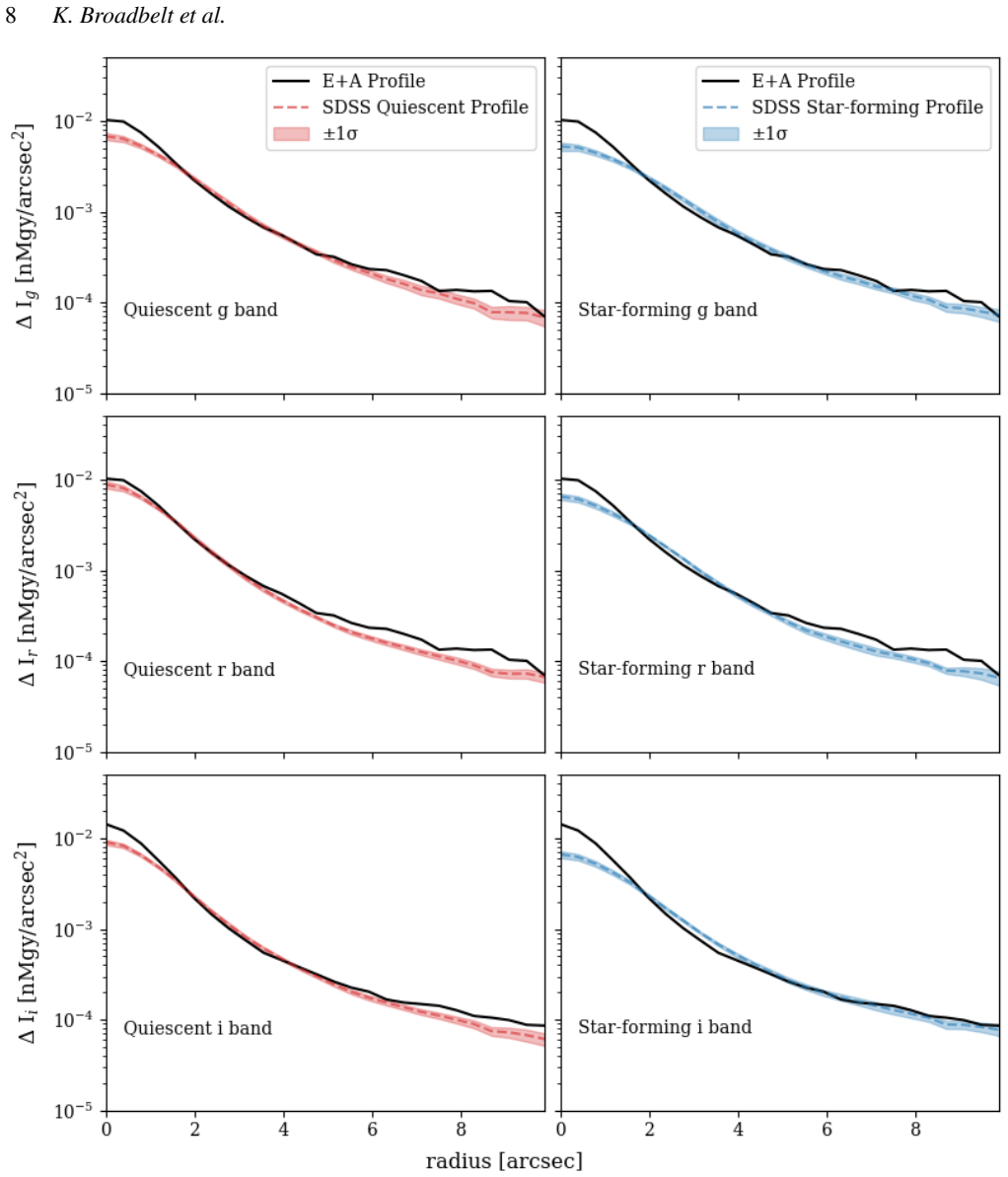
E+A post-starburst galaxies display brighter extended surface brightness profiles than matched non-post-starburst galaxies, revealing faint tidal features from small-scale interactions.
A machine-rendered reading of the paper's core claim, the machinery that carries it, and where it could break.
Core claim
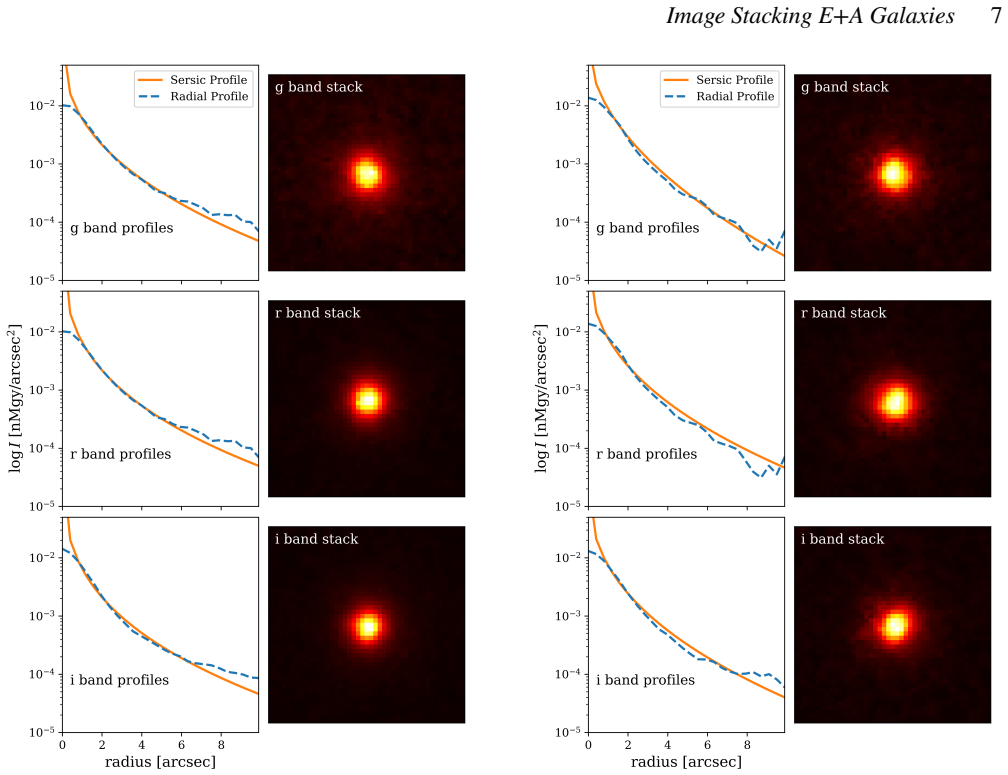
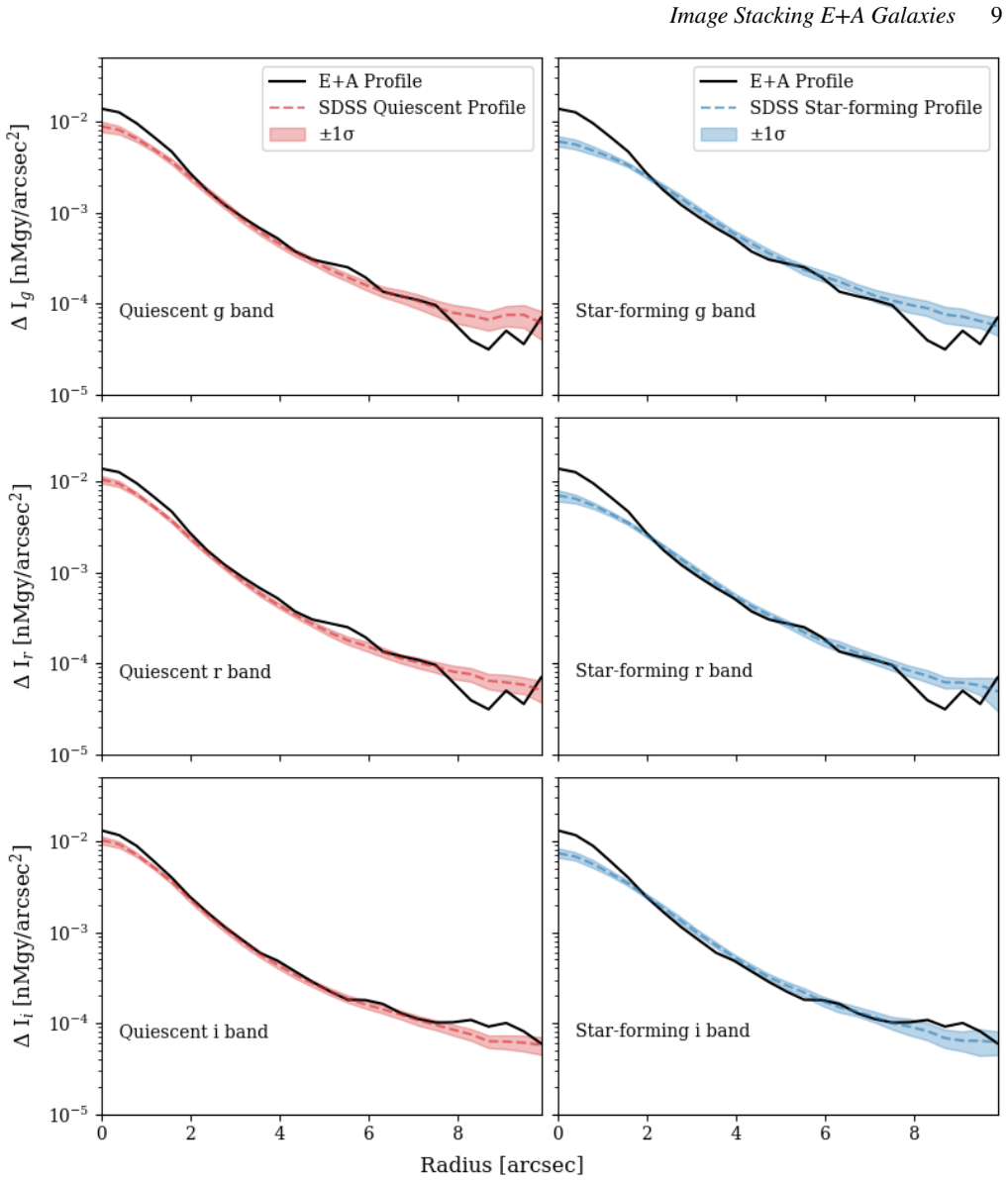
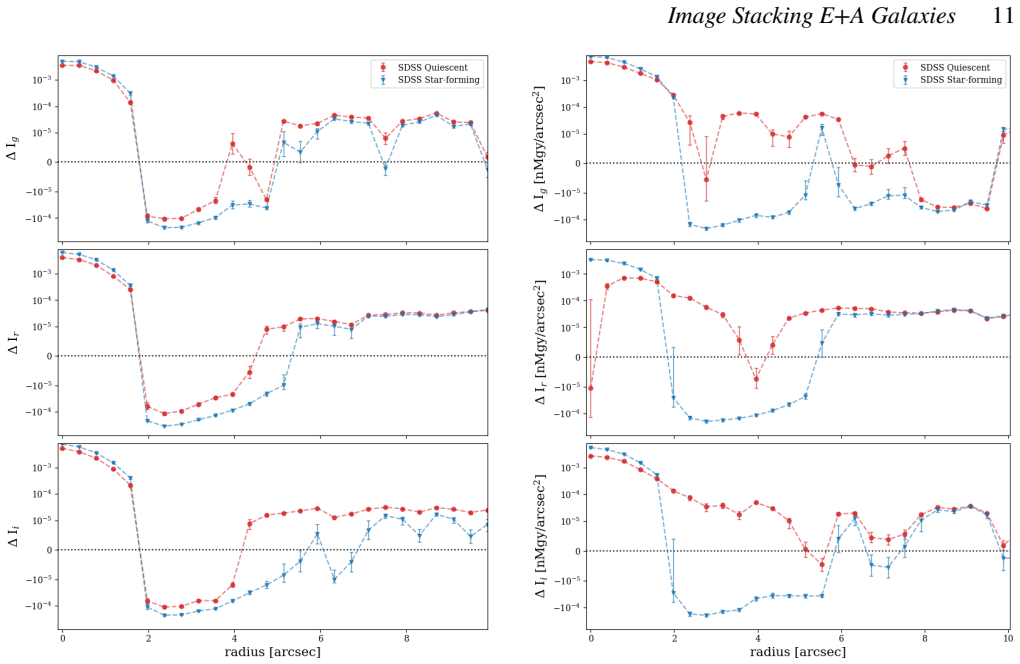
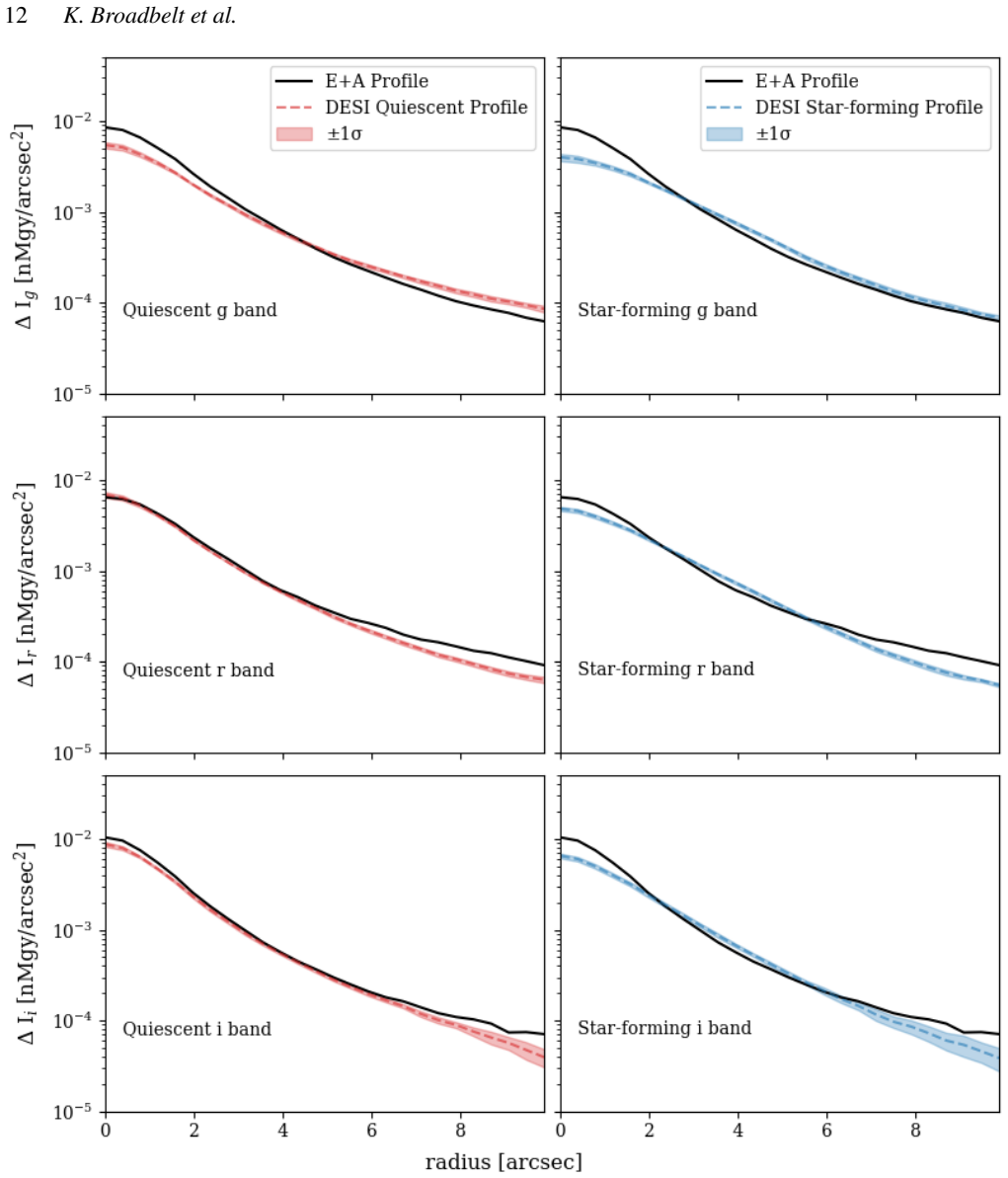
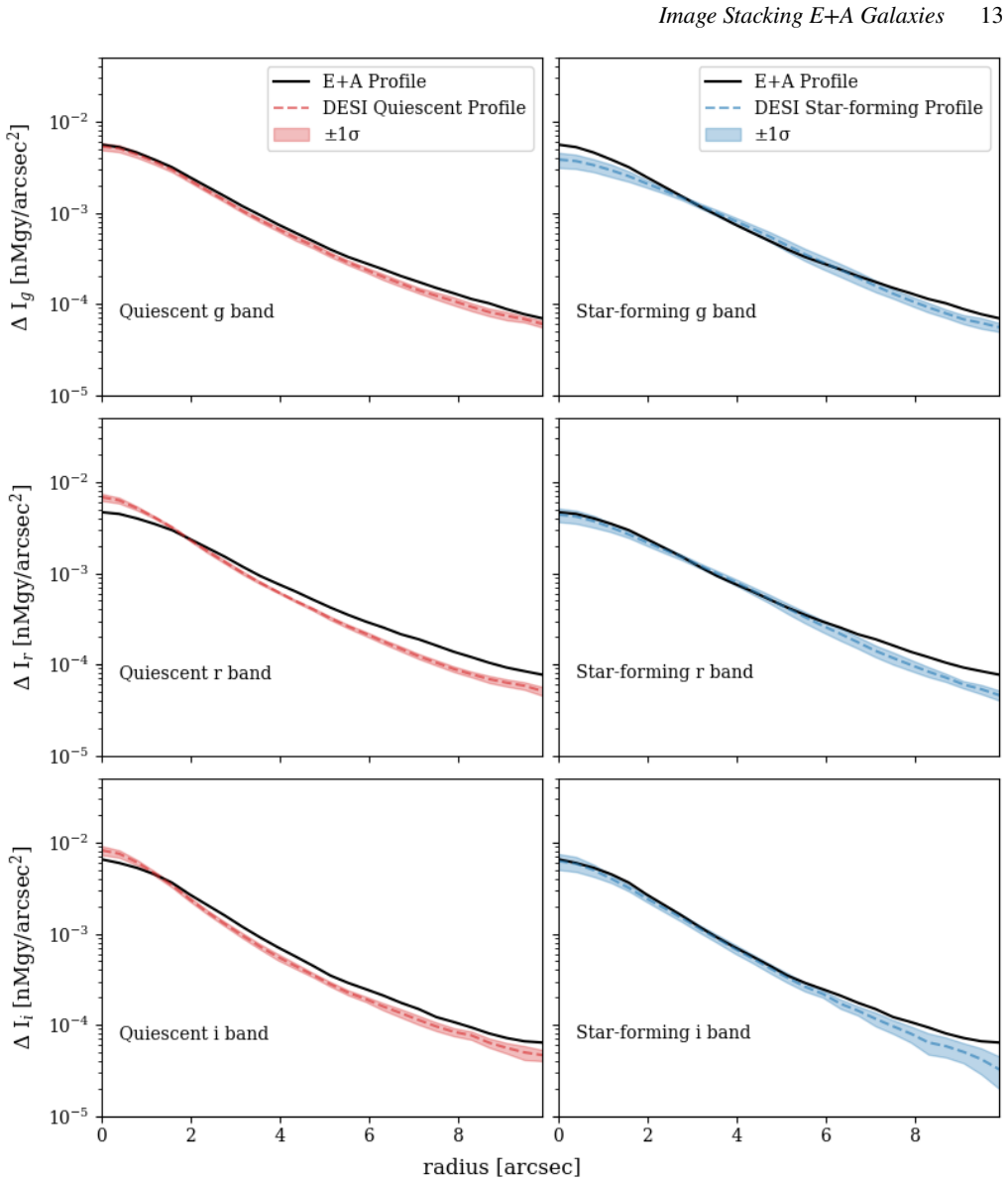
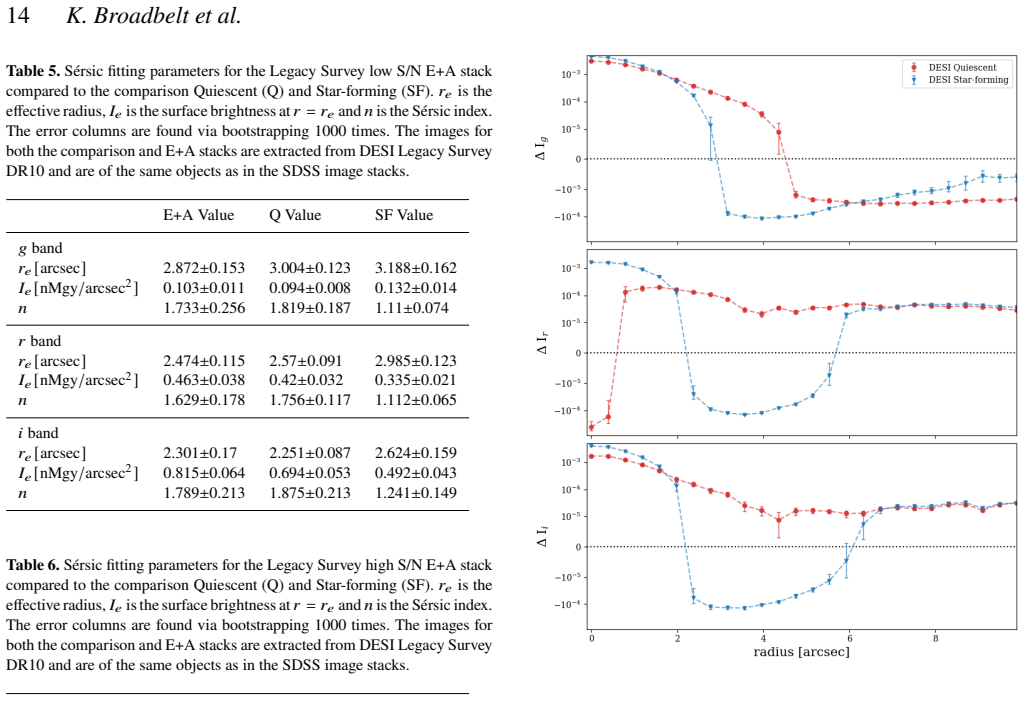
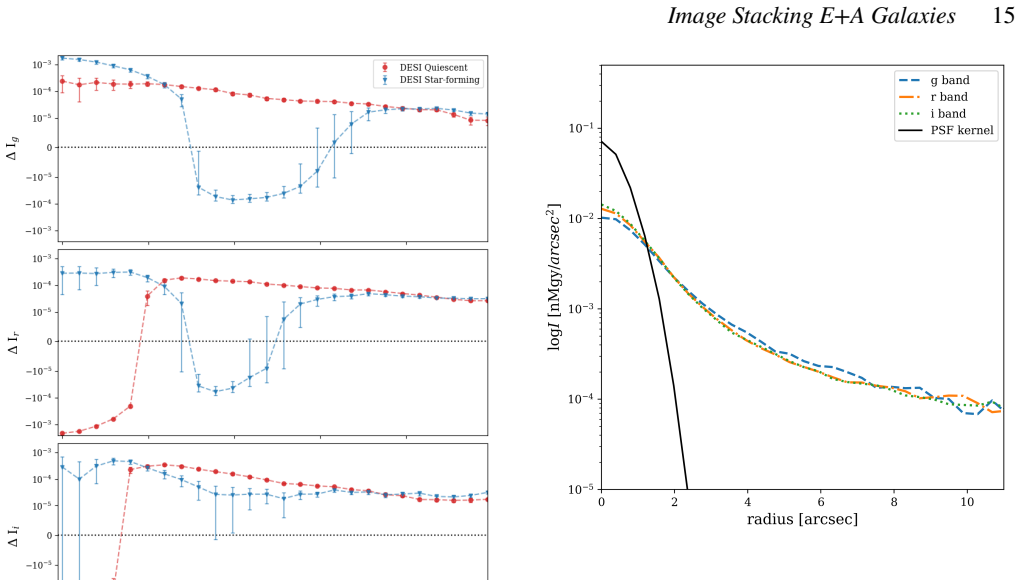
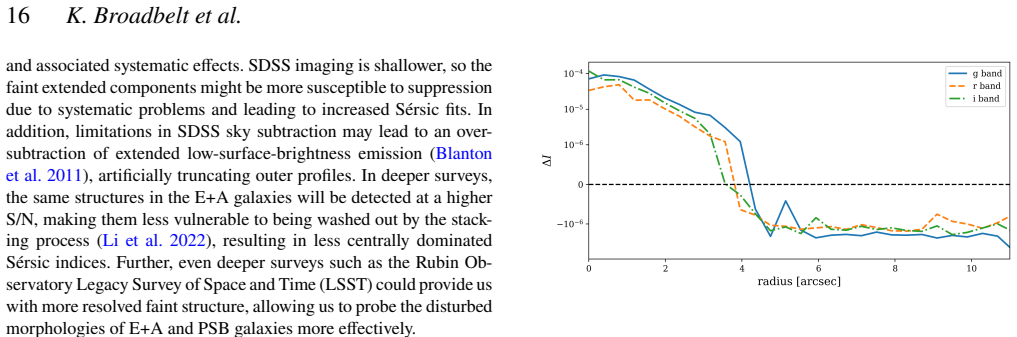
Stacking SDSS images of E+A galaxies produces averaged radial surface brightness profiles that are brighter at extended radii than profiles from comparison samples of non-PSB galaxies matched in stellar mass, redshift, and environment. Sersic fits to the stacked profiles, together with independent confirmation from deeper DESI Legacy Survey data, indicate the presence of faint tidal features attributable to small-scale interactions.
What carries the argument
Image stacking to derive averaged radial surface brightness profiles of E+A galaxies, followed by Sersic fitting and comparison to matched non-PSB samples.
If this is right
- Small-scale interactions are common drivers that can initiate and quench star formation in post-starburst galaxies.
- Faint tidal features are statistically detectable in E+A populations once individual images are stacked.
- Deeper wide-field surveys such as LSST will strengthen constraints on the frequency and strength of these extended structures.
Where Pith is reading between the lines
- The stacking approach could be applied to other transitional galaxy classes to uncover similarly subtle morphological signatures.
- Excess extended light might serve as a statistical proxy for recent interaction history across large galaxy samples.
- The result suggests that the post-starburst phase is frequently accompanied by low-surface-brightness merger remnants that are missed in single-object studies.
Load-bearing premise
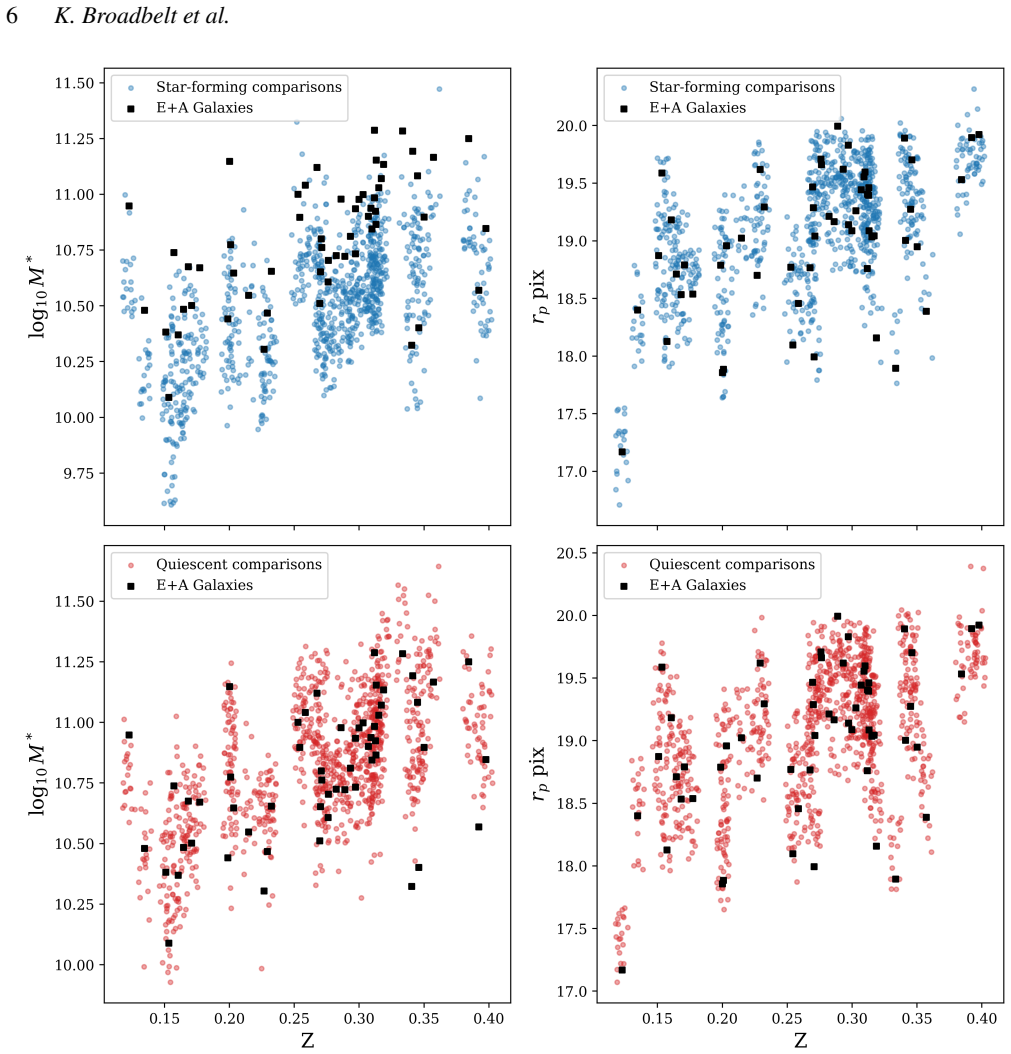
The non-PSB comparison galaxies are matched closely enough in stellar mass, redshift, and environment that differences in extended light arise from the post-starburst property rather than selection or observational biases.
What would settle it
Repeating the stacking analysis on samples re-matched more stringently or on mock images that include only selection effects without tidal features would eliminate the reported excess light at large radii.
Figures
read the original abstract
Small-scale interactions such as minor mergers, flybys and harassment are considered common driving mechanisms that can both initiate and quench star-forming processes within post-starburst (PSB) galaxies. PSBs have been linked to disturbed morphologies and faint tidal features in numerous works. We aim to independently study these features in E+A galaxies found in the Galaxy and Mass Assembly Fourth Data Release (GAMA DR4). Using image stacking techniques, we derive the averaged radial surface brightness profiles of E+A image stacks alongside the S\'ersic parameters that best fit these profiles. These E+A stacks consist of 57 images extracted from the Sloan Digital Sky Survey (SDSS) in g, r & i bands. The E+A stacks are shown to have brighter extended regions than similar non-PSB galaxies, which is indicative of faint tidal features that could be caused by small-scale interactions. Additionally, we make use of Dark Energy Spectroscopic Instrument (DESI) Legacy Survey imaging, which is deeper than SDSS, to further support our conclusions and find that the Legacy Survey images independently strengthen the evidence for excess light at extended radii relative to the comparison samples. We discuss these findings in the context of future surveys such as the Vera C. Rubin Legacy Survey of Space and Time (LSST) survey.
Editorial analysis
A structured set of objections, weighed in public.
Referee Report
Summary. The manuscript analyzes stacked radial surface-brightness profiles of 57 E+A (post-starburst) galaxies selected from GAMA DR4 using SDSS g, r, and i imaging. Sersic fits to the stacks are compared against control samples of non-PSB galaxies, with the E+A stacks reported to show excess light at large radii. Deeper DESI Legacy Survey imaging is used to corroborate the result, which is interpreted as evidence for faint tidal features driven by small-scale interactions. The work discusses implications for future surveys such as LSST.
Significance. If the control-sample matching holds, the result would provide empirical support for a morphological signature associated with the post-starburst phase at low surface brightness, complementing existing studies of disturbed morphologies in PSBs. The stacking approach and cross-survey comparison are standard techniques that can detect faint extended structure when sample sizes permit.
major comments (1)
- [Abstract] Abstract and implied methods: The central claim that E+A stacks exhibit brighter extended regions than 'similar' non-PSB galaxies requires that the comparison samples are matched sufficiently closely in stellar mass, redshift, and environment. No quantitative matching tolerances, tables of median/mean properties, or post-matching statistical tests (e.g., KS tests on mass or local density) are described. Residual differences in these quantities could produce the observed excess light via known correlations with merger-driven structure, independent of the post-starburst selection.
minor comments (2)
- [Abstract] Abstract: The E+A sample size (57 galaxies) and exact selection criteria from GAMA DR4 are stated without further detail on redshift range, spectral classification thresholds, or contaminant rejection; adding these would improve reproducibility.
- The manuscript does not discuss the impact of sample variance or bootstrap uncertainties on the stacked profiles at large radii, which would help assess the robustness of the reported excess light.
Simulated Author's Rebuttal
We thank the referee for their constructive review and recommendation for major revision. We address the single major comment below and will revise the manuscript accordingly.
read point-by-point responses
-
Referee: [Abstract] Abstract and implied methods: The central claim that E+A stacks exhibit brighter extended regions than 'similar' non-PSB galaxies requires that the comparison samples are matched sufficiently closely in stellar mass, redshift, and environment. No quantitative matching tolerances, tables of median/mean properties, or post-matching statistical tests (e.g., KS tests on mass or local density) are described. Residual differences in these quantities could produce the observed excess light via known correlations with merger-driven structure, independent of the post-starburst selection.
Authors: We agree that explicit documentation of the control-sample matching is required to substantiate the central claim. The manuscript refers to 'similar' non-PSB galaxies but does not provide the quantitative tolerances, summary statistics, or post-matching tests mentioned by the referee. In the revised version we will add a table of median and mean stellar mass, redshift, and local density for the E+A and control samples, state the matching tolerances used, and report Kolmogorov-Smirnov test results on these quantities. These additions will allow readers to evaluate whether residual differences could account for the excess light. revision: yes
Circularity Check
No circularity: purely empirical stacking and profile comparison
full rationale
The paper conducts image stacking of SDSS and DESI observations of E+A galaxies, derives averaged radial surface-brightness profiles, fits Sersic models, and compares the extended light to non-PSB control samples matched in mass, redshift and environment. No equations, model predictions, or derivations are present that reduce to fitted parameters or self-citations by construction. All steps (stacking, profile extraction, Sersic fitting) are standard observational procedures applied to external survey data; the central claim is a direct empirical difference, not a self-referential result. The matching of controls is an assumption about sample construction, not a circular reduction.
Axiom & Free-Parameter Ledger
axioms (2)
- domain assumption Stacked images faithfully represent the average radial light distribution of the parent population without significant bias from alignment or selection effects.
- standard math Sersic profile is an adequate parametric description of the stacked light distribution for comparison purposes.
Reference graph
Works this paper leans on
-
[1]
, keywords =
Galaxy And Mass Assembly (GAMA): stellar mass estimates. , keywords =
-
[2]
MNRAS , year=2017, volume=465, pages=
Gordon, Y and Owers, M and Pimbblet, K and Croom, S and Alpaslan, M and Baldry, I and Brough, S and Brown, M and Cluver, M and Conselice, C and Holwerda, L and Hopkins, A and Gunawardhana, M and Loveday, J and Taylor, E and Wang, L , title=. MNRAS , year=2017, volume=465, pages=
2017
-
[3]
, keywords =
Galaxy And Mass Assembly (GAMA): assimilation of KiDS into the GAMA database. , keywords =
-
[4]
MNRAS , year=2015, volume=452, pages=
Liske, J and Baldry, I K and Driver, S P and Tuffs, R J and Alpaslan, M and Andrae, E and Brough, S and Cluver, M E and Grootes, M W and Gunawardhana, M L P and Kelvin, L S and Loveday, J and Robotham, A S G and Taylor, E N and Bamford, S P and Bland-Hawthorn, J and Brown, M J I and Drinkwater, M J and Hopkins, A M and Meyer, M J and Norberg, P and Peacoc...
-
[5]
, keywords =
Galaxy And Mass Assembly (GAMA): the 0.013 < z < 0.1 cosmic spectral energy distribution from 0.1 m to 1 mm. , keywords =
-
[6]
, keywords =
Galaxy And Mass Assembly (GAMA): Data Release 4 and the z < 0.1 total and z < 0.08 morphological galaxy stellar mass functions. , keywords =
-
[7]
and Croom, S
Brough, S. and Croom, S. and Sharp, R. and Hopkins, A. M. and Taylor, E. N. and Baldry, I. K. and Gunawardhana, M. L. P. and Liske, J. and Norberg, P. and Robotham, A. S. G. and Bauer, A. E. and Bland-Hawthorn, J. and Colless, M. and Foster, C. and Kelvin, L. S. and Lara-Lopez, M. A. and López-Sánchez, Á. R. and Loveday, J. and Owers, M. and Pimbblet, K. ...
2013
-
[8]
, keywords =
Galaxy And Mass Assembly (GAMA): stellar mass functions by Hubble type. , keywords =
-
[9]
2024, astropy/photutils: 2.0.2, 2.0.2, Zenodo, doi: 10.5281/zenodo.13989456
Bradley, L and Sip. astropy/photutils: 2.0.2 , month = oct, year = 2024, journal =. doi:10.5281/zenodo.13989456 , url =
-
[10]
doi:10.1088/1538-3873/aaecc2 , url =
Campagnolo, J C N , title =. doi:10.1088/1538-3873/aaecc2 , url =
-
[11]
Pedregosa, F and Varoquaux, G and Gramfort, A and Michel, V and Thirion, B and Grisel, O and Blondel, M and Prettenhofer, P and Weiss, R and Dubourg, B and Vanderplas, J and Passos, A and Cournapeau, D and Brucher, M and Perrot, M and Duchesnay, E , title=
-
[12]
, year = 2019, volume =
astroquery: An Astronomical Web-querying Package in Python. , year = 2019, volume =
2019
-
[13]
Astropy: A Community Python Package for Astronomy
doi:10.1051/0004-6361/201322068 , Eid =. arXiv , Author =:1307.6212 , Journal =
work page internal anchor Pith review Pith/arXiv arXiv doi:10.1051/0004-6361/201322068
-
[14]
The Astropy Project: Building an inclusive, open-science project and status of the v2.0 core package
The Astropy Project: Building an Open-science Project and Status of the v2.0 Core Package. , keywords =. doi:10.3847/1538-3881/aabc4f , archivePrefix =. 1801.02634 , primaryClass =
work page internal anchor Pith review Pith/arXiv arXiv doi:10.3847/1538-3881/aabc4f
-
[15]
The Astropy Project: Sustaining and Growing a Community-oriented Open-source Project and the Latest Major Release (v5.0) of the Core Package. , keywords =. doi:10.3847/1538-4357/ac7c74 , archivePrefix =. 2206.14220 , primaryClass =
work page internal anchor Pith review Pith/arXiv arXiv doi:10.3847/1538-4357/ac7c74
-
[16]
P\'erez, Fernando and Granger, Brian E. , Title =. Computing in Science and Engineering , Volume =. doi:10.1109/MCSE.2007.53 , publisher =
-
[17]
MNRAS , year = 2019, volume = 483, pages = 4140, doi =
Rodriquez-Gomez, V and Synder, G F and Lotz, J M and Nelson, D and Pillepich, A and Springel, V and Genel, S and Weiberger, R and Tacchella, S and Pakmor, R and Torrey, P and Marinacci, F and Vogelsberger, M and Hernquist, L and Thilker, D A , title =. MNRAS , year = 2019, volume = 483, pages = 4140, doi =
2019
-
[18]
MNRAS , volume =
Pawlik, M M and Taj Aldeen, L and Wild, V and Mendez-Abreu, J and Lahén, N and Johansson, P H and Jimenez, N and Lucas, W and Zheng, Y and Walcher, C J and Rowlands, K , title =. MNRAS , volume =. 2018 , month =
2018
-
[19]
MNRAS , year=2017, volume=472, pages=
Wilkinson, C and Pimbblet, K and Stott, J , title=. MNRAS , year=2017, volume=472, pages=
2017
-
[20]
ApJ , doi=
Dressler, A and Gunn, J E , title=. ApJ , doi=
-
[21]
A&A , doi=
Vergani, D and Zamorani, G and Lilly, S and Lamareille, F and Halliday, C and Scodeggio, M and Vignali, C and Ciliegi, P and Bolzonella, M and Bondi, M and Kovac, K and Knobel, C and Zucca, E and Caputi, K, and Pozzetti, L and Bardelli, S , title=. A&A , doi=
-
[22]
ApJ , doi=
Poggianti, B M and Aragon-Salamanca, A and Zaritsky, D and De Lucia, G and Milvang-Jensen, B and Desai, V and Jablonka, P and Halliday, C and Rudnick, G and Varela, J and Bamford, S and Best, P and Clowe, D and Noll, S and Saglia, R and Pello, R and Simard, L and von der Linden, A and White, S , title=. ApJ , doi=
-
[23]
ApJ , doi=
Hogg, D W and Masjedi, M and Berlind, A A and Blanton M R and Quintero, A D and Brinkmann J , title=. ApJ , doi=
-
[24]
2007 , volume=377, pages=1222, journal=
Goto, Tomotsugu , title=. 2007 , volume=377, pages=1222, journal=
2007
-
[25]
MNRAS , doi=
Couch, Warrick J and Sharples, R M , title=. MNRAS , doi=
-
[26]
ApJ , doi=
Zabludoff, A I and Zaritsky, D and Lin, H and Tucker, D and Hasimoto, Y and Shectman, S A and Oemler, A and Kirshner, R P , title=. ApJ , doi=
-
[27]
ApJ , year=2021, volume=
Greene, O A and Anderson, M R and Marinelli, M and Holley-Bockelmann, K and Campbel, L E P and Liu, C T , title=. ApJ , year=2021, volume=
2021
-
[28]
MNRAS , year=
Broadbelt, Kieran and Pimbblet, Kevin and Farrow, Daniel Joseph , title=. MNRAS , year=
-
[29]
PASJ , year=2003, volume=55, pages=771, doi=
Goto, T and Nichol, R C and Okamura, S and Sekiguchi, M and Miller, C J and Bernardi, M and Hopkins, A and Tremonti, C and Connolly, A and Castander, F J and Brinkmann, J and Fukugita, M and Harvanek, M and Ivezic, Z and Kleinman, S J and Krzesinski, J and Long, D and Loveday, J and Neilsen, E H and Newman, P R and Nitta, A and Snedden, S A and Subbarao, ...
2003
-
[30]
MNRAS , year=2005, volume=357, pages=937, doi=
Goto, T , title=. MNRAS , year=2005, volume=357, pages=937, doi=
2005
-
[31]
MNRAS , year=
Goto, T , title=. MNRAS , year=
-
[32]
SQuIGG<inline-formula> </inline-formula>E: Observational Evidence of Low Ongoing Star Formation Rates in Gas-rich Post-starburst Galaxies. , keywords =. doi:10.3847/1538-4357/adaf1c , archivePrefix =. 2501.16459 , primaryClass =
-
[33]
Caught in the Act of Quenching: A Population of Post-Starburst Ultra-Diffuse Galaxies. arXiv e-prints , keywords =. doi:10.48550/arXiv.2502.00117 , archivePrefix =. 2502.00117 , primaryClass =
-
[34]
A Large Population of Massive Compact Post-starburst Galaxies at z > 1: Implications for the Size Evolution and Quenching Mechanism of Quiescent Galaxies. , keywords =. doi:10.1088/0004-637X/745/2/179 , archivePrefix =. 1112.0313 , primaryClass =
work page internal anchor Pith review Pith/arXiv arXiv doi:10.1088/0004-637x/745/2/179
-
[35]
The Detailed Evolution of E+A Galaxies into Early Types
The Detailed Evolution of E+A Galaxies into Early Types. , keywords =. doi:10.1086/591656 , archivePrefix =. 0801.1190 , primaryClass =
work page internal anchor Pith review Pith/arXiv arXiv doi:10.1086/591656
-
[36]
and Cole, Shaun and Eisenstein, Daniel J
The UV properties of E+A galaxies: constraints on feedback-driven quenching of star formation. , keywords =. doi:10.1111/j.1365-2966.2007.12475.x , archivePrefix =. 0707.3570 , primaryClass =
-
[37]
Li, Y and li, N and Liu, F and Mao, J and Cui, Q and Ren, J and Zhao, P and Mo, H and Song, Q and Zhang, X , title =. Res. Astron, Astrophys. , year =
-
[38]
MEASURING STRUCTURAL PARAMETERS THROUGH STACKING GALAXY IMAGES , volume=
Li, Yubin and Zheng, Xian Zhong and Gu, Qiu-Sheng and Wang, Yi-Peng and Wen, Zhang Zheng and Guo, Kexin and An, Fang Xia , year=. MEASURING STRUCTURAL PARAMETERS THROUGH STACKING GALAXY IMAGES , volume=. AJ , publisher=. doi:10.3847/0004-6256/152/6/201 , number=
-
[39]
A Morphological Study of AGN-host Dwarf Galaxies , volume=
Tian, Jie and Zhao, Yinghe and Li, Xiejin and Bai, Jinming , year=. A Morphological Study of AGN-host Dwarf Galaxies , volume=. ApJ , publisher=. doi:10.3847/1538-4357/add140 , number=
-
[40]
MNRAS , year = 2004, volume = 347, pages = 556, doi=
Zibetti, S and White, S D M and Brinkmann, J , title =. MNRAS , year = 2004, volume = 347, pages = 556, doi=
2004
-
[41]
ApJ , year=
van de Wel, A and Holden, B P and Zirm, A W and Franx, M and Rettura, A and Illingworth, G D and Ford, H C , title=. ApJ , year=
-
[42]
ApJ , year=2013, volume=778, pages=23, doi=
Guo, K and Zheng, X Z and Fu, H , title=. ApJ , year=2013, volume=778, pages=23, doi=
2013
-
[43]
Herschel-ATLAS/GAMA: a census of dust in optically selected galaxies from stacking at submillimetre wavelengths. , keywords =. doi:10.1111/j.1365-2966.2012.20528.x , archivePrefix =. 1201.1916 , primaryClass =
-
[44]
Four eclipsing white dwarf main-sequence binaries
Radio source stacking and the infrared/radio correlation at Jy flux densities. , keywords =. doi:10.1111/j.1365-2966.2008.14296.x , archivePrefix =. 0812.0281 , primaryClass =
-
[45]
Visibility stacking in the quest for SNIa radio emission
Visibility Stacking in the Quest for Type Ia Supernova Radio Emission. , keywords =. doi:10.1088/2041-8205/735/2/L35 , archivePrefix =. 1105.6188 , primaryClass =
work page internal anchor Pith review Pith/arXiv arXiv doi:10.1088/2041-8205/735/2/l35 2041
-
[46]
The Growth of Massive Galaxies Since z=2
The Growth of Massive Galaxies Since z = 2. , keywords =. doi:10.1088/0004-637X/709/2/1018 , archivePrefix =. 0912.0514 , primaryClass =
work page internal anchor Pith review Pith/arXiv arXiv doi:10.1088/0004-637x/709/2/1018
-
[47]
Atlas de Galaxias Australes
-
[48]
and Butcher, Harvey and Couch, Warrick J
Dressler, Alan and Smail, Ian and Poggianti, Bianca M. and Butcher, Harvey and Couch, Warrick J. and Ellis, Richard S. and Oemler, Jr., Augustus , title =. 1999 , month =. doi:10.1086/313213 , url =
-
[49]
Quintero, Alejandro D. and Hogg, David W. and Blanton, Michael R. and Schlegel, David J. and Eisenstein, Daniel J. and Gunn, James E. and Brinkmann, J. and Fukugita, Masataka and Glazebrook, Karl and Goto, Tomotsugu , title =. 2004 , month =. doi:10.1086/380601 , url =
-
[50]
General sample properties and the prevalence of obscured starbursts
Multiphase outflows in post-starburst E+A galaxies - I. General sample properties and the prevalence of obscured starbursts. , keywords =. doi:10.1093/mnras/stab3232 , archivePrefix =. 2105.08071 , primaryClass =
-
[51]
Alatalo, Katherine and Cales, Sabrina L. and Rich, Jeffrey A. and Appleton, Philip N. and Kewley, Lisa J. and Lacy, Mark and Lanz, Lauranne and Medling, Anne M. and Nyland, Kristina , title =. 2016 , month =. doi:10.3847/0067-0049/224/2/38 , url =
-
[52]
Kelvin, Lee S. and Driver, Simon P. and Robotham, Aaron S. G. and Hill, David T. and Alpaslan, Mehmet and Baldry, Ivan K. and Bamford, Steven P. and Bland-Hawthorn, Joss and Brough, Sarah and Graham, Alister W. and Häussler, Boris and Hopkins, Andrew M. and Liske, Jochen and Loveday, Jon and Norberg, Peder and Phillipps, Steven and Popescu, Cristina C. an...
-
[53]
Sloan Digital Sky Survey: Early Data Release. , keywords =. doi:10.1086/324741 , adsurl =
-
[54]
Galaxy And Mass Assembly (GAMA): Panchromatic Data Release (far-UV-far-IR) and the low-z energy budget. , keywords =. doi:10.1093/mnras/stv2505 , archivePrefix =. 1508.02076 , primaryClass =
work page internal anchor Pith review Pith/arXiv arXiv doi:10.1093/mnras/stv2505
-
[55]
Planck 2018 results. VI. Cosmological parameters. , keywords =. doi:10.1051/0004-6361/201833910 , archivePrefix =. 1807.06209 , primaryClass =
work page internal anchor Pith review Pith/arXiv arXiv doi:10.1051/0004-6361/201833910 2018
-
[56]
AJ , year=2004, volume=128, pages=
Lotz, J and Primack, J and Madau, P , title=. AJ , year=2004, volume=128, pages=
2004
-
[57]
AJ , doi=
Bershady, M A and Jangren, A and Conselice, C J , title=. AJ , doi=
-
[58]
ApJS , year=2003, volume=147, pages=
Conselice, Chris , title=. ApJS , year=2003, volume=147, pages=
2003
-
[59]
MNRAS , year = 2013, volume = 434, pages = 282, doi =
Freeman, P E and Izbicki, R and Lee, A B and Newman, J A and Conselice, C J and Koekemoer, A M and Lotz, J M and Mozena, M , title =. MNRAS , year = 2013, volume = 434, pages = 282, doi =
2013
-
[60]
MNRAS , year = 2015, volume = 458, pages = 963, doi =
Peth, M A and Lotz, J M and Freeman, P E and McPartland, C and Alireza Mortazavi, S and Synder, G F and Barro, G and Grogin, N A and Guo, Y and Hemmati, S and Kartaltepe, J S and Kocevski, D D and Koekemoer, A M and McIntosh, D H and Nayyeri, H and Papovich, C and Primack, J R and Simons, R C , title =. MNRAS , year = 2015, volume = 458, pages = 963, doi =
2015
-
[61]
The Open Journal of Astrophysics , keywords =
RMS asymmetry: a robust metric of galaxy shapes in images with varied depth and resolution. The Open Journal of Astrophysics , keywords =. doi:10.33232/001c.123524 , archivePrefix =. 2404.05792 , primaryClass =
-
[62]
Probing Asymmetric Structures in the Outskirts of Galaxies
Probing Asymmetric Structures in the Outskirts of Galaxies. , keywords =. doi:10.1088/0004-637X/787/2/130 , archivePrefix =. 1404.2281 , primaryClass =
work page internal anchor Pith review Pith/arXiv arXiv doi:10.1088/0004-637x/787/2/130
-
[63]
Shape asymmetry: a morphological indicator for automatic detection of galaxies in the post-coalescence merger stages. , keywords =. doi:10.1093/mnras/stv2878 , archivePrefix =. 1512.02000 , primaryClass =
work page internal anchor Pith review Pith/arXiv arXiv doi:10.1093/mnras/stv2878
-
[64]
Annales d'Astrophysique , year = 1948, month = jan, volume =
Recherches sur les Nebuleuses Extragalactiques. Annales d'Astrophysique , year = 1948, month = jan, volume =
1948
-
[65]
How do minor mergers promote inside-out growth of ellipticals, transforming the size, density profile and dark matter fraction?. , keywords =. doi:10.1093/mnras/sts501 , archivePrefix =. 1206.5004 , primaryClass =
work page internal anchor Pith review Pith/arXiv arXiv doi:10.1093/mnras/sts501
-
[66]
Surface density profiles of collisionless disc merger remnants. , keywords =. doi:10.1111/j.1365-2966.2006.10252.x , archivePrefix =. astro-ph/0508362 , primaryClass =
-
[67]
, year = 2025, volume =
Quenching through Tidal Gas Removal: Molecular Gas and Star Formation in Tidal Tails of z 0.7 Post-starburst Galaxies. , year = 2025, volume =
2025
-
[68]
Nature , year = 2005, volume=433, pages=604, doi=
Di Matteo, T and Springel, V and Hernquist,L , title =. Nature , year = 2005, volume=433, pages=604, doi=
2005
-
[69]
Simple Yet Powerful: Hot Galactic Outflows Driven by Supernovae. , keywords =. doi:10.3847/2041-8213/ab7304 , archivePrefix =. 1910.09554 , primaryClass =
-
[70]
The merger-starburst connection across cosmic times. , keywords =. doi:10.1093/mnras/stac2557 , archivePrefix =. 2209.03983 , primaryClass =
-
[71]
ApJS , year = 2006, volume=163, pages=1, doi=
Hopkins, P F and Hernquist, L and Cox, T J and Di Matteo, T and Robertson, B and Springel, V , title =. ApJS , year = 2006, volume=163, pages=1, doi=
2006
-
[72]
Star Formation Suppression by Tidal Removal of Cold Molecular Gas from an Intermediate-redshift Massive Post-starburst Galaxy. , keywords =. doi:10.3847/2041-8213/ac75ea , archivePrefix =. 2208.13917 , primaryClass =
-
[73]
MNRAS , year = 2005, volume=361, pages=776, doi=
Springel, V and Di Matteo, T and Hernquist, L , title =. MNRAS , year = 2005, volume=361, pages=776, doi=
2005
-
[74]
The Formation of Massive, Compact Galaxies at z=2 in the Illustris Simulation
The formation of massive, compact galaxies at z = 2 in the Illustris simulation. , keywords =. doi:10.1093/mnras/stv303 , archivePrefix =. 1411.0667 , primaryClass =
work page internal anchor Pith review Pith/arXiv arXiv doi:10.1093/mnras/stv303
-
[75]
Merger Signatures are Common, but not Universal, in Massive, Recently Quenched Galaxies at z 0.7. , keywords =. doi:10.3847/1538-4357/acc38b , archivePrefix =. 2211.16532 , primaryClass =
-
[76]
Now You See It, Now You Don't: Star Formation Truncation Precedes the Loss of Molecular Gas by 100 Myr in Massive Poststarburst Galaxies at z 0.6. , keywords =. doi:10.3847/1538-4357/ac3dfa , archivePrefix =. 2111.14877 , primaryClass =
-
[77]
Massive quenched galaxies at z~0.7 retain large molecular gas reservoirs
Massive Quenched Galaxies at z 0.7 Retain Large Molecular Gas Reservoirs. , keywords =. doi:10.3847/2041-8213/aa85dc , archivePrefix =. 1708.03337 , primaryClass =
work page internal anchor Pith review Pith/arXiv arXiv doi:10.3847/2041-8213/aa85dc 2041
-
[78]
From Starburst to Quiescence: Testing AGN feedback in Rapidly Quenching Post-Starburst Galaxies
From Starburst to Quiescence: Testing Active Galactic Nucleus feedback in Rapidly Quenching Post-starburst Galaxies. , keywords =. doi:10.1088/0004-637X/792/2/84 , archivePrefix =. 1407.3834 , primaryClass =
work page internal anchor Pith review Pith/arXiv arXiv doi:10.1088/0004-637x/792/2/84
-
[79]
SQuIGG e c\ L\ E Survey: Massive z 0.6 Post-starburst Galaxies Exhibit Flat Age Gradients. , keywords =. doi:10.3847/1538-4357/abc265 , archivePrefix =. 2010.04734 , primaryClass =
-
[80]
ApJ , volume=874, year=2019, pages=17, doi=
Belli, S and Newman, A B and Ellis, R S , title=. ApJ , volume=874, year=2019, pages=17, doi=
2019
discussion (0)
Sign in with ORCID, Apple, or X to comment. Anyone can read and Pith papers without signing in.