Soft QED as Open Quantum System: Infrared Cancellation and Soft-Shell Coarse Graining
Pith reviewed 2026-06-29 01:15 UTC · model grok-4.3
The pith
Treating unresolved soft photons in QED as an environment produces a reduced density matrix whose probabilities match the infrared-finite results of full QED.
A machine-rendered reading of the paper's core claim, the machinery that carries it, and where it could break.
Core claim
The central claim is that the open quantum system formulation of soft QED, with the reduced density matrix constructed from Kraus operators given by the soft matrix elements of the S-matrix, reproduces exactly the infrared-finite probabilities of full QED for the same observable, perturbative order, diagrams, and phase space. The soft-photon evolution is a unitary coherent-state displacement driven by the scattering current; the equal-history identity of the influence functional normalizes this evolution and, together with the soft-photon theorem, eliminates the infrared-divergent leading-soft factor from inclusive probabilities. Tracing an infinitesimal soft-photon shell produces diagonal j
What carries the argument
The reduced density matrix of the hard system obtained by tracing out soft photons via Kraus operators from the soft matrix elements of the S-matrix, together with the equal-history identity of the Schwinger-Keldysh influence functional.
If this is right
- Inclusive probabilities for resolved hard outcomes are free of infrared divergences.
- The soft evolution is realized as a unitary coherent-state displacement driven by the scattering current.
- Tracing soft shells generates a completely positive unital Schur channel whose scale-invariant limit is a dephasing semigroup on the hard-branch space.
- The reduced-state description predicts a logarithmic visibility slope and monotonic purity loss as functions of the soft scale.
- The same controlled-displacement construction recovers the Sudakov probability, Poisson soft-photon multiplicities, and bremsstrahlung number spectrum.
Where Pith is reading between the lines
- The dephasing semigroup implies a concrete scale dependence for loss of coherence that could be compared against interference data in precision scattering experiments.
- The Schur-channel property guarantees that the reduced dynamics remains completely positive and trace-preserving at every finite soft-shell step, independent of the particular hard process.
- Because the equal-history identity normalizes the soft sector exactly, the same construction may organize infrared cancellations in other gauge theories where soft emissions produce analogous divergences.
Load-bearing premise
Unresolved soft photons can be traced out while preserving the equal-history identity of the influence functional, and the one-loop Schwinger-Keldysh expansion captures the full cancellation without higher-order corrections or non-eikonal contributions altering the reduced dynamics.
What would settle it
An explicit computation of the reduced density matrix at two loops for a concrete scattering process that produces either residual infrared divergences or finite terms differing from those of full QED would falsify the claim that the open-system description matches full QED at every perturbative order.
Figures
read the original abstract
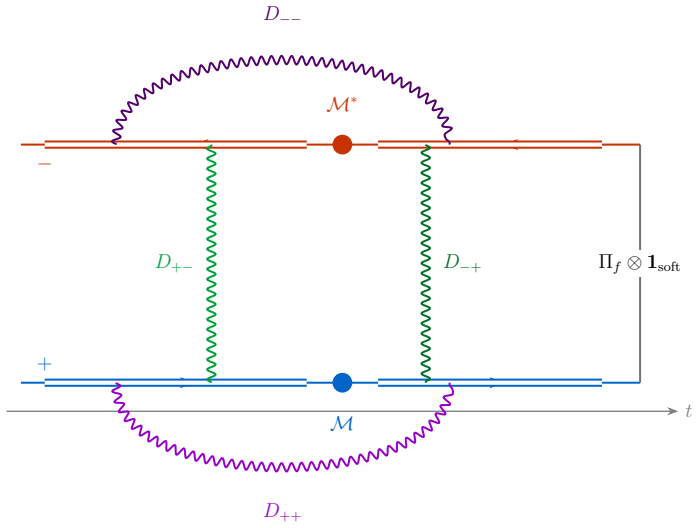
I formulate unresolved soft-photon sector of QED as open quantum system. Resolved charged particles and hard photons form the system, unresolved soft photons form the environment, and basic object is the reduced density matrix. A resolved outcome $f$ of multiple hard particles and photons has probability $P_{f}(i) =\sum_n|\langle f,n|S|i,0\rangle|^2=\langle i|F_f|i\rangle$, with Kraus operators $K_n= {}_{\rm soft} \langle n|S|0 \rangle_{\rm soft}$ and effect $F_f=\sum_nK_n^\dagger\Pi_fK_n$. The SK formulation places unresolved virtual and real terms in one doubled-contour expansion. At one loop they carry the same on-shell eikonal kernel with opposite signs. This elegantly organizes the QED probability: for the same observable, perturbative order, diagrams, and phase space, the OQS gives the same infrared-finite terms as the full-QED. The soft-photon evolution is a unitary coherent-state displacement driven by the scattering current. The equal-history identity of influence functional exactly normalizes this soft evolution; together with the soft-photon theorem it removes the IR divergent leading-soft factor from inclusive probability. I also derive explicit leading-soft QED realization of scale-parametrized Lindblad evolution on a fixed hard-branch space. Tracing an infinitesimal soft-photon shell produces diagonal jump operators whose entries are fixed by the corresponding eikonal emission amplitudes. The finite-shell map is a completely positive unital Schur channel and, in the sharp scale-invariant leading-soft regime, a dephasing semigroup of a completely-positive-divisible scale flow. The resulting logarithmic visibility slope and monotonic purity loss are off-diagonal predictions of the reduced-state description. The same controlled-displacement dilation gives the Sudakov probability, Poisson soft-photon multiplicities, and the bremsstrahlung number spectrum.
Editorial analysis
A structured set of objections, weighed in public.
Referee Report
Summary. The paper proposes treating the unresolved soft-photon sector in QED as an open quantum system, with the system consisting of resolved charged particles and hard photons, and the environment being the unresolved soft photons. The reduced density matrix is the basic object, and probabilities for resolved outcomes are expressed using Kraus operators constructed from the S-matrix elements. The Schwinger-Keldysh formulation is used to organize virtual and real soft contributions at one loop, showing they share the same on-shell eikonal kernel with opposite signs. The equal-history identity of the influence functional is invoked to normalize the soft evolution, and together with the soft-photon theorem, it removes the IR divergent leading-soft factor. The paper also derives an explicit leading-soft realization of scale-parametrized Lindblad evolution through soft-shell coarse graining, showing that the finite-shell map is a completely positive unital Schur channel that reduces to a dephasing semigroup in the sharp-scale limit, leading to predictions for logarithmic visibility slope and monotonic purity loss.
Significance. If the central claims hold beyond the one-loop level, this work provides a new perspective on infrared divergences in QED by mapping them to open quantum system dynamics, potentially offering tools from quantum information theory for handling soft physics. The explicit construction of the Lindblad evolution with jump operators determined by eikonal amplitudes and the matching to standard QED IR-finite terms at one loop are notable strengths. It also gives concrete off-diagonal predictions that could be tested in principle.
major comments (2)
- [Abstract (SK formulation and one-loop cancellation)] The assertion that the OQS gives the same infrared-finite terms as full QED for the same observable, perturbative order, diagrams, and phase space is based on the one-loop SK doubled-contour expansion where virtual and real terms have the same on-shell eikonal kernel but opposite signs. However, there is no derivation demonstrating that the equal-history identity of the influence functional is preserved when higher-order or non-eikonal corrections are retained in the soft trace. This is load-bearing for the claim of all-order IR cancellation in the reduced probability P_f(i).
- [Abstract (equal-history identity and soft-photon evolution)] The statement that the equal-history identity exactly normalizes the soft evolution and removes the IR divergent factor assumes that tracing out the unresolved soft photons preserves this identity. The manuscript provides no explicit check or argument that this holds at orders beyond one loop, which is required for the equivalence to full QED to extend generally.
minor comments (2)
- [Abstract] The notation in the definition of P_f(i) and the Kraus operators K_n could be clarified by explicitly defining the summation index n and the soft vacuum |0>_{soft} for readers unfamiliar with the setup.
- [Abstract (Lindblad evolution paragraph)] The transition from the finite-shell map being a Schur channel to the sharp-scale limit as a dephasing semigroup would benefit from a brief statement of the conditions under which this limit is taken.
Simulated Author's Rebuttal
We thank the referee for the careful reading and for highlighting the scope of our claims regarding all-order IR cancellation. We address the two major comments below, clarifying the regime of validity and the status of the equal-history identity.
read point-by-point responses
-
Referee: [Abstract (SK formulation and one-loop cancellation)] The assertion that the OQS gives the same infrared-finite terms as full QED for the same observable, perturbative order, diagrams, and phase space is based on the one-loop SK doubled-contour expansion where virtual and real terms have the same on-shell eikonal kernel but opposite signs. However, there is no derivation demonstrating that the equal-history identity of the influence functional is preserved when higher-order or non-eikonal corrections are retained in the soft trace. This is load-bearing for the claim of all-order IR cancellation in the reduced probability P_f(i).
Authors: The explicit one-loop SK calculation demonstrates cancellation via the shared on-shell eikonal kernel of opposite sign. The equal-history identity is a structural property of the influence functional arising from the unitary coherent-state displacement generated by the scattering current; this structure is exact within the leading-soft eikonal approximation and is independent of perturbative order in that limit. The all-order soft-photon theorem then removes the divergent factor from the inclusive probability. We agree that the manuscript does not supply an explicit derivation of identity preservation once non-eikonal or higher-order soft corrections are retained, which lies outside the leading-soft regime adopted throughout the work. We will revise the text to state the domain of validity more precisely and to note that extension beyond the eikonal limit would require additional analysis. revision: partial
-
Referee: [Abstract (equal-history identity and soft-photon evolution)] The statement that the equal-history identity exactly normalizes the soft evolution and removes the IR divergent factor assumes that tracing out the unresolved soft photons preserves this identity. The manuscript provides no explicit check or argument that this holds at orders beyond one loop, which is required for the equivalence to full QED to extend generally.
Authors: The equal-history identity follows directly from the normalization of the full unitary S-matrix evolution prior to the partial trace over soft modes; because the soft evolution remains a displacement operator in the leading-soft limit, the identity is preserved by construction when the trace is performed. This holds at all orders within the eikonal approximation used for the soft sector. We acknowledge that the manuscript contains no explicit verification of the identity once non-eikonal corrections or higher-loop soft contributions are included, and that such a check would be needed to claim equivalence to full QED outside the leading-soft regime. We will add a clarifying paragraph in the revised version specifying that the normalization argument is tied to the leading-soft coherent-state structure. revision: partial
Circularity Check
OQS probability and IR cancellation match full QED by definitional construction from S-matrix
specific steps
-
self definitional
[Abstract]
"A resolved outcome f of multiple hard particles and photons has probability P_f(i) =∑_n|⟨f,n|S|i,0⟩|^2=⟨i|F_f|i⟩, with Kraus operators K_n= _{soft}⟨n|S|0⟩_{soft} and effect F_f=∑_n K_n^† Π_f K_n. ... for the same observable, perturbative order, diagrams, and phase space, the OQS gives the same infrared-finite terms as the full-QED. ... The equal-history identity of influence functional exactly normalizes this soft evolution; together with the soft-photon theorem it removes the IR divergent leading-soft factor from inclusive probability."
P_f(i) and F_f are defined identically to the standard inclusive probability in full QED using the same S-matrix. The claimed matching of IR-finite terms and cancellation of the divergent factor are therefore tautological consequences of the definitions rather than derived results.
full rationale
The paper defines the reduced probability and Kraus operators directly from the full QED S-matrix elements, making the claimed equivalence to full-QED IR-finite terms and the removal of the leading-soft divergence (via the standard soft-photon theorem plus equal-history identity) true by construction rather than an independent derivation. The one-loop SK cancellation is shown explicitly, but the general claim reduces to the input definition. The Lindblad/Schur channel derivations may add independent structure, preventing a higher score.
Axiom & Free-Parameter Ledger
axioms (2)
- domain assumption Schwinger-Keldysh doubled-contour expansion organizes virtual and real soft contributions at one loop
- ad hoc to paper Equal-history identity of the influence functional exactly normalizes the soft evolution
invented entities (1)
-
Soft-shell coarse graining via infinitesimal tracing
no independent evidence
Forward citations
Cited by 2 Pith papers
-
Infrared Safety from ZX-Diagrams: A Categorical Proof of Soft-QED as Open Quantum System
Discard ZX-calculus yields a categorical proof of Bloch-Nordsieck cancellation in soft QED by reducing the influence functional normalization to a single wire identity under unitarity and discard rules.
-
Type IIB Axion--Dilaton Wormholes and the BPS Limit Hessian
In the axion charge sector of Type IIB, the E=0 BPS instanton has a physical Hessian that factorizes as Q dagger Q, interpreted as an endpoint theorem beyond stability for E>0 wormholes, with separation of throat from...
Reference graph
Works this paper leans on
-
[1]
Bloch and A
F. Bloch and A. Nordsieck,Note on the Radiation Field of the Electron, Phys. Rev. 52, 54 (1937)
1937
-
[2]
Yennie, S.C
D.R. Yennie, S.C. Frautschi and H. Suura,The infrared divergence phenomena and high-energy processes, Ann. Phys.13, 379 (1961)
1961
-
[3]
Breuer, and F
H-P. Breuer, and F. Petruccione.The theory of open quantum systems, (Oxford Univ Press, Oxford, 2002)
2002
-
[4]
Schwinger,Brownian motion of a quantum oscillator, J
J. Schwinger,Brownian motion of a quantum oscillator, J. Math. Phys.2, 407 (1961)
1961
-
[5]
Keldysh,Diagram technique for nonequilibrium processes, Sov
L.V. Keldysh,Diagram technique for nonequilibrium processes, Sov. Phys. JETP20, 1018 (1965)
1965
-
[6]
Chou, Z.B
K.C. Chou, Z.B. Su, B.L. Hao and L. Yu,Equilibrium and Nonequilibrium For- malisms Made Unified, Phys. Rept.118, 1 (1985)
1985
-
[7]
Weinberg,Infrared photons and gravitons, Phys
S. Weinberg,Infrared photons and gravitons, Phys. Rev.140, B516 (1965)
1965
-
[8]
D. Carney, L. Chaurette, D. Neuenfeld and G.W. Semenoff,Infrared quantum infor- mation, Phys. Rev. Lett.119, 180502 (2017), arXiv:1706.03782
work page internal anchor Pith review Pith/arXiv arXiv 2017
- [9]
-
[10]
Semenoff,Entanglement and the infrared, arXiv:1912.03187 (2019)
G.W. Semenoff,Entanglement and the infrared, arXiv:1912.03187 (2019)
-
[11]
T.N. Tomaras and N. Toumbas,IR dynamics and entanglement entropy, Phys. Rev. D101, 065006 (2020), arXiv:1910.07847
-
[12]
A. Irakleous, T.N. Tomaras and N. Toumbas,Soft photon radiation and entangle- ment, Eur. Phys. J. C81, 1045 (2021), arXiv:2105.11858
-
[13]
S. Caron-Huot, M. Giroux, H.S. Hannesdottir and S. Mizera,What can be measured asymptotically?, JHEP01, 139 (2024), arXiv:2308.02125
-
[14]
S. Caron-Huot, M. Giroux, H.S. Hannesdottir, S. Mizera and C. Pasiecznik,Records from the S-Matrix Marathon: Asymptotic Observables, arXiv:2502.13021 (2025)
-
[15]
F.M. Haehl and M. Rangamani,Records from the S-Matrix Marathon: Schwinger– Keldysh Formalism, arXiv:2410.10602 (2024)
-
[16]
Soft evolution after a hard scattering process
D. Neill and V. Vaidya,Soft evolution after a hard scattering process, arXiv:1803.02372
work page internal anchor Pith review Pith/arXiv arXiv
-
[17]
N. Armesto, F. Dominguez, A. Kovner, M. Lublinsky and V. Skokov,The Color Glass Condensate density matrix: Lindblad evolution, entanglement entropy and Wigner functional, JHEP05, 025 (2019), arXiv:1901.08080
work page internal anchor Pith review Pith/arXiv arXiv 2019
- [18]
-
[19]
Decoherence in high energy collisions as renormalization group flow,
J. Gu, S.-J. Lin, D.Y. Shao, L.-T. Wang and S.-X. Yang,Decoherence in high energy collisions as renormalization group flow, arXiv:2510.13951
-
[20]
Detector Resolution and Observable Infrared Memory in QED
T. Fukuyama,Detector Resolution and Observable Infrared Memory in QED, arXiv:2606.08879 (2026)
work page internal anchor Pith review Pith/arXiv arXiv 2026
-
[21]
Kraus,States, Effects and Operations: Fundamental Notions of Quantum Theory, Springer (1983)
K. Kraus,States, Effects and Operations: Fundamental Notions of Quantum Theory, Springer (1983)
1983
-
[22]
Nielsen and I.L
M.A. Nielsen and I.L. Chuang,Quantum Computation and Quantum Information, Cambridge University Press (2000)
2000
-
[23]
Kibble,Coherent soft-photon states and infrared divergences
T.W.B. Kibble,Coherent soft-photon states and infrared divergences. I–IV, J. Math. Phys.9, 315 (1968); Phys. Rev.174, 1882;175, 1624 (1968)
1968
-
[24]
Feynman and F.L
R.P. Feynman and F.L. Vernon,The theory of a general quantum system interacting with a linear dissipative system, Ann. Phys.24, 118 (1963)
1963
-
[25]
C. Frye, H. Hannesdottir, N. Paul, M.D. Schwartz and K. Yan,Infrared finiteness and forward scattering, Phys. Rev. D99, 056015 (2019), arXiv:1810.10022
work page internal anchor Pith review Pith/arXiv arXiv 2019
-
[26]
Dirac,The quantum theory of emission and absorption of radiation, Proc
P.A.M. Dirac,The quantum theory of emission and absorption of radiation, Proc. Roy. Soc. A. 114, 243 (1927); E. Fermi, ”Nuclear Physics”, formula VIII.2 and VIII.19 (U. Chicago Press, 1950)
1927
-
[27]
Gorini, A
V. Gorini, A. Kossakowski, E.C.G. Sudarshan,Completely positive dynamical semi- groups of N-level systems, J. Math. Phys. 17, 821 (1976); G. Lindblad,On the gen- erators of quantum dynamical semigroups, Comm. Math. Phys. 48, 119 (1976). 22
1976
-
[28]
C. DeLisle, P.C.E. Stamp,Decoherence of a two-path system by infrared photon, Phys. Rev. A110, 022223 (2024), arXiv:2211.05813
-
[29]
Sudakov,Vertex parts at very high energies in quantum electrodynamics, Sov
V.V. Sudakov,Vertex parts at very high energies in quantum electrodynamics, Sov. Phys. JETP3, 65 (1956)
1956
-
[30]
H. Czyz, A. Grzelinska, J.H. Kuhn and G. Rodrigo,The radiative return atϕ- and B-factories: final-state radiation for muon pair production at next-to-leading order, Eur. Phys. J. C39, 411 (2005), arXiv:hep-ph/0404078. 23
work page internal anchor Pith review Pith/arXiv arXiv 2005
discussion (0)
Sign in with ORCID, Apple, or X to comment. Anyone can read and Pith papers without signing in.