Exploring KXi^* and K^*Xi molecular states and the triangle singularity in the K^- p to K Xi(1530) reaction
Pith reviewed 2026-06-30 02:11 UTC · model grok-4.3
The pith
A proposed K* Ξ molecular state at 2150 MeV generates a triangle singularity that produces distinct spin effects in Ξ(1530) production.
A machine-rendered reading of the paper's core claim, the machinery that carries it, and where it could break.
Core claim
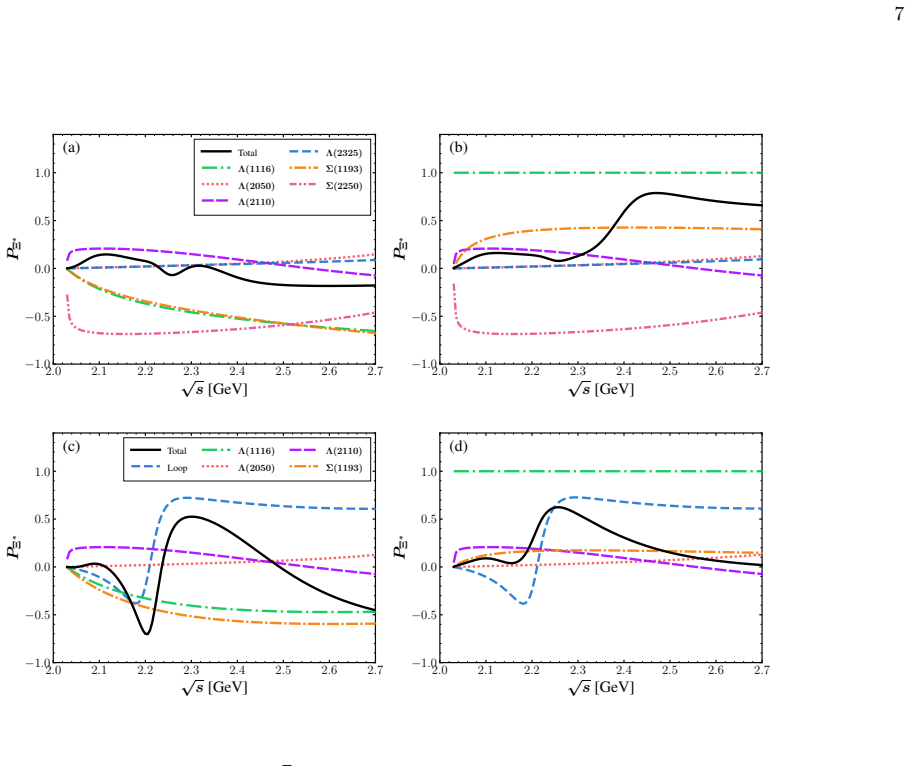
The Λ(2150) interpreted as a K* Ξ molecule with I(J^P)=0(3/2-) generates a triangle singularity via intermediate K*, Ξ, and π states that contributes to the reaction cross section and induces pronounced, energy-dependent spin effects in Ξ* that serve as a signature distinguishable from resonance production alone.
What carries the argument
The triangle singularity generated by the K*, Ξ, π loop diagrams attached to the K* Ξ molecular state.
If this is right
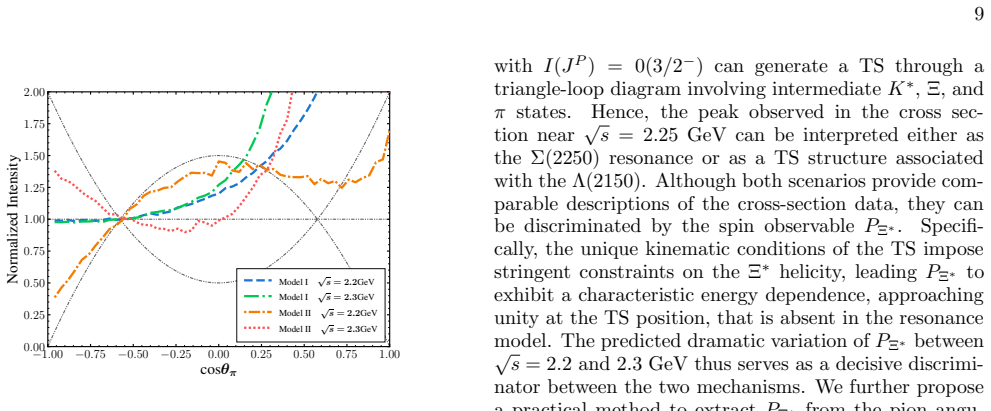
- Spin observables of Ξ* vary significantly with energy in the 2.2–2.3 GeV region when the triangle singularity is active.
- These variations are absent when only resonance production is considered.
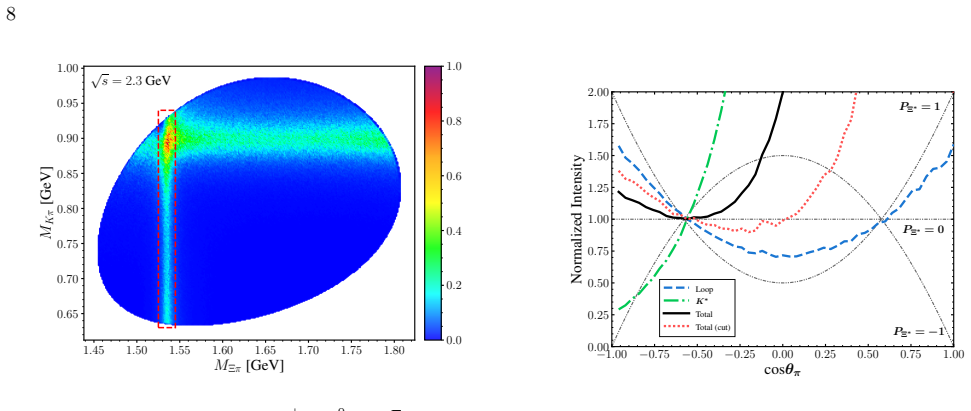
- The spin observables can be reliably obtained from the pion angular distribution in the Ξπ rest frame after a suitable kinematic cut on the Ξπ mass.
- The same spin signatures provide a test for the existence of the K* Ξ molecular state in data from J-PARC.
Where Pith is reading between the lines
- Confirmation of the predicted spin patterns would strengthen the case for using triangle singularities as probes of molecular assignments in other hyperon reactions.
- The kinematic-cut technique for extracting spin observables from three-body final states could be adapted to related processes involving Ξ* or other resonances.
- If the molecular state is present, similar loop effects may appear in photoproduction or other initial-state channels at comparable energies.
Load-bearing premise
That the Λ(2050) is a K Ξ* molecule and that a K* Ξ molecule exists near 2150 MeV and produces the triangle singularity in this reaction.
What would settle it
A measurement of the Ξ(1530) spin density matrix elements that either shows or fails to show the predicted strong variations specifically in the √s = 2.2–2.3 GeV interval.
Figures
read the original abstract
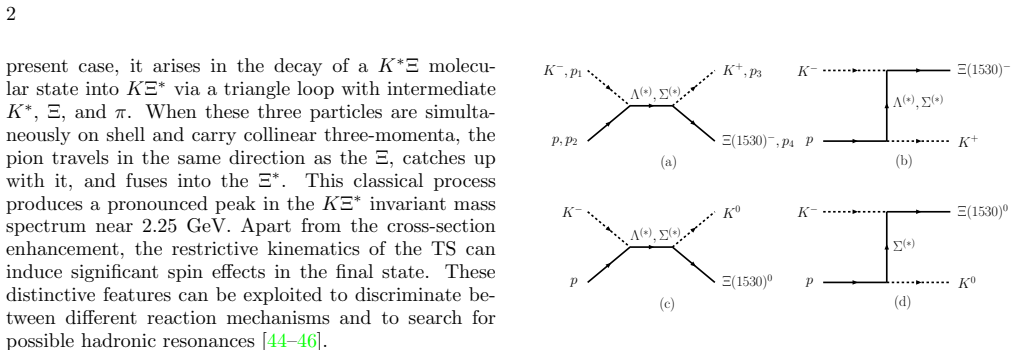
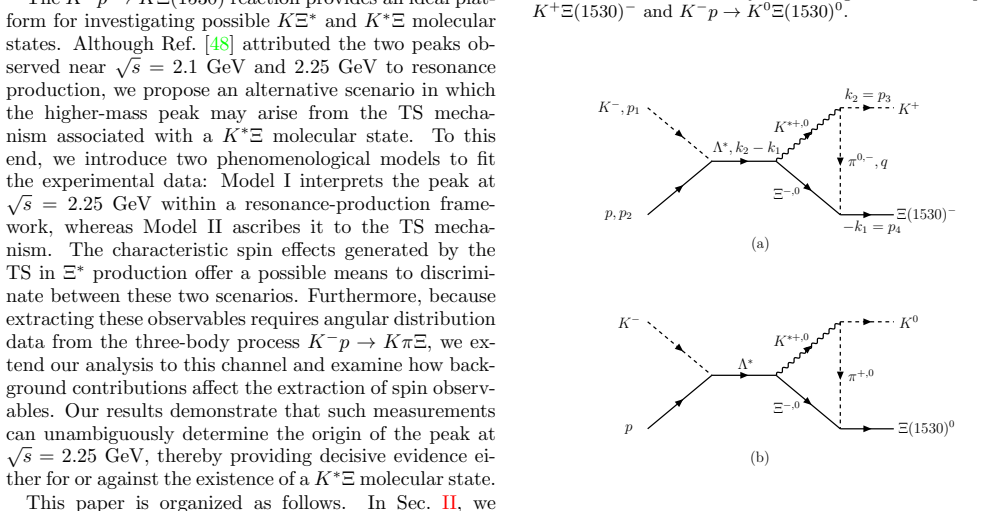
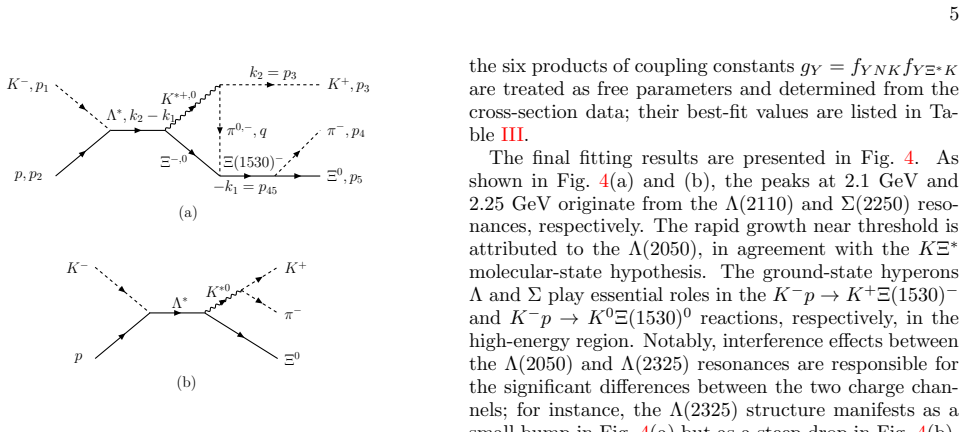
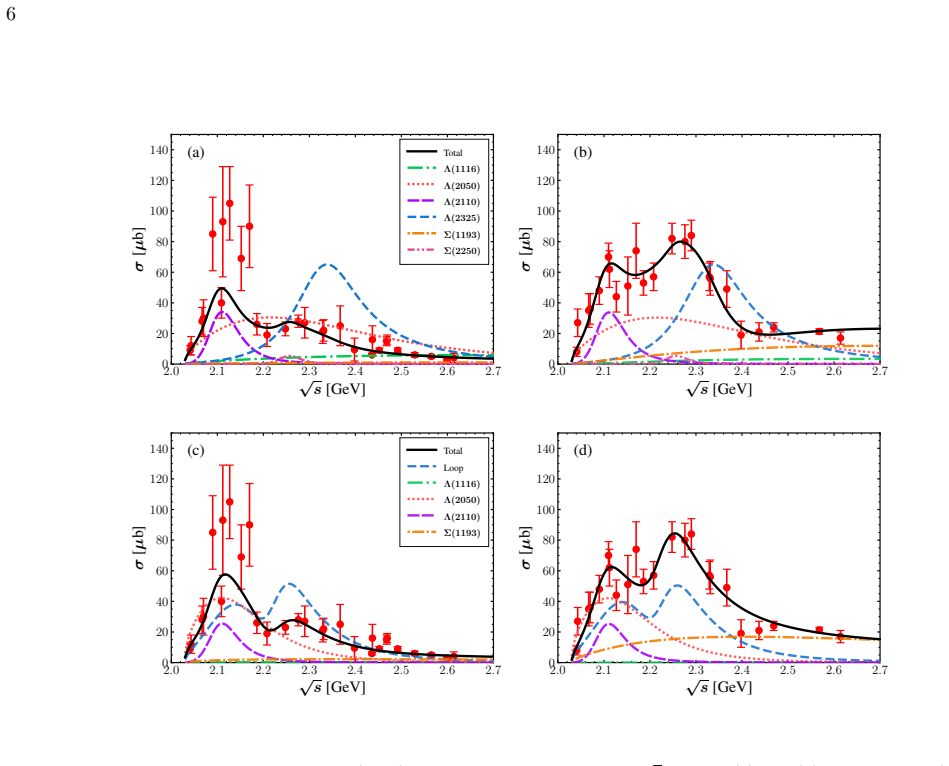
We investigate the $K^- p \to K \Xi(1530)$ reaction within an effective Lagrangian approach, exploring possible $K \Xi^*$ and $K^* \Xi$ hadronic molecular states and the role of the triangle singularity (TS). The $\Lambda(2050)3/2^-$ is interpreted as a $K \Xi^*$ molecule, whereas a $K^* \Xi$ molecule with $I(J^P)=0(3/2^-)$ and mass about 2150~MeV denoted as $\Lambda(2150)$ can generate a TS through triangle-loop diagrams with intermediate $K^*$, $\Xi$, and $\pi$. The peak structure observed in the cross section near $\sqrt{s}=2.25$ GeV is analyzed in terms of both the $\Sigma(2250)$ resonance production and the TS mechanism associated with $\Lambda(2150)$. We find that the TS induces pronounced spin effects in the final state $\Xi^*$, which can be probed through measurements of its spin density matrix elements. In particular, significant variations of the spin observables in the $\sqrt{s}=2.2$--$2.3$ GeV region serve as a distinct TS signature absent in a pure resonance scenario. Furthermore, for the three-body reaction $K^- p \to K^+ \pi^- \Xi^0$, we demonstrate that $\Xi^*$ spin observables can be reliably extracted from the $\pi$ angular distribution in the $\Xi \pi$ rest frame by applying an appropriate kinematic cut on the $\Xi\pi$ invariant mass to suppress background contributions. These predictions can be tested in future high-precision measurements at J-PARC, providing crucial insights into the nature of the TS and the possible existence of the $K^* \Xi$ molecular state.
Editorial analysis
A structured set of objections, weighed in public.
Referee Report
Summary. The manuscript investigates the K^- p → K Ξ(1530) reaction in an effective Lagrangian approach. It interprets the Λ(2050)3/2^- as a K Ξ* molecular state and introduces a K* Ξ molecular state with I(J^P)=0(3/2^-) and mass ~2150 MeV (denoted Λ(2150)) that generates a triangle singularity via K* Ξ π loops. The peak near √s=2.25 GeV is analyzed as arising from either Σ(2250) resonance production or this TS mechanism. The central prediction is that the TS produces pronounced variations in the Ξ* spin density matrix elements (distinct from a pure resonance scenario) in the √s=2.2–2.3 GeV region, testable at J-PARC; a method is also given to extract these observables from the three-body K^- p → K^+ π^- Ξ^0 channel via kinematic cuts on the Ξπ invariant mass.
Significance. If the effective Lagrangian amplitudes, loop integrals, and molecular assignments are correct, the work supplies a concrete, falsifiable signature (variations in spin observables) for distinguishing triangle singularities from resonant contributions in baryon reactions. This is a useful addition to the literature on TS mechanisms and possible molecular states, with the explicit comparison of TS versus resonance scenarios and the proposed experimental extraction procedure being particular strengths. The results remain exploratory due to the input assumptions but could guide future polarization measurements.
major comments (2)
- [Introduction and model setup] The mass of the proposed Λ(2150) is fixed at ~2150 MeV specifically to position the TS at the observed cross-section peak near √s=2.25 GeV. This choice makes the explanatory power of the TS mechanism dependent on an input parameter selected to match the data feature under study, reducing the independence of the prediction (see abstract and the discussion of the Λ(2150) state).
- [Results on spin observables] The central claim that TS induces distinct spin effects absent in a pure resonance scenario rests on the separation of the TS amplitude (from the K* Ξ π loop) from the resonance contribution; without explicit verification of the loop integrals and on-shell conditions in the results section, it is unclear whether interference or kinematic factors could alter the claimed distinction in the spin density matrix elements.
minor comments (2)
- The notation and definitions for the spin density matrix elements of Ξ* should include explicit formulas or references to standard conventions to improve clarity for readers.
- Figure captions describing the kinematic cuts for the three-body channel would benefit from additional detail on the precise invariant-mass window used to suppress backgrounds.
Simulated Author's Rebuttal
We thank the referee for the constructive comments, which help clarify the presentation of our results. We respond to each major comment below.
read point-by-point responses
-
Referee: The mass of the proposed Λ(2150) is fixed at ~2150 MeV specifically to position the TS at the observed cross-section peak near √s=2.25 GeV. This choice makes the explanatory power of the TS mechanism dependent on an input parameter selected to match the data feature under study, reducing the independence of the prediction (see abstract and the discussion of the Λ(2150) state).
Authors: We acknowledge that the mass of the proposed Λ(2150) is chosen to align the triangle singularity with the observed peak near √s=2.25 GeV. This is a deliberate modeling choice to explore the TS as a possible explanation for the structure. The key independent prediction remains the distinct energy dependence of the Ξ* spin density matrix elements, which differs from a resonance-only scenario and can be tested at J-PARC irrespective of the precise mass value. We will revise the introduction and model section to explicitly state the rationale for the mass choice and to emphasize that the spin observables constitute the falsifiable signature. revision: partial
-
Referee: The central claim that TS induces distinct spin effects absent in a pure resonance scenario rests on the separation of the TS amplitude (from the K* Ξ π loop) from the resonance contribution; without explicit verification of the loop integrals and on-shell conditions in the results section, it is unclear whether interference or kinematic factors could alter the claimed distinction in the spin density matrix elements.
Authors: We agree that additional explicit verification would strengthen the manuscript. In the revised version we will add to the results section the explicit form of the K* Ξ π loop integrals, the on-shell conditions that generate the singularity, and a brief discussion showing that the separation of the TS contribution produces the reported variations in the spin density matrix elements. We will also note that interference with the Σ(2250) resonance does not erase the distinctive TS signature in the √s=2.2–2.3 GeV window. revision: yes
Circularity Check
No significant circularity identified
full rationale
The paper constructs an effective Lagrangian model assuming the existence of a K* Ξ molecular state with mass ~2150 MeV chosen to align the triangle singularity with the observed cross-section peak near 2.25 GeV, then computes the resulting amplitudes, K* Ξ π loop integrals, and Ξ* spin density matrix elements as explicit functions of √s. These spin observables are shown to exhibit distinct variations in the 2.2–2.3 GeV window compared to a pure Σ(2250) resonance contribution, with the distinction arising from the structure of the TS amplitude rather than reducing to the input mass choice by construction. The molecular assignments function as exploratory inputs whose consequences (including testable spin signatures) are derived independently; no self-definitional equations, fitted parameters renamed as predictions, or load-bearing self-citations appear in the derivation chain.
Axiom & Free-Parameter Ledger
free parameters (1)
- mass of proposed Λ(2150) =
about 2150 MeV
axioms (1)
- domain assumption Effective Lagrangian approach is valid for describing the reaction and the molecular states
invented entities (2)
-
K Ξ* molecular state for Λ(2050)3/2-
no independent evidence
-
K* Ξ molecular state for Λ(2150) with I(J^P)=0(3/2-)
no independent evidence
Reference graph
Works this paper leans on
-
[1]
Therefore, all angular distributions are normalized to unity at cosθ π =−1/ √ 3, as shown in Fig. 7. The three black dashed lines indi- cate the expectations forP Ξ∗ = +1, 0, and−1 (from top to bottom at cosθ π = 1). The blue dashed and green dash-dotted curves represent the triangle-loop and K ∗-mediated background amplitudes, respectively. The −1.00 −0....
2050
-
[2]
Gell-Mann, Phys
M. Gell-Mann, Phys. Lett.8, 214 (1964)
1964
-
[3]
Zweig, (1964), 10.17181/CERN-TH-401
G. Zweig, (1964), 10.17181/CERN-TH-401
-
[4]
H.-X. Chen, W. Chen, X. Liu, and S.-L. Zhu, Phys. Rept.639, 1 (2016), arXiv:1601.02092 [hep-ph]
work page internal anchor Pith review Pith/arXiv arXiv 2016
-
[5]
F.-K. Guo, C. Hanhart, U.-G. Meißner, Q. Wang, Q. Zhao, and B.-S. Zou, Rev. Mod. Phys.90, 015004 (2018), [Erratum: Rev.Mod.Phys. 94, 029901 (2022)], arXiv:1705.00141 [hep-ph]
work page internal anchor Pith review Pith/arXiv arXiv 2018
-
[6]
X.-K. Dong, F.-K. Guo, and B.-S. Zou, Progr. Phys.41, 65 (2021), arXiv:2101.01021 [hep-ph]
- [7]
-
[8]
J.-J. Wu, R. Molina, E. Oset, and B. S. Zou, Phys. Rev. Lett.105, 232001 (2010), arXiv:1007.0573 [nucl-th]
work page internal anchor Pith review Pith/arXiv arXiv 2010
-
[9]
J.-J. Wu, R. Molina, E. Oset, and B. S. Zou, Phys. Rev. C84, 015202 (2011), arXiv:1011.2399 [nucl-th]
work page internal anchor Pith review Pith/arXiv arXiv 2011
-
[10]
W. L. Wang, F. Huang, Z. Y. Zhang, and B. S. Zou, Phys. Rev. C84, 015203 (2011), arXiv:1101.0453 [nucl- th]
work page internal anchor Pith review Pith/arXiv arXiv 2011
-
[11]
J.-J. Wu, T. S. H. Lee, and B. S. Zou, Phys. Rev. C85, 044002 (2012), arXiv:1202.1036 [nucl-th]
work page internal anchor Pith review Pith/arXiv arXiv 2012
-
[12]
S. L. Olsen, T. Skwarnicki, and D. Zieminska, Rev. Mod. Phys.90, 015003 (2018), arXiv:1708.04012 [hep-ph]
work page internal anchor Pith review Pith/arXiv arXiv 2018
-
[13]
A. Ali, J. S. Lange, and S. Stone, Prog. Part. Nucl. Phys. 97, 123 (2017), arXiv:1706.00610 [hep-ph]
work page internal anchor Pith review Pith/arXiv arXiv 2017
-
[14]
H. Garcilazo and A. Valcarce, Symmetry17, 1324 (2025), arXiv:2508.11483 [hep-ph]
-
[15]
N. H¨ usken, E. S. Norella, and I. Polyakov, Mod. Phys. Lett. A40, 2530002 (2025), arXiv:2410.06923 [hep-ph]
-
[16]
R. Aaijet al.(LHCb), Phys. Rev. Lett.115, 072001 (2015), arXiv:1507.03414 [hep-ex]
work page internal anchor Pith review Pith/arXiv arXiv 2015
-
[17]
R. Aaijet al.(LHCb), Phys. Rev. Lett.122, 222001 (2019), arXiv:1904.03947 [hep-ex]
work page internal anchor Pith review Pith/arXiv arXiv 2019
-
[18]
Strong LHCb evidence supporting the existence of the hidden-charm molecular pentaquarks
R. Chen, Z.-F. Sun, X. Liu, and S.-L. Zhu, Phys. Rev. D100, 011502 (2019), arXiv:1903.11013 [hep-ph]
work page internal anchor Pith review Pith/arXiv arXiv 2019
-
[19]
J. He, Eur. Phys. J. C79, 393 (2019), arXiv:1903.11872 [hep-ph]
work page internal anchor Pith review Pith/arXiv arXiv 2019
-
[20]
J. He and D.-Y. Chen, Eur. Phys. J. C79, 887 (2019), arXiv:1909.05681 [hep-ph]. 10
-
[21]
X.-K. Dong, F.-K. Guo, and B.-S. Zou, Commun. Theor. Phys.73, 125201 (2021), arXiv:2108.02673 [hep-ph]
-
[22]
Y.-F. Wang, C.-W. Shen, D. R¨ onchen, U.-G. Meißner, B.-S. Zou, and F. Huang, Phys. Rev. D112, 074010 (2025), arXiv:2506.21858 [hep-ph]
-
[23]
Looking for the hidden-charm pentaquark resonances in $J/\psi p$ scattering
H. Huang, J. He, and J. Ping, (2019), arXiv:1904.00221 [hep-ph]
work page internal anchor Pith review Pith/arXiv arXiv 2019
-
[24]
M.-Z. Liu, Y.-W. Pan, F.-Z. Peng, M. S´ anchez S´ anchez, L.-S. Geng, A. Hosaka, and M. Pavon Valderrama, Phys. Rev. Lett.122, 242001 (2019), arXiv:1903.11560 [hep- ph]
work page internal anchor Pith review Pith/arXiv arXiv 2019
-
[25]
D. Wang, W.-L. Wang, and F. Huang, Phys. Rev. C 109, 045204 (2024), arXiv:2403.17756 [hep-ph]
-
[26]
Nucleon resonances $N(1875)$ and $N(2100)$ as strange partners of LHCb pentaquarks
J. He, Phys. Rev. D95, 074031 (2017), arXiv:1701.03738 [hep-ph]
work page internal anchor Pith review Pith/arXiv arXiv 2017
-
[27]
Zou and J
B. Zou and J. Dai, Nucl. Phys. Rev.35, 369 (2018)
2018
-
[28]
Decay behavior of the strange and beauty partners of $P_c$ hadronic molecules
Y.-H. Lin, C.-W. Shen, and B.-S. Zou, Nucl. Phys. A 980, 21 (2018), arXiv:1805.06843 [hep-ph]
work page internal anchor Pith review Pith/arXiv arXiv 2018
- [29]
- [30]
- [31]
-
[32]
W.-Y. Tian, N.-C. Wei, Y.-F. Wang, F. Huang, and B.-S. Zou, Phys. Rev. C112, 055203 (2025), arXiv:2510.03673 [hep-ph]
-
[33]
L. D. Landau, Zh. Eksp. Teor. Fiz.37, 62 (1960)
1960
-
[34]
The puzzle of anomalously large isospin violations in $\eta(1405/1475)\to 3\pi$
J.-J. Wu, X.-H. Liu, Q. Zhao, and B.-S. Zou, Phys. Rev. Lett.108, 081803 (2012), arXiv:1108.3772 [hep-ph]
work page internal anchor Pith review Pith/arXiv arXiv 2012
-
[35]
Isospin breaking and $f_0(980)$-$a_0(980)$ mixing in the $\eta(1405) \to \pi^{0} f_0(980)$ reaction
F. Aceti, W. H. Liang, E. Oset, J. J. Wu, and B. S. Zou, Phys. Rev. D86, 114007 (2012), arXiv:1209.6507 [hep-ph]
work page internal anchor Pith review Pith/arXiv arXiv 2012
-
[36]
Understanding the property of $\eta(1405/1475)$ in the $J/\psi$ radiative decay
X.-G. Wu, J.-J. Wu, Q. Zhao, and B.-S. Zou, Phys. Rev. D87, 014023 (2013), arXiv:1211.2148 [hep-ph]
work page internal anchor Pith review Pith/arXiv arXiv 2013
-
[37]
N. N. Achasov, A. A. Kozhevnikov, and G. N. Shestakov, Phys. Rev. D92, 036003 (2015), arXiv:1504.02844 [hep- ph]
work page internal anchor Pith review Pith/arXiv arXiv 2015
- [38]
- [39]
-
[40]
Novel Method for Precisely Measuring the $X(3872)$ Mass
F.-K. Guo, Phys. Rev. Lett.122, 202002 (2019), arXiv:1902.11221 [hep-ph]
work page internal anchor Pith review Pith/arXiv arXiv 2019
- [41]
-
[42]
R. Molina and E. Oset, Eur. Phys. J. C80, 451 (2020), arXiv:2002.12821 [hep-ph]
-
[43]
S. Sakai, H.-J. Jing, and F.-K. Guo, Phys. Rev. D102, 114041 (2020), arXiv:2008.10829 [hep-ph]
- [44]
-
[45]
K. Wang, S.-F. Chen, and B.-C. Liu, Phys. Rev. D106, 094032 (2022), arXiv:2206.09308 [hep-ph]
- [46]
-
[47]
K. Wang, Y.-F. Wang, B.-C. Liu, and F. Huang, Phys. Rev. D110, 094017 (2024), arXiv:2408.12965 [hep-ph]
-
[48]
Coleman and R
S. Coleman and R. E. Norton, Nuovo Cim.38, 438 (1965)
1965
-
[49]
Q.-Y. Guo, J. Liu, P. Wu, and D.-Y. Chen, Phys. Rev. C112, 065201 (2025)
2025
-
[50]
Navaset al.(Particle Data Group), Phys
S. Navaset al.(Particle Data Group), Phys. Rev. D110, 030001 (2024)
2024
-
[51]
D. A. Sharov, V. L. Korotkikh, and D. E. Lanskoy, Eur. Phys. J. A47, 109 (2011), arXiv:1105.0764 [nucl-th]
work page internal anchor Pith review Pith/arXiv arXiv 2011
-
[52]
Photoproduction of $\Lambda (1405)$ with the $N^*$ and $t$-channel Regge contributions
S.-H. Kim, S.-i. Nam, D. Jido, and H.-C. Kim, Phys. Rev. D96, 014003 (2017), arXiv:1702.08645 [hep-ph]
work page internal anchor Pith review Pith/arXiv arXiv 2017
-
[53]
Coupling constant for $\Lambda(1405)\bar{K}N$
J.-J. Xie, B.-C. Liu, and C.-S. An, Phys. Rev. C88, 015203 (2013), arXiv:1307.3707 [nucl-th]
work page internal anchor Pith review Pith/arXiv arXiv 2013
-
[54]
Jacob and G
M. Jacob and G. C. Wick, Annals Phys.7, 404 (1959)
1959
-
[55]
Schilling, P
K. Schilling, P. Seyboth, and G. E. Wolf, Nucl. Phys. B 15, 397 (1970), [Erratum: Nucl.Phys.B 18, 332 (1970)]
1970
-
[56]
D. W. Thomas, A. Engler, H. E. Fisk, and R. W. Krae- mer, Nucl. Phys. B56, 15 (1973)
1973
-
[57]
S.-H. Kim, Y. Oh, and A. I. Titov, Phys. Rev. C95, 055206 (2017), arXiv:1702.05929 [nucl-th]
work page internal anchor Pith review Pith/arXiv arXiv 2017
-
[58]
Schmid, Phys
C. Schmid, Phys. Rev.154, 1363 (1967)
1967
-
[59]
V. R. Debastiani, S. Sakai, and E. Oset, Eur. Phys. J. C79, 69 (2019), arXiv:1809.06890 [hep-ph]
work page internal anchor Pith review Pith/arXiv arXiv 2019
-
[60]
K. Wang and B.-C. Liu, Phys. Lett. B813, 136019 (2021), arXiv:2012.11379 [nucl-th]
-
[61]
Wang and B.-C
K. Wang and B.-C. Liu, Phys. Rev. C107, 025203 (2023)
2023
-
[62]
J. P. Berge, P. Eberhard, J. R. Hubbard, D. W. Merrill, J. Button-Shafer, F. T. Solmitz, and M. L. Stevenson, Phys. Rev.147, 945 (1966)
1966
-
[63]
P. M. Dauber, J. P. Berge, J. R. Hubbard, D. W. Merrill, and R. A. Muller, Phys. Rev.179, 1262 (1969)
1969
-
[64]
Briefelet al., Phys
E. Briefelet al., Phys. Rev. D16, 2706 (1977)
1977
discussion (0)
Sign in with ORCID, Apple, or X to comment. Anyone can read and Pith papers without signing in.