Quark and hybrid stars with renormalization group improvement of NNLO perturbative QCD
Pith reviewed 2026-06-30 01:46 UTC · model grok-4.3
The pith
RGOPT-improved NNLO pQCD pressure supports pure quark stars for X=3.08-3.58 and hybrid stars for X=2-2.98.
A machine-rendered reading of the paper's core claim, the machinery that carries it, and where it could break.
Core claim
The RGOPT framework supplies renormalization-group properties to the NNLO pQCD pressure of cold dense quark matter with arbitrary masses; when this pressure is extended to beta equilibrium and charge neutrality the resulting equation of state permits stable pure quark stars for renormalization-scale parameters X in the range 3.08-3.58 and stable hybrid stars with quark cores for X of order 2 to 2.98, the largest values in that interval producing cores 5-8 km in radius.
What carries the argument
The RGOPT-resummed NNLO pQCD pressure extended to beta equilibrium and charge neutrality, which supplies the equation of state for the stellar models.
If this is right
- Pure quark stars consistent with astrophysical observations exist for X=3.08-3.58.
- Stable hybrid stars matching the mass of PSR J0740+6620 exist for X of order 2 to 2.98.
- The largest compatible X values produce the largest quark cores, with radii 5-8 km.
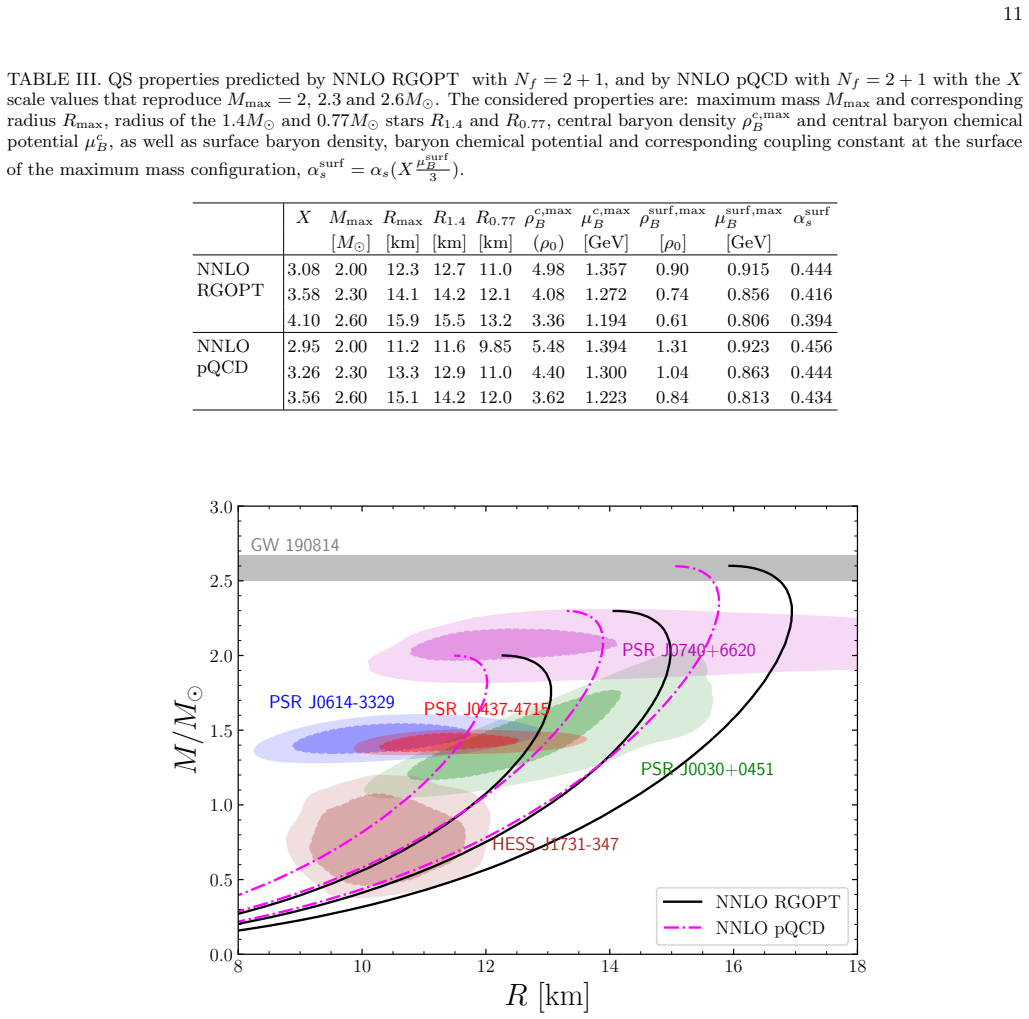
- If the low-mass object in GW190814 is a neutron star, pure quark stars require the higher value X=4.10.
Where Pith is reading between the lines
- Radius measurements of pulsars could further narrow the allowed window of X.
- The same fitting formulas could be inserted into merger simulations to predict gravitational-wave signals from quark-matter phases.
- If future lattice or functional QCD calculations confirm the RGOPT pressure at intermediate densities, the X intervals found here would become direct constraints on the strong coupling in dense matter.
Load-bearing premise
The RGOPT-improved NNLO pQCD pressure remains a reliable description of the true equation of state once it is extended to beta equilibrium and charge neutrality at the chemical potentials inside compact stars.
What would settle it
An observed compact star whose mass and radius lie outside the ranges produced by the EoS at X=3.08-3.58 for pure quark stars or at X=2-2.98 for hybrid stars would falsify the claim.
Figures
read the original abstract
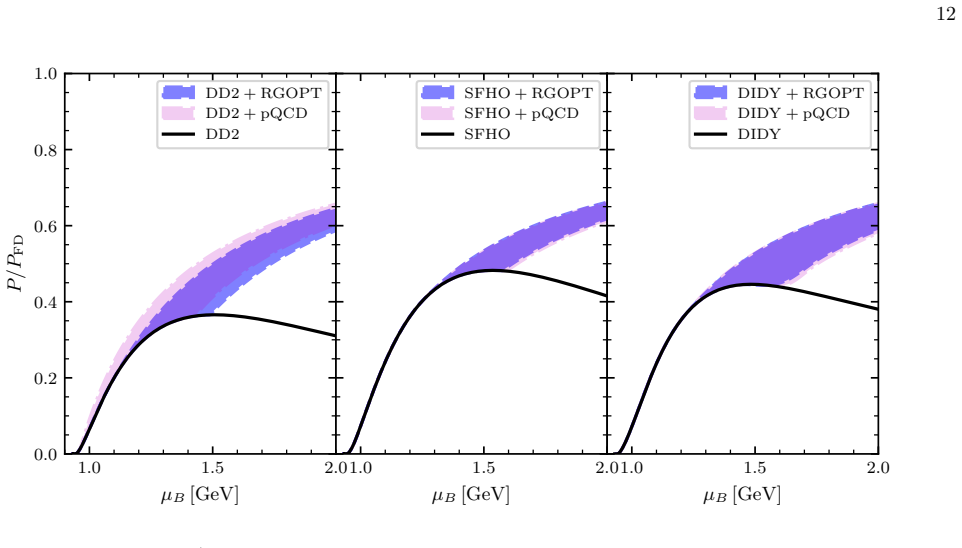
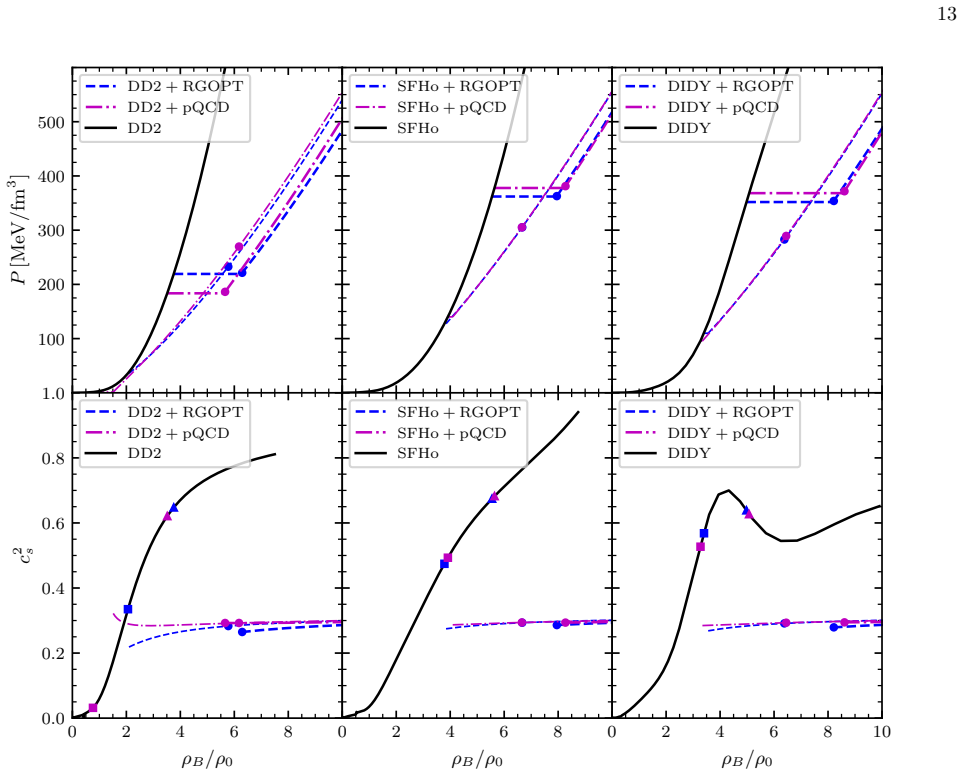
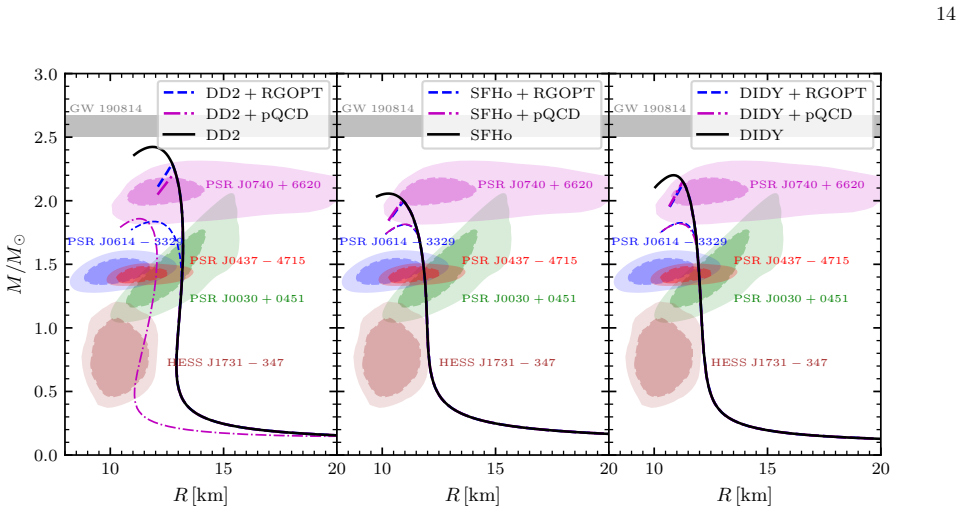
Recently, the NNLO perturbative QCD pressure of cold and dense symmetric matter, with arbitrary quark masses, has been resummed within the renormalization-group-optimized perturbation theory (RGOPT) framework. By being imbued with renormalization group properties, the resulting pressure is less sensitive to renormalization scale ($\Lambda\equiv X \mu_B/3$) variations than the NNLO perturbative QCD pressure. Here, we extend this by considering $\beta$-equilibrium and charge neutrality to evaluate the corresponding equation of state (EoS). We provide a compact ``pocket" fitting formula for the EoS for $N_f=2+1$ massive quarks at different renormalization scale parameter ($X$) values. We describe pure quark stars as well as hybrid stars with quark-cores. Pure quark stars compatible with astrophysical observations were obtained with $X=3.08-3.58$, whereas a larger value (4.10) is needed if the low mass object of the observation GW190814 represents a neutron star. Hybrid stars were built considering three representative hadron models based on a relativistic mean-field description, and chosen to produce soft and stiff EoSs. Stable hybrid stars with masses compatible with the massive pulsar PSR J0740+6620 were obtained considering $X$ of the order of 2 to 2.60-2.98, the largest scale giving rise to hybrid stars with a large quark core with a radius of 5 to 8 km, and the smallest to a small quark core at the center of the star.
Editorial analysis
A structured set of objections, weighed in public.
Referee Report
Summary. The manuscript extends the RGOPT-resummed NNLO pQCD pressure for cold dense symmetric quark matter (with arbitrary quark masses) to beta equilibrium and charge neutrality. It supplies an explicit compact fitting formula for the resulting EoS of Nf=2+1 massive quarks at several fixed values of the renormalization-scale parameter X ≡ Λ/(μB/3). Using this EoS, the authors construct pure quark stars and hybrid stars matched to three representative relativistic mean-field hadronic models (soft and stiff), and report the X intervals that yield stellar masses and radii compatible with PSR J0740+6620 and the low-mass object in GW190814.
Significance. If the RGOPT improvement genuinely reduces renormalization-scale dependence while remaining reliable at the chemical potentials inside compact stars, the work supplies a practical, scale-improved perturbative EoS together with a ready-to-use fitting formula that can be inserted directly into TOV integrators. The explicit mapping of viable X ranges to observed pulsar masses is a concrete, falsifiable output of the approach.
major comments (1)
- [Abstract] Abstract (paragraph on the extension to beta equilibrium and charge neutrality): the central claim that specific X intervals produce observationally compatible stars rests on the unverified step of extending the symmetric-matter RGOPT pressure to asymmetric matter; the manuscript supplies neither the explicit derivation, error estimates from the pQCD truncation, nor cross-checks against lattice data at finite isospin asymmetry.
minor comments (1)
- The fitting formula is described as a 'pocket' formula but its explicit functional form, coefficients, and domain of validity in chemical potential are not reproduced even in the abstract; providing the formula itself would increase usability.
Simulated Author's Rebuttal
We thank the referee for the careful reading of the manuscript and the constructive feedback. We address the single major comment below and will make targeted revisions to improve clarity on the extension procedure while noting limitations inherent to the field.
read point-by-point responses
-
Referee: [Abstract] Abstract (paragraph on the extension to beta equilibrium and charge neutrality): the central claim that specific X intervals produce observationally compatible stars rests on the unverified step of extending the symmetric-matter RGOPT pressure to asymmetric matter; the manuscript supplies neither the explicit derivation, error estimates from the pQCD truncation, nor cross-checks against lattice data at finite isospin asymmetry.
Authors: The RGOPT pressure functional (derived in the preceding symmetric-matter work) is already expressed in terms of independent quark chemical potentials and masses. The extension to β-equilibrium and charge neutrality consists of imposing the standard relations μ_d = μ_u + μ_e, μ_s = μ_u + μ_e together with the charge-neutrality constraint on the number densities obtained from the same pressure; the resulting EoS is then fitted at fixed X. We agree that an explicit derivation of this step was not sufficiently detailed and will add a dedicated subsection (including the explicit fitting formula and the numerical procedure for solving the neutrality conditions) in the revised manuscript. On truncation errors, the RGOPT resummation was constructed precisely to tame the dominant renormalization-scale uncertainty of NNLO pQCD; we will expand the discussion of residual truncation uncertainty by comparing neighboring perturbative orders where available. Cross-checks against lattice QCD at finite baryon density are not feasible at present. revision: partial
- Cross-checks against lattice data at finite isospin asymmetry for cold, dense matter cannot be performed because of the fermion sign problem; no such lattice results exist.
Circularity Check
No significant circularity; X ranges are compatibility constraints on a free renormalization parameter
full rationale
The paper derives the EoS from RGOPT-resummed NNLO pQCD extended to beta equilibrium and charge neutrality, supplies an explicit fitting formula, and then reports the numerical X intervals for which the resulting TOV solutions match observed masses. X is introduced as the renormalization-scale prefactor λ ≡ X μ_B/3 and is varied parametrically; the reported intervals (e.g., X=3.08-3.58 for pure quark stars) are the direct numerical output of that variation, not a quantity defined by or fitted inside the derivation itself. No self-citation, uniqueness theorem, or ansatz is invoked to force the central result. The procedure is therefore self-contained against external benchmarks (the cited pulsar masses) and does not reduce any claimed prediction to its own inputs by construction.
Axiom & Free-Parameter Ledger
free parameters (1)
- X =
2 to 4.1
axioms (2)
- domain assumption beta equilibrium and charge neutrality
- domain assumption RGOPT-resummed NNLO pQCD remains applicable at the relevant densities
Reference graph
Works this paper leans on
-
[1]
black widow
up to NNLO [44], and to NLO for the hot QCD pressure [60, 61], where in both cases it drastically reduces the residual renormalization scale dependence with respect to the standard weak-coupling expansion, SPT or HTLpt. For cold quark matter, the NLO RGOPT [62] also reduces the residual scale dependence, although more moderately than in theT̸= 0 case. Rec...
-
[2]
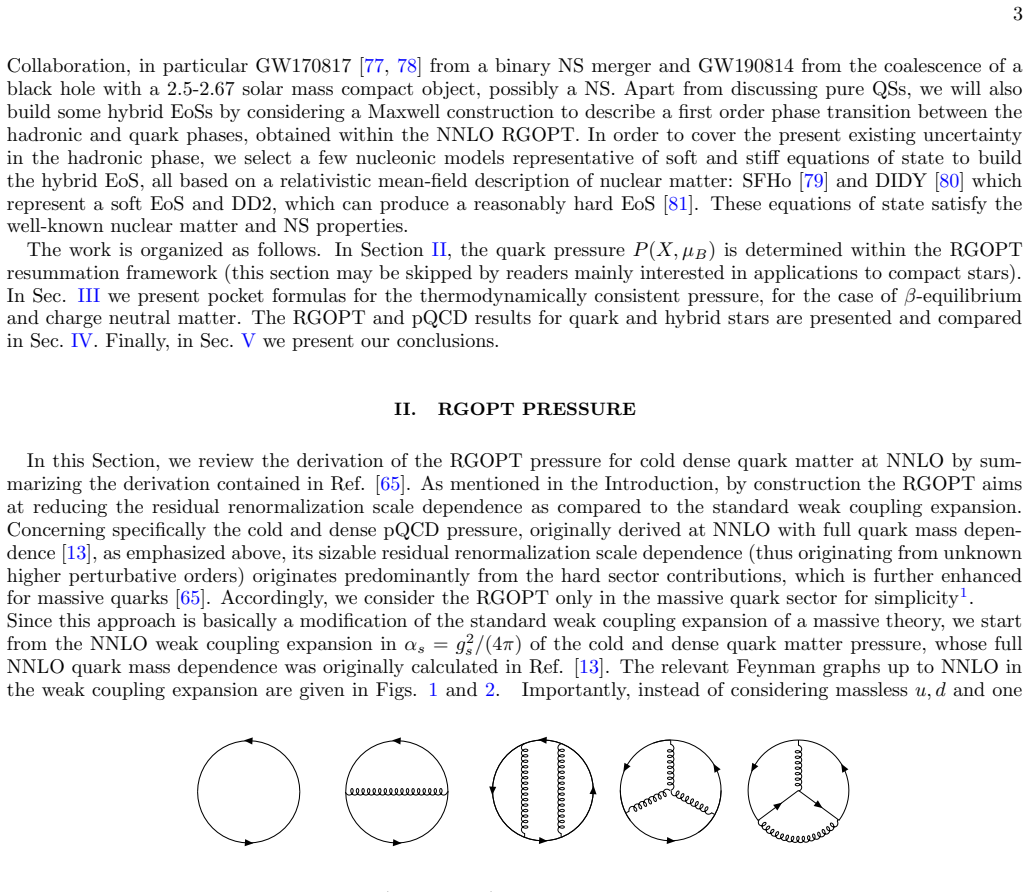
(2.1) corre- sponds to all two-gluon irreducible contributions in Fig
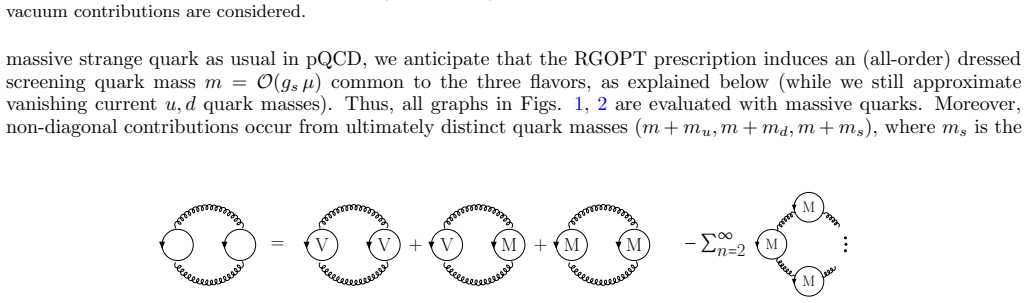
The NNLO weak coupling expansion of the matter (m) contributions,P N f=2∗+1∗ 2GI (mi, µi) in Eq. (2.1) corre- sponds to all two-gluon irreducible contributions in Fig. 1. 2.P Nf=2∗+1∗ VM (mi, µi) corresponds to mixed vacuum-matter (VM) contributions as indicated in Fig. 2
-
[3]
The plasmon sum “ring” contributions, that result after the all-order resummation sketched in the rightmost graph of Fig. 2: PRing(m) =−Ω Nf=3⋆ Ring (m).(2.2) Note that the latter contribution could not be handled analytically while maintaining an exact dependence on arbitrary masses and chemical potentials. However, thisO(α 2 s) contribution is numerical...
-
[4]
VV” contribution in Fig. 2. Importantly, such vacuum contributions should be supplemented with zero-point “subtraction
Finally, a fourth class of contributions, not present within the standard weak coupling expansion[13] and crucially involved in the RGOPT prescription, is to (re)introduce vacuum contributions to the pressure,P v LO −P v NNLO in Eq.(2.1), given by theµ= 0 contributions in Fig. 1 and “VV” contribution in Fig. 2. Importantly, such vacuum contributions shoul...
-
[5]
Current quark mass and QCD coupling input In our numerical applications, for the running couplingg 2 s(Λ)≡4πα s(Λ), we use the exact NLO result obtained for a given renormalization scale Λ upon solvingg 2 s exactly from ΛMS = Λe − 1 2b0 g2s b0g2 s 1 + b1 b0 g2s !− b1 2b2 0 ,(3.5) and fixing Λ MS = 330 MeV [90] so thatα s(Λ = 1.5 GeV)≃0.326 [91]. Since the...
-
[6]
Fit for3≤X≤6 The fitting functions provided in the following all depend on the quantityµ B,0(X) which represents the threshold for the vanishing of the strange quark density at different renormalization scalesX: µB,0(X) = 0.5565172 + 0.7615706 X1.0474315 + 0.0044533X 1.3455082 −0.0074282X 1.3726228.(3.7) It also gives the validity range:µ B ⊗X= Λ/µ∈[µ B,0...
-
[7]
For the threshold value TABLE II
Fit for2≤X≤3 To achieve sufficient accuracy, we considered an independent fit for lower 2≤X≤3 values: similarly to the previous ones, the following fitting functions depend onµ B,0(X), the threshold for the vanishing of the strange quark density at different renormalization scalesX: µB,0(X) = 0.0803569 + 2.596390 X5.125701 − 0.4668653 X2.225740 + 1.120141...
-
[8]
III A for RGOPT were used to generate the corresponding plots
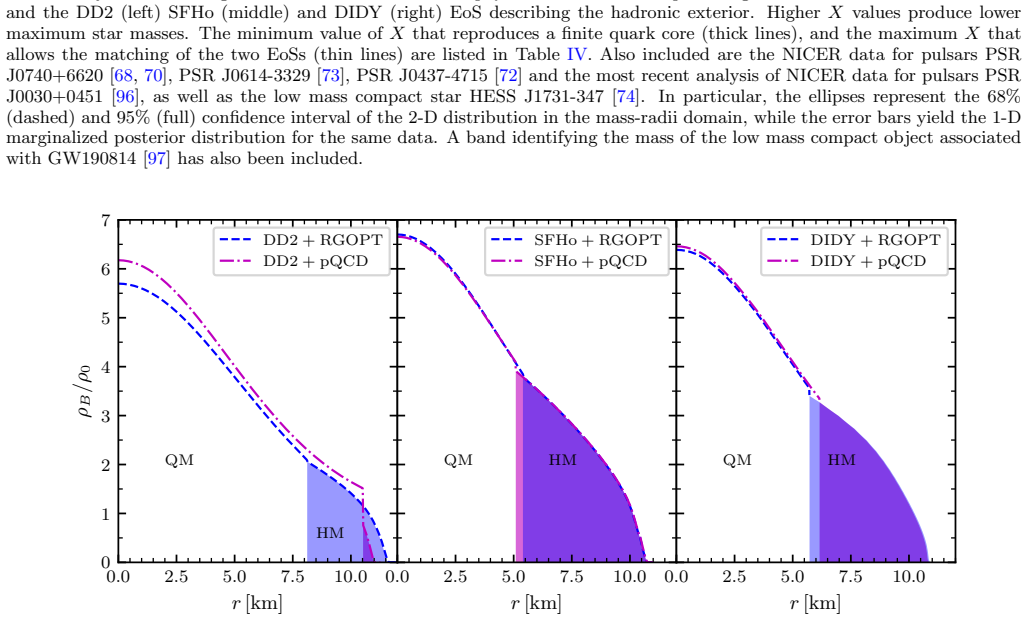
(pQCD) and the one derived in Sec. III A for RGOPT were used to generate the corresponding plots. The mass-radius curves for hybrid stars, together with the observational constraints from NICER and the compact object HESS J1731−347 are displayed in Fig. 8, while some of the main associated properties are summarized in Table IV. The maximum mass configurat...
-
[9]
Demorest, T
P. Demorest, T. Pennucci, S. Ransom, M. Roberts, and J. Hessels, A two-solar-mass neutron star measured using Shapiro delay, Nature467, 1081 (2010)
2010
-
[10]
Fonseca et al., Refined Mass and Geometric Measurements of the High-mass PSR J0740+6620, Astrophys
E. Fonseca et al., Refined Mass and Geometric Measurements of the High-mass PSR J0740+6620, Astrophys. J. Lett. 915, L12 (2021), arXiv:2104.00880 [astro-ph.HE]
-
[11]
Antoniadis et al., A Massive Pulsar in a Compact Relativistic Binary, Science340, 6131 (2013)
J. Antoniadis et al., A Massive Pulsar in a Compact Relativistic Binary, Science340, 6131 (2013)
2013
- [12]
- [13]
-
[14]
Simulating QCD at finite density
P. de Forcrand, Simulating QCD at finite density, PoSLA T2009, 010 (2009), arXiv:1005.0539 [hep-lat]
work page internal anchor Pith review Pith/arXiv arXiv 2009
-
[15]
Chiral interactions up to next-to-next-to-next-to-leading order and nuclear saturation
C. Drischler, K. Hebeler, and A. Schwenk, Chiral interactions up to next-to-next-to-next-to-leading order and nuclear saturation, Phys. Rev. Lett.122, 042501 (2019), arXiv:1710.08220 [nucl-th]
work page internal anchor Pith review Pith/arXiv arXiv 2019
-
[16]
K. Hebeler, Three-nucleon forces: Implementation and applications to atomic nuclei and dense matter, Phys. Rept.890, 1 (2021), arXiv:2002.09548 [nucl-th]
-
[17]
Equations of state for supernovae and compact stars
M. Oertel, M. Hempel, T. Kl¨ ahn, and S. Typel, Equations of state for supernovae and compact stars, Rev. Mod. Phys. 89, 015007 (2017), arXiv:1610.03361 [astro-ph.HE]
work page internal anchor Pith review Pith/arXiv arXiv 2017
-
[18]
Relativistic Mean-Field Hadronic Models under Nuclear Matter Constraints
M. Dutra, O. Louren¸ co, S. S. Avancini, B. V. Carlson, A. Delfino, D. P. Menezes, C. Providˆ encia, S. Typel, and J. R. Stone, Relativistic Mean-Field Hadronic Models under Nuclear Matter Constraints, Phys. Rev. C90, 055203 (2014), arXiv:1405.3633 [nucl-th]
work page internal anchor Pith review Pith/arXiv arXiv 2014
-
[19]
J. Cartaxo, C. Huang, T. Malik, S. Sourav, W.-L. Yuan, T. Zhou, X. Liu, and C. Providˆ encia, Covariant Energy Density Functionals for Modeling the Equation of State of Neutron Star Matter: Cross-comparison Analysis Using CompactObject, Astrophys. J. Suppl.282, 33 (2026), arXiv:2506.03112 [nucl-th]
-
[20]
B. A. Freedman and L. D. McLerran, Fermions and Gauge Vector Mesons at Finite Temperature and Density. 3. The Ground State Energy of a Relativistic Quark Gas, Phys. Rev. D16, 1169 (1977)
1977
-
[21]
A. Kurkela, P. Romatschke, and A. Vuorinen, Cold Quark Matter, Phys. Rev. D81, 105021 (2010), arXiv:0912.1856 [hep-ph]
work page internal anchor Pith review Pith/arXiv arXiv 2010
-
[22]
E. S. Fraga, A. Kurkela, and A. Vuorinen, Interacting quark matter equation of state for compact stars, Astrophys. J. Lett.781, L25 (2014), arXiv:1311.5154 [nucl-th]
work page internal anchor Pith review Pith/arXiv arXiv 2014
- [23]
- [24]
-
[25]
S. P. Klevansky, The Nambu-Jona-Lasinio model of quantum chromodynamics, Rev. Mod. Phys.64, 649 (1992)
1992
-
[26]
QCD Phenomenology based on a Chiral Effective Lagrangian
T. Hatsuda and T. Kunihiro, QCD phenomenology based on a chiral effective Lagrangian, Phys. Rept.247, 221 (1994), arXiv:hep-ph/9401310
work page internal anchor Pith review Pith/arXiv arXiv 1994
-
[27]
Hadronization in the SU(3) Nambu-Jona-Lasinio Model
P. Rehberg, S. P. Klevansky, and J. Hufner, Hadronization in the SU(3) Nambu-Jona-Lasinio model, Phys. Rev. C53, 410 (1996), arXiv:hep-ph/9506436
work page internal anchor Pith review Pith/arXiv arXiv 1996
-
[28]
NJL-model analysis of dense quark matter
M. Buballa, NJL model analysis of quark matter at large density, Phys. Rept.407, 205 (2005), arXiv:hep-ph/0402234
work page internal anchor Pith review Pith/arXiv arXiv 2005
-
[29]
J. T. Lenaghan, D. H. Rischke, and J. Schaffner-Bielich, Chiral symmetry restoration at nonzero temperature in the SU(3)(r) x SU(3)(l) linear sigma model, Phys. Rev. D62, 085008 (2000), arXiv:nucl-th/0004006
work page internal anchor Pith review Pith/arXiv arXiv 2000
- [30]
-
[31]
G. Baym, T. Hatsuda, T. Kojo, P. D. Powell, Y. Song, and T. Takatsuka, From hadrons to quarks in neutron stars: a review, Rept. Prog. Phys.81, 056902 (2018), arXiv:1707.04966 [astro-ph.HE]
work page internal anchor Pith review Pith/arXiv arXiv 2018
-
[32]
Constraining neutron star matter with QCD
A. Kurkela, E. S. Fraga, J. Schaffner-Bielich, and A. Vuorinen, Constraining neutron star matter with Quantum Chro- modynamics, Astrophys. J.789, 127 (2014), arXiv:1402.6618 [astro-ph.HE]
work page internal anchor Pith review Pith/arXiv arXiv 2014
- [33]
- [34]
-
[35]
S. Altiparmak, C. Ecker, and L. Rezzolla, On the Sound Speed in Neutron Stars, Astrophys. J. Lett.939, L34 (2022), arXiv:2203.14974 [astro-ph.HE]
- [36]
-
[37]
O. Komoltsev, R. Somasundaram, T. Gorda, A. Kurkela, J. Margueron, and I. Tews, Equation of state at neutron-star densities and beyond from perturbative QCD, Phys. Rev. D109, 094030 (2024), arXiv:2312.14127 [nucl-th]. 19
-
[38]
O. Komoltsev and A. Kurkela, How Perturbative QCD Constrains the Equation of State at Neutron-Star Densities, Phys. Rev. Lett.128, 202701 (2022), arXiv:2111.05350 [nucl-th]
- [39]
-
[40]
S. Traversi, P. Char, and G. Pagliara, Bayesian Inference of Dense Matter Equation of State within Relativistic Mean Field Models using Astrophysical Measurements, Astrophys. J.897, 165 (2020), arXiv:2002.08951 [astro-ph.HE]
- [41]
-
[42]
T. Malik and C. Providˆ encia, Bayesian inference of signatures of hyperons inside neutron stars, Phys. Rev. D106, 063024 (2022), arXiv:2205.15843 [nucl-th]
- [43]
-
[44]
J. Takatsy, P. Kovacs, G. Wolf, and J. Schaffner-Bielich, What neutron stars tell about the hadron-quark phase transition: A Bayesian study, Phys. Rev. D108, 043002 (2023), arXiv:2303.00013 [astro-ph.HE]
-
[45]
Zhou, Reexamining constraints on neutron star properties from perturbative QCD, Phys
D. Zhou, Reexamining constraints on neutron star properties from perturbative QCD, Phys. Rev. C111, 015810 (2025), arXiv:2307.11125 [astro-ph.HE]
-
[46]
Scale for the Phase Diagram of Quantum Chromodynamics
S. Gupta, X. Luo, B. Mohanty, H. G. Ritter, and N. Xu, Scale for the Phase Diagram of Quantum Chromodynamics, Science332, 1525 (2011), arXiv:1105.3934 [hep-ph]
work page internal anchor Pith review Pith/arXiv arXiv 2011
-
[47]
Thermodynamics of the high-temperature quark-gluon plasma
J.-P. Blaizot, E. Iancu, and A. Rebhan, Thermodynamics of the high temperature quark gluon plasma (2003) pp. 60–122, arXiv:hep-ph/0303185
work page internal anchor Pith review Pith/arXiv arXiv 2003
-
[48]
U. Kraemmer and A. Rebhan, Advances in perturbative thermal field theory, Rept. Prog. Phys.67, 351 (2004), arXiv:hep- ph/0310337
-
[49]
J. Ghiglieri, A. Kurkela, M. Strickland, and A. Vuorinen, Perturbative Thermal QCD: Formalism and Applications, Phys. Rept.880, 1 (2020), arXiv:2002.10188 [hep-ph]
-
[50]
Braaten and R
E. Braaten and R. D. Pisarski, Simple effective Lagrangian for hard thermal loops, Phys. Rev. D45, R1827 (1992)
1992
- [51]
-
[52]
L. Fernandez and J.-L. Kneur, All Order Resummed Leading and Next-to-Leading Soft Modes of Dense QCD Pressure, Phys. Rev. Lett.129, 212001 (2022), arXiv:2109.02410 [hep-ph]
-
[53]
E. S. Fraga and P. Romatschke, The Role of quark mass in cold and dense perturbative QCD, Phys. Rev. D71, 105014 (2005), arXiv:hep-ph/0412298
work page internal anchor Pith review Pith/arXiv arXiv 2005
-
[54]
M. Laine and Y. Schroder, Quark mass thresholds in QCD thermodynamics, Phys. Rev. D73, 085009 (2006), arXiv:hep- ph/0603048
-
[55]
T. Graf, J. Schaffner-Bielich, and E. S. Fraga, The impact of quark masses on pQCD thermodynamics, Eur. Phys. J. A 52, 208 (2016), arXiv:1507.08941 [hep-ph]
work page internal anchor Pith review Pith/arXiv arXiv 2016
-
[56]
A. Ipp, K. Kajantie, A. Rebhan, and A. Vuorinen, The Pressure of deconfined QCD for all temperatures and quark chemical potentials, Phys. Rev. D74, 045016 (2006), arXiv:hep-ph/0604060
work page internal anchor Pith review Pith/arXiv arXiv 2006
-
[57]
A. Kurkela and A. Vuorinen, Cool quark matter, Phys. Rev. Lett.117, 042501 (2016), arXiv:1603.00750 [hep-ph]
work page internal anchor Pith review Pith/arXiv arXiv 2016
-
[58]
A. K¨ arkk¨ ainen, P. Navarrete, M. Nurmela, R. Paatelainen, K. Sepp¨ anen, and A. Vuorinen, Quark Matter at Four Loops: Hardships and How to Overcome Them, Phys. Rev. Lett.135, 021901 (2025), arXiv:2501.17921 [hep-ph]
-
[59]
\alpha_S from $F_\pi$ and Renormalization Group Optimized Perturbation
J.-L. Kneur and A. Neveu,α S fromF π and Renormalization Group Optimized Perturbation Theory, Phys. Rev. D88, 074025 (2013), arXiv:1305.6910 [hep-ph]
work page internal anchor Pith review Pith/arXiv arXiv 2013
-
[60]
The chiral condensate from renormalization group optimized perturbation
J.-L. Kneur and A. Neveu, Chiral condensate from renormalization group optimized perturbation, Phys. Rev. D92, 074027 (2015), arXiv:1506.07506 [hep-ph]
work page internal anchor Pith review Pith/arXiv arXiv 2015
-
[61]
J. L. Kneur and M. B. Pinto, Scale Invariant Resummed Perturbation at Finite Temperatures, Phys. Rev. Lett.116, 031601 (2016), arXiv:1507.03508 [hep-ph]
work page internal anchor Pith review Pith/arXiv arXiv 2016
-
[62]
R. R. Parwani, Resummation in a hot scalar field theory, Phys. Rev. D45, 4695 (1992), [Erratum: Phys.Rev.D 48, 5965 (1993)], arXiv:hep-ph/9204216
work page internal anchor Pith review Pith/arXiv arXiv 1992
- [63]
-
[64]
J. O. Andersen, E. Braaten, and M. Strickland, Screened perturbation theory to three loops, Phys. Rev. D63, 105008 (2001), arXiv:hep-ph/0007159
work page internal anchor Pith review Pith/arXiv arXiv 2001
-
[65]
J. O. Andersen, E. Braaten, and M. Strickland, Hard thermal loop resummation of the free energy of a hot gluon plasma, Phys. Rev. Lett.83, 2139 (1999), arXiv:hep-ph/9902327
work page internal anchor Pith review Pith/arXiv arXiv 1999
-
[66]
J. O. Andersen, E. Braaten, and M. Strickland, Hard thermal loop resummation of the free energy of a hot quark - gluon plasma, Phys. Rev. D61, 074016 (2000), arXiv:hep-ph/9908323
work page internal anchor Pith review Pith/arXiv arXiv 2000
-
[67]
J. L. Kneur and M. B. Pinto, Renormalization Group Optimized Perturbation Theory at Finite Temperatures, Phys. Rev. D92, 116008 (2015), arXiv:1508.02610 [hep-ph]
work page internal anchor Pith review Pith/arXiv arXiv 2015
- [68]
- [69]
- [70]
- [71]
- [72]
-
[73]
L. Fernandez and J.-L. Kneur, Cold quark matter: Renormalization group improvement at next-to-next-to leading order, Phys. Rev. D111, 034020 (2025), arXiv:2408.16674 [hep-ph]
- [74]
-
[75]
M. C. Miller et al., PSR J0030+0451 Mass and Radius fromN ICERData and Implications for the Properties of Neutron Star Matter, Astrophys. J. Lett.887, L24 (2019), arXiv:1912.05705 [astro-ph.HE]
work page internal anchor Pith review Pith/arXiv arXiv 2019
- [76]
-
[77]
G. Raaijmakers, S. K. Greif, K. Hebeler, T. Hinderer, S. Nissanke, A. Schwenk, T. E. Riley, A. L. Watts, J. M. Lattimer, and W. C. G. Ho, Constraints on the Dense Matter Equation of State and Neutron Star Properties from NICER’s Mass–Radius Estimate of PSR J0740+6620 and Multimessenger Observations, Astrophys. J. Lett.918, L29 (2021), arXiv:2105.06981 [as...
-
[78]
M. C. Miller et al., The Radius of PSR J0740+6620 from NICER and XMM-Newton Data, Astrophys. J. Lett.918, L28 (2021), arXiv:2105.06979 [astro-ph.HE]
work page internal anchor Pith review Pith/arXiv arXiv 2021
-
[79]
Salmi et al., The Radius of the High-mass Pulsar PSR J0740+6620 with 3.6 yr of NICER Data, Astrophys
T. Salmi et al., The Radius of the High-mass Pulsar PSR J0740+6620 with 3.6 yr of NICER Data, Astrophys. J.974, 294 (2024), arXiv:2406.14466 [astro-ph.HE]
-
[80]
D. Choudhury et al., A NICER View of the Nearest and Brightest Millisecond Pulsar: PSR J0437–4715, Astrophys. J. Lett.971, L20 (2024), arXiv:2407.06789 [astro-ph.HE]
discussion (0)
Sign in with ORCID, Apple, or X to comment. Anyone can read and Pith papers without signing in.