Rapid Hubble constant inference from GW170817 using GPU-accelerated nested sampling: prior sensitivity and the limits of post-hoc reweighting
Pith reviewed 2026-06-30 04:43 UTC · model grok-4.3
The pith
Switching the luminosity-distance prior inside the sampler shifts the GW170817 high-H0 tail from 1.7 percent to 15.9 percent probability, while post-hoc reweighting recovers only a fraction of that change.
A machine-rendered reading of the paper's core claim, the machinery that carries it, and where it could break.
Core claim
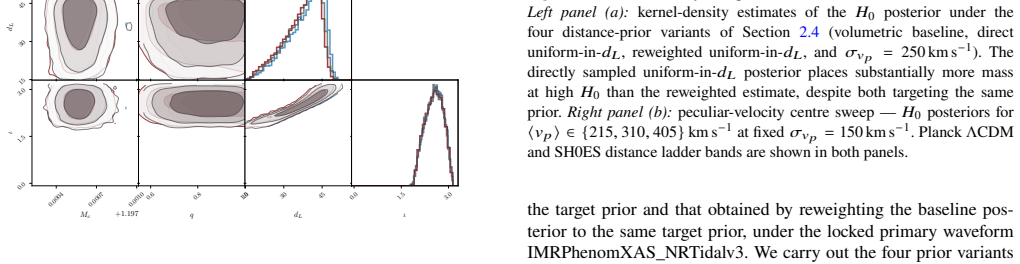
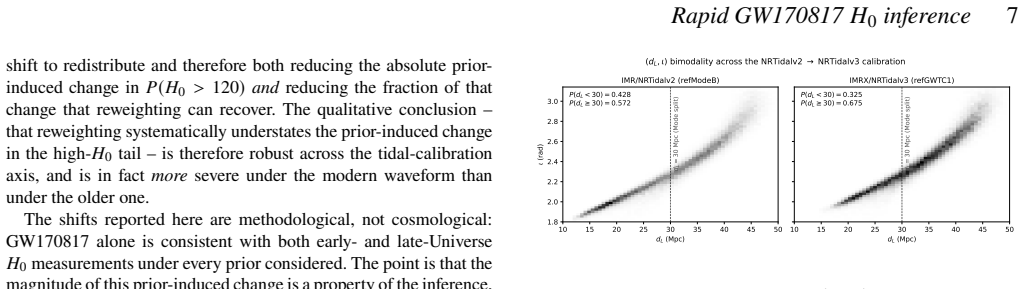
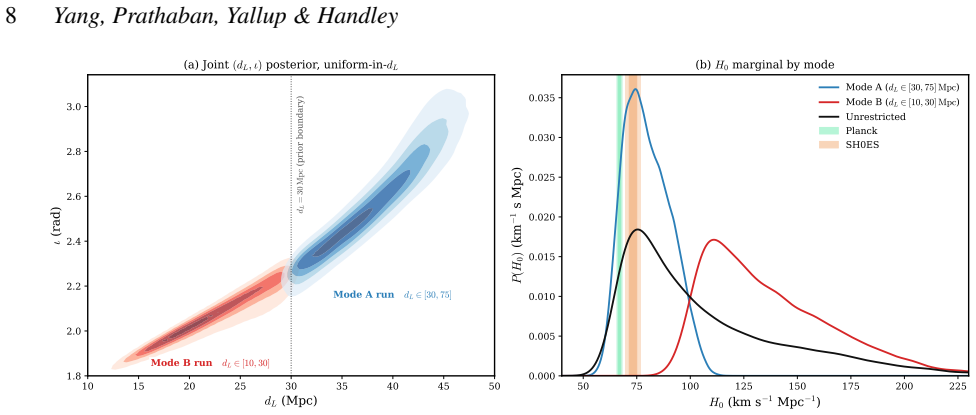
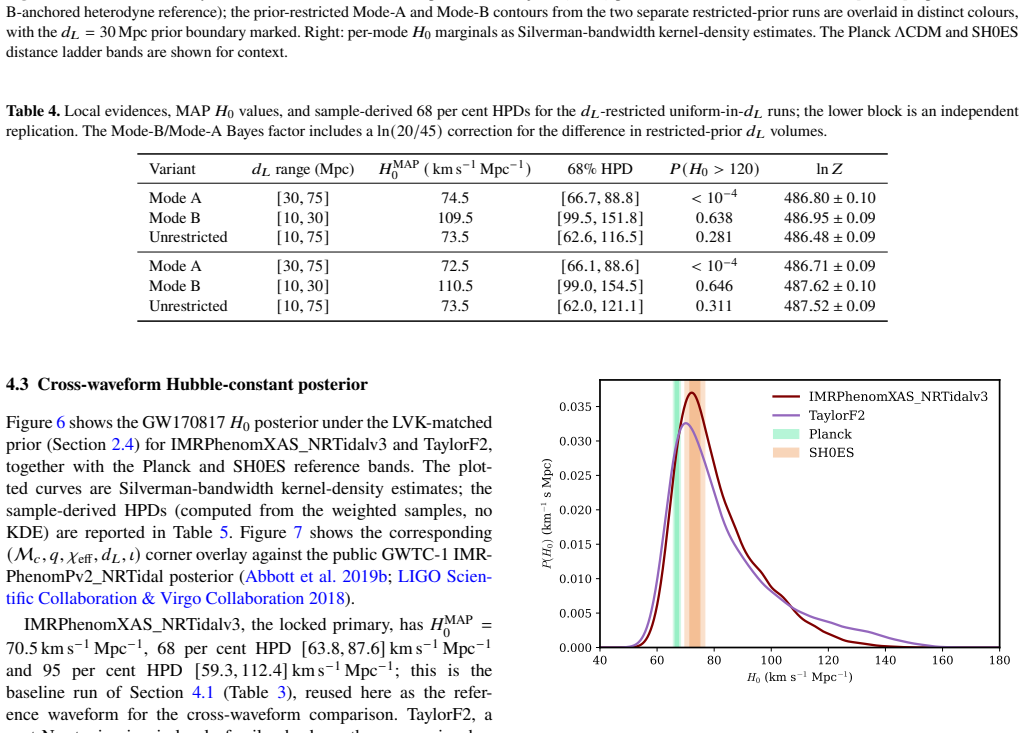
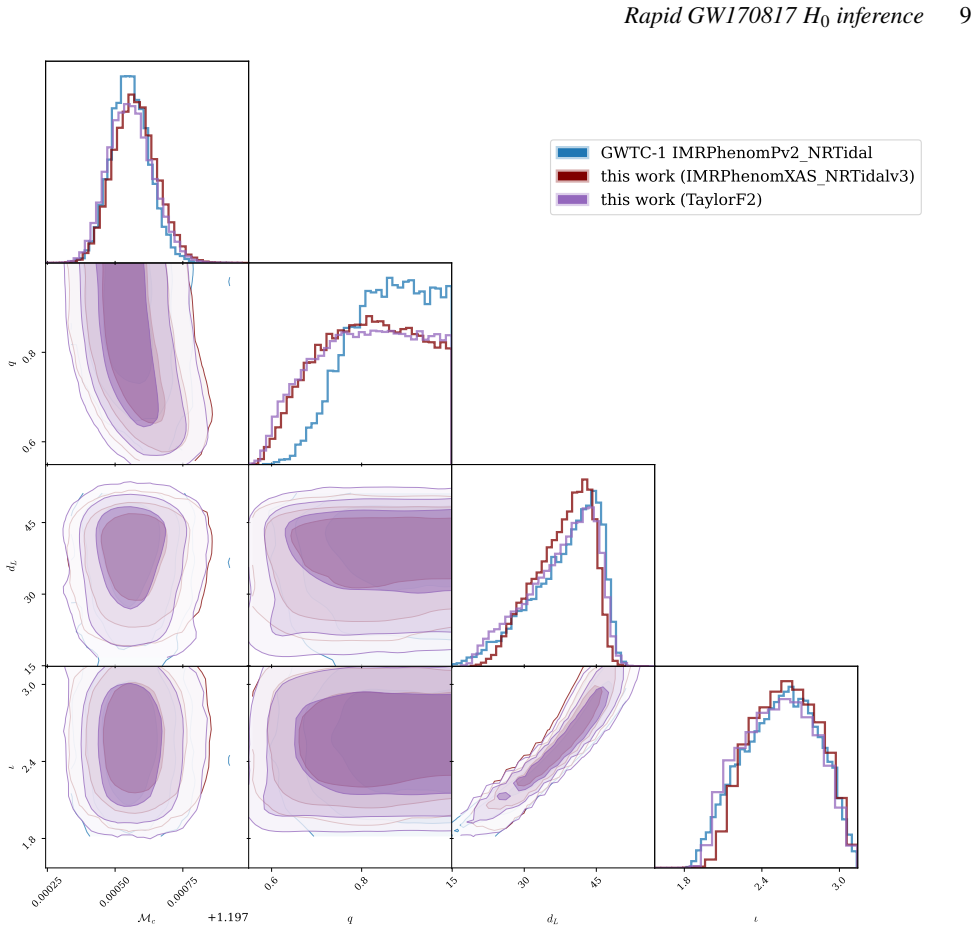
When the volumetric distance prior is replaced by a uniform-in-dL prior inside the nested sampler, P(H0 > 120 km/s/Mpc) rises from 0.017 to 0.159 and the weighted-median H0 moves from 77.6 to 87.6 km/s/Mpc; post-hoc reweighting of the baseline samples recovers only P = 0.041 in the tail. Targeted runs reveal a (dL, iota) bimodality whose high-H0 branch receives negligible weight under the volumetric prior, explaining the reweighting deficit. The three priors that allow independent evidence calculations agree to within Delta ln Z less than or equal to 1.8, confirming that the data do not strongly prefer one distance prior over another.
What carries the argument
The (dL, iota) bimodality in the likelihood surface under the IMRPhenomXAS_NRTidalv3 waveform, which causes the volumetric prior to assign negligible mass to the high-H0 branch.
If this is right
- The binned MAP value of H0 stays at 70.5 km/s/Mpc even while the tail and median move.
- The reweighted posterior has a lower effective sample size than the baseline samples.
- The three distance priors that carry independent evidence agree to within Delta ln Z less than or equal to 1.8.
- GPU-native heterodyned nested sampling completes each n_live=5000 run in roughly 13 minutes on one A100.
Where Pith is reading between the lines
- Future bright-siren analyses should treat full prior-sensitivity reruns as the default robustness check rather than relying on reweighting.
- The same bimodality mechanism may affect inclination or distance inferences for other compact-binary events.
- Rapid GPU sampling lowers the computational cost of testing multiple distance priors to the point where such checks can be performed routinely.
Load-bearing premise
The bimodality between luminosity distance and inclination is a real feature of the likelihood surface rather than an artifact of the sampler or waveform approximation.
What would settle it
Repeating the full analysis with an independent waveform family or a different nested-sampling code and finding that the same (dL, iota) bimodality and prior-induced tail shift either disappear or remain.
Figures
read the original abstract
The bright-siren measurement of the Hubble constant from GW170817 (Abbott et al. 2017) assumes that switching from a volumetric to a uniform-in-$d_L$ luminosity-distance prior can be implemented by post-hoc reweighting of the baseline samples, rather than by re-running the inference under the target prior. Using a GPU-native heterodyned nested sampling pipeline that completes the full $n_{\rm live}=5000$ analysis in about 13 min on a single A100, we recompute the GW170817 $H_0$ posterior under four prior variants for the modern aligned-spin tidal waveform IMRPhenomXAS_NRTidalv3. Switching from the volumetric to a uniform-in-$d_L$ distance prior raises the high-tail probability $P(H_0>120\,\mathrm{km/s/Mpc})$ from 0.017 to 0.159 when imposed during sampling and shifts the weighted-median $H_0$ from 77.6 to 87.6 km/s/Mpc, while the binned MAP stays at 70.5 km/s/Mpc: both the tail and the bulk move under a change of prior that leaves the mode in place. Post-hoc reweighting of the baseline samples to the same target prior recovers only $P=0.041$ in the tail, approximately 17% of the directly sampled shift. The three prior variants that carry an independent nested sampling evidence agree to $\Delta\ln Z\lesssim 1.8$, so the data show at most a weak preference among the distance priors; the tail and bulk shifts are therefore properties of the prior, not a data update. Targeted mode-isolated runs reveal a $(d_L,\iota)$ bimodality whose high-$H_0$, low-$d_L$ branch (Mode B; $|\ln\mathcal{B}_{\rm B/A}|<1$) the volumetric prior assigns negligible mass: this is the mechanism behind the reweighting deficit. The reweighted posterior has a lower effective sample size than the baseline, independently flagging the coverage failure. The runtime budget makes full-sample prior-sensitivity reruns the default robustness tool for bright-siren cosmology, replacing post-hoc reweighting.
Editorial analysis
A structured set of objections, weighed in public.
Referee Report
Summary. The manuscript claims that for the GW170817 bright-siren H0 inference with IMRPhenomXAS_NRTidalv3, direct GPU-accelerated nested sampling under a uniform-in-d_L prior yields P(H0>120 km/s/Mpc)=0.159 and median H0=87.6 km/s/Mpc versus 0.017 and 77.6 km/s/Mpc under the volumetric prior, while post-hoc reweighting recovers only P=0.041 (17% of the shift); a (d_L, ι) bimodality is identified as the mechanism, with evidence values agreeing to ΔlnZ≲1.8 across priors and lower ESS flagging the reweighting coverage failure. Full prior-sensitivity reruns are recommended over reweighting.
Significance. If the results hold, the work supplies a concrete, quantitatively documented case that post-hoc reweighting can substantially under-recover prior-induced shifts in multimodal bright-siren posteriors, while GPU-native nested sampling makes direct reruns feasible (∼13 min on A100). The independent evidence agreement and ESS diagnostic are explicit strengths that support the central comparison without circularity.
major comments (1)
- [Targeted mode-isolated runs] Targeted mode-isolated runs (abstract): the claim that the (d_L, ι) bimodality with |ln B_B/A|<1 is the mechanism for the reweighting deficit would be strengthened by explicit checks that the bimodality persists when n_live, proposal kernel, or heterodyning settings are varied; without those, the quantitative 17% recovery figure remains valid from the direct runs but the mechanistic interpretation carries a residual risk of sampling artifact.
minor comments (2)
- The abstract states that the binned MAP remains at 70.5 km/s/Mpc under the uniform-in-d_L prior; a brief description of the binning procedure or reference to the relevant figure would aid reproducibility.
- Consider adding a compact table that collects the four priors, their lnZ values, P(H0>120), medians, and ESS for direct visual comparison.
Simulated Author's Rebuttal
We thank the referee for their careful reading, positive assessment of the work, and recommendation for minor revision. We respond to the single major comment below.
read point-by-point responses
-
Referee: Targeted mode-isolated runs (abstract): the claim that the (d_L, ι) bimodality with |ln B_B/A|<1 is the mechanism for the reweighting deficit would be strengthened by explicit checks that the bimodality persists when n_live, proposal kernel, or heterodyning settings are varied; without those, the quantitative 17% recovery figure remains valid from the direct runs but the mechanistic interpretation carries a residual risk of sampling artifact.
Authors: We agree that systematic variation of n_live, proposal kernel, and heterodyning settings in the mode-isolated runs would provide additional reassurance against sampling artifacts and would strengthen the mechanistic claim. The manuscript reports the (d_L, ι) bimodality as revealed by the targeted mode-isolated runs performed with the pipeline's standard configuration; the primary quantitative result (the 17% recovery of the tail shift under post-hoc reweighting) is obtained from the direct full-prior nested-sampling comparisons and is independent of the mode-isolation procedure. The agreement of the evidence values across priors (ΔlnZ ≲ 1.8) and the ESS diagnostic supply separate support for the reweighting deficit. We will revise the text to state explicitly the settings employed for the targeted runs and to note the residual risk of sampling artifact in the mechanistic interpretation, thereby clarifying the scope of the claim without altering the central numerical findings. revision: yes
Circularity Check
No circularity: independent nested-sampling runs under each prior
full rationale
The paper's central results (tail probabilities P(H0>120), median shifts, and evidence ratios) are obtained by executing separate GPU-native nested-sampling runs under each distance prior variant and then directly comparing those outputs to the post-hoc reweighted baseline; none of the reported quantities are obtained by algebraic rearrangement or re-labeling of quantities already fitted inside the same run. The (dL,ι) bimodality is presented as an empirical observation from the targeted mode-isolated runs rather than an input assumption that is later recovered by construction. No self-citations are invoked to establish uniqueness theorems or to smuggle in ansatzes, and the cited Abbott et al. (2017) result is an external benchmark. The derivation chain therefore remains self-contained against the computational evidence the authors themselves produce.
Axiom & Free-Parameter Ledger
axioms (1)
- standard math Nested sampling with n_live=5000 produces accurate posterior samples and evidence estimates for the given likelihood and prior.
Reference graph
Works this paper leans on
-
[1]
Physical Review Letters , year =
-
[2]
Physical Review X , year =
-
[3]
Astronomy and Astrophysics , year =
-
[4]
The Astrophysical Journal , year =
-
[5]
The Astrophysical Journal Letters , year =
-
[6]
The Astrophysical Journal Supplement Series , year =
-
[9]
Monthly Notices of the Royal Astronomical Society , year =
-
[10]
Bayesian Analysis , year =
-
[11]
2018 , howpublished =
2018
-
[18]
Physical Review D , year =
-
[19]
2017 , howpublished =
2017
-
[20]
2022 , howpublished =
2022
-
[21]
Nature Astronomy , year =
-
[22]
Phys. Rev. D , year =
-
[23]
Living Reviews in Relativity , year =
-
[25]
Journal of Machine Learning Research , year =. 1507.02646 , archivePrefix =
-
[26]
2013 , howpublished =
2013
-
[28]
2026 , eprint =
Transactions on Machine Learning Research , issn =. 2026 , eprint =
2026
-
[36]
Abac A., Dietrich T., Buonanno A., Steinhoff J., Ujevic M., 2024, @doi [Physical Review D] 10.1103/PhysRevD.109.024062 , 109, 024062
-
[37]
P., et al., 2016, @doi [Physical Review Letters] 10.1103/PhysRevLett.116.061102 , 116, 061102
Abbott B. P., et al., 2016, @doi [Physical Review Letters] 10.1103/PhysRevLett.116.061102 , 116, 061102
-
[38]
P., et al., 2017a, @doi [Physical Review Letters] 10.1103/PhysRevLett.119.161101 , 119, 161101
Abbott B. P., et al., 2017a, @doi [Physical Review Letters] 10.1103/PhysRevLett.119.161101 , 119, 161101
-
[39]
P., et al., 2017b, @doi [Nature] 10.1038/nature24471 , 551, 85
Abbott B. P., et al., 2017b, @doi [Nature] 10.1038/nature24471 , 551, 85
-
[40]
P., et al., 2019a, @doi [Physical Review X] 10.1103/PhysRevX.9.011001 , 9, 011001
Abbott B. P., et al., 2019a, @doi [Physical Review X] 10.1103/PhysRevX.9.011001 , 9, 011001
-
[41]
P., et al., 2019b, @doi [Physical Review X] 10.1103/PhysRevX.9.031040 , 9, 031040
Abbott B. P., et al., 2019b, @doi [Physical Review X] 10.1103/PhysRevX.9.031040 , 9, 031040
-
[42]
P., et al., 2020, @doi [Living Reviews in Relativity] 10.1007/s41114-020-00026-9 , 23, 3
Abbott B. P., et al., 2020, @doi [Living Reviews in Relativity] 10.1007/s41114-020-00026-9 , 23, 3
-
[43]
Abbott R., et al., 2024, @doi [Physical Review D] 10.1103/PhysRevD.109.022001 , 109, 022001
-
[44]
Ashton G., 2026, @doi [RAS Techniques and Instruments] 10.1093/rasti/rzag012 , 5, rzag012
-
[45]
Ashton G., et al., 2019, @doi [The Astrophysical Journal Supplement Series] 10.3847/1538-4365/ab06fc , 241, 27
-
[46]
Bradbury J., et al., 2018, JAX: composable transformations of Python+NumPy programs , https://github.com/jax-ml/jax
2018
-
[47]
Branchesi M., et al., 2023, @doi [Journal of Cosmology and Astroparticle Physics] 10.1088/1475-7516/2023/07/068 , 2023, 068
-
[48]
Cabezas A., Corenflos A., Lao J., Louf R., et al., 2024, BlackJAX: Composable Bayesian inference in JAX ( @eprint arXiv 2402.10797 )
arXiv 2024
-
[49]
Chan R., Narola H., Ng T. C. K., Wouters T., Wong I. C. F., Gittins F., Janquart J., Van Den Broeck C., 2026, in prep
2026
-
[50]
E., 2018, @doi [Nature] 10.1038/s41586-018-0606-0 , 562, 545
Chen H.-Y., Fishbach M., Holz D. E., 2018, @doi [Nature] 10.1038/s41586-018-0606-0 , 562, 545
-
[51]
J., 2010, Fast Fisher Matrices and Lazy Likelihoods ( @eprint arXiv 1007.4820 )
Cornish N. J., 2010, Fast Fisher Matrices and Lazy Likelihoods ( @eprint arXiv 1007.4820 )
Pith/arXiv arXiv 2010
-
[52]
Dax M., et al., 2025, @doi [Nature] 10.1038/s41586-025-08593-z , 639, 49
-
[53]
Di Valentino E., et al., 2021, @doi [Classical and Quantum Gravity] 10.1088/1361-6382/ac086d , 38, 153001
-
[54]
Edwards T. D. P., Wong K. W. K., Lam K. K. H., Coogan A., Foreman-Mackey D., Isi M., Zimmerman A., 2024, @doi [Physical Review D] 10.1103/PhysRevD.110.064028 , 110, 064028
-
[55]
Finn L. S., Chernoff D. F., 1993, @doi [Phys. Rev. D] 10.1103/PhysRevD.47.2198 , 47, 2198
-
[56]
Holz D. E., Hughes S. A., 2005, @doi [The Astrophysical Journal] 10.1086/431341 , 629, 15
-
[57]
Hotokezaka K., Nakar E., Gottlieb O., Nissanke S., Masuda K., Hallinan G., Mooley K. P., Deller A. T., 2019, @doi [Nature Astronomy] 10.1038/s41550-019-0820-1 , 3, 940
-
[58]
M., 2020, @doi [Monthly Notices of the Royal Astronomical Society] 10.1093/mnras/staa049 , 492, 3803
Howlett C., Davis T. M., 2020, @doi [Monthly Notices of the Royal Astronomical Society] 10.1093/mnras/staa049 , 492, 3803
-
[59]
Hu Q., Veitch J., 2025, @doi [Physical Review D] 10.1103/dj7k-tk37 , 112, 084039
-
[60]
John Wiley & Sons, New York
Kish L., 1965, Survey Sampling . John Wiley & Sons, New York
1965
-
[61]
Krishna K., Vijaykumar A., Ganguly A., Talbot C., Biscoveanu S., George R. N., Williams N., Zimmerman A., 2023, Accelerated parameter estimation in Bilby with relative binning ( @eprint arXiv 2312.06009 )
arXiv 2023
-
[62]
LIGO Scientific Collaboration Virgo Collaboration 2017, A gravitational-wave standard siren measurement of the Hubble constant -- Data Release , LIGO Document P1700296; https://dcc.ligo.org/LIGO-P1700296/public
2017
-
[63]
LIGO Scientific Collaboration Virgo Collaboration 2018, Properties of the binary neutron star merger GW170817 -- Data Release , LIGO Document P1800061; https://dcc.ligo.org/LIGO-P1800061/public
2018
-
[64]
LIGO Scientific Collaboration Virgo Collaboration 2022, GWTC-2.1: Deep Extended Catalog of Compact Binary Coalescences Observed by LIGO and Virgo During the First Half of the Third Observing Run -- Parameter Estimation Data Release , Zenodo, https://doi.org/10.5281/zenodo.6513631, @doi 10.5281/zenodo.6513631
-
[65]
LIGO Scientific Collaboration Virgo Collaboration KAGRA Collaboration 2026, GWTC-5.0: Constraints on the Cosmic Expansion Rate and Modified Gravitational-wave Propagation ( @eprint arXiv 2605.27227 ), @doi 10.48550/arXiv.2605.27227
work page internal anchor Pith review Pith/arXiv arXiv doi:10.48550/arxiv.2605.27227 2026
-
[66]
P., et al., 2018, @doi [Nature] 10.1038/s41586-018-0486-3 , 561, 355
Mooley K. P., et al., 2018, @doi [Nature] 10.1038/s41586-018-0486-3 , 561, 355
-
[67]
Morisaki S., 2021, @doi [Physical Review D] 10.1103/PhysRevD.104.044062 , 104, 044062
-
[68]
Mukherjee S., Lavaux G., Bouchet F. R., Jasche J., Wandelt B. D., Nissanke S., Leclercq F., Hotokezaka K., 2021, @doi [Astronomy and Astrophysics] 10.1051/0004-6361/201936724 , 646, A65
-
[69]
Nicolaou C., Lahav O., Lemos P., Hartley W., Braden J., 2020, @doi [Monthly Notices of the Royal Astronomical Society] 10.1093/mnras/staa1120 , 495, 90
-
[70]
B., 2013, Monte Carlo Theory, Methods and Examples , https://artowen.su.domains/mc/
Owen A. B., 2013, Monte Carlo Theory, Methods and Examples , https://artowen.su.domains/mc/
2013
-
[71]
Palmese A., Mastrogiovanni S., 2025, Gravitational Wave Cosmology ( @eprint arXiv 2502.00239 )
arXiv 2025
-
[72]
Palmese A., Kaur R., Hajela A., Margutti R., McDowell A., MacFadyen A., 2024, @doi [Physical Review D] 10.1103/PhysRevD.109.063508 , 109, 063508
-
[73]
Payne E., Talbot C., Thrane E., 2019, @doi [Physical Review D] 10.1103/PhysRevD.100.123017 , 100, 123017
-
[74]
Planck Collaboration 2020, @doi [Astronomy and Astrophysics] 10.1051/0004-6361/201833910 , 641, A6
-
[75]
Prathaban M., Yallup D., Alvey J., Yang M. H., Templeton W., Handley W., 2026, @doi [RAS Techniques and Instruments] 10.1093/rasti/rzag034 , 5, rzag034
-
[76]
Pratten G., Husa S., Garc\'ia-Quir\'os C., Colleoni M., Ramos-Buades A., Estell\'es H., Jaume R., 2020, @doi [Physical Review D] 10.1103/PhysRevD.102.064001 , 102, 064001
-
[77]
Pratten G., et al., 2021, @doi [Physical Review D] 10.1103/PhysRevD.103.104056 , 103, 104056
-
[78]
G., et al., 2016, @doi [The Astrophysical Journal] 10.3847/0004-637X/826/1/56 , 826, 56
Riess A. G., et al., 2016, @doi [The Astrophysical Journal] 10.3847/0004-637X/826/1/56 , 826, 56
-
[79]
G., et al., 2022, @doi [The Astrophysical Journal Letters] 10.3847/2041-8213/ac5c5b , 934, L7
Riess A. G., et al., 2022, @doi [The Astrophysical Journal Letters] 10.3847/2041-8213/ac5c5b , 934, L7
-
[80]
Salvarese A., Chen H.-Y., 2024, @doi [The Astrophysical Journal Letters] 10.3847/2041-8213/ad7bbc , 974, L16
-
[81]
F., 1986, @doi [Nature] 10.1038/323310a0 , 323, 310
Schutz B. F., 1986, @doi [Nature] 10.1038/323310a0 , 323, 310
-
[82]
Skilling J., 2006, @doi [Bayesian Analysis] 10.1214/06-BA127 , 1, 833
-
[83]
Smith R., Field S. E., Blackburn K., Haster C.-J., P\"urrer M., Raymond V., Schmidt P., 2016, @doi [Physical Review D] 10.1103/PhysRevD.94.044031 , 94, 044031
-
[84]
S., 2020, @doi [Monthly Notices of the Royal Astronomical Society] 10.1093/mnras/staa278 , 493, 3132
Speagle J. S., 2020, @doi [Monthly Notices of the Royal Astronomical Society] 10.1093/mnras/staa278 , 493, 3132
-
[85]
Vehtari A., Simpson D., Gelman A., Yao Y., Gabry J., 2024, Journal of Machine Learning Research, 25, 1
2024
-
[86]
Vinciguerra S., Veitch J., Mandel I., 2017, @doi [Classical and Quantum Gravity] 10.1088/1361-6382/aa6d44 , 34, 115006
-
[87]
Williams M. J., Veitch J., Messenger C., 2021, @doi [Physical Review D] 10.1103/PhysRevD.103.103006 , 103, 103006
-
[88]
Williams M. J., Karamanis M., Luo Y., Seljak U., 2025, @doi [Monthly Notices of the Royal Astronomical Society] 10.1093/mnras/staf1458 , 543, 1479
-
[89]
Wong K. W. K., Isi M., Edwards T. D. P., 2023, @doi [The Astrophysical Journal] 10.3847/1538-4357/acf5cd , 958, 129
-
[90]
Wouters T., Pang P. T. H., Dietrich T., Van Den Broeck C., 2024, @doi [Physical Review D] 10.1103/PhysRevD.110.083033 , 110, 083033
-
[91]
Yallup D., Prathaban M., Alvey J., Handley W., 2025, Parallel Nested Slice Sampling for Gravitational Wave Parameter Estimation ( @eprint arXiv 2509.24949 )
arXiv 2025
-
[92]
Yallup D., Kroupa N., Handley W., 2026, @doi [Transactions on Machine Learning Research] 10.48550/arXiv.2601.23252
work page internal anchor Pith review Pith/arXiv arXiv doi:10.48550/arxiv.2601.23252 2026
-
[93]
Yang M. H., Prathaban M., Yallup D., Handley W., 2026, GW170817 bright-siren H_0 : data and analysis release , https://github.com/ming-256/GW170817-bright-siren-H0, @doi 10.5281/zenodo.21038511
-
[94]
Zackay B., Dai L., Venumadhav T., 2018, Relative binning and fast likelihood evaluation for gravitational-wave parameter estimation ( @eprint arXiv 1806.08792 )
Pith/arXiv arXiv 2018
discussion (0)
Sign in with ORCID, Apple, or X to comment. Anyone can read and Pith papers without signing in.