Testing the prevalence of hydrogen-silicate miscibility in young sub-Neptunes
Pith reviewed 2026-06-30 03:05 UTC · model grok-4.3
The pith
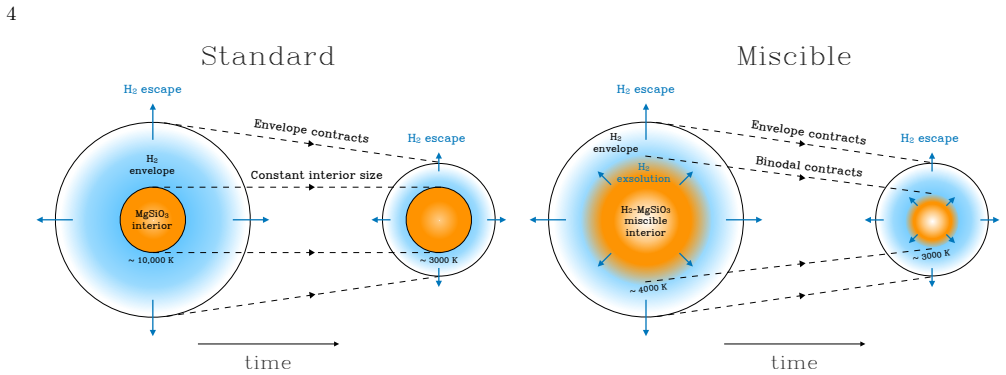
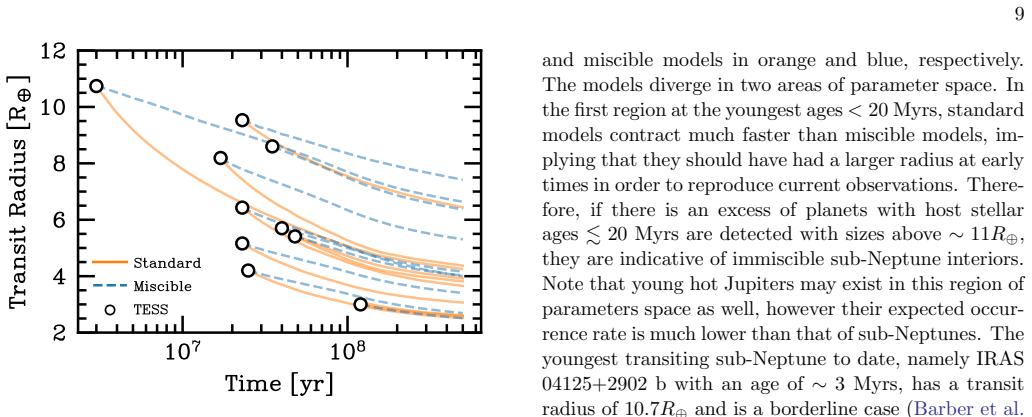
For the first 100 million years, sub-Neptunes store most hydrogen in miscible interiors, shielding it from escape and delaying contraction.
A machine-rendered reading of the paper's core claim, the machinery that carries it, and where it could break.
Core claim
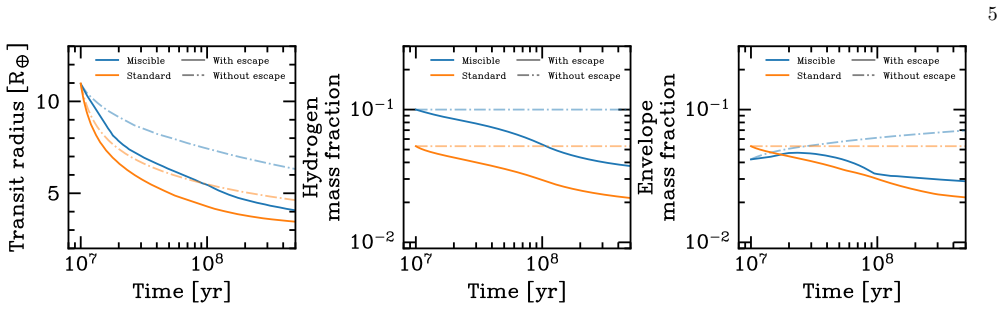
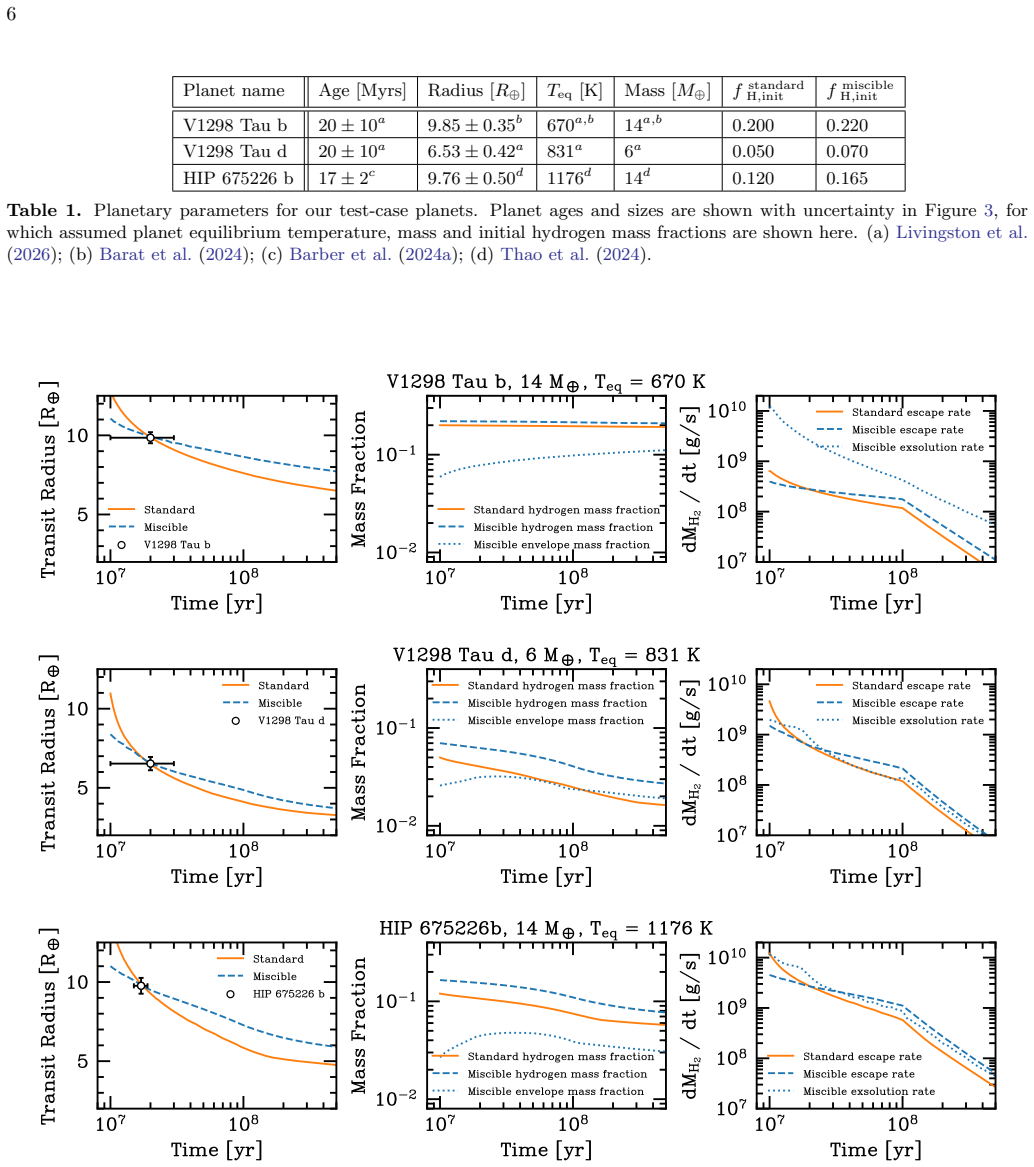
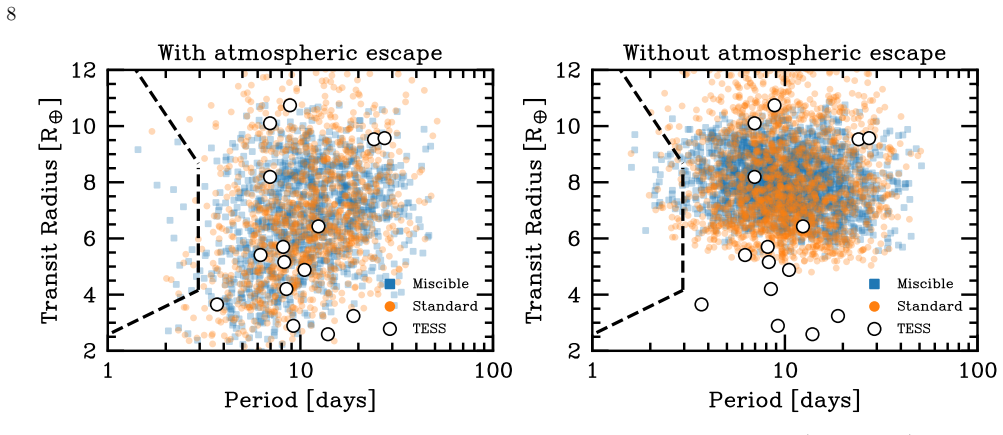
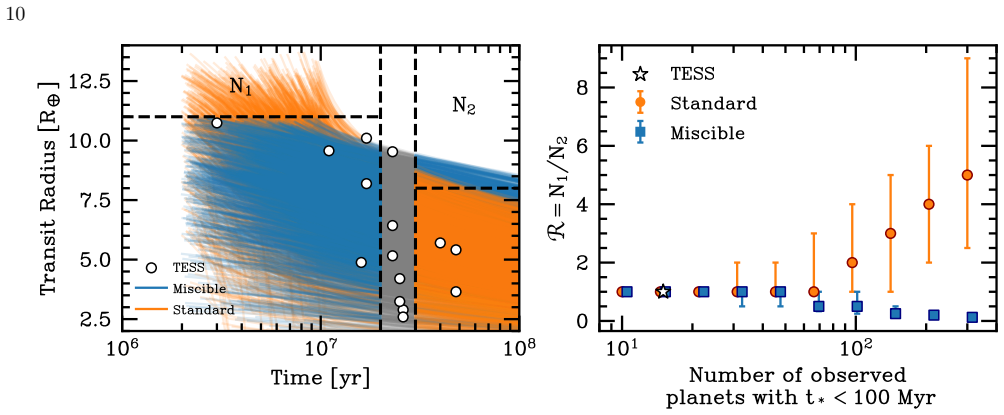
Hydrogen-silicate miscibility causes sub-Neptunes to store most of their hydrogen content within their interiors for the first ~100 Myrs, protecting it from escape. Atmospheric hydrogen loss triggers exsolution from the miscible interior, resupplying envelope mass and delaying contraction compared with non-miscible models. Atmospheric escape alone reproduces the young planet observations from TESS, including the emergence of the primordial Neptune desert at short orbital periods. A population-level test for miscible sub-Neptunes exploits their slower radial contraction and requires ~70-100 observed young sub-Neptunes with ages ≲100 Myrs.
What carries the argument
Hydrogen-silicate miscibility, the process by which hydrogen dissolves into the silicate interior and exsolves in response to envelope mass loss, which resupplies the atmosphere and slows contraction.
If this is right
- Most hydrogen remains protected in the interior rather than lost to escape during the first 100 million years.
- Exsolution from the interior continuously resupplies the envelope as atmospheric gas is removed.
- Planets with miscible interiors contract more slowly than those without.
- Stellar-driven escape still matches TESS observations of young planets and produces the primordial Neptune desert.
- Distinguishing miscible from non-miscible populations requires a sample of 70-100 young sub-Neptunes.
Where Pith is reading between the lines
- If the mechanism holds, radius measurements of young planets could serve as a proxy for interior composition without needing direct interior probes.
- The delayed contraction might shift the timing at which sub-Neptunes cross the radius valley or enter the Neptune desert.
- Models that omit miscibility would systematically underestimate envelope masses at early times.
- The test could be repeated on planets orbiting stars of different metallicities to check whether miscibility depends on formation conditions.
Load-bearing premise
Hydrogen-silicate miscibility occurs at the pressures and temperatures inside sub-Neptunes and exsolution directly responds to atmospheric mass loss by resupplying the envelope.
What would settle it
If radii measured for 70-100 young sub-Neptunes with ages under 100 million years show contraction rates indistinguishable from non-miscible models, the claim of widespread miscibility would be ruled out.
Figures
read the original abstract
Hydrogen-silicate miscibility can significantly alter the interior structure and thermal evolution of sub-Neptunes. We consider the interplay between this miscibility and stellar-driven atmospheric escape. We find that, for the first $\sim 100$ Myrs, sub-Neptunes store most of their hydrogen content within their miscible interiors, protecting it from escape. As hydrogen is removed from the top of the atmosphere, more hydrogen is exsolved from the miscible interior, resupplying the envelope mass and delaying the planet's contraction when compared with models that do not account for miscibility. Regardless of miscibility, atmospheric escape reproduces the young planet observations from TESS, and we highlight the emergence of the primordial Neptune desert at short orbital periods. We construct a population-level test for the prevalence of miscible sub-Neptunes which exploits their slower radial contraction. We find that $\sim 70-100$ observed young sub-Neptunes with ages $\lesssim 100$ Myrs are required to answer this question.
Editorial analysis
A structured set of objections, weighed in public.
Referee Report
Summary. The paper models the interplay between hydrogen-silicate miscibility and stellar-driven atmospheric escape in young sub-Neptunes. It claims that for the first ~100 Myr most hydrogen resides in miscible interiors (protecting it from escape), that exsolution resupplies the envelope as atmospheric hydrogen is lost (delaying contraction relative to non-miscible models), that escape reproduces TESS young-planet radii and produces the primordial Neptune desert, and that a sample of 70-100 observed young sub-Neptunes with ages ≲100 Myr would suffice to test the prevalence of miscibility via its effect on radial contraction.
Significance. If the central mechanism holds, the work supplies a physically motivated explanation for delayed contraction in young sub-Neptunes and a concrete, population-level observational test. The explicit prediction of the required sample size is a strength that makes the hypothesis falsifiable with forthcoming data.
major comments (1)
- [modeling of miscibility-escape interplay] The resupply mechanism (abstract and modeling sections) requires that hydrogen exsolves from the miscible H-silicate interior on timescales shorter than atmospheric escape (~10-100 Myr). No calculation or reference is supplied for diffusion through the silicate layer, phase-separation kinetics, or convective mixing timescales; if any of these exceed the escape rate the protective-storage and resupply effect disappears and the models revert to standard non-miscible behavior.
minor comments (1)
- [abstract] The abstract states model outcomes without equations, parameter choices, or validation steps; the full text should supply these explicitly (e.g., the functional form used for the miscible interior mass fraction and the escape prescription).
Simulated Author's Rebuttal
We thank the referee for their constructive review and for noting the potential importance of the work. We address the single major comment below.
read point-by-point responses
-
Referee: The resupply mechanism (abstract and modeling sections) requires that hydrogen exsolves from the miscible H-silicate interior on timescales shorter than atmospheric escape (~10-100 Myr). No calculation or reference is supplied for diffusion through the silicate layer, phase-separation kinetics, or convective mixing timescales; if any of these exceed the escape rate the protective-storage and resupply effect disappears and the models revert to standard non-miscible behavior.
Authors: We agree that explicit justification of the exsolution timescale is required for the resupply mechanism to be robust. The current manuscript assumes equilibrium between interior and envelope on Myr timescales without providing supporting estimates. In the revised manuscript we will add a dedicated paragraph in Section 2 that supplies order-of-magnitude calculations: convective mixing times in the miscible layer are estimated at 10^3–10^5 yr using mixing-length theory with sub-Neptune parameters; hydrogen diffusion coefficients from high-P-T silicate experiments imply layer-crossing times ≪1 Myr; and phase-separation kinetics are rapid at the relevant temperatures. Appropriate references will be included. These additions will make the assumption explicit while noting that a fully time-dependent coupled simulation remains future work. If the timescales prove longer, the protective effect would indeed weaken as the referee states. revision: yes
Circularity Check
No circularity: model outputs independent of inputs
full rationale
The abstract and context describe forward modeling of miscibility effects on escape and contraction, with a population test derived from simulated observables. No equations or self-citations are shown that reduce the reported delay, resupply, or required sample size (~70-100) to a fitted parameter or prior result by construction. The derivation chain remains self-contained against external benchmarks and does not exhibit any of the enumerated circular patterns.
Axiom & Free-Parameter Ledger
Reference graph
Works this paper leans on
-
[1]
2024, Nature Astronomy, 8, 899, doi: 10.1038/s41550-024-02257-0
Barat, S., D´ esert, J.-M., Vazan, A., et al. 2024, Nature Astronomy, 8, 899, doi: 10.1038/s41550-024-02257-0
-
[2]
Barber, M. G., Thao, P. C., Mann, A. W., et al. 2024a, ApJL, 973, L30, doi: 10.3847/2041-8213/ad77d9
-
[3]
Barber, M. G., Mann, A. W., Vanderburg, A., et al. 2024b, Nature, 533, 221, doi: 10.1038/nature17448
- [4]
-
[5]
Borucki, W. J., Koch, D. G., Basri, G., et al. 2011, ApJ, 736, 19, doi: 10.1088/0004-637X/736/1/19 Castro-Gonz´ alez, A., Bourrier, V., Lillo-Box, J., et al. 2024, A&A, 689, A250, doi: 10.1051/0004-6361/202450957
-
[6]
2019, ApJ, 872, 51, doi: 10.3847/1538-4357/aaf99f
Chabrier, G., Mazevet, S., & Soubiran, F. 2019, ApJ, 872, 51, doi: 10.3847/1538-4357/aaf99f
-
[7]
Christiansen, J. L., Zink, J. K., Hardegree-Ullman, K. K., et al. 2023, AJ, 166, 248, doi: 10.3847/1538-3881/acf9f9
-
[8]
2025, arXiv e-prints, arXiv:2512.07029, doi: 10.48550/arXiv.2512.07029
Dai, Y.-Z., Liu, H.-G., Pang, X., et al. 2025, arXiv e-prints, arXiv:2512.07029, doi: 10.48550/arXiv.2512.07029
-
[9]
David, T. J., Petigura, E. A., Luger, R., et al. 2019a, ApJL, 885, L12, doi: 10.3847/2041-8213/ab4c99
-
[10]
David, T. J., Cody, A. M., Hedges, C. L., et al. 2019b, AJ, 158, 79, doi: 10.3847/1538-3881/ab290f Dos Santos, L. A. 2023, IAU Symposium, 370, 56, doi: 10.1017/S1743921322004239
-
[11]
21cmfast: a fast, seminumerical simulation of the high-redshift 21-cm signal: 21cmfast , volume=
Ercolano, B., Clarke, C. J., & Hall, A. C. 2011, MNRAS, 410, 671, doi: 10.1111/j.1365-2966.2010.17473.x
-
[12]
Fernandes, R. B., Mulders, G. D., Pascucci, I., et al. 2022, arXiv e-prints, arXiv:2206.03989. https://arxiv.org/abs/2206.03989
-
[13]
Fernandes, R. B., Bergsten, G. J., Mulders, G. D., et al. 2025, arXiv e-prints, arXiv:2503.10856, doi: 10.48550/arXiv.2503.10856
-
[14]
Fortney, J. J., Marley, M. S., & Barnes, J. W. 2007, ApJ, 659, 1661, doi: 10.1086/512120
work page internal anchor Pith review doi:10.1086/512120 2007
-
[15]
2013, ApJ, 766, 81, doi: 10.1088/0004-637X/766/2/81
Fressin, F., Torres, G., Charbonneau, D., et al. 2013, ApJ, 766, 81, doi: 10.1088/0004-637X/766/2/81
-
[16]
Fulton, B. J., Petigura, E. A., Howard, A. W., et al. 2017, AJ, 154, 109, doi: 10.3847/1538-3881/aa80eb
-
[17]
2026, Nature, 650, 60, doi: 10.1038/s41586-025-09970-4
Gilmore, T., & Stixrude, L. 2026, Nature, 650, 60, doi: 10.1038/s41586-025-09970-4
-
[18]
Ginzburg, S., Schlichting, H. E., & Sari, R. 2016, ApJ, 825, 29, doi: 10.3847/0004-637X/825/1/29 —. 2018, MNRAS, 476, 759, doi: 10.1093/mnras/sty290
-
[19]
Pierrehumbert, R. T. 2021, PSJ, 2, 207, doi: 10.3847/PSJ/ac214c
-
[20]
Gupta, A., & Schlichting, H. E. 2019, MNRAS, 487, 24, doi: 10.1093/mnras/stz1230
-
[21]
Gupta, A., Stixrude, L., & Schlichting, H. E. 2024, arXiv e-prints, arXiv:2407.04685, doi: 10.48550/arXiv.2407.04685
-
[22]
2026, ApJ, 997, 139, doi: 10.3847/1538-4357/adfb75
Hallatt, T., & Millholland, S. 2026, ApJ, 997, 139, doi: 10.3847/1538-4357/adfb75
-
[23]
Schlichting, H. E. 2024, arXiv e-prints, arXiv:2401.12378, doi: 10.48550/arXiv.2401.12378
-
[24]
Jackson, A. P., Davis, T. A., & Wheatley, P. J. 2012, MNRAS, 422, 2024, doi: 10.1111/j.1365-2966.2012.20657.x
-
[25]
Jontof-Hutter, D., Lissauer, J. J., Rowe, J. F., & Fabrycky, D. C. 2014, ApJ, 785, 15, doi: 10.1088/0004-637X/785/1/15
-
[26]
Kenyon, S. J., & Hartmann, L. 1995, ApJS, 101, 117, doi: 10.1086/192235
-
[27]
M., Ercolano, B., Dale, J., et al
Koepferl, C. M., Ercolano, B., Dale, J., et al. 2013, MNRAS, 428, 3327, doi: 10.1093/mnras/sts276
-
[28]
Lee, E. J., & Chiang, E. 2015, ApJ, 811, 41, doi: 10.1088/0004-637X/811/1/41
-
[29]
Lee, E. J., & Owen, J. E. 2025, ApJL, 980, L40, doi: 10.3847/2041-8213/adafa3
-
[30]
Livingston, J. H., Petigura, E. A., David, T. J., et al. 2026, Nature, 649, 310, doi: 10.1038/s41586-025-09840-z
-
[31]
Lopez, E. D., & Fortney, J. J. 2013, ApJ, 776, 2, doi: 10.1088/0004-637X/776/1/2
-
[32]
Loyd, R. O. P., Schreyer, E., Owen, J. E., et al. 2025, Nature, 638, 636, doi: 10.1038/s41586-024-08490-x
-
[33]
S., Kjeldsen, H., Albrecht, S., et al
Lundkvist, M. S., Kjeldsen, H., Albrecht, S., et al. 2016, Nature Communications, 7, 11201, doi: 10.1038/ncomms11201
-
[34]
2025, Journal of Geophysical Research (Planets), 130, e2024JE008678, doi: 10.1029/2024JE008678
Luo, H., & Deng, J. 2025, Journal of Geophysical Research (Planets), 130, e2024JE008678, doi: 10.1029/2024JE008678
-
[35]
2022, AAP, 665, A12, doi: 10.1051/0004-6361/202243359
Markham, S., Guillot, T., & Stevenson, D. 2022, AAP, 665, A12, doi: 10.1051/0004-6361/202243359
-
[36]
2021, PSJ, 2, 146, doi: 10.3847/PSJ/ac091d
Markham, S., & Stevenson, D. 2021, PSJ, 2, 146, doi: 10.3847/PSJ/ac091d
-
[37]
2016, A&A, 589, A75, doi: 10.1051/0004-6361/201528065
Mazeh, T., Holczer, T., & Faigler, S. 2016, A&A, 589, A75, doi: 10.1051/0004-6361/201528065
-
[38]
McDonald, G. D., Kreidberg, L., & Lopez, E. 2019, ApJ, 876, 22, doi: 10.3847/1538-4357/ab1095
-
[39]
Goncharov, A. F. 2016, Phys. Rev. Lett., 116, 255501, doi: 10.1103/PhysRevLett.116.255501
-
[40]
Misener, W., Schulik, M., Schlichting, H. E., & Owen, J. E. 2026, arXiv e-prints, arXiv:2605.02766, doi: 10.48550/arXiv.2605.02766 13
work page internal anchor Pith review Pith/arXiv arXiv doi:10.48550/arxiv.2605.02766 2026
-
[41]
Morton, T. D., Bryson, S. T., Coughlin, J. L., et al. 2016, ApJ, 822, 86, doi: 10.3847/0004-637X/822/2/86
-
[42]
2025, A&A, 694, A313, doi: 10.1051/0004-6361/202452325
Nascimbeni, V., Piotto, G., Cabrera, J., et al. 2025, A&A, 694, A313, doi: 10.1051/0004-6361/202452325
-
[43]
Owen, J. E. 2020, MNRAS, 498, 5030, doi: 10.1093/mnras/staa2784
-
[44]
Owen, J. E., & Lai, D. 2018, MNRAS, 479, 5012, doi: 10.1093/mnras/sty1760
-
[45]
Owen, J. E., & Schlichting, H. E. 2024, MNRAS, 528, 1615, doi: 10.1093/mnras/stad3972
-
[46]
Kepler planets: a tale of evaporation
Owen, J. E., & Wu, Y. 2013, ApJ, 775, 105, doi: 10.1088/0004-637X/775/2/105 —. 2016, ApJ, 817, 107, doi: 10.3847/0004-637X/817/2/107
work page internal anchor Pith review doi:10.1088/0004-637x/775/2/105 2013
-
[47]
Petigura, E. A., Howard, A. W., & Marcy, G. W. 2013, Proceedings of the National Academy of Science, 110, 19273, doi: 10.1073/pnas.1319909110
-
[48]
arXiv , author =:2201.10020 , journal =
Petigura, E. A., Rogers, J. G., Isaacson, H., et al. 2022, AJ, 163, 179, doi: 10.3847/1538-3881/ac51e3
-
[49]
Rogers, J. G. 2025, MNRAS, 539, 2230, doi: 10.1093/mnras/staf628
-
[50]
Rogers, J. G., Gupta, A., Owen, J. E., & Schlichting, H. E. 2021, MNRAS, 508, 5886, doi: 10.1093/mnras/stab2897
-
[51]
G., Jan´ o Mu˜ noz, C., Owen, J
Rogers, J. G., Jan´ o Mu˜ noz, C., Owen, J. E., & Makinen, T. L. 2023, MNRAS, 519, 6028, doi: 10.1093/mnras/stad089
-
[52]
Rogers, J. G., & Owen, J. E. 2021, MNRAS, 503, 1526, doi: 10.1093/mnras/stab529
-
[53]
Rogers, J. G., Owen, J. E., & Schlichting, H. E. 2024, MNRAS, 529, 2716, doi: 10.1093/mnras/stae563
-
[54]
Rogers, J. G., Young, E. D., & Schlichting, H. E. 2025, MNRAS, 544, 3496, doi: 10.1093/mnras/staf1940
-
[55]
Shkolnik, E. L., & Barman, T. S. 2014, AJ, 148, 64, doi: 10.1088/0004-6256/148/4/64 Szab´ o, G. M., & Kiss, L. L. 2011, ApJL, 727, L44, doi: 10.1088/2041-8205/727/2/L44
-
[56]
Tang, Y., Fortney, J. J., & Murray-Clay, R. 2024, arXiv e-prints, arXiv:2410.08577, doi: 10.48550/arXiv.2410.08577
-
[57]
Thao, P. C., Mann, A. W., Feinstein, A. D., et al. 2024, AJ, 168, 297, doi: 10.3847/1538-3881/ad81d7
-
[58]
Vach, S., Zhou, G., Huang, C. X., et al. 2024, AJ, 167, 210, doi: 10.3847/1538-3881/ad3108 Van Eylen, V., Agentoft, C., Lundkvist, M. S., et al. 2018, MNRAS, 479, 4786, doi: 10.1093/mnras/sty1783
-
[59]
Vissapragada, S., Knutson, H. A., Greklek-McKeon, M., et al. 2022, AJ, 164, 234, doi: 10.3847/1538-3881/ac92f2
-
[60]
Watson, A. J., Donahue, T. M., & Walker, J. C. G. 1981, Icarus, 48, 150, doi: 10.1016/0019-1035(81)90101-9
-
[61]
Weiss, L. M., & Marcy, G. W. 2014, ApJ, 783, L6, doi: 10.1088/2041-8205/783/1/L6
-
[62]
Wolf, A. S., & Bower, D. J. 2018, Physics of the Earth and Planetary Interiors, 278, 59, doi: 10.1016/j.pepi.2018.02.00410.31223/osf.io/4c2s5
work page doi:10.1016/j.pepi.2018.02.00410.31223/osf.io/4c2s5 2018
-
[63]
Wright, N. J., Drake, J. J., Mamajek, E. E., & Henry, G. W. 2011, ApJ, 743, 48, doi: 10.1088/0004-637X/743/1/48
-
[64]
Young, E. D., Stixrude, L., Rogers, J. G., Schlichting, H. E., & Marcum, S. P. 2024, arXiv e-prints, arXiv:2408.11321, doi: 10.48550/arXiv.2408.11321
-
[65]
Young, E. D., & Werlen, A. 2026, arXiv e-prints, arXiv:2604.28135, doi: 10.48550/arXiv.2604.28135
work page internal anchor Pith review Pith/arXiv arXiv doi:10.48550/arxiv.2604.28135 2026
-
[66]
Young, E. D., Werlen, A., Marcum, S. P., & Dullemond, C. P. 2025, arXiv e-prints, arXiv:2507.00947. https://arxiv.org/abs/2507.00947
-
[67]
Zhou, G., Rogers, J. G., Burt, J. A., et al. 2026, arXiv e-prints, arXiv:2606.04283, doi: 10.48550/arXiv.2606.04283
work page internal anchor Pith review Pith/arXiv arXiv doi:10.48550/arxiv.2606.04283 2026
discussion (0)
Sign in with ORCID, Apple, or X to comment. Anyone can read and Pith papers without signing in.