A Coherence Law for Trainability in Noisy Equivariant Quantum Neural Networks
Pith reviewed 2026-07-01 06:44 UTC · model grok-4.3
The pith
The readout-visible aligned coherence rate sets the leading training law for gradients in noisy U(1)-equivariant quantum neural networks.
A machine-rendered reading of the paper's core claim, the machinery that carries it, and where it could break.
Core claim
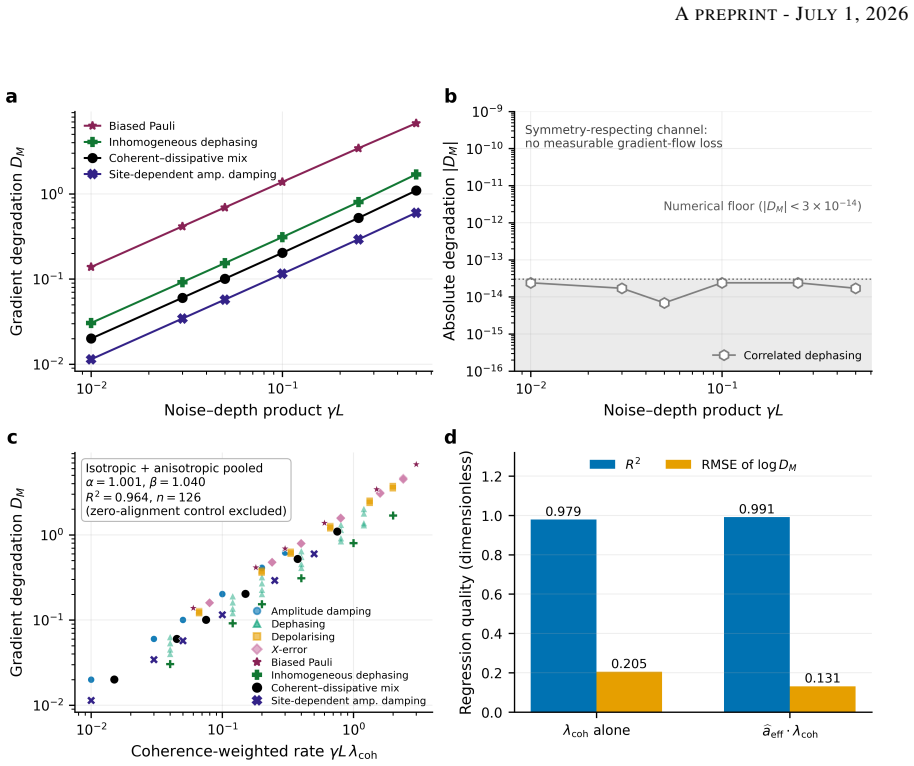
The central claim is that the readout-visible aligned coherence rate determines the leading-order training law for gradient survival under noise in these circuits. The light-cone reduction pins the noiseless gradient to the sector-restricted cone independently of qubit number. The rate quantifies contraction of off-diagonal modes visible to the readout. Open-system perturbation converts the rate into the law, and simulations validate that finite-noise effects follow one accumulated variable.
What carries the argument
The readout-visible aligned coherence rate as a Rayleigh quotient of the noise generator along the gradient-carrying mode, which converts open-system decay into a training law.
If this is right
- Gradient survival is controlled by the aligned coherence rate rather than worst-case noise rates.
- Specific channels with high general rates but low aligned rates leave gradients intact.
- The light-cone reduction holds with a bound independent of total qubit number.
- Degradation depends on a single variable from noise depth and coherence contraction.
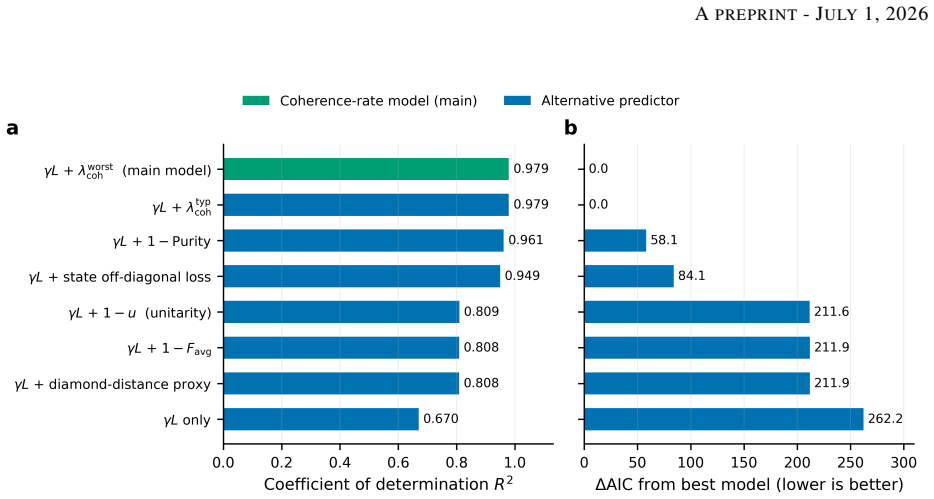
- Sector coherence outperforms standard channel diagnostics for predicting trainability.
Where Pith is reading between the lines
- Designers might target high aligned coherence rates when choosing noise models or architectures.
- The method could extend to other symmetry groups in equivariant quantum neural networks.
- This rate could be estimated in advance to assess trainability without full noisy simulations.
- It connects symmetry preservation directly to measurable open-system quantities for trainability.
Load-bearing premise
The perturbative open-system analysis converting the coherence rate into the training law is valid, along with the light-cone reduction being independent of system size.
What would settle it
Observing gradient loss in the correlated-dephasing channel where the aligned rate is near zero would falsify the predicted training law.
Figures
read the original abstract
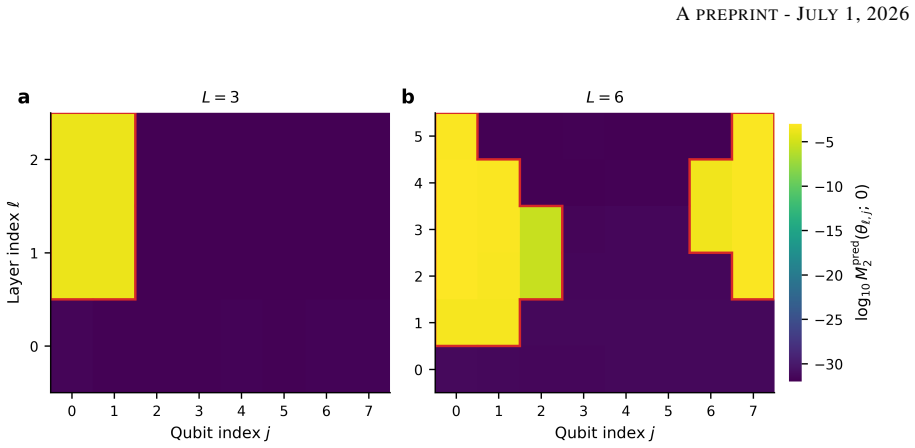
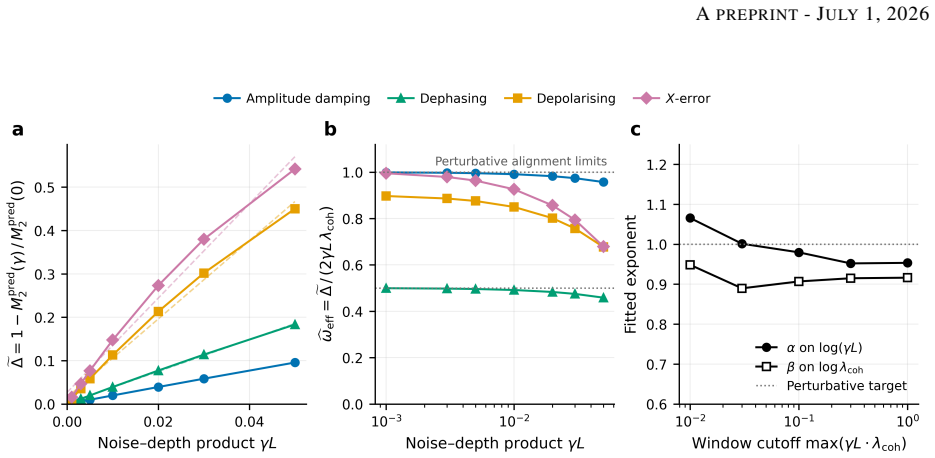
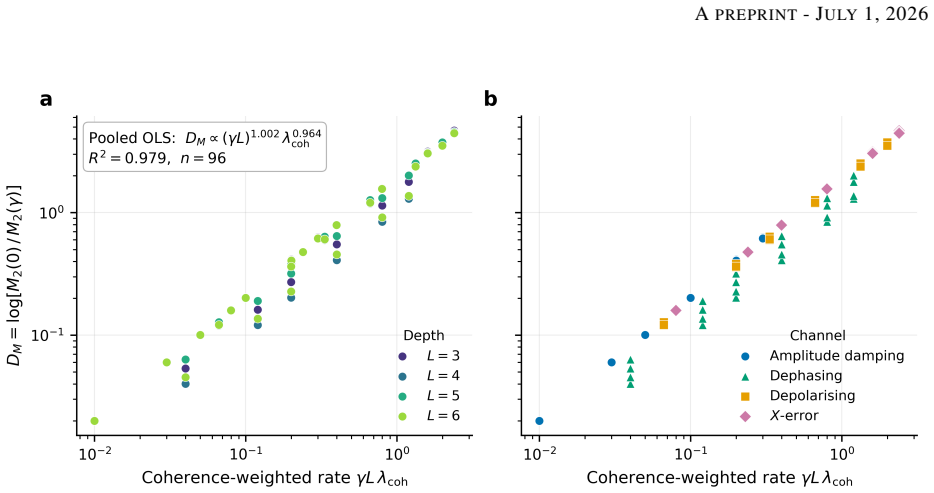
Symmetry provides a quantum neural network structure, but on its own it does not keep the network trainable once noise is present. We ask which physical quantity decides whether the gradients of an equivariant circuit survive decoherence, and we answer with a compact training law. Working with U(1)-equivariant brickwork circuits that conserve a charge, we find that two distinct effects govern a trainable gradient. Causality fixes where the gradient can live, confining it to the backward light cone of the readout inside the active charge sector. Coherence then determines how fast it decays through the contraction of the off-diagonal sector modes that the projected readout can actually observe. We prove a light-cone reduction that pins the noiseless gradient to the sector-restricted cone with a lower bound independent of the total qubit number, and we define a readout-visible aligned coherence rate as a Rayleigh quotient of the noise generator along the gradient-carrying mode. A perturbative open-system analysis turns this rate into a leading-order training law. Density-matrix simulations then confirm that the finite-noise degradation follows a single accumulated variable built from noise depth and coherence contraction, with a coefficient of determination of 0.979. The sharpest test comes from a correlated-dephasing channel that has a large worst-case rate but a near-zero aligned rate. The law predicts no gradient loss for this channel, and none is seen. Sector coherence outperforms every standard channel diagnostic we compare it against, and the analysis identifies readout-visible sector coherence as the quantity that links equivariant architecture, open-system dynamics and noisy trainability.
Editorial analysis
A structured set of objections, weighed in public.
Referee Report
Summary. The manuscript claims that in U(1)-equivariant brickwork quantum neural networks, gradient trainability under noise is governed by a readout-visible aligned coherence rate defined as a Rayleigh quotient of the noise generator along the gradient-carrying mode. A light-cone reduction is proven to pin the noiseless gradient to the sector-restricted cone with a lower bound independent of total qubit number. A perturbative open-system analysis converts this rate into a leading-order training law. Density-matrix simulations confirm degradation follows a single accumulated variable (R²=0.979), and a correlated-dephasing channel test (high worst-case rate but near-zero aligned rate) shows no loss as predicted, with sector coherence outperforming standard diagnostics.
Significance. If the central claim holds, the work identifies readout-visible sector coherence as the quantity linking equivariant structure, open-system dynamics, and noisy trainability, providing a compact law that outperforms standard channel diagnostics. Credit is due for the N-independent light-cone reduction, the falsifiable prediction confirmed by the correlated-dephasing test, and the high R² numerical support within the tested regime. This could inform design of noise-resilient symmetric QNNs.
major comments (2)
- [paragraph on perturbative analysis] Paragraph on perturbative analysis: the conversion of the aligned coherence rate (Rayleigh quotient of the noise generator) into the leading-order training law relies on a perturbative open-system analysis whose validity outside the weak-noise regime is assumed but not bounded; the reported R²=0.979 and zero-loss prediction for correlated dephasing are consistent with perturbation but do not rule out that the single-variable collapse is an artifact of the simulated parameter range (noise strength × depth).
- [light-cone reduction paragraph] Light-cone reduction paragraph: while stated as proven with an N-independent lower bound on the noiseless gradient in the sector-restricted cone, the manuscript provides no explicit derivation steps or bound expression, leaving the independence from total qubit number unverified for the gradient-carrying mode that the projected readout observes.
minor comments (2)
- Terminology for 'readout-visible aligned coherence rate' versus 'sector coherence' is used interchangeably in the abstract and main text; a single consistent definition would aid readability.
- The simulations section reports R²=0.979 but does not specify the exact noise models, depth ranges, or number of random instances used to obtain the fit.
Simulated Author's Rebuttal
We thank the referee for their constructive feedback and positive assessment of the work. We address each major comment below.
read point-by-point responses
-
Referee: the conversion of the aligned coherence rate (Rayleigh quotient of the noise generator) into the leading-order training law relies on a perturbative open-system analysis whose validity outside the weak-noise regime is assumed but not bounded; the reported R²=0.979 and zero-loss prediction for correlated dephasing are consistent with perturbation but do not rule out that the single-variable collapse is an artifact of the simulated parameter range (noise strength × depth).
Authors: We agree that the perturbative analysis assumes the weak-noise regime and that the reported R² and special-channel result are consistent with this regime but do not exclude higher-order corrections at stronger noise. In the revision we will add an explicit discussion of the validity range of the leading-order training law, state the conditions under which higher-order terms become appreciable, and include additional density-matrix simulations at higher noise strengths to test the breakdown of the single-variable collapse. revision: yes
-
Referee: while stated as proven with an N-independent lower bound on the noiseless gradient in the sector-restricted cone, the manuscript provides no explicit derivation steps or bound expression, leaving the independence from total qubit number unverified for the gradient-carrying mode that the projected readout observes.
Authors: The light-cone reduction and the claimed N-independent lower bound are derived in the manuscript, yet we acknowledge that the explicit steps and the bound expression were not presented with sufficient detail. In the revised version we will supply the complete derivation of the light-cone reduction, explicitly obtain the lower bound on the noiseless gradient within the sector-restricted cone, and verify that the bound remains independent of total qubit number for the gradient-carrying mode observed by the projected readout. revision: yes
Circularity Check
No significant circularity; derivation uses independent perturbative analysis and external simulation checks
full rationale
The paper defines the aligned coherence rate via Rayleigh quotient on the noise generator, proves a light-cone reduction separately, then applies perturbative open-system analysis to convert the rate into a leading-order training law. Simulations (R²=0.979) and the correlated-dephasing channel test (where aligned rate is near zero but worst-case rate is large, correctly predicting no loss) serve as independent validation rather than tautological confirmation. No self-citation chains, fitted inputs renamed as predictions, or reductions by construction appear in the load-bearing steps. The central claim remains externally falsifiable via the channel test and does not collapse to its inputs.
Axiom & Free-Parameter Ledger
axioms (2)
- domain assumption U(1)-equivariant brickwork circuits conserve charge and permit a light-cone reduction that confines the noiseless gradient to the sector-restricted cone independently of qubit number
- domain assumption Perturbative open-system analysis applies to convert the aligned coherence rate into a leading-order training law
invented entities (1)
-
readout-visible aligned coherence rate
no independent evidence
Reference graph
Works this paper leans on
-
[1]
J. Biamonte, P. Wittek, N. Pancotti, P. Rebentrost, N. Wiebe, and S. Lloyd, “Quantum machine learning,”Nature, vol. 549, pp. 195–202, 2017.https://doi.org/10.1038/nature23474
-
[2]
Quantum computing in the NISQ era and beyond,
J. Preskill, “Quantum computing in the NISQ era and beyond,”Quantum, vol. 2, art. 79, 2018. https://doi. org/10.22331/q-2018-08-06-79
work page internal anchor Pith review doi:10.22331/q-2018-08-06-79 2018
-
[3]
Variational quantum algorithms,
M. Cerezoet al., “Variational quantum algorithms,”Nature Reviews Physics, vol. 3, pp. 625–644, 2021. https: //doi.org/10.1038/s42254-021-00348-9
-
[4]
K. Mitarai, M. Negoro, M. Kitagawa, and K. Fujii, “Quantum circuit learning,”Physical Review A, vol. 98, art. 032309, 2018.https://doi.org/10.1103/PhysRevA.98.032309
-
[5]
Supervised learning with quantum-enhanced feature spaces,
V . Havlíˇceket al., “Supervised learning with quantum-enhanced feature spaces,”Nature, vol. 567, pp. 209–212, 2019.https://doi.org/10.1038/s41586-019-0980-2
-
[6]
Effect of data encoding on the expressive power of variational quantum machine learning models,
M. Schuld, R. Sweke, and J. J. Meyer, “Effect of data encoding on the expressive power of variational quantum machine learning models,”Physical Review A, vol. 103, art. 032430, 2021. https://doi.org/10.1103/ PhysRevA.103.032430
2021
-
[7]
The power of quantum neural networks,
A. Abbaset al., “The power of quantum neural networks,”Nature Computational Science, vol. 1, pp. 403–409, 2021.https://doi.org/10.1038/s43588-021-00084-1
-
[8]
Barren plateaus in quantum neural network training landscapes,
J. R. McClean, S. Boixo, V . N. Smelyanskiy, R. Babbush, and H. Neven, “Barren plateaus in quantum neural network training landscapes,”Nature Communications, vol. 9, art. 4812, 2018. https://doi.org/10.1038/ s41467-018-07090-4
2018
-
[9]
Cost function dependent barren plateaus in shallow parametrized quantum circuits,
M. Cerezo, A. Sone, T. V olkoff, L. Cincio, and P. J. Coles, “Cost function dependent barren plateaus in shallow parametrized quantum circuits,”Nature Communications, vol. 12, art. 1791, 2021. https://doi.org/10.1038/ s41467-021-21728-w
2021
-
[10]
Connecting ansatz expressibility to gradient magnitudes and barren plateaus,
Z. Holmes, K. Sharma, M. Cerezo, and P. J. Coles, “Connecting ansatz expressibility to gradient magnitudes and barren plateaus,”PRX Quantum, vol. 3, art. 010313, 2022. https://doi.org/10.1103/PRXQuantum.3. 010313 12 APREPRINT- JULY1, 2026
-
[11]
A Lie algebraic theory of barren plateaus for deep parameterized quantum circuits,
M. Ragoneet al., “A Lie algebraic theory of barren plateaus for deep parameterized quantum circuits,”Nature Communications, vol. 15, art. 7172, 2024.https://doi.org/10.1038/s41467-024-49909-3
-
[12]
Noise-induced barren plateaus in variational quantum algorithms,
S. Wanget al., “Noise-induced barren plateaus in variational quantum algorithms,”Nature Communications, vol. 12, art. 6961, 2021.https://doi.org/10.1038/s41467-021-27045-6
-
[13]
Limitations of optimization algorithms on noisy quantum devices,
D. Stilck França and R. García-Patrón, “Limitations of optimization algorithms on noisy quantum devices,”Nature Physics, vol. 17, pp. 1221–1227, 2021.https://doi.org/10.1038/s41567-021-01356-3
-
[14]
Noise resilience of variational quantum compiling,
K. Sharma, S. Khatri, M. Cerezo, and P. J. Coles, “Noise resilience of variational quantum compiling,”New Journal of Physics, vol. 22, art. 043006, 2020.https://doi.org/10.1088/1367-2630/ab784c
-
[15]
Group Equivariant Convolutional Networks
T. Cohen and M. Welling, “Group equivariant convolutional networks,”Proceedings of the 33rd International Conference on Machine Learning, pp. 2990–2999, 2016. https://proceedings.mlr.press/v48/cohenc16. html. arXiv DOI:https://doi.org/10.48550/arXiv.1602.07576
work page internal anchor Pith review Pith/arXiv arXiv doi:10.48550/arxiv.1602.07576 2016
-
[16]
Geometric Deep Learning: Grids, Groups, Graphs, Geodesics, and Gauges
M. M. Bronstein, J. Bruna, T. Cohen, and P. Veli ˇckovi’c, “Geometric deep learning: grids, groups, graphs, geodesics, and gauges,”arXiv:2104.13478, 2021.https://doi.org/10.48550/arXiv.2104.13478
work page internal anchor Pith review Pith/arXiv arXiv doi:10.48550/arxiv.2104.13478 2021
-
[17]
Group-invariant quantum machine learning,
M. Laroccaet al., “Group-invariant quantum machine learning,”PRX Quantum, vol. 3, art. 030341, 2022. https://doi.org/10.1103/PRXQuantum.3.030341
-
[18]
Theory for equivariant quantum neural networks,
Q. T. Nguyenet al., “Theory for equivariant quantum neural networks,”PRX Quantum, vol. 5, art. 020328, 2024. https://doi.org/10.1103/PRXQuantum.5.020328
-
[19]
Theoretical guarantees for permutation- equivariant quantum neural networks,
L. Schätzki, M. Larocca, Q. T. Nguyen, F. Sauvage, and M. Cerezo, “Theoretical guarantees for permutation- equivariant quantum neural networks,”npj Quantum Information, vol. 10, art. 12, 2024. https://doi.org/10. 1038/s41534-024-00804-1
2024
-
[20]
Exploiting symmetry in variational quantum machine learning,
J. J. Meyeret al., “Exploiting symmetry in variational quantum machine learning,”PRX Quantum, vol. 4, art. 010328, 2023.https://doi.org/10.1103/PRXQuantum.4.010328
-
[21]
Symmetry-organised complexity in quantum neural networks,
H. Ugail and N. Howard, “Symmetry-organised complexity in quantum neural networks,”Symmetry, vol. 18, no. 6, art. 912, 2026.https://doi.org/10.3390/sym18060912
-
[22]
Absence of barren plateaus in quantum convolutional neural networks,
A. Pesahet al., “Absence of barren plateaus in quantum convolutional neural networks,”Physical Review X, vol. 11, art. 041011, 2021.https://doi.org/10.1103/PhysRevX.11.041011
-
[23]
Generalization in quantum machine learning from few training data,
M. C. Caroet al., “Generalization in quantum machine learning from few training data,”Nature Communications, vol. 13, art. 4919, 2022.https://doi.org/10.1038/s41467-022-32550-3
-
[24]
Quantum machine learning beyond kernel methods,
S. Jerbiet al., “Quantum machine learning beyond kernel methods,”Nature Communications, vol. 14, art. 517, 2023.https://doi.org/10.1038/s41467-023-36159-y
-
[25]
Evaluation of latent diffusion enhanced face recognition under forensic image degradations,
H. Ugail, H. M. Alawar, A. A. Zehi, A. M. Alkendi, and I. L. Jaleel, “Evaluation of latent diffusion enhanced face recognition under forensic image degradations,”Discover Computing, vol. 29, art. 193, 2026. https: //doi.org/10.1007/s10791-026-10082-4
-
[26]
Deep face recognition using imperfect facial data,
A. Elmahmudi and H. Ugail, “Deep face recognition using imperfect facial data,”Future Generation Computer Systems, vol. 99, pp. 213–225, 2019.https://doi.org/10.1016/j.future.2019.04.025
-
[27]
Deep transfer learning for visual analysis and attribution of paintings by Raphael,
H. Ugail, D. G. Stork, H. G. M. Edwards, S. C. Seward, and C. Brooke, “Deep transfer learning for visual analysis and attribution of paintings by Raphael,”Heritage Science, vol. 11, article 268, 2023. https://doi.org/10. 1186/s40494-023-01094-0
2023
-
[28]
A. A. Ibrahim, N. H. Ugail, and H. Ugail, “Is facial beauty in the eyes? A multi-method approach to interpreting facial beauty prediction in machine learning models,”Discover Artificial Intelligence, vol. 5, p. 16, 2025. https://doi.org/10.1007/s44163-025-00226-8
-
[29]
H. Ugail and N. Howard, “Quantifying the dynamics of consciousness using hierarchical integration, organ- ised complexity and metastability,”arXiv:2512.10972, Dec. 2025. https://doi.org/10.48550/arXiv.2512. 10972
-
[30]
Extending Noether’s theorem by quantifying the asymmetry of quantum states,
I. Marvian and R. W. Spekkens, “Extending Noether’s theorem by quantifying the asymmetry of quantum states,” Nature Communications, vol. 5, art. 3821, 2014.https://doi.org/10.1038/ncomms4821
-
[31]
Robustness of asymmetry and coherence of quantum states,
M. Pianiet al., “Robustness of asymmetry and coherence of quantum states,”Physical Review A, vol. 93, art. 042107, 2016.https://doi.org/10.1103/PhysRevA.93.042107
-
[32]
T. Baumgratz, M. Cramer, and M. B. Plenio, “Quantifying coherence,”Physical Review Letters, vol. 113, art. 140401, 2014.https://doi.org/10.1103/PhysRevLett.113.140401
-
[33]
A channel-level diagnostic for symmetry breaking in noisy equivariant quantum neural networks,
H. Ugail and N. Howard, “A channel-level diagnostic for symmetry breaking in noisy equivariant quantum neural networks,”IEEE Access, vol. 14, 2026.https://doi.org/10.1109/ACCESS.2026.3706394 13 APREPRINT- JULY1, 2026
-
[34]
On the generators of quantum dynamical semigroups,
G. Lindblad, “On the generators of quantum dynamical semigroups,”Communications in Mathematical Physics, vol. 48, pp. 119–130, 1976.https://doi.org/10.1007/BF01608499
-
[35]
Completely positive dynamical semigroups of N-level systems,
V . Gorini, A. Kossakowski, and E. C. G. Sudarshan, “Completely positive dynamical semigroups of N-level systems,”Journal of Mathematical Physics, vol. 17, pp. 821–825, 1976.https://doi.org/10.1063/1.522979
-
[36]
H.-P. Breuer and F. Petruccione,The Theory of Open Quantum Systems. Oxford University Press, Oxford, 2002. https://doi.org/10.1093/acprof:oso/9780199213900.001.0001
work page doi:10.1093/acprof:oso/9780199213900.001.0001 2002
-
[37]
An initialization strategy for addressing barren plateaus in parametrized quantum circuits,
E. Grant, L. Wossnig, M. Ostaszewski, and M. Benedetti, “An initialization strategy for addressing barren plateaus in parametrized quantum circuits,”Quantum, vol. 3, art. 214, 2019. https://doi.org/10.22331/ q-2019-12-09-214
2019
-
[38]
Evaluating analytic gradients on quantum hardware,
M. Schuld, V . Bergholm, C. Gogolin, J. Izaac, and N. Killoran, “Evaluating analytic gradients on quantum hardware,”Physical Review A, vol. 99, art. 032331, 2019. https://doi.org/10.1103/PhysRevA.99.032331
-
[39]
General parameter-shift rules for quantum gradients,
D. Wierichs, J. Izaac, C. Wang, and C. Y .-Y . Lin, “General parameter-shift rules for quantum gradients,”Quantum, vol. 6, art. 677, 2022.https://doi.org/10.22331/q-2022-03-30-677
-
[40]
Covariant quantum Markovian evolutions,
A. S. Holevo, “Covariant quantum Markovian evolutions,”Journal of Mathematical Physics, vol. 37, pp. 1812– 1832, 1996.https://doi.org/10.1063/1.531481
-
[41]
M. A. Nielsen and I. L. Chuang,Quantum Computation and Quantum Information. Cambridge University Press, Cambridge, 2010.https://doi.org/10.1017/CBO9780511976667 14
discussion (0)
Sign in with ORCID, Apple, or X to comment. Anyone can read and Pith papers without signing in.