REVIEW 3 major objections 2 minor 39 references
A teacher-student model using gradient reversal and a variational bottleneck suppresses linguistic bias to improve spoofing detector generalization.
Reviewed by Pith at T0; open to challenge. T0 means a machine referee read the full paper against a public rubric. the ladder, T0–T4 →
T0 review · grok-4.3
2026-07-01 05:54 UTC pith:HTA3M52L
load-bearing objection The paper applies gradient reversal from a linguistic teacher plus VIB to reduce language bias in spoofing detection and reports up to 36.2% relative EER drop on nine DF Arena sets, but supplies no ablations or probes to confirm the mechanism. the 3 major comments →
Linguistic Bias Mitigation for Spoofing Detection via Gradient Reversal and A Variational Information Bottleneck
The pith
A machine-rendered reading of the paper's core claim, the machinery that carries it, and where it could break.
Core claim
Linguistic bias, arising from reliance on content cues present in training data, explains poor cross-dataset performance of spoofing detectors; a linguistic-aware teacher combined with gradient reversal and a variational information bottleneck allows the detector to minimize linguistic information while retaining non-linguistic spoofing cues, yielding up to 36.2 percent relative EER reduction on the DF Arena collection.
What carries the argument
Teacher-student adversarial learning in which gradient reversal from a pre-trained linguistic teacher drives the student detector to minimize linguistic information, regularized by a variational information bottleneck that controls the trade-off between suppression and retention of spoofing cues.
Load-bearing premise
Linguistic bias is the primary driver of poor out-of-domain performance and the proposed teacher-plus-bottleneck mechanism can remove that bias without also discarding the acoustic or other cues needed to detect spoofs.
What would settle it
Training the same detector architecture with the proposed components and measuring that equal error rate on the nine held-out DF Arena sets does not drop relative to the baseline, or that the detector's accuracy collapses once linguistic information is demonstrably removed.
If this is right
- The detector becomes more robust when evaluated on recording conditions, languages, or synthesis methods absent from its original training data.
- The same gradient-reversal-plus-bottleneck recipe can be attached to other audio classifiers that currently overfit to content or channel artifacts.
- Performance gains are largest on the most mismatched evaluation sets, confirming that the method targets the generalization gap rather than in-domain accuracy.
- The variational bottleneck prevents the adversarial signal from erasing all non-linguistic information, preserving detection capability while language cues are suppressed.
Where Pith is reading between the lines
- The same architecture could be tested on image or video deepfake detectors that suffer analogous content bias.
- If linguistic information can be isolated and removed in this way, the method might also help with speaker verification systems that inadvertently encode accent or language.
- An open question left by the work is whether the teacher model needs to be trained on the same languages as the target data or can be language-agnostic.
Editorial analysis
A structured set of objections, weighed in public.
Referee Report
Summary. The manuscript claims that poor out-of-domain generalization in spoofing detectors stems from linguistic bias in training data. It proposes a teacher-student adversarial framework in which a pre-trained linguistic teacher guides the student detector via gradient reversal to minimize linguistic information, with a Variational Information Bottleneck added to avoid discarding spoofing-discriminative cues. The method is reported to yield up to a 36.2% relative EER reduction across nine DF Arena datasets relative to an unspecified baseline.
Significance. If the reported gains prove robust and the selective-suppression mechanism can be verified, the approach would offer a targeted way to improve cross-domain robustness in voice-biometrics anti-spoofing systems. The combination of gradient reversal with VIB is a plausible technical direction, but the manuscript supplies no supporting evidence that the performance change arises from linguistic debiasing rather than incidental regularization.
major comments (3)
- [Abstract] Abstract: the central claim of a 36.2% relative EER reduction is presented without any description of the experimental protocol, baseline architecture, training hyperparameters, dataset partitions, or statistical tests, rendering the numerical result impossible to evaluate or reproduce.
- [Abstract] Abstract: no probing results, mutual-information estimates, or ablation studies isolating the gradient-reversal and VIB components are reported. Without such diagnostics it cannot be established that linguistic content is selectively suppressed while spoofing cues are retained, which is required to attribute any EER improvement to the stated bias-mitigation mechanism rather than generic regularization.
- [Abstract] Abstract: the training objective is described only at a high level; no loss equations, gradient-reversal formulation, VIB variational bound, or optimization procedure are supplied, preventing verification that the method implements the claimed information-bottleneck behavior.
minor comments (2)
- [Abstract] Abstract: 'compare to the baseline' should read 'compared to the baseline'.
- [Abstract] Abstract: 'A Variational Information Bottleneck' should be 'a variational information bottleneck' for grammatical consistency with the surrounding sentence.
Simulated Author's Rebuttal
We thank the referee for the constructive comments on the abstract. We agree that the abstract would benefit from additional context on the experimental setup and will revise it accordingly while preserving conciseness. We address each major comment below.
read point-by-point responses
-
Referee: [Abstract] Abstract: the central claim of a 36.2% relative EER reduction is presented without any description of the experimental protocol, baseline architecture, training hyperparameters, dataset partitions, or statistical tests, rendering the numerical result impossible to evaluate or reproduce.
Authors: The full manuscript details the experimental protocol and dataset partitions in Section 4, the baseline architecture (a standard ResNet-based spoofing detector) in Section 3.1, training hyperparameters in Section 4.2, and statistical significance via bootstrap resampling in Section 4.3. We will revise the abstract to briefly specify the baseline and the nine DF Arena datasets to provide necessary context for the reported result. revision: yes
-
Referee: [Abstract] Abstract: no probing results, mutual-information estimates, or ablation studies isolating the gradient-reversal and VIB components are reported. Without such diagnostics it cannot be established that linguistic content is selectively suppressed while spoofing cues are retained, which is required to attribute any EER improvement to the stated bias-mitigation mechanism rather than generic regularization.
Authors: Ablation studies isolating the gradient-reversal and VIB components appear in Section 5.3, and mutual-information estimates between detector features and linguistic labels are reported in Section 5.4 to demonstrate selective suppression of linguistic information while retaining spoofing cues. These results support attribution to the debiasing mechanism. We will add a reference to these diagnostics in the revised abstract. revision: yes
-
Referee: [Abstract] Abstract: the training objective is described only at a high level; no loss equations, gradient-reversal formulation, VIB variational bound, or optimization procedure are supplied, preventing verification that the method implements the claimed information-bottleneck behavior.
Authors: Abstracts conventionally summarize the approach at a high level. The complete loss equations, gradient-reversal formulation, VIB variational bound, and optimization procedure are provided in Equations (1)–(5) and Section 3.2 of the manuscript. We will revise the abstract to include a short reference to the combined objective to better indicate the information-bottleneck behavior. revision: yes
Circularity Check
Empirical method with no derivation chain or fitted predictions
full rationale
The paper describes a teacher-student adversarial framework using gradient reversal and VIB to mitigate linguistic bias in spoofing detection, then reports an empirical EER reduction of up to 36.2% across nine datasets. No equations, first-principles derivations, parameter fits, or predictions are presented that could reduce to inputs by construction. The abstract states the mechanism at a high level and presents aggregate performance numbers as experimental outcomes. No self-citation load-bearing steps, uniqueness theorems, or ansatzes appear in the provided text. This is a standard empirical ML contribution whose central claim rests on measured results rather than any algebraic or definitional reduction.
Axiom & Free-Parameter Ledger
axioms (1)
- domain assumption Linguistic cues observed in training data are the primary cause of poor generalization to out-of-domain settings in spoofing detectors.
read the original abstract
Rapid advancements in generative speech technology have compromised the reliability of voice biometrics. While current spoofing detectors excel when assessed under in-domain conditions, generalisation to out-of-domain settings is often poor. We show that this can be due to linguistic bias. A reliance on linguistic cues observed in training data can then compromise robustness to cross-data. We propose a linguistic-invariant spoofing detection framework utilizing teacher-student adversarial learning. The linguistic-aware teacher model, pre-trained on linguistic content of an external dataset, guides the student detector via gradient reversal to minimize the linguistic information. To prevent the inadvertent removal of non-linguistic cues, we incorporate a Variational Information Bottleneck to enable suppression of principal cues. Across nine DF Arena datasets, our method achieves up to a 36.2% relative reduction in the EER compare to the baseline.
Figures

Reference graph
Works this paper leans on
-
[1]
Introduction Advances in text-to-speech (TTS) and voice conversion have led to realistic speech deepfakes, posing security risks to the reliability of voice biometrics. To mitigate these threats, spoof- ing detection systems are deployed to protect voice biometrics. In recent years, the ASVspoof and Audio Deepfake Detection (ADD) initiatives have driven s...
work page internal anchor Pith review Pith/arXiv arXiv 2019
-
[2]
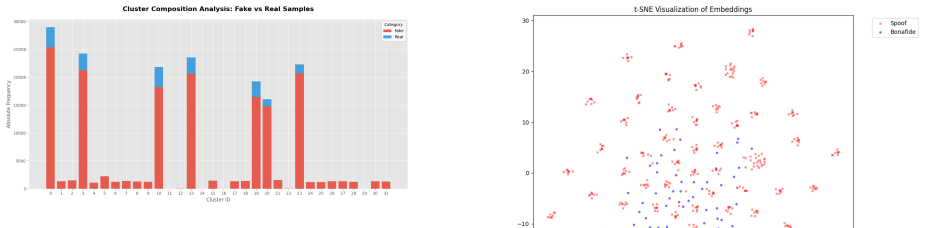
Linguistic Bias Analysis Spoofing detection corpora can suffer from linguistic bias when spoofed and bona fide utterances differ in spoken content. In such cases, classifiers may learn to associate specific linguis- tic patterns with class labels, allowing them to rely on what is being said rather than acoustic artifacts indicative of spoofing. We investi...
-
[3]
Method for Linguistic Bias Mitigation We describe in the following our use of a teacher-student frame- work to suppress the use of linguistic information for spoofing detection. The teacher model is trained using a phrase linguis- tic content classification task to capture linguistic features. The student model is trained in a multi-task manner for both s...
-
[4]
Average” reports the mean EER across evaluation sets. “Pooled
Experimental Setup 4.1. Phrase linguistic content classification dataset We train a phrase linguistic content classification model using the Common V oice dataset [19]. Passphrases are grouped ac- cording to their transcriptions, and only those occurring at least five times and fewer than twenty times are retained. This fil- tering results in approximatel...
work page 2019
-
[5]
Results 5.1. Baseline spoofing detection performance The variation in performance for baseline models AASIST, Conformer, and MHFA (Table 1) underscores the generaliza- tion challenge in spoofing detection. While EERs are between approximately 5 and 7% EERs for the ASVspoof 2021 DF database, with only few exceptions, performance degrades sub- stantially fo...
work page 2021
-
[6]
Conclusions In this paper, we address a critical yet unexplored limitation of spoofing detection systems: linguistic bias. We demonstrate that, in ASVspoof 5, mismatches in spoken content between spoofed and bona fide utterances enable models to exploit lin- guistic cues, undermining generalization. To address this, we propose IVLing-VIB, a teacher–studen...
-
[7]
This work was financially supported by ANR BRUEL (ANR-22-CE39-0009)
Acknowledgements This work was performed using HPC resources from GENCI- IDRIS. This work was financially supported by ANR BRUEL (ANR-22-CE39-0009)
-
[8]
Generative AI Use Disclosure During the preparation of this work, the authors used generative AI models (specifically Google Gemini and ChatGPT) to polish the language and correct grammatical errors in this manuscript. The authors rigorously reviewed and edited all text and take full responsibility for the publication content
-
[9]
ASVspoof 5: crowd- sourced speech data, deepfakes, and adversarial attacks at scale,
X. Wang, H. Delgado, H. Tak, J. weon Jung, H. jin Shim, M. Todisco, I. Kukanov, X. Liu, M. Sahidullah, T. H. Kinnunen, N. Evans, K. A. Lee, and J. Yamagishi, “ASVspoof 5: crowd- sourced speech data, deepfakes, and adversarial attacks at scale,” inASVspoof, 2024
work page 2024
-
[10]
ADD 2022: the first audio deep synthesis detection challenge,
J. Yi, R. Fu, J. Tao, S. Nie, H. Ma, C. Wang, T. Wang, Z. Tian, Y . Bai, C. Fan, S. Liang, S. Wang, S. Zhang, X. Yan, L. Xu, Z. Wen, and H. Li, “ADD 2022: the first audio deep synthesis detection challenge,” inICASSP, 2022
work page 2022
-
[11]
AASIST: audio anti-spoofing using integrated spectro- temporal graph attention networks,
J. Jung, H. Heo, H. Tak, H. Shim, J. S. Chung, B. Lee, H. Yu, and N. Evans, “AASIST: audio anti-spoofing using integrated spectro- temporal graph attention networks,” inICASSP. IEEE, 2022, pp. 6367–6371
work page 2022
-
[12]
A conformer-based classifier for variable-length utterance process- ing in anti-spoofing,
E. Rosello, A. G. Alan ´ıs, A. M. Gomez, and A. M. Peinado, “A conformer-based classifier for variable-length utterance process- ing in anti-spoofing,” inINTERSPEECH, 2023
work page 2023
-
[13]
Exploring WavLM back-ends for speech spoofing and deepfake detection,
T. Stourbe, V . Miara, T. Lepage, and R. Dehak, “Exploring WavLM back-ends for speech spoofing and deepfake detection,” inASVspoof, 2024
work page 2024
-
[14]
Audio deepfake detection with self- supervised xls-r and sls classifier
Q. Zhang, S. Wen, and T. Hu, “Audio deepfake detection with self- supervised xls-r and sls classifier.” Association for Computing Machinery, 2024
work page 2024
-
[15]
Xlsr-mamba: A dual-column bidirec- tional state space model for spoofing attack detection,
Y . Xiao and R. K. Das, “Xlsr-mamba: A dual-column bidirec- tional state space model for spoofing attack detection,”IEEE Sig- nal Processing Letters, 2025
work page 2025
-
[16]
Aasist: Audio anti-spoofing using inte- grated spectro-temporal graph attention networks,
J.-w. Jung, H.-S. Heo, H. Tak, H.-j. Shim, J. S. Chung, B.-J. Lee, H.-J. Yu, and N. Evans, “Aasist: Audio anti-spoofing using inte- grated spectro-temporal graph attention networks,” inICASSP - IEEE International Conference on Acoustics, Speech and Signal Processing (ICASSP), 2022
work page 2022
-
[17]
End-to-end anti-spoofing with rawnet2,
H. Tak, J. Patino, M. Todisco, A. Nautsch, N. Evans, and A. Larcher, “End-to-end anti-spoofing with rawnet2,” inIEEE International Conference on Acoustics, Speech and Signal Pro- cessing, ICASSP 2021, Toronto, ON, Canada, June 6-11, 2021. IEEE, 2021, pp. 6369–6373
work page 2021
-
[18]
ASVspoof 5 challenge: advanced resnet architectures for robust voice spoofing detection,
A.-T. Dao, M. Rouvier, and D. Matrouf, “ASVspoof 5 challenge: advanced resnet architectures for robust voice spoofing detection,” inASVspoof, 2024
work page 2024
-
[19]
Speech is silver, silence is golden: What do ASVspoof-trained models really learn?
N. M. M ¨uller, F. Dieckmann, P. Czempin, R. Canals, and K. B ¨ottinger, “Speech is silver, silence is golden: What do ASVspoof-trained models really learn?”ArXiv, 2021
work page 2021
-
[20]
X. Wang, H. Delgado, N. Evans, X. Liu, T. Kinnunen, H. Tak, K. A. Lee, I. Kukanov, M. Sahidullah, M. Todisco, and J. Yamag- ishi, “ASVspoof 5: Evaluation of spoofing, deepfake, and adver- sarial attack detection using crowdsourced speech,” 2026
work page 2026
-
[21]
Unsupervised domain adaptation by backpropagation,
Y . Ganin and V . Lempitsky, “Unsupervised domain adaptation by backpropagation,” inICML, 2015
work page 2015
-
[22]
Assessing the impact of speaker identity in speech spoofing detection,
A.-T. Dao, D. Matrouf, and N. Evans, “Assessing the impact of speaker identity in speech spoofing detection,” inICASSP, 2026
work page 2026
-
[23]
A.-T. Dao, D. Matrouf, M. Rouvier, and N. Evans, “Enhancing multi-corpus training in ssl-based anti-spoofing models: Domain- invariant feature extraction,”arXiv preprint arXiv:2603.18657, 2026
-
[24]
Deep vari- ational information bottleneck,
A. A. Alemi, I. Fischer, J. V . Dillon, and K. Murphy, “Deep vari- ational information bottleneck,”ICLR, 2017
work page 2017
-
[25]
SONAR: Sentence-Level Multimodal and Language-Agnostic Representations
P.-A. Duquenne, H. Schwenk, and B. Sagot, “SONAR: sentence- level multimodal and language-agnostic representations,” 2023. [Online]. Available: https://arxiv.org/abs/2308.11466
work page Pith review arXiv 2023
-
[26]
XLS-R: self-supervised cross-lingual speech representation learning at scale,
A. Babu, C. Wang, A. Tjandra, K. Lakhotia, Q. Xu, N. Goyal, K. Singh, P. von Platen, Y . Saraf, J. Pino, A. Baevski, A. Con- neau, and M. Auli, “XLS-R: self-supervised cross-lingual speech representation learning at scale,” inINTERSPEECH, 2022
work page 2022
-
[27]
Unified text and speaker verification using ssl model for text- dependent speaker verification,
N. Griot, D. Matrouf, R. Blouet, J.-F. Bonastre, and A. Mantecon, “Unified text and speaker verification using ssl model for text- dependent speaker verification,” inProc. Interspeech 2025, 2025, pp. 1648–1652
work page 2025
-
[28]
Speech df arena: A leaderboard for speech deepfake detection models,
S. Dowerah, A. Kulkarni, A. Kulkarni, H. M. Tran, J. Kalda, A. Fedorchenko, B. Fauve, D. Lolive, T. Alum¨ae, and M. M. Doss, “Speech df arena: A leaderboard for speech deepfake detection models,” 2025
work page 2025
-
[29]
Does audio deepfake detection generalize?
N. M. M ¨uller, P. Czempin, F. Dieckmann, A. Froghyar, and K. B¨ottinger, “Does audio deepfake detection generalize?” inIN- TERSPEECH 2022. ISCA, 2022, pp. 2783–2787
work page 2022
-
[30]
ASVspoof 2019: Future horizons in spoofed and fake audio detection,
M. Todisco, X. Wang, V . Vestman, M. Sahidullah, H. Delgado, A. Nautsch, J. Yamagishi, N. Evans, T. H. Kinnunen, and K. A. Lee, “ASVspoof 2019: Future horizons in spoofed and fake audio detection,” inINTERSPEECH, 2019
work page 2019
-
[31]
ASVspoof 2021: accelerating progress in spoofed and deepfake speech detection,
J. Yamagishi, X. Wang, M. Todisco, M. Sahidullah, J. Patino, A. Nautsch, X. Liu, K. A. Lee, T. Kinnunen, N. Evans, and H. Delgado, “ASVspoof 2021: accelerating progress in spoofed and deepfake speech detection,” inASVspoof, 2021
work page 2021
-
[32]
For: A dataset for synthetic speech detection,
R. Reimao and V . Tzerpos, “For: A dataset for synthetic speech detection,” in2019 International Conference on Speech Technol- ogy and Human-Computer Dialogue, SpeD 2019, Timisoara, Ro- mania, October 10-12, C. Burileanu and H. Teodorescu, Eds., 2019
work page 2019
-
[33]
The codecfake dataset and countermeasures for the universally detection of deepfake audio,
Y . Xie, Y . Lu, R. Fu, Z. Wen, Z. Wang, J. Tao, X. Qi, X. Wang, Y . Liu, H. Cheng, L. Ye, and Y . Sun, “The codecfake dataset and countermeasures for the universally detection of deepfake audio,” IEEE Transactions on Audio, Speech and Language Processing, 2025
work page 2025
-
[34]
Dfadd: The diffusion and flow- matching based audio deepfake dataset,
J. Du, I.-M. Lin, I.-H. Chiu, X. Chen, H. Wu, W. Ren, Y . Tsao, H.-Y . Lee, and J.-S. R. Jang, “Dfadd: The diffusion and flow- matching based audio deepfake dataset,” in2024 IEEE Spoken Language Technology Workshop (SLT), 2024
work page 2024
-
[35]
Ai-synthesized voice detection using neural vocoder artifacts,
C. Sun, S. Jia, S. Hou, and S. Lyu, “Ai-synthesized voice detection using neural vocoder artifacts,” in2023 IEEE/CVF Conference on Computer Vision and Pattern Recognition Workshops (CVPRW), 2023
work page 2023
-
[36]
X. Li, P.-Y . Chen, and W. Wei, “Where are we in audio deep- fake detection? a systematic analysis over generative and detec- tion models,”ACM Transactions on Internet Technology, 2025
work page 2025
-
[37]
MUSAN: A music, speech, and noise corpus,
D. Snyder, G. Chen, and D. Povey, “MUSAN: A music, speech, and noise corpus,”ArXiv, 2015
work page 2015
-
[38]
A study on data augmentation of reverberant speech for robust speech recognition,
T. Ko, V . Peddinti, D. Povey, M. L. Seltzer, and S. Khudanpur, “A study on data augmentation of reverberant speech for robust speech recognition,” inICASSP, 2017
work page 2017
-
[39]
Adam: A method for stochastic opti- mization,
D. P. Kingma and J. Ba, “Adam: A method for stochastic opti- mization,” inICLR, Y . Bengio and Y . LeCun, Eds., 2015
work page 2015
discussion (0)
Sign in with ORCID, Apple, or X to comment. Anyone can read and Pith papers without signing in.