Team MKC at CLPsych 2026: Capturing and Characterizing Mental Health Changes through Social Media Timeline Dynamics
Pith reviewed 2026-07-01 05:46 UTC · model grok-4.3
The pith
An LLM pipeline jointly performs post-level assessment and user-level temporal modeling of mental health changes from social media timelines.
A machine-rendered reading of the paper's core claim, the machinery that carries it, and where it could break.
Core claim
The central claim is that the proposed LLM-based pipeline offers a unified framework that jointly enables post-level assessment and user-level temporal modeling for comprehensive mental health analysis over sequentially ordered user posts.
What carries the argument
The LLM-based pipeline that processes sequentially ordered user posts to jointly perform post-level assessment and user-level temporal modeling.
Load-bearing premise
Social media post sequences contain sufficient signal for reliable LLM-based detection and characterization of mental health changes.
What would settle it
An experiment where the pipeline's outputs show low agreement with clinical ground truth on a held-out set of user timelines that were never seen during task development.
Figures
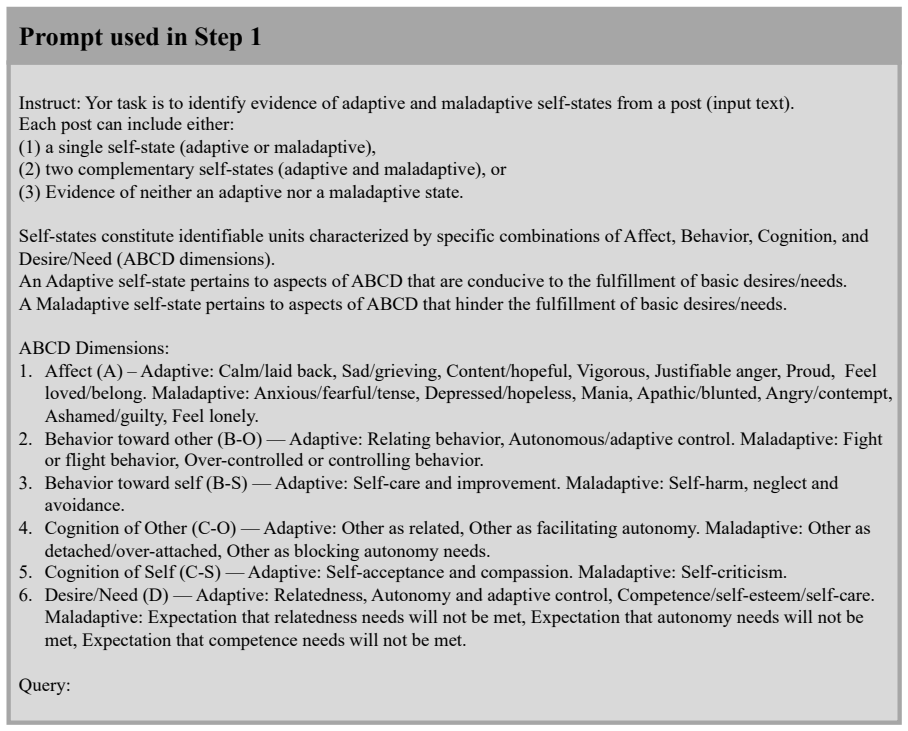
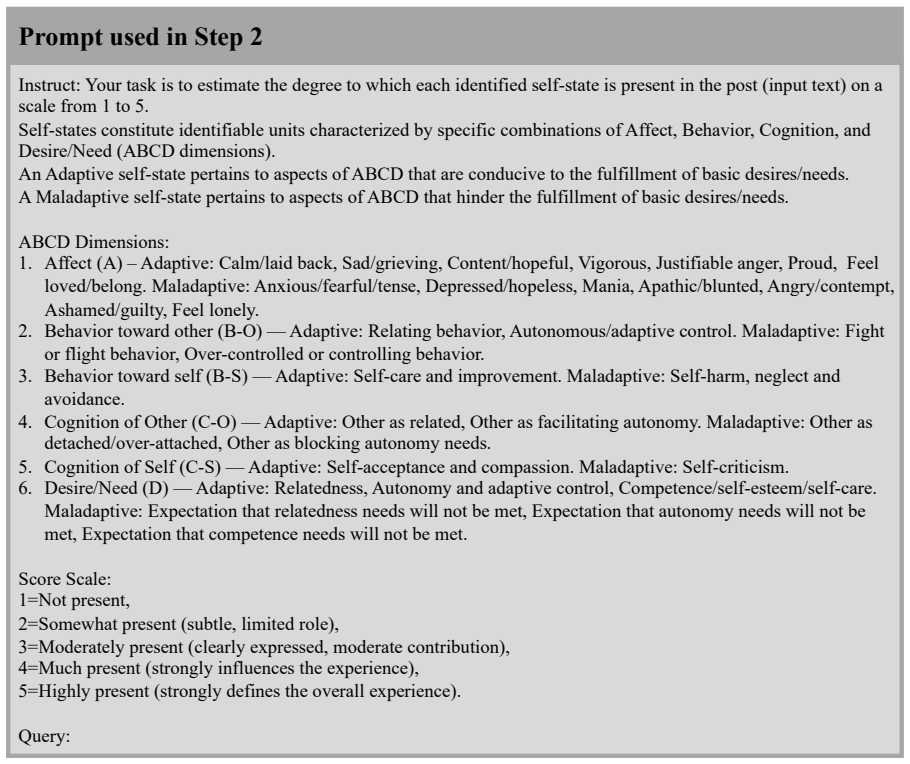
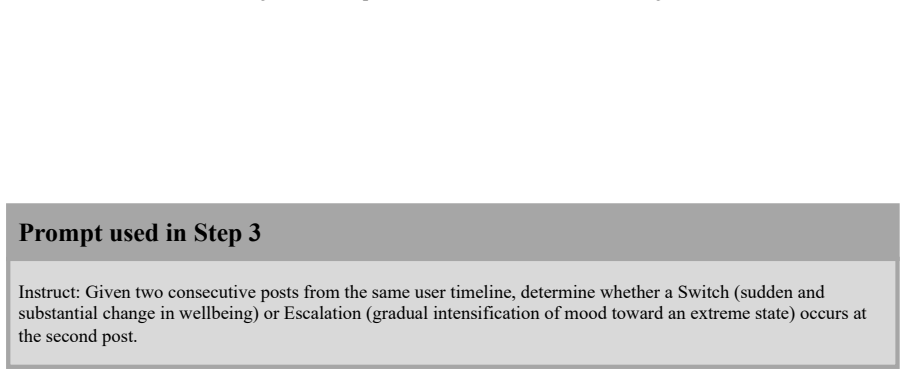
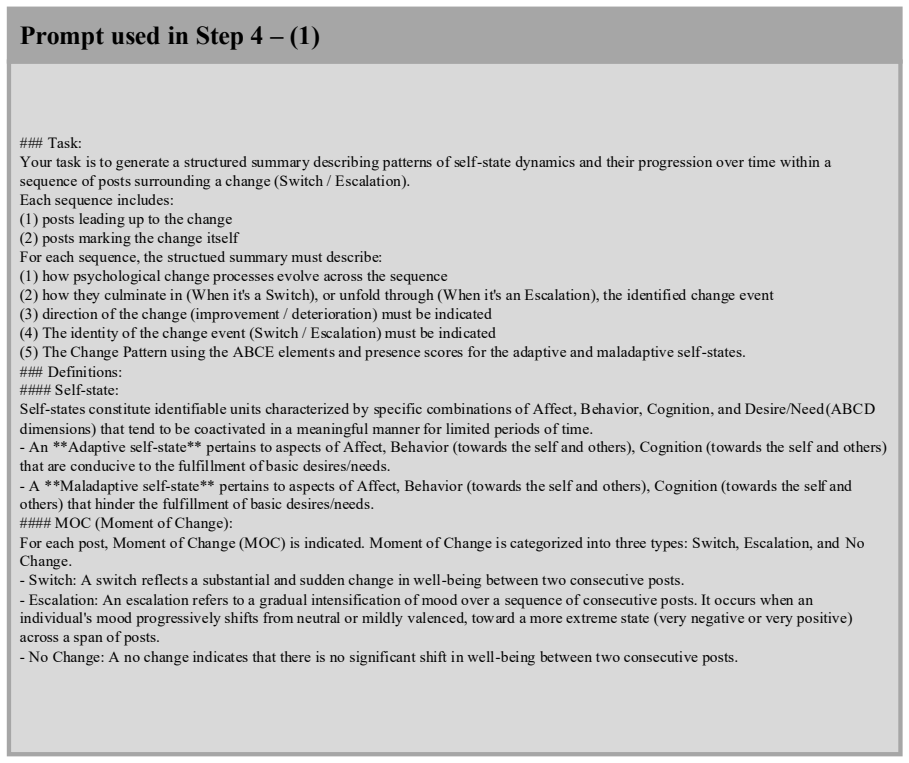
read the original abstract
Recent advances in Large Language Models (LLMs) have motivated their adoption across a wide range of domains, including Artificial Intelligence (AI) for mental health. Given the growing prevalence of mental health disorders worldwide and the limited accessibility of professional care, there is an increasing demand for scalable computational approaches that can assist in early detection and continuous monitoring of psychological well-being. In this area, ongoing efforts have focused on curating domain-specific datasets and leveraging them to develop LLMs capable of supporting holistic mental health analysis. In line with this direction, we propose an LLM-based pipeline for comprehensive mental health analysis over sequentially ordered user posts, as part of the CLPsych shared task. Our pipeline offers a unified framework that jointly enables post-level assessment and user-level temporal modeling.
Editorial analysis
A structured set of objections, weighed in public.
Referee Report
Summary. The paper proposes an LLM-based pipeline for comprehensive mental health analysis over sequentially ordered user posts from social media, submitted to the CLPsych 2026 shared task. It claims this pipeline constitutes a unified framework that jointly enables post-level assessment and user-level temporal modeling of mental health changes.
Significance. If the pipeline were shown to reliably extract diagnostic signal from raw social media timelines without extensive adaptation or external validation, it could advance scalable computational methods for mental health monitoring. The area is timely given rising mental health prevalence and LLM capabilities, but the manuscript supplies no empirical results, ablations, or clinical validation to establish whether the claimed joint framework delivers measurable gains over separate post- and user-level approaches.
major comments (2)
- [Abstract] Abstract: the central claim that the pipeline 'jointly enables post-level assessment and user-level temporal modeling' is presented without any description of the joint modeling mechanism, loss function, or integration step between the two levels.
- [Abstract] Abstract: no performance metrics, ablation studies, or comparison against clinical ground truth are reported, leaving the premise that raw social media post sequences contain sufficient signal for reliable off-the-shelf LLM detection untested and therefore unable to support the unified-framework assertion.
minor comments (1)
- The manuscript consists solely of the abstract with no methods, results, or error-analysis sections, which prevents evaluation of the pipeline's technical soundness.
Simulated Author's Rebuttal
We thank the referee for the detailed feedback on our system description paper for the CLPsych 2026 shared task. Below we respond point-by-point to the major comments.
read point-by-point responses
-
Referee: [Abstract] Abstract: the central claim that the pipeline 'jointly enables post-level assessment and user-level temporal modeling' is presented without any description of the joint modeling mechanism, loss function, or integration step between the two levels.
Authors: The pipeline operates sequentially: individual posts receive post-level mental health assessments via targeted LLM prompting, after which the ordered sequence of assessments is fed to a second LLM stage that performs temporal reasoning to detect and characterize changes at the user level. This constitutes the integration mechanism; there is no single end-to-end loss because the approach is an inference pipeline rather than a jointly trained model. We will revise the abstract to concisely describe this two-stage integration. revision: yes
-
Referee: [Abstract] Abstract: no performance metrics, ablation studies, or comparison against clinical ground truth are reported, leaving the premise that raw social media post sequences contain sufficient signal for reliable off-the-shelf LLM detection untested and therefore unable to support the unified-framework assertion.
Authors: This manuscript is a system paper submitted to the shared task; its primary contribution is the pipeline architecture. Official performance metrics, including comparison to clinical annotations, will be produced by the shared-task organizers on the held-out test set and reported in the task overview. We will add a clarifying sentence in the abstract and introduction noting that quantitative evaluation occurs via the shared task. The framework claim refers to the pipeline's ability to address both levels within one workflow, which can be validated once task results are available. revision: partial
Circularity Check
No circularity: pipeline description contains no derivations or self-referential reductions
full rationale
The paper presents a high-level LLM pipeline for post-level assessment and user-level temporal modeling in a shared task setting. No equations, fitted parameters, uniqueness theorems, or self-citations appear in the provided text. The central claim is a descriptive framework statement rather than a derivation that reduces to its own inputs by construction. No load-bearing steps match any of the enumerated circularity patterns.
Axiom & Free-Parameter Ledger
Reference graph
Works this paper leans on
-
[1]
Aho and Jeffrey D
Alfred V. Aho and Jeffrey D. Ullman , title =. 1972
1972
-
[2]
Publications Manual , year = "1983", publisher =
1983
-
[3]
Ashok K. Chandra and Dexter C. Kozen and Larry J. Stockmeyer , year = "1981", title =. doi:10.1145/322234.322243
-
[4]
Scalable training of
Andrew, Galen and Gao, Jianfeng , booktitle=. Scalable training of
-
[5]
Dan Gusfield , title =. 1997
1997
-
[6]
Tetreault , title =
Mohammad Sadegh Rasooli and Joel R. Tetreault , title =. Computing Research Repository , volume =. 2015 , url =
2015
-
[7]
A Framework for Learning Predictive Structures from Multiple Tasks and Unlabeled Data , Volume =
Ando, Rie Kubota and Zhang, Tong , Issn =. A Framework for Learning Predictive Structures from Multiple Tasks and Unlabeled Data , Volume =. Journal of Machine Learning Research , Month = dec, Numpages =
-
[8]
Identifying Moments of Change from Longitudinal User Text
Tsakalidis, Adam and Nanni, Federico and Hills, Anthony and Chim, Jenny and Song, Jiayu and Liakata, Maria. Identifying Moments of Change from Longitudinal User Text. Proceedings of the 60th Annual Meeting of the Association for Computational Linguistics (Volume 1: Long Papers). 2022. doi:10.18653/v1/2022.acl-long.318
-
[9]
Gpt-4 technical report , author=. arXiv preprint arXiv:2303.08774 , year=
work page internal anchor Pith review Pith/arXiv arXiv
-
[10]
The Claude 3 Model Family: Opus, Sonnet, Haiku , author=
-
[11]
2025 , institution =
2025
-
[12]
arXiv preprint arXiv:2603.26046 , year=
Retrieval-Augmented Generation Based Nurse Observation Extraction , author=. arXiv preprint arXiv:2603.26046 , year=
-
[13]
Saullm-7b: A pioneering large language model for law , author=. arXiv preprint arXiv:2403.03883 , year=
-
[14]
arXiv preprint arXiv:2308.13565 , year=
Darwin series: Domain specific large language models for natural science , author=. arXiv preprint arXiv:2308.13565 , year=
-
[15]
OpenVLA: An Open-Source Vision-Language-Action Model
Openvla: An open-source vision-language-action model , author=. arXiv preprint arXiv:2406.09246 , year=
work page internal anchor Pith review Pith/arXiv arXiv
-
[16]
Advances in neural information processing systems , volume=
Language models are few-shot learners , author=. Advances in neural information processing systems , volume=
-
[17]
Practice-Based Evidence in the Psychological Therapies: Toward Policy Implications for Research, Training, and Clinical Guidelines , editor =
Atzil-Slonim, Dana , title =. Practice-Based Evidence in the Psychological Therapies: Toward Policy Implications for Research, Training, and Clinical Guidelines , editor =. 2026 , url =
2026
-
[18]
Proceedings of the 11th Workshop on Computational Linguistics and Clinical Psychology , month=
Overview of the CLPsych 2026 Shared Task: Capturing and Characterizing Mental Health Changes through Social Media Timeline Dynamics , author=. Proceedings of the 11th Workshop on Computational Linguistics and Clinical Psychology , month=
2026
-
[19]
Tseriotou, Talia and Chim, Jenny and Klein, Ayal and Shamir, Aya and Dvir, Guy and Ali, Iqra and Kennedy, Cian and Singh Kohli, Guneet and Hills, Anthony and Zirikly, Ayah and Atzil-Slonim, Dana and Liakata, Maria. Overview of the CLP sych 2025 Shared Task: Capturing Mental Health Dynamics from Social Media Timelines. Proceedings of the 10th Workshop on C...
-
[20]
Overview of the CLP sych 2022 Shared Task: Capturing Moments of Change in Longitudinal User Posts
Tsakalidis, Adam and Chim, Jenny and Bilal, Iman Munire and Zirikly, Ayah and Atzil-Slonim, Dana and Nanni, Federico and Resnik, Philip and Gaur, Manas and Roy, Kaushik and Inkster, Becky and Leintz, Jeff and Liakata, Maria. Overview of the CLP sych 2022 Shared Task: Capturing Moments of Change in Longitudinal User Posts. Proceedings of the Eighth Worksho...
-
[21]
M ental BERT : Publicly Available Pretrained Language Models for Mental Healthcare
Ji, Shaoxiong and Zhang, Tianlin and Ansari, Luna and Fu, Jie and Tiwari, Prayag and Cambria, Erik. M ental BERT : Publicly Available Pretrained Language Models for Mental Healthcare. Proceedings of the Thirteenth Language Resources and Evaluation Conference. 2022
2022
-
[22]
Proceedings of the ACM Web Conference 2024 , pages=
MentaLLaMA: interpretable mental health analysis on social media with large language models , author=. Proceedings of the ACM Web Conference 2024 , pages=
2024
-
[23]
Bert: Pre-training of deep bidirectional transformers for language understanding , author=. Proceedings of the 2019 conference of the North American chapter of the association for computational linguistics: human language technologies, volume 1 (long and short papers) , pages=
2019
-
[24]
Llama 2: Open Foundation and Fine-Tuned Chat Models
Llama 2: Open foundation and fine-tuned chat models , author=. arXiv preprint arXiv:2307.09288 , year=
work page internal anchor Pith review Pith/arXiv arXiv
-
[25]
2025 , month = oct, publisher =
Atzil-Slonim, Dana , title =. 2025 , month = oct, publisher =. doi:10.17605/OSF.IO/SJE8C , url =
-
[26]
Qwen3 Embedding: Advancing Text Embedding and Reranking Through Foundation Models
Qwen3 embedding: Advancing text embedding and reranking through foundation models , author=. arXiv preprint arXiv:2506.05176 , year=
work page internal anchor Pith review Pith/arXiv arXiv
-
[27]
Qwen3 technical report , author=. arXiv preprint arXiv:2505.09388 , year=
work page internal anchor Pith review Pith/arXiv arXiv
-
[28]
, author=
Lora: Low-rank adaptation of large language models. , author=. Iclr , volume=
-
[29]
Annals of Mathematical Statistics , year=
Robust Estimation of a Location Parameter , author=. Annals of Mathematical Statistics , year=
-
[30]
Proceedings of the IEEE/CVF Conference on Computer Vision and Pattern Recognition (CVPR) Workshops , month =
Kim, Taehoon and Ahn, Pyunghwan and Kim, Sangyun and Lee, Sihaeng and Marsden, Mark and Sala, Alessandra and Kim, Seung Hwan and Han, Bohyung and Lee, Kyoung Mu and Lee, Honglak and Bae, Kyounghoon and Wu, Xiangyu and Gao, Yi and Zhang, Hailiang and Yang, Yang and Guo, Weili and Lu, Jianfeng and Oh, Youngtaek and Cho, Jae Won and Kim, Dong-Jin and Kweon, ...
2024
-
[31]
2019 , url=
Language Models are Unsupervised Multitask Learners , author=. 2019 , url=
2019
-
[32]
Scaling Laws for Neural Language Models
Scaling laws for neural language models , author=. arXiv preprint arXiv:2001.08361 , year=
work page internal anchor Pith review Pith/arXiv arXiv 2001
discussion (0)
Sign in with ORCID, Apple, or X to comment. Anyone can read and Pith papers without signing in.