Holographic Krylov Complexity with Lifshitz Scaling and Hyperscaling Violation
Pith reviewed 2026-07-01 04:17 UTC · model grok-4.3
The pith
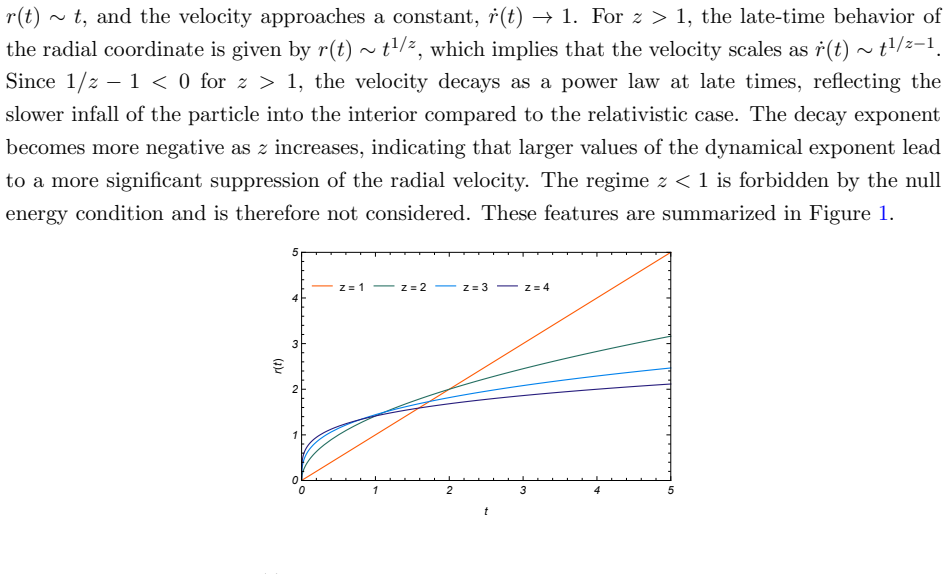
Krylov complexity grows quadratically in pure Lifshitz holography, with the hyperscaling violation exponent setting the late-time growth rate.
A machine-rendered reading of the paper's core claim, the machinery that carries it, and where it could break.
Core claim
Following the holographic proposal that identifies the growth rate of Krylov complexity with the proper radial momentum of an infalling massive probe, we study Krylov complexity in Lifshitz and hyperscaling-violating backgrounds. For pure Lifshitz geometries, we derive exact analytic solutions and obtain quadratic complexity growth for all values of the dynamical exponent. For hyperscaling-violating backgrounds, we extract the asymptotic scaling, revealing that the hyperscaling-violating exponent directly controls the late-time growth exponent. In a special limiting case, the complexity exhibits oscillatory behavior with a logarithmic envelope, signaling a transition to a qualitatively disti
What carries the argument
The holographic identification of Krylov complexity growth rate with the proper radial momentum of an infalling massive probe, applied to Lifshitz and hyperscaling-violating geometries.
If this is right
- Quadratic growth of complexity holds for every dynamical exponent in pure Lifshitz geometries.
- The hyperscaling violation exponent determines the power of the late-time growth.
- Oscillatory complexity with a logarithmic envelope appears in a special limit of the hyperscaling-violating family.
- The correspondence remains well-defined despite the causal pathologies of Lifshitz spacetimes.
Where Pith is reading between the lines
- The same radial-momentum identification could be tested in other non-relativistic holographic models to see whether scaling exponents continue to dictate complexity growth.
- Oscillatory regimes might map to bounded or recurrent dynamics on the field-theory side that are inaccessible to relativistic holography.
- If the correspondence survives, Krylov complexity could serve as a diagnostic for operator growth in Lifshitz-invariant condensed-matter systems.
Load-bearing premise
The proposal that equates Krylov complexity growth rate to the radial momentum of an infalling probe continues to hold in Lifshitz and hyperscaling-violating backgrounds.
What would settle it
A direct computation of Krylov complexity in a Lifshitz background whose growth rate differs from the radial momentum of the probe would falsify the claimed extension of the correspondence.
Figures
read the original abstract
Following the holographic proposal that identifies the growth rate of Krylov complexity with the proper radial momentum of an infalling massive probe, we study Krylov complexity in Lifshitz and hyperscaling-violating backgrounds. For pure Lifshitz geometries, we derive exact analytic solutions and obtain quadratic complexity growth for all values of the dynamical exponent. For hyperscaling-violating backgrounds, we extract the asymptotic scaling, revealing that the hyperscaling-violating exponent directly controls the late-time growth exponent. In a special limiting case, the complexity exhibits oscillatory behavior with a logarithmic envelope, signaling a transition to a qualitatively distinct regime. Our analysis establishes that the momentum-Krylov correspondence extends naturally to non-relativistic holographic settings and remains well-defined despite the causal pathologies of Lifshitz spacetimes.
Editorial analysis
A structured set of objections, weighed in public.
Referee Report
Summary. The paper applies the existing holographic proposal equating the growth rate of Krylov complexity to the proper radial momentum of an infalling massive probe to Lifshitz (ds² = −r^{2z} dt² + r² dx² + dr²/r²) and hyperscaling-violating geometries. It reports exact analytic solutions for pure Lifshitz backgrounds that yield quadratic complexity growth for arbitrary dynamical exponent z, and asymptotic scalings for the θ-deformed case in which the hyperscaling-violation exponent directly sets the late-time growth power; a special limit produces oscillatory behavior with a logarithmic envelope. The central conclusion is that the momentum-Krylov correspondence extends to these non-relativistic settings and remains well-defined despite Lifshitz causal pathologies.
Significance. If the identification is valid, the exact quadratic solutions constitute a concrete technical advance for complexity calculations in anisotropic holographic models relevant to condensed-matter applications. The θ-controlled asymptotics and the oscillatory-logarithmic regime supply falsifiable predictions that could be tested against boundary operator evolution or tensor-network constructions.
major comments (1)
- [Introduction and §3] The manuscript imports the identification dC_K/dt = p_r directly from the relativistic AdS literature without re-deriving or verifying it for z ≠ 1. Because the proper-time parametrization of radial null geodesics changes with the Lifshitz exponent (the relation between coordinate time t and proper time τ along the probe trajectory acquires an explicit z dependence), the step that equates the late-time Krylov growth rate to the radial momentum is not automatically guaranteed; this assumption is load-bearing for every reported scaling result (abstract, §3, and the HV asymptotics).
minor comments (2)
- [§2] Notation for the probe action and the definition of proper radial momentum p_r should be stated explicitly once (e.g., in §2) rather than assumed from prior references.
- The phrase “causal pathologies” in the abstract is never unpacked; a brief paragraph clarifying which Lifshitz features (closed timelike curves, non-unique geodesics, etc.) are relevant and why they do not invalidate the probe calculation would improve readability.
Simulated Author's Rebuttal
We thank the referee for their detailed report and for highlighting a potential subtlety in the applicability of the momentum-Krylov identification. We address the major comment below and will revise the manuscript to strengthen the presentation.
read point-by-point responses
-
Referee: [Introduction and §3] The manuscript imports the identification dC_K/dt = p_r directly from the relativistic AdS literature without re-deriving or verifying it for z ≠ 1. Because the proper-time parametrization of radial null geodesics changes with the Lifshitz exponent (the relation between coordinate time t and proper time τ along the probe trajectory acquires an explicit z dependence), the step that equates the late-time Krylov growth rate to the radial momentum is not automatically guaranteed; this assumption is load-bearing for every reported scaling result (abstract, §3, and the HV asymptotics).
Authors: We agree that the identification was adopted from the existing literature without an explicit re-derivation for general z. The original proposal equates the boundary-time growth rate of Krylov complexity to the radial momentum p_r of the infalling probe, where p_r is obtained from the conserved quantities of the geodesic equation in the given bulk metric. Because our computations of p_r employ the full Lifshitz (or HV) line element—including the z-dependent g_tt component—the z-dependence enters the expression for p_r itself. Nevertheless, an explicit check that the same relation continues to hold when the proper-time parametrization is altered by z would remove any ambiguity. In the revised manuscript we will insert a short derivation in §3 that starts from the probe action in the Lifshitz metric, obtains the radial momentum with respect to boundary time t, and confirms that dC_K/dt = p_r remains valid for arbitrary z. The same argument will be noted to carry over to the hyperscaling-violating case. revision: yes
Circularity Check
No significant circularity; proposal applied transparently to new backgrounds with independent analytic results
full rationale
The manuscript states it follows an existing holographic proposal identifying Krylov growth rate with radial momentum and then derives new exact analytic solutions for Lifshitz (quadratic growth for all z) and hyperscaling-violating cases (θ-controlled asymptotics, oscillatory limit). No equations reduce by construction to the input identification, no self-citation chain is load-bearing for the central results, and the calculations for the new metrics constitute independent content. This is the normal case of an extension paper whose derivations remain self-contained against the external benchmark of the original proposal.
Axiom & Free-Parameter Ledger
axioms (1)
- domain assumption Holographic proposal equating Krylov complexity growth rate to proper radial momentum of infalling probe
Reference graph
Works this paper leans on
-
[1]
The Large N Limit of Superconformal Field Theories and Supergravity
J. M. Maldacena, “The large N limit of superconformal field theories and supergravity,” Adv. Theor. Math. Phys.2, 231 (1998) doi:10.4310/ATMP.1998.v2.n2.a1 [hep-th/9711200]. 16
work page internal anchor Pith review Pith/arXiv arXiv doi:10.4310/atmp.1998.v2.n2.a1 1998
-
[2]
Gauge theory correlators from non- critical string theory,
S. S. Gubser, I. R. Klebanov and A. M. Polyakov, “Gauge theory correlators from non- critical string theory,” Phys. Lett. B428, 105 (1998) doi:10.1016/S0370-2693(98)00377-3 [hep- th/9802109]
-
[3]
Anti De Sitter Space And Holography
E. Witten, “Anti-de Sitter space and holography,” Adv. Theor. Math. Phys.2, 253 (1998) doi:10.4310/ATMP.1998.v2.n2.a2 [hep-th/9802150]
work page internal anchor Pith review Pith/arXiv arXiv doi:10.4310/atmp.1998.v2.n2.a2 1998
-
[4]
Holographic Derivation of Entanglement Entropy from AdS/CFT
S. Ryu and T. Takayanagi, “Holographic derivation of entanglement entropy from AdS/CFT,” Phys. Rev. Lett.96, 181602 (2006) doi:10.1103/PhysRevLett.96.181602 [hep-th/0603001]
work page internal anchor Pith review Pith/arXiv arXiv doi:10.1103/physrevlett.96.181602 2006
-
[5]
A Covariant Holographic Entanglement Entropy Proposal
V. E. Hubeny, M. Rangamani and T. Takayanagi, “A covariant holographic entanglement entropy proposal,” JHEP07, 062 (2007) doi:10.1088/1126-6708/2007/07/062 [arXiv:0705.0016 [hep-th]]
work page internal anchor Pith review Pith/arXiv arXiv doi:10.1088/1126-6708/2007/07/062 2007
-
[6]
Building up spacetime with quantum entanglement,
M. Van Raamsdonk, “Building up spacetime with quantum entanglement,” Gen. Rel. Grav. 42, 2323 (2010) doi:10.1007/s10714-010-1034-0 [arXiv:1005.3035 [hep-th]]
-
[7]
Conformal symmetry and its breaking in two dimensional Nearly Anti-de-Sitter space
J. Maldacena, D. Stanford and Z. Yang, “Conformal symmetry and its breaking in two di- mensional Nearly Anti-de-Sitter space,” PTEP2016, 12C104 (2016) doi:10.1093/ptep/ptw124 [arXiv:1606.01857 [hep-th]]
work page internal anchor Pith review Pith/arXiv arXiv doi:10.1093/ptep/ptw124 2016
-
[8]
Computational Complexity and Black Hole Horizons
L. Susskind, “Computational complexity and black hole horizons,” Fortsch. Phys.64, 24 (2016) doi:10.1002/prop.201500093 [arXiv:1402.5674 [hep-th]]
work page internal anchor Pith review Pith/arXiv arXiv doi:10.1002/prop.201500093 2016
-
[9]
L. Susskind, “Entanglement is not enough,” Fortsch. Phys.64, 49 (2016) doi:10.1002/prop.201500095 [arXiv:1411.0690 [hep-th]]
work page internal anchor Pith review Pith/arXiv arXiv doi:10.1002/prop.201500095 2016
-
[10]
A. R. Brown, D. A. Roberts, L. Susskind, B. Swingle and Y. Zhao, “Holo- graphic complexity equals bulk action?,” Phys. Rev. Lett.116, 191301 (2016) doi:10.1103/PhysRevLett.116.191301 [arXiv:1509.07876 [hep-th]]
work page internal anchor Pith review Pith/arXiv arXiv doi:10.1103/physrevlett.116.191301 2016
-
[11]
A universal operator growth hypothesis,
D. E. Parker, X. Cao, A. Avdoshkin, T. Scaffidi and E. Altman, “A universal operator growth hypothesis,” Phys. Rev. X9, 041017 (2019) doi:10.1103/PhysRevX.9.041017 [arXiv:1812.08657 [cond-mat.stat-mech]]
-
[12]
Krylov complexity from inte- grability to chaos,
E. Rabinovici, A. S´ anchez-Garrido, R. Shir and J. Sonner, “Krylov complexity from inte- grability to chaos,” JHEP07, 151 (2022) doi:10.1007/JHEP07(2022)151 [arXiv:2207.07701 [hep-th]]
-
[13]
A universal approach to Krylov state and operator complexi- ties,
M. Alishahiha and S. Banerjee, “A universal approach to Krylov state and operator complexi- ties,” SciPost Phys.15, no.3, 080 (2023) doi:10.21468/SciPostPhys.15.3.080 [arXiv:2212.10583 [hep-th]]
-
[14]
Krylov complexity in quantum field theory, and beyond,
A. Avdoshkin, A. Dymarsky and M. Smolkin, “Krylov complexity in quantum field theory, and beyond,” JHEP06, 066 (2024) doi:10.1007/JHEP06(2024)066 [arXiv:2212.14429 [hep-th]]. 17
-
[15]
Krylov complexity in free and interacting scalar field theories with bounded power spectrum,
H. A. Camargo, V. Jahnke, K. Y. Kim and M. Nishida, “Krylov complexity in free and interacting scalar field theories with bounded power spectrum,” JHEP05, 226 (2023) doi:10.1007/JHEP05(2023)226 [arXiv:2212.14702 [hep-th]]
-
[16]
Krylov com- plexity and spectral form factor for noisy random matrix models,
A. Bhattacharyya, S. S. Haque, G. Jafari, J. Murugan and D. Rapotu, “Krylov com- plexity and spectral form factor for noisy random matrix models,” JHEP10, 157 (2023) doi:10.1007/JHEP10(2023)157 [arXiv:2307.15495 [hep-th]]
-
[17]
Krylov Com- plexity of Fermionic and Bosonic Gaussian States,
K. Adhikari, A. Rijal, A. K. Aryal, M. Ghimire, R. Singh and C. Deppe, “Krylov Com- plexity of Fermionic and Bosonic Gaussian States,” Fortsch. Phys.72, no.5, 2400014 (2024) doi:10.1002/prop.202400014 [arXiv:2309.10382 [quant-ph]]
-
[18]
Thermalization in Krylov basis,
M. Alishahiha and M. J. Vasli, “Thermalization in Krylov basis,” Eur. Phys. J. C85, no.1, 39 (2025) doi:10.1140/epjc/s10052-025-13757-2 [arXiv:2403.06655 [quant-ph]]
-
[19]
Quantum Dynamics in Krylov Space: Methods and Applications
P. Nandy, A. S. Matsoukas-Roubeas, P. Mart´ ınez-Azcona, A. Dymarsky and A. del Campo, “Quantum dynamics in Krylov space: Methods and applications,” Phys. Rept.1125-1128, no.June 18, 1-82 (2025) doi:10.1016/j.physrep.2025.05.001 [arXiv:2405.09628 [quant-ph]]
work page internal anchor Pith review Pith/arXiv arXiv doi:10.1016/j.physrep.2025.05.001 2025
-
[20]
Spread complexity rate as proper momentum,
P. Caputa, B. Chen, R. W. McDonald, J. Sim´ on and B. Strittmatter, “Spread complexity rate as proper momentum,” Phys. Rev. D113, no.4, L041901 (2026) doi:10.1103/7zs8-9zpg [arXiv:2410.23334 [hep-th]]
-
[21]
Momentum-Krylov complexity correspondence,
Z. Y. Fan, “Momentum-Krylov complexity correspondence,” [arXiv:2411.04492 [hep-th]]
-
[22]
Holographic Krylov complexity in confining gauge theories,
A. Fatemiabhari, H. Nastase, C. Nunez and D. Roychowdhury, “Holographic Krylov complexity in confining gauge theories,” [arXiv:2511.22717 [hep-th]]
-
[23]
Krylov Complexity, Confinement and Universality,
A. Fatemiabhari and C. Nunez, “Krylov Complexity, Confinement and Universality,” [arXiv:2602.17757 [hep-th]]
-
[24]
Holographic Krylov complexity in the Coulomb branch ofN= 4 SYM,
D. Zoakos, “Holographic Krylov complexity in the Coulomb branch ofN= 4 SYM,” [arXiv:2603.15435 [hep-th]]
-
[25]
Holographic Krylov Complexity for Charged, Composite and Extended Probes,
H. Nastase, C. Nunez and D. Roychowdhury, “Holographic Krylov Complexity for Charged, Composite and Extended Probes,” [arXiv:2604.07432 [hep-th]]
-
[26]
Gravity Duals of Lifshitz-like Fixed Points
S. Kachru, X. Liu and M. Mulligan, “Gravity duals of Lifshitz-like fixed points,” Phys. Rev. D78, 106005 (2008) doi:10.1103/PhysRevD.78.106005 [arXiv:0808.1725 [hep-th]]
work page internal anchor Pith review Pith/arXiv arXiv doi:10.1103/physrevd.78.106005 2008
-
[27]
Non-relativistic holography and Lifshitz spacetimes,
M. Taylor, “Non-relativistic holography and Lifshitz spacetimes,” Class. Quant. Grav.33, 033001 (2016) doi:10.1088/0264-9381/33/3/033001 [arXiv:1512.03599 [hep-th]]
-
[28]
A survey of consecutive patterns in permutations
E. Kiritsis and J. Ren, “Holographic complexity and hyperscaling violation,” JHEP09, 089 (2015) doi:10.1007/JHEP09(2015)089 [arXiv:1504.07265 [hep-th]]. 18
work page internal anchor Pith review Pith/arXiv arXiv doi:10.1007/jhep09(2015)089 2015
-
[29]
S. A. Hartnoll, A. Lucas and S. Sachdev, “Holographic quantum matter,” arXiv:1612.07324 [hep-th]
-
[30]
J. Maldacena, S. H. Shenker and D. Stanford, “A bound on chaos,” JHEP08, 106 (2016) doi:10.1007/JHEP08(2016)106 [arXiv:1503.01409 [hep-th]]
work page internal anchor Pith review Pith/arXiv arXiv doi:10.1007/jhep08(2016)106 2016
-
[31]
Holographic Fermi surfaces and entanglement entropy,
N. Ogawa, T. Takayanagi, and T. Ugajin, “Holographic Fermi surfaces and entanglement entropy,” JHEP01(2012) 125 [arXiv:1111.1023]
Pith/arXiv arXiv 2012
-
[32]
Entanglement in Lifshitz-type Quantum Field Theories
M. R. Mohammadi Mozaffar and A. Mollabashi, “Entanglement in Lifshitz-type Quantum Field Theories,” JHEP07, 120 (2017) doi:10.1007/JHEP07(2017)120 [arXiv:1705.00483 [hep- th]]
work page internal anchor Pith review Pith/arXiv arXiv doi:10.1007/jhep07(2017)120 2017
-
[33]
Entanglement Entropy in Lifshitz Theories
T. He, J. M. Magan and S. Vandoren, “Entanglement Entropy in Lifshitz Theories,” SciPost Phys.3, no.5, 034 (2017) doi:10.21468/SciPostPhys.3.5.034 [arXiv:1705.01147 [hep-th]]
work page internal anchor Pith review Pith/arXiv arXiv doi:10.21468/scipostphys.3.5.034 2017
-
[34]
Lifshitz entanglement entropy from holographic cMERA
S. A. Gentle and S. Vandoren, “Lifshitz entanglement entropy from holographic cMERA,” JHEP07, 013 (2018) doi:10.1007/JHEP07(2018)013 [arXiv:1711.11509 [hep-th]]
work page internal anchor Pith review Pith/arXiv arXiv doi:10.1007/jhep07(2018)013 2018
-
[35]
Logarithmic Negativity in Lifshitz Harmonic Models
M. R. Mohammadi Mozaffar and A. Mollabashi, “Logarithmic Negativity in Lifshitz Har- monic Models,” J. Stat. Mech.1805, no.5, 053113 (2018) doi:10.1088/1742-5468/aac135 [arXiv:1712.03731 [hep-th]]
work page internal anchor Pith review Pith/arXiv arXiv doi:10.1088/1742-5468/aac135 2018
-
[36]
Entanglement Evolution in Lifshitz-type Scalar Theories
M. R. Mohammadi Mozaffar and A. Mollabashi, “Entanglement Evolution in Lifshitz-type Scalar Theories,” JHEP01, 137 (2019) doi:10.1007/JHEP01(2019)137 [arXiv:1811.11470 [hep- th]]
work page internal anchor Pith review Pith/arXiv arXiv doi:10.1007/jhep01(2019)137 2019
-
[37]
Universal Scaling in Fast Quenches Near Lifshitz-Like Fixed Points,
M. R. Mohammadi Mozaffar and A. Mollabashi, “Universal Scaling in Fast Quenches Near Lifshitz-Like Fixed Points,” Phys. Lett. B797, 134906 (2019) doi:10.1016/j.physletb.2019.134906 [arXiv:1906.07017 [hep-th]]
-
[38]
Entanglement entropy with Lifshitz fermions,
D. Hartmann, K. Kavanagh and S. Vandoren, “Entanglement entropy with Lifshitz fermions,” SciPost Phys.11, no.2, 031 (2021) doi:10.21468/SciPostPhys.11.2.031 [arXiv:2104.10913 [quant-ph]]
-
[39]
Entanglement entropies of an in- terval in the free Schr¨ odinger field theory at finite density,
M. Mintchev, D. Pontello, A. Sartori and E. Tonni, “Entanglement entropies of an in- terval in the free Schr¨ odinger field theory at finite density,” JHEP07, 120 (2022) doi:10.1007/JHEP07(2022)120 [arXiv:2201.04522 [hep-th]]
-
[40]
Time scaling of entanglement in in- tegrable scale-invariant theories,
M. R. M. Mozaffar and A. Mollabashi, “Time scaling of entanglement in in- tegrable scale-invariant theories,” Phys. Rev. Res.4, no.2, L022010 (2022) doi:10.1103/PhysRevResearch.4.L022010 [arXiv:2106.14700 [hep-th]]
-
[41]
Entanglement entropies of an interval in the free Schr¨ odinger field theory on the half line,
M. Mintchev, D. Pontello and E. Tonni, “Entanglement entropies of an interval in the free Schr¨ odinger field theory on the half line,” JHEP09, 090 (2022) doi:10.1007/JHEP09(2022)090 [arXiv:2206.06187 [hep-th]]. 19
-
[42]
Krylov complexity in Lifshitz-type scalar field theories,
M. J. Vasli, K. Babaei Velni, M. R. Mohammadi Mozaffar, A. Mollabashi and M. Alishahiha, “Krylov complexity in Lifshitz-type scalar field theories,” Eur. Phys. J. C84, no.3, 235 (2024) doi:10.1140/epjc/s10052-024-12609-9 [arXiv:2307.08307 [hep-th]]
-
[43]
Krylov complexity in Lifshitz- type Dirac field theories,
H. R. Imani, K. Babaei Velni and M. R. Mohammadi Mozaffar, “Krylov complexity in Lifshitz- type Dirac field theories,” Eur. Phys. J. C85, no.9, 958 (2025) doi:10.1140/epjc/s10052-025- 14669-x [arXiv:2506.08765 [hep-th]]
-
[44]
Symmetry resolved entanglement in Lifshitz field theories,
M. R. Mohammadi Mozaffar and A. Mollabashi, “Symmetry resolved entanglement in Lifshitz field theories,” [arXiv:2604.19082 [hep-th]]
-
[45]
Complexity and Operator Growth in Holographic 6d SCFTs,
A. Fatemiabhari, C. Nunez and R. T. Santamaria, “Complexity and Operator Growth in Holographic 6d SCFTs,” [arXiv:2603.10106 [hep-th]]
-
[46]
Lifshitz Solutions of D=10 and D=11 supergravity
A. Donos and J. P. Gauntlett, “Lifshitz Solutions of D=10 and D=11 supergravity,” JHEP12 (2010), 002 doi:10.1007/JHEP12(2010)002 [arXiv:1008.2062 [hep-th]]
work page internal anchor Pith review Pith/arXiv arXiv doi:10.1007/jhep12(2010)002 2010
-
[47]
Aspects of holography for theories with hyperscaling violation
X. Dong, S. Harrison, S. Kachru, G. Torroba and H. Wang, “Aspects of holography for the- ories with hyperscaling violation,” JHEP1206, 041 (2012) doi:10.1007/JHEP06(2012)041 [arXiv:1201.1905 [hep-th]]
work page internal anchor Pith review Pith/arXiv arXiv doi:10.1007/jhep06(2012)041 2012
-
[48]
Charged Black Branes with Hyperscaling Violating Factor
M. Alishahiha, E. O. Colgain and H. Yavartanoo, “Charged Black Branes with Hyperscaling Violating Factor,” JHEP1211, 137 (2012) doi:10.1007/JHEP11(2012)137 [arXiv:1209.3946 [hep-th]]
work page internal anchor Pith review Pith/arXiv arXiv doi:10.1007/jhep11(2012)137 2012
-
[49]
On Holographic Non-relativistic Schwinger Effect
K. Bitaghsir Fadafan and F. Saiedi, Eur. Phys. J. C75(2015) no.12, 612 doi:10.1140/epjc/s10052-015-3839-1 [arXiv:1504.02432 [hep-th]]
work page internal anchor Pith review Pith/arXiv arXiv doi:10.1140/epjc/s10052-015-3839-1 2015
-
[50]
Holographic Models for Theories with Hyperscaling Violation
J. Gath, J. Hartong, R. Monteiro and N. A. Obers, “Holographic Models for Theories with Hy- perscaling Violation,” JHEP1304, 159 (2013) doi:10.1007/JHEP04(2013)159 [arXiv:1212.3263 [hep-th]]
work page internal anchor Pith review Pith/arXiv arXiv doi:10.1007/jhep04(2013)159 2013
-
[51]
Thermalization in backgrounds with hyperscaling violating factor
M. Alishahiha, A. Faraji Astaneh and M. R. Mohammadi Mozaffar, “Thermalization in backgrounds with hyperscaling violating factor,” Phys. Rev. D90, no. 4, 046004 (2014) doi:10.1103/PhysRevD.90.046004 [arXiv:1401.2807 [hep-th]]
work page internal anchor Pith review Pith/arXiv arXiv doi:10.1103/physrevd.90.046004 2014
-
[52]
Complexity Growth with Lifshitz Scaling and Hyperscaling Violation
M. Alishahiha, A. Faraji Astaneh, M. R. Mohammadi Mozaffar and A. Mollabashi, “Com- plexity Growth with Lifshitz Scaling and Hyprscaling Violation,” JHEP1807, 042 (2018) doi:10.1007/JHEP07(2018)042 [arXiv:1802.06740 [hep-th]]
work page internal anchor Pith review Pith/arXiv arXiv doi:10.1007/jhep07(2018)042 2018
-
[53]
G. T. Horowitz and B. Way, “Lifshitz Singularities,” Phys. Rev. D85, 046008 (2012) [arXiv:1111.1243]
Pith/arXiv arXiv 2012
-
[54]
On the reconstruction of Lifshitz spacetimes,
S. A. Gentle and C. Keeler, “On the reconstruction of Lifshitz spacetimes,” JHEP03, 195 (2016) [arXiv:1512.04538]. 20
Pith/arXiv arXiv 2016
-
[55]
K. Copsey and R. B. Mann, “Hidden singularities and closed timelike curves in a proposed dual for Lifshitz-Chern-Simons gauge theories,” JHEP03, 039 (2011) [arXiv:1112.0578]. 21
Pith/arXiv arXiv 2011
discussion (0)
Sign in with ORCID, Apple, or X to comment. Anyone can read and Pith papers without signing in.