Hot or Cold? Radial Redistribution of Stars in FIRE Simulations of Milky Way-Mass Galaxies and the Asymmetry of Inward versus Outward Migrators
Pith reviewed 2026-07-02 18:35 UTC · model grok-4.3
The pith
Radial redistribution of stars in Milky Way-mass galaxies is typically not cold between birth and today.
A machine-rendered reading of the paper's core claim, the machinery that carries it, and where it could break.
Core claim
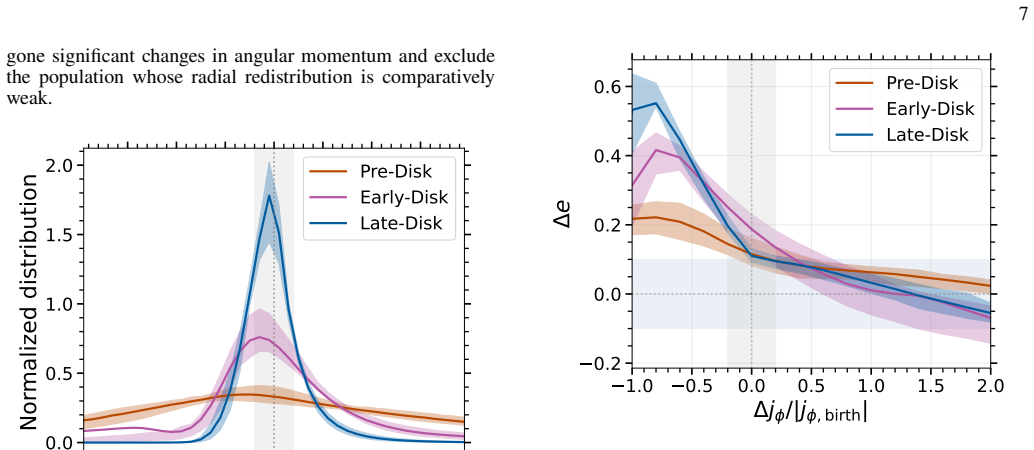
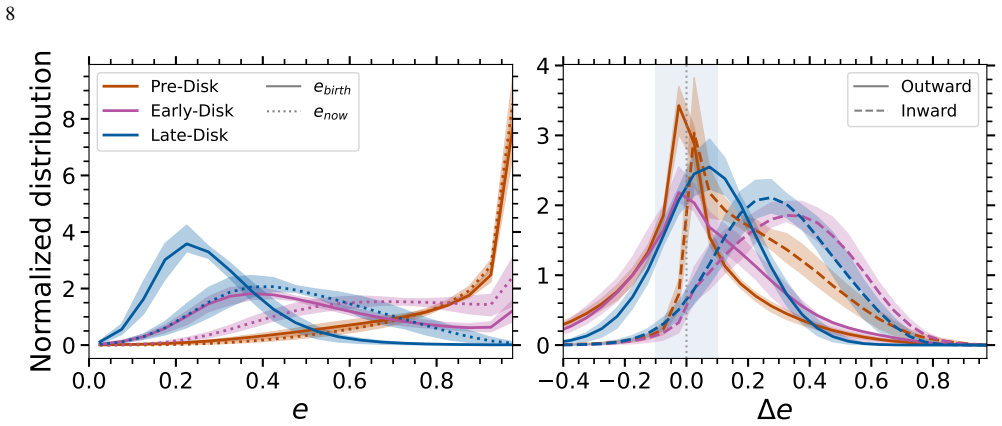
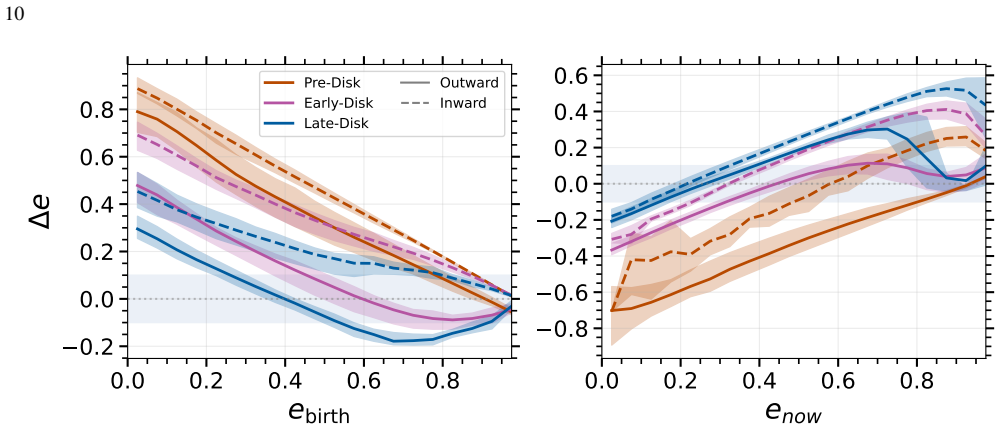
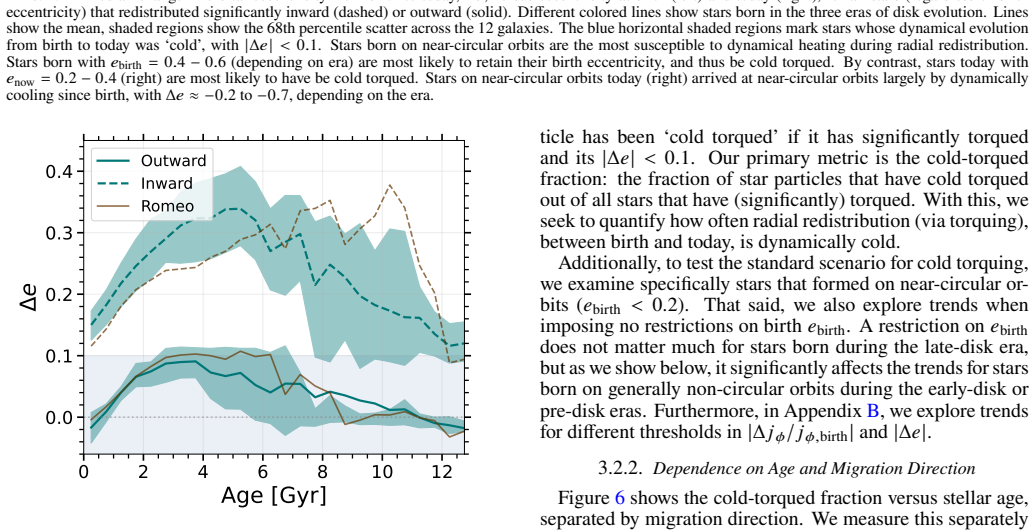
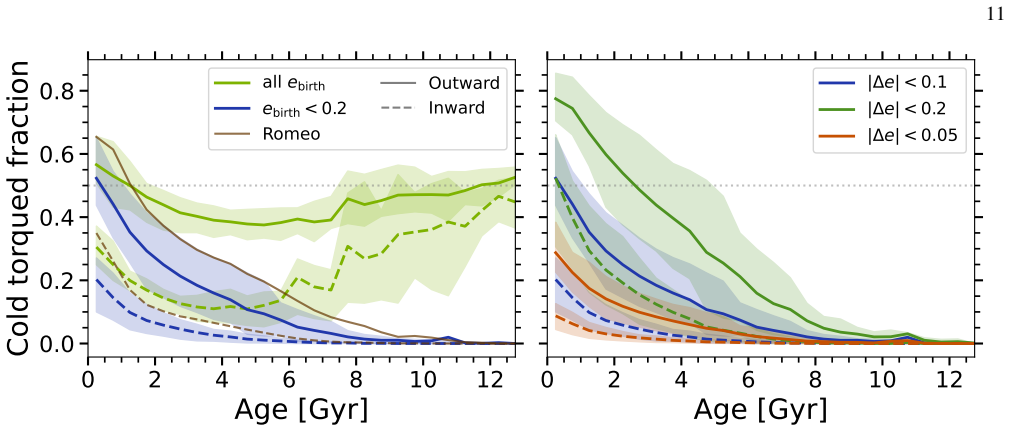
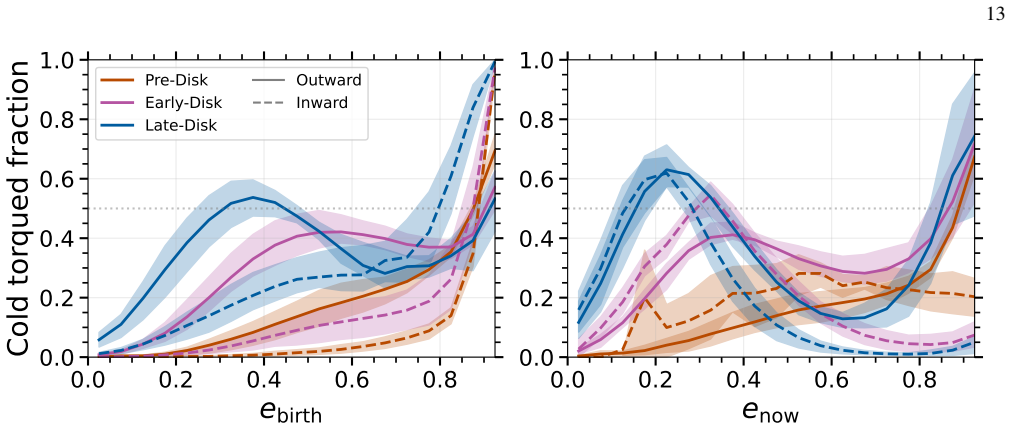
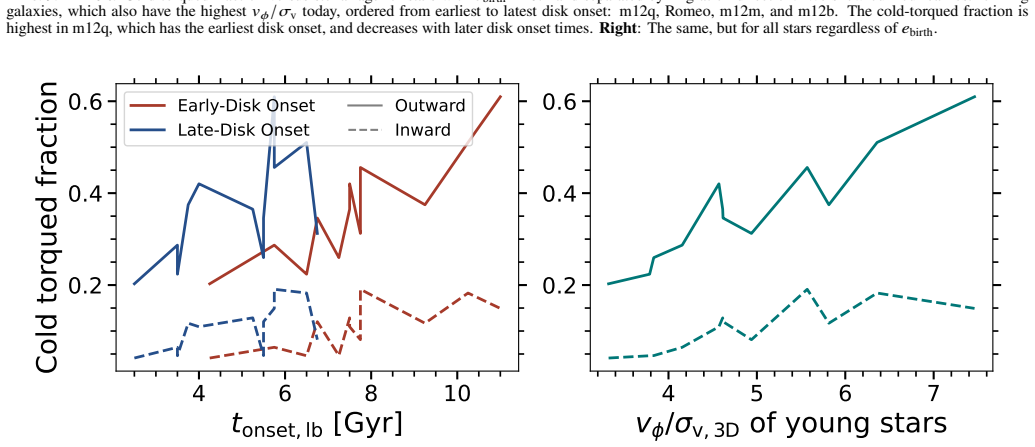
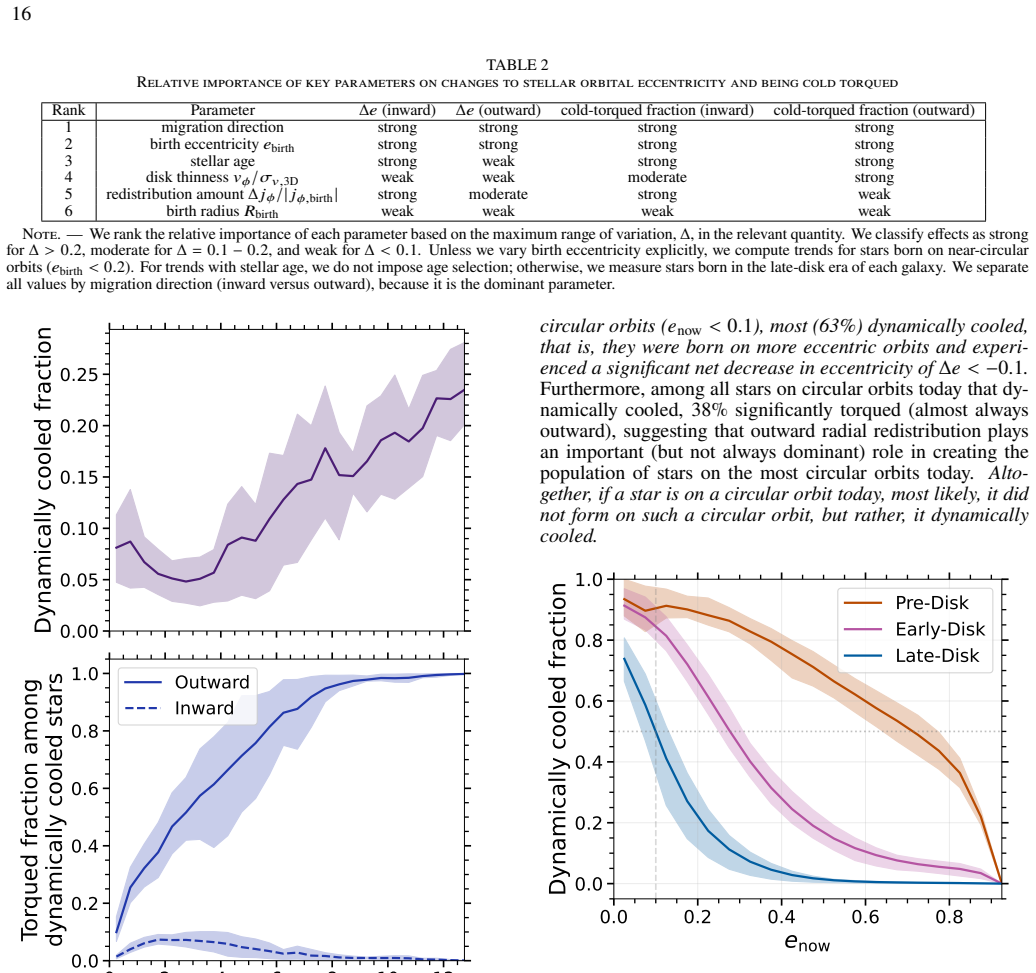
In the FIRE simulations, the cold-torqued fraction of star particles with |Δj_φ/j_φ,birth| > 0.2 that also satisfy |Δe| < 0.1 is generally low. For stars born on near-circular orbits the fraction falls rapidly with age and is typically under 50 percent beyond ~2 Gyr. Inward-migrating stars heat almost without exception while outward migrators experience smaller net eccentricity growth. Stars born with moderate eccentricity (~0.4) are likeliest to preserve their birth value. Earlier-forming or dynamically colder disks show higher cold fractions. A cooling population exists and is the primary way stars reach near-circular orbits today. Overall, migration direction, e_birth, and age determine t
What carries the argument
The cold-torqued fraction, which measures the share of significantly migrated star particles that preserve |Δe| < 0.1 since birth and thereby quantifies net dynamical heating versus preservation.
If this is right
- Inward-migrating stars almost always experience net dynamical heating.
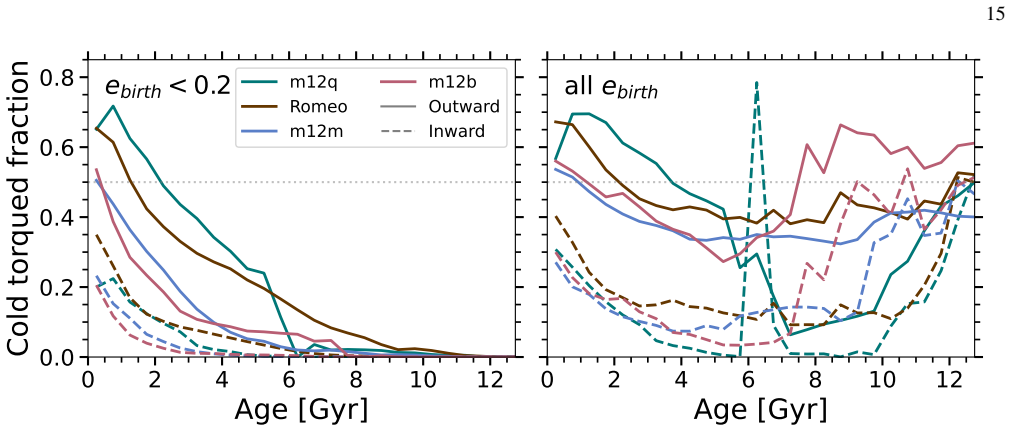
- The cold-torqued fraction decreases rapidly with age for stars born on near-circular orbits.
- Stars born on moderately eccentric orbits are the most likely to keep their birth eccentricity.
- A population of stars that cool dynamically supplies most of the near-circular orbits observed today.
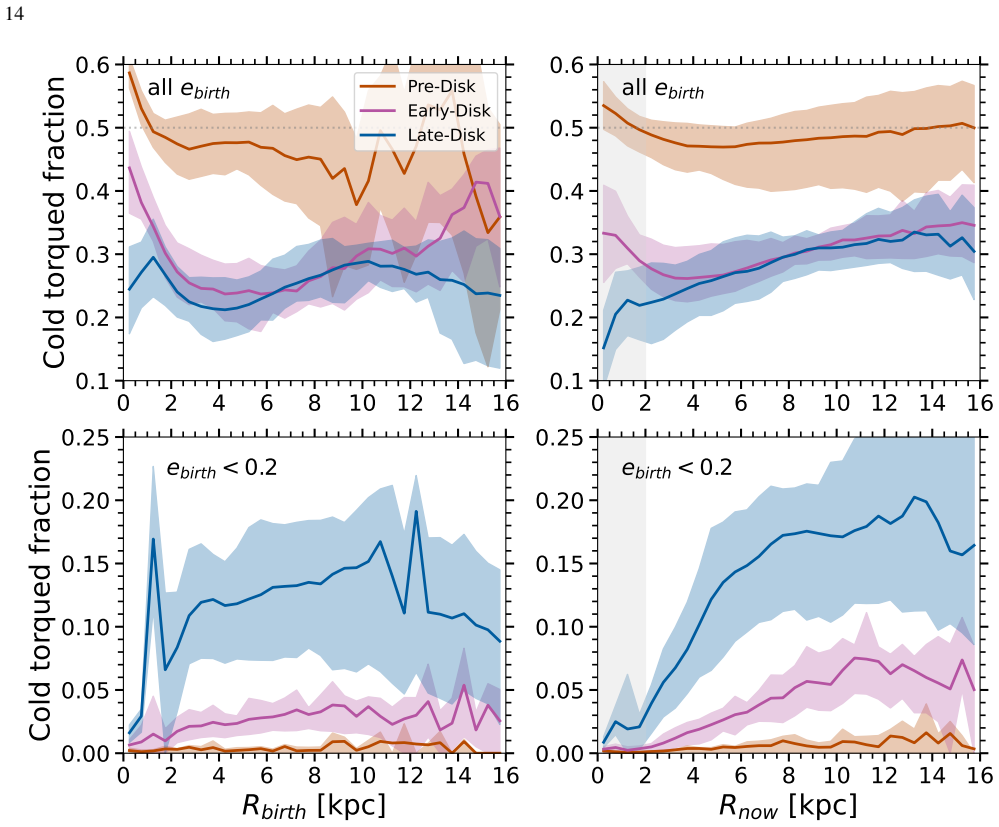
- Earlier-forming and dynamically colder disks retain higher fractions of cold migrators.
Where Pith is reading between the lines
- Models that rely on cold torquing alone will under-predict the heating of inward-migrated stars and mis-estimate the ages of stars on circular orbits.
- The asymmetry between inward and outward migrators offers a testable signature in the eccentricity distribution of the Milky Way disk at different radii.
- The cooling population implies that some old stars on circular orbits formed with higher eccentricity and later lost it rather than forming cold.
- Applying the same birth-to-present tracking to lower-mass or higher-redshift disks would reveal how the balance of heating versus cooling changes with galaxy properties.
Load-bearing premise
The FIRE simulations correctly capture the combined heating and cooling effects on stellar orbits from birth to the present day.
What would settle it
A direct count in the Milky Way showing that most stars with large radial migration since birth have |Δe| < 0.1, especially among inward migrators older than 2 Gyr, would falsify the typical-not-cold result.
Figures
read the original abstract
Stars can radially redistribute (migrate) within galactic disks. The degree to which this occurs as dynamically `cold' (preserves orbital eccentricity) or `hot' (increases eccentricity) remains debated. Many models presume that radial redistribution occurs primarily via cold torquing, resulting in changes in angular momentum without dynamical heating. We test the net dynamical heating associated with redistribution over stellar lifetimes using the FIRE cosmological zoom-in simulations of 12 Milky Way-mass galaxies. We select star particles today that underwent significant changes in orbital angular momentum, j_phi, since birth. We investigate net changes in their orbital eccentricity, e, and we quantify the `cold-torqued' fraction of star particles with |Delta j_phi/j_phi,birth| > 0.2 that preserved eccentricity (|Delta e| < 0.1) since birth. The direction of radial redistribution is most critical: outward-migrating stars experienced smaller net changes in eccentricity, whereas inward-migrating stars almost always heat since birth. For stars born on near-circular orbits (e_birth < 0.2), the cold-torqued fraction decreases rapidly with age today and is generally < 50% at ages >~2 Gyr. Stars born on moderately eccentric orbits (e_birth ~ 0.4) are the most likely to preserve their birth eccentricity. However, the cold-torqued fraction is higher in earlier-forming and/or dynamically-colder disks. Significantly, we identify a population of stars that dynamically `cooled', decreasing in eccentricity since birth: this is the primary way that stars end up on near-circular orbits today. Overall, a star's migration direction, its e_birth, and its age primarily determine whether it was dynamically heated, cooled, or unchanged. In general, radial redistribution in FIRE is typically not cold between birth and today.
Editorial analysis
A structured set of objections, weighed in public.
Referee Report
Summary. The paper analyzes star particles in 12 FIRE cosmological zoom-in simulations of Milky Way-mass galaxies, selecting those with significant angular momentum changes since birth (|Δj_φ/j_φ,birth| > 0.2). It reports that inward migrators almost always increase eccentricity while outward migrators show smaller net changes; for stars born on near-circular orbits (e_birth < 0.2), the cold-torqued fraction (|Δe| < 0.1) drops below 50% for ages ≳2 Gyr, with a population that cools dynamically; migration direction, birth eccentricity, and age determine net heating/cooling, leading to the conclusion that radial redistribution in FIRE is typically not cold.
Significance. If the reported Δe values are physical, the work provides direct evidence from multiple high-resolution cosmological simulations that challenges the common modeling assumption of primarily cold torquing during radial migration. It quantifies an asymmetry between inward and outward migrators, identifies dynamical cooling as a route to near-circular orbits today, and shows that birth conditions and age control outcomes. The approach of direct particle counts and fractions (no fitted parameters) across 12 galaxies offers a statistically grounded, falsifiable assessment of net dynamical effects over stellar lifetimes.
major comments (1)
- [Methods and Results (selection of migrators and Δe measurements)] The central claim that redistribution is typically not cold (cold-torqued fraction generally <50% for e_birth<0.2 at ages>2 Gyr) rests on measured Δe being physical rather than numerical. The manuscript reports results for the |Δj_φ/j_φ,birth|>0.2 sample across 12 galaxies but does not present resolution-convergence tests or softening-variation runs at the ~7000 M⊙ star-particle mass resolution; this is load-bearing because two-body scattering and potential fluctuations can artificially drive eccentricity growth, especially for inward migrators.
minor comments (2)
- [Abstract] The abstract states the main thresholds and conclusions but omits the simulation mass resolution and any discussion of selection effects on the migrator sample; adding these would improve clarity for readers.
- [Discussion] The paper credits direct particle tracking but could explicitly note the absence of free parameters or fitted models in the fraction calculations to highlight this strength.
Simulated Author's Rebuttal
We thank the referee for their careful reading and for emphasizing the need to establish that the measured Δe values reflect physical processes. We respond to the single major comment below.
read point-by-point responses
-
Referee: [Methods and Results (selection of migrators and Δe measurements)] The central claim that redistribution is typically not cold (cold-torqued fraction generally <50% for e_birth<0.2 at ages>2 Gyr) rests on measured Δe being physical rather than numerical. The manuscript reports results for the |Δj_φ/j_φ,birth|>0.2 sample across 12 galaxies but does not present resolution-convergence tests or softening-variation runs at the ~7000 M⊙ star-particle mass resolution; this is load-bearing because two-body scattering and potential fluctuations can artificially drive eccentricity growth, especially for inward migrators.
Authors: We agree that explicit demonstration that Δe is not dominated by numerical effects is essential for the central claim. The current manuscript does not include dedicated resolution or softening tests for this specific measurement. However, the FIRE-2 simulations at this resolution have been shown in prior work to produce converged orbital eccentricity distributions and radial migration statistics for Milky Way-mass galaxies (Hopkins et al. 2018; Garrison-Kimmel et al. 2018; Wetzel et al. 2023). More importantly, two aspects of the results are difficult to explain as numerical artifacts: (1) the strong directional asymmetry, with inward migrators systematically heating while outward migrators show smaller net changes, and (2) the existence of a dynamically cooling population that decreases in eccentricity. Two-body scattering and potential fluctuations would be expected to increase eccentricity isotropically rather than produce net cooling or a clear inward/outward asymmetry. We will add a concise subsection in the Methods section that summarizes these prior convergence results and explicitly notes the cooling population as supporting evidence that the trends are physical. We therefore view the requested tests as addressable via citation and discussion rather than new simulations. revision: yes
Circularity Check
No circularity: direct particle statistics from simulations
full rationale
The paper reports fractions of star particles satisfying explicit selection criteria (|Δj_φ/j_φ,birth| > 0.2 and |Δe| < 0.1) computed directly from tracked simulation outputs across 12 galaxies. No equations, fitted parameters, or self-citations are used to derive the central cold-torqued fractions or the inward/outward asymmetry; these are raw counts and binned statistics. The derivation chain consists solely of particle selection and histogram construction on the simulation data, with no reduction of outputs to inputs by construction. External concerns about numerical heating are validity issues, not circularity.
Axiom & Free-Parameter Ledger
axioms (1)
- domain assumption FIRE cosmological zoom-in simulations accurately represent the physics of stellar radial migration in Milky Way-mass galaxies.
Reference graph
Works this paper leans on
-
[1]
Wrinkles in Time. II. Stellar Age Trends in Kinematic Signatures from Transient Spiral Structure , journal =. 2026 , doi =
2026
-
[2]
The Galactic underdogs: Dynamic tales of a Milky Way metal-poor population
The Pristine survey: XXIV. The Galactic underdogs: Dynamic tales of a Milky Way metal-poor population. , keywords =. doi:10.1051/0004-6361/202450513 , archivePrefix =. 2406.05728 , primaryClass =
-
[3]
, eprint =. 1999 , month =. doi:10.1046/j.1365-8711.1999.02715.x , adsurl =
-
[4]
Simulations of Galaxy Formation in a Cold Dark Matter Universe. II. The Fine Structure of Simulated Galactic Disks. , eprint =. doi:10.1086/378316 , adsurl =
-
[5]
The Seventh Data Release of the Sloan Digital Sky Survey
, archiveprefix =. 2009 , month =. doi:10.1088/0067-0049/182/2/543 , adsurl =. 0812.0649 , keywords =
work page internal anchor Pith review Pith/arXiv arXiv doi:10.1088/0067-0049/182/2/543 2009
-
[6]
The Seventeenth Data Release of the Sloan Digital Sky Surveys: Complete Release of MaNGA, MaStar, and APOGEE-2 Data. , keywords =. doi:10.3847/1538-4365/ac4414 , archivePrefix =. 2112.02026 , primaryClass =
-
[7]
The Formation of the First Star in the Universe. Science , eprint =. doi:10.1126/science.1063991 , adsurl =
-
[8]
Caught in the Act: Strong, Active Ram Pressure Stripping in Virgo Cluster Spiral NGC 4330
, archiveprefix =. 2011 , month =. doi:10.1088/0004-6256/141/5/164 , adsurl =. 1101.4066 , primaryclass =
work page internal anchor Pith review Pith/arXiv arXiv doi:10.1088/0004-6256/141/5/164 2011
-
[9]
, eprint =. 2004 , month =. doi:10.1086/383221 , adsurl =
-
[10]
, archivePrefix = "arXiv", eprint =
Splashback in accreting dark matter halos. , archivePrefix = "arXiv", eprint =. doi:10.1088/1475-7516/2014/11/019 , adsurl =
-
[11]
, eprint =. 2007 , month =. doi:10.1111/j.1365-2966.2007.12183.x , adsurl =
-
[12]
, archiveprefix =. 2009 , month =. doi:10.1111/j.1745-3933.2009.00685.x , adsurl =. 0901.2536 , primaryclass =
-
[13]
, archivePrefix = "arXiv", eprint =
On the Interplay between Star Formation and Feedback in Galaxy Formation Simulations. , archivePrefix = "arXiv", eprint =. doi:10.1088/0004-637X/804/1/18 , adsurl =
-
[14]
ArXiv e-prints , archivePrefix = "arXiv", eprint =
The impact of stellar feedback on the structure, size and morphology of galaxies in Milky Way size dark matter haloes. ArXiv e-prints , archivePrefix = "arXiv", eprint =
-
[15]
, eprint =. 2001 , month =. doi:10.1086/323370 , adsurl =
-
[16]
, keywords =. 1985 , month =. doi:10.1086/163382 , adsurl =
-
[17]
The 16th Data Release of the Sloan Digital Sky Surveys: First Release from the APOGEE-2 Southern Survey and Full Release of eBOSS Spectra. , keywords =. doi:10.3847/1538-4365/ab929e , archivePrefix =. 1912.02905 , primaryClass =
-
[18]
Quenching Timescales of Dwarf Satellites around Milky Way-mass Hosts. , keywords =. doi:10.3847/1538-4357/abe2ab , archivePrefix =. 2008.02805 , primaryClass =
-
[19]
What drives the growth of black holes: A decade of progress. , keywords =. doi:10.1016/j.newar.2025.101733 , archivePrefix =. 2506.19166 , primaryClass =
-
[20]
A Spectroscopic Study of the Ancient Milky Way: F- and G-Type Stars in the Third Data Release of the Sloan Digital Sky Survey. , eprint =. doi:10.1086/498131 , adsurl =
-
[21]
2006 , month =
, eprint =. 2006 , month =
2006
-
[22]
Tidal dwarf galaxies in the nearby Universe: Tidal dwarf galaxies in the nearby Universe , volume=
, archiveprefix =. 2011 , month =. doi:10.1111/j.1365-2966.2011.18614.x , adsurl =. 1102.5736 , primaryclass =
-
[23]
Chemodynamics of the Milky Way. I. The first year of APOGEE data. , keywords =. doi:10.1051/0004-6361/201323038 , archivePrefix =. 1311.4549 , primaryClass =
work page internal anchor Pith review Pith/arXiv arXiv doi:10.1051/0004-6361/201323038
-
[24]
Red giants observed by CoRoT and APOGEE: The evolution of the Milky Way's radial metallicity gradient. , keywords =. doi:10.1051/0004-6361/201629363 , archivePrefix =. 1608.04951 , primaryClass =
work page internal anchor Pith review Pith/arXiv arXiv doi:10.1051/0004-6361/201629363
-
[25]
Spectroscopic age estimates for APOGEE red-giant stars: Precise spatial and kinematic trends with age in the Galactic disc. , keywords =. doi:10.1051/0004-6361/202346666 , archivePrefix =. 2304.08276 , primaryClass =
-
[26]
Instrument Science Report ACS 2007-08, 12 pages , year =
2007
-
[27]
, archiveprefix =. 2010 , month =. doi:10.1088/0004-637X/710/2/1032 , adsurl =. 0905.0627 , primaryclass =
work page internal anchor Pith review Pith/arXiv arXiv doi:10.1088/0004-637x/710/2/1032 2010
-
[28]
An Empirical Pixel-Based Correction for Imperfect CTE. I. HST's Advanced Camera for Surveys
, archiveprefix =. 2010 , month =. doi:10.1086/656399 , adsurl =. 1007.3987 , primaryclass =
work page internal anchor Pith review Pith/arXiv arXiv doi:10.1086/656399 2010
-
[29]
, archivePrefix = "arXiv", eprint =
Gravitational torque-driven black hole growth and feedback in cosmological simulations. , archivePrefix = "arXiv", eprint =. doi:10.1093/mnras/stw2565 , adsurl =
-
[30]
Black Holes on FIRE: Stellar Feedback Limits Early Feeding of Galactic Nuclei
Black holes on FIRE: stellar feedback limits early feeding of galactic nuclei. , keywords =. doi:10.1093/mnrasl/slx161 , archivePrefix =. 1707.03832 , primaryClass =
work page internal anchor Pith review Pith/arXiv arXiv doi:10.1093/mnrasl/slx161
-
[31]
Cosmological Simulations of Quasar Fueling to Subparsec Scales Using Lagrangian Hyper-refinement. , keywords =. doi:10.3847/1538-4357/ac09e8 , archivePrefix =. 2008.12303 , primaryClass =
-
[32]
, archiveprefix =. 2009 , month =. doi:10.1111/j.1365-2966.2009.15333.x , adsurl =. 0810.2177 , keywords =
-
[33]
Bar Formation and Destruction in the FIRE-2 Simulations. , keywords =. doi:10.3847/1538-4357/ad8b45 , archivePrefix =. 2309.16811 , primaryClass =
-
[34]
Ultrafaint Dwarfs in a Milky Way Context: Introducing the Mint Condition DC Justice League Simulations. , keywords =. doi:10.3847/1538-4357/abcafa , archivePrefix =. 2008.11207 , primaryClass =
-
[35]
Active Galactic Nuclei in Groups and Clusters of Galaxies: Detection and Host Morphology
, archiveprefix =. 2009 , month =. doi:10.1088/0004-637X/707/2/1691 , adsurl =. 0911.0392 , primaryclass =
work page internal anchor Pith review Pith/arXiv arXiv doi:10.1088/0004-637x/707/2/1691 2009
-
[36]
On the Stability of Tidal Streams in Action Space. , keywords =. doi:10.3847/1538-4357/ac93fb , archivePrefix =. 2207.13481 , primaryClass =
-
[37]
The Astrophysical Journal , volume=
Efficient and accurate force replay in cosmological-baryonic simulations , author=. The Astrophysical Journal , volume=. 2024 , publisher=
2024
-
[38]
The Astrophysical Journal , volume=
Shaping the Milky Way: The interplay of mergers and cosmic filaments , author=. The Astrophysical Journal , volume=. 2025 , publisher=
2025
-
[39]
, archivePrefix = "arXiv", eprint =
New Constraints on the Faint End of the UV Luminosity Function at z \ 7-8 Using the Gravitational Lensing of the Hubble Frontier Fields Cluster A2744. , archivePrefix = "arXiv", eprint =. doi:10.1088/0004-637X/800/1/18 , adsurl =
-
[40]
The extreme faint end of the UV luminosity function at z ̃ 6 through gravitational telescopes: a comprehensive assessment of strong lensing uncertainties. , keywords =. 2018. doi:10.1093/mnras/sty1820 , archivePrefix =. 1803.09747 , primaryClass =
work page internal anchor Pith review Pith/arXiv arXiv doi:10.1093/mnras/sty1820 2018
-
[41]
The existence and shapes of dust lanes in galactic bars. , keywords =. doi:10.1093/mnras/259.2.345 , adsurl =
-
[42]
doi:10.1046/j.1365-8711.2003.06653.x , eprint =
What determines the strength and the slowdown rate of bars?. , keywords =. doi:10.1046/j.1365-8711.2003.06473.x , archivePrefix =. astro-ph/0302519 , primaryClass =
-
[43]
Bar formation and evolution in disc galaxies with gas and a triaxial halo: morphology, bar strength and halo properties. , keywords =. doi:10.1093/mnras/sts452 , archivePrefix =. 1211.6754 , primaryClass =
work page internal anchor Pith review Pith/arXiv arXiv doi:10.1093/mnras/sts452
-
[44]
, eprint =. 2004 , month =. doi:10.1111/j.1365-2966.2004.07883.x , adsurl =
-
[45]
The quiescent phase of galactic disc growth
The quiescent phase of galactic disc growth. , keywords =. doi:10.1093/mnras/stw777 , archivePrefix =. 1604.00191 , primaryClass =
work page internal anchor Pith review Pith/arXiv arXiv doi:10.1093/mnras/stw777
-
[46]
Age velocity dispersion relations and heating histories in disc galaxies
Age-velocity dispersion relations and heating histories in disc galaxies. , keywords =. doi:10.1093/mnras/stw1639 , archivePrefix =. 1607.01972 , primaryClass =
work page internal anchor Pith review Pith/arXiv arXiv doi:10.1093/mnras/stw1639
-
[47]
Influence of bar formation on star formation segregation and stellar migration: Implications for variations in the age distribution of Milky Way disk stars. , keywords =. doi:10.1093/pasj/psaf062 , archivePrefix =. 2505.16528 , primaryClass =
-
[48]
Why does the environmental influence on group and cluster galaxies extend beyond the virial radius?
, archiveprefix =. 2013 , month =. doi:10.1093/mnras/stt109 , adsurl =. 1210.8407 , primaryclass =
work page internal anchor Pith review Pith/arXiv arXiv doi:10.1093/mnras/stt109 2013
-
[49]
Star formation quenching in simulated group and cluster galaxies: When, how, and why?
, archiveprefix =. 2015 , month =. doi:10.1093/mnras/stu2293 , adsurl =. 1410.8161 , keywords =
work page internal anchor Pith review Pith/arXiv arXiv doi:10.1093/mnras/stu2293 2015
-
[50]
The Hydrangea simulations: galaxy formation in and around massive clusters
The Hydrangea simulations: galaxy formation in and around massive clusters. , keywords =. doi:10.1093/mnras/stx1403 , archivePrefix =. 1703.10610 , primaryClass =
work page internal anchor Pith review Pith/arXiv arXiv doi:10.1093/mnras/stx1403
-
[51]
, archiveprefix =. 2008 , month =. doi:10.1111/j.1365-2966.2008.13828.x , adsurl =. 0706.1350 , keywords =
-
[52]
, eprint =. 2006 , month =. doi:10.1111/j.1365-2966.2006.11081.x , adsurl =
-
[53]
, archiveprefix =. 2008 , month =. doi:10.1111/j.1365-2966.2008.13348.x , adsurl =. 0804.2892 , keywords =
-
[54]
Monthly Notices of the Royal Astronomical Society , volume =
, archiveprefix =. 2012 , month =. doi:10.1111/j.1365-2966.2012.20340.x , adsurl =. 1111.5707 , primaryclass =
-
[55]
2008 , month =
, eprint =. 2008 , month =
2008
-
[56]
, eprint =. 1997 , month =. doi:10.1086/310927 , adsurl =
-
[57]
, eprint =. 1999 , month =. doi:10.1086/308056 , adsurl =
-
[58]
, eprint =. 2000 , month =. doi:10.1086/309323 , adsurl =
-
[59]
, eprint =. 2004 , month =. doi:10.1111/j.1365-2966.2004.07453.x , adsurl =
-
[60]
, archiveprefix =. 2009 , month =. doi:10.1111/j.1365-2966.2009.15193.x , adsurl =. 0905.3401 , primaryclass =
-
[61]
, archiveprefix =. 2010 , month =. doi:10.1111/j.1745-3933.2009.00800.x , adsurl =. 0912.0938 , primaryclass =
-
[62]
, archiveprefix =. 2011 , month =. doi:10.1111/j.1365-2966.2010.18052.x , adsurl =. 1011.5509 , primaryclass =
-
[63]
HII Region Metallicity Distribution in the Milky Way Disk
H II Region Metallicity Distribution in the Milky Way Disk. , keywords =. doi:10.1088/0004-637X/738/1/27 , archivePrefix =. 1106.1660 , primaryClass =
work page internal anchor Pith review Pith/arXiv arXiv doi:10.1088/0004-637x/738/1/27
-
[64]
Azimuthal Metallicity Structure in the Milky Way Disk
Azimuthal Metallicity Structure in the Milky Way Disk. , keywords =. doi:10.1088/0004-637X/806/2/199 , archivePrefix =. 1505.04090 , primaryClass =
work page internal anchor Pith review Pith/arXiv arXiv doi:10.1088/0004-637x/806/2/199
-
[65]
, archiveprefix =. 2009 , month =. doi:10.1111/j.1365-2966.2008.14252.x , adsurl =. 0805.2612 , keywords =
-
[66]
, year = 1967, month = nov, volume =
Orbits in Spiral Galaxies and the Velocity Dispersion of Population i Stars. , year = 1967, month = nov, volume =. doi:10.1086/149349 , adsurl =
-
[67]
, keywords =. 1986 , month =. doi:10.1086/164143 , adsurl =
-
[68]
The redshift evolution of massive galaxy clusters in the MACSIS simulations
The redshift evolution of massive galaxy clusters in the MACSIS simulations. , keywords =. doi:10.1093/mnras/stw2722 , archivePrefix =. 1607.04569 , primaryClass =
work page internal anchor Pith review Pith/arXiv arXiv doi:10.1093/mnras/stw2722
-
[69]
The Cluster-EAGLE project: global properties of simulated clusters with resolved galaxies
The Cluster-EAGLE project: global properties of simulated clusters with resolved galaxies. , keywords =. doi:10.1093/mnras/stx1647 , archivePrefix =. 1703.10907 , primaryClass =
work page internal anchor Pith review Pith/arXiv arXiv doi:10.1093/mnras/stx1647
-
[70]
1988 , month =
, keywords =. 1988 , month =
1988
-
[71]
, keywords =. 1987 , month =. doi:10.1086/165480 , adsurl =
-
[72]
, keywords =. 1991 , month =. doi:10.1086/185978 , adsurl =
- [73]
-
[74]
, eprint =. 2002 , month =. doi:10.1046/j.1365-8711.2002.05335.x , adsurl =
-
[75]
The dark side of FIRE: predicting the population of dark matter subhaloes around Milky Way-mass galaxies. arXiv e-prints , keywords =. doi:10.48550/arXiv.2303.05527 , archivePrefix =. 2303.05527 , primaryClass =
-
[76]
The EGNoG Survey: Molecular Gas in Intermediate-Redshift Star-Forming Galaxies
, archiveprefix =. 2013 , month =. doi:10.1088/0004-637X/768/2/132 , adsurl =. 1304.0010 , primaryclass =
work page internal anchor Pith review Pith/arXiv arXiv doi:10.1088/0004-637x/768/2/132 2013
-
[77]
Reports on Progress in Physics , eprint =. 2006 , month =. doi:10.1088/0034-4885/69/12/R02 , adsurl =
-
[78]
, archivePrefix = "arXiv", eprint =
Eight New Milky Way Companions Discovered in First-year Dark Energy Survey Data. , archivePrefix = "arXiv", eprint =. doi:10.1088/0004-637X/807/1/50 , adsurl =
-
[79]
The Rockstar Phase-Space Temporal Halo Finder and the Velocity Offsets of Cluster Cores
, archiveprefix =. 2013 , month =. doi:10.1088/0004-637X/762/2/109 , adsurl =. 1110.4372 , primaryclass =
work page internal anchor Pith review Pith/arXiv arXiv doi:10.1088/0004-637x/762/2/109 2013
-
[80]
Gravitationally Consistent Halo Catalogs and Merger Trees for Precision Cosmology
, archiveprefix =. 2013 , month =. doi:10.1088/0004-637X/763/1/18 , adsurl =. 1110.4370 , primaryclass =
work page internal anchor Pith review Pith/arXiv arXiv doi:10.1088/0004-637x/763/1/18 2013
discussion (0)
Sign in with ORCID, Apple, or X to comment. Anyone can read and Pith papers without signing in.