Point spread function wavefront recovery from in-focus stellar observations
Pith reviewed 2026-07-02 05:32 UTC · model grok-4.3
The pith
A new optimization method recovers wavefront errors to 3 percent from noisy in-focus stellar images alone
A machine-rendered reading of the paper's core claim, the machinery that carries it, and where it could break.
Core claim
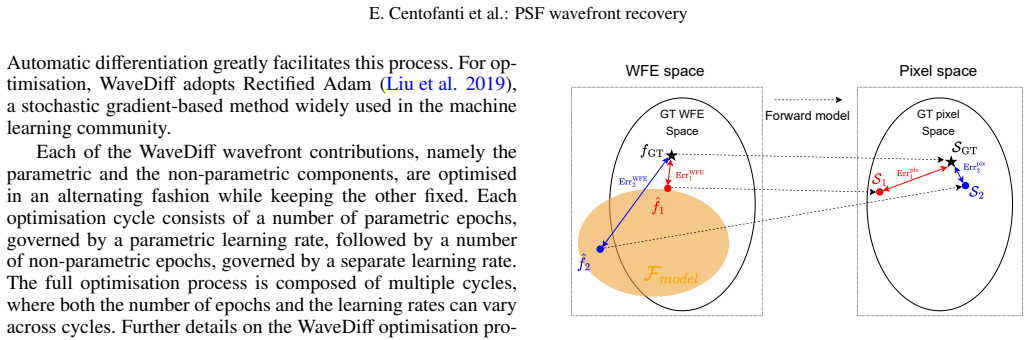
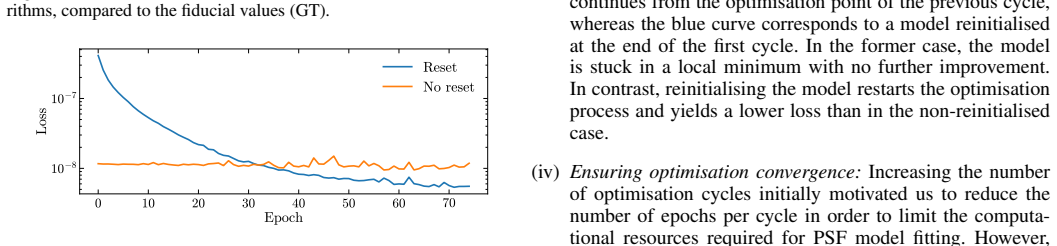
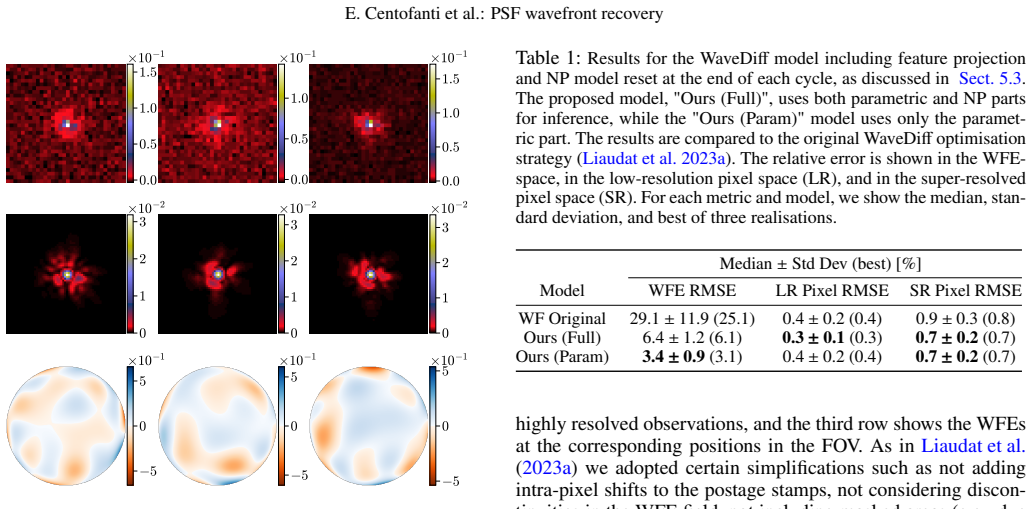
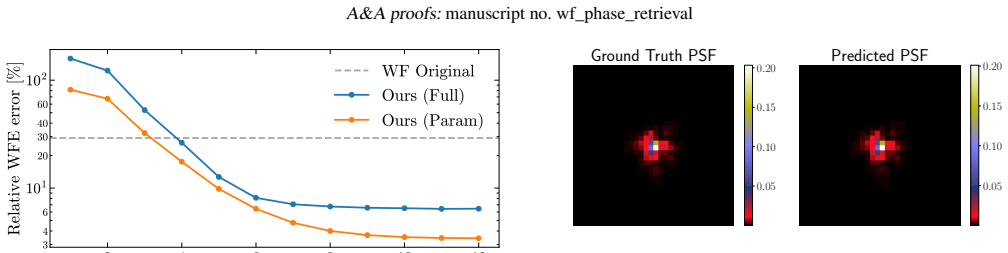
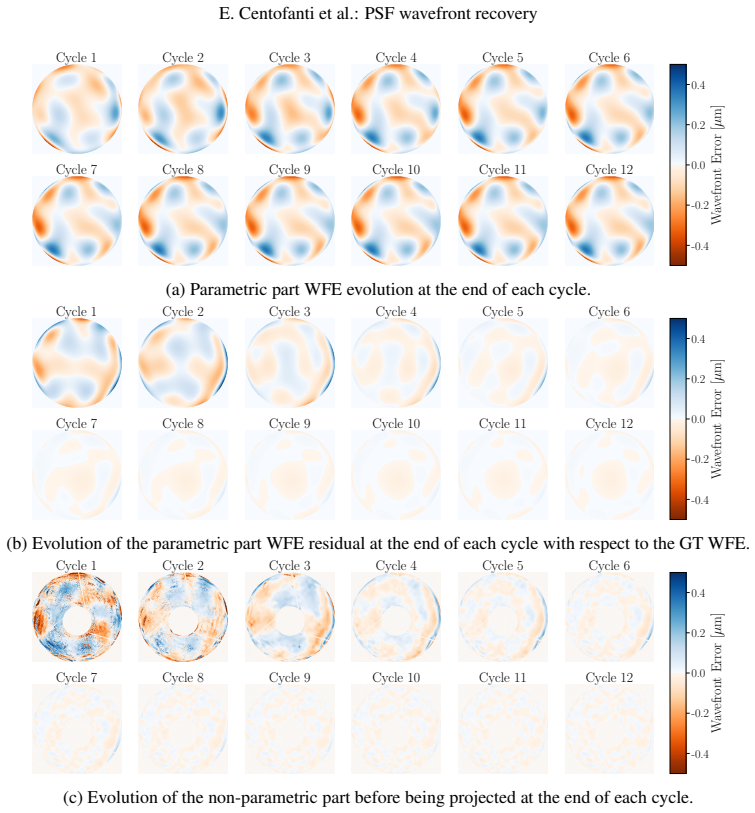
Incorporating wavefront projections and increasing the number of optimisation cycles enables WaveDiff to recover the WFE with an error of approximately 3 % using only noisy, undersampled, in-focus observations. This represents a tenfold improvement over the original model while further reducing the pixel-space error.
What carries the argument
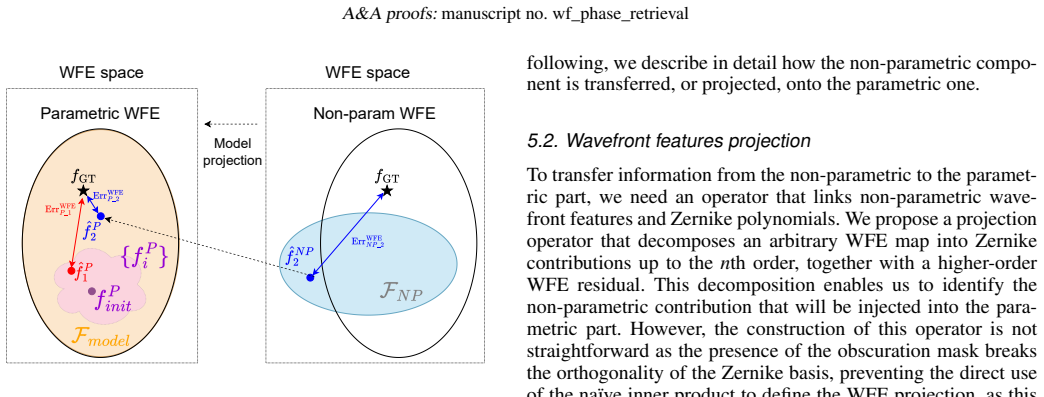
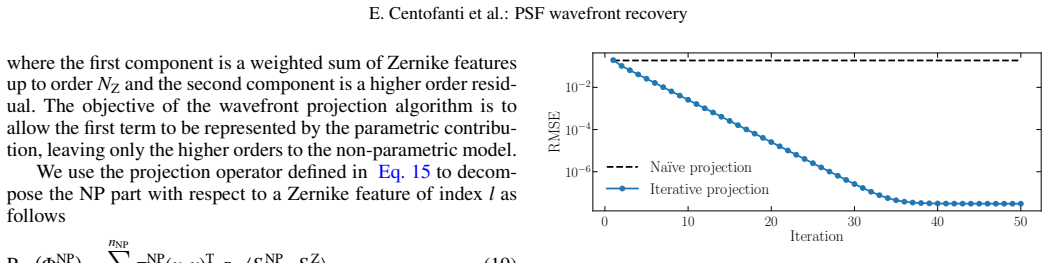
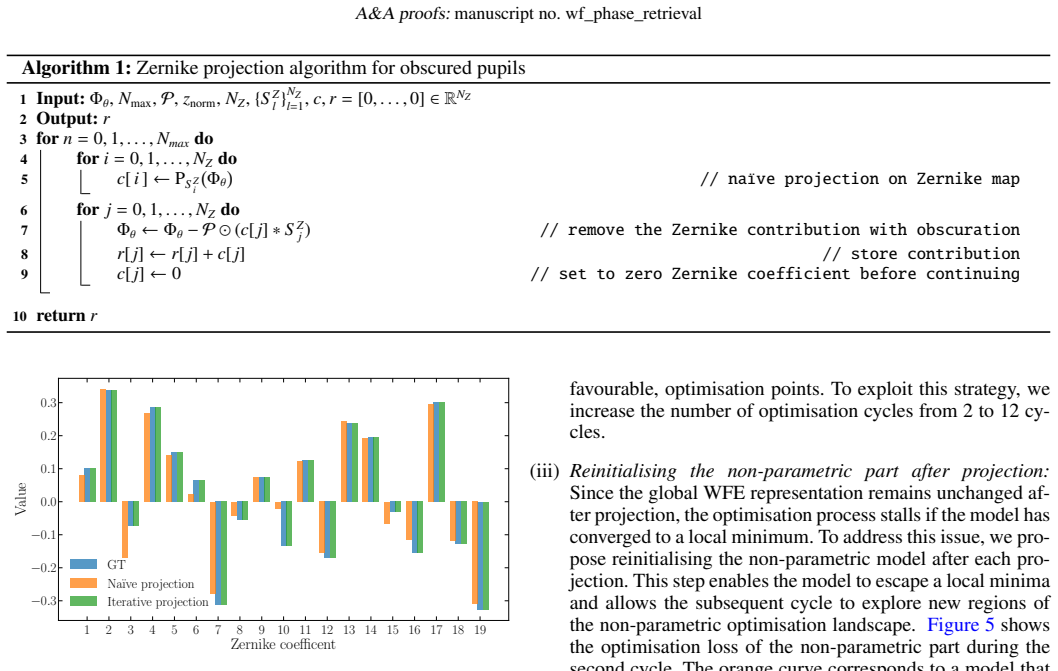
Wavefront feature projection that bridges the parametric and non-parametric components of WaveDiff during optimization
If this is right
- Precise PSF modelling becomes possible for space telescopes without requiring out-of-focus calibration images.
- Direct monitoring of telescope optics state is feasible from routine in-focus stellar fields, aiding malfunction detection.
- Non-parametric wavefront features can now be used reliably for wide-field phase retrieval in polychromatic in-focus data.
- Pixel-level PSF accuracy improves as a direct result of the better wavefront solution.
Where Pith is reading between the lines
- The method could be tested on ground-based instruments if a model for atmospheric turbulence is added to the forward operator.
- Future surveys might rely on this for on-orbit calibration using only the dense star fields already present in science exposures.
- Extending the same projection idea to time-varying optics could allow tracking of thermal or mechanical drifts without dedicated calibration sequences.
Load-bearing premise
The spatial variation of the PSF across the field of view together with the differentiable forward model is enough to uniquely constrain the wavefront solution from in-focus data alone.
What would settle it
Recovery tests on real telescope data that still show more than 10 percent wavefront error after the projections and extra cycles are applied
Figures


read the original abstract
Recovering the wavefront error (WFE) field of an optical system from intensity in-focus observations is a challenging inverse problem with broad implications for telescope point spread function (PSF) modelling. Accurate WFE recovery enables both precise PSF modelling and direct insight into the state of the telescope optics, facilitating the detection of potential malfunctions. Recently, non-parametric PSF models have shown promising performance in modelling complex optical systems in space-based telescopes. WaveDiff is a semi-parametric PSF model that represents the PSF in wavefront space by combining parametric and learnable features with a differentiable forward optical model. This parameterisation enables phase retrieval from in-focus observations by exploiting the spatial variation of the PSF across the field of view (FOV). The original version of WaveDiff achieves outstanding PSF recovery results in pixel space; however, the recovered WFE is far from the ground truth, with a relative error of around $30 \%$. In this paper, we present a new optimisation scenario that bridges WaveDiff's parametric and non-parametric components through wavefront feature projection, yielding a substantial improvement in WFE recovery and making WaveDiff the first demonstrated method to combine wide-field WFE recovery, in-focus-only polychromatic observations, and non-parametric wavefront features in a single framework. We show that incorporating wavefront projections and increasing the number of optimisation cycles enables WaveDiff to recover the WFE with an error of approximately $3 \%$ using only noisy, undersampled, in-focus observations. This represents a tenfold improvement over the original model while further reducing the pixel-space error. The code to reproduce the results of this article is publicly available at https://github.com/tobias-liaudat/wf-psf/tree/v1.4.0
Editorial analysis
A structured set of objections, weighed in public.
Referee Report
Summary. The paper introduces an updated optimization procedure for the WaveDiff semi-parametric PSF model. By adding wavefront feature projections that bridge its parametric and non-parametric components and by increasing the number of optimization cycles, the method recovers the wavefront error (WFE) field to ~3% relative error from noisy, undersampled, polychromatic in-focus stellar images alone. This is presented as a tenfold improvement over the original WaveDiff's ~30% WFE error while also lowering pixel-space PSF error; the approach is claimed to be the first to combine wide-field WFE recovery, in-focus-only data, and non-parametric wavefront features.
Significance. If the reported WFE recovery is shown to be unique and not an artifact of the simulation or optimization, the result would be significant for space-based telescope calibration: it would enable direct wavefront diagnostics and high-fidelity PSF modeling without requiring out-of-focus or monochromatic data, with the released code providing a reproducible baseline for further work.
major comments (3)
- [§3 and §4] §3 (method) and §4 (results): the central claim that wavefront projections plus extra cycles yield a unique WFE solution from in-focus data rests on the assertion that PSF spatial variation across the FOV supplies sufficient constraints, yet no identifiability analysis, no ablation that removes the projection step, and no multi-start optimization from varied initializations are reported to show convergence to the same WFE rather than to different minima that still match the intensity data.
- [§4.1–4.2] §4.1–4.2 and associated tables/figures: the 3% WFE error is demonstrated only on simulated ground-truth data whose generation details (optical model, noise model, exact polychromatic integration) are not cross-checked against an independent forward model; without this, it remains unclear whether the reported improvement reflects genuine inverse-problem solution or consistency with the same differentiable model used for training.
- [§3.2] Eq. (wavefront projection definition, §3.2): the projection operator that couples parametric and non-parametric components is introduced without a proof or numerical test that it reduces the null-space dimension of the intensity-to-WFE map; if the mapping remains many-to-one after projection, the tenfold error reduction on simulated data does not establish that the method solves the inverse problem in general.
minor comments (2)
- [Abstract and §1] The abstract and §1 cite the original WaveDiff error as “around 30 %” and the new result as “approximately 3 %”; explicit numerical values with standard deviations across multiple realizations should be stated in the text and tables for reproducibility.
- [§4 and figures] Figure captions and §4 lack a clear statement of the exact metric used for “relative WFE error” (RMS over what aperture? normalized by what quantity?).
Simulated Author's Rebuttal
We thank the referee for their thorough and constructive review. The comments highlight important aspects of identifiability and validation that we address below. We will revise the manuscript accordingly where feasible.
read point-by-point responses
-
Referee: [§3 and §4] §3 (method) and §4 (results): the central claim that wavefront projections plus extra cycles yield a unique WFE solution from in-focus data rests on the assertion that PSF spatial variation across the FOV supplies sufficient constraints, yet no identifiability analysis, no ablation that removes the projection step, and no multi-start optimization from varied initializations are reported to show convergence to the same WFE rather than to different minima that still match the intensity data.
Authors: We agree that explicit checks for uniqueness would strengthen the claim. In the revised manuscript we will add an ablation study (with and without the projection operator) and multi-start optimization results from varied initializations in §4, demonstrating convergence to the same low-error WFE solution across runs. revision: yes
-
Referee: [§4.1–4.2] §4.1–4.2 and associated tables/figures: the 3% WFE error is demonstrated only on simulated ground-truth data whose generation details (optical model, noise model, exact polychromatic integration) are not cross-checked against an independent forward model; without this, it remains unclear whether the reported improvement reflects genuine inverse-problem solution or consistency with the same differentiable model used for training.
Authors: The data are generated with the differentiable model described in the paper and released code. To address the concern we will add, in the revised §4, a cross-check against an independent non-differentiable optical simulator for a subset of fields, confirming that noise and polychromatic integration details are reproduced. revision: yes
-
Referee: [§3.2] Eq. (wavefront projection definition, §3.2): the projection operator that couples parametric and non-parametric components is introduced without a proof or numerical test that it reduces the null-space dimension of the intensity-to-WFE map; if the mapping remains many-to-one after projection, the tenfold error reduction on simulated data does not establish that the method solves the inverse problem in general.
Authors: We will add a numerical experiment in revised §3.2 showing that the projection measurably reduces WFE variance across random initializations. A general mathematical proof that the null-space dimension is reduced for arbitrary optical systems lies beyond the scope of the present work; the empirical improvement on the tested cases is the primary evidence offered. revision: partial
Circularity Check
No significant circularity; empirical optimization improvement stands on independent simulation benchmarks
full rationale
The paper reports an empirical result: adding wavefront feature projections and extra optimization cycles to the existing WaveDiff differentiable forward model reduces WFE recovery error from ~30% to ~3% on noisy, undersampled, in-focus simulated data. This is framed as a change in the optimization procedure rather than a closed-form derivation. No equation is shown to equal its own input by construction, no fitted parameter is relabeled as a prediction, and no uniqueness theorem is imported via self-citation to force the result. The spatial-variation constraint is asserted as sufficient but is tested directly against ground-truth simulations, providing an external check. The public code further allows independent reproduction. These elements keep the central claim self-contained against external benchmarks.
Axiom & Free-Parameter Ledger
Reference graph
Works this paper leans on
-
[1]
2022 , MONTH = Oct, KEYWORDS =
Liaudat, Tobias Ignacio , URL =. 2022 , MONTH = Oct, KEYWORDS =
2022
-
[2]
Artificial intelligence and statistics , pages=
The loss surfaces of multilayer networks , author=. Artificial intelligence and statistics , pages=. 2015 , organization=
2015
-
[3]
Journal of Astronomical Telescopes, Instruments, and Systems , volume=
Differentiable optics with∂ Lux: I—deep calibration of flat field and phase retrieval with automatic differentiation , author=. Journal of Astronomical Telescopes, Instruments, and Systems , volume=. 2023 , publisher=
2023
-
[4]
Euclid. I. Overview of the Euclid mission , author=. Astronomy & Astrophysics , year=
-
[5]
Euclid. I. Overview of the Euclid mission , author=. 2024 , eprint=
2024
-
[6]
Ivezić, Zeljko and Kahn, Steven M. and Tyson, J. Anthony and Abel, Bob and Acosta, Emily and Allsman, Robyn and Alonso, David and AlSayyad, Yusra and Anderson, Scott F. and Andrew, John and P. Angel, James Roger and Angeli, George Z. and Ansari, Reza and Antilogus, Pierre and Araujo, Constanza and Armstrong, Robert and Arndt, Kirk T. and Astier, Pierre an...
-
[7]
2019 , eprint=
The Wide Field Infrared Survey Telescope: 100 Hubbles for the 2020s , author=. 2019 , eprint=
2019
-
[8]
doi:10.1117/12.2630072 , editor =
Space Telescopes and Instrumentation 2022: Optical, Infrared, and Millimeter Wave , date-added =. doi:10.1117/12.2630072 , editor =
-
[9]
arXiv preprint arXiv:2501.01912 , year=
Exoplanet Detection via Differentiable Rendering , author=. arXiv preprint arXiv:2501.01912 , year=
-
[10]
Wiley interdisciplinary reviews: data mining and knowledge discovery , volume=
A review of automatic differentiation and its efficient implementation , author=. Wiley interdisciplinary reviews: data mining and knowledge discovery , volume=. 2019 , publisher=
2019
-
[11]
AMIGO: a Data-Driven Calibration of the JWST Interferometer
AMIGO: a Data-Driven Calibration of the JWST Interferometer , author=. arXiv preprint arXiv:2510.09806 , year=
work page internal anchor Pith review Pith/arXiv arXiv
-
[12]
Louis Desdoigts and Benjamin J. S. Pope and Jordan Dennis and Peter G. Tuthill , date-added =. 2023 , bdsk-url-1 =. doi:10.1117/1.JATIS.9.2.028007 , journal =
-
[13]
arXiv , author =:2406.08704 , journal =
doi:10.48550/arXiv.2406.08704 , eid =. arXiv , author =:2406.08704 , journal =
-
[14]
Frontiers in Astronomy and Space Sciences , title =
Liaudat, Tob. Frontiers in Astronomy and Space Sciences , title =. 2023 , bdsk-url-1 =. doi:10.3389/fspas.2023.1158213 , issn =
-
[15]
Rethinking data-driven point spread function modeling with a differentiable optical model , url =
Tobias Liaudat and Jean-Luc Starck and Martin Kilbinger and Pierre-Antoine Frugier , date-added =. Rethinking data-driven point spread function modeling with a differentiable optical model , url =. 2023 , bdsk-url-1 =. doi:10.1088/1361-6420/acb664 , journal =
-
[16]
doi:10.1051/0004-6361/202243970 , journal =
ShapePipe: A modular weak-lensing processing and analysis pipeline , url =. doi:10.1051/0004-6361/202243970 , journal =
-
[17]
doi:10.1051/0004-6361/200913524 , journal =
Weak lensing power spectra for precision cosmology - Multiple-deflection, reduced shear, and lensing bias corrections , url =. doi:10.1051/0004-6361/200913524 , journal =
-
[18]
Publications of the Astronomical Society of Japan , month =
Li, Xiangchong and Miyatake, Hironao and Luo, Wentao and More, Surhud and Oguri, Masamune and Hamana, Takashi and Mandelbaum, Rachel and Shirasaki, Masato and Takada, Masahiro and Armstrong, Robert and Kannawadi, Arun and Takita, Satoshi and Miyazaki, Satoshi and Nishizawa, Atsushi J and Plazas Malagon, Andres A and Strauss, Michael A and Tanaka, Masayuki...
-
[19]
2012, , 427, 127, 10.1111/j.1365-2966.2012.21948.x
Heymans, Catherine and van Waerbeke, Ludovic and Miller, Lance and Erben, Thomas and Hildebrandt, Hendrik and Hoekstra, Henk and Kitching, Thomas D. and Mellier, Yannick and Simon, Patrick and Bonnett, Christopher and Coupon, Jean and Fu, Liping and Harnois-D. Monthly Notices of the Royal Astronomical Society , month =. 2012 , bdsk-url-1 =. doi:10.1111/j....
-
[20]
Mugnier and Amandine Blanc and
Laurent M. Mugnier and Amandine Blanc and. Phase Diversity: A Technique for Wave-Front Sensing and for Diffraction-Limited Imaging , url =. 2006 , bdsk-url-1 =. doi:https://doi.org/10.1016/S1076-5670(05)41001-0 , editor =
-
[21]
Applied optics , volume=
Phase-retrieval algorithms for a complicated optical system , author=. Applied optics , volume=. 1993 , publisher=
1993
-
[22]
J. R. Fienup and J. C. Marron and T. J. Schulz and J. H. Seldin , date-added =. Hubble Space Telescope characterized by using phase-retrieval algorithms , url =. 1993 , bdsk-file-1 =. doi:10.1364/AO.32.001747 , journal =
-
[23]
Joyce, Kevin T. and Bardsley, Johnathan M. and Luttman, Aaron , date-added =. Point Spread Function Estimation in X-Ray Imaging with Partially Collapsed Gibbs Sampling , url =. SIAM Journal on Scientific Computing , number =. 2018 , bdsk-url-1 =. doi:10.1137/17M1149250 , eprint =
-
[24]
Dougherty, Geoff and Kawaf, Z. , date-added =. The point spread function revisited: Image restoration using 2-D deconvolution , volume =. 2001 , bdsk-url-1 =. doi:10.1053/radi.2001.0341 , journal =
-
[25]
2016 , bdsk-url-1 =
M. 2016 , bdsk-url-1 =
2016
-
[26]
The Euclid Wide Survey , url =
Euclid preparation - I. The Euclid Wide Survey , url =. doi:10.1051/0004-6361/202141938 , journal =
-
[27]
doi:10.1086/143864 , journal =
-
[28]
Measurements of Omega and Lambda from 42 High-Redshift Supernovae
S. Perlmutter and G. Aldering and G. Goldhaber and R. A. Knop and P. Nugent and P. G. Castro and S. Deustua and S. Fabbro and A. Goobar and D. E. Groom and I. M. Hook and A. G. Kim and M. Y. Kim and J. C. Lee and N. J. Nunes and R. Pain and C. R. Pennypacker and R. Quimby and C. Lidman and R. S. Ellis and M. Irwin and R. G. McMahon and P. Ruiz-Lapuente an...
work page internal anchor Pith review doi:10.1086/307221
-
[29]
Report of the Dark Energy Task Force
Albrecht, Andreas and Bernstein, Gary and Cahn, Robert and Freedman, Wendy L. and Hewitt, Jacqueline and Hu, Wayne and Huth, John and Kamionkowski, Marc and Kolb, Edward W. and Knox, Lloyd and Mather, John C. and Staggs, Suzanne and Suntzeff, Nicholas B. , copyright =. Report of the Dark Energy Task Force , url =. 2006 , bdsk-url-1 =. doi:10.48550/ARXIV.A...
work page internal anchor Pith review doi:10.48550/arxiv.astro-ph/0609591 2006
-
[30]
The NISP photometric system , url =
Euclid preparation - XVIII. The NISP photometric system , url =. doi:10.1051/0004-6361/202142897 , journal =
-
[31]
Dependencies on methods, simulation parameters, and measured parameters , url =
Shear measurement bias - I. Dependencies on methods, simulation parameters, and measured parameters , url =. doi:10.1051/0004-6361/202038657 , journal =
-
[32]
Monthly Notices of the Royal Astronomical Society , month =
MacCrann, N and Becker, M R and McCullough, J and Amon, A and Gruen, D and Jarvis, M and Choi, A and Troxel, M A and Sheldon, E and Yanny, B and Herner, K and Dodelson, S and Zuntz, J and Eckert, K and Rollins, R P and Varga, T N and Bernstein, G M and Gruendl, R A and Harrison, I and Hartley, W G and Sevilla-Noarbe, I and Pieres, A and Bridle, S L and My...
-
[33]
2012, , 427, 127, 10.1111/j.1365-2966.2012.21948.x
Melchior, P. and Viola, M. , date-added =. Monthly Notices of the Royal Astronomical Society , month =. 2012 , bdsk-url-1 =. doi:10.1111/j.1365-2966.2012.21381.x , eprint =
-
[34]
Monthly Notices of the Royal Astronomical Society , month =
Kacprzak, Tomasz and Bridle, Sarah and Rowe, Barnaby and Voigt, Lisa and Zuntz, Joe and Hirsch, Michael and MacCrann, Niall , date-added =. Monthly Notices of the Royal Astronomical Society , month =. 2014 , bdsk-url-1 =. doi:10.1093/mnras/stu588 , eprint =
-
[35]
Erin S. Sheldon and Matthew R. Becker and Niall MacCrann and Michael Jarvis , date-added =. Mitigating Shear-dependent Object Detection Biases with Metacalibration , url =. doi:10.3847/1538-4357/abb595 , journal =
-
[36]
Michael D. Schneider and David W. Hogg and Philip J. Marshall and William A. Dawson and Joshua Meyers and Deborah J. Bard and Dustin Lang , date-added =. doi:10.1088/0004-637x/807/1/87 , journal =
-
[37]
Boletin de la Asociacion Argentina de Astronomia La Plata Argentina , month = feb, pages =
-
[38]
doi:10.1051/0004-6361/201833775 , journal =
Weak-lensing shear measurement with machine learning - Teaching artificial neural networks about feature noise , url =. doi:10.1051/0004-6361/201833775 , journal =
-
[39]
Joseph J. Mohr and Robert Armstrong and Emmanuel Bertin and Greg Daues and Shantanu Desai and Michelle Gower and Robert Gruendl and William Hanlon and Nikolay Kuropatkin and Huan Lin and John Marriner and Donald Petravic and Ignacio Sevilla and Molly Swanson and Todd Tomashek and Douglas Tucker and Brian Yanny , booktitle =. The Dark Energy Survey data pr...
-
[40]
S. Desai and R. Armstrong and J. J. Mohr and D. R. Semler and J. Liu and E. Bertin and S. S. Allam and W. A. Barkhouse and G. Bazin and E. J. Buckley-Geer and M. C. Cooper and S. M. Hansen and F. W. High and H. Lin and Y.-T. Lin and C.-C. Ngeow and A. Rest and J. Song and D. Tucker and A. Zenteno , date-added =. doi:10.1088/0004-637x/757/1/83 , journal =
-
[41]
doi:10.1051/0004-6361/202141166 , journal =
Deep transfer learning for blended source identification in galaxy survey data , url =. doi:10.1051/0004-6361/202141166 , journal =
-
[42]
P. Melchior and F. Moolekamp and M. Jerdee and R. Armstrong and A.-L. Sun and J. Bosch and R. Lupton , date-added =. Scarlet: Source separation in multi-band images by Constrained Matrix Factorization , url =. Astronomy and Computing , keywords =. 2018 , bdsk-url-1 =. doi:https://doi.org/10.1016/j.ascom.2018.07.001 , issn =
-
[43]
doi:10.1038/s42254-021-00353-y , journal =
-
[44]
E. A. Magnier and J.-C. Cuillandre , date-added =. The Elixir System: Data Characterization and Calibration at the Canada-France-Hawaii Telescope , url =. doi:10.1086/420756 , journal =
-
[45]
Astronomical Data Analysis Software and Systems XXVII , date-added =
-
[46]
Stephen D. J. Gwyn , date-added =. doi:10.1086/526794 , journal =
-
[47]
Publications of the Astronomical Society of Japan , month =
Bosch, James and Armstrong, Robert and Bickerton, Steven and Furusawa, Hisanori and Ikeda, Hiroyuki and Koike, Michitaro and Lupton, Robert and Mineo, Sogo and Price, Paul and Takata, Tadafumi and Tanaka, Masayuki and Yasuda, Naoki and AlSayyad, Yusra and Becker, Andrew C and Coulton, William and Coupon, Jean and Garmilla, Jose and Huang, Song and Krughof...
-
[48]
Publications of the Astronomical Society of Japan , month =
Mandelbaum, Rachel and Miyatake, Hironao and Hamana, Takashi and Oguri, Masamune and Simet, Melanie and Armstrong, Robert and Bosch, James and Murata, Ryoma and Lanusse, Fran. Publications of the Astronomical Society of Japan , month =. 2017 , bdsk-url-1 =. doi:10.1093/pasj/psx130 , eprint =
-
[49]
The many flavours of photometric redshifts
Salvato, Mara and Ilbert, Olivier and Hoyle, Ben , copyright =. The many flavours of photometric redshifts , url =. 2018 , bdsk-url-1 =. doi:10.48550/ARXIV.1805.12574 , keywords =
work page internal anchor Pith review Pith/arXiv arXiv doi:10.48550/arxiv.1805.12574 2018
-
[50]
Monthly Notices of the Royal Astronomical Society , month =
Kilbinger, Martin and Heymans, Catherine and Asgari, Marika and Joudaki, Shahab and Schneider, Peter and Simon, Patrick and Van Waerbeke, Ludovic and Harnois-D. Monthly Notices of the Royal Astronomical Society , month =. 2017 , bdsk-url-1 =. doi:10.1093/mnras/stx2082 , eprint =
-
[51]
doi:10.1086/171151 , journal =
-
[52]
doi:10.1086/145672 , journal =
-
[53]
Weak lensing analysis of the Canada-France Imaging Survey : from pixels to cosmology, preparation for the Euclid mission , url =
Guinot, Axel , date-added =. Weak lensing analysis of the Canada-France Imaging Survey : from pixels to cosmology, preparation for the Euclid mission , url =. 2020 , bdsk-url-1 =
2020
-
[54]
, date-added =
Schmitz, Morgan A. , date-added =. Euclid weak lensing : PSF field estimation , url =. 2019 , bdsk-url-1 =
2019
-
[55]
Higher order statistics for cosmology : likelihood development for future surveys like Euclid , url =
Ajani, Virginia , date-added =. Higher order statistics for cosmology : likelihood development for future surveys like Euclid , url =. 2021 , bdsk-url-1 =
2021
-
[56]
Estimators and covariances , url =
Analysis of two-point statistics of cosmic shear - I. Estimators and covariances , url =. doi:10.1051/0004-6361:20021341 , journal =
-
[57]
Monthly Notices of the Royal Astronomical Society , month =
Jeffrey, N and Gatti, M and Chang, C and Whiteway, L and Demirbozan, U and Kovacs, A and Pollina, G and Bacon, D and Hamaus, N and Kacprzak, T and Lahav, O and Lanusse, F and Mawdsley, B and Nadathur, S and Starck, J L and Vielzeuf, P and Zeurcher, D and Alarcon, A and Amon, A and Bechtol, K and Bernstein, G M and Campos, A and Rosell, A Carnero and Kind,...
-
[58]
doi:10.1051/0004-6361/202039451 , journal =
Weak-lensing mass reconstruction using sparsity and a Gaussian random field , url =. doi:10.1051/0004-6361/202039451 , journal =
-
[59]
doi:10.1051/0004-6361/201628278 , journal =
High resolution weak lensing mass mapping combining shear and flexion , url =. doi:10.1051/0004-6361/201628278 , journal =
-
[60]
Monthly Notices of the Royal Astronomical Society , month =
Jeffrey, Niall and Lanusse, Fran. Monthly Notices of the Royal Astronomical Society , month =. 2020 , bdsk-url-1 =. doi:10.1093/mnras/staa127 , eprint =
-
[61]
Pires, S. and Starck, J.-L. and Amara, A. and Teyssier, R. and R. Monthly Notices of the Royal Astronomical Society , month =. 2009 , bdsk-url-1 =. doi:10.1111/j.1365-2966.2009.14625.x , eprint =
-
[62]
doi:10.1086/172297 , journal =
-
[63]
Troxel and Mustapha Ishak , date-added =
M.A. Troxel and Mustapha Ishak , date-added =. The intrinsic alignment of galaxies and its impact on weak gravitational lensing in an era of precision cosmology , url =. Physics Reports , keywords =. 2015 , bdsk-url-1 =. doi:https://doi.org/10.1016/j.physrep.2014.11.001 , issn =
-
[64]
David M. Goldberg and David J. Bacon , date-added =. Galaxy-Galaxy Flexion: Weak Lensing to Second Order , url =. doi:10.1086/426782 , journal =
-
[65]
arXiv , author =:astro-ph/9408050 , journal =
work page internal anchor Pith review Pith/arXiv arXiv
-
[66]
arXiv , author =:astro-ph/9407032 , journal =
work page internal anchor Pith review Pith/arXiv arXiv
-
[67]
arXiv , author =:astro-ph/9601079 , journal =
work page internal anchor Pith review Pith/arXiv arXiv
-
[68]
Charles Shapiro and Asantha Cooray , date-added =. The Born and lens. doi:10.1088/1475-7516/2006/03/007 , journal =
-
[69]
doi:10.1007/978-3-662-03758-4 , publisher =
-
[70]
2020, @doi [Astronomy & Astrophysics] 10.1051/0004-6361/201833910 , 641, A6
Planck 2018 results - VI. Cosmological parameters , url =. doi:10.1051/0004-6361/201833910 , journal =
-
[71]
Light propagation in arbitrary spacetimes and the gravitational lens approximation , url =
Stella Seitz and Peter Schneider and J. Light propagation in arbitrary spacetimes and the gravitational lens approximation , url =. doi:10.1088/0264-9381/11/9/016 , journal =
-
[72]
Weak Gravitational Lensing by Large-Scale Structure , url =
Refregier, Alexandre , date-added =. Weak Gravitational Lensing by Large-Scale Structure , url =. Annual Review of Astronomy and Astrophysics , number =. 2003 , bdsk-url-1 =. doi:10.1146/annurev.astro.41.111302.102207 , eprint =
-
[73]
2012, , 427, 127, 10.1111/j.1365-2966.2012.21948.x
Refregier, Alexandre and Kacprzak, Tomasz and Amara, Adam and Bridle, Sarah and Rowe, Barnaby , date-added =. Monthly Notices of the Royal Astronomical Society , month =. 2012 , bdsk-url-1 =. doi:10.1111/j.1365-2966.2012.21483.x , eprint =
-
[74]
M. Jarvis and G. M. Bernstein and P. Fischer and D. Smith and B. Jain and J. A. Tyson and D. Wittman , date-added =. Weak-Lensing Results from the 75 Square Degree Cerro Tololo Inter-American Observatory Survey , url =. doi:10.1086/367799 , journal =
-
[75]
Matthias Bartelmann and Peter Schneider , date-added =. Weak gravitational lensing , url =. Physics Reports , number =. 2001 , bdsk-url-1 =. doi:https://doi.org/10.1016/S0370-1573(00)00082-X , issn =
-
[76]
R. Laureijs and G. D. Racca and Y. Mellier and P. Musi and L. Brouard and T. B. Space Telescopes and Instrumentation 2020: Optical, Infrared, and Millimeter Wave , date-added =. 2020 , bdsk-url-1 =. doi:10.1117/12.2563145 , editor =
-
[77]
Gaspar Venancio and Lionel Carminati and Jose Lorenzo Alvarez and J
Luis M. Gaspar Venancio and Lionel Carminati and Jose Lorenzo Alvarez and J. Space Telescopes and Instrumentation 2016: Optical, Infrared, and Millimeter Wave , date-added =. 2016 , bdsk-url-1 =. doi:10.1117/12.2232842 , editor =
-
[78]
Shear Measurement with Poorly Resolved Images , url =
Zhang, Jun and Liu, Cong and Vaquero, Pedro Alonso and Li, Hekun and Wang, Haoran and Shen, Zhi and Dong, Fuyu , copyright =. Shear Measurement with Poorly Resolved Images , url =. 2022 , bdsk-url-1 =. doi:10.48550/ARXIV.2206.02434 , keywords =
-
[79]
Tolerance For the Pixelation Effect in Shear Measurement , url =
Shen, Zhi and Zhang, Jun and Li, Hekun and Wang, Haoran and Wei, Chengliang and Li, Guoliang and Li, Xiaobo and Ban, Zhang and Yue, Dan , copyright =. Tolerance For the Pixelation Effect in Shear Measurement , url =. 2022 , bdsk-url-1 =. doi:10.48550/ARXIV.2206.01377 , keywords =
-
[80]
doi:10.1146/annurev.aa.31.090193.000305 , journal =
discussion (0)
Sign in with ORCID, Apple, or X to comment. Anyone can read and Pith papers without signing in.