Preheating and oscillon formation in Einstein-scalar-Gauss-Bonnet gravity
Pith reviewed 2026-07-02 08:17 UTC · model grok-4.3
The pith
In Einstein-scalar-Gauss-Bonnet gravity oscillon properties stay largely unchanged during preheating but large couplings drive the leading-order EFT outside its regime of validity.
A machine-rendered reading of the paper's core claim, the machinery that carries it, and where it could break.
Core claim
Whilst the properties of the oscillons are not significantly modified, and black holes do not generically form, for large couplings the period of formation can result in the evolution leaving the regime of validity of the EFT, at which point predictivity is lost. If the oscillons survive their formation, they tend to be stable and the EFT corrections remain bounded. The EFT breakdown is triggered by large curvature terms in the metric in the densest regions of the oscillon.
What carries the argument
Numerical integration of the Einstein-scalar-Gauss-Bonnet equations during preheating, monitoring the local curvature scale against the EFT cutoff.
If this is right
- Oscillon formation proceeds with only minor changes to amplitude, frequency, and lifetime compared with Einstein gravity.
- Black-hole collapse is not a typical outcome of the overdense regions that develop.
- When the Gauss-Bonnet coupling is large the curvature in the oscillon cores grows enough to invalidate the leading EFT truncation.
- Oscillons that persist after formation keep the higher-curvature corrections bounded.
Where Pith is reading between the lines
- Methods that neglect local metric backreaction during oscillon formation are likely to underestimate the curvature-driven breakdown of the EFT.
- Continuing the evolution past the reported breakdown requires inclusion of the next term in the EFT expansion.
- Analogous curvature spikes could appear in other higher-curvature models when scalar fields undergo rapid non-linear clustering.
Load-bearing premise
The numerical solutions remain inside the regime where the leading-order EFT truncation stays self-consistent until the reported breakdown point.
What would settle it
A calculation showing that the next-order curvature invariants or higher-derivative scalar terms remain perturbatively small throughout the formation epoch even at the largest couplings considered.
Figures

read the original abstract
Non-perturbative processes in the early universe may create overdense structures in scalar fields like the inflaton, called oscillons. In this work, we explore whether the leading order higher derivative contributions to the scalar-tensor theory change the formation and growth of these structures, and investigate the limits in which the effective field theory (EFT) description breaks down. We find that whilst the properties of the oscillons are not significantly modified, and black holes do not generically form, for large couplings the period of formation can result in the evolution leaving the regime of validity of the EFT, at which point predictivity is lost and the next order terms in the EFT should become relevant. If the oscillons survive their formation, they tend to be stable and the EFT corrections remain bounded. The EFT breakdown is triggered by large curvature terms in the metric in the densest regions of the oscillon, meaning that approximations of such modified theories that neglect the local backreaction and non-linear dynamics of the fields may miss important effects.
Editorial analysis
A structured set of objections, weighed in public.
Referee Report
Summary. The manuscript investigates preheating and oscillon formation in Einstein-scalar-Gauss-Bonnet gravity via numerical simulations of the leading-order EFT. It claims that oscillon properties remain largely unmodified relative to GR, black holes do not form generically, and surviving oscillons are stable with bounded corrections; however, for sufficiently large Gauss-Bonnet couplings the formation epoch drives local curvatures high enough that the evolution exits the regime of validity of the leading-order truncation, after which predictivity is lost and higher-order terms become relevant. The breakdown is attributed to local backreaction in the densest regions rather than to global effects.
Significance. If the central numerical results hold, the work is significant because it supplies a concrete, simulation-based diagnostic for the breakdown of the EFT truncation during non-perturbative scalar dynamics. By showing that large local curvature can push the system outside the controlled regime even when global quantities remain moderate, the paper underscores the necessity of retaining full non-linear backreaction in modified-gravity preheating studies. The explicit identification of a stability window for oscillons inside the EFT is a useful positive result.
major comments (2)
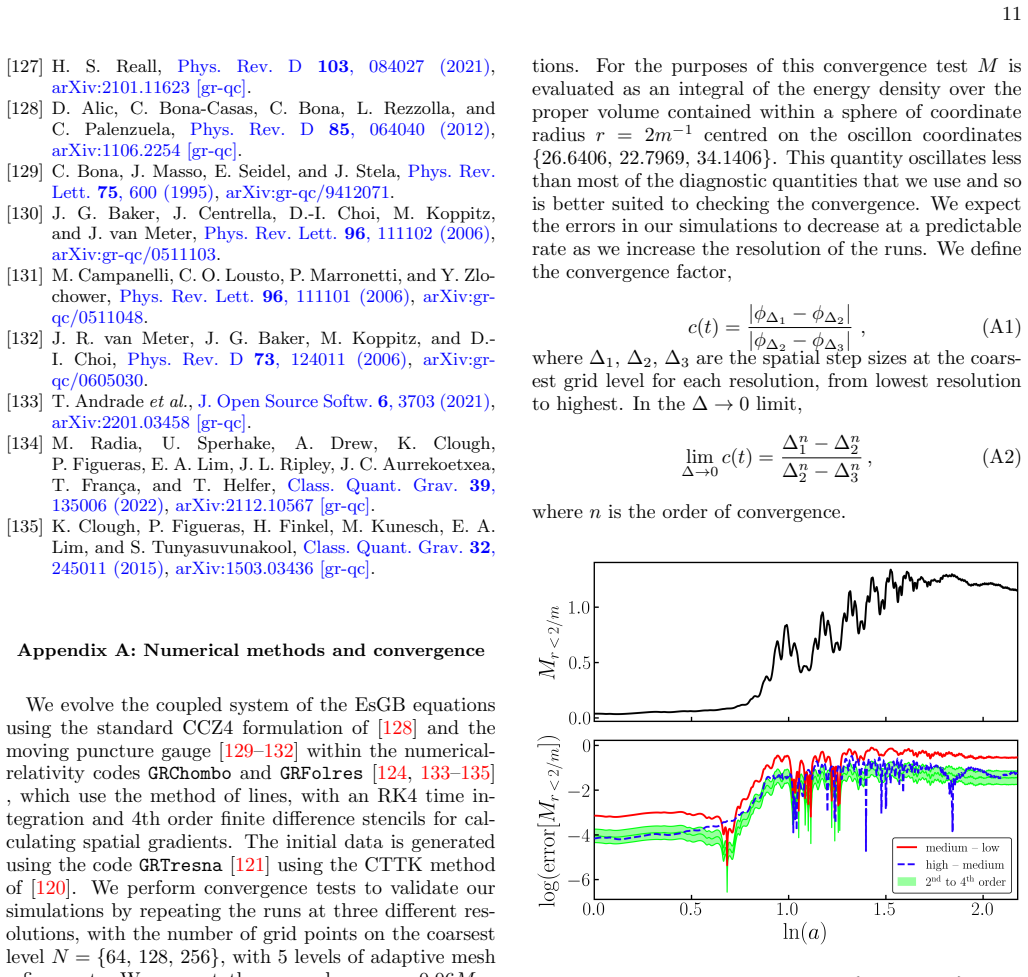
- [Numerical Methods / Results] Numerical Methods / Results sections: the central claims rest on simulation outcomes (oscillon properties, absence of generic black-hole formation, and the threshold for EFT breakdown), yet the manuscript supplies no information on spatial or temporal resolution, convergence tests, error estimates, or validation against the GR limit. Without these diagnostics it is impossible to assess whether the reported curvature thresholds are numerically robust.
- [EFT validity discussion] § on EFT validity criterion: the statement that the system “leaves the regime of validity” is triggered by “large curvature terms,” but no quantitative threshold (e.g., comparison of the Gauss-Bonnet term to the Einstein-Hilbert term, or an estimate of the size of neglected higher-order operators) is provided. This makes the boundary between “still predictive” and “predictivity lost” difficult to reproduce or falsify.
minor comments (2)
- [Abstract] The abstract would be clearer if it briefly indicated the dimensionality and initial conditions of the simulations.
- [Introduction / Setup] Notation for the Gauss-Bonnet coupling and the scalar potential should be introduced once and used consistently; occasional redefinitions slow reading.
Simulated Author's Rebuttal
We thank the referee for the constructive report and the positive assessment of the work's significance. We address the two major comments point by point below. Both points identify areas where additional information will improve the manuscript, and we will incorporate the requested details in the revised version.
read point-by-point responses
-
Referee: [Numerical Methods / Results] Numerical Methods / Results sections: the central claims rest on simulation outcomes (oscillon properties, absence of generic black-hole formation, and the threshold for EFT breakdown), yet the manuscript supplies no information on spatial or temporal resolution, convergence tests, error estimates, or validation against the GR limit. Without these diagnostics it is impossible to assess whether the reported curvature thresholds are numerically robust.
Authors: We agree that explicit documentation of numerical resolution, convergence, and validation is necessary to establish robustness. In the revised manuscript we will add a new subsection to the Numerical Methods section that reports the spatial and temporal resolutions employed, the results of convergence tests at multiple resolutions, quantitative error estimates, and direct validation runs in the GR limit (vanishing Gauss-Bonnet coupling). These additions will allow readers to assess the reliability of the reported curvature thresholds. revision: yes
-
Referee: [EFT validity discussion] § on EFT validity criterion: the statement that the system “leaves the regime of validity” is triggered by “large curvature terms,” but no quantitative threshold (e.g., comparison of the Gauss-Bonnet term to the Einstein-Hilbert term, or an estimate of the size of neglected higher-order operators) is provided. This makes the boundary between “still predictive” and “predictivity lost” difficult to reproduce or falsify.
Authors: We accept that a quantitative criterion is required for reproducibility. In the revised manuscript we will define an explicit threshold, for example by monitoring the local ratio of the Gauss-Bonnet term to the Einstein-Hilbert term (or an estimate of the magnitude of the next-order operators) and will apply this diagnostic to the simulation outputs. This will replace the current qualitative statement with a reproducible, falsifiable boundary between the controlled and uncontrolled regimes. revision: yes
Circularity Check
No significant circularity; results are direct numerical outputs
full rationale
The paper performs numerical evolutions of the Einstein-scalar-Gauss-Bonnet system to study oscillon formation and EFT validity. All reported outcomes (oscillon properties unmodified, no generic black hole formation, EFT breakdown at large curvature) are stated as direct simulation results rather than predictions derived from fitted parameters, self-definitions, or load-bearing self-citations. No equations reduce the conclusions to input assumptions by construction, and the analysis explicitly tracks the regime of validity without smuggling ansatze or renaming known results. The derivation chain is therefore self-contained against external benchmarks.
Axiom & Free-Parameter Ledger
Reference graph
Works this paper leans on
-
[1]
(although they will be excited dynamically during the subsequent evolution). Evolution To obtain a well-posed initial value problem for (1) and to solve the equations of motion of this theory numeri- cally, it is necessary to find an appropriate gauge choice and gauge-fixing procedure [113, 114, 123]. Stable nu- merical simulations further require the add...
2023
-
[2]
A. H. Guth, Phys. Rev. D23, 347 (1981)
1981
-
[3]
A. D. Linde, Phys. Lett. B108, 389 (1982)
1982
-
[4]
Albrecht and P
A. Albrecht and P. J. Steinhardt, Phys. Rev. Lett.48, 1220 (1982)
1982
-
[5]
A. A. Starobinsky, Phys. Lett. B91, 99 (1980)
1980
-
[6]
A. D. Linde, Phys. Lett. B129, 177 (1983)
1983
-
[7]
Seven-Year Wilkinson Microwave Anisotropy Probe (WMAP) Observations: Cosmological Interpretation
E. Komatsu, K. M. Smith, J. Dunkley, C. L. Bennett, B. Gold, G. Hinshaw, N. Jarosik, D. Larson, M. R. Nolta, L. Page, D. N. Spergel, M. Halpern, R. S. Hill, A. Kogut, M. Limon, S. S. Meyer, N. Odegard, G. S. Tucker, J. L. Weiland, E. Wollack, and E. L. Wright, ApJS192, 18 (2011), arXiv:1001.4538 [astro-ph.CO]. 2 www.grtlcollaboration.org
work page internal anchor Pith review Pith/arXiv arXiv 2011
-
[8]
Planck 2018 results. VI. Cosmological parameters
N. Aghanimet al.(Planck), Astron. Astrophys.641, A6 (2020), [Erratum: Astron.Astrophys. 652, C4 (2021)], arXiv:1807.06209 [astro-ph.CO]
work page internal anchor Pith review Pith/arXiv arXiv 2020
-
[9]
Planck 2018 results. X. Constraints on inflation
Y. Akramiet al.(Planck), Astron. Astrophys.641, A10 (2020), arXiv:1807.06211 [astro-ph.CO]
work page internal anchor Pith review Pith/arXiv arXiv 2020
-
[10]
The Atacama Cosmology Telescope: DR6 Power Spectra, Likelihoods and $\Lambda$CDM Parameters
T. Louiset al.(Atacama Cosmology Telescope), JCAP 11, 062, arXiv:2503.14452 [astro-ph.CO]
work page internal anchor Pith review Pith/arXiv arXiv
-
[11]
The Atacama Cosmology Telescope: DR6 Constraints on Extended Cosmological Models
E. Calabreseet al.(Atacama Cosmology Telescope), JCAP11, 063, arXiv:2503.14454 [astro-ph.CO]
work page internal anchor Pith review Pith/arXiv arXiv
-
[12]
E. Camphuiset al.(SPT-3G), Phys. Rev. D113, 083504 (2026), arXiv:2506.20707 [astro-ph.CO]
work page internal anchor Pith review Pith/arXiv arXiv 2026
-
[13]
Superconformal Inflationary $\alpha$-Attractors
R. Kallosh, A. Linde, and D. Roest, JHEP11, 198, arXiv:1311.0472 [hep-th]
work page internal anchor Pith review Pith/arXiv arXiv
-
[14]
Non-minimal Inflationary Attractors
R. Kallosh and A. Linde, JCAP10, 033, arXiv:1307.7938 [hep-th]. 9
work page internal anchor Pith review Pith/arXiv arXiv
-
[15]
Large Field Inflation and Double $\alpha$-Attractors
R. Kallosh, A. Linde, and D. Roest, JHEP08, 052, arXiv:1405.3646 [hep-th]
work page internal anchor Pith review Pith/arXiv arXiv
-
[16]
Yogesh, A. Mohammadi, Q. Wu, and T. Zhu, JCAP10, 010, arXiv:2505.05363 [astro-ph.CO]
- [17]
- [18]
- [19]
- [20]
- [21]
-
[22]
Lovelock, J
D. Lovelock, J. Math. Phys.12, 498 (1971)
1971
-
[23]
Zwiebach, Phys
B. Zwiebach, Phys. Lett. B156, 315 (1985)
1985
-
[24]
D. G. Boulware and S. Deser, Phys. Rev. Lett.55, 2656 (1985)
1985
-
[25]
G. W. Horndeski, Int. J. Theor. Phys.10, 363 (1974)
1974
-
[26]
L. Kofman, A. D. Linde, and A. A. Starobinsky, Phys. Rev. Lett.73, 3195 (1994), arXiv:hep-th/9405187
work page internal anchor Pith review Pith/arXiv arXiv 1994
-
[27]
Towards the Theory of Reheating After Inflation
L. Kofman, A. D. Linde, and A. A. Starobinsky, Phys. Rev. D56, 3258 (1997), arXiv:hep-ph/9704452
work page internal anchor Pith review Pith/arXiv arXiv 1997
-
[28]
Albrecht, P
A. Albrecht, P. J. Steinhardt, M. S. Turner, and F. Wilczek, Phys. Rev. Lett.48, 1437 (1982)
1982
-
[29]
J. H. Traschen and R. H. Brandenberger, Phys. Rev. D 42, 2491 (1990)
1990
-
[30]
M. A. Amin, M. P. Hertzberg, D. I. Kaiser, and J. Karouby, Int. J. Mod. Phys. D24, 1530003 (2014), arXiv:1410.3808 [hep-ph]
work page internal anchor Pith review Pith/arXiv arXiv 2014
-
[31]
I. L. Bogolyubsky and V. G. Makhankov, JETP Lett. 24, 12 (1976)
1976
-
[32]
I. L. Bogolyubsky and V. G. Makhankov, Pisma Zh. Eksp. Teor. Fiz.25, 120 (1977)
1977
- [33]
-
[34]
E. J. Copeland, M. Gleiser, and H. R. Muller, Phys. Rev. D52, 1920 (1995), arXiv:hep-ph/9503217
work page internal anchor Pith review Pith/arXiv arXiv 1920
-
[35]
S. Kasuya, M. Kawasaki, and F. Takahashi, Phys. Lett. B559, 99 (2003), arXiv:hep-ph/0209358
work page internal anchor Pith review Pith/arXiv arXiv 2003
- [36]
-
[37]
M. P. Hertzberg, Phys. Rev. D82, 045022 (2010), arXiv:1003.3459 [hep-th]
work page internal anchor Pith review Pith/arXiv arXiv 2010
-
[38]
Radiation and Relaxation of Oscillons
P. Salmi and M. Hindmarsh, Phys. Rev. D85, 085033 (2012), arXiv:1201.1934 [hep-th]
work page internal anchor Pith review Pith/arXiv arXiv 2012
-
[39]
M. Gleiser and M. Krackow, Phys. Rev. D100, 116005 (2019), arXiv:1906.04070 [hep-th]
-
[40]
S. Antusch, F. Cefal` a, and F. Torrent´ ı, JCAP10, 002, arXiv:1907.00611 [hep-ph]
-
[41]
M. Ibe, M. Kawasaki, W. Nakano, and E. Sonomoto, JHEP04, 030, arXiv:1901.06130 [hep-ph]
work page internal anchor Pith review Pith/arXiv arXiv 1901
- [42]
-
[43]
F. van Dissel, O. Pujolas, and E. I. Sfakianakis, JHEP07, 194, [Erratum: JHEP 04, 191 (2025)], arXiv:2303.16072 [hep-th]
-
[44]
S.-Y. Zhou, Rept. Prog. Phys.88, 046901 (2025), arXiv:2411.16604 [hep-th]
-
[45]
G. N. Felder and I. Tkachev, Comput. Phys. Commun. 178, 929 (2008), arXiv:hep-ph/0011159
work page internal anchor Pith review Pith/arXiv arXiv 2008
-
[46]
G. N. Felder and L. Kofman, Phys. Rev. D75, 043518 (2007), arXiv:hep-ph/0606256
work page internal anchor Pith review Pith/arXiv arXiv 2007
-
[47]
A. V. Frolov, JCAP11, 009, arXiv:0809.4904 [hep-ph]
work page internal anchor Pith review Pith/arXiv arXiv
-
[48]
M. A. Amin and D. Shirokoff, Phys. Rev. D81, 085045 (2010), arXiv:1002.3380 [astro-ph.CO]
work page internal anchor Pith review Pith/arXiv arXiv 2010
-
[49]
M. A. Amin, R. Easther, and H. Finkel, JCAP12, 001, arXiv:1009.2505 [astro-ph.CO]
work page internal anchor Pith review Pith/arXiv arXiv
-
[50]
M. A. Amin, R. Easther, H. Finkel, R. Flauger, and M. P. Hertzberg, Phys. Rev. Lett.108, 241302 (2012), arXiv:1106.3335 [astro-ph.CO]
work page internal anchor Pith review Pith/arXiv arXiv 2012
-
[51]
M. A. Amin, Phys. Rev. D87, 123505 (2013), arXiv:1303.1102 [astro-ph.CO]
work page internal anchor Pith review Pith/arXiv arXiv 2013
-
[52]
K. D. Lozanov and M. A. Amin, Phys. Rev. D90, 083528 (2014), arXiv:1408.1811 [hep-ph]
work page internal anchor Pith review Pith/arXiv arXiv 2014
-
[53]
Impact of other scalar fields on oscillons after hilltop inflation
S. Antusch and S. Orani, JCAP03, 026, arXiv:1511.02336 [hep-ph]
work page internal anchor Pith review Pith/arXiv arXiv
-
[54]
Parametric resonance after hilltop inflation caused by an inhomogeneous inflaton field
S. Antusch, F. Cefala, D. Nolde, and S. Orani, JCAP 02, 044, arXiv:1510.04856 [hep-ph]
work page internal anchor Pith review Pith/arXiv arXiv
-
[55]
M. P. DeCross, D. I. Kaiser, A. Prabhu, C. Prescod- Weinstein, and E. I. Sfakianakis, Phys. Rev. D97, 023526 (2018), arXiv:1510.08553 [astro-ph.CO]
work page internal anchor Pith review Pith/arXiv arXiv 2018
-
[56]
M. P. DeCross, D. I. Kaiser, A. Prabhu, C. Prescod- Weinstein, and E. I. Sfakianakis, Phys. Rev. D97, 023527 (2018), arXiv:1610.08868 [astro-ph.CO]
work page internal anchor Pith review Pith/arXiv arXiv 2018
-
[57]
M. P. DeCross, D. I. Kaiser, A. Prabhu, C. Prescod- Weinstein, and E. I. Sfakianakis, Phys. Rev. D97, 023528 (2018), arXiv:1610.08916 [astro-ph.CO]
work page internal anchor Pith review Pith/arXiv arXiv 2018
-
[58]
J. Kim and J. McDonald, Phys. Rev. D95, 123537 (2017), arXiv:1702.08777 [astro-ph.CO]
work page internal anchor Pith review Pith/arXiv arXiv 2017
-
[59]
K. D. Lozanov and M. A. Amin, Phys. Rev. D97, 023533 (2018), arXiv:1710.06851 [astro-ph.CO]
work page internal anchor Pith review Pith/arXiv arXiv 2018
- [60]
- [61]
- [62]
- [63]
- [64]
- [65]
-
[66]
B. Eggemeier, J. C. Niemeyer, and R. Easther, Phys. Rev. D103, 063525 (2021), arXiv:2011.13333 [astro- ph.CO]
-
[67]
O. Iarygina, E. I. Sfakianakis, D.-G. Wang, and A. Ach´ ucarro, (2020), arXiv:2005.00528 [astro-ph.CO]
-
[68]
Y. Sang and Q.-G. Huang, Phys. Lett. B823, 136781 (2021), arXiv:2012.14697 [hep-th]
- [69]
-
[70]
J. van de Vis, R. Nguyen, E. I. Sfakianakis, J. T. Gib- lin, and D. I. Kaiser, Phys. Rev. D102, 043528 (2020), arXiv:2005.00433 [astro-ph.CO]
- [71]
- [72]
-
[73]
B. Eggemeier, B. Schwabe, J. C. Niemeyer, and R. East- her, Phys. Rev. D105, 023516 (2022), arXiv:2110.15109 [astro-ph.CO]. 10
- [74]
- [75]
-
[76]
R. Mahbub and S. S. Mishra, Phys. Rev. D108, 063524 (2023), arXiv:2303.07503 [astro-ph.CO]
- [77]
- [78]
- [79]
-
[80]
J. Baeza-Ballesteros, D. G. Figueroa, A. Florio, J. Lizarraga, N. Loayza, K. Marschall, T. Opferkuch, B. A. Stefanek, F. Torrent´ ı, and A. Urio, (2025), arXiv:2512.15627 [astro-ph.CO]
discussion (0)
Sign in with ORCID, Apple, or X to comment. Anyone can read and Pith papers without signing in.