REVIEW 3 major objections 19 references
Attention from a few cross-modal retrieval heads can attribute multimodal answers in long documents without training, faster and more accurately than prompting the same model.
Reviewed by Pith at T0; open to challenge. T0 means a machine referee read the full paper against a public rubric. the ladder, T0–T4 →
T0 review · grok-4.5
2026-07-12 08:49 UTC pith:YW4VFL3L
load-bearing objection Solid systems paper: training-free multimodal attribution from prefill attention plus a first long-doc free-form MultAttrEval benchmark; gains and latency look real on this setup, with the main soft spot being small same-pipeline probe calibration. the 3 major comments →
MultAttnAttrib: Training-Free Multimodal Attribution in Long Document Question Answering
The pith
A machine-rendered reading of the paper's core claim, the machinery that carries it, and where it could break.
Core claim
MultAttnAttrib claims that multimodal answer attribution in long interleaved documents can be recovered, without any training, by identifying a sparse set of cross-modal retrieval heads via causal mediation on a small probe set, averaging their attention over image patches and text windows, and applying modality-specific thresholds learned by an F1 sweep; the resulting citations outperform prompting-based attribution on the same backbone and remain competitive with frontier models while costing a single prefill pass.
What carries the argument
Cross-modal retrieval heads selected by causal mediation analysis (clean vs. corrupted evidence) plus min-max-normalized attention scores thresholded for images and text; attribution is a single forward prefill pass that scores image slots and sliding text windows jointly.
Load-bearing premise
A small labeled probe set of about ninety question-answer-attribution triples is enough to pick heads and thresholds that still work on the held-out long documents.
What would settle it
Re-run head identification and threshold calibration on a disjoint probe sample drawn from different documents or domains; if the new heads and thresholds produce a large drop in test F1 relative to the original probe, the generalization claim fails.
Editorial analysis
A structured set of objections, weighed in public.
Referee Report
Summary. The paper proposes MultAttnAttrib, a training-free multimodal attribution method for long-document QA that identifies cross-modal retrieval heads via causal mediation analysis (CMA) on a small labeled probe set, calibrates modality-specific thresholds by F1 sweep, and extracts text-span and image-slot citations from a single prefill attention pass (Alg. 1–4, §3). It also introduces MultAttrEval, a synthetic QAA benchmark over long PDFs spanning text-only, image-only, and joint regimes across five domains (§4, App. A). On a held-out MultAttrEval test split, MultAttnAttrib on Qwen3-VL-30B outperforms same-backbone VLM/LLM/RAG prompting baselines in F1 across regimes (Table 2), is competitive with prompted GPT-5.4 especially on image metrics (Fig. 3, App. F), and reports ~7× lower latency and ~15 GB lower peak VRAM than direct VLM prompting (Table 1).
Significance. If the gains hold beyond this benchmark, the work is a useful contribution: multimodal attribution in long interleaved documents is under-served relative to unimodal citation work, MultAttrEval is the first fine-grained localization benchmark of its kind rather than candidate-pool citation selection, and a single-pass attention method that matches frontier prompting at a fraction of the cost is practically valuable for grounded assistants. Strengths include explicit head-agreement analyses (IoU/Spearman, layer distributions; §6.3, Figs. 4–5), latency/memory measurements, multi-regime tables on both open and frontier models, and an LLM-as-judge supplement. The main significance risk is that both method calibration and evaluation live on the same synthetically generated MultAttrEval distribution.
major comments (3)
- §5.1 and §3.2–3.3: Head identification (CMA on MultAttrEval ground-truth positions) and F1-maximizing threshold calibration (Alg. 4) both use a 90-item probe drawn from the same MultAttrEval generation pipeline as the 608-item test set. Table 2’s large same-backbone F1 gains and GPT-competitive image results therefore rest on an untested transfer assumption. The Limitations section notes the labeled-probe requirement but does not report sensitivity to probe size, random split, or label source. At minimum, ablations (probe-size curves; leave-one-domain-out calibration; thresholds fixed without F1 sweep) are needed before the central claim can be treated as robust rather than MultAttrEval-specific.
- §4 and App. K: MultAttrEval QAAs are MLLM-generated under strict synthetic filters (entity co-occurrence, 12–25-word extractive spans, cross-modal grounding and circularity rubrics). Evaluation then uses exact image match and fuzzy substring tiers with length-ratio penalties (App. C). Limitations already notes near-duplicate images depress image metrics; more load-bearing is whether the benchmark’s generation artifacts (single-image image-only items, short extractive text spans, entity-verified multimodal pairs) systematically favor attention localization over generative citation. Without a human-authored or external-document subset, it is hard to separate method quality from benchmark style.
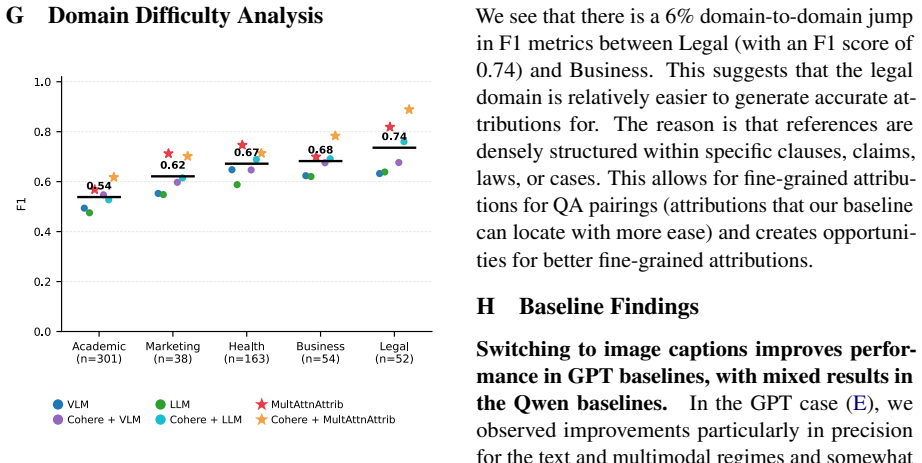
- Table 2 vs. App. F / Fig. 3: The abstract and §6.2 claim MultAttnAttrib “matches” or is competitive with GPT-5.4, but the strongest GPT Cohere+LLM text F1 (0.888) and multimodal F1 (0.663) still exceed Cohere+MultAttnAttrib (0.665 / 0.601), while MultAttnAttrib leads mainly on image precision/F1 and recall-oriented text metrics. The claim should be restated with regime-specific caveats (stronger on visual localization and efficiency; mixed or weaker on high-precision text citation) so the contribution is not oversold.
Circularity Check
No by-construction circularity: MultAttnAttrib is supervised head/threshold calibration on a held-out MultAttrEval split, not a first-principles prediction forced by its inputs.
full rationale
This is an empirical methods paper, not a derivation of a physical or mathematical quantity from axioms. MultAttnAttrib (1) scores attention heads on a labeled probe set via CMA/MAS against MultAttrEval ground-truth evidence positions, (2) sweeps F1-maximizing modality thresholds on those probe score distributions, and (3) attributes held-out test QAAs with the selected heads and thresholds in one prefill pass. That is standard labeled calibration plus held-out evaluation, not a self-definitional loop: the test attributions are not algebraically or statistically forced to equal the probe fits. Baselines (prompting, captioning, RAG) are run without those probe-derived heads/thresholds, so Table 2 F1 gains are comparative empirical results, not tautologies. Overlap with Basu et al. (2025) is ordinary methodological inheritance for CMA-style head scoring, not a load-bearing uniqueness theorem that forbids alternatives. The only mild circularity-adjacent concern is that probe and test share the same MultAttrEval generation pipeline and domain mix, so calibration may overfit that synthetic label style—this is a generalization/overfitting risk, not reduction of the central claim to its inputs by construction. Limitations already note the labeled-probe requirement. Score 1 reflects that minor same-family calibration dependency without elevating it to fitted-input-as-prediction or self-definitional circularity.
Axiom & Free-Parameter Ledger
free parameters (4)
- top-k retrieval heads H
- text sliding-window length W
- modality thresholds T_img and T_txt
- probe set size and composition (90 QAAs)
axioms (4)
- domain assumption A sparse subset of attention heads causally mediates retrieval of supporting evidence from long multimodal context.
- ad hoc to paper Clean-vs-corrupted mean attention difference (CMA), entropy-weighted, ranks heads by causal retrieval contribution across modalities.
- ad hoc to paper Min-max normalized head-averaged attention over image slots and text windows, thresholded, yields valid citations (with max-score fallback).
- domain assumption MultAttrEval filtered MLLM-generated QAA labels are sufficiently accurate ground truth for ranking methods.
invented entities (2)
-
MultAttnAttrib pipeline (cross-modal retrieval heads + calibrated multimodal thresholds)
no independent evidence
-
MultAttrEval benchmark
no independent evidence
read the original abstract
As grounded QA systems are increasingly deployed in AI assistants, accurately attributing generated answers to evidence is critical for user trust and model safety. While unimodal attributions have been explored in depth, the multimodal setting remains relatively under-researched. As a result, we introduce MultAttnAttrib, a training-free attribution-generation method that leverages a model's prefill pass, selected attention heads, and calibrated thresholds to locate source evidence within a document. To establish baseline results for the method, we introduce MultAttrEval, a complementary benchmark dataset annotated with fine-grained, ground-truth attributions for answer components grounded in multimodal source documents. To our knowledge, this is the first evaluation dataset designed specifically for multimodal attribution in long-form documents. Experimental results show that MultAttnAttrib consistently outperforms a variety of attribution-generation methods, including several strong prompting-based approaches and matches the latest frontier models such as GPT 5.4. Our method not only substantially improves attribution accuracy for both unimodal and multimodal attribution types, but also produces attributions at up to one-seventh of the direct inference latency compared to prompting on the same base model.
Figures




Reference graph
Works this paper leans on
-
[1]
Benchmarking retrieval-augmented multi- modal generation for document question answer- ing.Advances in Neural Information Processing Systems, 38. Luyu Gao, Zhuyun Dai, Panupong Pasupat, An- thony Chen, Arun Tejasvi Chaganty, Yicheng Fan, Vincent Y . Zhao, Ni Lao, Hongrae Lee, Da-Cheng Juan, and Kelvin Guu. 2023a. Rarr: 9 Researching and revising what lang...
arXiv 2023
-
[2]
InProceedings of the 2025 Annual In- ternational ACM SIGIR Conference on Research and Development in Information Retrieval in the Asia Pacific Region, pages 47–54
Vericite: Towards reliable citations in retrieval-augmented generation via rigorous ver- ification. InProceedings of the 2025 Annual In- ternational ACM SIGIR Conference on Research and Development in Information Retrieval in the Asia Pacific Region, pages 47–54. Pritika Ramu, Koustava Goswami, Apoorv Saxena, and Balaji Vasan Srinivasan. 2024. Enhancing p...
2025
-
[3]
InProceedings of the AAAI Confer- ence on Artificial Intelligence, volume 40, pages 33028–33037
Mavis: A benchmark for multimodal source attribution in long-form visual question 10 answering. InProceedings of the AAAI Confer- ence on Artificial Intelligence, volume 40, pages 33028–33037. David Wan, Han Wang, Ziyang Wang, Elias Stengel-Eskin, Hyunji Lee, and Mohit Bansal
-
[4]
Multimodal fact-level attribution for verifiable reasoning.arXiv preprint arXiv:2602.11509. Kevin Wang, Alexandre Variengien, Arthur Conmy, Buck Shlegeris, and Jacob Steinhardt. 2022. In- terpretability in the wild: a circuit for indirect ob- ject identification in gpt-2 small.arXiv preprint arXiv:2211.00593. Yanting Wang, Runpeng Geng, Ying Chen, and Jin...
Pith/arXiv arXiv 2022
-
[5]
Produce ‘domain_grounding‘ (2--4 sentences) summarizing subject matter and terminology from **raster-legible** content, aligned with grounding chunks for domain only
-
[6]
Set ‘is_relevant‘ false only for blank/decorative/unusably degraded content
-
[7]
visual"‘ (specific values/labels/readouts in the raster are **essential** to justify the answer) or ‘
If relevant, emit all strong non-redundant ‘qa_pairs‘. Each pair **must** include: - ‘question‘, ‘answer‘, ‘type‘ in \{relational, inferential, procedural, quantitative\} - ‘answer_evidence‘: one of ‘"visual"‘ (specific values/labels/readouts in the raster are **essential** to justify the answer) or ‘"visual_plus_general"‘ (answer combines one raster-spec...
-
[8]
The answer MAY be paraphrased (it does not need to be copied verbatim)
-
[9]
Do NOT add facts not present in the paragraph
The answer MUST be fully supported by the paragraph. Do NOT add facts not present in the paragraph
-
[10]
The answer MUST be between 12 and 25 words long (inclusive)
-
[11]
The question MUST require reading comprehension of the paragraph, not just simple word or name lookup
-
[12]
Each question MUST be answerable solely from the given paragraph, without any external knowledge
-
[13]
Triplets must be diverse: do NOT ask multiple questions that can be answered with nearly the same statement
-
[14]
this page
NEVER refer to ’the paragraph’, ’this paragraph’, ’the text’, ’the document’, or similar meta wording in the question. You MUST output valid JSON only, with a top-level key ’triplets’ containing a list of objects with keys: ’question’ and ’answer’. L.1.3 Multimodal Listing 7: Multimodal QAA System Prompt You are an expert at creating challenging, non-triv...
-
[15]
**Scan document images** and identify indices whose visual content (figures, tables, charts, diagrams, schematics, photos, labeled components, layouts) is relevant and supportive of the reference answer
-
[17]
L.3.3 LLM Preamble When using captions instead of raw raster content, we can apply the modification below, followed by the general prompt
Use whichever evidence is actually supportive: - text only, - images only, or - both text and images. L.3.3 LLM Preamble When using captions instead of raw raster content, we can apply the modification below, followed by the general prompt. You are given **document image captions** (for labels ‘[Image 0]‘, ‘[Image 1]‘, ... in order) and **document text**....
-
[18]
**Scan image captions** tied to ‘[Image k]‘ and identify indices whose described visual content is relevant and supportive of the reference answer
-
[19]
**Scan document text** and find the passage that most directly states or supports the key fact(s) in the reference answer
-
[20]
Use whichever evidence is actually supportive: - text only, - images only, or - both text and images. 25
discussion (0)
Sign in with ORCID, Apple, or X to comment. Anyone can read and Pith papers without signing in.