REVIEW 1 major objections 5 minor 172 references
A new AREPO-2 SIDM module decouples scattering from gravity so multiple collisions per step stay conserved and cheap.
Reviewed by Pith at T0; open to challenge. T0 means a machine referee read the full paper against a public rubric. the ladder, T0–T4 →
T0 review · grok-4.5
2026-07-11 06:36 UTC pith:OGBCXMAG
load-bearing objection Solid methods paper: dedicated DM tree + multi-scatter MPI makes AREPO-2 SIDM practical for hierarchical gravity and deep core collapse, with thorough validation and real speedups. the 1 major comments →
A Novel Implementation of Self-Interacting Dark Matter in AREPO
The pith
A machine-rendered reading of the paper's core claim, the machinery that carries it, and where it could break.
Core claim
The authors show that a Monte-Carlo SIDM implementation built around a dedicated DM-only neighbour tree, ordered pairwise MPI communication that reloads the latest particle state after every accepted scatter, and a per-pair time-step criterion (C_SIDM = 0.1) conserves momentum and energy to machine precision, reproduces analytic and gravothermal-fluid benchmarks, matches the legacy AREPO-1 SIDM results, and incurs only modest overhead relative to CDM except in late core collapse (where it remains substantially faster than AREPO-1).
What carries the argument
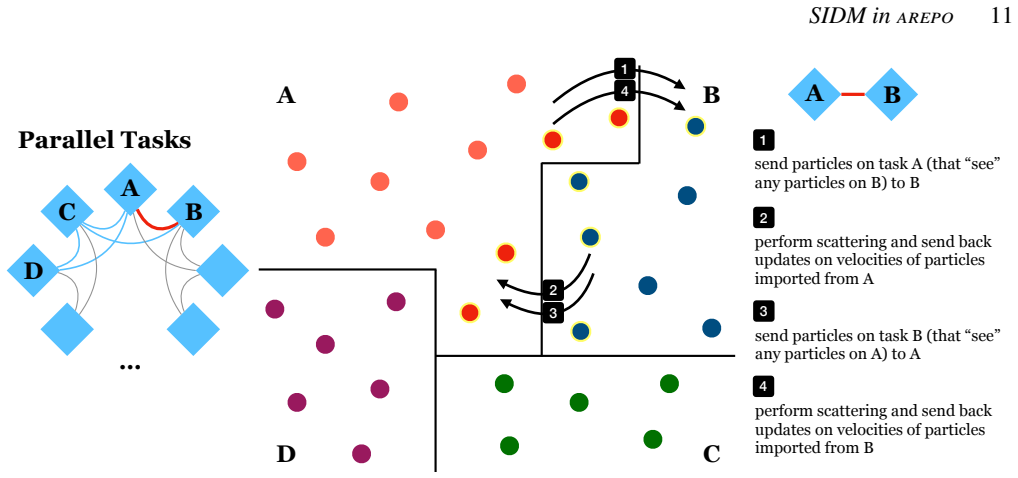
Dedicated DM-only neighbour-search tree plus pairwise MPI protocol: the tree decouples scattering from gravity so hierarchical time integration remains usable; the protocol processes remote pairs one task-pair at a time, reloading the export-buffer state before each successive scatter on an imported particle, thereby keeping multi-scatter kinematics self-consistent and conserving momentum and energy by construction.
Load-bearing premise
That the one-sided cubic-spline kernel with a fixed neighbour count of roughly 32, together with the continuum Monte-Carlo rate formula, still gives an unbiased approximation to the true collision physics even when the mean free path becomes much shorter than the gravitational scale height and many particles scatter repeatedly inside one time step.
What would settle it
Evolve the same isolated NFW halo deep into core collapse with both this module and an independent high-resolution Boltzmann or calibrated fluid solver; a statistically significant mismatch in core-density evolution or energy conservation once the Knudsen number falls well below unity would falsify the claim that the scheme remains accurate in the short-mean-free-path regime.
If this is right
- Isolated and cosmological SIDM runs that reach the late core-collapse phase become practical at resolutions previously limited by time-step cost.
- Full-physics cosmological boxes that include both SIDM and baryons can reuse the hierarchical gravity solver without the order-of-magnitude slowdown of the older gravity-tree neighbour search.
- Velocity-dependent and inelastic SIDM models can be added by writing only four user functions, without re-engineering the parallel layer.
- Performance overhead relative to pure CDM stays modest outside deep collapse, making large-volume SIDM survey suites cheaper than before.
Where Pith is reading between the lines
- Because the neighbour tree is already dynamic and shared-memory aware, the same infrastructure can later host other short-range non-gravitational DM interactions (e.g., drag or effective-force schemes) with little extra engineering.
- The per-pair time-step criterion may allow controlled exploration of the short-mean-free-path regime at mass resolutions still affordable for zoom-in galaxy simulations, tightening empirical calibration of fluid conductivity parameters.
- Once core-collapse densities become routinely reachable, the module supplies a ready numerical laboratory for testing whether dense SIDM subhaloes can explain the concentrated perturbers inferred from stellar streams and strong lenses.
Editorial analysis
A structured set of objections, weighed in public.
Referee Report
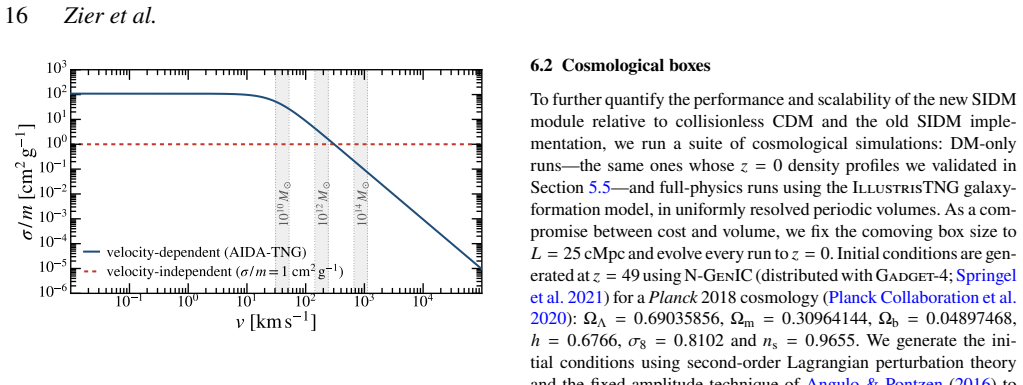
Summary. The paper presents a new Monte-Carlo SIDM module for AREPO-2. Its main design choices are a dedicated DM-only neighbour tree that decouples scattering from gravity (preserving hierarchical time integration), a pairwise MPI protocol that updates particle states after every accepted scatter so multiple events per step conserve momentum and energy by construction, and a per-pair timestep criterion (C_SIDM=0.1) that is far less restrictive than the total-probability limit used in AREPO-1. The module supports velocity-dependent and inelastic cross-sections through a four-function interface. Validation covers isotropic elastic scattering: beam deflection on a lattice, Maxwellian thermalization (including a Yukawa-type VDCS) against an independent Boltzmann solver, isolated NFW core collapse against a calibrated gravothermal fluid model and against AREPO-1, MW-mass zoom-ins, and 25 cMpc boxes at three resolutions with and without baryons. Performance tests show modest overhead relative to CDM outside late core collapse and substantially lower cost than the legacy AREPO-1 SIDM implementation, especially once baryons force a deep timestep hierarchy.
Significance. If the results hold, this is a solid, practically important methods contribution for the SIDM community. Late-time gravothermal core collapse is currently of high observational interest (dense substructures in lenses and streams; possible DM-seeded black holes), and existing Monte-Carlo implementations become prohibitively expensive precisely in that regime. The multi-scatter MPI scheme, per-pair timestep, and gravity-decoupled neighbour tree make that regime tractable while remaining compatible with modern AREPO-2 gravity and full-physics galaxy formation. The public Boltzmann solver and SoftIsoICs generator, the explicit conservation properties, and the clear extensibility interface are concrete strengths that raise the bar for subsequent SIDM modules.
major comments (1)
- The continuum validity of the one-sided cubic-spline estimator (Eq. 14, N_ngb=32±5) deep in the SMFP core-collapse regime (Kn≪1) remains the softest load-bearing point of the “deep-collapse tractability” claim. Table 1 footnote a and §2.3.1 already state that unbiasedness then requires prohibitively fine resolution; the N-body–fluid comparison (Figs. 8, B1) uses a fluid model whose LMFP conductivity is itself calibrated to N-body (C_κ=0.8, §B2). Agreement past Kn=1 is therefore only a partial, non-independent check of the SMFP asymptote. This is a known limitation of the Monte-Carlo class, not a coding error, but the manuscript should state more explicitly in the abstract/conclusions which density range of the collapse phase is considered reliable at the resolutions used, and what additional resolution or alternative estimator (e.g. the overlap kernel of App. A, or the drag-force scheme
minor comments (5)
- Fig. 13 (bottom) and the associated text in §6.1 make the wall-clock advantage during runaway collapse clear; a short quantitative statement of the density ratio reached at equal cost (already visible in the figure) would help readers who only skim the text.
- The four-function user interface (§4.6) is a genuine strength; a one-line example of how an anisotropic or inelastic model would be registered would make the extensibility claim more concrete for potential users.
- In §4.4, the comparison of the new per-pair criterion with the AREPO-1 total-probability limit (Eqs. 18–22) is useful; stating the numerical factor Δt_old/Δt_new ~ 10^{-2} already in the main text (rather than only in the derivation) would help non-specialist readers.
- Typos / notation: “arepo-2” / “AREPO-2” capitalization is inconsistent across abstract and body; “gravothermal” vs “gravothermal-fluid” is fine but the fluid-model reference (Outmezguine et al. 2023; Gad-Nasr et al. 2024) should be cited at first mention in §5.3 as well as in App. B.
- Table 2: the baryonic full-physics run is only at 2×256^{3}; a brief caveat that the order-of-magnitude speed-up relative to AREPO-1 may change at higher resolution (deeper hierarchy) would be prudent.
Circularity Check
Methods paper with external analytic/Boltzmann/fluid benchmarks and free-parameter variation; only minor self-referential calibration of the fluid conductivity used as a check, not a forced prediction.
specific steps
-
fitted input called prediction
[Appendix B2 / Fig. B1 / Eq. (B16)]
"We find that C_κ = 0.8 gives the best agreement with the N-body benchmark in both collapse time and late-time behaviour (Figure B1); the corresponding core-density evolution is also shown in Figure 8. ... In the LMFP regime ... the fluid approximation requires a calibration parameter C_κ, fitted so that the heat flux matches that measured in N-body simulations"
The fluid model’s LMFP conductivity is explicitly fitted (C_κ = 0.8) to N-body heat flux before the same fluid solution is plotted as a reference for the N-body core-collapse runs. The late-time visual agreement is therefore partly by construction for the LMFP segment; the paper acknowledges the need for calibration and does not claim a parameter-free first-principles match. This is a minor, field-standard check rather than a load-bearing circular prediction.
full rationale
This is a numerical-methods contribution whose correctness claims rest on (i) analytic beam-deflection and isotropic angular distributions, (ii) an independent kinetic Boltzmann solver for thermalization (publicly released), (iii) energy/momentum conservation to machine precision by construction of the pairwise update, (iv) direct comparison to the legacy AREPO-1 SIDM module on identical ICs, and (v) performance scaling against pure CDM. Free numerical parameters (C_SIDM, N_ngb, η, kernel choice) are varied and shown not to alter the macroscopic outcome within the tested range. The sole mild self-reference is the conventional calibration of the gravothermal-fluid conductivity parameter C_κ against N-body data before using the fluid solution as a visual benchmark for core collapse; the paper itself states that such calibration is required and does not present the fluid agreement as an independent first-principles derivation. No uniqueness theorem, ansatz smuggled via self-citation, or fitted parameter re-used as a prediction appears. Score 1 reflects only that minor calibration step; the central implementation claims remain externally falsifiable.
Axiom & Free-Parameter Ledger
free parameters (4)
- C_SIDM =
0.1
- N_ngb =
32±5
- C_κ =
0.8
- η (gravity timestep) =
0.005
axioms (4)
- domain assumption The Monte-Carlo pairwise scatter rate with one-sided or overlap kernel converges to the continuum Boltzmann collision operator for large particle number and small smoothing length.
- domain assumption Elastic isotropic scattering with the total cross-section σ (rather than σ_T or σ_V) is an adequate description for the validation suite.
- domain assumption Hierarchical operator-splitting time integration of Springel et al. (2021) remains symplectic and accurate when SIDM kicks are inserted after the second half-kick.
- standard math Standard mathematical properties of the cubic-spline kernel and of MPI collective/pairwise communication.
read the original abstract
Self-interacting dark matter (SIDM) influences halo structure through collisional heat transport and may solve several small-scale puzzles in structure formation. SIDM creates thermalized cores in low-mass haloes, which may account for the observed cored dwarf galaxies. During late-time gravothermal core collapse, SIDM can produce dense low-mass DM haloes and substructures detected through perturbations to cold stellar streams and strong gravitational lenses. In this work, we present a new Monte-Carlo SIDM implementation in the moving-mesh code AREPO-2, designed for efficiency, scalability, and extensibility. The central feature of the implementation is a dedicated DM-only neighbour-search tree that decouples the scattering solver from gravity. This preserves compatibility with the hierarchical time integration used by AREPO-2 while leaving the optimized gravity solver unconstrained. A pairwise communication scheme between MPI tasks allows tracking multiple scattering events in a single timestep while conserving momentum and energy and maintaining parallel consistency by construction. This is complemented by a per-pair timestep criterion that significantly reduces unnecessary timestep restrictions. The implementation natively supports velocity-dependent cross-sections and inelastic interactions, while a compact interface is designed for additional SIDM physics to be implemented without knowledge of the parallelization layer. We validate the implementation for isotropic, elastic scattering using a suite of idealized and cosmological tests. We assess performance and scalability in isolated core-collapse simulations and in cosmological boxes, both DM-only and with baryons. Except during the late stages of gravothermal collapse, SIDM simulations incur only modest overhead relative to the corresponding CDM runs and are substantially faster than the previous SIDM implementation in AREPO-1.
Figures






Reference graph
Works this paper leans on
-
[1]
Towards optimal softening in three-dimensional N-body codes - I. Minimizing the force error. , keywords =. doi:10.1046/j.1365-8711.2001.04237.x , archivePrefix =. astro-ph/0011568 , primaryClass =
-
[2]
Computer simulation using particles
-
[3]
Hidden sector hydrogen as dark matter: Small-scale structure formation predictions and the importance of hyperfine interactions. , keywords =. doi:10.1103/PhysRevD.94.123017 , archivePrefix =. 1609.03592 , primaryClass =
-
[4]
Colliding clusters and dark matter self-interactions. , keywords =. doi:10.1093/mnras/stt2097 , archivePrefix =. 1308.3419 , primaryClass =
-
[5]
Halo-Shape and Relic-Density Exclusions of Sommerfeld-Enhanced Dark Matter Explanations of Cosmic Ray Excesses. , keywords =. doi:10.1103/PhysRevLett.104.151301 , archivePrefix =. 0911.0422 , primaryClass =
-
[6]
SHH method for SIDM: An SIDM-hydro hybrid method for simulating self-interacting dark matter. arXiv e-prints , keywords =. doi:10.48550/arXiv.2508.10278 , archivePrefix =. 2508.10278 , primaryClass =
-
[7]
Universal gravothermal evolution of isolated self-interacting dark matter halos for velocity-dependent cross-sections. , keywords =. doi:10.1093/mnras/stad1705 , archivePrefix =. 2204.06568 , primaryClass =
-
[8]
Numerical Evolution of Self-Gravitating Halos of Self-Interacting Dark Matter. , keywords =. doi:10.1103/qht7-5tz3 , archivePrefix =. 2506.04334 , primaryClass =
-
[9]
A semi-analytic study of self-interacting dark-matter haloes with baryons. , keywords =. doi:10.1093/mnras/stad705 , archivePrefix =. 2206.12425 , primaryClass =
-
[10]
The surprising accuracy of isothermal Jeans modelling of self-interacting dark matter density profiles. , keywords =. doi:10.1093/mnras/staa3954 , archivePrefix =. 2009.07844 , primaryClass =
-
[11]
First-Principles Formalism for Simulating Self-Interacting Dark Matter. arXiv e-prints , keywords =. doi:10.48550/arXiv.2512.17998 , archivePrefix =. 2512.17998 , primaryClass =
-
[12]
Subhaloes in self-interacting galactic dark matter haloes. , keywords =. doi:10.1111/j.1365-2966.2012.21182.x , archivePrefix =. 1201.5892 , primaryClass =
-
[13]
Improving the convergence properties of the moving-mesh code AREPO. , keywords =. doi:10.1093/mnras/stv2380 , archivePrefix =. 1503.00562 , primaryClass =
-
[14]
E pur si muove: Galilean-invariant cosmological hydrodynamical simulations on a moving mesh. , keywords =. doi:10.1111/j.1365-2966.2009.15715.x , archivePrefix =. 0901.4107 , primaryClass =
-
[15]
The AREPO Public Code Release. , keywords =. doi:10.3847/1538-4365/ab908c , archivePrefix =. 1909.04667 , primaryClass =
-
[16]
The MillenniumTNG Project: the hydrodynamical full physics simulation and a first look at its galaxy clusters. , keywords =. doi:10.1093/mnras/stac3620 , archivePrefix =. 2210.10060 , primaryClass =
-
[17]
Moving mesh cosmology: numerical techniques and global statistics. , keywords =. doi:10.1111/j.1365-2966.2012.21590.x , archivePrefix =. 1109.1281 , primaryClass =
-
[18]
A hierarchical O(N log N) force-calculation algorithm. , keywords =. doi:10.1038/324446a0 , adsurl =
-
[19]
Journal of Astrophysics and Astronomy , keywords =
TreePM: A Code for Cosmological N-Body Simulations. Journal of Astrophysics and Astronomy , keywords =. doi:10.1007/BF02702282 , archivePrefix =. astro-ph/9911025 , primaryClass =
-
[20]
Performance characteristics of TreePM codes. , keywords =. doi:10.1016/S1384-1076(03)00056-3 , archivePrefix =. astro-ph/0212129 , primaryClass =
-
[21]
Evaporating the Milky Way halo and its satellites with inelastic self-interacting dark matter. , keywords =. doi:10.1093/mnras/stz340 , archivePrefix =. 1805.03203 , primaryClass =
-
[22]
Simulating galactic dust grain evolution on a moving mesh. , keywords =. doi:10.1093/mnras/sty1248 , archivePrefix =. 1805.04521 , primaryClass =
-
[23]
Simulating galaxy formation with black hole driven thermal and kinetic feedback. , keywords =. doi:10.1093/mnras/stw2944 , archivePrefix =. 1607.03486 , primaryClass =
-
[24]
Supermassive black holes and their feedback effects in the IllustrisTNG simulation. , keywords =. doi:10.1093/mnras/sty1733 , archivePrefix =. 1710.04659 , primaryClass =
-
[25]
Simulating cosmic structure formation with the GADGET-4 code. , keywords =. doi:10.1093/mnras/stab1855 , archivePrefix =. 2010.03567 , primaryClass =
-
[26]
, year = 1994, month = aug, volume =
Evidence against dissipation-less dark matter from observations of galaxy haloes. , year = 1994, month = aug, volume =. doi:10.1038/370629a0 , adsurl =
doi:10.1038/370629a0 1994
-
[27]
Where Are the Missing Galactic Satellites?. , keywords =. doi:10.1086/307643 , archivePrefix =. astro-ph/9901240 , primaryClass =
-
[28]
The GD-1 Stellar Stream Perturber as a Core-collapsed Self-interacting Dark Matter Halo. , keywords =. doi:10.3847/2041-8213/ada02b , archivePrefix =. 2409.19493 , primaryClass =
-
[29]
Universal structure of dark matter haloes over a mass range of 20 orders of magnitude. , keywords =. doi:10.1038/s41586-020-2642-9 , archivePrefix =. 1911.09720 , primaryClass =
-
[30]
The abundance of dark matter haloes down to Earth mass. , keywords =. doi:10.1093/mnras/stae289 , archivePrefix =. 2310.16093 , primaryClass =
-
[31]
A Universal Density Profile from Hierarchical Clustering. , keywords =. doi:10.1086/304888 , archivePrefix =. astro-ph/9611107 , primaryClass =
-
[32]
Planck 2018 results. VI. Cosmological parameters. , keywords =. doi:10.1051/0004-6361/201833910 , archivePrefix =. 1807.06209 , primaryClass =
-
[33]
Reviews of Modern Physics , keywords =
History of dark matter. Reviews of Modern Physics , keywords =. doi:10.1103/RevModPhys.90.045002 , archivePrefix =. 1605.04909 , primaryClass =
-
[34]
The Aquarius Project: the subhaloes of galactic haloes. , keywords =. doi:10.1111/j.1365-2966.2008.14066.x , archivePrefix =. 0809.0898 , primaryClass =
-
[35]
Clumps and streams in the local dark matter distribution. , keywords =. doi:10.1038/nature07153 , archivePrefix =. 0805.1244 , primaryClass =
-
[36]
Earth-mass dark-matter haloes as the first structures in the early Universe. , keywords =. doi:10.1038/nature03270 , archivePrefix =. astro-ph/0501589 , primaryClass =
-
[37]
Too big to fail? The puzzling darkness of massive Milky Way subhaloes. , keywords =. doi:10.1111/j.1745-3933.2011.01074.x , archivePrefix =. 1103.0007 , primaryClass =
-
[38]
The unexpected diversity of dwarf galaxy rotation curves. , keywords =. doi:10.1093/mnras/stv1504 , archivePrefix =. 1504.01437 , primaryClass =
-
[39]
Small-Scale Challenges to the CDM Paradigm. , keywords =. doi:10.1146/annurev-astro-091916-055313 , archivePrefix =. 1707.04256 , primaryClass =
-
[40]
The APOSTLE simulations: solutions to the Local Group's cosmic puzzles. , keywords =. doi:10.1093/mnras/stw145 , archivePrefix =. 1511.01098 , primaryClass =
-
[41]
Bulgeless dwarf galaxies and dark matter cores from supernova-driven outflows. , keywords =. doi:10.1038/nature08640 , archivePrefix =. 0911.2237 , primaryClass =
-
[42]
How supernova feedback turns dark matter cusps into cores. , keywords =. doi:10.1111/j.1365-2966.2012.20571.x , archivePrefix =. 1106.0499 , primaryClass =
-
[43]
Observational Evidence for Self-Interacting Cold Dark Matter. , keywords =. doi:10.1103/PhysRevLett.84.3760 , archivePrefix =. astro-ph/9909386 , primaryClass =
-
[44]
Halo Properties in Cosmological Simulations of Self-interacting Cold Dark Matter. , keywords =. doi:10.1086/318417 , archivePrefix =. astro-ph/0006218 , primaryClass =
-
[45]
Core formation in dwarf haloes with self-interacting dark matter: no fine-tuning necessary. , keywords =. doi:10.1093/mnras/stv1470 , archivePrefix =. 1412.1477 , primaryClass =
-
[46]
Dark matter self-interactions and small scale structure. , keywords =. doi:10.1016/j.physrep.2017.11.004 , archivePrefix =. 1705.02358 , primaryClass =
-
[47]
Dark Matter Halos as Particle Colliders: Unified Solution to Small-Scale Structure Puzzles from Dwarfs to Clusters. , keywords =. doi:10.1103/PhysRevLett.116.041302 , archivePrefix =. 1508.03339 , primaryClass =
-
[48]
A Test of the Collisional Dark Matter Hypothesis from Cluster Lensing. , keywords =. doi:10.1086/324138 , archivePrefix =. astro-ph/0002050 , primaryClass =
-
[49]
Halo shapes versus observations
Cosmological simulations with self-interacting dark matter - II. Halo shapes versus observations. , keywords =. doi:10.1093/mnras/sts535 , archivePrefix =. 1208.3026 , primaryClass =
-
[50]
Constraints on the Self-Interaction Cross Section of Dark Matter from Numerical Simulations of the Merging Galaxy Cluster 1E 0657-56. , keywords =. doi:10.1086/587859 , archivePrefix =. 0704.0261 , primaryClass =
-
[51]
The nongravitational interactions of dark matter in colliding galaxy clusters. Science , keywords =. doi:10.1126/science.1261381 , archivePrefix =. 1503.07675 , primaryClass =
-
[52]
Cores in Dwarf Galaxies from Dark Matter with a Yukawa Potential. , keywords =. doi:10.1103/PhysRevLett.106.171302 , archivePrefix =. 1011.6374 , primaryClass =
-
[53]
Dark matter self-interactions and light force carriers. , keywords =. doi:10.1103/PhysRevD.81.083522 , archivePrefix =. 0911.3898 , primaryClass =
-
[54]
Beyond collisionless dark matter: Particle physics dynamics for dark matter halo structure. , keywords =. doi:10.1103/PhysRevD.87.115007 , archivePrefix =. 1302.3898 , primaryClass =
-
[55]
Off the Beaten Path: Gaia Reveals GD-1 Stars outside of the Main Stream. , keywords =. doi:10.3847/2041-8213/aad7b5 , archivePrefix =. 1805.00425 , primaryClass =
-
[56]
Gravothermal collapse of isolated self-interacting dark matter haloes: N-body simulation versus the fluid model. , keywords =. doi:10.1111/j.1365-2966.2011.18684.x , archivePrefix =. 1101.3097 , primaryClass =
-
[57]
What does the Bullet Cluster tell us about self-interacting dark matter?. , keywords =. doi:10.1093/mnras/stw2670 , archivePrefix =. 1605.04307 , primaryClass =
-
[58]
Weakly Self-interacting Dark Matter and the Structure of Dark Halos. , keywords =. doi:10.1086/317306 , archivePrefix =. astro-ph/0006134 , primaryClass =
-
[59]
The Structure and Evolution of Weakly Self-interacting Cold Dark Matter Halos. , keywords =. doi:10.1086/312674 , archivePrefix =. astro-ph/0002409 , primaryClass =
-
[60]
The cosmological simulation code GADGET-2. , keywords =. doi:10.1111/j.1365-2966.2005.09655.x , archivePrefix =. astro-ph/0505010 , primaryClass =
-
[61]
Simulating galaxy formation with the IllustrisTNG model. , keywords =. doi:10.1093/mnras/stx2656 , archivePrefix =. 1703.02970 , primaryClass =
-
[62]
The interplay of self-interacting dark matter and baryons in shaping the halo evolution. , keywords =. doi:10.1093/mnras/stz273 , archivePrefix =. 1811.02569 , primaryClass =
-
[63]
Observable tests of self-interacting dark matter in galaxy clusters: cosmological simulations with SIDM and baryons. , keywords =. doi:10.1093/mnras/stz1815 , archivePrefix =. 1810.05649 , primaryClass =
-
[64]
Introducing the AIDA-TNG project: Galaxy formation in alternative dark matter models. , keywords =. doi:10.1051/0004-6361/202553836 , archivePrefix =. 2501.12439 , primaryClass =
-
[65]
Eight New Milky Way Companions Discovered in First-year Dark Energy Survey Data. , keywords =. doi:10.1088/0004-637X/807/1/50 , archivePrefix =. 1503.02584 , primaryClass =
-
[66]
Eight Ultra-faint Galaxy Candidates Discovered in Year Two of the Dark Energy Survey. , keywords =. doi:10.1088/0004-637X/813/2/109 , archivePrefix =. 1508.03622 , primaryClass =
-
[67]
Missing Satellites Problem: Completeness Corrections to the Number of Satellite Galaxies in the Milky Way are Consistent with Cold Dark Matter Predictions. , keywords =. doi:10.1103/PhysRevLett.121.211302 , archivePrefix =. 1711.06267 , primaryClass =
-
[68]
An unexpected high concentration for the dark substructure in the gravitational lens SDSSJ0946+1006. , keywords =. doi:10.1093/mnras/stab2247 , archivePrefix =. 2011.10627 , primaryClass =
-
[69]
A Robust Mass Estimator for Dark Matter Subhalo Perturbations in Strong Gravitational Lenses. , keywords =. doi:10.3847/1538-4357/aa7fee , archivePrefix =. 1612.05250 , primaryClass =
-
[70]
Gravitational imaging through a triple source plane lens: revisiting the CDM-defying dark subhalo in SDSSJ0946+1006. , keywords =. doi:10.1093/mnras/stae514 , archivePrefix =. 2309.04535 , primaryClass =
-
[71]
Constraints on the density profiles of two detected subhaloes
Detecting low-mass haloes with strong gravitational lensing: II. Constraints on the density profiles of two detected subhaloes. , keywords =. doi:10.1051/0004-6361/202451546 , archivePrefix =. 2407.12910 , primaryClass =
-
[72]
The overconcentrated dark halo in the strong lens SDSS J0946 + 1006 is a subhalo: evidence for self-interacting dark matter?. , keywords =. doi:10.1093/mnras/staf697 , archivePrefix =. 2411.08565 , primaryClass =
-
[73]
An excess of small-scale gravitational lenses observed in galaxy clusters. Science , keywords =. doi:10.1126/science.aax5164 , archivePrefix =. 2009.04471 , primaryClass =
-
[74]
Galaxies in the central regions of simulated galaxy clusters. , keywords =. doi:10.1051/0004-6361/202243651 , archivePrefix =. 2204.09067 , primaryClass =
-
[75]
A persistent excess of galaxy-galaxy strong lensing observed in galaxy clusters. , keywords =. doi:10.1051/0004-6361/202346975 , archivePrefix =. 2309.05799 , primaryClass =
-
[76]
New Cold Dark Matter Crisis Revealed by Multiscale Cluster Lensing. , keywords =. doi:10.3847/2041-8213/ae53ea , archivePrefix =. 2601.07909 , primaryClass =
-
[77]
, year = 1968, month = jan, volume =
The gravo-thermal catastrophe in isothermal spheres and the onset of red-giant structure for stellar systems. , year = 1968, month = jan, volume =. doi:10.1093/mnras/138.4.495 , adsurl =
-
[78]
The onset of gravothermal core collapse in velocity-dependent self-interacting dark matter subhaloes. , keywords =. doi:10.1093/mnras/stab1725 , archivePrefix =. 2010.02924 , primaryClass =
-
[79]
The diverse density profiles of galaxy clusters with self-interacting dark matter plus baryons. , keywords =. doi:10.1093/mnrasl/sly024 , archivePrefix =. 1711.09096 , primaryClass =
-
[80]
Galactic satellite systems in CDM, WDM and SIDM. , keywords =. doi:10.1093/mnras/stac3062 , archivePrefix =. 2208.07376 , primaryClass =
discussion (0)
Sign in with ORCID, Apple, or X to comment. Anyone can read and Pith papers without signing in.