REVIEW 2 major objections 5 minor 79 references
An on-shell nuclear-state EFT fit attributes the LUNA–ab initio offset in d(p,γ)3He to one natural next-to-leading electric-dipole contact, returning S(0)=0.209±0.008 eV b.
Reviewed by Pith at T0; open to challenge. T0 means a machine referee read the full paper against a public rubric. the ladder, T0–T4 →
T0 review · grok-4.5
2026-07-11 06:29 UTC pith:UC3P63Z2
load-bearing objection Solid first on-shell EFT for d(p,γ)³He that cleanly localizes the Marcucci–LUNA offset in one natural t_E1 and gives a usable S(0) with truncation band. the 2 major comments →
Deuterium-Proton Fusion in an Effective Field Theory Constructed from On-Shell Amplitudes
The pith
A machine-rendered reading of the paper's core claim, the machinery that carries it, and where it could break.
Core claim
Within a nuclear-state EFT whose gauge-invariant multipole S-factor is built from on-shell three-point vertices plus enumerated boundary currents, a global Bayesian fit to LUNA and related capture data plus nuclear priors yields S(0)=0.209±0.008 eV b and isolates the offset from the ab initio Marcucci curve to one natural next-to-leading electric-dipole contact, t_E1≈−0.15—equivalently C_eff_S=C_S(1+t_E1)≈1.83 fm^{1/2}.
What carries the argument
On-shell nuclear-state EFT amplitude: massive spinor-helicity vertices and recursion enumerate every tree-level structure consistent with Lorentz invariance, little-group weights, and the electromagnetic Ward identity; the resulting multipole reduced matrix elements map S-factor coefficients directly onto measured moments, the 3He ANC, and a handful of short-range contacts.
Load-bearing premise
Entrance-channel d–p rescattering is treated as higher-order or absorbed into the contacts, so that a single natural electric-dipole contact fully accounts for the theory–data offset.
What would settle it
A precise low-energy p–d doublet elastic measurement of the 3He pole residue that recovers the larger ab initio ANC while ruling out C_eff_S≈1.83 fm^{1/2} would falsify the claim that the offset is a natural short-range E1 contact.
If this is right
- BBN networks can recast the PRIMAT–PArthENoPE difference as a measurable question about one low-energy constant rather than a choice between curves.
- An elastic d–p doublet analysis (or sub-Coulomb transfer) can fix the ANC independently of capture and separate it from the E1 contact.
- The same on-shell pipeline extends to the dd transfer reactions that dominate remaining nuclear uncertainty on D/H.
- Leading truncation is estimated at roughly 1% near the Gamow peak rising to ~5% at the top of the BBN window and is bounded by the data.
Where Pith is reading between the lines
- If elastic data confirm the lower effective ANC, ab initio Hamiltonians may systematically over-normalize the p+d tail of 3He.
- Success on this well-measured radiative capture suggests the method can supply the missing systematic EFT treatment for the weaker dd transfer channels.
- Including LUNA photon angular distributions could lift M1 doublet/quartet and quadrupole degeneracies without new beam time.
Editorial analysis
A structured set of objections, weighed in public.
Referee Report
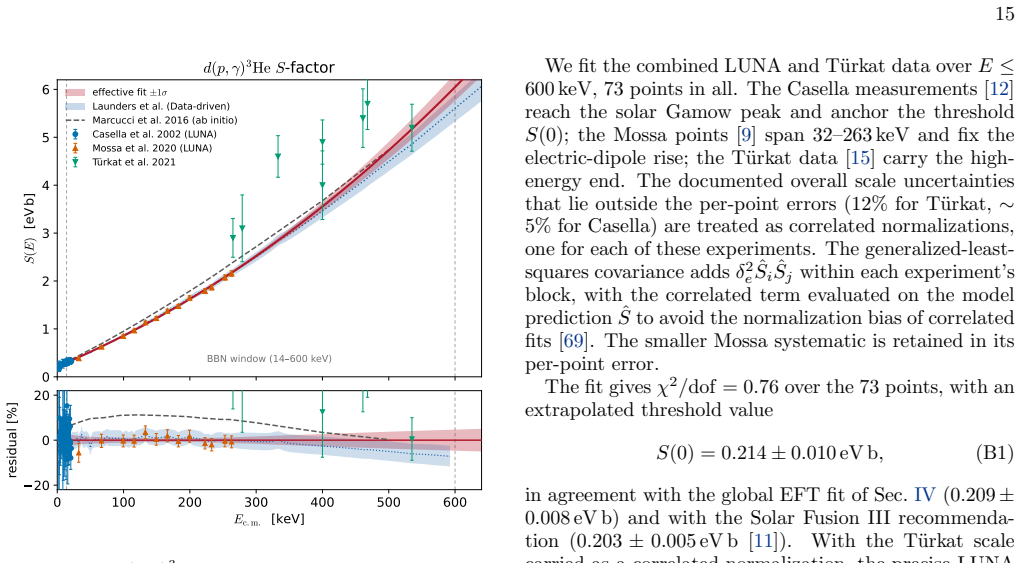
Summary. The paper constructs a nuclear-state EFT for d(p,γ)^{3}He in which the deuteron, proton, and ^{3}He are point-like degrees of freedom and finite-size/two-body-current physics is restored by short-range contacts ordered by p_rel/p*. The capture amplitude is built with massive spinor-helicity methods: all parity-even three-point vertices, factorized poles, a Ward boundary term, and dimension-6/7 transverse contacts are enumerated without an explicit Lagrangian (Appendix A). The gauge-invariant S-factor reduces to an incoherent multipole tower (Eqs. 3–5) whose leading E1 strength is fixed by the recoil charge and the ^{3}He ANC residue. A global Bayesian fit to LUNA/Türkat data plus ANC and NDA priors returns S(0)=0.209±0.008 eV b, χ^{2}/dof=0.83, and a natural-sized contact t_E1≈−0.15 that accounts for the Marcucci–LUNA offset (equivalently C_eff_S=C_S(1+t_E1)≈1.83 fm^{-1/2}). Truncation is estimated from the deuteron-breakup scale and an elastic d–p doublet residue is identified as the observable that would separate C_S from c_E1.
Significance. If the construction and fit hold, the work supplies a data-anchored S(E) with quantified truncation for the BBN Gamow window and recasts the PRIMAT–PArthENoPE split as a single measurable LEC rather than a choice of curves. Methodologically it is, to the authors’ knowledge, the first complete on-shell amplitude construction carried through to a nuclear-astrophysics observable with Bayesian uncertainties; the multipole map, Ward cancellation, and explicit C_S–c_E1 degeneracy diagnosis are concrete deliverables. The elastic-doublet residue prediction is falsifiable and would cleanly separate the contact from the ANC. These strengths make the paper a useful bridge between modern amplitude methods and low-energy nuclear reaction theory, with direct relevance to the post-LUNA D/H budget.
major comments (2)
- Sec. II.A and the truncation discussion of Sec. III.B.4: the tree-level omission of entrance-channel d–p rescattering is the softest load-bearing assumption. E1 is argued to be p-wave protected (rescattering absorbed into c_E1) and M1 data-anchored near threshold, with NDA truncation R(p_rel/p*)^{2} bounded by χ^{2}/dof=0.83. That justification is plausible but not demonstrated quantitatively. A short estimate (or reference to existing pionless-EFT pd results) of residual continuum distortion relative to the fitted |t_E1|≈0.15 and the R≈0.19 band would strengthen the claim that a single natural contact isolates the Marcucci offset.
- Sec. IV and Eq. (18): the angle-integrated S-factor constrains only the product C_eff_S=C_S(1+t_E1). The diagnosis that the offset lives in a natural t_E1 (rather than a lower ANC) therefore rests on the external Gaussian prior σ_CS=0.02 C_S. The paper correctly flags the elastic doublet residue as the separator, but the present posterior width on t_E1 (±0.021) is prior-dominated. The manuscript should state more explicitly that, without that prior, the data alone do not prefer a contact over a rescaled ANC, so the “single natural contact” language is prior-dependent.
minor comments (5)
- Fig. 3 / Table II: the Türkat normalization λ=1.28(6) lies ~2.3σ high; a one-sentence remark on whether excluding Türkat shifts S(0) or t_E1 would help readers assess robustness.
- Eqs. (A12)–(A16): the projection of the five dimension-6 contacts onto multipoles is stated but not derived; a brief intermediate step or reference would aid reproducibility.
- Appendix B: the purely data-driven three-coefficient fit is valuable; stating the numerical {a0,a1,a2} (or S(0),S',S'') and their covariance matrix would make the appendix immediately usable by network codes.
- Notation: t_E1 is introduced as a fractional amplitude shift (Eq. 12) but sometimes discussed as if it were a rate correction; a consistent wording would avoid confusion.
- AI-usage note: the acknowledgement that analytic results were primarily derived with Claude Opus 4.8 is transparent; a short statement that all numerical posteriors and χ^{2} values were independently recomputed would further reassure readers.
Circularity Check
No significant circularity: standard EFT matching of enumerated on-shell multipoles to data plus external ANC/NDA priors; S(0) and t_E1 are explicitly fitted, not claimed as independent predictions.
full rationale
The derivation chain is self-contained and non-circular. On-shell recursion plus the helicity-category algorithm enumerates the complete tree-level multipole tower (factorized poles + Ward boundary + dimension-6/7 contacts) from Lorentz, little-group and gauge symmetries alone (Appendix A, Eqs. A1–A29, Table III); this structure is independent of the capture data. Leading E1 and E2 strengths are fixed by measured masses, recoil charges e_eff/q_eff and the external 3He ANC residue (Sec. III B, Eqs. 11–13, 5), while M1 is data-anchored near threshold. The global Bayesian posterior (Sec. IV, Eq. 15) then fits the remaining short-range contacts (chiefly t_E1) and reports the resulting S(0) and the product C_eff_S that the angle-integrated data actually constrain; the paper states the C_S–c_E1 degeneracy explicitly and proposes an independent elastic d–p observable to break it. No step reduces a claimed prediction to its own input by construction, no load-bearing uniqueness theorem is imported from self-citation, and the offset diagnosis is presented as a data-driven matching result of natural NDA size rather than a first-principles forecast. Appendix B’s pure three-coefficient data-driven fit yields a consistent S(0), confirming the result is not forced by the nuclear-theory priors. This is ordinary, transparent EFT phenomenology.
Axiom & Free-Parameter Ledger
free parameters (5)
- t_E1 (or c_E1) =
-0.146 ± 0.021
- |U_M1|^2 (or c_M1 combination) =
SM1(0)=0.107 ± 0.008 eV b
- c_E2, c_M2 =
t_E2=0.0±0.5; c_M2 consistent with 0
- λ_e (per-experiment normalizations) =
1.01(3), 0.98(2), 1.28(6)
- R (truncation coefficient) =
R ≈ 0.19
axioms (5)
- standard math Massive spinor-helicity three-point amplitudes and BCFW-style on-shell recursion plus boundary terms enumerate all tree-level structures consistent with Lorentz invariance, little-group weights, and the Ward identity.
- domain assumption The relevant breakdown scale is the deuteron-breakup momentum p*≈53 MeV; contact operators are normalized at Λ=√(4π)p*≈187 MeV and are natural-sized O(1).
- domain assumption Tree-level construction without explicit entrance-channel d-p rescattering is adequate: E1 p-wave phases are small and absorbed into c_E1; M1 is fixed from data.
- domain assumption 3He s-wave ANC C_S=2.144(8) fm^{-1/2} (and D/S ratio) from ab initio few-body theory can be used as a Gaussian prior.
- domain assumption Angle-integrated S-factor collapses the five dimension-6 contacts onto five multipole combinations, of which only three combinations (a0,a1,a2) are constrained by data.
read the original abstract
Big Bang nucleosynthesis (BBN) predicts the primordial deuterium abundance to a precision now limited by the nuclear reactions that burn deuterium. For the simplest of them, proton-deuteron radiative capture, d + p -> \gamma + 3He [d(p,\gamma)3He], the precise LUNA data sit below the ab initio benchmark, and BBN reaction networks split on which to adopt. We develop an effective field theory (EFT) expanding in the finite size of the nuclei, building the amplitude with modern on-shell methods that enumerate every tree-level structure consistent with symmetries without the need for an explicit Lagrangian. A global Bayesian fit to the capture data and nuclear-theory priors returns S(0) = 0.209 +/- 0.008 eV b and traces the offset from the ab initio benchmark to a single natural-sized next-to-leading contact term (t_E1 ~ -0.15, the fractional shift of the electric-dipole amplitude) -- equivalently a ~15% lower effective 3He asymptotic normalization. We estimate the leading EFT truncation errors and identify an elastic d-p observable that would separate them. Our results suggest that amplitude methods enable systematic and complete tree-level construction and matching of EFTs for low-energy nuclear reactions.
Figures


Reference graph
Works this paper leans on
-
[1]
Both are related to asymptotic normalizations of the 3He ground state in thep+dchannel:C S thes-wave,C D thed-wave
Strong Couplings:C S andC D The strongd–p– 3He couplings encode important nuclear-structure input that the EFT cannot predict. Both are related to asymptotic normalizations of the 3He ground state in thep+dchannel:C S thes-wave,C D thed-wave. They are fixed fromab initiofew-body the- ory [40, 57] and the measuredD/Sratio. CS is the dimensionfuls-wave ANC,...
-
[2]
The dipole carries eeff =e Zdmp −Z pmd md +m p =e mp −m d md +m p =−0.333e,(11) nonzero precisely because the deuteron and proton carry different charge-to-mass ratios
Electric Multipoles:e eff,q eff,c E1, andc E2 The electric multipoles couple through recoil effective charges of the relatived–pcoordinate. The dipole carries eeff =e Zdmp −Z pmd md +m p =e mp −m d md +m p =−0.333e,(11) nonzero precisely because the deuteron and proton carry different charge-to-mass ratios. In the dipole reduced matrix elementU E1 =e eff ...
-
[3]
(5)]: the 2S1/2 doublet and a 4S3/2 quartet fed only by the proton and deuteron channels
Magnetic Dipole:c M1 TheM1 operator connects the initiald+p s-waves to 3He through the total magnetic moments of the three legs and resolves into two incoherent channel-spin pieces [Eq. (5)]: the 2S1/2 doublet and a 4S3/2 quartet fed only by the proton and deuteron channels. Each carries its own short-range contact term. The magnetic dipole is not protect...
-
[4]
The masses, theQ-value, the magnetic moments, the deuteron quadrupole, and the recoil charges of Eqs
Error Budget The form ofS(E) rests on precisely known inputs, with a single external quantity dominating the uncertainty. The masses, theQ-value, the magnetic moments, the deuteron quadrupole, and the recoil charges of Eqs. (11) and (13) are all known to far better than the target pre- cision, so they fix theformofS(E) essentially exactly. The leading ext...
2005
-
[5]
Each entry multiplies the listed bracket structure, and the equations below intro- duce them in that same notation
Three-Point Vertices The Wilson coefficients are collected in Table III, in- cluding the three-point vertex couplings which assem- ble into four-point amplitudes via factorization, and the four-point boundary terms. Each entry multiplies the listed bracket structure, and the equations below intro- duce them in that same notation. a. Strong Vertex Thed–p– ...
-
[6]
2S1/2 doublet.E (D) is dominantly the (L, s) = (2, 3
-
[7]
These are the two parity-even channels reachingJ π = 1 2 +
channel-spin-3 2 quartet, the 4D1/2 D-state of 3He (weight 8 9; the 1 9 doublet remainder enters observ- ables only at higher order inp rel). These are the two parity-even channels reachingJ π = 1 2 + . In this basis M3 = 1 md ˜CS E(S) + ˜CD E(D) , ˜CS = 1 2( ˜C1 + ˜C2), ˜CD = 1 2( ˜C1 − ˜C2), (A3) with ˜CS thes-wave and ˜CD thed-wave vertex coupling; we ...
-
[8]
1(a)–(c)]: internal 3He (sdp =m 2 3, final-state radia- tion), internal proton (s pγ =m 2 p), and internal deuteron (sdγ =m 2 d)
Factorized Four-Point Amplitude and the Ward Identity On-shell recursion reconstructs the factorizable part of the capture amplitude from its residues on the three physical poles, one per charged leg radiating the photon [Fig. 1(a)–(c)]: internal 3He (sdp =m 2 3, final-state radia- tion), internal proton (s pγ =m 2 p), and internal deuteron (sdγ =m 2 d). ...
-
[9]
1(d)], genuine electromag- netic two-body currents, which are free LECs
Boundary Two-Body Currents Beyond the Ward boundary termB W , there are trans- verse contact structures [Fig. 1(d)], genuine electromag- netic two-body currents, which are free LECs. We enumerate them with the helicity-category algorithm of Ref. [50]. The minimal operator dimension is 6 (two fermions at 3 2, the deuteron at 1, the photon field strength at...
-
[10]
Matrix Element The full tree amplitude to leading boundary order is the sum of the factorized channels, the Ward boundary termB W , and the transverse boundary currents, M=M fact +B W + e Λ3 X a ca Ba.(A17) 14 Squaring with the initial spin average 1 6, summing over the deuteron polarizations, and integrating over the pho- ton emission angle, produces an ...
2016
-
[11]
R. A. Alpher, H. Bethe, and G. Gamow, Phys. Rev.73, 803 (1948)
1948
-
[12]
R. V. Wagoner, W. A. Fowler, and F. Hoyle, Astrophys. J.148, 3 (1967)
1967
-
[13]
R. H. Cyburt, B. D. Fields, K. A. Olive, and T.-H. Yeh, Rev. Mod. Phys.88, 015004 (2016), arXiv:1505.01076 [astro-ph.CO]
Pith/arXiv arXiv 2016
-
[14]
C. Pitrou, A. Coc, J.-P. Uzan, and E. Vangioni, Phys. Rept.754, 1 (2018), arXiv:1801.08023 [astro-ph.CO]
Pith/arXiv arXiv 2018
-
[15]
R. J. Cooke, M. Pettini, and C. C. Steidel, Astrophys. J. 855, 102 (2018), arXiv:1710.11129 [astro-ph.CO]
Pith/arXiv arXiv 2018
-
[16]
N. Aghanimet al.(Planck), Astron. Astrophys.641, A6 (2020), [Erratum: Astron. Astrophys. 652, C4 (2021)], arXiv:1807.06209 [astro-ph.CO]
Pith/arXiv arXiv 2020
-
[17]
M. Pospelov and J. Pradler, Ann. Rev. Nucl. Part. Sci. 60, 539 (2010), arXiv:1011.1054 [hep-ph]
Pith/arXiv arXiv 2010
-
[18]
T.-H. Yeh, K. A. Olive, and B. D. Fields, JCAP03, 046, arXiv:2011.13874 [astro-ph.CO]
Pith/arXiv arXiv 2011
-
[19]
Mossaet al.(LUNA), Nature587, 210 (2020)
V. Mossaet al.(LUNA), Nature587, 210 (2020)
2020
-
[20]
E. G. Adelbergeret al., Rev. Mod. Phys.83, 195 (2011), arXiv:1004.2318 [nucl-ex]
Pith/arXiv arXiv 2011
-
[21]
B. Acharyaet al., Rev. Mod. Phys.97, 035002 (2025), arXiv:2405.06470 [astro-ph.SR]
arXiv 2025
-
[22]
Casellaet al.(LUNA), Nucl
C. Casellaet al.(LUNA), Nucl. Phys. A706, 203 (2002)
2002
-
[23]
St¨ ockel, N
K. St¨ ockel, N. Mozumdar, S. Zavatarelli, F. Ferraro, M. Aliotta, C. Ananna, L. Barbieri, F. Barile, D. Be- mmerer, A. Best, A. Boeltzig, C. Broggini, C. G. Bruno, A. Caciolli,et al., Phys. Rev. C110, L032801 (2024)
2024
-
[24]
Tiˇ sma, M
I. Tiˇ sma, M. Lipoglavˇ sek, M. Mihoviloviˇ c, S. Markelj, M. Vencelj, and J. Vesi´ c, Eur. Phys. J. A55, 137 (2019)
2019
-
[25]
S. Turkatet al., Phys. Rev. C103, 045805 (2021), arXiv:2104.06914 [nucl-ex]
Pith/arXiv arXiv 2021
-
[26]
G. J. Schmidet al., Phys. Rev. C56, 2565 (1997)
1997
-
[27]
L. E. Marcucci, G. Mangano, A. Kievsky, and M. Viviani, Phys. Rev. Lett.116, 102501 (2016), [Erratum: Phys. Rev. Lett. 117, 049901 (2016)], arXiv:1510.07877 [nucl- 16 th]
Pith/arXiv arXiv 2016
-
[28]
C. Pitrou, A. Coc, J.-P. Uzan, and E. Vangioni, Mon. Not. Roy. Astron. Soc.502, 2474 (2021), arXiv:2011.11320 [astro-ph.CO]
Pith/arXiv arXiv 2021
-
[29]
O. Pisanti, G. Mangano, G. Miele, and P. Mazzella, JCAP04, 020, arXiv:2011.11537 [astro-ph.CO]
Pith/arXiv arXiv 2011
-
[30]
J. Moscoso, R. S. de Souza, A. Coc, and C. Iliadis, Astro- phys. J.923, 49 (2021), arXiv:2109.00049 [astro-ph.CO]
Pith/arXiv arXiv 2021
-
[31]
S. Gariazzo, P. F. de Salas, O. Pisanti, and R. Con- siglio, Comput. Phys. Commun.271, 108205 (2022), arXiv:2103.05027 [astro-ph.IM]
Pith/arXiv arXiv 2022
-
[32]
T. Launders, C. Giovanetti, and H. Liu, (2026), arXiv:2604.16600 [astro-ph.CO]
Pith/arXiv arXiv 2026
-
[33]
C. A. Bertulani, H.-W. Hammer, and U. van Kolck, Nucl. Phys. A712, 37 (2002), arXiv:nucl-th/0205063
Pith/arXiv arXiv 2002
-
[34]
P. F. Bedaque, H.-W. Hammer, and U. van Kolck, Phys. Lett. B569, 159 (2003), arXiv:nucl-th/0304007
Pith/arXiv arXiv 2003
-
[35]
Rupak, Int
G. Rupak, Int. J. Mod. Phys. E25, 1641004 (2016)
2016
-
[36]
E. Epelbaum, H.-W. Hammer, and U.-G. Meißner, Rev. Mod. Phys.81, 1773 (2009), arXiv:0811.1338 [nucl-th]
Pith/arXiv arXiv 2009
-
[37]
R. Machleidt and D. R. Entem, Phys. Rept.503, 1 (2011), arXiv:1105.2919 [nucl-th]
Pith/arXiv arXiv 2011
-
[38]
C. Hebborn, G. Hupin, K. Kravvaris, S. Quaglioni, P. Navr´ atil, P. Gysbers, and B. D. Fields, Phys. Rev. Lett.129, 042503 (2022), arXiv:2203.15914 [nucl-th]
Pith/arXiv arXiv 2022
-
[39]
M. C. Atkinson, K. Kravvaris, S. Quaglioni, and P. Navr´ atil, Phys. Lett. B860, 139189 (2025)
2025
-
[40]
R. Skibi´ nski, J. Golak, H. Wita la, W. Gl¨ ockle, A. Nogga, and E. Epelbaum, Acta Phys. Polon. B37, 2905 (2006), arXiv:nucl-th/0606021
Pith/arXiv arXiv 2006
-
[41]
H.-W. Hammer, S. K¨ onig, and U. van Kolck, Rev. Mod. Phys.92, 025004 (2020), arXiv:1906.12122 [nucl-th]
Pith/arXiv arXiv 2020
-
[42]
D. B. Kaplan, M. J. Savage, and M. B. Wise, Nucl. Phys. B534, 329 (1998), arXiv:nucl-th/9802075
Pith/arXiv arXiv 1998
- [43]
-
[44]
J.-W. Chen, G. Rupak, and M. J. Savage, Nucl. Phys. A 653, 386 (1999), arXiv:nucl-th/9902056
Pith/arXiv arXiv 1999
-
[45]
F. Nazari, M. Radin, and M. Moeini Arani, (2024), arXiv:2412.12205 [nucl-th]
Pith/arXiv arXiv 2024
-
[46]
J.-W. Chen and M. J. Savage, Phys. Rev. C60, 065205 (1999), arXiv:nucl-th/9907042
Pith/arXiv arXiv 1999
-
[47]
X. Kong and F. Ravndal, Phys. Rev. C64, 044002 (2001), arXiv:nucl-th/0004038
Pith/arXiv arXiv 2001
-
[48]
Sadeghi, Few Body Syst.44, 149 (2008), arXiv:0908.2091 [nucl-th]
H. Sadeghi, Few Body Syst.44, 149 (2008), arXiv:0908.2091 [nucl-th]
Pith/arXiv arXiv 2008
-
[49]
G. Rupak and X.-w. Kong, Nucl. Phys. A717, 73 (2003), arXiv:nucl-th/0108059
Pith/arXiv arXiv 2003
-
[50]
A. Kievsky, S. Rosati, M. Viviani, C. R. Brune, H. J. Karwowski, E. J. Ludwig, and M. H. Wood, Phys. Lett. B406, 292 (1997), arXiv:nucl-th/9706077 [nucl-th]
Pith/arXiv arXiv 1997
-
[51]
P. F. Bedaque, H.-W. Hammer, and U. van Kolck, Phys. Rev. Lett.82, 463 (1999), arXiv:nucl-th/9809025
Pith/arXiv arXiv 1999
-
[52]
J. Vanasse, D. A. Egolf, J. Kerin, S. K¨ onig, and R. P. Springer, Phys. Rev. C89, 064003 (2014), arXiv:1402.5441 [nucl-th]
Pith/arXiv arXiv 2014
-
[53]
S. K¨ onig, H. W. Grießhammer, H.-W. Hammer, and U. van Kolck, J. Phys. G43, 055106 (2016), arXiv:1508.05085 [nucl-th]
Pith/arXiv arXiv 2016
-
[54]
J. Vanasse, Int. J. Mod. Phys. E25, 1641002 (2016), arXiv:1609.03086 [nucl-th]
Pith/arXiv arXiv 2016
-
[55]
J. Vanasse, Phys. Rev. C95, 024002 (2017), arXiv:1512.03805 [nucl-th]
Pith/arXiv arXiv 2017
-
[56]
N. Arkani-Hamed, T.-C. Huang, and Y.-t. Huang, JHEP 11, 070, arXiv:1709.04891 [hep-th]
-
[57]
C. Cheung,Anticipating the Next Discoveries in Parti- cle Physics (TASI 2016), , 571 (2018), arXiv:1708.03872 [hep-ph]
Pith/arXiv arXiv 2016
-
[58]
R. Britto, F. Cachazo, and B. Feng, Nucl. Phys. B715, 499 (2005), arXiv:hep-th/0412308
Pith/arXiv arXiv 2005
-
[59]
R. Britto, F. Cachazo, B. Feng, and E. Witten, Phys. Rev. Lett.94, 181602 (2005), arXiv:hep-th/0501052
Pith/arXiv arXiv 2005
-
[60]
De Angelis, JHEP08, 299, arXiv:2202.02681 [hep-th]
S. De Angelis, JHEP08, 299, arXiv:2202.02681 [hep-th]
-
[61]
Manohar and H
A. Manohar and H. Georgi, Nucl. Phys. B234, 189 (1984)
1984
-
[62]
P. J. Mohr, D. B. Newell, B. N. Taylor, and E. Tiesinga, Rev. Mod. Phys.97, 025002 (2025), arXiv:2409.03787 [hep-ph]
Pith/arXiv arXiv 2025
-
[63]
M. Wang, W. J. Huang, F. G. Kondev, G. Audi, and S. Naimi, Chin. Phys. C45, 030003 (2021)
2021
-
[64]
Navaset al.(Particle Data Group), Phys
S. Navaset al.(Particle Data Group), Phys. Rev. D110, 030001 (2024)
2024
-
[65]
Pavanello, W.-C
M. Pavanello, W.-C. Tung, and L. Adamowicz, Phys. Rev. A81, 042526 (2010)
2010
-
[66]
N. L. Rodning and L. D. Knutson, Phys. Rev. C41, 898 (1990)
1990
-
[67]
K. M. Nollett and R. B. Wiringa, Phys. Rev. C83, 041001 (2011), arXiv:1102.1787 [nucl-th]
Pith/arXiv arXiv 2011
-
[68]
J. L. Friar, B. F. Gibson, D. R. Lehman, and G. L. Payne, Phys. Rev. C37, 2859 (1988)
1988
-
[69]
Bethe and R
H. Bethe and R. Peierls, Proc. Roy. Soc. Lond. A148, 146 (1935)
1935
-
[70]
Z. Ayer, H. J. Karwowski, B. Kozlowska, and E. J. Lud- wig, Phys. Rev. C52, 2851 (1995)
1995
-
[71]
E. A. George and L. D. Knutson, Phys. Rev. C48, 688 (1993)
1993
-
[72]
Carlson and R
J. Carlson and R. Schiavilla, Rev. Mod. Phys.70, 743 (1998)
1998
-
[73]
S. R. Beane and M. J. Savage, Nucl. Phys. A694, 511 (2001), arXiv:nucl-th/0011067
Pith/arXiv arXiv 2001
-
[74]
L. E. Marcucci, M. Viviani, R. Schiavilla, A. Kievsky, and S. Rosati, Phys. Rev. C72, 014001 (2005), arXiv:nucl- th/0502048 [nucl-th]
arXiv 2005
-
[75]
M. J. Savage, P. E. Shanahan, B. C. Tiburzi, M. L. Wag- man, F. Winter, S. R. Beane, E. Chang, Z. Davoudi, W. Detmold, and K. Orginos, Phys. Rev. Lett.119, 062002 (2017), arXiv:1610.04545 [hep-lat]
Pith/arXiv arXiv 2017
-
[76]
Z. Davoudi, W. Detmold, P. E. Shanahan, K. Orginos, A. Parre˜ no, M. J. Savage, and M. L. Wagman, Phys. Rept.900, 1 (2021), arXiv:2008.11160 [hep-lat]
Pith/arXiv arXiv 2021
-
[77]
A.-K. Burns, T. M. P. Tait, and M. Valli, Eur. Phys. J. C84, 86 (2024), arXiv:2307.07061 [hep-ph]
Pith/arXiv arXiv 2024
-
[78]
C. Giovanetti, M. Lisanti, H. Liu, S. Mishra-Sharma, and J. T. Ruderman, Phys. Rev. D112, 063531 (2025), arXiv:2408.14538 [astro-ph.CO]
arXiv 2025
-
[79]
D’Agostini, Nucl
G. D’Agostini, Nucl. Instrum. Meth. A346, 306 (1994)
1994
discussion (0)
Sign in with ORCID, Apple, or X to comment. Anyone can read and Pith papers without signing in.