REVIEW 2 major objections 5 minor 53 references
Generated multilingual transcripts boost speech sentiment analysis, and distillation packs the gains into an audio-only model with no extra inference cost.
Reviewed by Pith at T0; open to challenge. T0 means a machine referee read the full paper against a public rubric. the ladder, T0–T4 →
T0 review · grok-4.5
2026-07-11 01:52 UTC pith:QGTHOX7Z
load-bearing objection Solid systems paper: generated multilingual text as privileged info + CCMT + KD gives real ~5-pt multimodal and ~1.5-pt distilled gains on MSP-Podcast polarity, with public code and no load-bearing flaw. the 2 major comments →
Audio Sentiment Analysis via Distillation and Cross-Modal Integration of Generated Multilingual Transcripts
The pith
A machine-rendered reading of the paper's core claim, the machinery that carries it, and where it could break.
Core claim
Automatically generated English transcripts and their machine translations into other languages supply complementary polarity cues that a cascaded cross-modal transformer can fuse with audio, producing large gains over a strong WavLM baseline; those gains can be distilled into an audio-only student that retains the higher accuracy at the original inference speed.
What carries the argument
Cascaded Cross-Modal Transformer (CCMT) teacher that progressively integrates one modality at a time via cross-attention, followed by temperature-scaled knowledge distillation into a WavLM student under the learning-using-privileged-information setting.
Load-bearing premise
ASR and translation errors still leave enough complementary sentiment signal for the teacher to learn, and that signal can be compressed into the audio student.
What would settle it
Replace the generated transcripts and translations with random or scrambled text of the same length; if the multimodal teacher and the distilled student then lose essentially all of their reported gains over the plain WavLM baseline, the central claim fails.
Editorial analysis
A structured set of objections, weighed in public.
Referee Report
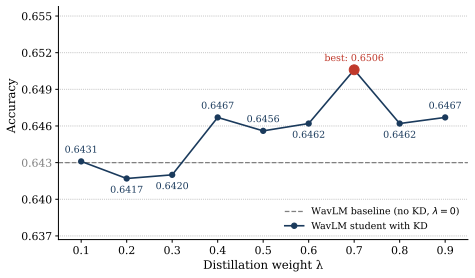
Summary. The paper proposes a knowledge-distillation pipeline for speech sentiment polarity classification (negative/neutral/positive) on MSP-Podcast. A multimodal teacher first obtains English ASR transcripts (Faster-Whisper) and automatic translations into Spanish, German and French (NLLB-200), encodes them with language-specific transformers (RoBERTa, RoBERTuito, GBERT, CamemBERT) and the audio with WavLM, then fuses the modalities via a cascaded cross-modal transformer (CCMT). Soft targets from the best teachers are distilled into a WavLM-only student that never sees text at inference. On the official MSP-Podcast splits the best multimodal teachers improve macro-F1 by up to +5.89 % and accuracy by +5.15 % over a strong WavLM baseline; distillation recovers +1.54 % macro-F1 / +0.81 % accuracy for the student at identical inference cost. Ablations examine language combinations and the distillation weight λ; code is released.
Significance. If the reported gains hold, the work supplies a practical LUPI-style recipe that lets practitioners keep the latency of a pure audio foundation model while still exploiting complementary lexical polarity cues that are available only at training time. The combination of large-scale naturalistic data (MSP-Podcast), progressive unimodal-then-multimodal training, language ablations, a λ-sweep, and public code makes the empirical claim reproducible and useful for real-time applications (call centers, driver monitoring, virtual assistants). The absolute KD lift is modest, yet the demonstration that ASR/NMT noise still leaves transferable signal is a concrete, non-trivial contribution to the multimodal-SER literature.
major comments (2)
- Table 2 reports point estimates only; no standard deviations, bootstrap intervals or statistical significance tests accompany the claimed +5.89 % / +1.54 % macro-F1 gains. Because the absolute KD improvement is small (+0.81 % accuracy) and only the two best teachers were distilled, it is impossible to judge whether the student gains are reliable or could reverse under re-seeding or different teacher selection. Adding error bars or a paired significance test on the official test-1 split is load-bearing for the central claim that distillation “boosts performance without any computational overhead.”
- All quantitative claims rest on a single corpus (MSP-Podcast). Section 4 maps the original emotion labels onto three polarity classes via a valence-based rule that is dataset-specific; no cross-corpus or cross-domain evaluation is provided. While the large official splits mitigate overfitting concerns, the generalizability of both the multimodal gains and the distillable residual signal remains untested. A second naturalistic corpus (or at least an out-of-domain subset) would substantially strengthen the claim that generated multilingual transcripts constitute generally useful privileged information.
minor comments (5)
- In Table 1 the KD weight is labeled “α” while Eq. (5) and the surrounding text use λ; unify the notation.
- Figure 1 caption and the main text both refer to “privileged information” / LUPI, yet the abstract and introduction never introduce the acronym; a one-sentence definition would help non-specialist readers.
- Inference times in Table 2 (up to 76 s for the full five-modality CCMT) are measured on a consumer GPU with batch size 8; a short note on whether the times include ASR/NMT or only the fusion stage would clarify the practical bottleneck.
- The mapping from continuous valence to discrete polarity (Section 4) is described only qualitatively; stating the exact valence thresholds used would improve reproducibility.
- A few typographical inconsistencies appear (e.g., “Automati( Spee(h” in Figure 1, mixed en/em-dashes). A light copy-edit pass would polish the presentation.
Circularity Check
No circularity: purely empirical multimodal + KD pipeline whose claims are measured against held-out labels, not derived by construction from fitted inputs.
full rationale
The paper is an empirical systems paper. Its central claims are performance deltas on the official MSP-Podcast test-1 split (Table 2): multimodal CCMT teachers that fuse WavLM audio with ASR/NMT text reach ~0.68 macro-F1 / ~0.69 accuracy versus a WavLM baseline of 0.6239 / 0.6425, and KD (Eqs. 2–5) transfers a further +1.54 % macro-F1 / +0.81 % accuracy to an audio-only student. The fusion equations (Eq. 1) are standard cross-attention; the KD objective is the ordinary temperature-scaled KL + CE combination. Neither equation, nor the progressive training pipeline (unimodal fine-tuning → cached embeddings → CCMT → distillation), reduces a claimed prediction to a fitted constant by construction. Self-citations to the authors’ earlier CCMT work supply the fusion module architecture but do not define the evaluation metric or force the reported gains; those gains are measured against external ground-truth polarity labels. Ablations (text-only models, progressive language addition, λ-sweep in Figure 2) further test rather than tautologically restate the inputs. Consequently the derivation chain contains no self-definitional step, no fitted-input-called-prediction, and no load-bearing uniqueness theorem imported from the authors. Score 0 is the correct outcome.
Axiom & Free-Parameter Ledger
free parameters (4)
- distillation weight λ =
0.7
- temperature τ =
2.0
- LoRA ranks and alphas =
r=8/16, α=16/32
- choice of target languages (ES, DE, FR) =
ES+DE+FR
axioms (3)
- domain assumption ASR transcripts and NMT translations retain usable sentiment polarity signal despite recognition and translation errors.
- domain assumption Emotion categories and valence scores of MSP-Podcast can be deterministically mapped onto three polarity classes (negative/neutral/positive).
- domain assumption Soft teacher logits convey transferable inter-class structure that a unimodal student can exploit (standard KD / LUPI assumption).
read the original abstract
Automatically recognizing the sentiment, positive or negative, from speech is a challenging task, requiring both the analysis of vocal inflections and the interpretation of uttered words. Recent solutions rely on audio foundation models to solve the task, but it remains unclear if such models can take all aspects into account. To this end, we propose a multimodal solution that integrates audio and text information via cross-modal transformers, where text transcripts are automatically generated via an automatic speech recognition (ASR) tool. Moreover, we create multiple text modalities by automatically translating the transcripts into multiple languages via machine translation tools. Audio and multilingual text features are combined via a cascaded architecture comprising cross-modal transformer blocks that integrate modalities one by one. We further distill knowledge from the multimodal model, called teacher, into a unimodal (audio only) model, called student. We conduct experiments on a large-scale dataset, demonstrating that the automatically generated textual information can bring significant performance boosts in multimodal sentiment polarity classification. Our ablation study confirms that both automatic transcripts and automatic translations are helpful. Moreover, we show that the audio-only model can be enhanced via distillation, boosting performance without any computational overhead during inference. To reproduce the reported results, we publicly release our code at https://github.com/andreidurdun/cross-modal-audio-sentiment.
Figures

Reference graph
Works this paper leans on
-
[1]
Anilsagar, T., Syed, S.S.A., 2025. The evolution of sentiment analysis and conversational AI: Techniques applications and future research directions. Journal of Systems Engineering and Electronics 35, 71–82
work page 2025
-
[2]
Sentiment analysis and emotion recognition from speech using universal speech representations
Atmaja, B.T., Sasou, A., 2022. Sentiment analysis and emotion recognition from speech using universal speech representations. Sensors 22, 6369
work page 2022
-
[3]
Baevski, A., Zhou, Y ., Mohamed, A., Auli, M., 2020. wav2vec 2.0: A framework for self-supervised learning of speech representations, in: Proceedings of NeurIPS, pp. 12449–12460
work page 2020
-
[4]
Barbieri, F., Camacho-Collados, J., Espinosa Anke, L., Neves, L., 2020. TweetEval: Unified benchmark and comparative evaluation for tweet classification, in: Findings of EMNLP, pp. 1644–1650
work page 2020
-
[5]
Bulkrock, O., Qusef, A., BaniMustafa, A., 2025. Sentiment Analysis of Customer Feedback and Reviews in E-Commerce Systems, in: Proceedings of ICTCS, pp. 379–385
work page 2025
-
[6]
IEMOCAP: Interactive emotional dyadic motion capture database
Busso, C., Bulut, M., Lee, C.C., Kazemzadeh, A., Mower, E., Kim, S., Chang, J.N., Lee, S., Narayanan, S.S., 2008. IEMOCAP: Interactive emotional dyadic motion capture database. Language Resources and Evaluation 42, 335–359
work page 2008
-
[7]
Busso, C., Lotfian, R., Sridhar, K., Salman, A.N., Lin, W.C., Goncalves, L., Parthasarathy, S., Naini, A.R., Leem, S.G., Martinez-Lucas, L., et al., 2025. The MSP-Podcast Corpus. arXiv preprint arXiv:2509.09791
work page internal anchor Pith review Pith/arXiv arXiv 2025
-
[8]
German’s next language model, in: Proceedings of COLING, pp
Chan, B., Schweter, S., M ¨oller, T., 2020. German’s next language model, in: Proceedings of COLING, pp. 6788–6796
work page 2020
-
[9]
WavLM: Large-Scale Self-Supervised Pre-Training for Full Stack Speech Processing
Chen, S., Wang, C., Chen, Z., Wu, Y ., Liu, S., Chen, Z., Li, J., Kanda, N., Yoshioka, T., Xiao, X., Wu, J., Zhou, L., Ren, S., Qian, Y ., Qian, Y ., Wu, J., Zeng, M., Yu, X., Wei, F., 2022. WavLM: Large-Scale Self-Supervised Pre-Training for Full Stack Speech Processing. IEEE Journal of Selected Topics in Signal Processing 16, 1505–1518
work page 2022
-
[10]
Devlin, J., Chang, M.W., Lee, K., Toutanova, K., 2019. BERT: Pre-training of deep bidirectional transformers for language understanding, in: Proceedings of NAACT-HLT, pp. 4171–4186
work page 2019
-
[11]
Garcia, A.B., Gerardo, B.D., Medina, R.P., 2024. Optimized Sentiment Analysis in Tagalog Speech Using PCA and BRNN on Prosodic Suprasegmental and MFCC Features, in: Proceedings of ICTC, pp. 60–65
work page 2024
-
[12]
George, S.M., Ilyas, P.M., 2024. A review on speech emotion recognition: A survey, recent advances, challenges, and the influence of noise. Neurocomputing 568, 127015
work page 2024
-
[13]
Georgescu, M.I., Ionescu, R.T., 2020. Teacher-Student Training and Triplet Loss for Facial Expression Recognition under Occlusion, in: Proceedings of ICPR, pp. 2288–2295
work page 2020
-
[14]
AST: Audio Spectrogram Transformer, in: Proceedings of INTERSPEECH, pp
Gong, Y ., Chung, Y .A., Glass, J., 2021. AST: Audio Spectrogram Transformer, in: Proceedings of INTERSPEECH, pp. 571–575
work page 2021
-
[15]
Distilling the Knowledge in a Neural Network
Hinton, G., Vinyals, O., Dean, J., 2015. Distilling the knowledge in a neural network. arXiv preprint arXiv:1503.02531
work page internal anchor Pith review Pith/arXiv arXiv 2015
-
[16]
HuBERT: Self-Supervised Speech Representation Learning by Masked Prediction of Hidden Units
Hsu, W.N., Bolte, B., Tsai, Y .H.H., Lakhotia, K., Salakhutdinov, R., Mohamed, A., 2021. HuBERT: Self-Supervised Speech Representation Learning by Masked Prediction of Hidden Units. IEEE/ACM Transactions on Audio, Speech and Language Processing 29, 3451–3460
work page 2021
-
[17]
LoRA: Low-Rank Adaptation of Large Language Models, in: Proceedings of ICLR
Hu, E.J., Shen, Y ., Wallis, P., Allen-Zhu, Z., Li, Y ., Wang, S., Wang, L., Chen, W., 2022. LoRA: Low-Rank Adaptation of Large Language Models, in: Proceedings of ICLR
work page 2022
-
[18]
Kim, J., Kong, J., Son, J., 2021. Conditional Variational Autoencoder with Adversarial Learning for End-to-End Text-to-Speech, in: Pro- ceedings of ICML, pp. 5530–5540
work page 2021
-
[19]
Klein, G., et al., 2023. faster-whisper: Faster Whisper transcription with CTranslate2.https://github.com/SYSTRAN/faster-whisper
work page 2023
-
[20]
Lakomkin, E., Zamani, M.A., Weber, C., Magg, S., Wermter, S., 2019. Incorporating end-to-end speech recognition models for sentiment analysis, in: Proceedings of ICRA, pp. 7976–7982
work page 2019
-
[21]
Li, J., Yu, R., Huang, H., Yan, H., 2025. Unimodal-driven distillation in multimodal emotion recognition with dynamic fusion, in: Proceedings of ICME, pp. 1–6
work page 2025
-
[22]
Li, Y ., Bell, P., Lai, C., 2024. Speech Emotion Recognition With ASR Transcripts: a Comprehensive Study on Word Error Rate and Fusion Techniques, in: Proceedings of SLT, pp. 518–525
work page 2024
-
[23]
Decoupled multimodal distilling for emotion recognition, in: Proceedings of CVPR, pp
Li, Y ., Wang, Y ., Cui, Z., 2023. Decoupled multimodal distilling for emotion recognition, in: Proceedings of CVPR, pp. 6631–6640
work page 2023
-
[24]
A survey of deep learning-based multimodal emotion recognition: Speech, text, and face
Lian, H., Lu, C., Li, S., Zhao, Y ., Tang, C., Zong, Y ., 2023. A survey of deep learning-based multimodal emotion recognition: Speech, text, and face. Entropy 25, 1440
work page 2023
-
[25]
Liu, J., 2025. Development of interactive English e-learning video entertainment teaching environment based on virtual reality and game teaching emotion analysis. Entertainment Computing 52, 100884
work page 2025
-
[26]
Unifying distillation and privileged information, in: Proceedings of ICLR
Lopez-Paz, D., Bottou, L., Sch ¨olkopf, B., Vapnik, V ., 2016. Unifying distillation and privileged information, in: Proceedings of ICLR
work page 2016
-
[27]
ScaleVLAD: Improving Multimodal Sentiment Analysis via Multi-Scale Fusion of Locally Descriptors
Luo, H., Ji, L., Huang, Y ., Wang, B., Ji, S., Li, T., 2021. ScaleVLAD: Improving Multimodal Sentiment Analysis via Multi-Scale Fusion of Locally Descriptors. arXiv preprint arXiv:2112.01368
work page internal anchor Pith review Pith/arXiv arXiv 2021
-
[28]
Luo, Z., Xu, H., Chen, F., 2019. Audio sentiment analysis by heterogeneous signal features learned from utterance-based parallel neural network, in: Proceedings of AffCon@AAAI, pp. 80–87
work page 2019
-
[29]
CamemBERT: a tasty French language model, in: Proceedings of ACL, pp
Martin, L., Muller, B., Ortiz Su ´arez, P.J., Dupont, Y ., Romary, L., de la Clergerie, ´E., Seddah, D., Sagot, B., 2020. CamemBERT: a tasty French language model, in: Proceedings of ACL, pp. 7203–7219
work page 2020
-
[30]
Menadil, R.E., Georgescu, M.I., Ionescu, R.T., 2024. Learning using generated privileged information by text-to-image diffusion models, in: Proceedings of ICPR, pp. 423–438
work page 2024
-
[31]
Mohanty, M.D., Mohanty, M.N., 2022. Verbal sentiment analysis and detection using recurrent neural network, in: Advanced Data Mining Tools and Methods for Social Computing. Academic Press, pp. 85–106. 9
work page 2022
-
[32]
Muaz, M., Paull, N., Malagavalli, J., 2024. Bridging modalities: Knowledge distillation and masked training for translating multi-modal emotion recognition to uni-modal, speech-only emotion recognition. arXiv preprint arXiv:2401.03000
work page internal anchor Pith review Pith/arXiv arXiv 2024
-
[33]
Naini, A., Goncalves, L., Salman, A., Mote, P., ¨Ulgen, I., Thebaud, T., Moro-Vel´azquez, L., Garcia, L., Dehak, N., Sisman, B., Busso, C.,
- [34]
-
[35]
No Language Left Behind: Scaling Human-Centered Machine Translation
NLLB Team, Costa-Juss `a, M.R., Cross, J., C ¸ elebi, O., Elbayad, M., Heafield, K., Heffernan, K., Kalbassi, E., Lam, J., Licht, D., Maillard, J., et al., 2022. No Language Left Behind: Scaling human-centered machine translation. arXiv preprint arXiv:2207.04672
work page internal anchor Pith review Pith/arXiv arXiv 2022
-
[36]
P ´erez, J.M., Furman, D.A., Alonso Alemany, L., Luque, F.M., 2022. RoBERTuito: a pre-trained language model for social media text in Spanish, in: Proceedings of LREC, pp. 7235–7243
work page 2022
-
[37]
Poria, S., Hazarika, D., Majumder, N., Naik, G., Cambria, E., Mihalcea, R., 2019. MELD: A Multimodal Multi-Party Dataset for Emotion Recognition in Conversations, in: Proceedings of ACL, pp. 527–536
work page 2019
-
[38]
Scaling speech technology to 1,000+languages
Pratap, V ., Tjandra, A., Shi, B., Tomasello, P., Babu, A., Kundu, S., Elkahky, A., Ni, Z., Vyas, A., Fazel-Zarandi, M., Baevski, A., Adi, Y ., Zhang, X., Hsu, W.N., Conneau, A., Auli, M., 2024. Scaling speech technology to 1,000+languages. Journal of Machine Learning Research 25, 1–52
work page 2024
-
[39]
Robust Speech Recognition via Large-Scale Weak Supervision, in: Proceedings of ICML, pp
Radford, A., Kim, J.W., Xu, T., Brockman, G., McLeavey, C., Sutskever, I., 2023. Robust Speech Recognition via Large-Scale Weak Supervision, in: Proceedings of ICML, pp. 28492–28518
work page 2023
-
[40]
Cascaded cross-modal transformer for audio-textual classification
Ristea, N.C., Anghel, A., Ionescu, R.T., 2024. Cascaded cross-modal transformer for audio-textual classification. Artificial Intelligence Review 57, 225
work page 2024
-
[41]
Cascaded cross-modal transformer for request and complaint detection, in: Proceedings of ACMMM, pp
Ristea, N.C., Ionescu, R.T., 2023. Cascaded cross-modal transformer for request and complaint detection, in: Proceedings of ACMMM, pp. 9467–9471
work page 2023
-
[42]
SepTr: Separable Transformer for Audio Spectrogram Processing, in: Proceedings of INTER- SPEECH, pp
Ristea, N.C., Ionescu, R.T., Khan, F.S., 2022. SepTr: Separable Transformer for Audio Spectrogram Processing, in: Proceedings of INTER- SPEECH, pp. 4103–4107
work page 2022
-
[43]
An integrated approach for mental health assessment using emotion analysis and scales
Shanthi, N., Stonier, A.A., Sherine, A., Devaraju, T., Abinash, S., Ajay, R., Arul Prasath, V ., Ganji, V ., 2025. An integrated approach for mental health assessment using emotion analysis and scales. Healthcare Technology Letters 12, e12040
work page 2025
-
[44]
Shon, S., Brusco, P., Pan, J., Han, K.J., Watanabe, S., 2021. Leveraging pre-trained language model for speech sentiment analysis, in: Proceedings of INTERSPEECH, pp. 3420–3424
work page 2021
-
[45]
Shruti, A.C., Rifat, R.H., Kamal, M., Alam, M.G.R., 2023. A comparative study on Bengali speech sentiment analysis based on audio data, in: Proceedings of BigComp, pp. 219–226
work page 2023
-
[46]
Multimodal transformer for unaligned multimodal language sequences, in: Proceedings of ACL, pp
Tsai, Y .H.H., Bai, S., Liang, P.P., Kolter, J.Z., Morency, L.P., Salakhutdinov, R., 2019. Multimodal transformer for unaligned multimodal language sequences, in: Proceedings of ACL, pp. 6558–6569
work page 2019
-
[47]
Vamsidhar, D., Desai, P., Shahade, A.K., Patil, S., Deshmukh, P.V ., 2025. Hierarchical cross-modal attention and dual audio pathways for enhanced multimodal sentiment analysis. Scientific Reports 15, 25440
work page 2025
-
[48]
Learning using privileged information: Similarity control and knowledge transfer
Vapnik, V ., Izmailov, R., 2015. Learning using privileged information: Similarity control and knowledge transfer. Journal of Machine Learning Research 16, 2023–2049
work page 2015
-
[49]
Wang, Y ., Boumadane, A., Heba, A., 2021. A Fine-tuned Wav2vec 2.0/HuBERT Benchmark For Speech Emotion Recognition, Speaker Verification and Spoken Language Understanding. arXiv preprint arXiv:2111.02735
work page internal anchor Pith review Pith/arXiv arXiv 2021
-
[50]
Wu, S., He, D., Wang, X., Wang, L., Dang, J., 2025. Enriching multimodal sentiment analysis through textual emotional descriptions of visual-audio content, in: Proceedings of AAAI, pp. 1601–1609
work page 2025
-
[51]
A Self-Adjusting Fusion Representation Learning Model for Unaligned Text-Audio Sequences
Yang, K., Zhang, R., Xu, H., Gao, K., 2022. A self-adjusting fusion representation learning model for unaligned text-audio sequences. arXiv preprint arXiv:2212.11772
work page internal anchor Pith review Pith/arXiv arXiv 2022
-
[52]
Multimodal speech emotion recognition using audio and text, in: Proceedings of SLT, pp
Yoon, S., Byun, S., Jung, K., 2018. Multimodal speech emotion recognition using audio and text, in: Proceedings of SLT, pp. 112–118
work page 2018
-
[53]
Personality-aware multimodal driver emotion recognition towards intelligent connected vehicles
Zhang, P., Hu, M., Zhang, H., Wu, C., Yang, Z., 2026. Personality-aware multimodal driver emotion recognition towards intelligent connected vehicles. IEEE Transactions on Affective Computing 17, 801–816. 10
work page 2026
discussion (0)
Sign in with ORCID, Apple, or X to comment. Anyone can read and Pith papers without signing in.