REVIEW 1 major objections 8 minor 62 references
Steering LLM internals cuts African American English bias 5–20x
Reviewed by Pith at T0; open to challenge. T0 means a machine referee read the full paper against a public rubric. the ladder, T0–T4 →
T0 review · glm-5.2
2026-07-10 00:22 UTC pith:IEEQSGZY
load-bearing objection Solid contribution: first activation-steering method for dialect bias, plus a useful corpus and a clean finding about syntactic triggers. The translation fidelity concern is real but doesn't undermine the main mitigation claim. the 1 major comments →
LLMs Silently Correct African American English: Auditing and Mitigating Dialect Bias via Activation Steering
The pith
A machine-rendered reading of the paper's core claim, the machinery that carries it, and where it could break.
Core claim
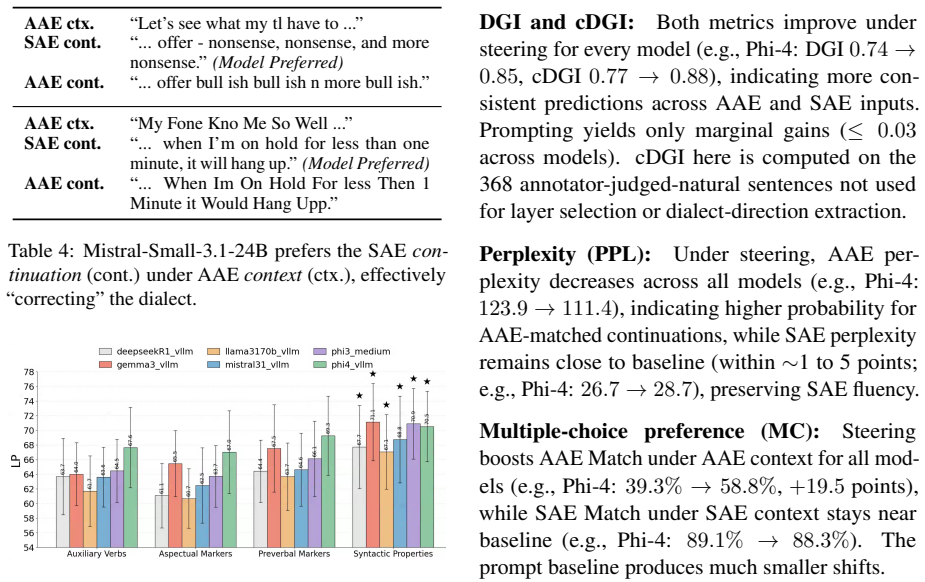
The paper's central claim is that dialect preference bias in LLMs is a structural property of internal model representations, not a surface-level behavior. The authors show this in two steps: first, that the bias is systematically triggered by specific linguistic features (especially syntactic negative concord) across all tested models, suggesting a consistent internal mechanism rather than random variation; and second, that directly modifying hidden-state activations at causally identified layers reduces the bias 5–20x more effectively than prompting, which barely moves the needle. The contrast is load-bearing: if bias were merely a surface-level tendency, instructions should suffice. The 5
What carries the argument
The core mechanism is activation steering via causal tracing. In an offline phase, the method computes a 'dialect direction' at each layer by averaging the difference between hidden-state activations produced by paired AAE and SAE inputs. It then uses corruption-and-restore causal tracing—adding Gaussian noise to AAE feature-token embeddings and measuring which layer restorations most strongly shift the model toward dialect-matched behavior—to identify the four most bias-relevant layers. At inference time, the method injects the normalized dialect direction into those four layers, weighted by their causal importance, shifting the model's internal representations toward treating AAE and SAE等效
Load-bearing premise
The method depends on LLM-generated SAE translations and back-translations being semantically faithful to the original AAE tweets. If the translation model introduces systematic drift—especially drift that correlates with specific AAE features—the 'translation-stable' examples used to isolate genuine model bias may still carry translator artifacts, and some measured bias reduction could reflect correction of translation errors rather than true dialect debiasing.
What would settle it
If one applied activation steering to a held-out set of AAE texts judged by native speakers as semantically equivalent to their SAE counterparts—bypassing LLM translation entirely—and found that the bias reduction disappeared or reversed, the claim that steering addresses genuine dialect bias (rather than translation artifacts) would be undermined.
If this is right
- Activation steering could be extended to other marginalized dialects—Scottish English, Singapore English, Caribbean creoles—using the same extract-direction-and-inject pipeline, since the method is dialect-agnostic and requires only paired inputs.
- The finding that syntactic constructions are universal bias triggers suggests that dialect bias may be partially learned from training data distributions where certain grammatical structures are systematically associated with lower-quality or informal text, pointing to data curation as a complementary intervention.
- If activation steering proves effective across additional dialects and model families, it could become a standard test-time deployment tool for organizations using LLMs in hiring, healthcare, or content moderation where dialect speakers are affected.
- The 5–20x gap between steering and prompting implies that bias audits relying only on prompt-based mitigation may substantially understate the severity of correctable bias, skewing risk assessments.
Where Pith is reading between the lines
- The fact that prompting barely reduces dialect bias while activation steering does suggests that instruction-tuned models may have learned to comply with surface-level fairness instructions without changing underlying representations—a pattern that may extend to other bias dimensions (race, gender, religion) where prompting shows limited effect.
- The universality of syntactic constructions as bias triggers across model families trained on different data suggests a common origin in how LLMs internalize prestige hierarchies of language varieties, possibly inherited from the distributional statistics of internet text where non-standard syntax correlates with informal contexts.
- If the LLM-generated SAE translations contain systematic semantic drift that correlates with dialect features, the cDGI conditioning set could still be contaminated, and the true bias reduction from steering might be partially attributable to correcting translation artifacts rather than genuine dialect debiasing.
Editorial analysis
A structured set of objections, weighed in public.
Referee Report
Summary. This paper presents an end-to-end framework for auditing and mitigating dialect preference bias against African American English (AAE) in large language models. The authors construct REAL-AAE, a parallel corpus of 17,479 AAE/SAE/AAE_back triplets from natural tweets, validated automatically and by three native AAE speakers. They audit six instruction-tuned LLMs (14B–70B) using a new conditional Dialect Group Invariance (cDGI) metric and generative-preference metrics (perplexity, log-probability bias, forced-choice continuation), finding that all models systematically prefer SAE continuations even under AAE context. A feature-level localization analysis identifies syntactic constructions (especially negative concord) as universal bias triggers. For mitigation, the authors introduce the first application of activation steering to dialect bias: a training-free, test-time method that extracts dialect directions via causal tracing and injects them into bias-relevant layers. The method reduces bias 5–20× more than prompting while preserving SAE fluency.
Significance. The paper makes several strong contributions. The REAL-AAE corpus is the largest real-AAE parallel resource to date, and the AAE-first construction pipeline is a meaningful methodological improvement over synthetic benchmarks. The cDGI metric addresses a real confound (translator artifacts) in prior work. The activation steering method is training-free, test-time, and applicable across model scales, making it practically deployable. The feature-level localization (identifying negative concord as a universal trigger) is a concrete, falsifiable finding that future work can build on. The experimental design is thorough: six models, multiple complementary metrics, confidence intervals via paired bootstrap, ablations on prompt wording and single- vs. multi-layer steering, and a full β sweep. The code and corpus are released. These are substantive contributions that advance both fairness in NLP and mechanistic interpretability.
major comments (1)
- §4.1.1, Eq. (1): The cDGI metric conditions on examples where y_AAE = y_AAE_back (prediction preserved under back-translation) AND where AAE_back was judged natural by annotators. The authors state this isolates model bias from translator artifacts. However, there is a subtle selection effect: if the model's bias is feature-specific (e.g., triggered by negative concord, as shown in §6.3), examples containing those features may be systematically excluded from the conditioning set because the model gives different predictions for AAE vs. AAE_back based on surface feature differences, not translation drift. This could make cDGI underestimate true bias for the most problematic feature categories. The paper should discuss this potential interaction between the conditioning logic and feature-specific bias, and ideally report cDGI stratified by feature category to verify that the conditioning设置
minor comments (8)
- §4.3, Phase 1b: The choice of α=3.0 for noise scaling is fixed across all models. Given that models differ in scale (14B–70B) and architecture, a brief justification for why a single α is appropriate across this range would strengthen the method's robustness claim.
- Table 3 and §6.4: The '5 to 20 times more than prompting' claim is computed on the LP metric. The paper should clarify this is specific to LP and note that the ratio differs across metrics (e.g., DGI improvements are more modest), to avoid overgeneralization.
- §3, Translation pipeline: The use of Gemini-3-flash for both forward and back-translation creates a potential systematic bias if the translator itself has dialect preferences. While cDGI is designed to address this, the paper could strengthen its case by reporting translation quality metrics stratified by AAE feature category, to verify that features triggering the most model bias are not also the most poorly translated.
- Table 2: cDGI confidence intervals are substantially wider than DGI intervals (e.g., ±0.045 vs. ±0.005 for Gemma-3), reflecting the smaller conditioning set. The paper should note the sample size underlying cDGI in the main text, not only in §6.4.
- §4.2.2 and Appendix B.3: The feature lexicon is adapted from Harris et al. (2022) and grouped into four classes. The paper should report the distribution of examples across these four categories in REAL-AAE, as imbalanced category sizes could affect the feature-level analysis in §6.3.
- Figure 3: The y-axis for Gemma-3 AAE perplexity is on a very different scale (~14,000) than other models. A log scale or separate panel would improve readability.
- §7 (Conclusion): The claim that the framework 'can extend to other marginalized varieties' is stated but not demonstrated. Either soften this claim or provide a brief discussion of what additional validation would be needed.
- Table 1: The 'Disc.' and 'Gen.' column abbreviations are not defined in the caption; their meaning is only inferable from context.
Circularity Check
No significant circularity found; the central mitigation claim is measured relative to a base model on identical inputs, and the cDGI conditioning logic, while potentially self-referential, does not undermine the headline result.
full rationale
The paper's central claim—that activation steering reduces dialect bias 5 to 20 times more effectively than prompting—is grounded in the LP metric (Eq. 4), which compares the steered model against the unsteered base model on the same held-out evaluation set. This is a standard comparative evaluation, not a self-definitional reduction. The cDGI metric (Eq. 1) conditions on the model's own prediction stability (y_AAE = y_AAE_back), which is mildly self-referential (using the model's biased outputs to define the conditioning set), but this affects only the cDGI column in Table 3, not the LP-based headline. The feature-level localization (§4.2) is an empirical analysis of which markers trigger bias, not a derived prediction. The activation steering method (§4.3) extracts directions from data and applies them at test time; its effectiveness is measured externally, not by construction. The translation pipeline (Gemini-3-flash) is validated both automatically (BERTScore) and by human annotators, providing independent checks. No step in the derivation chain reduces to its inputs by definition or by self-citation chain. The paper is self-contained against external benchmarks and its central claim has independent empirical content.
Axiom & Free-Parameter Ledger
free parameters (5)
- alpha (noise scaling for causal tracing) =
3.0
- beta (steering strength) =
[0.1, 0.2, 0.4, 0.6, 0.8, 1.0]
- K (number of steering layers) =
4
- rho (balance penalty for segmentation) =
0.5
- gamma (balance penalty weight) =
0.3
axioms (4)
- domain assumption AAE is a rule-governed dialect with its own consistent grammar and phonology, spoken by over 30 million people.
- domain assumption TwitterAAE corpus identifies tweets from African American accounts via demographic inference from geolocation and network analysis.
- domain assumption Gemini-3-flash can produce accurate SAE translations and AAE back-translations.
- standard math Activation steering can modify model behavior by adding learned directions to hidden states at inference without retraining.
invented entities (3)
-
REAL-AAE corpus
independent evidence
-
conditional Dialect Group Invariance (cDGI)
independent evidence
-
Dialect direction
independent evidence
read the original abstract
African American English (AAE), a rule-governed dialect spoken by over 30 million people, is routinely misinterpreted and "corrected" by large language models (LLMs). Across six instruction-tuned LLMs (14B to 70B), we show that state-of-the-art models systematically prefer Standard American English (SAE) continuations even when the preceding context is in AAE, effectively rewriting AAE into SAE. We present an end-to-end framework to audit and mitigate this bias. For auditing, we introduce conditional Dialect Group Invariance (cDGI), which isolates true model bias from translator-induced artifacts, and a feature-level localization analysis that identifies which AAE markers most strongly trigger bias; we find that syntactic constructions, especially negative concord (e.g., "ain't nobody"), are universal triggers across all models. For mitigation, we introduce, to our knowledge, the first application of activation steering to dialect bias: a training-free, test-time method that extracts dialect directions via causal tracing and injects them into bias-relevant layers. Activation steering reduces bias 5 to 20 times more than prompting while preserving SAE fluency. To enable this work, we release REAL-AAE , the largest real-AAE parallel corpus to date: 17,479 AAE/SAE/ AAE_back triplets from natural tweets (2 to 6 times larger than prior real-AAE resources), validated automatically (BERTScore F1 = 0.95) and by three native AAE speakers (83.0% semantic agreement).
Figures




Reference graph
Works this paper leans on
-
[1]
Representation Engineering: A Top-Down Approach to
Zou, Andy and Phan, Long and Chen, Sarah and Campbell, James and Guo, Phillip and Ren, Richard and Pan, Alexander and Yin, Xuwang and Mazeika, Mantas and Dombrowski, Ann-Kathrin and others , journal=. Representation Engineering: A Top-Down Approach to
-
[2]
Locating and Editing Factual Associations in
Kevin Meng and David Bau and Alex J Andonian and Yonatan Belinkov , booktitle=. Locating and Editing Factual Associations in. 2022 , url=
work page 2022
-
[3]
Steering Language Models With Activation Engineering
Activation Addition: Steering Language Models Without Optimization , author=. arXiv preprint arXiv:2308.10248 , year=
work page internal anchor Pith review Pith/arXiv arXiv
-
[4]
In-Context Vectors: Making In Context Learning More Effective and Controllable Through Latent Space Steering , author=. Proceedings of ICML , year=
-
[5]
Racial Bias in Hate Speech and Abusive Language Detection Datasets
Davidson, Thomas and Bhattacharya, Debasmita and Weber, Ingmar. Racial Bias in Hate Speech and Abusive Language Detection Datasets. Proceedings of the Third Workshop on Abusive Language Online. 2019. doi:10.18653/v1/W19-3504
-
[6]
Groenwold, Sophie and Ou, Lily and Parekh, Aesha and Honnavalli, Samhita and Levy, Sharon and Mirza, Diba and Wang, William Yang , booktitle=. Investigating
-
[7]
Annotators with Attitudes: How Annotator Beliefs And Identities Bias Toxic Language Detection
Sap, Maarten and Swayamdipta, Swabha and Vianna, Laura and Zhou, Xuhui and Choi, Yejin and Smith, Noah A. Annotators with Attitudes: How Annotator Beliefs And Identities Bias Toxic Language Detection. Proceedings of the 2022 Conference of the North American Chapter of the Association for Computational Linguistics: Human Language Technologies. 2022. doi:10...
-
[8]
Demographic Dialectal Variation in Social Media: A Case Study of
Blodgett, Su Lin and Green, Lisa and O'Connor, Brendan , booktitle =. Demographic Dialectal Variation in Social Media: A Case Study of. 2016 , pages =
work page 2016
-
[9]
T witter U niversal D ependency Parsing for A frican- A merican and Mainstream A merican E nglish
Blodgett, Su Lin and Wei, Johnny and O ' Connor, Brendan. T witter U niversal D ependency Parsing for A frican- A merican and Mainstream A merican E nglish. Proceedings of the 56th Annual Meeting of the Association for Computational Linguistics (Volume 1: Long Papers). 2018. doi:10.18653/v1/P18-1131
-
[10]
VALUE : U nderstanding Dialect Disparity in NLU
Ziems, Caleb and Chen, Jiaao and Harris, Camille and Anderson, Jessica and Yang, Diyi. VALUE : U nderstanding Dialect Disparity in NLU. Proceedings of the 60th Annual Meeting of the Association for Computational Linguistics (Volume 1: Long Papers). 2022. doi:10.18653/v1/2022.acl-long.258
-
[11]
The Llama 3 Herd of Models , author=. arXiv preprint arXiv:2407.21783 , year=
work page internal anchor Pith review Pith/arXiv arXiv
-
[12]
Meng, Kevin and Bau, David and Andonian, Alex and Belinkov, Yonatan , title =. Proceedings of the 36th International Conference on Neural Information Processing Systems , articleno =. 2022 , isbn =
work page 2022
-
[13]
Word Alignment by Fine-tuning Embeddings on Parallel Corpora
Dou, Zi-Yi and Neubig, Graham. Word Alignment by Fine-tuning Embeddings on Parallel Corpora. Proceedings of the 16th Conference of the European Chapter of the Association for Computational Linguistics: Main Volume. 2021. doi:10.18653/v1/2021.eacl-main.181
-
[14]
Social Bias Frames: Reasoning about Social and Power Implications of Language , author =. Proceedings of the 60th Annual Meeting of the Association for Computational Linguistics (ACL) , year =
-
[15]
International AI Safety Report
International ai safety report , author=. arXiv preprint arXiv:2501.17805 , year=
work page internal anchor Pith review Pith/arXiv arXiv
-
[16]
Sentence-bert: Sentence embeddings using siamese bert-networks
Reimers, Nils and Gurevych, Iryna. Sentence- BERT : Sentence Embeddings using S iamese BERT -Networks. Proceedings of the 2019 Conference on Empirical Methods in Natural Language Processing and the 9th International Joint Conference on Natural Language Processing (EMNLP-IJCNLP). 2019. doi:10.18653/v1/D19-1410
-
[17]
Proceedings of the 2022 ACM Conference on Fairness, Accountability, and Transparency , pages=
Exploring the role of grammar and word choice in bias toward african american english (aae) in hate speech classification , author=. Proceedings of the 2022 ACM Conference on Fairness, Accountability, and Transparency , pages=
work page 2022
-
[18]
E n D ive: A Cross-Dialect Benchmark for Fairness and Performance in Large Language Models
Gupta, Abhay and Cheung, Jacob and Meng, Philip and Sayyed, Shayan and Zhu, Kevin and Liao, Austen and O ' Brien, Sean. E n D ive: A Cross-Dialect Benchmark for Fairness and Performance in Large Language Models. Findings of the Association for Computational Linguistics: EMNLP 2025. 2025. doi:10.18653/v1/2025.findings-emnlp.913
-
[19]
Advances in neural information processing systems , volume=
Man is to computer programmer as woman is to homemaker? debiasing word embeddings , author=. Advances in neural information processing systems , volume=
-
[20]
Computational Linguistics , volume=
Bias and fairness in large language models: A survey , author=. Computational Linguistics , volume=. 2024 , publisher=
work page 2024
-
[21]
Steering Llama 2 via Contrastive Activation Addition , author =. Proceedings of the 62nd Annual Meeting of the Association for Computational Linguistics (Volume 1: Long Papers) , editor =. 2024 , address =
work page 2024
-
[22]
Proceedings of the 40th International Conference on Machine Learning (ICML) , year =
Discovering Latent Knowledge in Language Models without Supervision , author =. Proceedings of the 40th International Conference on Machine Learning (ICML) , year =
-
[23]
CEUR Workshop Proceedings , volume=
Bias mitigation for large language models using adversarial learning , author=. CEUR Workshop Proceedings , volume=. 2023 , organization=
work page 2023
-
[24]
Refusal in Language Models Is Mediated by a Single Direction , author=. 2024 , eprint=
work page 2024
-
[25]
Large Language Model Bias Mitigation from the Perspective of Knowledge Editing
Large language model bias mitigation from the perspective of knowledge editing , author=. arXiv preprint arXiv:2405.09341 , year=
work page internal anchor Pith review Pith/arXiv arXiv
-
[26]
Persona Vectors: Monitoring and Controlling Character Traits in Language Models
Persona vectors: Monitoring and controlling character traits in language models , author=. arXiv preprint arXiv:2507.21509 , year=
work page internal anchor Pith review Pith/arXiv arXiv
-
[27]
arXiv preprint arXiv:2408.14845 , year=
Aavenue: Detecting llm biases on nlu tasks in aave via a novel benchmark , author=. arXiv preprint arXiv:2408.14845 , year=
-
[28]
AAVENUE : Detecting LLM Biases on NLU Tasks in AAVE via a Novel Benchmark
Gupta, Abhay and Yurtseven, Ece and Meng, Philip and Zhu, Kevin. AAVENUE : Detecting LLM Biases on NLU Tasks in AAVE via a Novel Benchmark. Proceedings of the Third Workshop on NLP for Positive Impact. 2024. doi:10.18653/v1/2024.nlp4pi-1.28
-
[29]
UMass Amherst Doctoral Dissertations , volume=
Sociolinguistically driven approaches for just natural language processing , author=. UMass Amherst Doctoral Dissertations , volume=
-
[30]
Multi- VALUE : A Framework for Cross-Dialectal E nglish NLP
Ziems, Caleb and Held, William and Yang, Jingfeng and Dhamala, Jwala and Gupta, Rahul and Yang, Diyi. Multi- VALUE : A Framework for Cross-Dialectal E nglish NLP. Proceedings of the 61st Annual Meeting of the Association for Computational Linguistics (Volume 1: Long Papers). 2023. doi:10.18653/v1/2023.acl-long.44
-
[31]
DialectGen: Benchmarking and Improving Dialect Robustness in Multimodal Generation , author=. 2025 , eprint=
work page 2025
- [32]
-
[33]
Evaluating Dialect Robustness of Language Models via Conversation Understanding
Srirag, Dipankar and Sahoo, Nihar Ranjan and Joshi, Aditya. Evaluating Dialect Robustness of Language Models via Conversation Understanding. Proceedings of the Second Workshop on Scaling Up Multilingual & Multi-Cultural Evaluation. 2025
work page 2025
-
[34]
Linguistic Bias in C hat GPT : Language Models Reinforce Dialect Discrimination
Fleisig, Eve and Smith, Genevieve and Bossi, Madeline and Rustagi, Ishita and Yin, Xavier and Klein, Dan. Linguistic Bias in C hat GPT : Language Models Reinforce Dialect Discrimination. Proceedings of the 2024 Conference on Empirical Methods in Natural Language Processing. 2024. doi:10.18653/v1/2024.emnlp-main.750
-
[35]
Natural Language Processing for Dialects of a Language: A Survey , author=. 2024 , eprint=
work page 2024
-
[36]
Rejected Dialects: Biases Against A frican A merican Language in Reward Models
Mire, Joel and Aysola, Zubin Trivadi and Chechelnitsky, Daniel and Deas, Nicholas and Zerva, Chrysoula and Sap, Maarten. Rejected Dialects: Biases Against A frican A merican Language in Reward Models. Findings of the Association for Computational Linguistics: NAACL 2025. 2025. doi:10.18653/v1/2025.findings-naacl.417
-
[37]
Proceedings of the AAAI Symposium Series , author=
Dialectic Preference Bias in Large Language Models , volume=. Proceedings of the AAAI Symposium Series , author=. 2025 , month=. doi:10.1609/aaaiss.v5i1.35613 , number=
-
[38]
Lin, Fangru and Mao, Shaoguang and La Malfa, Emanuele and Hofmann, Valentin and de Wynter, Adrian and Wang, Xun and Chen, Si-Qing and Wooldridge, Michael J. and Pierrehumbert, Janet B. and Wei, Furu. Assessing Dialect Fairness and Robustness of Large Language Models in Reasoning Tasks. Proceedings of the 63rd Annual Meeting of the Association for Computat...
-
[39]
Hofmann, Valentin and Kalluri, Pratyusha Ria and Jurafsky, Dan and King, Sharese , title =. Nature , year =. doi:10.1038/s41586-024-07856-5 , url =
-
[40]
Bias in Language Models: Beyond Trick Tests and Towards RUTE d Evaluation
Lum, Kristian and Anthis, Jacy Reese and Robinson, Kevin and Nagpal, Chirag and D ' Amour, Alexander Nicholas. Bias in Language Models: Beyond Trick Tests and Towards RUTE d Evaluation. Proceedings of the 63rd Annual Meeting of the Association for Computational Linguistics (Volume 1: Long Papers). 2025. doi:10.18653/v1/2025.acl-long.7
-
[41]
Philosophical Psychology , volume =
Uwe Peters , title =. Philosophical Psychology , volume =. 2024 , publisher =. doi:10.1080/09515089.2023.2261976 , URL =
-
[42]
Linguistic profiling , editor =
Black linguistics: Language, society and politics in Africa and the Americas , author =. Linguistic profiling , editor =. 2003 , pages =
work page 2003
- [43]
-
[44]
Rickford, John R. and King, Sharese , journal =. Language and linguistics on trial: Hearing. 2016 , doi =
work page 2016
-
[45]
Philosophical Psychology , year =
The complexities of linguistic discrimination , author =. Philosophical Psychology , year =
-
[46]
The Risk of Racial Bias in Hate Speech Detection
Sap, Maarten and Card, Dallas and Gabriel, Saadia and Choi, Yejin and Smith, Noah A. The Risk of Racial Bias in Hate Speech Detection. Proceedings of the 57th Annual Meeting of the Association for Computational Linguistics. 2019. doi:10.18653/v1/P19-1163
-
[47]
Proceedings of the National Academy of Sciences , volume =
Racial disparities in automated speech recognition , author =. Proceedings of the National Academy of Sciences , volume =. 2020 , doi =
work page 2020
-
[48]
Martin, J. L. and Tang, K. , booktitle =. Understanding Racial Disparities in Automatic Speech Recognition:. 2020 , doi =
work page 2020
-
[49]
Evaluation of A frican A merican Language Bias in Natural Language Generation
Deas, Nicholas and Grieser, Jessica and Kleiner, Shana and Patton, Desmond and Turcan, Elsbeth and McKeown, Kathleen. Evaluation of A frican A merican Language Bias in Natural Language Generation. Proceedings of the 2023 Conference on Empirical Methods in Natural Language Processing. 2023. doi:10.18653/v1/2023.emnlp-main.421
-
[50]
Whose Language Counts as High Quality? Measuring Language Ideologies in Text Data Selection
Gururangan, Suchin and Card, Dallas and Dreier, Sarah and Gade, Emily and Wang, Leroy and Wang, Zeyu and Zettlemoyer, Luke and Smith, Noah A. Whose Language Counts as High Quality? Measuring Language Ideologies in Text Data Selection. Proceedings of the 2022 Conference on Empirical Methods in Natural Language Processing. 2022. doi:10.18653/v1/2022.emnlp-main.165
-
[51]
Wang, Alex and Singh, Amanpreet and Michael, Julian and Hill, Felix and Levy, Omer and Bowman, Samuel. GLUE : A Multi-Task Benchmark and Analysis Platform for Natural Language Understanding. Proceedings of the 2018 EMNLP Workshop B lackbox NLP : Analyzing and Interpreting Neural Networks for NLP. 2018. doi:10.18653/v1/W18-5446
-
[52]
SuperGLUE: A Stickier Benchmark for General-Purpose Language Understanding Systems , author=. 2020 , eprint=
work page 2020
-
[53]
Predicting the Target Word of Game-playing Conversations using a Low-Rank Dialect Adapter for Decoder Models , author=. 2025 , eprint=
work page 2025
-
[54]
A Multi-Agent Framework for Mitigating Dialect Biases in Privacy Policy Question-Answering Systems , author=. 2025 , eprint=
work page 2025
-
[55]
Gemma 3 Technical Report , author=. arXiv preprint arXiv:2503.19786 , year=
work page internal anchor Pith review Pith/arXiv arXiv
- [56]
-
[57]
Mistral Small 3.1 , year =
-
[58]
Phi-3 Technical Report: A Highly Capable Language Model Locally on Your Phone
Phi-3 Technical Report: A Highly Capable Language Model Locally on Your Phone , author=. arXiv preprint arXiv:2404.14219 , year=
work page internal anchor Pith review Pith/arXiv arXiv
-
[59]
Phi-4 Technical Report , author=. arXiv preprint arXiv:2412.08905 , year=
work page internal anchor Pith review Pith/arXiv arXiv
-
[60]
DeepSeek-R1: Incentivizing Reasoning Capability in LLMs via Reinforcement Learning
DeepSeek-R1: Incentivizing Reasoning Capability in LLMs via Reinforcement Learning , author=. arXiv preprint arXiv:2501.12948 , year=
work page internal anchor Pith review Pith/arXiv arXiv
-
[61]
Proceedings of the 29th Symposium on Operating Systems Principles , year=
Efficient Memory Management for Large Language Model Serving with PagedAttention , author=. Proceedings of the 29th Symposium on Operating Systems Principles , year=
-
[62]
Transformers: State-of-the-Art Natural Language Processing , author=. Proceedings of the 2020 Conference on Empirical Methods in Natural Language Processing: System Demonstrations , pages=. 2020 , publisher=
work page 2020
discussion (0)
Sign in with ORCID, Apple, or X to comment. Anyone can read and Pith papers without signing in.