REVIEW 3 major objections 6 minor 48 references
Reviewed by Pith at T0; open to challenge.
T0 means a machine referee read the full paper against a public rubric. The mark states how deep the mechanical check went, never who wrote it. the ladder, T0–T4 →
T0 review · glm-5.2
DUNE can probe quasi-Dirac neutrino splitting 2× deeper than current experiments
2026-07-10 00:00 UTC pith:PGUYRWKT
load-bearing objection Solid quasi-Dirac sensitivity forecast for DUNE, but the flavor-universal mixing assumption is load-bearing and insufficiently stress-tested the 3 major comments →
Probing Quasi-Dirac Neutrino Oscillations at Long Baseline Experiments
The pith
A machine-rendered reading of the paper's core claim, the machinery that carries it, and where it could break.
Core claim
The paper's central result is that quasi-Dirac neutrino oscillations produce a characteristic interference signature — a slowly varying phase Δm²_54·L/4E modulating the envelope of averaged oscillations — that is qualitatively distinct from both standard three-neutrino oscillations and non-degenerate sterile scenarios. This signature is detectable at long-baseline experiments, with DUNE achieving uniform sensitivity down to θ_sa ≈ 0.05 without the degeneracy valleys and resonance artifacts that limit NOvA and T2K. The coupling between sterile mixing and CP violation means that the 5ν appearance probability is universally suppressed relative to the 3ν case by the factor c_sa, making the sign,
What carries the argument
The five-neutrino mixing matrix U = W45 R35 R34 W25 W24 R23 W15 W14 W13 R12 · DM, with all six active-sterile angles set to a single flavor-universal value θ_sa. The averaged appearance probability P(νμ→νe) = P3ν + 4|Uμ4|²|Ue4|²(1 + cos(x54)cos(x54 − φ45)), where x54 = Δm²_54 L/4E is the quasi-Dirac interference phase. The CP-suppression factor c_sa multiplying the δCP-dependent amplitude. GLoBES simulation of NOvA (810 km), T2K (295 km), and DUNE (1300 km) with Gaussian-filtered oscillation probabilities and marginalized systematic uncertainties.
Load-bearing premise
All six active-sterile mixing angles are set to a single flavor-universal value θ_sa. This collapses a fifteen-parameter sterile mixing space into one angle, and the sensitivity contours, degeneracy structures, and CP-suppression analysis all depend on this simplification. If individual angles differ substantially across flavors, the appearance and disappearance channels would be affected differently, potentially opening or closing degeneracy valleys not captured here.
What would settle it
If DUNE data shows no deviation from 3ν predictions down to θ_sa ≈ 0.05 for any Δm²_54 in the range 10⁻⁵–10⁻¹ eV², the quasi-Dirac scenario with flavor-universal mixing at that scale is excluded. Conversely, if a deviation is found, it must be distinguishable from a non-degenerate 3+1 sterile scenario — the quasi-Dirac interference signature requires the specific cos(x54) modulation, not just a constant flux suppression.
If this is right
- DUNE's quasi-Dirac search and its CP-violation measurement are not independent programs — a joint analysis is required because sterile mixing suppresses CP-sensitive amplitudes by c_sa, biasing δCP extraction if the 5ν sector is ignored.
- The atmospheric resonance near Δm²_54 ≈ Δm²_31 creates parameter degeneracies at NOvA and T2K that DUNE's longer baseline naturally washes out, making DUNE the unambiguous near-term probe.
- The degeneracy valley near θ_sa ≈ θ23 ≈ 0.4, where the 5ν model can mimic 3ν spectra, represents a blind spot for current experiments that DUNE's broad-band averaging avoids.
- Neutrinoless double beta decay experiments (nEXO, LEGEND) provide complementary constraints because quasi-Dirac pairs produce near-complete cancellations in the effective Majorana mass, with residuals potentially accessible at next-generation sensitivity.
Editorial analysis
A structured set of objections, weighed in public.
Referee Report
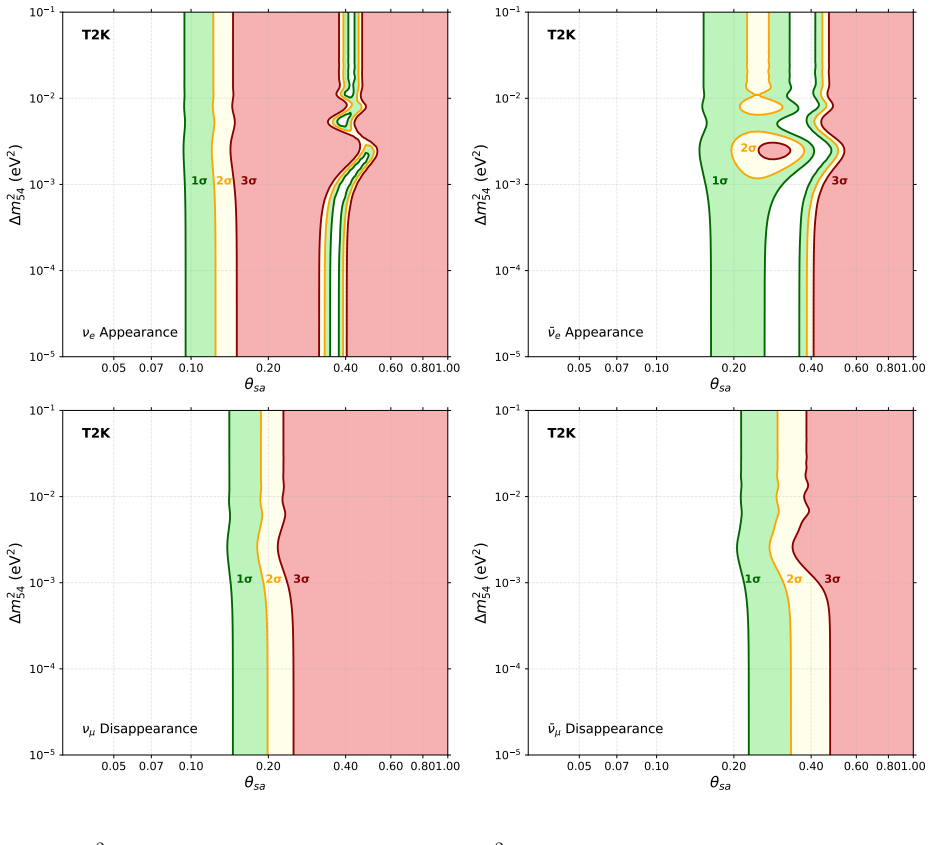
Summary. This paper studies quasi-Dirac neutrino oscillations within a 3+2 framework motivated by the inverse seesaw mechanism. Two nearly degenerate sterile neutrinos form a quasi-Dirac pair with splitting controlled by a small lepton-number-violating Majorana mass. The authors derive averaged oscillation probabilities for the appearance and disappearance channels, identifying a sterile-sector interference phase that has no analogue in non-degenerate 3+1 or 3+2 scenarios. Using GLoBES simulations of NOvA, T2K, and DUNE with realistic systematic uncertainties, they map sensitivity contours in the (theta_sa, Delta m^2_54) plane and analyse how the five-neutrino framework modifies CP-violating observables relative to the standard three-neutrino case. They find that current NOvA+T2K data constrains theta_sa >~ 0.08, while DUNE can reach theta_sa ~ 0.05 with uniform sensitivity across the full Delta m^2_54 range.
Significance. The paper provides a clean analytic treatment of quasi-Dirac oscillation probabilities (Eqs. 38-41) and a thorough simulation study with experimentally realistic systematics. The identification of the c_sa suppression factor governing the CP-dependent amplitude (Eq. 43) and the threshold delta_CP^thresh (Eq. 45) is a useful analytic insight. The DUNE sensitivity forecast, showing uniform coverage free of the resonance and degeneracy structures that affect NOvA and T2K, is a concrete and falsifiable prediction. The coupling of quasi-Dirac sensitivity to delta_CP measurements is an interesting and timely observation given DUNE's dual science goals. The work is well-motivated and the simulation methodology is sound.
major comments (3)
- Section II.B, Eq. (43): The claim that the CP-dependent amplitude is 'universally suppressed' by the factor c_sa < 1 is load-bearing for the paper's central analytic result, but it depends critically on the assumption that all six active-sterile mixing angles are equal (theta_14 = theta_15 = theta_24 = theta_25 = theta_34 = theta_35 = theta_sa). With independent angles, the clean factorization into a single cosine rescaling of the active 3x3 submatrix breaks down, as different rows of the PMNS matrix would be rescaled by different cosines. The authors acknowledge this in the Conclusion as a future direction, but all quantitative results — sensitivity contours, degeneracy structures, and the CP-suppression claim — rest on this simplification. The paper should either (a) explicitly state in Section II.C that Eq. (43) and the 'universal suppression' claim are derived under the flavor-univer
- Section III.B, Eq. (53): The chi-s2 analysis fixes the standard oscillation parameters to their NuFit best-fit values rather than marginalizing over them. Given that theta_23 has approximately 5% uncertainty and the degeneracy valley identified in Section IV sits near theta_sa ~ theta_23 ~ 0.4, allowing theta_23 to float would likely deepen this valley for NOvA and T2K, potentially weakening the claimed theta_sa >~ 0.08 bound. The authors should clarify whether this effect was checked and, if not, discuss how marginalization over theta_23 (and delta_CP) would affect the quoted sensitivity limits. The DUNE result (theta_sa ~ 0.05) is less affected since its contours lack the degeneracy valley, but this should be stated explicitly.
- Section II.B: The sterile CP phases eta_13, eta_14, and eta_24 are set to zero throughout the analysis. The phase phi_45 = (eta_14 - eta_15) - (eta_24 - eta_25) defined in Eq. (37) enters the appearance probability in Eq. (38) and could shift the sensitivity contours, particularly in the appearance channel where the sterile contribution is most pronounced. The paper should briefly discuss the expected impact of non-zero sterile CP phases on the sensitivity results, even if a full scan is deferred to future work.
minor comments (6)
- Table I: The range for theta_sa is listed as 0.1-1, but the sensitivity contours in Figs. 7-10 extend down to theta_sa = 0.05. Clarify whether the table range refers to the scan range or the physically motivated range.
- Figure 2: The caption states delta_CP = 0.82 and 3.66, but the text in Section II.C discusses these values without explaining why 0.82 is chosen (it is not a standard benchmark). A brief justification would help the reader.
- Section II.E, Eqs. (49)-(52): The decay width expressions use theta_sa as the mixing angle, but the sterile neutrino mass m_N is not explicitly defined in terms of the mass eigenvalues m_4, m_5. Clarify which mass is used (presumably the average).
- Figure 3: The Earth-Sun and SN1987A labels appear in the legend but are not discussed in the text. Either add a brief discussion or remove them from the figure.
- Section IV: The text states that the degeneracy valley near theta_sa ~ 0.4 arises because 'the sterile contribution to the oscillation amplitude becomes comparable to the active-active contribution.' This is a qualitative statement; a more quantitative explanation of the cancellation condition would strengthen the analysis.
- Reference [19] (Abada et al., arXiv:2506.16390) appears to be a very recent preprint. If the present work overlaps significantly with it, the relationship should be clarified.
Circularity Check
No significant circularity; derivation is self-contained with only minor non-load-bearing self-citations
full rationale
The paper's derivation chain is self-contained and does not reduce to its own inputs by construction. The theoretical framework (Section II) derives the 5×5 mixing matrix U from the inverse seesaw Lagrangian (Eq. 8) via the Schur complement (Eqs. 24-27), yielding the quasi-Dirac splitting Δm²₅₄ = μ as a first-principles result from the mass matrix structure — not a fitted input renamed as a prediction. The oscillation probabilities (Eqs. 38-41) follow from standard vacuum oscillation formalism applied to the derived mixing matrix, with the averaging over rapid Δm²₄₁ phases performed analytically (Eq. 36). The CP-suppression factor c_sa in Eq. 43 arises from the parametrization choice (uniform θ_sa) and the algebraic structure of the PMNS matrix, not from fitting to data. The χ² sensitivity analysis (Eq. 53) uses externally determined NuFit 6.0 best-fit values as inputs and compares 3ν vs 5ν predictions — the 'predictions' are GLoBES simulation outputs, not fitted quantities repackaged as results. Self-citations exist (Deppisch appears on refs [3,11,13,14,15,33]) but these provide theoretical motivation and methodological context; none are invoked as load-bearing mathematical facts that would make the central claim circular. The sensitivity contours are computed from simulated event rates with systematic uncertainties marginalized over, not constrained to reproduce prior results. The flavor-universal θ_sa assumption is a simplification that limits generality (a correctness concern, not circularity), but it does not make any prediction equivalent to its input by definition.
Axiom & Free-Parameter Ledger
free parameters (5)
- θ_sa =
scanned over [0.1, 1.0]
- Δm²_54 =
scanned over [10⁻⁵, 10⁻¹] eV²
- Δm²_41 =
10 eV²
- δ_CP =
0.82 and 3.66 (NuFit best-fit), varied over [0, 2π]
- σ_e =
not specified numerically
axioms (5)
- domain assumption Inverse seesaw mechanism with μ_L = 0
- ad hoc to paper All six active-sterile mixing angles are equal (θ_sa)
- domain assumption Constant matter density approximation
- ad hoc to paper Sterile CP phases η₁₃, η₁₄, η₂₄ set to zero
- domain assumption Sterile neutrinos are stable over experimental baselines
invented entities (1)
-
ν₄, ν₅ quasi-Dirac sterile neutrino pair
independent evidence
read the original abstract
The Dirac or Majorana nature of neutrinos remains one of the most fundamental open problems in particle physics. A natural intermediate scenario arises when small lepton-number-violating Majorana mass terms break the exact Dirac symmetry. These cause mass eigenstates to form nearly degenerate pairs, each separated by a small mass splitting. We study this quasi-Dirac scenario within a five-neutrino framework, extending the Standard Model by two right-handed neutrinos, which form a nearly degenerate sterile pair alongside the three active states. This extended mixing structure introduces additional phenomenological parameters, including new mixing angles, mass splittings, and CP phases. We use appearance and disappearance data from NO$\nu$A and T2K to constrain the active-sterile mixing angles $\theta_{sa}$ and the mass splitting within the sterile pair $\Delta m_{54}^2$ and forecast the sensitivity achievable at DUNE. We analyse how these parameters modify CP-violating observables relative to the standard three-neutrino case, comparing predicted event rates across both mass orderings and as a function of $\delta_{CP}$.
Figures




Reference graph
Works this paper leans on
-
[1]
The effect of the sterile mixing in this channel is qualitatively different: theν µ can now oscillate into the sterile states, reducing the survival probability by an amount proportional to|U µ4|2 +|U µ5|2. This depletion carries no dependence on the Dirac phases, in contrast to the appearance channel, making the two channels complementary probes of the s...
-
[2]
and magnitude scaling linearly withn e [10, 32]. As shown in Fig. 1, the splitting ∆m 2 54 is taken comparable in magnitude to ∆m 2 21, precisely the regime in which such matter-induced modifications to the active-sterile level structure become non-negligible at long baselines [12]. NOvA and in particular DUNE are thus well-suited to the quasi-Dirac mass ...
work page 2014
-
[3]
We notice that an enhanced sensitivity in the appearance channel relative to disappearance arises because theν µ →ν e transition amplitude receives direct contributions from the active-sterile mixing anglesθ 14,θ 15,θ 24, θ25 at leading order, opening new oscillation pathways that are absent in the 3νcase. The νµ →ν µ survival probability, by contrast, is...
work page 2010
-
[4]
With a near detector at the Sanford Underground Research Facility and a far detector at Fermilab, neutrinos will travel a distance of 1300 km. Our simulation of DUNE includes the expected event rates in theν µ disappearance andν e appearance channels with neutrino energies ranging from 0 to 8 GeV over 64 bins. As this is a future experiment, we base our a...
work page 2027
-
[5]
parameter space usingGLoBESsimulations of NOνA, T2K, and DUNE with full systematic treatment. Several structural features of the 5νoscillation framework were identified consistently across experiments. In the degenerate limit ∆m 2 54 →0, the sterile pair mimics a single Dirac neutrino and sensitivity vanishes. At intermediate splittings, a resonance enhan...
-
[6]
Evidence for oscillation of atmospheric neutrinos
Y. Fukudaet al.(Super-Kamiokande), “Evidence for oscillation of atmospheric neutrinos,” Phys. Rev. Lett.81, 1562–1567 (1998), arXiv:hep-ex/9807003
work page internal anchor Pith review Pith/arXiv arXiv 1998
-
[7]
Atmospheric neutrinos and discovery of neutrino oscillations,
Takaaki Kajita, “Atmospheric neutrinos and discovery of neutrino oscillations,” Proc. Japan Acad. B86, 303–321 (2010)
work page 2010
-
[8]
Neutrinos and Collider Physics
Frank F. Deppisch, P. S. Bhupal Dev, and Apostolos Pilaftsis, “Neutrinos and Collider Physics,” New J. Phys.17, 075019 (2015), arXiv:1502.06541 [hep-ph]
work page internal anchor Pith review Pith/arXiv arXiv 2015
-
[9]
The Present and Future Status of Heavy Neutral Leptons
Asli M. Abdullahiet al., “The present and future status of heavy neutral leptons,” J. Phys. G50, 020501 (2023), arXiv:2203.08039 [hep-ph]
work page internal anchor Pith review Pith/arXiv arXiv 2023
-
[10]
Signa- tures of quasi-Dirac neutrinos in diffuse high-energy astrophysical neutrino data,
Kiara Carloni, Yago Porto, Carlos A. Arg¨ uelles, P. S. Bhupal Dev, and Sudip Jana, “Signa- tures of quasi-Dirac neutrinos in diffuse high-energy astrophysical neutrino data,” Phys. Rev. D113, 115004 (2026), arXiv:2503.19960 [hep-ph]
-
[11]
P.S. Bhupal Dev, Pedro A.N. Machado, and Ivan Mart´ ınez-Soler, “Pseudo-dirac neutrinos and relic neutrino matter effect on the high-energy neutrino flavor composition,” Physics Letters B862, 139306 (2025)
work page 2025
-
[12]
Constraining the pseudo-dirac nature of neutrinos using astrophysical neutrino flavor data,
Chee Sheng Fong and Yago Porto, “Constraining the pseudo-dirac nature of neutrinos using astrophysical neutrino flavor data,” Physical Review D112(2025), 10.1103/yc27-61w5
-
[13]
Lepton-number violation with quasi-dirac neutrinos,
J. W. F. Valle and M. Singer, “Lepton-number violation with quasi-dirac neutrinos,” Phys. Rev. D28, 540–545 (1983)
work page 1983
-
[14]
Significant neutrinoless double beta decay with quasi-dirac neutrinos,
Pei-Hong Gu, “Significant neutrinoless double beta decay with quasi-dirac neutrinos,” Physical Review D85(2012), 10.1103/physrevd.85.093016
-
[15]
Quasi Dirac neutrino oscillations
G. Anamiati, R. M. Fonseca, and M. Hirsch, “Quasi Dirac neutrino oscillations,” Phys. Rev. D97, 095008 (2018), arXiv:1710.06249 [hep-ph]. 33
work page internal anchor Pith review Pith/arXiv arXiv 2018
-
[16]
Neutrinoless double beta decay versus other probes of heavy sterile neutrinos
Patrick D. Bolton, Frank F. Deppisch, and P. S. Bhupal Dev, “Neutrinoless double beta decay versus other probes of heavy sterile neutrinos,” JHEP03, 170 (2020), arXiv:1912.03058 [hep-ph]
work page internal anchor Pith review Pith/arXiv arXiv 2020
-
[17]
Quasi-Dirac neutrino oscillations at DUNE and JUNO
G. Anamiati, V. De Romeri, M. Hirsch, C. A. Ternes, and M. T´ ortola, “Quasi-Dirac neutrino oscillations at DUNE and JUNO,” Phys. Rev. D100, 035032 (2019), arXiv:1907.00980 [hep- ph]
work page internal anchor Pith review Pith/arXiv arXiv 2019
-
[18]
Alternative formulation of left-right symmetry with $B-L$ conservation and purely Dirac neutrinos
Patrick D. Bolton, Frank F. Deppisch, Chandan Hati, Sudhanwa Patra, and Utpal Sarkar, “Alternative formulation of left-right symmetry withB−Lconservation and purely Dirac neutrinos,” Phys. Rev. D100, 035013 (2019), arXiv:1902.05802 [hep-ph]
work page internal anchor Pith review Pith/arXiv arXiv 2019
-
[19]
Probing the Nature of Heavy Neutral Leptons in Direct Searches and Neutrinoless Double Beta Decay
Patrick D. Bolton, Frank F. Deppisch, Mudit Rai, and Zhong Zhang, “Probing the nature of Heavy Neutral Leptons in direct searches and neutrinoless double beta decay,” Nucl. Phys. B 1010, 116785 (2025), arXiv:2212.14690 [hep-ph]
work page internal anchor Pith review Pith/arXiv arXiv 2025
-
[20]
Probing nonstandard lepton number violating interactions in neutrino oscillations
Patrick D. Bolton and Frank F. Deppisch, “Probing nonstandard lepton number violating interactions in neutrino oscillations,” Phys. Rev. D99, 115011 (2019), arXiv:1903.06557 [hep- ph]
work page internal anchor Pith review Pith/arXiv arXiv 2019
-
[21]
Neutrino mass and baryon-number nonconservation in superstring models,
R. N. Mohapatra and J. W. F. Valle, “Neutrino mass and baryon-number nonconservation in superstring models,” Phys. Rev. D34, 1642–1645 (1986)
work page 1986
-
[22]
TeV Scale Inverse Seesaw in SO(10) and Leptonic Non-Unitarity Effects
P. S. Bhupal Dev and R. N. Mohapatra, “TeV Scale Inverse Seesaw in SO(10) and Leptonic Non-Unitarity Effects,” Phys. Rev. D81, 013001 (2010), arXiv:0910.3924 [hep-ph]
work page internal anchor Pith review Pith/arXiv arXiv 2010
-
[23]
Very Light Sterile Neutrinos at NOvA and T2K
Andr´ e de Gouvˆ ea, Giancarlo Jusino S´ anchez, and Kevin J. Kelly, “Very light sterile neutrinos at NOvA and T2K,” Phys. Rev. D106, 055025 (2022), arXiv:2204.09130 [hep-ph]
work page internal anchor Pith review Pith/arXiv arXiv 2022
-
[24]
Investigating DUNE oscillations sensitivity to sterile pseudo-Dirac neutrinos,
Asmaa Abada, Jo˜ ao Paulo Pinheiro, and Salvador Urrea, “Investigating DUNE oscillations sensitivity to sterile pseudo-Dirac neutrinos,” JHEP11, 136 (2025), arXiv:2506.16390 [hep- ph]
-
[25]
Diffuse supernova neutrino background search at super-kamiokande,
K. Abeet al., “Diffuse supernova neutrino background search at super-kamiokande,” Physical Review D104(2021), 10.1103/physrevd.104.122002
-
[26]
First measurement of neutrino oscillation parameters using neutrinos and antineutrinos by NOvA
M. A. Aceroet al.(NOvA), “First Measurement of Neutrino Oscillation Parameters using Neu- trinos and Antineutrinos by NOvA,” Phys. Rev. Lett.123, 151803 (2019), arXiv:1906.04907 [hep-ex]
work page internal anchor Pith review Pith/arXiv arXiv 2019
-
[27]
Neutrino Experiments and the Problem of Conservation of Leptonic Charge,
B. Pontecorvo, “Neutrino Experiments and the Problem of Conservation of Leptonic Charge,” Sov. Phys. JETP26, 984–988 (1968). 34
work page 1968
-
[28]
Different varieties of massive dirac neutrinos,
Lincoln Wolfenstein, “Different varieties of massive dirac neutrinos,” Nuclear Physics B186, 147–152 (1981)
work page 1981
-
[29]
The Nature of Massive Neutrinos
S. T. Petcov, “The Nature of Massive Neutrinos,” Adv. High Energy Phys.2013, 852987 (2013), arXiv:1303.5819 [hep-ph]
work page internal anchor Pith review Pith/arXiv arXiv 2013
-
[30]
Kim,Fundamentals of Neutrino Physics and Astrophysics(Oxford Univ., 2007)
Carlo Giunti and Chung W. Kim,Fundamentals of Neutrino Physics and Astrophysics(Oxford Univ., 2007)
work page 2007
-
[31]
Teiji TAKAGI, “On an algebraic problem reluted to an analytic theorem of carath´ eodory and fej´ er and on an allied theorem of landau,” Japanese journal of mathematics :transactions and abstracts1, 83–93 (1924)
work page 1924
-
[32]
Roger A. Horn and Charles R. Johnson,Matrix Analysis(Cambridge University Press, Cam- bridge, 1985)
work page 1985
-
[33]
Massive Neutrinos and Neutrino Oscillations,
Samoil M. Bilenky and S. T. Petcov, “Massive Neutrinos and Neutrino Oscillations,” Rev. Mod. Phys.59, 671 (1987), [Erratum: Rev.Mod.Phys. 61, 169 (1989), Erratum: Rev.Mod.Phys. 60, 575–575 (1988)]
work page 1987
-
[34]
Sterile-neutrino search based on 259 days of KATRIN data
Himal Acharyaet al.(KATRIN), “Sterile-neutrino search based on 259 days of KATRIN data,” Nature648, 70–75 (2025), arXiv:2503.18667 [hep-ex]
work page internal anchor Pith review Pith/arXiv arXiv 2025
-
[35]
Leptonic CP violation studies at MiniBooNE in the (3+2) sterile neutrino oscillation hypothesis
G. Karagiorgi, A. Aguilar-Arevalo, J. M. Conrad, M. H. Shaevitz, K. Whisnant, M. Sorel, and V. Barger, “Leptonic CP violation studies at MiniBooNE in the (3+2) sterile neutrino oscillation hypothesis,” Phys. Rev. D75, 013011 (2007), [Erratum: Phys.Rev.D 80, 099902 (2009)], arXiv:hep-ph/0609177
work page internal anchor Pith review Pith/arXiv arXiv 2007
-
[36]
NuFit-6.0: Updated global analysis of three-flavor neutrino oscillations
Ivan Esteban, M. C. Gonzalez-Garcia, Michele Maltoni, Ivan Martinez-Soler, Jo˜ ao Paulo Pin- heiro, and Thomas Schwetz, “NuFit-6.0: updated global analysis of three-flavor neutrino oscillations,” JHEP12, 216 (2024), arXiv:2410.05380 [hep-ph]
work page internal anchor Pith review Pith/arXiv arXiv 2024
-
[37]
Minimal models with light sterile neutrinos
A. Donini, P. Hernandez, J. Lopez-Pavon, and M. Maltoni, “Minimal models with light sterile neutrinos,” JHEP07, 105 (2011), arXiv:1106.0064 [hep-ph]
work page internal anchor Pith review Pith/arXiv arXiv 2011
-
[38]
Probing the nature of heavy neutral leptons in direct searches and neutrinoless double beta decay,
Patrick D. Bolton, Frank F. Deppisch, Mudit Rai, and Zhong Zhang, “Probing the nature of heavy neutral leptons in direct searches and neutrinoless double beta decay,” Nuclear Physics B1010, 116785 (2025)
work page 2025
-
[39]
Phe- nomenology of gev-scale heavy neutral leptons,
Kyrylo Bondarenko, Alexey Boyarsky, Dmitry Gorbunov, and Oleg Ruchayskiy, “Phe- nomenology of gev-scale heavy neutral leptons,” Journal of High Energy Physics2018(2018), 10.1007/jhep11(2018)032. 35
work page internal anchor Pith review doi:10.1007/jhep11(2018)032 2018
-
[40]
Simulation of long-baseline neutrino oscillation experiments with GLoBES
Patrick Huber, M. Lindner, and W. Winter, “Simulation of long-baseline neutrino oscillation experiments with GLoBES (General Long Baseline Experiment Simulator),” Comput. Phys. Commun.167, 195 (2005), arXiv:hep-ph/0407333
work page internal anchor Pith review Pith/arXiv arXiv 2005
-
[41]
Patrick Huber, Joachim Kopp, Manfred Lindner, Mark Rolinec, and Walter Winter, “New features in the simulation of neutrino oscillation experiments with GLoBES 3.0: General Long Baseline Experiment Simulator,” Comput. Phys. Commun.177, 432–438 (2007), arXiv:hep- ph/0701187
-
[42]
S. Abubakaret al.(NOvA), “Precision Measurement of Neutrino Oscillation Parameters with 10 Years of Data from the NOvA Experiment,” Phys. Rev. Lett.136, 011802 (2026), arXiv:2509.04361 [hep-ex]
- [43]
-
[44]
Experiment Simulation Configurations Approximating DUNE TDR,
B. Abiet al.(DUNE), “Experiment Simulation Configurations Approximating DUNE TDR,” arXiv (2021), arXiv:2103.04797 [hep-ex]
-
[45]
M. A. Aceroet al.(NOvA), “Measurement of the double-differential muon-neutrino charged- current inclusive cross section in the NOvA near detector,” Phys. Rev. D107, 052011 (2023), arXiv:2109.12220 [hep-ex]
work page internal anchor Pith review Pith/arXiv arXiv 2023
-
[46]
M. A. Aceroet al.(NOvA), “Measurement of the double-differential cross section of muon- neutrino charged-current interactions with low hadronic energy in the NOvA Near Detector,” (2024), arXiv:2410.10222 [hep-ex]
-
[47]
Physics potential of the cern-memphys neutrino oscillation project,
Jean-Eric Campagne, Michele Maltoni, Mauro Mezzetto, and Thomas Schwetz, “Physics potential of the cern-memphys neutrino oscillation project,” Journal of High Energy Physics 2007, 003–003 (2007)
work page 2007
-
[48]
K. Abeet al., “Sensitivity of the t2k accelerator-based neutrino experiment with an extended run to 20×10 21 pot,” (2016), arXiv:1607.08004 [hep-ex]. 36
work page internal anchor Pith review Pith/arXiv arXiv 2016
discussion (0)
Sign in with ORCID, Apple, or X to comment. Anyone can read and Pith papers without signing in.