REVIEW 3 major objections 8 minor 40 references
Foundation models learn to predict audience emotions from video
Reviewed by Pith at T0; open to challenge. T0 means a machine referee read the full paper against a public rubric. the ladder, T0–T4 →
T0 review · glm-5.2
2026-07-09 23:41 UTC pith:4XOP7E4Q
load-bearing objection New dataset and benchmark for video-to-audience-reaction prediction; LLM-annotated ground truth is the main soft spot but the stress-test concern overstates the problem. the 3 major comments →
Video2Reaction: Mapping Video to Audience Reaction Distribution in the Wild
The pith
A machine-rendered reading of the paper's core claim, the machinery that carries it, and where it could break.
Core claim
The paper establishes that predicting the distribution of audience emotional reactions from video content alone is a learnable task, but one that requires task-specific finetuning: foundation vision-language models cannot perform it zero-shot despite extensive video pretraining, yet become capable predictors after lightweight adaptation. The gap between zero-shot failure and finetuned competence reveals that modeling collective, distributional audience emotion is a distinct capability not acquired through generic multimodal pretraining.
What carries the argument
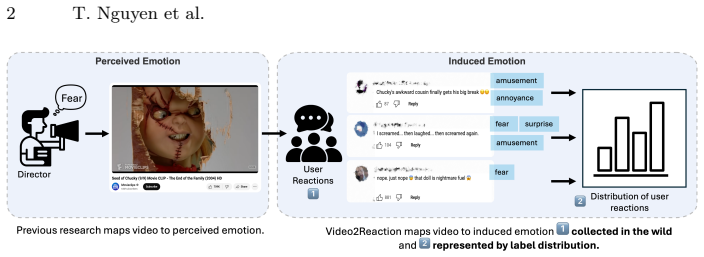
The central object is the induced emotion distribution, a probability vector over 21 fine-grained reaction categories derived from social media comments and mapped to each video clip. The pipeline connecting video to this distribution has three load-bearing components: a two-stage LLM annotation pipeline (rephrase-then-label with three-agent majority voting), a label distribution learning formulation that treats each clip as having a soft target over emotions rather than a single label, and a benchmark evaluation split into full distribution matching (Chebyshev, Clark, KL, Cosine, Intersection, CAD) and dominant reaction prediction (MRR, Top-1 Probability Error, weighted Top-k F1).
Load-bearing premise
The distribution of emotions extracted from YouTube comments is treated as a faithful proxy for the true distribution of emotions experienced by the broader audience, but the paper verifies whether LLM labels match comment intent, not whether commenting viewers represent the full audience. Commenters are self-selected, and several emotion categories show 0% annotation correctness in human evaluation.
What would settle it
If the comment-derived reaction distributions systematically diverge from emotions experienced by a representative sample of viewers (e.g., measured in a controlled lab setting with the same clips), the benchmark's ground truth labels would not measure what they claim, and model performance gains would reflect comment-distribution fitting rather than audience emotion prediction.
If this is right
- Content creators and recommendation systems could use finetuned video models to anticipate audience emotional responses before release, without needing to collect comments post-hoc.
- The two-stage rephrase-then-label annotation pipeline offers a reusable template for constructing distributional emotion labels from noisy social media at scale, adaptable to other platforms and evolving cultural contexts.
- The finding that text modality (clip descriptions) substantially boosts performance for both classical and foundation models suggests that current video encoders miss information about narrative context that text readily provides, pointing to a limitation in visual understanding.
- The cross-dataset transfer result, where finetuning on Video2Reaction plus 1% of a target domain outperforms training on 10% of target data alone, suggests the dataset captures generalizable signals about video-to-emotion mapping.
Editorial analysis
A structured set of objections, weighed in public.
Referee Report
Summary. This paper introduces Video2Reaction, a dataset of over 10,000 movie clips paired with audience reaction distributions derived from YouTube comments. A two-stage multi-agent LLM pipeline annotates comments into 21 fine-grained emotion categories, achieving 86% correctness under dual-blind human verification. The authors establish a benchmark for video-to-reaction-distribution prediction, evaluating classical label distribution learning (LDL) methods, adapted multimodal models, and foundation vision-language models (VLMs). Key findings: pretrained VLMs fail in zero-shot settings, but LoRA finetuning yields state-of-the-art performance (77% Top-3 F1 for dominant reaction prediction). The paper also provides longitudinal analysis showing audience reactions are non-stationary, and preliminary cross-dataset transfer results to the VCE benchmark.
Significance. The paper addresses an important gap in affective computing: most existing video emotion datasets capture perceived (character) emotions rather than induced (audience) emotions, and those that do capture induced emotions rely on controlled lab settings. Video2Reaction is the first large-scale dataset mapping video to distributional induced emotions from social media, which is ecologically valid and scalable. The two-stage annotation pipeline with open-source LLMs is a practical contribution enabling continuous dataset updates. The comprehensive benchmark spanning four algorithm families and two evaluation axes (full distribution and dominant reaction) is well-designed. The release of dataset, code, and pretrained features supports reproducibility. The finding that finetuned VLMs substantially outperform classical LDL methods on dominant reaction prediction while remaining competitive on distribution metrics is valuable for the community. However, the significance of the benchmark results is partially tempered by concerns about the validity of LLM-generated ground-truth labels for certain emotion categories, as detailed below.
major comments (3)
- Table 13 (Appendix B.2) shows that three emotion categories—nervousness (0% correct, 100% incorrect), embarrassment (0% correct, 66.67% incorrect), and anger (0% correct, 75% not sure)—have effectively zero human-verified annotation correctness. Yet Table 19 (Appendix D.4) shows these same categories achieving near-perfect per-class Top-3 F1 scores for finetuned LLaVA-Next: nervousness 0.9981, embarrassment 0.9985, anger 0.9959. This disconnect is load-bearing for the central claim that finetuning 'transforms VLMs into state-of-the-art predictors of audience reaction distributions.' If the ground-truth labels for these categories are essentially noise (0% human correctness), near-perfect F1 indicates the model has learned to replicate systematic LLM annotation patterns—including errors—rather than predict genuine audience emotions. The paper should explicitly address this: (1) report the
- The 86% overall annotation correctness (Table 11) is measured at the comment level, but the benchmark trains and evaluates on clip-level distributions aggregated from these comments (§3.2). No validation is provided that aggregated clip-level distributions from LLM-annotated comments match distributions obtainable from a representative sample of actual viewers. The self-selected commenter population (YouTube users who choose to comment) may systematically differ from the broader viewing audience in emotional response. The paper acknowledges this as a limitation (§6) but does not quantify its potential impact on benchmark validity. A targeted analysis—for example, comparing LLM-derived distributions to human-annotated distributions on a subset of clips—would substantially strengthen the claim that the benchmark measures genuine audience reaction prediction rather than commenter reaction
- The cross-dataset transfer experiment (§5.2, Appendix D.2, Table 18) uses only 1% of VCE training data and reports Top-3 accuracy of 0.46 (Qwen2.5-VL) and 0.44 (LLaVA-Next), compared to 0.35/0.37 with 10% of VCE data alone. While the authors frame this as 'meaningful cross-dataset transfer,' the absolute performance remains far below fully supervised performance (VideoMAE at 0.68 with 100% EmoDiversity data). The claim that Video2Reaction 'provides complementary supervision signals that can partially substitute expensive human-annotated data' is overstated given that 1% of target data is a very low baseline. The authors should temper this claim or provide additional evidence (e.g., performance with 5% or 10% of target data combined with Video2Reaction pretraining).
minor comments (8)
- §3.2, Figure 2 caption: 'AI Agent 1' and 'AI Agent 2' both show the same rephrased text, which appears to be a copy-paste error in the figure. This makes the multi-agent design unclear.
- Table 2: The 21 reaction categories are grouped by sentiment (Positive, Negative, Ambiguous), but the grouping of 'realization' and 'curiosity' as Ambiguous could benefit from brief justification, as these are not standard sentiment categories.
- §4.2: The CAD metric maps 21 categories onto a 'valence-arousal-based emotional space' but the mapping itself is not provided in the main text or appendix. This hinders reproducibility of this metric.
- Table 5: KL divergence for finetuned LLaVA-Next (3.1765) is worse than SA-BFGS (0.5976) and several other baselines, yet the text states finetuned models achieve 'best and comparable performances.' The framing should clarify that finetuned VLMs excel on Chebyshev, Intersection, and Cosine but underperform on KL divergence.
- §3.4: The longitudinal analysis shows reactions shift over time (e.g., 'There Will Be Blood' shifted from positive to disapproval), but the dataset is released as a single aggregate distribution per clip. Consider clarifying whether time-stratified distributions are available for future longitudinal research.
- Appendix B.2, Table 13: The 'anger' category shows 0% correct and 75% 'Not Sure,' which differs from the pattern for nervousness (100% incorrect). These represent different failure modes (ambiguity vs. systematic mislabeling) and should be discussed separately.
- §5.4, Table 7: The ablation shows text modality provides significant gains, but the 'Text' input for LLaVA-Next is the clip description from the YouTube channel, not the comments. This should be clarified to avoid confusion about whether the model has access to audience-generated text at inference time.
- Reference [6] cites 'Gemini 2.5' with a 2025 arXiv ID (2507.06261), which appears to be a future-dated preprint. Please verify this reference.
Circularity Check
No significant circularity; label-quality concerns are validity issues, not derivation circularity
full rationale
The paper's derivation chain is: (1) YouTube comments are collected for movie clips, (2) a set of open-source text LLMs (LLaMA-3.1-8B, Qwen2.5-14B, DeepSeek-R1-Distill-Qwen-7B) annotate comments with emotion labels via a two-stage pipeline, (3) these annotations are aggregated into clip-level reaction distributions serving as ground truth, (4) separate vision-language models (LLaVA-Next-Video-7B, Qwen2.5-VL, Gemini) are finetuned on video clips paired with these distributions, and (5) the finetuned VLMs are evaluated on held-out clips against the same labeling process. Each step has independent content: the annotation LLMs differ from the evaluated VLMs, the VLMs could in principle fail to learn the mapping (and do fail in zero-shot settings with Top-1 F1 below 0.30), and the evaluation uses held-out data. The paper also provides external validation of label quality via dual-blind human verification (86% correctness, Table 11) and a human-LLM correlation study (0.40 vs 0.43 inter-rater, Section 3.2). The skeptic's observation that 0%-correctness categories (nervousness, embarrassment, anger in Table 13) show near-perfect per-class F1 (Table 19) is a serious validity concern—it suggests the model may be replicating systematic LLM annotation artifacts rather than learning genuine emotion prediction—but this is a data quality and benchmark validity issue, not a circularity in the derivation chain. The prediction is not forced by construction: the VLM receives only video input and must independently learn to map visual content to the LLM-derived label distributions. No equation or definition in the paper reduces a claimed prediction to its own inputs. The minor score of 2 reflects that the ground-truth generation and model evaluation share the same labeling pipeline, creating a weak coupling, but this coupling is explicitly acknowledged and partially validated by independent human evaluation.
Axiom & Free-Parameter Ledger
free parameters (6)
- LoRA rank r =
8
- LoRA alpha =
16 (paper states 16 in §5, 6 in Appendix C.3)
- Temperature scaling parameter =
tuned on validation data
- Scene detection threshold =
3.0
- Minimum views filter =
10000
- Minimum comments filter =
10
axioms (4)
- domain assumption YouTube comments reflect genuine audience emotional reactions to video content
- domain assumption LLM-assigned emotion labels are valid proxies for human emotion labels
- domain assumption GoEmotions taxonomy (adapted to 21 categories) covers the relevant space of audience reactions to movie content
- standard math Label distribution learning framework is appropriate for modeling audience reaction diversity
invented entities (2)
-
Video2Reaction dataset
independent evidence
-
Two-stage multi-agent annotation pipeline
independent evidence
read the original abstract
Understanding and forecasting audience reactions to video content are crucial for improving content creation, recommendation systems, and media analysis. To enable audience reaction prediction and other content engagement applications, we introduce $\textbf{Video2Reaction}$, a multimodal dataset that maps short movie segments to a distribution of $\textit{induced emotions}$ of viewers in the wild, as expressed through social media. $\textbf{Video2Reaction}$ spans more than 10,000 videos and serves as a reliable benchmark as well as a training resource for audience reaction prediction. To enable cost-effective continuous annotations as reactions may change over time, we develop a two-stage multi-agent pipeline using only open-source LLMs, achieving 86% correctness under blind human verification despite the inherently noisy and subjective nature of the task. We establish the first benchmark for video-to-reaction-distribution prediction in the wild and show that pretrained foundation video models fail in zero-shot settings, while finetuning transforms them into state-of-the-art predictors capable of modeling both full reaction distributions and dominant responses from video alone. However, the task remains challenging: even the strongest methods achieve only 77% Top-3 F1 in dominant reaction prediction (LLaVA-Next), highlighting a substantial gap in modeling collective audience reaction. \modification{Dataset and code are available at our project page: https://information-fusion-lab-umass.github.io/video2reaction-bench.github.io
Figures


Reference graph
Works this paper leans on
-
[1]
Bain, M., Nagrani, A., Brown, A., Zisserman, A.: Condensed movies: Story based retrieval with contextual embeddings (2020)
work page 2020
-
[2]
IEEE Transactions on Affective Computing6(1), 43– 55 (2015)
Baveye, Y., Dellandrea, E., Chamaret, C., Chen, L.: Liris-accede: A video database for affective content analysis. IEEE Transactions on Affective Computing6(1), 43– 55 (2015)
work page 2015
-
[3]
Language resources and evaluation42, 335–359 (2008)
Busso, C., Bulut, M., Lee, C.C., Kazemzadeh, A., Mower, E., Kim, S., Chang, J.N., Lee, S., Narayanan, S.S.: Iemocap: Interactive emotional dyadic motion capture database. Language resources and evaluation42, 335–359 (2008)
work page 2008
-
[4]
Advances in Neural Information Processing Systems37, 45767–45790 (2024)
Chen, L., Davis, J.Q., Hanin, B., Bailis, P., Stoica, I., Zaharia, M.A., Zou, J.Y.: Are more llm calls all you need? towards the scaling properties of compound ai systems. Advances in Neural Information Processing Systems37, 45767–45790 (2024)
work page 2024
-
[5]
Choi, J., Yun, J., Jin, K., Kim, Y.: Multi-news+: Cost-efficient dataset cleansing via llm-based data annotation. In: EMNLP (2024)
work page 2024
-
[6]
Comanici, G., Bieber, E., Schaekermann, M., et al.: Gemini 2.5: Pushing the fron- tier with advanced reasoning, multimodality, long context, and next generation agentic capabilities. arXiv preprint arXiv:2507.06261 (2025),https://arxiv.org/ abs/2507.06261
work page internal anchor Pith review Pith/arXiv arXiv 2025
-
[7]
DeepSeek-AI: Deepseek-r1: Incentivizing reasoning capability in llms via reinforce- ment learning (2025),https://arxiv.org/abs/2501.12948
work page internal anchor Pith review Pith/arXiv arXiv 2025
-
[8]
GoEmotions: A Dataset of Fine-Grained Emotions
Demszky, D., Movshovitz-Attias, D., Ko, J., Cowen, A., Nemade, G., Ravi, S.: Goemotions: A dataset of fine-grained emotions. arXiv preprint arXiv:2005.00547 (2020)
work page internal anchor Pith review Pith/arXiv arXiv 2005
-
[9]
BERT: Pre-training of Deep Bidirectional Transformers for Language Understanding
Devlin, J., Chang, M., Lee, K., Toutanova, K.: BERT: pre-training of deep bidirec- tional transformers for language understanding. CoRRabs/1810.04805(2018), http://arxiv.org/abs/1810.04805
work page internal anchor Pith review Pith/arXiv arXiv 2018
-
[10]
Geng, X.: Label Distribution Learning (Apr 2016).https://doi.org/10.48550/ arXiv.1408.6027,http://arxiv.org/abs/1408.6027
work page internal anchor Pith review Pith/arXiv arXiv 2016
- [11]
-
[12]
Grattafiori, A., Dubey, A., Jauhri, A., Pandey, A., Kadian, A., Al-Dahle, A., Let- man, A., Mathur, A., Schelten, A., Vaughan, A., Yang, A., Fan, A., Goyal, A., Hartshorn, A., Yang, A., Mitra, A., Sravankumar, A., Korenev, A., Hinsvark, A., Rao, A., Zhang, A., Rodriguez, A., Gregerson, A., Spataru, A., Roziere, B., Biron, B., Tang, B., Chern, B., Cauchete...
work page internal anchor Pith review Pith/arXiv arXiv 2024
-
[13]
In: Proceedings of the 2021 Conference on Empirical Methods in Natural Language Processing
Han, W., Chen, H., Poria, S.: Improving multimodal fusion with hierarchical mu- tual information maximization for multimodal sentiment analysis. In: Proceedings of the 2021 Conference on Empirical Methods in Natural Language Processing. pp. 4946–4958 (2021)
work page 2021
-
[14]
Hsu, W.N., Bolte, B., Tsai, Y.H.H., Lakhotia, K., Salakhutdinov, R., Mohamed, A.: Hubert: Self-supervised speech representation learning by masked prediction of hidden units (2021),https://arxiv.org/abs/2106.07447
work page internal anchor Pith review Pith/arXiv arXiv 2021
-
[15]
Hu, E.J., Shen, Y., Wallis, P., Allen-Zhu, Z., Li, Y., Wang, S., Wang, L., Chen, W.: Lora: Low-rank adaptation of large language models. In: International Con- ference on Learning Representations (2022),https://openreview.net/forum?id= nZeVKeeFYf9
work page 2022
-
[16]
Aligning Language Models to User Opinions
Hwang, E., Majumder, B.P., Tandon, N.: Aligning language models to user opin- ions. arXiv preprint arXiv:2305.14929 (2023)
work page internal anchor Pith review Pith/arXiv arXiv 2023
-
[17]
IEEE Transactions on Knowledge and Data Engineering33(4), 1619–1631 (2019)
Jia, X., Li, Z., Zheng, X., Li, W., Huang, S.J.: Label distribution learning with label correlations on local samples. IEEE Transactions on Knowledge and Data Engineering33(4), 1619–1631 (2019)
work page 2019
-
[18]
CommunityLM: Probing Partisan Worldviews from Language Models
Jiang, H., Beeferman, D., Roy, B., Roy, D.: Communitylm: Probing partisan world- views from language models. arXiv preprint arXiv:2209.07065 (2022)
work page internal anchor Pith review Pith/arXiv arXiv 2022
-
[19]
IEEE transactions on affective computing3(1), 18–31 (2011)
Koelstra, S., Muhl, C., Soleymani, M., Lee, J.S., Yazdani, A., Ebrahimi, T., Pun, T., Nijholt, A., Patras, I.: Deap: A database for emotion analysis; using physiolog- ical signals. IEEE transactions on affective computing3(1), 18–31 (2011)
work page 2011
-
[20]
In: Proceedings of the AAAI Conference on Artificial Intel- ligence
Kou, Z., Wang, J., Jia, Y., Geng, X.: Exploiting multi-label correlation in label distribution learning. In: Proceedings of the AAAI Conference on Artificial Intel- ligence. Association for the Advancement of Artificial Intelligence (2024)
work page 2024
-
[21]
Advances in Neural Information Processing Systems35, 18571– 18585 (2022)
Mazeika, M., Tang, E., Zou, A., Basart, S., Chan, J.S., Song, D., Forsyth, D., Stein- hardt, J., Hendrycks, D.: How would the viewer feel? estimating wellbeing from video scenarios. Advances in Neural Information Processing Systems35, 18571– 18585 (2022)
work page 2022
-
[22]
Meister, N., Guestrin, C., Hashimoto, T.: Benchmarking distributional alignment of large language models (2024),https://arxiv.org/abs/2411.05403
work page internal anchor Pith review Pith/arXiv arXiv 2024
-
[23]
IEEE Transactions on Affective Computing12(1), 36–52 (2019)
Muszynski, M., Tian, L., Lai, C., Moore, J.D., Kostoulas, T., Lombardo, P., Pun, T., Chanel, G.: Recognizing induced emotions of movie audiences from multimodal information. IEEE Transactions on Affective Computing12(1), 36–52 (2019)
work page 2019
-
[24]
In: Proceedings of the 36th annual acm symposium on user interface software and technology
Park, J.S., O’Brien, J., Cai, C.J., Morris, M.R., Liang, P., Bernstein, M.S.: Gener- ative agents: Interactive simulacra of human behavior. In: Proceedings of the 36th annual acm symposium on user interface software and technology. pp. 1–22 (2023) Video2Reaction 19
work page 2023
-
[25]
MELD: A Multimodal Multi-Party Dataset for Emotion Recognition in Conversations
Poria, S., Hazarika, D., Majumder, N., Naik, G., Cambria, E., Mihalcea, R.: Meld: A multimodal multi-party dataset for emotion recognition in conversations. arXiv preprint arXiv:1810.02508 (2018)
work page internal anchor Pith review Pith/arXiv arXiv 2018
-
[26]
In: Proceedings of the 30th ACM international conference on multimedia
Sun, H., Wang, H., Liu, J., Chen, Y.W., Lin, L.: Cubemlp: An mlp-based model for multimodal sentiment analysis and depression estimation. In: Proceedings of the 30th ACM international conference on multimedia. pp. 3722–3729 (2022)
work page 2022
-
[27]
Team, Q.: Qwen2.5: A party of foundation models (September 2024),https:// qwenlm.github.io/blog/qwen2.5/, accessed: March 1, 2026
work page 2024
-
[28]
5-vl/, accessed: March 1, 2026
Team, Q.: Qwen2.5-vl (January 2025),https://qwenlm.github.io/blog/qwen2. 5-vl/, accessed: March 1, 2026
work page 2025
-
[29]
Tian, L., Muszynski, M., Lai, C., Moore, J.D., Kostoulas, T., Lombardo, P., Pun, T., Chanel, G.: Recognizing induced emotions of movie audiences: Are induced and perceived emotions the same? In: 2017 Seventh International Conference on Affective Computing and Intelligent Interaction (ACII). pp. 28–35. IEEE (2017)
work page 2017
-
[30]
In: International Conference on Intelligent Systems and Pattern Recognition
Trad, F., Chehab, A.: To ensemble or not: Assessing majority voting strategies for phishing detection with large language models. In: International Conference on Intelligent Systems and Pattern Recognition. pp. 158–173. Springer (2024)
work page 2024
-
[31]
In: The Eleventh International Conference on Learning Representations (2023)
Wang, X., Wei, J., Schuurmans, D., Le, Q.V., Chi, E.H., Narang, S., Chowdhery, A., Zhou, D.: Self-consistency improves chain of thought reasoning in language models. In: The Eleventh International Conference on Learning Representations (2023)
work page 2023
-
[32]
In: Proceedings of the IEEE/CVF International Conference on Computer Vision
Wen, C., Zhang, X., Yao, X., Yang, J.: Ordinal label distribution learning. In: Proceedings of the IEEE/CVF International Conference on Computer Vision. pp. 23481–23491 (2023)
work page 2023
-
[33]
Wu, B., Xu, C., Dai, X., Wan, A., Zhang, P., Yan, Z., Tomizuka, M., Gonzalez, J., Keutzer, K., Vajda, P.: Visual transformers: Token-based image representation and processing for computer vision (2020)
work page 2020
-
[34]
Wu, Y., Chen, K., Zhang, T., Hui, Y., Berg-Kirkpatrick, T., Dubnov, S.: Large- scale contrastive language-audio pretraining with feature fusion and keyword-to- caption augmentation (2022).https://doi.org/10.48550/ARXIV.2211.06687, https://arxiv.org/abs/2211.06687
work page internal anchor Pith review Pith/arXiv arXiv doi:10.48550/arxiv.2211.06687 2022
-
[35]
Advances in Neural Information Processing Systems37, 103737–103750 (2024)
Xu, C., Liu, L., Jin, L., Du, G., Guo, Z., Zhao, Y., Huang, X., Li, R., et al.: Infer induced sentiment of comment response to video: A new task, dataset and baseline. Advances in Neural Information Processing Systems37, 103737–103750 (2024)
work page 2024
-
[36]
Yang,J.,Sun,M.,Sun,X.:LearningVisualSentimentDistributionsviaAugmented Conditional Probability Neural Network. Proceedings of the AAAI Conference on Artificial Intelligence31(1) (Feb 2017).https://doi.org/10.1609/aaai.v31i1. 10485,https://ojs.aaai.org/index.php/AAAI/article/view/10485
-
[37]
Zadeh, A.B., Liang, P.P., Poria, S., Cambria, E., Morency, L.P.: Multimodal lan- guage analysis in the wild: Cmu-mosei dataset and interpretable dynamic fusion graph. In: Proceedings of the 56th Annual Meeting of the Association for Compu- tational Linguistics (Volume 1: Long Papers). pp. 2236–2246 (2018)
work page 2018
-
[38]
Zhang, Y., Li, B., Liu, h., Lee, Y.j., Gui, L., Fu, D., Feng, J., Liu, Z., Li, C.: Llava- next: A strong zero-shot video understanding model (April 2024),https://llava- vl.github.io/blog/2024-04-30-llava-next-video/, accessed: March 1, 2026
work page 2024
-
[39]
In: Proceedings of the IEEE/CVF conference on computer vision and pattern recognition
Zhang, Z., Wang, L., Yang, J.: Weakly supervised video emotion detection and prediction via cross-modal temporal erasing network. In: Proceedings of the IEEE/CVF conference on computer vision and pattern recognition. pp. 18888– 18897 (2023) 20 T. Nguyen et al
work page 2023
-
[40]
Zlatintsi, A., Koutras, P., Evangelopoulos, G., Malandrakis, N., Efthymiou, N., Pastra, K., Potamianos, A., Maragos, P.: Cognimuse: A multimodal video database annotated with saliency, events, semantics and emotion with application to sum- marization. EURASIP Journal on Image and Video Processing2017, 1–24 (2017) Video2Reaction 21 Video2Reaction: Mapping ...
discussion (0)
Sign in with ORCID, Apple, or X to comment. Anyone can read and Pith papers without signing in.