REVIEW 3 major objections 7 minor 43 references
Frozen robot models learn new tasks from raw human video at test time
Reviewed by Pith at T0; open to challenge. T0 means a machine referee read the full paper against a public rubric. the ladder, T0–T4 →
T0 review · glm-5.2
2026-07-09 22:05 UTC pith:6VH44RPU
load-bearing objection Solid new idea with one unfair baseline comparison that doesn't sink the core contribution the 3 major comments →
WAM-TTT: Steering World-Action Models by Watching Human Play at Test Time
The pith
A machine-rendered reading of the paper's core claim, the machinery that carries it, and where it could break.
Core claim
The paper claims that absorbing human videos into a parametric fast-weight memory through self-supervised video prediction is a more effective and robust way to transfer skill from human demonstration to a robot policy than feeding those same videos as in-context conditioning tokens. The key-value memory reconstruction loss is shown analytically (in the linear case) to produce a weight matrix equivalent to linear attention against the human key-value cache, meaning the inner-loop optimization directly constructs an attention-like retrieval mechanism from human visual cues to robot queries without requiring any explicit action labels, hand poses, or retargeted trajectories on the human side.
What carries the argument
The method has three load-bearing components. First, a world-action model (WAM) that jointly models visual dynamics and robot actions through coupled video and action experts in a diffusion transformer. Second, a test-time training (TTT) layer: a fast-weight memory branch added to the video expert that updates via inner-loop SGD during each forward pass. Third, a key-value memory reconstruction loss that trains the fast-weight network to map human-derived keys to human-derived values, which analytically reduces to a linear-attention readout when the robot side queries it. The meta-training stage optimizes the slow projections and initializations of this interface on paired human-robot data,;
Load-bearing premise
The meta-training stage assumes that phase-aligned paired human-robot data is sufficient to learn a human-to-robot memory interface that generalizes to unseen tasks and environments at deployment, and the paper acknowledges that the boundary of this generalization has not been characterized empirically.
What would settle it
If the fast-weight memory, after meta-training, fails to produce useful control signals when fed human videos from tasks or visual domains sufficiently different from the meta-training distribution, or if the key-value memory reconstruction loss does not produce attention-like retrieval behavior in the nonlinear MLP case, the central mechanism would not hold.
If this is right
- A robot deployed in a new home could be shown a task once via a head-mounted camera by a non-expert, and the policy would adapt without any fine-tuning of the core model or any robot-side demonstration collection.
- The parametric memory approach sidesteps the growing context-length problem of in-context learning, since each new demonstration updates a fixed-size set of fast weights rather than appending tokens to a context window.
- The decoupling of human-side adaptation from the frozen action prior suggests a path where foundation models ship with explicit 'adaptation seats' that downstream users can drive with whatever side information they have.
- The analytical equivalence between the memory reconstruction loss and linear attention provides a principled justification for why self-supervised video prediction on human data produces useful control signals: it is literally constructing a cross-attention retrieval mechanism.
Where Pith is reading between the lines
- If the fast-weight memory can be driven by video prediction alone, it could in principle be driven by any modality with a phase-pairable training signal, such as audio of contact events or depth maps, opening a general interface for multi-modal test-time adaptation.
- The 39-point gap between WAM-TTT and in-context conditioning on unseen tasks suggests that long-context conditioning on raw video may be fundamentally fragile under visual distribution shift, since perturbed visual statistics flow directly into the policy stream rather than being filtered through a learned memory interface.
- The saturation of human-data benefit at 100 episodes per task, combined with the 1-for-1 substitution of human for robot data at equal total budget, implies that the bottleneck for robot learning may shift from data collection to the quality of the human-to-robot alignment interface itself.
Editorial analysis
A structured set of objections, weighed in public.
Referee Report
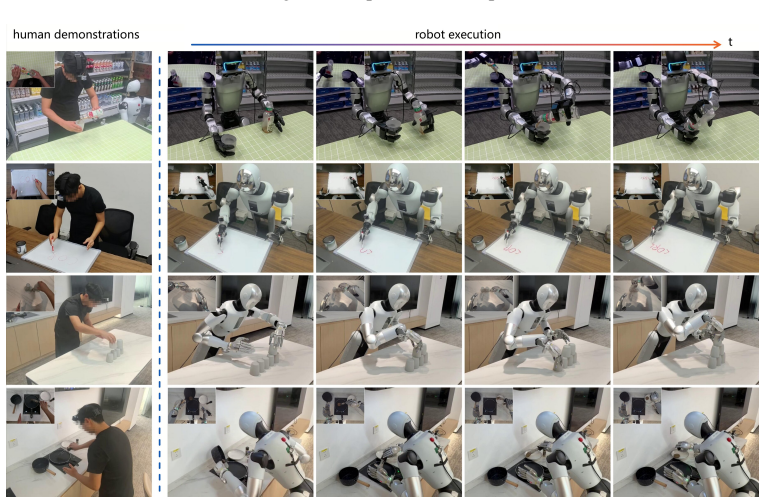
Summary. The paper presents WAM-TTT, a test-time training framework for steering frozen world-action models (WAMs) using unlabeled egocentric human videos. The method attaches lightweight fast-weight (TTT) memory branches to the video expert of a pretrained WAM (LDA backbone). A meta-training stage uses paired human-robot data and a key-value memory reconstruction loss to calibrate the TTT interface so that human-video keys/values align with robot-side queries. At deployment, only the fast weights are updated via self-supervised video prediction on unseen human videos, while the WAM backbone and slow projections remain frozen. Experiments span three robot embodiments and nine manipulation tasks, with ablations isolating the TTT mechanism, meta-training, and memory reconstruction loss. The central claim is that absorbing human videos as fast-weight memory outperforms in-context video conditioning, co-training, and no-adaptation baselines, particularly under out-of-distribution household-scene perturbations.
Significance. The paper addresses a practically important problem: steering robot foundation models toward new task variants without collecting additional robot demonstrations or fine-tuning the full model. The idea of using action-free human videos as deployment-time memory for a frozen WAM is novel and well-motivated. The linear-attention witness analysis (Eq. A.2-A.4) provides a self-contained theoretical justification for why the key-value memory reconstruction loss induces attention-like retrieval behavior, which is a strength. The experimental scope—three embodiments, nine tasks, both in-distribution and OOD settings, plus ablations on data ratio, architecture, and pseudo-action injection—is commendable. The finding that retargeted pseudo-actions are net-negative (Table E.3, -43.4 pts) is a useful negative result for the community. The generalization preservation analysis (Table 3) and the six-axis perturbation study (Appendix E.3) provide additional evidence that the TTT mechanism does not catastrophically overwrite pretrained capabilities.
major comments (3)
- The WAM-ICL baseline comparison is structurally unfair and undermines the paper's headline claim. Section 4.2 states that 'the gap against WAM-ICL is the strongest piece of evidence for the design hypothesis,' and the abstract claims WAM-TTT 'consistently outperforms in-context human-video conditioning baselines.' However, WAM-ICL is defined only as 'the same WAM that ingests deployment-time human videos as in-context demonstrations, with no fast-weight adaptation' (Section 4.2). No implementation details are given for how human videos are tokenized and fed into the WAM's context, and critically, the paper itself acknowledges in Section 1 that in-context conditioning 'requires learning such capabilities during large-scale pretraining.' The WAM-ICL baseline receives no such pretraining, no paired human-robot meta-training, no TTT architecture, and no KVM objective. The symptoms confirm an
- unfair comparison: WAM-ICL scores 48.4% in Orig (below LDA's 50.2% with zero human data) and collapses to 7.1% in New (far below LDA's 32.5%). In-context human video actively hurts relative to no human data at all, which is not what a properly trained ICL baseline should do. The paper should either (a) provide a fair ICL baseline where the WAM is trained to consume in-context video tokens during pretraining or meta-training, or (b) substantially soften the claim of 'consistently outperforms in-context conditioning' to acknowledge that the comparison is against an untrained ICL interface. The independent evidence from the LDA comparison (+13.7 pts) and the ablations (Table 2) does support WAM-TTT's value, but the specific ICL comparison as currently constructed is not load-bearing evidence.
- The generalization boundary of the meta-training interface is uncharacterized and limits the interpretability of the results. Section 5 states that 'the further the deployment task drifts from the meta-training pairing distribution, the weaker the adaptation' and that this boundary 'has not been characterised empirically.' All nine evaluation tasks are also represented in the meta-training dataset (Section 4.1: 2,286 paired episodes covering 9 tasks). The paper does not test on a task that is entirely absent from meta-training, so it is unclear whether the TTT mechanism generalizes to genuinely novel skills or merely adapts to new visual conditions of known skills. The 'New' setting changes lighting, objects, and table height but preserves task structure. Adding at least one held-out task (absent from meta-training) to the evaluation would substantially strengthen the claim of 'steering'
minor comments (7)
- Appendix D, Stamp Paper rubric: 'stamp s[uccessfully grasped' contains a stray bracket and broken word.
- Table 3 caption: 'Diliver Drink' should be 'Deliver Drink'.
- Section 4.1: the progress metric is defined only briefly as 'partial-credit' with reference to 'recent VLA evaluations.' The full rubric in Appendix D should be referenced here, and the potential subjectivity of task-specific additive scoring should be acknowledged.
- Table B.1: N=1 inner SGD iteration for both meta-training and test-time is a surprisingly small value. A brief justification or sensitivity analysis would strengthen the paper.
- Section 3.2, Eq. (3): the normalization constant BL_h d is described as making the loss 'invariant to mini-batch size, human-sequence length, and embedding dimension.' This is correct for the linear case but the justification for the nonlinear MLP case is not provided. A brief note would help.
- Figure 2: the diagram is dense and the distinction between meta-training and test-time pathways could be more clearly separated visually. The current single-figure layout conflates two stages that are described separately in the text.
- The paper uses 'WAM' and 'WAM-TTT' interchangeably in some places (e.g., Section 3.1 title 'World Action Model' vs. the method name). Consistent capitalization would improve readability.
Circularity Check
No circularity found: the derivation chain is self-contained, with no prediction reducing to its inputs by construction.
full rationale
I walked the paper's full derivation chain and found no circularity. (1) The core mechanism—meta-train TTT fast weights on paired human-robot data (Eq. 4–6), then adapt only fast weights at test time on human video (Eq. 7–8)—is a design with independent inputs (paired data, video prediction loss, KVM loss) and independent evaluation (robot rollout progress). No step defines a quantity in terms of the result it claims to derive. (2) The linear-attention witness (Eq. A.2–A.4) is a self-contained mathematical argument: minimizing the KVM loss in the linear special case yields W* = V_h^T K_h (K_h^T K_h)^{-1}, which under a stated isotropy hypothesis reduces to the Hebbian outer product, and querying with robot Q_r produces linear-attention readout. This derivation does not assume its conclusion. (3) The LDA backbone [22] has overlapping authors but is a tool/architecture dependency (like citing a framework), not a logical step where the result is defined in terms of itself. Spatial-TTT [34], the other load-bearing methodological citation, has no author overlap with this paper. (4) The WAM-ICL baseline comparison flagged by the skeptic is a fairness/correctness concern (the baseline may not have been trained to handle in-context video), not circularity: the paper does not define WAM-ICL's results in terms of WAM-TTT's, nor does any equation reduce one to the other. The paper also compares against fully external baselines (π0.5, EGOSCALE) and runs ablations (Table 2, Table E.1–E.3) that provide independent support. No step in the derivation chain reduces to its own inputs by construction.
Axiom & Free-Parameter Ledger
free parameters (4)
- lambda (memory reconstruction weight) =
4e-2
- N (inner SGD iterations) =
1
- eta (inner LR) =
0.1 (meta), 0.01 (test)
- TTT head dim d / fast-weight hidden width f_h =
48 / 128
axioms (3)
- domain assumption Phase alignment between human and robot data is a sufficient proxy for temporal synchronization.
- domain assumption The linear-attention witness (Eq. A.2-A.4) generalizes to the nonlinear MLP case.
- domain assumption The LDA backbone provides a shared visual-action representation that can be steered by video-side residuals.
invented entities (2)
-
TTT fast-weight memory branch
independent evidence
-
Key-value memory reconstruction loss (L_KVM)
independent evidence
read the original abstract
Steering robot foundation models (RFMs) toward new task variants or user-preferred behaviors remains challenging, often requiring additional robot demonstrations, task-specific fine-tuning, or long-context conditioning. We present WAM-TTT, a test-time training framework for steering world action models from raw human videos. Rather than treating human videos as trajectories to imitate, WAM-TTT absorbs them into a lightweight adaptive memory inside a frozen WAM through self-supervised video prediction. To make this memory useful for control, we introduce a meta-training stage that aligns human demonstrations with robot behaviors using paired human-robot data and a key--value memory reconstruction objective. At test time, only unlabeled human videos are required to adapt the memory, while the pretrained WAM remains frozen. This enables efficient and reusable steering without robot actions, human-side annotations, or task-specific fine-tuning, while preserving the generalization ability of the foundation model. Extensive experiments show that WAM-TTT consistently outperforms in-context human-video conditioning baselines across diverse manipulation tasks and generalization settings.
Figures



Reference graph
Works this paper leans on
- [1]
-
[2]
S. Bahl, A. Gupta, and D. Pathak. Human-to-robot imitation in the wild. InRSS, 2022
work page 2022
-
[3]
M. Xu, Z. Xu, C. Chi, M. Veloso, and S. Song. Xskill: Cross embodiment skill discovery. In CoRL, 2023
work page 2023
-
[4]
H. Bharadhwaj, A. Gupta, V . Kumar, and S. Tulsiani. Towards generalizable zero-shot manip- ulation via translating human interaction plans. InICRA, 2024
work page 2024
-
[5]
N. Hansen et al. Self-supervised policy adaptation during deployment. InICLR, 2021
work page 2021
-
[6]
M. Xu, Z. Xu, C. C. Pan, X. Zhu, C. Tomei, Y . Shen, Z. Wu, S.-R. Chen, J. B. Tenenbaum, T. Lozano-Perez, and S. Song. Flow as the cross-domain manipulation interface. InCoRL, 2024
work page 2024
-
[7]
EgoMimic: Scaling Imitation Learning via Egocentric Video
S. Kareer, D. Patel, R. Punamiya, P. Mathur, S. Cheng, C. Wang, J. Hoffman, and D. Xu. Egomimic: Scaling imitation learning via egocentric video.arXiv preprint arXiv:2410.24221, 2024
work page internal anchor Pith review Pith/arXiv arXiv 2024
-
[8]
EgoDex: Learning Dexterous Manipulation from Large-Scale Egocentric Video
R. Hoque, P. Huang, D. J. Yoon, M. Sivapurapu, and J. Zhang. Egodex: Learning dexterous manipulation from large-scale egocentric video.arXiv preprint arXiv:2505.11709, 2025
work page internal anchor Pith review Pith/arXiv arXiv 2025
-
[9]
K. Grauman et al. Ego-exo4d: Understanding skilled human activity from first- and third- person perspectives. InCVPR, 2024
work page 2024
-
[10]
Egoscale: Scaling dexterous manipulation with diverse egocentric human data, 2026
R. Zheng et al. Egoscale: Scaling dexterous manipulation with diverse egocentric human data. arXiv preprint arXiv:2602.16710, 2026
-
[11]
H. Chen et al. Vidbot: Learning generalizable 3d actions from in-the-wild 2d human videos for zero-shot robotic manipulation. InCVPR, 2025
work page 2025
- [12]
-
[13]
Z. Chen, S. Chen, E. Arlaud, I. Laptev, and C. Schmid. Vividex: Learning vision-based dex- terous manipulation from human videos. InICRA, 2025
work page 2025
-
[14]
C. Wang, L. Fan, J. Sun, R. Zhang, L. Fei-Fei, D. Xu, Y . Zhu, and A. Anandkumar. Mimicplay: Long-horizon imitation learning by watching human play. InCoRL, 2023. arXiv:2302.12422
work page internal anchor Pith review Pith/arXiv arXiv 2023
-
[15]
Zero-Shot Robot Manipulation from Passive Human Videos
H. Bharadhwaj, A. Gupta, S. Tulsiani, and V . Kumar. Zero-shot robot manipulation from passive human videos.arXiv preprint arXiv:2302.02011, 2023
work page internal anchor Pith review Pith/arXiv arXiv 2023
-
[16]
V . Jain, M. Attarian, N. J. Joshi, A. Wahid, D. Driess, Q. Vuong, P. R. Sanketi, P. Ser- manet, S. Welker, C. Chan, I. Gilitschenski, Y . Bisk, and D. Dwibedi. Vid2robot: End- to-end video-conditioned policy learning with cross-attention transformers.arXiv preprint arXiv:2403.12943, 2024
work page internal anchor Pith review Pith/arXiv arXiv 2024
-
[17]
Gen2Act: Human Video Generation in Novel Scenarios enables Generalizable Robot Manipulation
H. Bharadhwaj, D. Dwibedi, A. Gupta, S. Tulsiani, C. Doersch, T. Xiao, D. Shah, F. Xia, D. Sadigh, and S. Kirmani. Gen2act: Human video generation in novel scenarios enables generalizable robot manipulation.arXiv preprint arXiv:2409.16283, 2024
work page internal anchor Pith review Pith/arXiv arXiv 2024
-
[18]
R. Shah, S. Liu, Q. Wang, Z. Jiang, S. Kumar, M. Seo, R. Mart ´ın-Mart´ın, and Y . Zhu. Mim- icdroid: In-context learning for humanoid robot manipulation from human play videos.arXiv preprint arXiv:2509.09769, 2025. 10
work page internal anchor Pith review Pith/arXiv arXiv 2025
-
[19]
EVA: An Embodied World Model for Future Video Anticipation
X. Chi, C.-K. Fan, H. Zhang, X. Qi, R. Zhang, A. Chen, C.-m. Chan, W. Xue, Q. Liu, S. Zhang, et al. Eva: An embodied world model for future video anticipation.arXiv preprint arXiv:2410.15461, 2024
work page internal anchor Pith review Pith/arXiv arXiv 2024
- [20]
-
[21]
C. Zhu, R. Yu, S. Feng, B. Burchfiel, P. Shah, and A. Gupta. Unified world models: Cou- pling video and action diffusion for pretraining on large robotic datasets.arXiv preprint arXiv:2504.02792, 2025
work page internal anchor Pith review Pith/arXiv arXiv 2025
-
[22]
J. Lyu, K. Liu, X. Zhang, H. Liao, Y . Feng, W. Zhu, T. Shen, J. Chen, J. Zhang, Y . Dong, W. Cui, S. Qi, S. Wang, Y . Zheng, M. Yan, X. Shi, H. Li, D. Zhao, M.-Y . Liu, Z. Zhang, L. Yi, Y . Wang, and H. Wang. LDA-1B: Scaling latent dynamics action model via universal embodied data ingestion.arXiv preprint arXiv:2602.12215, 2026
work page internal anchor Pith review Pith/arXiv arXiv 2026
-
[23]
H. Bi, H. Tan, S. Xie, Z. Wang, S. Huang, H. Liu, R. Zhao, Y . Feng, C. Xiang, Y . Rong, et al. Motus: A unified latent action world model. InProceedings of the IEEE/CVF Conference on Computer Vision and Pattern Recognition, pages 35101–35113, 2026
work page 2026
-
[24]
M. Team, C. Xiang, F. Bao, H. Liu, H. Tan, H. Bi, J. Li, J. Liu, J. Pang, K. Jing, et al. Mo- tubrain: An advanced world action model for robot control.arXiv preprint arXiv:2604.27792, 2026
work page internal anchor Pith review Pith/arXiv arXiv 2026
-
[25]
ImageWAM: Do World Action Models Really Need Video Generation, or Just Image Editing?
Y . Zhang, W. Zhang, Z. Qi, H. Zhang, H. Lin, J. Zhang, Y . Mu, X. Yang, W. Zeng, and X. Jin. Imagewam: Do world action models really need video generation, or just image editing?, 2026. URLhttps://arxiv.org/abs/2606.19531
work page internal anchor Pith review Pith/arXiv arXiv 2026
-
[26]
H. Yu, H. Lin, J. Zhang, W. Zhang, C. Gu, H. Li, and P. Tan. Maskwam: Unifying mask prompting and prediction for world-action models.arXiv preprint arXiv:2606.13515, 2026
work page internal anchor Pith review Pith/arXiv arXiv 2026
- [27]
-
[28]
Y . Sun, X. Wang, Z. Liu, J. Miller, A. A. Efros, and M. Hardt. Test-time training with self- supervision for generalization under distribution shifts. InICML, 2020
work page 2020
-
[29]
D. Wang, E. Shelhamer, S. Liu, B. Olshausen, and T. Darrell. Tent: Fully test-time adaptation by entropy minimization. InICLR, 2021
work page 2021
-
[30]
Y . Liu, P. Kothari, B. van Delft, B. Bellot-Gurlet, T. Mordan, and A. Alahi. Ttt++: When does self-supervised test-time training fail or thrive? InNeurIPS, 2021
work page 2021
-
[31]
Y . Gandelsman, Y . Sun, X. Chen, and A. A. Efros. Test-time training with masked autoen- coders. InNeurIPS, 2022
work page 2022
-
[32]
Y . Sun, X. Li, K. Dalal, J. Xu, A. Vikram, G. Zhang, Y . Dubois, X. Chen, X. Wang, S. Koyejo, T. Hashimoto, and C. Guestrin. Learning to (learn at test time): Rnns with expressive hidden states. InICML, 2025
work page 2025
-
[33]
Titans: Learning to Memorize at Test Time
A. Behrouz, P. Zhong, and V . Mirrokni. Titans: Learning to memorize at test time.arXiv preprint arXiv:2501.00663, 2025
work page internal anchor Pith review Pith/arXiv arXiv 2025
- [34]
-
[35]
S. Yang, Y . Ze, and H. Xu. Movie: Visual model-based policy adaptation for view generaliza- tion. InNeurIPS, 2023
work page 2023
- [36]
-
[37]
C. Liu, Y . Liu, T. Wang, Q. Zhuang, J. C. Liang, W. Yang, R. Xu, Q. Wang, D. Liu, and C. Han. On-the-fly vla adaptation via test-time reinforcement learning.arXiv preprint arXiv:2601.06748, 2026
work page internal anchor Pith review Pith/arXiv arXiv 2026
-
[38]
$\pi_{0.5}$: a Vision-Language-Action Model with Open-World Generalization
K. Black, N. Brown, D. Driess, A. Esmail, M. Equi, C. Finn, N. Fusai, L. Groom, K. Haus- man, B. Ichter, S. Jakubczak, T. Jones, L. Ke, S. Levine, A. Li-Bell, M. Mothukuri, S. Nair, K. Pertsch, L. X. Shi, L. Smith, J. T. Springenberg, K. Stachowicz, J. Tanner, Q. Vuong, H. Walke, A. Walling, H. Wang, L. Yu, and U. Zhilinsky.π0.5: a vision-language-action ...
work page internal anchor Pith review Pith/arXiv arXiv 2025
- [39]
-
[40]
A. Katharopoulos, A. Vyas, N. Pappas, and F. Fleuret. Transformers are RNNs: Fast autore- gressive transformers with linear attention. InInternational Conference on Machine Learning (ICML), 2020
work page 2020
-
[41]
MediaPipe: A Framework for Building Perception Pipelines
C. Lugaresi, J. Tang, H. Nash, C. McClanahan, E. Uboweja, M. Hays, F. Zhang, C.-L. Chang, M. G. Yong, J. Lee, W.-T. Chang, W. Hua, M. Georg, and M. Grundmann. MediaPipe: A framework for building perception pipelines.arXiv preprint arXiv:1906.08172, 2019
work page internal anchor Pith review Pith/arXiv arXiv 1906
- [42]
-
[43]
O. Sim ´eoni, H. V . V o, M. Seitzer, F. Baldassarre, M. Oquab, C. Jose, V . Khalidov, M. Szafraniec, S. Yi, M. Ramamonjisoa, F. Massa, D. Haziza, L. Wehrstedt, J. Wang, T. Darcet, T. Moutakanni, L. Sentana, C. Roberts, A. Vedaldi, J. Tolan, J. Brandt, C. Couprie, J. Mairal, H. J´egou, P. Labatut, and P. Bojanowski. DINOv3.arXiv preprint arXiv:2508.10104,...
work page internal anchor Pith review Pith/arXiv arXiv 2025
discussion (0)
Sign in with ORCID, Apple, or X to comment. Anyone can read and Pith papers without signing in.