REVIEW 3 major objections 6 minor 300 references
Reviewed by Pith at T0; open to challenge.
T0 means a machine referee read the full paper against a public rubric. The mark states how deep the mechanical check went, never who wrote it. the ladder, T0–T4 →
T0 review · glm-5.2
Dark matter vortex tangles reconnect too weakly to shake galactic cores
2026-07-09 19:40 UTC pith:4NXD3BFW
load-bearing objection Honest semi-analytical estimate of vortex reconnection heating in condensed DM halos; the framework is sound but rests on an unverified identification of spectral peak scale with vortex-line density. the 3 major comments →
Reconnection diagnostics for vortex tangles in Bose-condensed and superfluid dark matter halos
The pith
A machine-rendered reading of the paper's core claim, the machinery that carries it, and where it could break.
Core claim
When the non-interacting Schrodinger-Poisson soliton relation is imposed, the three reconnection diagnostics become independent of boson mass and core density, taking fixed values: roughly 0.1 reconnection events per dynamical time, a vortex-energy dissipation time about 340 times longer than the dynamical time, and a virial-impact parameter of about 6 times 10 to the minus 4. This means vortex reconnections are a secular internal-heating channel that does not compete with the gravitational binding energy of the core. The entire result is controlled by a single unknown dimensionless parameter, the ratio of the true vortex-line density to the spectral-peak proxy from simulations.
What carries the argument
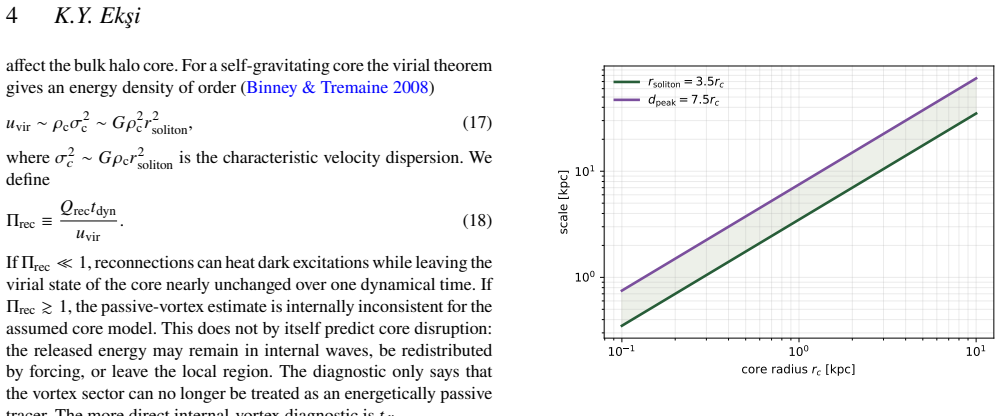
The argument is built from three components. First, the local Gross-Pitaevskii reconnection law, which states that the distance between reconnecting vortex segments scales as the square root of time multiplied by the circulation quantum kappa = h/m. Second, a Vinen-type reconnection rate density proportional to kappa times the vortex-line density L raised to the 5/2 power. Third, the non-interacting soliton relation rho_c proportional to m^{-2} r_c^{-4}, which when substituted into the diagnostic expressions cancels all explicit dependence on m and rho_c. The line density L is written as eta_v times a simulation-motivated scale L_M, and the three diagnostics rescale as simple powers of eta_v
Load-bearing premise
The paper identifies the spectral peak scale from numerical simulations as a proxy for the vortex-network correlation length, giving a line density L proportional to the inverse square of that scale. The author acknowledges this is not a direct measurement of vortex length and that the true line density could be much smaller or zero if the spectral peak traces wave interference granules rather than actual vortex filaments. Since all three diagnostics scale as powers of this未知
What would settle it
A direct measurement of vortex-line density from phase singularities in Gross-Pitaevskii-Poisson simulations of equilibrium soliton cores. If the true line density is much smaller than the spectral-peak proxy (eta_v far less than 1), or if relaxed non-interacting cores contain no vortices at all, then all reconnection diagnostics collapse and the secular-heating channel is absent rather than merely weak.
If this is right
- Direct Gross-Pitaevskii-Poisson simulations should measure phase singularities and the true vortex-line density L separately in the solitonic core and the turbulent envelope, replacing the spectral-peak proxy used here.
- For the superfluid dark matter branch with phonon-baryon coupling, the reconnection heating rate Q_rec should be compared to the phonon heat capacity and the local critical temperature to test whether reconnections could locally reduce the superfluid fraction and modify the MOND-like force.
- The reconnection rate provides the sink term for a vortex-population balance; combining it with a nucleation or forcing rate from tidal torques or mergers would yield a model for time-varying vortex number density relevant to lensing flux-ratio anomalies or axion haloscope coherence.
- In merger-perturbed or externally confined cores where the soliton relation does not hold, the fixed-radius scan shows regions where the passive-vortex picture breaks down, identifying targets for future dynamical simulations.
Where Pith is reading between the lines
- If future simulations confirm that relaxed non-interacting soliton cores typically contain no vortices, then reconnection heating is absent rather than merely small in the most common halo state, and the paper's conditional results would apply only to transient or perturbed configurations.
- The mass-radius cancellation that makes the soliton-branch diagnostics universal is specific to the non-interacting Schrodinger-Poisson relation; repulsive self-interacting branches would have a different mass-radius relation and the diagnostics would regain explicit mass and density dependence, potentially reopening the parameter space for virial backreaction.
- The ratio of the de Broglie wavelength to the spectral peak scale being of order 0.5 along the soliton relation suggests that the distinction between true phase singularities and wave-interference granules is not sharp in the non-interacting limit, which could mean that the very concept of a vortex-line density needs reformulation for fuzzy dark matter.
Editorial analysis
A structured set of objections, weighed in public.
Referee Report
Summary. This manuscript estimates the dynamical and energetic importance of quantized vortex reconnections in Bose-Einstein-condensed (BECDM) and superfluid dark matter (SFDM) halo cores. The author combines three ingredients: (i) the local Gross-Pitaevskii square-root reconnection law (Eq. 2), (ii) a Vinen-type reconnection rate scaling Gamma_rec = C_rec kappa L^{5/2} (Eq. 7), and (iii) a halo-scale vortex-line density L = eta_v L_M calibrated against the spectral peak scale d_peak from the Schrodinger-Poisson simulations of Mocz et al. (2017). Three dimensionless diagnostics are constructed: chi (event count per dynamical time), t_diss/t_dyn (vortex-energy reservoir depletion time), and Pi_rec (virial impact parameter). For a fixed-radius scan, the parameter space is explored across boson masses 10^{-24}--10^{-20} eV and core densities 10^6--10^9 M_sun/kpc^3. When the non-interacting soliton relation (Eq. 27) is imposed, the diagnostics collapse to chi ~ 0.10, t_diss/t_dyn ~ 3.4e2, and Pi_rec ~ 6.1e-4, independent of mass and density. The paper concludes that reconnections are at most a secular process for soliton cores, with no virial backreaction, and that visible emission requires portal physics. The treatment is transparent about its conditional nature: if the core contains no vortices, all diagnostics vanish.
Significance. The paper addresses a well-posed and timely question: whether vortex reconnection physics, well established in laboratory superfluids, can become dynamically relevant in condensed dark matter halos. The dimensional analysis is clean and internally consistent. The cancellation of core density in t_diss (Eq. 16) and of mass/density along the soliton relation (Eq. 29) are correctly derived and provide useful, falsifiable scaling relations. The paper is commendably transparent about its assumptions, explicitly flagging the line-density normalization eta_v as the central uncertainty and noting that Schobesberger et al. (2021) find typical non-interacting soliton cores may contain no vortices at all. The separation of the fixed-radius stress test from the equilibrium soliton sequence is a useful framing device. The work provides concrete targets for future Gross-Pitaevskii-Poisson simulations (direct measurement of phase singularities, L, Gamma_rec, and Delta_E_rec).
major comments (3)
- Section 2.2, Eqs. (5)-(6): The identification of the spectral peak scale d_peak from Mocz et al. (2017) as a proxy for the vortex-network correlation length is the load-bearing assumption of the paper. The author acknowledges this, but the concern is sharper than a normalization uncertainty. The entire framework rests on three Gross-Pitaevskii-derived ingredients: the Vinen rate (Eq. 7), the line-energy formula (Eq. 12), and the square-root law (Eq. 2). All assume a tangle of true phase singularities with well-defined healing-length cores. The Mocz et al. simulations solve the non-interacting Schrodinger-Poisson equation, where the author notes that 'much of the turbulent-looking structure is wave interference: granules, beating modes, and density fluctuations on the local de Broglie scale.' If d_peak traces granulation rather than intervortex spacing, then L_M = d_peak^{-2} is not an 'M
- Section 2.3, Eq. (12) and Section 4: The extrapolation of the Gross-Pitaevskii line-energy formula E_line/ell = rho_c kappa^2/(4pi) ln(b/xi) to the non-interacting Schrodinger-Poisson limit is not justified. In a contact-interacting condensate, xi is the healing length and the logarithmic cutoff is well-defined. In the non-interacting limit, the author notes that 'phase singularities and density zeros exist, but the relevant cutoff is tied to the local wave scale, interference structure, and numerical resolution.' The paper states that 'the energy of such nodal lines may differ from the Gross-Pitaevskii vortex expression,' but then proceeds to use Eq. (12) throughout. Since u_vort (Eq. 15) enters t_diss (Eq. 16), and ln(b/xi) is set to 10 as a calibration value, the t_diss diagnostic carries an unquantified systematic uncertainty. The author should either provide a stronger argument for
- Section 4, paragraph on 'BECDM versus superfluid dark matter': The author notes that Brax and Valageas (2025a,b) find that self-interacting rotating cores favor an ordered Abrikosov lattice rather than a turbulent tangle. An ordered lattice has few reconnections unless shear or forcing generates crossings. The Vinen-type rate (Eq. 7) assumes an isotropic turbulent tangle. Applying it to a lattice would overestimate the event rate. The paper acknowledges this, but the abstract and conclusions do not clearly state that the results apply only to the non-interacting Schrodinger-Poisson branch with a turbulent tangle, not to the self-interacting SFDM branch that motivates the phonon-mediated force. Given that the title references both BEC and SFDM halos, this scope limitation should be stated more prominently.
minor comments (6)
- Section 2.1, Eq. (2): The coefficients A_+ and A_- are introduced but never assigned numerical values or ranges. The author states they are treated as 'dark-matter calibration parameters,' but they do not appear in any subsequent equation. Their role in the final diagnostics should be clarified, or they should be noted as absorbed into C_rec.
- Figure 2: The color bar label 'log10 chi' is clear, but the white and black contour labels (chi=0.1 and chi=1) are small. Consider enlarging or adding a legend.
- Section 2.4, Eq. (21): The statement that eta_v^F ~ 8.4 eta_Omega is given without derivation. A one-line intermediate step showing how the soliton relation and Eq. (20) combine to give this factor would help the reader verify it.
- Table 1: The caption states 'The last row is not a fixed-radius scan; it rescales the soliton-row values using eta_v = eta_v^F inferred from Eq. (21).' This is clear, but the table would benefit from a column explicitly listing eta_v for each row (1, 0.25-0.84) to make the comparison immediate.
- Section 2.5, Eq. (22): The gravitational-wave strain estimate h_E ~ 2.3e-18 is described as an 'energy-equivalent upper bound.' It would help to state explicitly that the actual quadrupole strain is smaller by a factor of order v^2/c^2, so the reader does not over-interpret this number.
- References: The paper cites several 2025 and 2026 papers (Brax and Valageas 2025a,b; Stasiak et al. 2025; Scollo et al. 2026; Berezhiani et al. 2026; Galantucci et al. 2026; Zeng et al. 2026). Given the July 2026 submission date these are plausibly available, but the editor may wish to verify that all cited preprints are accessible.
Circularity Check
No circularity: all load-bearing inputs come from independent third-party sources, and the paper's main result is a non-trivial consequence of combining them.
full rationale
The paper's central result—that for an equilibrium non-interacting Schrödinger-Poisson soliton the reconnection diagnostics collapse to chi ~ 0.10, t_diss/t_dyn ~ 3.4e2, and Pi_rec ~ 6.1e-4, independent of m and rho_c—does not reduce to its inputs by construction. The derivation chain is as follows: (1) The local reconnection law (Eq. 2, delta ~ A±(kappa|t-t0|)^{1/2}) is imported from independent laboratory experiments (Bewley et al. 2008) and GP simulations (Galantucci et al. 2019). (2) The Vinen-type reconnection rate (Eq. 7, Gamma_rec = C_rec kappa L^{5/2}) is a standard dimensional-scaling result from quantum turbulence (Vinen 1957). (3) The halo-scale line density L_M = d_peak^{-2} (Eq. 5) is calibrated from the third-party simulations of Mocz et al. (2017). (4) The soliton relation rho_c ~ m^{-2} r_c^{-4} (Eq. 27) is from Schive et al. (2014). The author does not appear in any of these citation chains. The key non-trivial step is substituting Eq. (27) into the scaling relations (Eq. 25), which cancels the explicit m and rho_c dependence and yields the mass-independent constants (Eq. 29-30). This cancellation is a genuine algebraic consequence of combining two independently derived relations (the Vinen scaling and the soliton mass-radius relation), not a tautology. The paper is transparent that the result is conditional on the uncertain line-density normalization eta_v and that the Mocz-scale identification may not trace true vortex lines (Section 2.2, Section 4). This is a correctness/assumption risk, not circularity: the framework's inputs are independently sourced, and the output is not forced to equal any single input by definition.
Axiom & Free-Parameter Ledger
free parameters (4)
- eta_v =
1 (fiducial)
- C_rec =
1 (fiducial), scanned over 0.1-10
- epsilon_rec =
1e-2
- ln(b/xi) =
10
axioms (4)
- domain assumption The square-root reconnection law delta(t) = A_± (kappa|t-t_0|)^{1/2} (Eq. 2) applies to dark matter condensate vortices.
- domain assumption The Vinen-type reconnection rate Gamma_rec = C_rec * kappa * L^{5/2} (Eq. 7) applies to halo-scale vortex tangles.
- ad hoc to paper The spectral peak scale d_peak from Mocz et al. (2017) is a proxy for the vortex-network correlation length.
- ad hoc to paper The Gross-Pitaevskii vortex line-energy formula (Eq. 12) extrapolates to the non-interacting Schrödinger-Poisson limit.
read the original abstract
Bose-Einstein-condensed (BEC) and superfluid dark-matter (SFDM) halos can contain coherent, wave-supported cores whose angular momentum is carried by quantized vortices. When vortices form a tangle, reconnections convert part of the vortex kinetic energy into dark phonons, density waves, Kelvin waves, and vortex loops, providing a microscopic channel by which SFDM vortex structure can affect halo-core evolution. We estimate the dynamical importance of this channel by combining the local Gross-Pitaevskii reconnection law with a halo-scale vortex-line density calibrated against Schr\"odinger-Poisson simulations. In the minimal model the released energy stays in the dark sector, and standard-model luminosity requires additional portal physics.
Figures


Reference graph
Works this paper leans on
-
[1]
Galactic Dynamics: Second Edition
- [2]
- [3]
-
[4]
Quantized Vortices in Helium II
-
[5]
Bose-Einstein Condensation in Dilute Gases
-
[6]
History of dark matter. Reviews of Modern Physics , keywords =. doi:10.1103/RevModPhys.90.045002 , archivePrefix =. 1605.04909 , primaryClass =
work page internal anchor Pith review Pith/arXiv arXiv doi:10.1103/revmodphys.90.045002
-
[7]
Small-Scale Challenges to the $\Lambda$CDM Paradigm
Small-Scale Challenges to the CDM Paradigm. , keywords =. doi:10.1146/annurev-astro-091916-055313 , archivePrefix =. 1707.04256 , primaryClass =
work page internal anchor Pith review Pith/arXiv arXiv doi:10.1146/annurev-astro-091916-055313
-
[8]
Small scale problems of the $\Lambda$CDM model: a short review
Small Scale Problems of the CDM Model: A Short Review. Galaxies , keywords =. doi:10.3390/galaxies5010017 , archivePrefix =. 1606.07790 , primaryClass =
work page internal anchor Pith review Pith/arXiv arXiv doi:10.3390/galaxies5010017
-
[9]
Dark matter as the source of neutrino mass: Theory overview and experimental prospects. , keywords =. doi:10.1016/j.physrep.2026.02.003 , archivePrefix =. 2506.24027 , primaryClass =
-
[10]
Annual Review of Condensed Matter Physics , year = 2011, month = mar, volume =
Quantum Turbulence. Annual Review of Condensed Matter Physics , year = 2011, month = mar, volume =. doi:10.1146/annurev-conmatphys-062910-140533 , adsurl =
-
[11]
Modified Newtonian Dynamics (MOND): Observational Phenomenology and Relativistic Extensions
Modified Newtonian Dynamics (MOND): Observational Phenomenology and Relativistic Extensions. Living Reviews in Relativity , keywords =. doi:10.12942/lrr-2012-10 , archivePrefix =. 1112.3960 , primaryClass =
work page internal anchor Pith review Pith/arXiv arXiv doi:10.12942/lrr-2012-10 2012
-
[12]
WIMP dark matter candidates and searches - current status and future prospects
WIMP dark matter candidates and searches current status and future prospects. Reports on Progress in Physics , keywords =. doi:10.1088/1361-6633/aab913 , archivePrefix =. 1707.06277 , primaryClass =
work page internal anchor Pith review Pith/arXiv arXiv doi:10.1088/1361-6633/aab913
-
[13]
Reviews of Modern Physics , year = 2019, month = oct, volume =
Colloquium: The physics of axion stars. Reviews of Modern Physics , year = 2019, month = oct, volume =. doi:10.1103/RevModPhys.91.041002 , adsurl =
-
[14]
Annual Review of Fluid Mechanics , keywords =
Quantum vortices and turbulence in helium ii. Annual Review of Fluid Mechanics , keywords =. doi:10.1146/annurev.fl.25.010193.001545 , adsurl =
-
[15]
, year = 2013, month = mar, volume =
Quantum turbulence: Theoretical and numerical problems. , year = 2013, month = mar, volume =. doi:10.1016/j.physrep.2012.10.005 , adsurl =
-
[16]
Introduction to quantum turbulence
Introduction to quantum turbulence. Proceedings of the National Academy of Science , keywords =. doi:10.1073/pnas.1400033111 , archivePrefix =. 1404.1909 , primaryClass =
work page internal anchor Pith review Pith/arXiv arXiv doi:10.1073/pnas.1400033111 1909
-
[17]
Quantum turbulence in quantum gases
Quantum Turbulence in Quantum Gases. Annual Review of Condensed Matter Physics , keywords =. doi:10.1146/annurev-conmatphys-031119-050821 , archivePrefix =. 1903.12215 , primaryClass =
work page internal anchor Pith review Pith/arXiv arXiv doi:10.1146/annurev-conmatphys-031119-050821 1903
-
[18]
Low Temperature Physics , year = 2021, month = sep, volume =
Dynamics, properties and spectrum of reconnecting vortex loops in superfluid helium (Review article). Low Temperature Physics , year = 2021, month = sep, volume =. doi:10.1063/10.0005797 , adsurl =
-
[19]
Annual Review of Fluid Mechanics , year = 1994, month = jan, volume =
Vortex reconnection. Annual Review of Fluid Mechanics , year = 1994, month = jan, volume =. doi:10.1146/annurev.fl.26.010194.001125 , adsurl =
-
[20]
Annual Review of Fluid Mechanics , keywords =
Vortex Reconnection and Turbulence Cascade. Annual Review of Fluid Mechanics , keywords =. doi:10.1146/annurev-fluid-030121-125143 , adsurl =
-
[21]
Wave Dark Matter. , keywords =. doi:10.1146/annurev-astro-120920-010024 , archivePrefix =. 2101.11735 , primaryClass =
work page internal anchor Pith review Pith/arXiv arXiv doi:10.1146/annurev-astro-120920-010024
-
[22]
Living Reviews in Relativity , keywords =
Dynamical boson stars. Living Reviews in Relativity , keywords =. doi:10.1007/s41114-023-00043-4 , adsurl =
-
[23]
Dark Matter Superfluidity. SciPost Phys. Lect. Notes , keywords =. doi:10.21468/SciPostPhysLectNotes.42 , url=
- [24]
-
[25]
Superfluid dark matter. , keywords =. doi:10.1016/j.physrep.2026.02.001 , archivePrefix =. 2505.23900 , primaryClass =
-
[26]
Nonrelativistic Superfluids in Cosmology from a Relativistic Approach: Revisiting Two Formulations of Superfluidity. Universe , keywords =. doi:10.3390/universe11050150 , archivePrefix =. 2410.18214 , primaryClass =
work page internal anchor Pith review Pith/arXiv arXiv doi:10.3390/universe11050150
-
[27]
Relativistic fluid dynamics: physics for many different scales
Relativistic fluid dynamics: physics for many different scales. Living Reviews in Relativity , keywords =. doi:10.1007/s41114-021-00031-6 , archivePrefix =. 2008.12069 , primaryClass =
work page internal anchor Pith review Pith/arXiv arXiv doi:10.1007/s41114-021-00031-6 2008
-
[28]
Reviews of Modern Physics , keywords =
Astrophysical tests of dark matter self-interactions. Reviews of Modern Physics , keywords =. doi:10.1103/m2vm-59y3 , archivePrefix =. 2207.10638 , primaryClass =
-
[29]
Ultra-light dark matter. , keywords =. doi:10.1007/s00159-021-00135-6 , archivePrefix =. 2005.03254 , primaryClass =
work page internal anchor Pith review Pith/arXiv arXiv doi:10.1007/s00159-021-00135-6 2005
-
[30]
A brief Review of the Scalar Field Dark Matter model
A brief Review of the Scalar Field Dark Matter model. Journal of Physics Conference Series , year = 2012, series =. doi:10.1088/1742-6596/378/1/012012 , archivePrefix =. 1201.6107 , primaryClass =
work page internal anchor Pith review Pith/arXiv arXiv doi:10.1088/1742-6596/378/1/012012 2012
-
[31]
Quantum vorticity in nature. International Journal of Modern Physics A , keywords =. doi:10.1142/S0217751X15300562 , archivePrefix =. 1508.05619 , primaryClass =
work page internal anchor Pith review Pith/arXiv arXiv doi:10.1142/s0217751x15300562
-
[32]
Hydrodynamic Instability and Turbulence in Quantum Fluids
Hydrodynamic Instability and Turbulence in Quantum Fluids. Journal of Low Temperature Physics , keywords =. doi:10.1007/s10909-012-0831-0 , archivePrefix =. 1207.3589 , primaryClass =
work page internal anchor Pith review Pith/arXiv arXiv doi:10.1007/s10909-012-0831-0
-
[33]
Dark Matter Realism. Foundations of Physics , keywords =. doi:10.1007/s10701-021-00524-y , archivePrefix =. 2202.00958 , primaryClass =
work page internal anchor Pith review Pith/arXiv arXiv doi:10.1007/s10701-021-00524-y
-
[34]
Vortices in a trapped dilute Bose-Einstein condensate
TOPICAL REVIEW: Vortices in a trapped dilute Bose-Einstein condensate. Journal of Physics Condensed Matter , keywords =. doi:10.1088/0953-8984/13/12/201 , archivePrefix =. cond-mat/0102003 , primaryClass =
work page internal anchor Pith review Pith/arXiv arXiv doi:10.1088/0953-8984/13/12/201
-
[35]
Reviews of Modern Physics , keywords =
Rotating trapped Bose-Einstein condensates. Reviews of Modern Physics , keywords =. doi:10.1103/RevModPhys.81.647 , adsurl =
-
[36]
Quantum turbulence in trapped atomic Bose-Einstein condensates
Quantum turbulence in trapped atomic Bose-Einstein condensates. , keywords =. doi:10.1016/j.physrep.2016.02.003 , archivePrefix =. 1512.05262 , primaryClass =
work page internal anchor Pith review Pith/arXiv arXiv doi:10.1016/j.physrep.2016.02.003 2016
-
[37]
Collective Excitations of Self-Gravitating Bose-Einstein Condensates: Breathing Mode and Appearance of Anisotropy under Self-Gravity. Progress of Theoretical and Experimental Physics , keywords =. doi:10.1093/ptep/ptae078 , archivePrefix =. 2307.14018 , primaryClass =
work page internal anchor Pith review Pith/arXiv arXiv doi:10.1093/ptep/ptae078
-
[38]
Theory of ultracold Fermi gases
Theory of ultracold atomic Fermi gases. Reviews of Modern Physics , keywords =. doi:10.1103/RevModPhys.80.1215 , archivePrefix =. 0706.3360 , primaryClass =
work page internal anchor Pith review Pith/arXiv arXiv doi:10.1103/revmodphys.80.1215
-
[39]
Many-Body Physics with Ultracold Gases
Many-body physics with ultracold gases. Reviews of Modern Physics , keywords =. doi:10.1103/RevModPhys.80.885 , archivePrefix =. 0704.3011 , primaryClass =
work page internal anchor Pith review Pith/arXiv arXiv doi:10.1103/revmodphys.80.885
-
[40]
Progress in Particle and Nuclear Physics , keywords =
Dark matter and the early Universe: A review. Progress in Particle and Nuclear Physics , keywords =. doi:10.1016/j.ppnp.2021.103865 , archivePrefix =. 2104.11488 , primaryClass =
-
[41]
Cirelli, Marco and Strumia, Alessandro and Zupan, Jure , journal =. Dark matter , pages =. 2026 , publisher =. doi:10.21468/SciPostPhysRev.1 , url =
-
[42]
Dark Matter Candidates from Particle Physics and Methods of Detection
Dark Matter Candidates from Particle Physics and Methods of Detection. , keywords =. doi:10.1146/annurev-astro-082708-101659 , archivePrefix =. 1003.0904 , primaryClass =
work page internal anchor Pith review Pith/arXiv arXiv doi:10.1146/annurev-astro-082708-101659
-
[43]
Supersymmetric dark matter. , keywords =. doi:10.1016/0370-1573(95)00058-5 , archivePrefix =. hep-ph/9506380 , primaryClass =
work page internal anchor Pith review Pith/arXiv arXiv doi:10.1016/0370-1573(95)00058-5
-
[44]
Do Dark Matter Axions Form a Condensate with Long-Range Correlation?
Do dark matter axions form a condensate with long-range correlation?. , keywords =. doi:10.1103/PhysRevD.92.103513 , archivePrefix =. 1412.5930 , primaryClass =
work page internal anchor Pith review Pith/arXiv arXiv doi:10.1103/physrevd.92.103513
-
[45]
The dark-matter axion mass. , keywords =. doi:10.1088/1475-7516/2017/11/049 , archivePrefix =. 1708.07521 , primaryClass =
work page internal anchor Pith review Pith/arXiv arXiv doi:10.1088/1475-7516/2017/11/049 2017
-
[46]
Physics Letters B , year = 1983, month = jan, volume =
Cosmology of the invisible axion. Physics Letters B , year = 1983, month = jan, volume =. doi:10.1016/0370-2693(83)90637-8 , adsurl =
-
[47]
Bose-Einstein Condensation of Dark Matter Axions
Bose-Einstein Condensation of Dark Matter Axions. , keywords =. doi:10.1103/PhysRevLett.103.111301 , archivePrefix =. 0901.1106 , primaryClass =
work page internal anchor Pith review Pith/arXiv arXiv doi:10.1103/physrevlett.103.111301
-
[48]
Axions: Bose Einstein Condensate or Classical Field?
Axions: Bose Einstein condensate or classical field?. Astroparticle Physics , keywords =. doi:10.1016/j.astropartphys.2014.12.007 , archivePrefix =. 1405.1139 , primaryClass =
work page internal anchor Pith review Pith/arXiv arXiv doi:10.1016/j.astropartphys.2014.12.007 2014
-
[49]
Bose Einstein condensation of the classical axion field in cosmology?
Bose-Einstein condensation of the classical axion field in cosmology?. , keywords =. doi:10.1088/1475-7516/2013/12/034 , archivePrefix =. 1307.8024 , primaryClass =
work page internal anchor Pith review Pith/arXiv arXiv doi:10.1088/1475-7516/2013/12/034 2013
-
[50]
European Physical Journal Plus , keywords =
Scalar dark matter: theoretical frontiers and multi-messenger detection. European Physical Journal Plus , keywords =. doi:10.1140/epjp/s13360-026-07887-z , adsurl =
-
[51]
Axion cosmology. , keywords =. doi:10.1016/j.physrep.2016.06.005 , archivePrefix =. 1510.07633 , primaryClass =
work page internal anchor Pith review Pith/arXiv arXiv doi:10.1016/j.physrep.2016.06.005 2016
-
[52]
Planck 2015 results. XIII. Cosmological parameters. , keywords =. doi:10.1051/0004-6361/201525830 , archivePrefix =. 1502.01589 , primaryClass =
work page internal anchor Pith review Pith/arXiv arXiv doi:10.1051/0004-6361/201525830 2015
-
[53]
The 3D power spectrum of galaxies from the SDSS
The Three-Dimensional Power Spectrum of Galaxies from the Sloan Digital Sky Survey. , keywords =. doi:10.1086/382125 , archivePrefix =. astro-ph/0310725 , primaryClass =
work page internal anchor Pith review Pith/arXiv arXiv doi:10.1086/382125
-
[54]
Physical Review Fluids , keywords =
Turbulence and large-scale structures in self-gravitating superfluids. Physical Review Fluids , keywords =. doi:10.1103/7jtd-kybt , archivePrefix =. 2502.20006 , primaryClass =
-
[55]
Self-gravitating Superfluids: The Gross-Pitaevskii-Poisson Framework. arXiv e-prints , keywords =. doi:10.48550/arXiv.2512.16936 , archivePrefix =. 2512.16936 , primaryClass =
-
[56]
Fluid Dark Matter. , keywords =. doi:10.1086/312677 , archivePrefix =. astro-ph/0002495 , primaryClass =
work page internal anchor Pith review Pith/arXiv arXiv doi:10.1086/312677
-
[57]
European Physical Journal C , keywords =
Macroscopic states in Bose─Einstein condensate dark matter model with axionlike interaction. European Physical Journal C , keywords =. doi:10.1140/epjc/s10052-025-14893-5 , archivePrefix =. 2506.23761 , primaryClass =
-
[58]
Can dark matter be a Bose-Einstein condensate?
Can dark matter be a Bose Einstein condensate?. , keywords =. doi:10.1088/1475-7516/2007/06/025 , archivePrefix =. 0705.4158 , primaryClass =
work page internal anchor Pith review Pith/arXiv arXiv doi:10.1088/1475-7516/2007/06/025 2007
-
[59]
Galactic Halos of Fluid Dark Matter
Galactic halos of fluid dark matter. , keywords =. doi:10.1103/PhysRevD.68.023511 , archivePrefix =. astro-ph/0301533 , primaryClass =
work page internal anchor Pith review Pith/arXiv arXiv doi:10.1103/physrevd.68.023511
-
[60]
Understanding the Core-Halo Relation of Quantum Wave Dark Matter, $\psi$DM, from 3D Simulations
Understanding the Core-Halo Relation of Quantum Wave Dark Matter, DM, from 3D Simulations. , keywords =. doi:10.1103/PhysRevLett.113.261302 , archivePrefix =. 1407.7762 , primaryClass =
work page internal anchor Pith review Pith/arXiv arXiv doi:10.1103/physrevlett.113.261302
-
[61]
Galaxy Formation with BECDM: I. Turbulence and relaxation of idealised haloes
Galaxy formation with BECDM - I. Turbulence and relaxation of idealized haloes. , keywords =. doi:10.1093/mnras/stx1887 , archivePrefix =. 1705.05845 , primaryClass =
work page internal anchor Pith review Pith/arXiv arXiv doi:10.1093/mnras/stx1887
-
[62]
Bose-Einstein Condensate dark matter models in the presence of baryonic matter and random confining potentials. European Physical Journal C , keywords =. doi:10.1140/epjc/s10052-022-10344-7 , archivePrefix =. 2205.00297 , primaryClass =
work page internal anchor Pith review Pith/arXiv arXiv doi:10.1140/epjc/s10052-022-10344-7
-
[63]
Constraints on self-interacting Bose-Einstein condensate dark matter using large-scale observables
Constraints on self-interacting Bose-Einstein condensate dark matter using large-scale observables. , keywords =. doi:10.1088/1475-7516/2022/02/005 , archivePrefix =. 2108.07496 , primaryClass =
work page internal anchor Pith review Pith/arXiv arXiv doi:10.1088/1475-7516/2022/02/005 2022
-
[64]
Testing Bose-Einstein Condensate dark matter models with the SPARC galactic rotation curves data
Testing Bose-Einstein condensate dark matter models with the SPARC galactic rotation curves data. European Physical Journal C , keywords =. doi:10.1140/epjc/s10052-020-8272-4 , archivePrefix =. 2007.12222 , primaryClass =
work page internal anchor Pith review Pith/arXiv arXiv doi:10.1140/epjc/s10052-020-8272-4 2007
-
[65]
Jeans instability and turbulent gravitational collapse of Bose-Einstein Condensate dark matter halos
Jeans instability and turbulent gravitational collapse of Bose-Einstein condensate dark matter halos. European Physical Journal C , keywords =. doi:10.1140/epjc/s10052-019-7285-3 , archivePrefix =. 1909.05022 , primaryClass =
work page internal anchor Pith review Pith/arXiv arXiv doi:10.1140/epjc/s10052-019-7285-3 1909
-
[66]
First Constraints on Fuzzy Dark Matter from Lyman- Forest Data and Hydrodynamical Simulations. , keywords =. doi:10.1103/PhysRevLett.119.031302 , archivePrefix =. 1703.04683 , primaryClass =
work page internal anchor Pith review Pith/arXiv arXiv doi:10.1103/physrevlett.119.031302
-
[67]
Dwarf galaxies imply dark matter is heavier than $\mathbf{2.2 \times 10^{-21}} \, \mathbf{eV}$
Dwarf Galaxies Imply Dark Matter is Heavier than 2.2 10-21 eV. , keywords =. doi:10.1103/PhysRevLett.134.151001 , archivePrefix =. 2405.20374 , primaryClass =
work page internal anchor Pith review Pith/arXiv arXiv doi:10.1103/physrevlett.134.151001
-
[68]
Constraining the mass of light bosonic dark matter using SDSS Lyman- forest. Mon. Not. R. Astron. Soc. , year = 2017, volume =. doi:10.1093/mnras/stx1870 , archivePrefix =. 1703.09126 , primaryClass =
work page internal anchor Pith review Pith/arXiv arXiv doi:10.1093/mnras/stx1870 2017
-
[69]
Lyman- constraints on ultralight scalar dark matter: Implications for the early and late universe. , keywords =. doi:10.1103/PhysRevD.96.123514 , archivePrefix =. 1708.00015 , primaryClass =
work page internal anchor Pith review Pith/arXiv arXiv doi:10.1103/physrevd.96.123514
-
[70]
Probing the radial acceleration relation and the strong equivalence principle with the Coma cluster ultra-diffuse galaxies. , keywords =. doi:10.1051/0004-6361/202142060 , archivePrefix =. 2109.04487 , primaryClass =
work page internal anchor Pith review Pith/arXiv arXiv doi:10.1051/0004-6361/202142060
-
[71]
Self-Interacting Superfluid Dark Matter Droplets. arXiv e-prints , keywords =
-
[72]
Galactic Mass-to-Light Ratios With Superfluid Dark Matter. arXiv e-prints , keywords =
-
[73]
Construction of Wave Dark Matter Halos: Numerical Algorithm and Analytical Constraints
Construction of wave dark matter halos: Numerical algorithm and analytical constraints. , keywords =. doi:10.1103/PhysRevD.105.023512 , archivePrefix =. 2109.06125 , primaryClass =
work page internal anchor Pith review Pith/arXiv arXiv doi:10.1103/physrevd.105.023512
-
[74]
, year = 2022, month = jan, volume =
Dark sound: Collective modes of the axionic dark matter condensate. , year = 2022, month = jan, volume =. doi:10.1103/PhysRevD.105.023504 , adsurl =
-
[75]
Dark Lepton Superfluid in Proto-Neutron Stars
Dark lepton superfluid in protoneutron stars. , keywords =. doi:10.1103/PhysRevD.105.023026 , archivePrefix =. 2107.06279 , primaryClass =
work page internal anchor Pith review Pith/arXiv arXiv doi:10.1103/physrevd.105.023026
-
[76]
Finite temperature effects in Bose-Einstein Condensed dark matter halos
Finite temperature effects in Bose-Einstein condensed dark matter halos. , keywords =. doi:10.1088/1475-7516/2012/01/020 , archivePrefix =. 1110.2829 , primaryClass =
work page internal anchor Pith review Pith/arXiv arXiv doi:10.1088/1475-7516/2012/01/020 2012
-
[77]
Cosmic Filament Spin from Dark Matter Vortices. arXiv e-prints , keywords =
-
[78]
Domain Adaptation for Simulation-Based Dark Matter Searches Using Strong Gravitational Lensing. arXiv e-prints , keywords =
-
[79]
Physics Letters B , keywords =
Strongly-interacting ultralight millicharged particles. Physics Letters B , keywords =. doi:10.1016/j.physletb.2021.136653 , archivePrefix =. 2011.06589 , primaryClass =
-
[80]
Slowly-rotating curved acoustic black holes: quasinormal modes, Hawking-Unruh radiation and quasibound states. arXiv e-prints , keywords =
discussion (0)
Sign in with ORCID, Apple, or X to comment. Anyone can read and Pith papers without signing in.