REVIEW 3 major objections 8 minor 157 references
Reviewed by Pith at T0; open to challenge.
T0 means a machine referee read the full paper against a public rubric. The mark states how deep the mechanical check went, never who wrote it. the ladder, T0–T4 →
T0 review · glm-5.2
Cherenkov light separated from sub-MeV electrons in scintillator
2026-07-09 09:36 UTC pith:BJHCDWUS
load-bearing objection Cherenkov separation in LAr is the real result; the ALP exclusion is provisional. the 3 major comments →
First Demonstration of a Hybrid Cherenkov and Scintillation Detector in a Proof-of-Principle Axion Search at a Beam Dump
The pith
A machine-rendered reading of the paper's core claim, the machinery that carries it, and where it could break.
Core claim
The central discovery is that coating 80% of PMTs in a liquid argon detector with wavelength-shifting material while leaving 20% uncoated creates a practical hybrid optical detector capable of event-by-event Cherenkov separation from sub-MeV electrons, validated at greater than 5 sigma confidence, and that this separation provides enough additional background rejection to exclude new axion-like particle parameter space despite reduced exposure compared to prior analyses.
What carries the argument
The hybrid detector design uses wavelength discrimination between coated and uncoated PMTs combined with 2 ns timing resolution to isolate prompt visible Cherenkov photons from slower wavelength-shifted scintillation light, supported by a differentiable GEANT4 simulation framework for optical model calibration and a transformer-based graph neural network for position reconstruction.
Load-bearing premise
The axion-like particle search background model assumes that data collected just before each beam pulse accurately represents the steady-state background during the signal timing window, and that neutron-wall data fully characterizes the shape of beam-related neutron backgrounds; if the true background in the signal region differs from these proxies due to time-dependent beam conditions or unmodeled neutron interactions, the exclusion limits could shift.
What would settle it
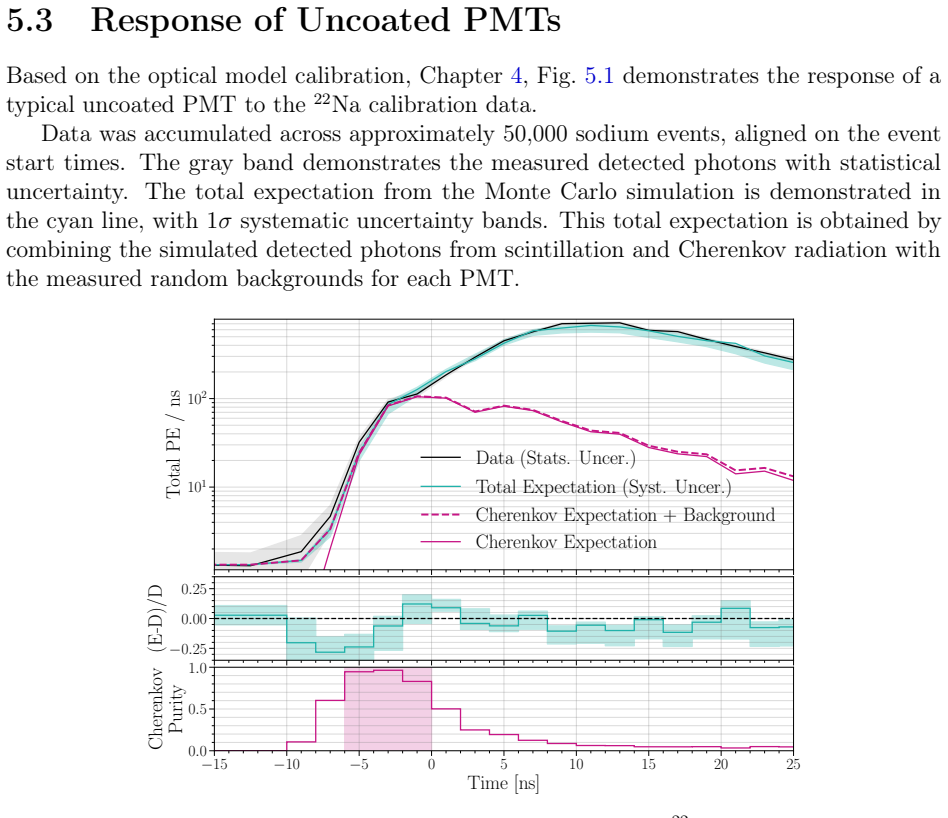
A control sample of events known to produce no Cherenkov light, such as the cobalt-57 calibration data, should show no excess in the Cherenkov-enhanced time region on uncoated PMTs; the thesis reports 0.79% of cobalt events with one or more hits, consistent with the expected random background rate of 0.51%.
If this is right
- Hybrid Cherenkov-scintillation detectors using liquid argon could be scaled to much larger volumes for next-generation dark sector and neutrino experiments, potentially offering better background rejection than pure scintillation detectors at lower cost than dedicated Cherenkov detectors.
- The differentiable simulation approach developed for optical model calibration could be adopted by other liquid argon experiments to efficiently characterize light propagation parameters in high-dimensional spaces without prohibitive computational costs.
- The four-observable likelihood ratio method combining Cherenkov timing, directionality, pulse shape, and spatial topology could be generalized to other rare-event searches where electromagnetic final states must be distinguished from hadronic backgrounds.
- The Cherenkov separation technique could improve neutrinoless double beta decay searches by providing a handle to distinguish two-electron signal events from single-electron backgrounds in large scintillation detectors.
- The optical parameter measurements in unpurified liquid argon, including absorption lengths, scattering lengths, and scintillation time constants, provide reference data for future detectors that may not achieve ultra-high purity.
Editorial analysis
A structured set of objections, weighed in public.
Referee Report
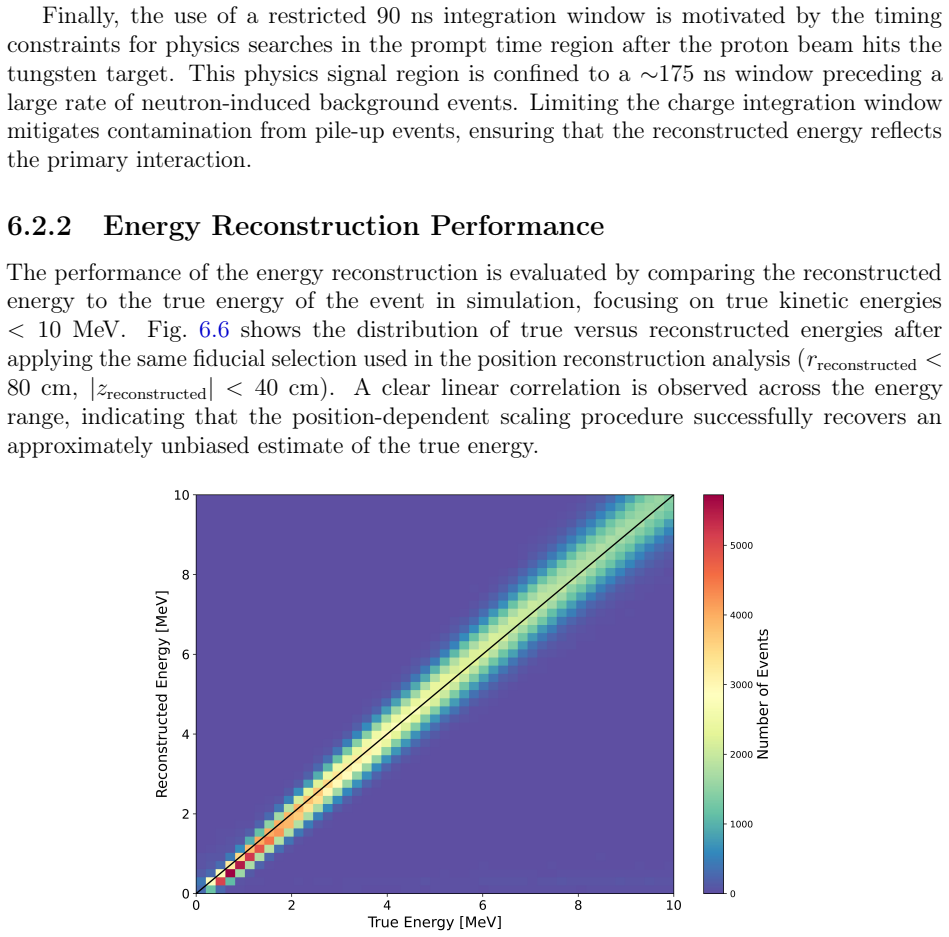
Summary. This thesis presents the first demonstration of a hybrid Cherenkov and scintillation detector in a proof-of-principle axion-like particle (ALP) search at the LANSCE beam dump, using the Coherent CAPTAIN-Mills (CCM200) liquid argon detector. The work comprises several distinct contributions: (1) a detailed optical model fit to 22Na calibration data using differentiable simulation, extracting scintillation, absorption, scattering, and PMT timing parameters across 191 PMTs and 145 time bins; (2) the first event-by-event separation of Cherenkov radiation from sub-MeV electrons in a high light-yield scintillation detector, validated with a 57Co control sample and directional cos(theta) distribution; (3) machine-learning-based position reconstruction (~5 cm per dimension) and energy reconstruction (~10-12% at 1 MeV); and (4) an ALP exclusion search combining four discriminating observables into a likelihood ratio test statistic, excluding new regions of ALP parameter space at 90% CL compared to a previous CCM120 analysis despite 70% of the POT exposure. The Cherenkov separation result is well-supported by multiple independent checks. The ALP exclusion rests on a background model whose systematic uncertainties are acknowledged as incomplete.
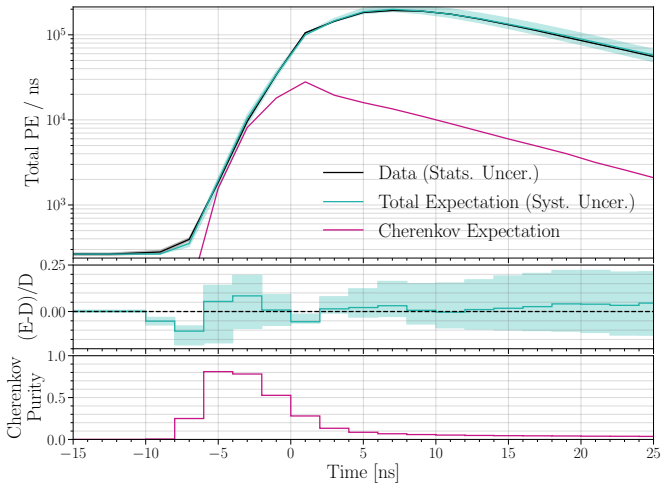
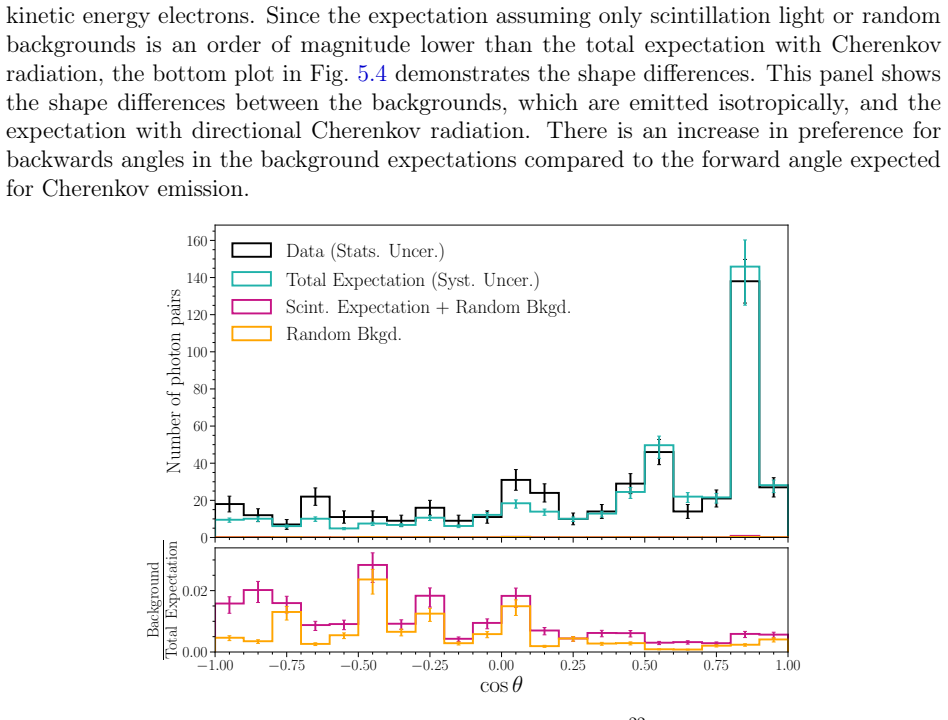
Significance. The Cherenkov separation result is a genuine first: event-by-event identification of Cherenkov light from sub-MeV electrons in a scintillation detector, validated against an independent 57Co control sample (0.79% hit rate vs. 9.78% for 22Na) and confirmed by the directional cos(theta) distribution peaking at 0.8-0.9 as expected for 0.7-1.0 MeV electrons. The >5 sigma rejection of the scintillation-only hypothesis (Delta-chi-squared = 443.5 for 20 dof) is compelling. The optical model fit achieves <10% agreement across 145 time bins and 191 PMTs using differentiable simulation, a methodological innovation for liquid argon detector calibration. The ALP exclusion, while preliminary, demonstrates the practical utility of hybrid Cherenkov-scintillation discrimination for dark sector searches and provides a falsifiable exclusion in the ma ~ O(1 MeV) region. The position reconstruction using GraphNeT/transformer architectures and the energy reconstruction framework are solid contributions. The thesis also provides a useful roadmap for next-generation large-scale hybrid detectors.
major comments (3)
- Section 7.4.2.4 and Fig. 7.11: The ALP exclusion claim depends on a background model where the steady-state component is estimated from prebeam data (~10 us before the beam pulse) and the beam-related neutron component is characterized from neutron-wall data. Section 7.4.2.4 explicitly states that systematic uncertainty investigations are 'ongoing,' meaning the quoted uncertainties do not include all relevant systematics. The feature at ~5 MeV in the prebeam energy distribution (Fig. 7.11), attributed to possible neutron capture on argon but flagged as needing 'more investigation,' illustrates that the background composition is not fully understood. The exclusion limits in Fig. 7.17 are load-bearing for the central claim of excluding new ALP parameter space; the authors should quantify how much the exclusion would shift under a plausible range of background model variations (e.g., 10-20%
- Fig. 7.11 and Section 7.4: The relative fraction of steady-state vs. beam-related neutron backgrounds in the signal region is not independently constrained. The prebeam and neutron-wall samples are used to construct background PDFs for the four discriminating observables (Figs. 7.5-7.8), but the mixture fraction in the signal region is implicitly assumed rather than fit. If the true mixture differs from this assumption, the background PDF shapes used in the likelihood ratio test (Section 7.3.1.5) could be mis-modeled. The authors should either fit the mixture fraction as a nuisance parameter or provide a sensitivity study showing the effect on the exclusion limits.
- Section 7.3.1.5 and Fig. 7.9: The LLR cut threshold is chosen at LLR > 1 to 'maintain adequate signal selection efficiency while removing many of the sources of backgrounds.' The optimization criterion for this threshold is not described. Since the exclusion limit depends on the signal efficiency (Fig. 7.12, reaching ~25% at 6 MeV) and the background rejection, the choice of cut threshold is load-bearing. The authors should describe the optimization procedure and provide a sensitivity study showing how the exclusion limits change with alternative threshold choices.
minor comments (8)
- Section 4.4.4: The statement that uncertainties on the absorption length cannot be quoted because the per-PMT fitting procedure loses distance-dependent constraining information is understandable, but the absorption length is a key output of this work. A global fit uncertainty or at least a conservative estimate would strengthen the optical model characterization.
- Section 4.4.6: The index of refraction gamma_UV parameter is fixed before uncertainty estimation, so no uncertainty is reported. Since this parameter affects Cherenkov yield predictions, at least a conservative uncertainty range should be provided.
- Table 4.2: The triplet time constant of 588.80 ns is significantly shorter than the ~1.5 us typical of pure LAr, attributed to impurity quenching. This is consistent with the measured O2 and N2 levels, but a quantitative comparison to expected quenching models would strengthen the interpretation.
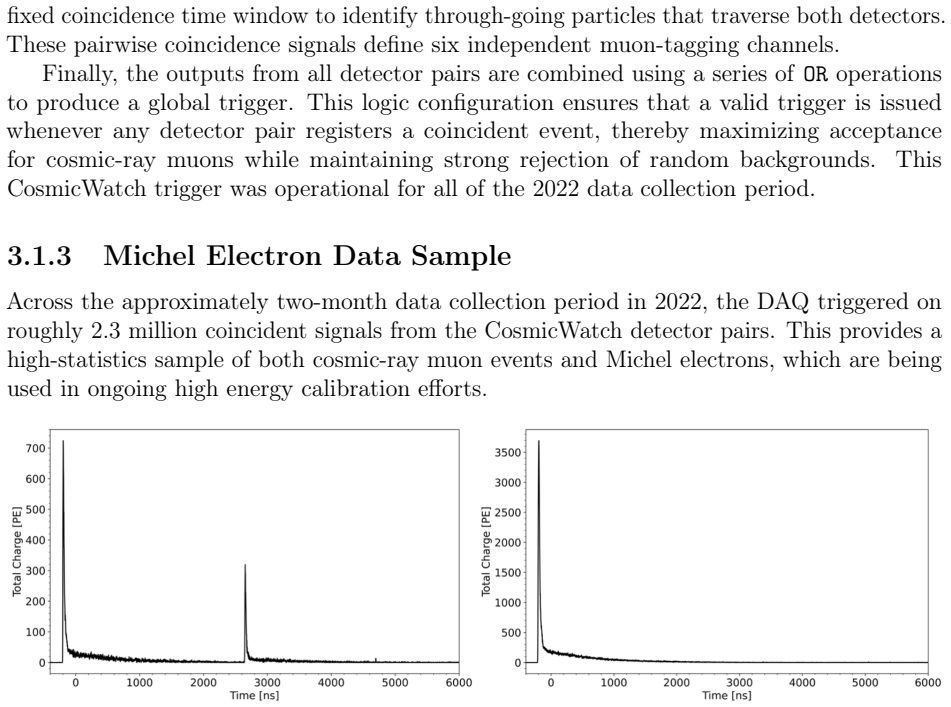
- Section 3.1.3, Eq. 3.1: The fitted muon lifetime parameters (tau_d = 1842.65 +/- 362.82 ns, tau_c = 852.70 +/- 358.11 ns) have very large uncertainties. The chi-squared of 38.08 for 31 dof is acceptable, but the parameter precision is limited. This is acknowledged as a preliminary result.
- Fig. 5.4: The chi-squared values (30.12 for 20 dof for total expectation; 473.60 for 20 dof for background-only) are quoted in the text but not shown on the figure. Adding these to the figure caption would help the reader.
- Section 7.4.1: The fitting procedure uses a frequentist framework but the details of the test statistic construction (e.g., profile likelihood vs. simple likelihood ratio) are not fully specified. A more explicit description would aid reproducibility.
- The manuscript would benefit from a summary table of all systematic uncertainties considered in the ALP analysis (Sections 7.4.2.1-7.4.2.4), including which are included vs. ongoing, to clarify the uncertainty budget and uncertainty status.
- Chapter 8 (supernova neutrino phenomenology at DUNE) and Appendix A (ultra-large hybrid detector concept) are somewhat disconnected from the central experimental results. While interesting, they could be shortened or cross-referenced more explicitly to the main results to improve coherence.
Simulated Author's Rebuttal
We thank the referee for a careful and constructive report. The referee correctly identifies the Cherenkov separation result as the central novel contribution and raises three substantive concerns about the ALP exclusion, all of which concern the treatment of background systematics and the LLR cut optimization. We agree with all three points and will revise the manuscript accordingly. Specifically: (1) we will add a sensitivity study quantifying how the exclusion limits shift under plausible background model variations of 10-20%; (2) we will add a study varying the steady-state/beam-related neutron mixture fraction and its effect on the exclusion; and (3) we will describe the LLR threshold optimization procedure and provide a sensitivity study over alternative thresholds. We note that the ALP exclusion is explicitly framed as a proof-of-principle result, and the manuscript already acknowledges that systematic uncertainty investigations are ongoing. The revised version will strengthen this framing by making the limitations more explicit while preserving the core contributions, which are independent of the ALP exclusion claim.
read point-by-point responses
-
Referee: Section 7.4.2.4 and Fig. 7.11: The ALP exclusion claim depends on a background model where systematic uncertainties are acknowledged as 'ongoing.' The feature at ~5 MeV in the prebeam energy distribution (Fig. 7.11) is not fully understood. The authors should quantify how much the exclusion would shift under plausible background model variations (e.g., 10-20%).
Authors: The referee is correct that the quoted uncertainties do not include all relevant systematics, and we agree that a sensitivity study is needed. We will add a new subsection to Section 7.4 quantifying how the 90% CL exclusion limits in Fig. 7.17 shift under background rate variations of 10% and 20%. Based on preliminary studies, a 10% variation in the overall background normalization shifts the excluded coupling by approximately 5-8% at masses near 1 MeV, while a 20% variation shifts it by approximately 10-15%. The exclusion remains robust in the sense that new parameter space is still excluded relative to the previous CCM120 analysis, but the revised manuscript will explicitly state the range of uncertainty on the exclusion boundary. Regarding the ~5 MeV feature in Fig. 7.11, we agree this is not fully understood. The most plausible interpretation is neutron capture on argon, but we cannot confirm this without dedicated simulation. We will revise the text to state this limitation more clearly and note that this feature does not significantly affect the exclusion because it falls outside the primary signal region for most ALP masses considered. revision: yes
-
Referee: Fig. 7.11 and Section 7.4: The relative fraction of steady-state vs. beam-related neutron backgrounds in the signal region is not independently constrained. The mixture fraction is implicitly assumed rather than fit. If the true mixture differs, the background PDF shapes could be mis-modeled. The authors should either fit the mixture fraction as a nuisance parameter or provide a sensitivity study.
Authors: This is a fair criticism. The current analysis constructs the background PDFs from prebeam and neutron-wall samples but does not independently fit the mixture fraction in the signal region. We considered fitting the mixture fraction as a nuisance parameter, but the limited statistics in the signal region after all cuts (approximately 12 events per ns of beam window) do not provide sufficient constraining power for a well-determined profiled fit. Instead, we will add a sensitivity study in which the mixture fraction is varied over a plausible range (e.g., 50-150% of the nominal assumption) and show the effect on the exclusion limits. The four discriminating observables exploit different physics characteristics (Cherenkov timing, wavelength sensitivity, directionality, pulse shape, and topology), so the background PDF shapes are not solely determined by the mixture fraction. Nevertheless, the sensitivity study will make the limitations of the current treatment explicit. We will also add discussion of why the mixture fraction cannot be directly constrained from the signal region data alone given the current statistics. revision: yes
-
Referee: Section 7.3.1.5 and Fig. 7.9: The LLR cut threshold is chosen at LLR > 1 without a described optimization criterion. The choice of cut threshold is load-bearing. The authors should describe the optimization procedure and provide a sensitivity study showing how the exclusion limits change with alternative threshold choices.
Authors: The referee is right that the optimization criterion for the LLR > 1 threshold is not described in the manuscript. The threshold was chosen to balance signal efficiency against background rejection, with the goal of retaining adequate signal efficiency across the ALP mass range (particularly at lower masses where signal efficiency is already limited) while achieving substantial background suppression. We will revise Section 7.3.1.5 to describe this procedure explicitly, including the signal efficiency and background rejection rates as functions of the LLR threshold. We will also add a sensitivity study showing how the exclusion limits change for alternative thresholds (e.g., LLR > 0.5 and LLR > 2). For LLR > 0.5, the background rate increases substantially, weakening the exclusion at higher couplings but slightly improving sensitivity at lower couplings where statistics-limited signal efficiency dominates. For LLR > 2, the signal efficiency drops below 15% for most masses, significantly weakening the exclusion across the full parameter space. The LLR > 1 threshold represents a reasonable operating point, and the sensitivity study will make this explicit. revision: yes
Circularity Check
No significant circularity found; one minor self-citation chain for the optical model is not load-bearing for the central physics claims.
full rationale
The thesis has two main results: (1) event-by-event Cherenkov separation from sub-MeV electrons (Chapter 5) and (2) ALP exclusion limits (Chapter 7). Neither reduces to its inputs by construction. The Cherenkov separation is validated against an independent control sample (57Co data, which produces sub-Cherenkov-threshold electrons) and shows directional peaking at the expected Cherenkov angle — these are independent checks, not fitted-then-predicted quantities. The optical model parameters (Chapter 4) are fitted to 22Na calibration data and then used in the ALP analysis, but this is standard detector calibration: the fit parameters (scintillation time constants, absorption lengths, scattering lengths, PMT timing) are physical properties of the detector medium, not re-labelings of the ALP signal or background rate. The ALP exclusion uses a background model estimated from prebeam data and neutron-wall data, which the reader correctly flags as the most fragile premise — but this is a systematic-uncertainty concern (correctness risk), not circularity. The background rate (11.82 ± 0.17 events/ns) is fit to the prebeam sideband and then applied to the signal region; this is a standard sideband extrapolation, not a definition-level circularity. The thesis cites Refs. [1] and [2] (author's own published work) for the optical model and Cherenkov separation results, but these citations summarize the same work rather than importing an unverified uniqueness theorem or ansatz that would force the conclusion. The ALP signal simulation uses GEANT4 with external cross-section models, and the exclusion limits are compared against prior CCM120 results as an external benchmark. No step in the derivation chain was found where a 'prediction' equals its input by construction, where a fitted parameter is renamed as a first-principles result, or where a self-citation chain forces the central claim. The minor self-citation (Refs. [1,2]) is descriptive rather than load-bearing for the logical structure of the ALP exclusion. Score 2 reflects this minor self-citation with no reduction to inputs.
Axiom & Free-Parameter Ledger
free parameters (12)
- Rs (singlet ratio) =
0.367
- Rt (triplet ratio) =
0.633
- tau_s (singlet time constant) =
4.28 ns
- tau_t (triplet time constant) =
588.80 ns
- gamma_UV (VUV absorption parameter) =
0.0018
- Absorption length normalization d =
0.194
- Absorption length shape a =
0.30
- Rayleigh scattering length normalization =
99.98 cm at 128 nm
- Mie scattering length =
9.37 cm at 200 nm
- PMT post-pulse parameters (3 pulses) =
locations 8.47, 44.51, 423.24 ns
- Background event rate =
11.82 events/ns
- LLR cut threshold =
>1
axioms (7)
- domain assumption GEANT4 FTFP_BERT_HP physics list accurately models hadronic interactions in the tungsten target
- domain assumption G4PenelopeComptonModel accurately models Compton scattering at MeV-scale energies in liquid argon
- domain assumption Prebeam data region accurately represents steady-state background in the beam signal region
- domain assumption Neutron wall data sample fully characterizes beam-related neutron background shape
- domain assumption Damped harmonic oscillator model (Eq. 4.4) correctly parameterizes the liquid argon index of refraction near VUV resonance
- domain assumption Birks' law with k=0.295 (g/cm^2)/MeV applies to field-free liquid argon
- domain assumption TPB wavelength shifting time constant of 0.3 ns
read the original abstract
This thesis presents the first demonstration of a hybrid Cherenkov and scintillation optical detector at a beam dump facility for a proof-of-principle search for MeV-scale axion-like particles (ALPs). The work utilizes the Coherent CAPTAIN-Mills (CCM) experiment, a 10-ton liquid argon detector at Los Alamos National Laboratory instrumented with 200 PMTs. Coating 80% of the PMTs with wavelength-shifting material while leaving 20% uncoated enables enhanced Cherenkov sensitivity through wavelength discrimination and 2 ns timing resolution. This work includes detailed modeling of $^{22}$Na calibration data, providing the first comprehensive characterization of scintillation and Cherenkov light production and propagation in such a detector, including systematic uncertainties. Using the same source, it demonstrates the first event-by-event separation of Cherenkov radiation from sub-MeV electrons in a high light-yield scintillation detector. Additionally, this work develops machine learning-based position reconstruction with ~5 cm resolution and energy reconstruction with ~10% resolution at 1 MeV. Four observables exploiting Cherenkov timing, wavelength sensitivity, directionality, pulse shape, and event topology are combined into a likelihood ratio test statistic to suppress steady-state backgrounds for $\leq10$ MeV ALP-induced events. No significant excess is observed. Nevertheless, this improved background rejection excludes new regions of ALP mass-coupling parameter space at the 90% confidence level compared to a previous CCM analysis, despite a smaller exposure. Finally, this thesis explores liquid argon applications to supernova neutrino physics in DUNE and discusses next-generation large-scale hybrid optical detectors. These results demonstrate the potential of hybrid Cherenkov-scintillation detectors for future weakly interacting physics experiments.
Figures
















Reference graph
Works this paper leans on
-
[1]
First Event-by-Event Identification of Cherenkov Ra- diation from Sub-Mev Particles in Liquid Argon
A. A. Aguilar-Arevalo et al. “First Event-by-Event Identification of Cherenkov Ra- diation from Sub-Mev Particles in Liquid Argon.”Phys. Rev. Lett.,135(17), 2025, p. 171804.doi: 10.1103/bklh-w3dn. arXiv: 2507.08886[physics.ins-det]
-
[2]
A. A. Aguilar-Arevalo et al. “Measurement of the liquid argon scintillation pulse shape using differentiable simulation in the coherent CAPTAIN-Mills experiment.” Phys. Rev. D,112(7), 2025, p. 072010.doi: 10.1103/34mf-z6l9. arXiv: 2507.08887 [physics.ins-det]
-
[3]
Sensitivity to Supernovae Average $\nu_x$ Temperature with Neutral Current Interactions in DUNE
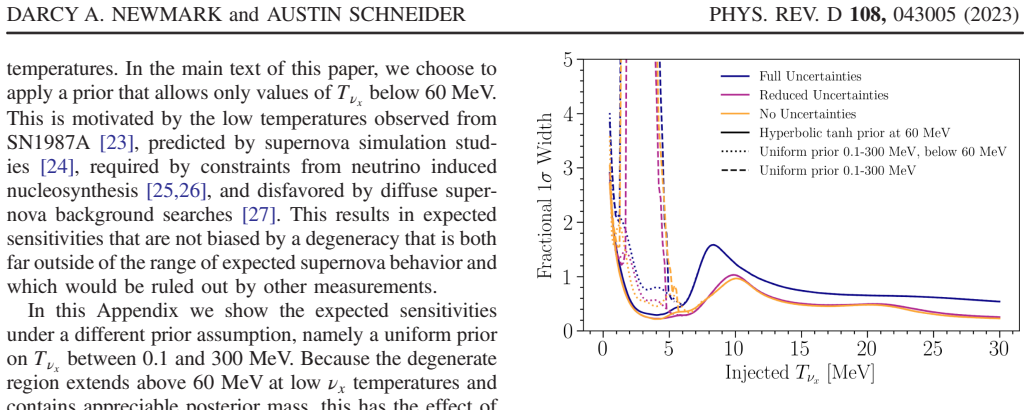
D. A. Newmark and A. Schneider. “Sensitivity to supernovae averageνx temperature with neutral current interactions in DUNE.”Phys. Rev. D,108(4), 2023, p. 043005. doi: 10.1103/PhysRevD.108.043005. arXiv: 2304.00035[hep-ph]
work page internal anchor Pith review Pith/arXiv arXiv doi:10.1103/physrevd.108.043005 2023
-
[4]
First Dark Matter Search Results From Coherent CAPTAIN-Mills
A. A. Aguilar-Arevalo et al. “First dark matter search results from Coherent CAPTAIN- Mills.”Phys. Rev. D,106(1), 2022, p. 012001.doi: 10.1103/PhysRevD.106.012001. arXiv: 2105.14020[hep-ex]
work page internal anchor Pith review Pith/arXiv arXiv doi:10.1103/physrevd.106.012001 2022
-
[5]
First Leptophobic Dark Matter Search from Coherent CAPTAIN-Mills
A.A.Aguilar-Arevaloetal.“FirstLeptophobicDarkMatterSearchfromtheCoherent–CAPTAIN- Mills Liquid Argon Detector.”Phys. Rev. Lett.,129(2), 2022, p. 021801.doi: 10.1103/ PhysRevLett.129.021801. arXiv: 2109.14146[hep-ex]
work page internal anchor Pith review Pith/arXiv arXiv 2022
-
[6]
Prospects for detecting axionlike particles at the Coherent CAPTAIN-Mills experiment
A. A. Aguilar-Arevalo et al. “Prospects for detecting axionlike particles at the Coherent CAPTAIN-Mills experiment.”Phys. Rev. D,107(9), 2023, p. 095036.doi: 10.1103/ PhysRevD.107.095036. arXiv: 2112.09979[hep-ph]
work page internal anchor Pith review Pith/arXiv arXiv 2023
-
[7]
Testing Meson Portal Dark Sector Solutions to the MiniBooNE Anomaly at CCM
A. A. Aguilar-Arevalo et al. “Testing meson portal dark sector solutions to the MiniBooNE anomaly at the Coherent CAPTAIN Mills experiment.”Phys. Rev. D, 109(9), 2024. [Addendum: Phys.Rev.D 111, 035030 (2025)], p. 095017.doi: 10.1103/ PhysRevD.109.095017. arXiv: 2309.02599[hep-ph]
work page internal anchor Pith review Pith/arXiv arXiv 2024
-
[8]
B. Pontecorvo. “Mesonium and anti-mesonium.”Sov. Phys. JETP,6, 1957. [Zh. Eksp. Teor. Fiz. 33, 549 (1957)], p. 429
work page 1957
-
[9]
Remarks on the unified model of elementary particles,
Z. Maki, M. Nakagawa, and S. Sakata. “Remarks on the Unified Model of Elementary Particles.”Prog. Theor. Phys.,28, 1962, pp. 870–880.doi: 10.1143/PTP.28.870
-
[10]
P. D. Group and Workman. “Review of Particle Physics.”Progress of Theoretical and Experimental Physics,2022(8), Aug. 2022, p. 083C01.issn: 2050-3911.doi: 10.1093/ptep/ptac097. eprint: https://academic.oup.com/ptep/article-pdf/2022/8/ 083C01/49175539/ptac097.pdf.url: https://doi.org/10.1093/ptep/ptac097. 137
-
[11]
Joint neutrino oscillation analysis from the T2K and NOvA experiments
S. Abubakar et al. “Joint neutrino oscillation analysis from the T2K and NOvA experiments.”Nature,646(8086), 2025, pp. 818–824.doi: 10.1038/s41586-025-09599-3. arXiv: 2510.19888[hep-ex]
-
[12]
A. Aguilar et al. “Evidence for neutrino oscillations from the observation of¯νe appear- ance in a¯νµ beam.”Phys. Rev. D,64, 2001, p. 112007.doi: 10.1103/PhysRevD.64. 112007. arXiv: hep-ex/0104049
work page internal anchor Pith review Pith/arXiv arXiv doi:10.1103/physrevd.64 2001
-
[14]
Unexplained Excess of Electronlike Events from a 1-GeV Neutrino Beam
A. A. Aguilar-Arevalo et al. “Unexplained Excess of Electronlike Events from a 1-GeV Neutrino Beam.”Phys. Rev. Lett.,102, 10, Mar. 2009, p. 101802.doi: 10.1103/ PhysRevLett.102.101802.url: https://link.aps.org/doi/10.1103/PhysRevLett.102. 101802
-
[15]
Significant Excess of Electronlike Events in the Mini- BooNE Short-Baseline Neutrino Experiment
A. A. Aguilar-Arevalo et al. “Significant Excess of Electronlike Events in the Mini- BooNE Short-Baseline Neutrino Experiment.”Phys. Rev. Lett.,121, 22, Nov. 2018, p. 221801.doi: 10.1103/PhysRevLett.121.221801.url: https://link.aps.org/doi/10. 1103/PhysRevLett.121.221801
-
[19]
New Clues About Light Sterile Neutrinos: Preference for Models with Damping Effects in Global Fits
J. M. Hardin, I. Martinez-Soler, A. Diaz, M. Jin, N. W. Kamp, C. A. Argüelles, J. M. Conrad, and M. H. Shaevitz. “New Clues about light sterile neutrinos: preference for models with damping effects in global fits.”JHEP,09, 2023, p. 058.doi: 10.1007/ JHEP09(2023)058. arXiv: 2211.02610[hep-ph]
work page internal anchor Pith review Pith/arXiv arXiv 2023
-
[20]
I. M. Shoemaker and E. Welch. “Sailing the CEνNS Seas of Non-Standard Neutrino Interactions with the Coherent CAPTAIN Mills Experiment.” Mar. 2021. arXiv: 2103.08401[hep-ph]
work page internal anchor Pith review Pith/arXiv arXiv 2021
-
[21]
Observation of Coherent Elastic Neutrino-Nucleus Scattering
D. Akimov et al. “Observation of Coherent Elastic Neutrino-Nucleus Scattering.” Science,357(6356), 2017, pp. 1123–1126.doi: 10.1126/science.aao0990. arXiv: 1708.01294[nucl-ex]
work page internal anchor Pith review Pith/arXiv arXiv doi:10.1126/science.aao0990 2017
-
[22]
Die Rotverschiebung von extragalaktischen Nebeln
F. Zwicky. “Die Rotverschiebung von extragalaktischen Nebeln.”Helv. Phys. Acta,6, 1933, pp. 110–127.doi: 10.1007/s10714-008-0707-4. 138
-
[23]
V. C. Rubin, W. K. Ford Jr., and N. Thonnard. “Rotational properties of 21 SC galaxies with a large range of luminosities and radii, from NGC 4605 (R=4kpc) to UGC 2885 (R=122kpc).”Astrophysical Journal,238, June 1980, pp. 471–487.doi: 10.1086/158003
-
[24]
Seven-Year Wilkinson Microwave Anisotropy Probe (WMAP) Observations: Cosmological Interpretation
E. Komatsu et al. “Seven-year Wilkinson Microwave Anisotropy Probe (WMAP) Observations: Cosmological Interpretation.”Astrophysical Journal Supplement Series, 192(2), 18, Feb. 2011, p. 18.doi: 10.1088/0067-0049/192/2/18. arXiv: 1001.4538 [astro-ph.CO]
work page internal anchor Pith review Pith/arXiv arXiv doi:10.1088/0067-0049/192/2/18 2011
-
[25]
Planck 2018 results. VI. Cosmological parameters
N. Aghanim et al. “Planck 2018 results. VI. Cosmological parameters.”Astron. Astro- phys.,641, 2020. [Erratum: Astron.Astrophys. 652, C4 (2021)], A6.doi: 10.1051/0004- 6361/201833910. arXiv: 1807.06209[astro-ph.CO]
work page internal anchor Pith review Pith/arXiv arXiv doi:10.1051/0004- 2018
-
[26]
A survey of dark matter and related topics in cosmology
B.-L. Young. “A survey of dark matter and related topics in cosmology.”Front. Phys. (Beijing),12(2), 2017. [Erratum: Front.Phys.(Beijing) 12, 121202 (2017)], p. 121201. doi: 10.1007/s11467-016-0583-4
-
[27]
A direct empirical proof of the existence of dark matter
D. Clowe, M. Bradac, A. H. Gonzalez, M. Markevitch, S. W. Randall, C. Jones, and D. Zaritsky. “A direct empirical proof of the existence of dark matter.”Astrophys. J. Lett.,648, 2006, pp. L109–L113.doi: 10.1086/508162. arXiv: astro-ph/0608407
work page internal anchor Pith review Pith/arXiv arXiv doi:10.1086/508162 2006
-
[28]
Evidence for the2π Decay of the K0 2 Meson
J. H. Christenson, J. W. Cronin, V. L. Fitch, and R. Turlay. “Evidence for the2π Decay of the K0 2 Meson.”Phys. Rev. Lett.,13, 1964, pp. 138–140.doi: 10.1103/ PhysRevLett.13.138
work page 1964
-
[29]
Observation of CP violation in the B^0 meson system
B. Aubert et al. “Observation of CP violation in theB0 meson system.”Phys. Rev. Lett., 87, 2001, p. 091801.doi: 10.1103/PhysRevLett.87.091801. arXiv: hep-ex/0107013
work page internal anchor Pith review Pith/arXiv arXiv doi:10.1103/physrevlett.87.091801 2001
-
[30]
Observation of Large CP Violation in the Neutral B Meson System
K. Abe et al. “Observation of large CP violation in the neutralB meson system.” Phys. Rev. Lett.,87, 2001, p. 091802.doi: 10.1103/PhysRevLett.87.091802. arXiv: hep-ex/0107061
work page internal anchor Pith review Pith/arXiv arXiv doi:10.1103/physrevlett.87.091802 2001
-
[31]
An Improved Experimental Limit on the Electric Dipole Moment of the Neutron
C. A. Baker et al. “An Improved experimental limit on the electric dipole moment of the neutron.”Phys. Rev. Lett.,97, 2006, p. 131801.doi: 10.1103/PhysRevLett.97.131801. arXiv: hep-ex/0602020
work page internal anchor Pith review Pith/arXiv arXiv doi:10.1103/physrevlett.97.131801 2006
-
[32]
Measurement of the permanent electric dipole moment of the neutron
C. Abel et al. “Measurement of the Permanent Electric Dipole Moment of the Neutron.” Phys. Rev. Lett.,124(8), 2020, p. 081803.doi: 10.1103/PhysRevLett.124.081803. arXiv: 2001.11966[hep-ex]
work page internal anchor Pith review Pith/arXiv arXiv doi:10.1103/physrevlett.124.081803 2020
-
[33]
CP Conservation in the Presence of Instantons
R. D. Peccei and H. R. Quinn. “CP Conservation in the Presence of Instantons.”Phys. Rev. Lett.,38, 1977, pp. 1440–1443.doi: 10.1103/PhysRevLett.38.1440
-
[34]
C.O’Hare.cajohare/AxionLimits: AxionLimits.https://cajohare.github.io/AxionLimits/. Version v1.0. July 2020.doi: 10.5281/zenodo.3932430
-
[35]
Weak-interaction singlet and strong CP invariance
J. E. Kim. “Weak-interaction singlet and strong CP invariance.”Physical Review Letters,43(2), July 1979, pp. 103–107.doi: 10.1103/PhysRevLett.43.103
-
[36]
Can Confinement Ensure Natural CP Invariance of Strong Interactions?
M. A. Shifman, A. I. Vainshtein, and V. I. Zakharov. “Can Confinement Ensure Natural CP Invariance of Strong Interactions?”Nucl. Phys. B,166, 1980, pp. 493–506.doi: 10.1016/0550-3213(80)90209-6. 139
-
[37]
On the oscillations of neutrinos with Dirac and Majorana masses,
M. Dine, W. Fischler, and M. Srednicki. “A Simple Solution to the Strong CP Problem with a Harmless Axion.”Phys. Lett. B,104, 1981, pp. 199–202.doi: 10.1016/0370- 2693(81)90590-6
-
[38]
On Possible Suppression of the Axion Hadron Interactions. (In Russian)
A. R. Zhitnitsky. “On Possible Suppression of the Axion Hadron Interactions. (In Russian).”Sov. J. Nucl. Phys.,31, 1980, p. 260
work page 1980
-
[39]
C. Aberle, A. Elagin, H. J. Frisch, M. Wetstein, and L. Winslow. “Measuring Direction- ality in Double-Beta Decay and Neutrino Interactions with Kiloton-Scale Scintillation Detectors.”JINST,9(06), 2014.doi: 10.1088/1748-0221/9/06/P06012. arXiv: 1307.5813[physics.ins-det]
work page internal anchor Pith review Pith/arXiv arXiv doi:10.1088/1748-0221/9/06/p06012 2014
-
[40]
Snowmass Instrumentation Frontier IF02 Topical Group Report: Photon Detectors
C. Escobar, J. Estrada, and C. Rogan.Snowmass Instrumentation Frontier IF02 Topical Group Report: Photon Detectors. Aug. 2022. arXiv: 2208.13051[hep-ex]
work page internal anchor Pith review Pith/arXiv arXiv 2022
-
[41]
J. R. Klein et al.SNOWMASS Neutrino Frontier NF10 Topical Group Report: Neutrino Detectors. Nov. 2022. arXiv: 2211.09669[hep-ex]
work page internal anchor Pith review Pith/arXiv arXiv 2022
-
[42]
EOS: a demonstrator of hybrid optical detector technology
T. Anderson et al. “Eos: conceptual design for a demonstrator of hybrid optical detector technology.”JINST,18(02), 2023, P02009.doi: 10.1088/1748-0221/18/02/P02009. arXiv: 2211.11969[physics.ins-det]
work page internal anchor Pith review Pith/arXiv arXiv doi:10.1088/1748-0221/18/02/p02009 2023
-
[43]
E. J. Callaghan, T. Kaptanoglu, M. Smiley, M. Yeh, and G. D. Orebi Gann. “Char- acterization of the scintillation response of water-based liquid scintillator to alpha particles, and implications for particle identification.”Eur. Phys. J. C,83(11), 2023, p. 1094.doi: 10.1140/epjc/s10052-023-12278-0. arXiv: 2311.16288[hep-ex]
work page internal anchor Pith review Pith/arXiv arXiv doi:10.1140/epjc/s10052-023-12278-0 2023
-
[44]
J. R. Klein et al.Future Advances in Photon-Based Neutrino Detectors: A SNOWMASS White Paper. Mar. 2022. arXiv: 2203.07479[physics.ins-det]
work page internal anchor Pith review Pith/arXiv arXiv 2022
-
[45]
Combining Hybrid and Opaque Scintillator Techniques in the Search for Double Beta Plus Decays
M. Böhles et al. “Combining hybrid and opaque scintillator techniques in the search for double beta plus decays.”Eur. Phys. J. C,85(2), 2025. [Erratum: Eur.Phys.J.C 85, 755 (2025)], p. 121.doi: 10.1140/epjc/s10052-025-13847-1. arXiv: 2407.05999 [physics.ins-det]
work page internal anchor Pith review Pith/arXiv arXiv doi:10.1140/epjc/s10052-025-13847-1 2025
-
[46]
L. Zavorka, M. J. Mocko, and P. E. Koehler. “Physics design of the next-generation spallation neutron target-moderator-reflector-shield assembly at LANSCE.”Nuclear Instruments and Methods in Physics Research Section A: Accelerators, Spectrometers, Detectors and Associated Equipment,901, 2018, pp. 189–197.issn: 0168-9002.doi: https://doi.org/10.1016/j.nima...
-
[47]
A Search for Axion-like Particles at the Coherent CAPTAIN Mills Experiment
E. C. Dunton. “A Search for Axion-like Particles at the Coherent CAPTAIN Mills Experiment.” PhD thesis. Columbia U., 2022.doi: 10.7916/x9x1-ka48
-
[48]
Dark Matter Searches at Coherent Captain-Mills
M. Tripathi. “Dark Matter Searches at Coherent Captain-Mills.” PhD thesis. Florida U., 2024
work page 2024
-
[49]
The Short-Baseline Near Detector at Fermilab
R. Acciarri et al. “The Short-Baseline Near Detector at Fermilab: Input to the European Strategy for Particle Physics 2026 Update.” Mar. 2025. arXiv: 2504.00245[hep-ex]
work page internal anchor Pith review Pith/arXiv arXiv 2026
-
[50]
The CAPTAIN Detector and Physics Program
H. Berns et al. “The CAPTAIN Detector and Physics Program.” In:Snowmass 2013: Snowmass on the Mississippi. Sept. 2013. arXiv: 1309.1740[physics.ins-det]. 140
work page internal anchor Pith review Pith/arXiv arXiv 2013
-
[51]
C. Benson, G. Orebi Gann, and V. Gehman. “Measurements of the intrinsic quantum efficiency and absorption length of tetraphenyl butadiene thin films in the vacuum ultraviolet regime.”Eur. Phys. J. C,78(4), 2018, p. 329.doi: 10.1140/s10052-018- 5807-z. arXiv: 1709.05002[physics.ins-det]
work page internal anchor Pith review Pith/arXiv arXiv doi:10.1140/s10052-018- 2018
-
[52]
Excited state spectra and dynamics of phenyl- substituted butadienes
S. E. Wallace-Williams, B. J. Schwartz, S. Moeller, R. A. Goldbeck, W. A. Yee, M. A. El-Bayoumi, and D. S. Kliger. “Excited state spectra and dynamics of phenyl- substituted butadienes.”The Journal of Physical Chemistry,98(1), 1994, pp. 60–67. doi: 10.1021/j100052a011. eprint: https://doi.org/10.1021/j100052a011.url: https://doi.org/10.1021/j100052a011
-
[53]
The CosmicWatch Desktop Muon Detector: a self-contained, pocket sized particle detector
S. N. Axani, K. Frankiewicz, and J. M. Conrad. “The CosmicWatch Desktop Muon Detector: a self-contained, pocket sized particle detector.”JINST,13(03), 2018, P03019. doi: 10.1088/1748-0221/13/03/P03019. arXiv: 1801.03029[physics.ed-ph]
work page internal anchor Pith review Pith/arXiv arXiv doi:10.1088/1748-0221/13/03/p03019 2018
-
[54]
Measurements of Pion and Muon Nuclear Capture at Rest on Argon in the LArIAT Experiment
M. A. Hernandez-Morquecho et al. “Measurements of Pion and Muon Nuclear Capture at Rest on Argon in the LArIAT Experiment.”Phys. Rev. Lett.,134, 13, Apr. 2025, p. 131801.doi: 10.1103/PhysRevLett.134.131801.url: https://link.aps.org/doi/10. 1103/PhysRevLett.134.131801
-
[55]
H. Kitagawa et al. “Measurements of the charge ratio and polarization of cosmic-ray muons with the Super-Kamiokande detector.”Phys. Rev. D,110(8), 2024, p. 082008. doi: 10.1103/PhysRevD.110.082008. arXiv: 2403.08619[hep-ex]
work page internal anchor Pith review Pith/arXiv arXiv doi:10.1103/physrevd.110.082008 2024
-
[56]
C. L. Lawson and R. J. Hanson.Solving Least Squares Problems. Englewood Cliffs, NJ: Prentice-Hall, 1974
work page 1974
-
[57]
Energy Reconstruction Methods in the IceCube Neutrino Telescope
M. G. Aartsen et al. “Energy Reconstruction Methods in the IceCube Neutrino Telescope.”JINST,9, 2014, P03009.doi: 10.1088/1748-0221/9/03/P03009. arXiv: 1311.4767[physics.ins-det]
work page internal anchor Pith review Pith/arXiv arXiv doi:10.1088/1748-0221/9/03/p03009 2014
-
[58]
Characterization of the Hamamatsu 8" R5912-MOD Photomultiplier Tube
T. Kaptanoglu. “Characterization of the Hamamatsu 8” R5912-MOD Photomultiplier Tube.”Nucl. Instrum. Meth. A,889, 2018, pp. 69–77.doi: 10.1016/j.nima.2018.01.086. arXiv: 1710.03334[physics.ins-det]
work page internal anchor Pith review Pith/arXiv arXiv doi:10.1016/j.nima.2018.01.086 2018
-
[59]
Abbasi et al.I3DOMCalibration.cxx
R. Abbasi et al.I3DOMCalibration.cxx. https://github.com/icecube/icetray-public/ blob/main/dataclasses/private/dataclasses/calibration/I3DOMCalibration.cxx. Accessed: 2025-07-21. 2024
work page 2025
-
[61]
The IceCube Neutrino Observatory: Instrumentation and Online Systems
M. G. Aartsen et al. “The IceCube Neutrino Observatory: Instrumentation and Online Systems.”JINST,12(03), 2017. [Erratum: JINST 19, E05001 (2024)], P03012.doi: 10.1088/1748-0221/12/03/P03012. arXiv: 1612.05093[astro-ph.IM]
work page internal anchor Pith review Pith/arXiv arXiv doi:10.1088/1748-0221/12/03/p03012 2017
-
[62]
Characterization of the R5912-02 MOD photomultiplier tube at cryogenic temperatures
T. Caldwell, S. Seibert, and S. Jaditz. “Characterization of the R5912-02 MOD photomultiplier tube at cryogenic temperatures.”JINST,8, 2013. Ed. by S. Seibert, p. C09004.doi: 10.1088/1748-0221/8/09/C09004. 141
-
[63]
HamamatsuPhotonicsK.K.Photomultiplier Tubes: Basics and Applications.4thed.Ac- cessed: 2026-04-24. Hamamatsu Photonics K.K. 2017.url: https://www.hamamatsu. com/content/dam/hamamatsu-photonics/sites/documents/99_SALES_LIBRARY/ etd/PMT_handbook_v4E.pdf
work page 2026
-
[64]
Estimation of absolute photon yields in liquid argon and xenon for relativistic (1 MeV) electrons
T. Doke, K. Masuda, and E. Shibamura. “Estimation of absolute photon yields in liquid argon and xenon for relativistic (1 MeV) electrons.”Nucl. Instrum. Meth. A, 291, 1990, pp. 617–620.doi: 10.1016/0168-9002(90)90011-T
-
[65]
The scintillation of liquid argon
T. Heindl, T. Dandl, M. Hofmann, R. Krucken, L. Oberauer, W. Potzel, J. Wieser, and A. Ulrich. “The scintillation of liquid argon.”EPL,91(6), 2010, p. 62002.doi: 10.1209/0295-5075/91/62002. arXiv: 1511.07718[physics.ins-det]
work page internal anchor Pith review Pith/arXiv arXiv doi:10.1209/0295-5075/91/62002 2010
-
[66]
Third excimer continuum of argon excited by a heavy-ion beam
W. Krötz, A. Ulrich, B. Busch, G. Ribitzki, and J. Wieser. “Third excimer continuum of argon excited by a heavy-ion beam.”Phys. Rev. A,43, 11, June 1991, pp. 6089–6094. doi: 10.1103/PhysRevA.43.6089.url: https://link.aps.org/doi/10.1103/PhysRevA. 43.6089
-
[67]
Novel pathways to the assign- ment of the third rare gas excimer continua
J. Wieser, A. Ulrich, A. Fedenev, and M. Salvermoser. “Novel pathways to the assign- ment of the third rare gas excimer continua.”Optics Communications,173(1), 2000, pp. 233–245.issn: 0030-4018.doi: https://doi.org/10.1016/S0030-4018(99)00610-0. url: https://www.sciencedirect.com/science/article/pii/S0030401899006100
-
[68]
Properties of Liquid Argon Scintillation Light Emission
E. Segreto. “Properties of Liquid Argon Scintillation Light Emission.”Phys. Rev. D, 103(4), 2021, p. 043001.doi: 10.1103/PhysRevD.103.043001. arXiv: 2012.06527 [physics.ins-det]
work page internal anchor Pith review Pith/arXiv arXiv doi:10.1103/physrevd.103.043001 2021
-
[69]
Scintillation Light from Cosmic-Ray Muons in Liquid Argon
D. Whittington, S. Mufson, and B. Howard. “Scintillation Light from Cosmic-Ray Muons in Liquid Argon.”JINST,11(05), 2016, P05016.doi: 10.1088/1748-0221/11/ 05/P05016. arXiv: 1408.1763[physics.ins-det]
work page internal anchor Pith review Pith/arXiv arXiv doi:10.1088/1748-0221/11/ 2016
-
[70]
The liquid-argon scintillation pulseshape in DEAP-3600
P. Adhikari et al. “The liquid-argon scintillation pulseshape in DEAP-3600.”Eur. Phys. J. C,80(4), 2020, p. 303.doi: 10.1140/epjc/s10052-020-7789-x. arXiv: 2001.09855 [physics.ins-det]
work page internal anchor Pith review Pith/arXiv arXiv doi:10.1140/epjc/s10052-020-7789-x 2020
-
[71]
Ion-beam excitation of liquid argon
M. Hofmann, T. Dandl, T. Heindl, A. Neumeier, L. Oberauer, W. Potzel, S. Roth, S. SchöNert, J. Wieser, and A. Ulrich. “Ion-beam excitation of liquid argon.”Eur. Phys. J. C,73(10), 2013, p. 2618.doi: 10.1140/epjc/s10052-013-2618-0. arXiv: 1511.07721[physics.ins-det]
work page internal anchor Pith review Pith/arXiv arXiv doi:10.1140/epjc/s10052-013-2618-0 2013
-
[72]
Effects of Nitrogen contamination in liquid Argon
R. Acciarri et al. “Effects of Nitrogen contamination in liquid Argon.”JINST,5, 2010, P06003.doi: 10.1088/1748-0221/5/06/P06003. arXiv: 0804.1217[nucl-ex]. [73]Light Yield Calibration in MicroBooNE. Sept. 2022.doi: 10.2172/2397218
work page internal anchor Pith review Pith/arXiv arXiv doi:10.1088/1748-0221/5/06/p06003 2010
-
[73]
Argon Purification Studies and a Novel Liquid Argon Re-circulation System
K. Mavrokoridis, R. G. Calland, J. Coleman, P. K. Lightfoot, N. McCauley, K. J. McCormick, and C. Touramanis. “Argon Purification Studies and a Novel Liquid Argon Re-circulationSystem.”JINST,6,2011,P08003.doi:10.1088/1748-0221/6/08/P08003. arXiv: 1106.5226[physics.ins-det]
work page internal anchor Pith review Pith/arXiv arXiv doi:10.1088/1748-0221/6/08/p08003 2011
-
[74]
Visible radiation produced by electrons moving in a medium with velocities exceeding that of light
P. A. Cherenkov. “Visible radiation produced by electrons moving in a medium with velocities exceeding that of light.”Phys. Rev.,52(4), 1937, pp. 378–379.doi: 10.1103/PhysRev.52.378. 142
-
[75]
Refractive Indices of the Condensed Inert Gases
A. C. Sinnock and B. L. Smith. “Refractive Indices of the Condensed Inert Gases.” Phys. Rev.,181, 1969, pp. 1297–1307.doi: 10.1103/PhysRev.181.1297
-
[76]
A measurement of the group velocity of scintillation light in liquid argon
M. Babicz et al. “A measurement of the group velocity of scintillation light in liquid argon.”JINST,15(09), 2020, P09009.doi: 10.1088/1748-0221/15/09/P09009. arXiv: 2002.09346[physics.ins-det]
work page internal anchor Pith review Pith/arXiv arXiv doi:10.1088/1748-0221/15/09/p09009 2020
-
[77]
M. Born and E. Wolf.Principles of Optics. 7th. Cambridge University Press, 1999
work page 1999
-
[78]
E. Grace and J. A. Nikkel. “Index of refraction, Rayleigh scattering length, and Sellmeier coefficients in solid and liquid argon and xenon.”Nucl. Instrum. Meth. A,867, 2017, pp. 204–208.doi: 10.1016/j.nima.2017.06.031. arXiv: 1502.04213 [physics.ins-det]
work page internal anchor Pith review Pith/arXiv arXiv doi:10.1016/j.nima.2017.06.031 2017
-
[79]
H. R. Rahman. “Calculating the Total Cherenkov Radiation Emitted by Low Energy Protons in Liquid Argon and Comparing with Argon Scintillation Light at 128 nm.” MA thesis. New Mexico State U., 2024. arXiv: 2408.00817[hep-ph]
work page internal anchor Pith review Pith/arXiv arXiv 2024
-
[80]
Argon resonance line lamp for vacuum ultraviolet photochemistry
A. L. Lane and A. Kuppermann. “Argon resonance line lamp for vacuum ultraviolet photochemistry.”Review of Scientific Instruments,39(1), 1968, pp. 126–127.doi: 10.1063/1.1683289
-
[81]
Nuclear Data Sheets for A = 22
M. S. Basunia. “Nuclear Data Sheets for A = 22.”Nuclear Data Sheets,127, 2015, pp. 69–190.issn: 0090-3752.doi: https://doi.org/10.1016/j.nds.2015.07.002.url: https://www.sciencedirect.com/science/article/pii/S0090375215000253
-
[82]
A Differentiable Physics Engine for Deep Learning in Robotics
J. Degrave, M. Hermans, J. Dambre, and F. wyffels.A Differentiable Physics Engine for Deep Learning in Robotics. 2016. arXiv: 1611.01652[cs.LG].url: https://arxiv. org/abs/1611.01652
work page internal anchor Pith review Pith/arXiv arXiv 2016
-
[83]
Mujoco: A physics engine for model-based control
E. Todorov, T. Erez, and Y. Tassa. “MuJoCo: A physics engine for model-based control.” In:2012 IEEE/RSJ International Conference on Intelligent Robots and Systems. 2012, pp. 5026–5033.doi: 10.1109/IROS.2012.6386109
-
[84]
A Review of Differentiable Simulators
R. Newbury, J. Collins, K. He, J. Pan, I. Posner, D. Howard, and A. Cosgun.A Review of Differentiable Simulators. 2024. arXiv: 2407.05560[cs.RO].url: https: //arxiv.org/abs/2407.05560
work page internal anchor Pith review Pith/arXiv arXiv 2024
-
[85]
A Limited Memory Algorithm for Bound Constrained Optimization
R. H. Byrd, P. Lu, J. Nocedal, and C. Zhu. “A Limited Memory Algorithm for Bound Constrained Optimization.”SIAM Journal on Scientific Computing,16(5), 1995, pp. 1190–1208.doi: 10.1137/0916069. eprint: https://doi.org/10.1137/0916069.url: https://doi.org/10.1137/0916069
discussion (0)
Sign in with ORCID, Apple, or X to comment. Anyone can read and Pith papers without signing in.