REVIEW 1 major objections 7 minor 78 references
Pruning makes full-orbit binary pulsar searches tractable
Reviewed by Pith at T0; open to challenge. T0 means a machine referee read the full paper against a public rubric. the ladder, T0–T4 →
T0 review · glm-5.2
2026-07-09 01:45 UTC pith:3IE5BAA7
load-bearing objection Novel pruning algorithm for coherent binary pulsar search; sound framework but claims rest on simulated noise only the 1 major comments →
Coherent Signal Detection with Pruning -- I. Finding Short-Period Binary Pulsars in Circular Orbits
The pith
A machine-rendered reading of the paper's core claim, the machinery that carries it, and where it could break.
Core claim
The core discovery is that the cost-sensitivity frontier for hierarchical coherent searches is strongly convex: per-pass detection probability can be driven very low (around 10 percent) at minuscule computational cost, and an ensemble of such cheap passes with well-separated anchor segments recovers ensemble detection probabilities exceeding 90 percent through binomial combination, because the early-stage pruning decisions across disjoint data segments behave as statistically independent trials. This converts a formally intractable ten-dimensional circular-orbit template enumeration into a bounded-complexity search whose cost is dominated by a characteristic pruning timescale rather than by总
What carries the argument
Extreme Pruning (EP): a hierarchical, multi-stage coherent search that (1) partitions the observation into base segments, (2) progressively accumulates and scores candidates on a refining parameter grid, (3) prunes candidates below stage-dependent thresholds optimized via Viterbi-style dynamic programming, and (4) runs an ensemble of such passes with different anchor segments, combining results binomially. A Polynomial Fast Folding Algorithm (P-FFA) provides the efficient base-segment initialization through dynamic programming with data reuse.
Load-bearing premise
The multi-pass ensemble strategy assumes that pruning runs with well-separated anchor segments behave as statistically independent Bernoulli trials. This independence is empirically validated for constant-acceleration and constant-jerk searches but shows modest deviations for the full circular-orbit search near the detection threshold, which the paper attributes to implementation-level discretization effects rather than a fundamental limitation.
What would settle it
If the effective number of independent pruning trials is substantially lower than the number of physically separated anchor segments (due to inter-run segment overlap or shared late-stage data), the ensemble detection probability would be systematically overestimated, particularly for high-dimensional searches.
If this is right
- Archival pulsar survey data (HTRU-S, PMPS, LOTAAS) can be reprocessed for compact binary systems at full coherent sensitivity for the first time, potentially discovering pulsars in orbits with periods of tens of minutes to a few hours that were invisible to acceleration-based searches.
- Next-generation facilities like SKA can run fully coherent jerk or circular-orbit searches in near real-time on modest GPU clusters, preventing sensitivity loss at the search stage for the most compact binaries.
- Globular cluster observations, which require few beams and narrow DM ranges, become prime targets for deep circular-orbit EP searches covering multiple orbital cycles, accessing ultra-compact and ultra-fast pulsar populations.
- The pruning principle is general and applicable to other inference problems with structured phase models beyond pulsar searching.
- A 3- to 5-fold sensitivity improvement over conventional acceleration searches translates directly to a cubed-to-fifth-power increase in searchable volume for compact binary pulsars.
Where Pith is reading between the lines
- The convexity of the cost-sensitivity frontier (Figure 12) suggests a natural economic interpretation: the marginal cost of an additional unit of detection probability diverges as probability approaches unity, meaning there is a well-defined optimal operating point that depends on the ratio of compute cost to scientific value of a missed detection.
- The basis-transition strategy from polynomial to Cartesian circular-orbit coordinates (Section 6.3) implies that searches over multiple orbital cycles could scale as T-squared rather than T-to-the-tenth, which would make multi-orbit coherent integration dramatically cheaper than single-orbit searches per unit of phase coverage.
- The phase-trap phenomenon near zero-acceleration orbital phases (Figure 18) suggests that an adaptive anchor-selection strategy that avoids seeding in these regions could recover the lost 5 percent of orbital phases without additional compute cost.
- If the independence assumption holds more broadly, the multi-pass ensemble strategy could be applied to other hierarchical search problems in astronomy (e.g., gravitational wave template banks) where a single high-completeness search is prohibitively expensive.
Editorial analysis
A structured set of objections, weighed in public.
Referee Report
Summary. This paper introduces Extreme Pruning (EP), a hierarchical search framework that combines progressive candidate elimination with the Polynomial Fast Folding Algorithm (P-FFA) to enable fully coherent searches for binary pulsars in circular orbits. The core idea is to prune statistically implausible parameter-space branches at intermediate integration stages, converting the polynomial scaling of template enumeration into a bounded asymptotic cost. A multi-pass ensemble strategy with well-separated anchor segments is used to recover high aggregate detection probability from low per-pass survival rates. The paper presents the mathematical framework (Sections 2–6), software implementation in LOKI (Section 7), and validation via signal injection in simulated white Gaussian noise (Section 5.5, Figure 15). The authors claim >90% detection probability at the sensitivity threshold and up to 10 orders of magnitude computational reduction relative to an unpruned hierarchical baseline.
Significance. The problem addressed is real and important: the compact-binary regime ($T_{obs} / P_{orb} sim 0.1$–$1$) is where scientific payoff is highest and where existing acceleration/jerk searches lose phase coherence. The EP framework, if it performs as described, would represent a genuine advance in making fully coherent circular-orbit searches computationally tractable. The paper ships a public C++20/CUDA implementation (LOKI) with Python bindings, which strengthens reproducibility. The complexity analysis (Section 2, Eqs. 1–4) is clean and the bounded-cost argument is well-constructed. The Viterbi-style threshold optimization (Section 5.4.2) is a thoughtful contribution. The multi-pass ensemble strategy (Section 5.5) is a clever exploitation of the convex cost–sensitivity frontier. However, the significance of the central claims is tempered by the fact that all validation is on simulated white Gaussian noise with no real telescope data, and the most demanding search configuration (full circular orbit) shows a measurable threshold shift that is not fully decomposed.
major comments (1)
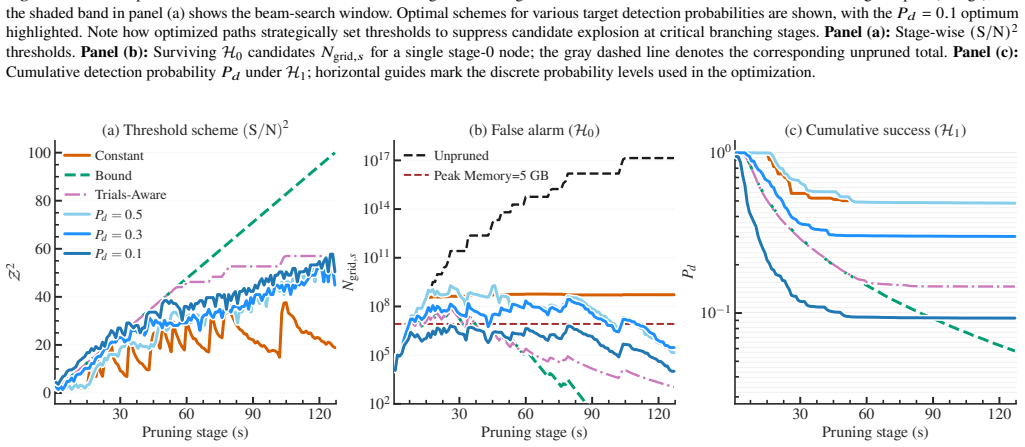
- Section 5.5, Figure 15 (right column): For the full circular-orbit search, the empirical ensemble detection probability shows a rightward shift relative to the independent-trial binomial prediction of Eq. (70), with complete recovery requiring $Z gtrsim 12$ versus the nominal $Z_t = 10$ (a ~20% threshold penalty). The paper attributes this to 'accumulated discretization effects arising from finite phase tolerance ($eta$), residual phase transport errors, and higher-dimensional tiling losses' but does not decompose the individual contributions. This matters because the abstract claims '>90% detection probability at the sensitivity threshold.' If tiling gaps from the aggressive diagonal-only scheme (Section 5.2.4) dominate the shift, this is not an implementation-level artifact but a fundamental trade-off of the chosen tiling strategy, and the headline claim should be qualified accordingly
minor comments (7)
- Section 5.2.4: The paper adopts aggressive tiling as the operational default but states that sensitivity gaps 'must then be controlled empirically, for example by tightening the search tolerance $eta$.' It would help to state whether the $eta=1.0$ used in Figure 15 already reflects such tightening, or whether additional tightening was applied for the circular-orbit benchmark.
- Section 5.4.1, paragraph on Monte Carlo framework: The resampling/duplication procedure used to maintain trial populations introduces correlations that 'slightly increases the variance of the final $P_d$ estimates.' No quantitative bound on this variance inflation is given. A brief statement of the expected magnitude would strengthen the reader's confidence in the threshold optimization.
- Section 6.2.5, Figure 18(a): The phase-trap dropouts where $P_d$ collapses near zero are noted but their impact on the ensemble detection probability is not quantified. Since these affect <5% of anchor positions, a brief statement confirming that the multi-pass ensemble with $n_{run} = 16$–$32$ is not systematically degraded by these traps would be useful.
- Table 1: The 'EP Gain' column reports orders-of-magnitude reduction relative to an 'unpruned hierarchical baseline.' It would be helpful to clarify whether this baseline includes the P-FFA data-reuse speedup (Eq. 41) or is purely brute-force folding, as this affects interpretation of the gain factor.
- Section 8.1: The projected GPU-hours for archival reprocessing (e.g., 85M GPU-hours for HTRU-S circular-orbit search) are described as 'conservative upper bounds.' The assumptions behind these estimates (number of DM trials, frequency range) should be stated explicitly for each survey entry in Table 2.
- Abstract: The claim of '3- to 5-fold improvement in sensitivity' relative to conventional acceleration searches is not directly demonstrated in the validation section. This appears to follow from the extended coherent integration time rather than an explicit injection-recovery comparison. Consider qualifying this as a projected improvement.
- Section 3.3.2: The choice of $Z_alpha$ (Eq. 18) over the statistically optimal $Z_beta$ (Eq. 19) is stated as a computational convenience. Since sensitivity claims depend on the detection statistic, a brief quantification of the suboptimality of $Z_alpha$ for the duty cycles relevant to MSPs would be informative.
Simulated Author's Rebuttal
We thank the referee for a careful and constructive report. The referee's single major comment is well-taken: the threshold shift in the full circular-orbit search is not decomposed, and the abstract claim should be qualified. We agree to revise accordingly.
read point-by-point responses
-
Referee: Section 5.5, Figure 15 (right column): For the full circular-orbit search, the empirical ensemble detection probability shows a rightward shift relative to the independent-trial binomial prediction of Eq. (70), with complete recovery requiring Z ≳ 12 versus the nominal Z_t = 10 (a ~20% threshold penalty). The paper attributes this to 'accumulated discretization effects arising from finite phase tolerance (η), residual phase transport errors, and higher-dimensional tiling losses' but does not decompose the individual contributions. This matters because the abstract claims '>90% detection probability at the sensitivity threshold.' If tiling gaps from the aggressive diagonal-only scheme (Section 5.2.4) dominate the shift, this is not an implementation-level artifact but a fundamental trade-off of the chosen tiling strategy, and the headline claim should be qualified accordingly.
Authors: The referee is correct on both counts: (1) we did not decompose the individual contributions to the threshold shift, and (2) the abstract claim '>90% detection probability at the sensitivity threshold' is not adequately qualified given the observed ~20% threshold penalty for the full circular-orbit search. We will revise the manuscript to address both issues. revision_made = 'yes' On the decomposition: we agree that attributing the shift to a generic list of effects without quantifying their relative contributions is insufficient. In the revised manuscript, we will add a controlled ablation study using the existing injection framework, isolating each contribution by toggling them independently: (a) varying η (1.0 → 0.5 → 0.25) to isolate grid discretization losses, (b) switching between time-domain and Fourier-domain folding to isolate phase-shift quantization, and (c) switching between aggressive and quadrature tiling (Section 5.2.4) to isolate tiling-gap losses. This will directly show which effects dominate. On the tiling concern specifically: the referee raises a legitimate point about whether the aggressive diagonal-only tiling is a fundamental design trade-off rather than a mere implementation artifact. We acknowledge that our current characterization of the shift as 'implementation-level' is not fully supported without the decomposition. The aggressive tiling scheme was adopted as the operational default because it is the only strategy that maintains bounded computational cost across all anchor segments (Section 5.2.4, Figure 7); the quadrature alternative inflates the branching factor by orders of magnitude and is therefore not a drop-in replacement. If the ablation confirms that tiling gaps are the dominant contributor, we will state this explicitly and frame它— revision: no
Circularity Check
No circularity found: derivation chain is self-contained with independent validation
full rationale
The paper's derivation chain is self-contained and does not exhibit circularity. The central claims rest on three pillars: (1) the pruning concept (Section 2), derived from the statistical separation of H0 and H1 distributions under coherent integration — a standard signal-processing argument; (2) the threshold optimization (Section 5.4.2), which uses Monte Carlo simulations of pruning dynamics under known noise (H0: Gaussian) and signal (H1: known injection) models to calibrate stage-dependent thresholds via Viterbi-style dynamic programming — this is standard calibration against a known forward model, not fitting to the target result; (3) the multi-pass ensemble strategy (Section 5.5), whose binomial prediction P_ensemble = 1-(1-P_d)^{n_run} (equation 70) is validated against 50 independent signal injections per configuration (Figure 15), with the paper honestly reporting a ~20% threshold shift for the circular-orbit case and attributing it to discretization effects rather than claiming perfect agreement. The complexity reduction claim (up to 10 orders of magnitude) follows directly from the algorithm's structure: exponential pruning of noise candidates versus polynomial expansion of the search grid, quantified by counting surviving candidates under the calibrated thresholds. The thresholds are calibrated on simulated H0/H1 models and applied to independent validation injections — the prediction (binomial ensemble probability) is not forced by construction. The only in-preparation self-citation (D. Gazith et al. 2026) concerns the Kadane-based boxcar scoring optimization, which is a minor implementation detail not load-bearing for any central claim. No uniqueness theorems are invoked, no ansatz is smuggled through self-citation, and no result is renamed from a known empirical pattern.
Axiom & Free-Parameter Ledger
free parameters (6)
- eta (phase tolerance) =
1.0-2.0 in benchmarks
- P_d (per-pass detection probability) =
0.05-0.10
- n_run (number of ensemble passes) =
16-32
- C_max (candidate buffer limit) =
~10^7
- T_seg (base segment duration) =
T_obs/128
- Z_t (detection threshold) =
8.2-10.0
axioms (6)
- domain assumption Noise is white and Gaussian after pre-processing
- domain assumption Signal amplitude is constant over the observation
- domain assumption Orbits are circular
- domain assumption Sky position is known to within beam uncertainty
- ad hoc to paper Pruning runs with separated anchors are statistically independent
- domain assumption Phase errors accumulate as random walk across merge stages
invented entities (3)
-
Extreme Pruning (EP) algorithm
independent evidence
-
Polynomial FFA (P-FFA)
independent evidence
-
Phase debt mechanism
no independent evidence
read the original abstract
Detecting pulsars in short-period binary systems, which are unparalleled laboratories for fundamental physics and tests of general relativity, is a prime objective of radio astronomy. Their rapid orbital motion, however, presents a formidable computational challenge. Conventional searches are therefore limited to simplified signal models (e.g., constant acceleration) that remain valid for only short integrations ($\lesssim 4$-$10$% of an orbital period). This fundamental limitation severely degrades search sensitivity, placing much of the faint, relativistic pulsar population beyond the reach of current surveys. We present a novel hierarchical search framework based on extreme pruning that overcomes these limitations by progressively eliminating improbable regions of parameter space across successive coherent integration stages. The algorithm achieves $>90$% detection probability at the sensitivity threshold, with near-unity recovery for stronger signals, while reducing the computational complexity of full circular-orbit searches by up to 10 orders of magnitude relative to an unpruned hierarchical baseline. The resulting efficiency enables, for the first time, fully coherent integration over an entire orbital period and beyond. Compared to conventional acceleration searches, the proposed method delivers a 3- to 5-fold improvement in sensitivity, dramatically increasing the discovery potential for high-value targets such as pulsar-black hole binaries.
Figures






Reference graph
Works this paper leans on
-
[1]
Allen B., et al., 2013, @doi [ ] 10.1088/0004-637X/773/2/91 , https://ui.adsabs.harvard.edu/abs/2013ApJ...773...91A 773, 91
-
[2]
Andersen B. C., Ransom S. M., 2018, @doi [ ] 10.3847/2041-8213/aad59f , https://ui.adsabs.harvard.edu/abs/2018ApJ...863L..13A 863, L13
-
[3]
C., 1970, @doi [ ] 10.1038/228042a0 , https://ui.adsabs.harvard.edu/abs/1970Natur.228...42B 228, 42
Backer D. C., 1970, @doi [ ] 10.1038/228042a0 , https://ui.adsabs.harvard.edu/abs/1970Natur.228...42B 228, 42
-
[4]
Bagchi M., Lorimer D. R., Chennamangalam J., 2011, @doi [ ] 10.1111/j.1365-2966.2011.19498.x , https://ui.adsabs.harvard.edu/abs/2011MNRAS.418..477B 418, 477
-
[5]
Bagchi M., Lorimer D. R., Wolfe S., 2013, @doi [ ] 10.1093/mnras/stt559 , https://ui.adsabs.harvard.edu/abs/2013MNRAS.432.1303B 432, 1303
-
[6]
Bagchi M., et al., 2025, @doi [The Open Journal of Astrophysics] 10.33232/001c.154251 , https://ui.adsabs.harvard.edu/abs/2025OJAp....854251B 8, 54251
-
[7]
Balakrishnan V., Champion D., Barr E., Kramer M., Venkatraman Krishnan V., Eatough R. P., Sengar R., Bailes M., 2022, @doi [ ] 10.1093/mnras/stab3746 , https://ui.adsabs.harvard.edu/abs/2022MNRAS.511.1265B 511, 1265
-
[8]
Barr E., 2020, Peasoup: C++/CUDA GPU pulsar searching library , Astrophysics Source Code Library, record ascl:2001.014 ( @eprint ascl 2001.014 )
work page 2020
-
[9]
Bates S. D., Lorimer D. R., Verbiest J. P. W., 2013, @doi [ ] 10.1093/mnras/stt257 , https://ui.adsabs.harvard.edu/abs/2013MNRAS.431.1352B 431, 1352
-
[10]
Princeton University Press, Princeton
Bellman R., 1957, Dynamic Programming . Princeton University Press, Princeton
work page 1957
-
[11]
https://github.com/NVIDIA/cccl
CCCL Development Team 2023, CCCL : CUDA C++ C ore L ibraries. https://github.com/NVIDIA/cccl
work page 2023
-
[12]
Cadelano M., Ransom S. M., Freire P. C. C., Ferraro F. R., Hessels J. W. T., Lanzoni B., Pallanca C., Stairs I. H., 2018, @doi [ ] 10.3847/1538-4357/aaac2a , https://ui.adsabs.harvard.edu/abs/2018ApJ...855..125C 855, 125
-
[13]
Cameron A. D., Barr E. D., Champion D. J., Kramer M., Zhu W. W., 2017, @doi [ ] 10.1093/mnras/stx589 , https://ui.adsabs.harvard.edu/abs/2017MNRAS.468.1994C 468, 1994
-
[14]
Chennamangalam J., Lorimer D. R., Mandel I., Bagchi M., 2013, @doi [ ] 10.1093/mnras/stt205 , https://ui.adsabs.harvard.edu/abs/2013MNRAS.431..874C 431, 874
-
[15]
Dunning A., et al., 2023, in 2023 IEEE International Symposium on Antennas and Propagation and USNC-URSI Radio Science Meeting (USNC-URSI). 2023 IEEE International Symposium on Antennas and Propagation and USNC-URSI Radio Science Meeting (USNC-URSI). pp 757--758, @doi 10.1109/USNC-URSI52151.2023.10238280
-
[16]
Eatough R. P., Kramer M., Lyne A. G., Keith M. J., 2013, @doi [ ] 10.1093/mnras/stt161 , https://ui.adsabs.harvard.edu/abs/2013MNRAS.431..292E 431, 292
-
[17]
doi:10.1111/j.1365-2966.2004.07942.x , journal=
Faulkner A. J., et al., 2004, @doi [ ] 10.1111/j.1365-2966.2004.08310.x , https://ui.adsabs.harvard.edu/abs/2004MNRAS.355..147F 355, 147
-
[18]
G., 2005, @doi [Proceedings of the IEEE] 10.1109/JPROC.2004.840301 , 93, 216
Frigo M., Johnson S. G., 2005, @doi [Proceedings of the IEEE] 10.1109/JPROC.2004.840301 , 93, 216
-
[19]
Fruchter A. S., Stinebring D. R., Taylor J. H., 1988, @doi [ ] 10.1038/333237a0 , https://ui.adsabs.harvard.edu/abs/1988Natur.333..237F 333, 237
-
[20]
Q., Regev O., 2010, in Gilbert H., ed., Advances in Cryptology - EUROCRYPT 2010 Vol
Gama N., Nguyen P. Q., Regev O., 2010, in Gilbert H., ed., Advances in Cryptology - EUROCRYPT 2010 Vol. 6110, Advances in Cryptology - EUROCRYPT 2010 . Springer Berlin Heidelberg, Berlin, Heidelberg, pp 257--278, @doi 10.1007/978-3-642-13190-5_13
-
[21]
Hallinan G., et al., 2019, in Bulletin of the American Astronomical Society. p. 255 ( @eprint arXiv 1907.07648 ), @doi 10.48550/arXiv.1907.07648
work page internal anchor Pith review Pith/arXiv arXiv doi:10.48550/arxiv.1907.07648 2019
-
[22]
Han J. L., et al., 2021, @doi [Research in Astronomy and Astrophysics] 10.1088/1674-4527/21/5/107 , https://ui.adsabs.harvard.edu/abs/2021RAA....21..107H 21, 107
-
[23]
Han J. L., et al., 2025, @doi [Research in Astronomy and Astrophysics] 10.1088/1674-4527/ada3b7 , https://ui.adsabs.harvard.edu/abs/2025RAA....25a4001H 25, 014001
-
[24]
Harris C. R., et al., 2020, @doi [ ] 10.1038/s41586-020-2649-2 , https://ui-adsabs-harvard-edu.ezproxy.lib.swin.edu.au/abs/2020Natur.585..357H 585, 357
-
[25]
577, Blockchain Technology and Emerging Applications
He E., Xu T., Wu M., Chen J., Yao S., Li P., 2024, in Chen J., Xia Z., eds, Blockchain Technology and Emerging Applications Vol. 577, Blockchain Technology and Emerging Applications. Springer Nature Switzerland, Cham, pp 57--76, @doi 10.1007/978-3-031-60037-1_4
-
[26]
Hessels J. W. T., Ransom S. M., Stairs I. H., Freire P. C. C., Kaspi V. M., Camilo F., 2006, @doi [Science] 10.1126/science.1123430 , https://ui.adsabs.harvard.edu/abs/2006Sci...311.1901H 311, 1901
-
[27]
Hulse R. A., Taylor J. H., 1975, @doi [ ] 10.1086/181708 , https://ui.adsabs.harvard.edu/abs/1975ApJ...195L..51H 195, L51
-
[28]
Computing in Science and Engineering , keywords =
Hunter J. D., 2007, @doi [Computing in Science and Engineering] 10.1109/MCSE.2007.55 , https://ui-adsabs-harvard-edu.ezproxy.lib.swin.edu.au/abs/2007CSE.....9...90H 9, 90
-
[29]
Jankowski F., van Straten W., Keane E. F., Bailes M., Barr E. D., Johnston S., Kerr M., 2018, @doi [ ] 10.1093/mnras/stx2476 , https://ui.adsabs.harvard.edu/abs/2018MNRAS.473.4436J 473, 4436
-
[30]
Johnston H. M., Kulkarni S. R., 1991, @doi [ ] 10.1086/169715 , https://ui.adsabs.harvard.edu/abs/1991ApJ...368..504J 368, 504
-
[31]
Joshi K. J., Rasio F. A., 1997, @doi [ ] 10.1086/303916 , https://ui.adsabs.harvard.edu/abs/1997ApJ...479..948J 479, 948
-
[32]
Jouteux S., Ramachandran R., Stappers B. W., Jonker P. G., van der Klis M., 2002, @doi [ ] 10.1051/0004-6361:20020052 , https://ui.adsabs.harvard.edu/abs/2002A&A...384..532J 384, 532
-
[33]
B., 2023, @doi [Algorithms] 10.3390/a16110519 , 16
Kadane J. B., 2023, @doi [Algorithms] 10.3390/a16110519 , 16
-
[34]
The Open Journal of Astrophysics , keywords =
Keane E. F., et al., 2025, @doi [The Open Journal of Astrophysics] 10.33232/001c.154256 , https://ui.adsabs.harvard.edu/abs/2025OJAp....854256K 8, 54256
-
[35]
Keith M. J., et al., 2010, @doi [ ] 10.1111/j.1365-2966.2010.17325.x , https://ui.adsabs.harvard.edu/abs/2010MNRAS.409..619K 409, 619
-
[36]
Knispel B., et al., 2013, @doi [ ] 10.1088/0004-637X/774/2/93 , https://ui.adsabs.harvard.edu/abs/2013ApJ...774...93K 774, 93
-
[37]
Kondratiev V. I., McLaughlin M. A., Lorimer D. R., Burgay M., Possenti A., Turolla R., Popov S. B., Zane S., 2009, @doi [ ] 10.1088/0004-637X/702/1/692 , https://ui.adsabs.harvard.edu/abs/2009ApJ...702..692K 702, 692
-
[38]
Kramer M., et al., 2006, @doi [Science] 10.1126/science.1132305 , https://ui.adsabs.harvard.edu/abs/2006Sci...314...97K 314, 97
-
[39]
Lam S. K., Pitrou A., Seibert S., 2015, in Proc. Second Workshop on the LLVM Compiler Infrastructure in HPC. Proc. Second Workshop on the LLVM Compiler Infrastructure in HPC. pp 1--6, @doi 10.1145/2833157.2833162
-
[40]
Levin L., et al., 2018, in Weltevrede P., Perera B. B. P., Preston L. L., Sanidas S., eds, IAU Symposium Vol. 337, Pulsar Astrophysics the Next Fifty Years. pp 171--174 ( @eprint arXiv 1712.01008 ), @doi 10.1017/S1743921317009528
work page internal anchor Pith review Pith/arXiv arXiv doi:10.1017/s1743921317009528 2018
-
[41]
Levin L., et al., 2025, @doi [The Open Journal of Astrophysics] 10.33232/001c.154653 , https://ui.adsabs.harvard.edu/abs/2025OJAp....854653L 8, 54653
-
[42]
Lorimer D. R., 2008, @doi [Living Reviews in Relativity] 10.12942/lrr-2008-8 , https://ui.adsabs.harvard.edu/abs/2008LRR....11....8L 11, 8
-
[43]
R., Kramer M., 2004, Handbook of Pulsar Astronomy
Lorimer D. R., Kramer M., 2004, Handbook of Pulsar Astronomy . Cambridge Observing Handbooks for Research Astronomers Vol. 4, Cambridge University Press
work page 2004
-
[44]
Lovelace R. V. E., Sutton J. M., 1969, @doi [ ] 10.1038/222231a0 , https://ui.adsabs.harvard.edu/abs/1969Natur.222..231L 222, 231
-
[45]
Manchester R. N., et al., 2001, @doi [ ] 10.1046/j.1365-8711.2001.04751.x , https://ui.adsabs.harvard.edu/abs/2001MNRAS.328...17M 328, 17
-
[46]
Martsen A. R., et al., 2022, @doi [ ] 10.3847/1538-4357/aca156 , https://ui.adsabs.harvard.edu/abs/2022ApJ...941...22M 941, 22
-
[47]
C., 2002, Chebyshev Polynomials
Mason J., Handscomb D. C., 2002, Chebyshev Polynomials. Chapman and Hall/CRC, @doi 10.1201/9781420036114 , http://dx.doi.org/10.1201/9781420036114
-
[48]
Men Y., Barr E., Clark C. J., Carli E., Desvignes G., 2023, @doi [ ] 10.1051/0004-6361/202347356 , https://ui.adsabs.harvard.edu/abs/2023A&A...679A..20M 679, A20
-
[49]
Morello V., et al., 2019, @doi [ ] 10.1093/mnras/sty3328 , https://ui.adsabs.harvard.edu/abs/2019MNRAS.483.3673M 483, 3673
-
[50]
Morello V., Barr E. D., Stappers B. W., Keane E. F., Lyne A. G., 2020, @doi [ ] 10.1093/mnras/staa2291 , https://ui.adsabs.harvard.edu/abs/2020MNRAS.497.4654M 497, 4654
-
[51]
Nieder L., Allen B., Clark C. J., Pletsch H. J., 2020, @doi [ ] 10.3847/1538-4357/abaf53 , https://ui.adsabs.harvard.edu/abs/2020ApJ...901..156N 901, 156
-
[52]
\"O zel F., Freire P., 2016, @doi [ ] 10.1146/annurev-astro-081915-023322 , https://ui.adsabs.harvard.edu/abs/2016ARA&A..54..401O 54, 401
-
[53]
Padmanabh P. V., et al., 2023, @doi [ ] 10.1093/mnras/stad1900 , https://ui.adsabs.harvard.edu/abs/2023MNRAS.524.1291P 524, 1291
-
[54]
Padmanabh P. V., et al., 2024, @doi [ ] 10.1051/0004-6361/202449303 , https://ui.adsabs.harvard.edu/abs/2024A&A...686A.166P 686, A166
-
[55]
Parent E., et al., 2018, @doi [ ] 10.3847/1538-4357/aac5f0 , https://ui.adsabs.harvard.edu/abs/2018ApJ...861...44P 861, 44
-
[56]
Pearlman A. B., 2021, PhD thesis, California Institute of Technology, Division of Physics, Mathematics and Astronomy
work page 2021
-
[57]
Phinney E. S., 1992, @doi [Philosophical Transactions of the Royal Society of London Series A] 10.1098/rsta.1992.0084 , https://ui.adsabs.harvard.edu/abs/1992RSPTA.341...39P 341, 39
-
[58]
Ransom S., 2011, PRESTO: PulsaR Exploration and Search TOolkit , Astrophysics Source Code Library, record ascl:1107.017 ( @eprint ascl 1107.017 )
work page 2011
-
[59]
Fourier Techniques for Very Long Astrophysical Time Series Analysis
Ransom S. M., Eikenberry S. S., Middleditch J., 2002, @doi [ ] 10.1086/342285 , https://ui.adsabs.harvard.edu/abs/2002AJ....124.1788R 124, 1788
work page internal anchor Pith review doi:10.1086/342285 2002
-
[60]
Ransom S. M., Cordes J. M., Eikenberry S. S., 2003, @doi [ ] 10.1086/374806 , https://ui.adsabs.harvard.edu/abs/2003ApJ...589..911R 589, 911
-
[61]
Rickett B. J., 1990, @doi [ ] 10.1146/annurev.aa.28.090190.003021 , https://ui.adsabs.harvard.edu/abs/1990ARA&A..28..561R 28, 561
-
[62]
Roberts M. S. E., 2013, in van Leeuwen J., ed., IAU Symposium Vol. 291, Neutron Stars and Pulsars: Challenges and Opportunities after 80 years. pp 127--132 ( @eprint arXiv 1210.6903 ), @doi 10.1017/S174392131202337X
work page internal anchor Pith review Pith/arXiv arXiv doi:10.1017/s174392131202337x 2013
-
[63]
Sanidas S., et al., 2019, @doi [ ] 10.1051/0004-6361/201935609 , https://ui.adsabs.harvard.edu/abs/2019A&A...626A.104S 626, A104
-
[64]
Sengar R., et al., 2023, @doi [ ] 10.1093/mnras/stad508 , https://ui.adsabs.harvard.edu/abs/2023MNRAS.522.1071S 522, 1071
-
[65]
Sengar R., et al., 2025, @doi [ ] 10.1093/mnras/stae2716 , https://ui.adsabs.harvard.edu/abs/2025MNRAS.536.3159S 536, 3159
-
[66]
Shahaf S., Zackay B., Mazeh T., Faigler S., Ivashtenko O., 2022, @doi [ ] 10.1093/mnras/stac960 , https://ui.adsabs.harvard.edu/abs/2022MNRAS.513.2732S 513, 2732
-
[67]
Sheikh S. Z., MacDonald M. G., 2021, @doi [ ] 10.1093/mnras/stab282 , https://ui.adsabs.harvard.edu/abs/2021MNRAS.502.4669S 502, 4669
-
[68]
New algorithms for radio pulsar search
Smith K. M., 2016, @doi [arXiv e-prints] 10.48550/arXiv.1610.06831 , https://ui.adsabs.harvard.edu/abs/2016arXiv161006831S p. arXiv:1610.06831
work page internal anchor Pith review Pith/arXiv arXiv doi:10.48550/arxiv.1610.06831 2016
-
[69]
Sparre Andersen E., 1954, @doi [Mathematica Scandinavica] 10.7146/math.scand.a-10407 , 2, 195
-
[70]
Staelin D. H., 1969, @doi [IEEE Proceedings] 10.1109/PROC.1969.7051 , https://ui.adsabs.harvard.edu/abs/1969IEEEP..57..724S 57, 724
-
[71]
Stappers B., Kramer M., 2016, in MeerKAT Science: On the Pathway to the SKA. p. 9, @doi 10.22323/1.277.0009
-
[72]
Physics of Binary Star Evolution -- from Stars to X-ray Binaries and Gravitational Wave Sources
Tauris T. M., van den Heuvel E. P. J., 2023, Physics of Binary Star Evolution. From Stars to X-ray Binaries and Gravitational Wave Sources . Princeton University Press, @doi 10.48550/arXiv.2305.09388
work page internal anchor Pith review Pith/arXiv arXiv doi:10.48550/arxiv.2305.09388 2023
-
[73]
Thompson C., Blandford R. D., Evans C. R., Phinney E. S., 1994, @doi [ ] 10.1086/173728 , https://ui.adsabs.harvard.edu/abs/1994ApJ...422..304T 422, 304
-
[74]
Turk P. J., Lorimer D. R., 2013, @doi [ ] 10.1093/mnras/stt1850 , https://ui.adsabs.harvard.edu/abs/2013MNRAS.436.3720T 436, 3720
-
[75]
Viterbi A., 1967, @doi [IEEE Transactions on Information Theory] 10.1109/TIT.1967.1054010 , 13, 260
-
[76]
Testing Relativistic Gravity with Radio Pulsars
Wex N., 2014, @doi [arXiv e-prints] 10.48550/arXiv.1402.5594 , https://ui.adsabs.harvard.edu/abs/2014arXiv1402.5594W p. arXiv:1402.5594
work page internal anchor Pith review Pith/arXiv arXiv doi:10.48550/arxiv.1402.5594 2014
-
[77]
Roofline: an insightful visual perfor- mance model for multicore architectures,
Williams S., Waterman A., Patterson D., 2009, @doi [Commun. ACM] 10.1145/1498765.1498785 , 52, 65–76
-
[78]
Wood K. S., et al., 1991, @doi [ ] 10.1086/170505 , https://ui.adsabs.harvard.edu/abs/1991ApJ...379..295W 379, 295
discussion (0)
Sign in with ORCID, Apple, or X to comment. Anyone can read and Pith papers without signing in.