REVIEW 2 major objections 7 minor 299 references
AI formal math systems must stop acting as competition solvers and become research agents that can tackle open, under-specified frontier problems with machine-checked reasoning.
Reviewed by Pith at T0; open to challenge. T0 means a machine referee read the full paper against a public rubric. the ladder, T0–T4 →
T0 review · grok-4.5
2026-07-10 18:15 UTC pith:2WNC2JY2
load-bearing objection Solid, high-signal position paper: clean taxonomy plus the first structured six-category snapshot of AI work on Erdős problems; the five-pillar roadmap is useful advocacy, not a new theorem. the 2 major comments →
From Solvers to Research: Large Language Model-Driven Formal Mathematics at the Research Frontier
The pith
A machine-rendered reading of the paper's core claim, the machinery that carries it, and where it could break.
Core claim
The central claim is that the next leap in AI for formal mathematics is not another incremental solver for predefined problems, but a decisive shift to research agents that can address open-ended, under-specified frontier challenges under rigorous interactive theorem proving. Current systems excel at isolated, well-defined proof generation and have largely saturated MiniF2F and reached medal-level IMO performance, yet their contributions to open Erdős problems are mostly literature review, formalization, or rediscovery of known results rather than genuine discovery. Closing five structural gaps—data and evaluation, relational structure, mathematical exploration, tool integration, and human-A
What carries the argument
The five strategic pillars that separate competition solvers from research agents: (1) limitations of formal math data and fidelity-aware evaluation, (2) shifting from isolated proofs to deep relational structure and knowledge graphs, (3) evolving from verification to discovery and conjecturing, (4) external tool integration with certificate reconstruction, and (5) human-AI collaboration with explainable interaction.
Load-bearing premise
The paper assumes that these five barriers are the main obstacles, and that closing them will be enough to turn today's solvers into genuine research-level agents rather than merely stronger competition provers.
What would settle it
A sustained series of AI-primary full solutions to long-standing open problems (for example several Erdős problems with no prior known work, or a non-trivial Millennium-adjacent result) that introduce new concepts or constructions, pass independent statement-fidelity checks against the original informal claims, and are accepted by working mathematicians as novel—without the solutions later collapsing into rediscovery or weakened formalizations.
Editorial analysis
A structured set of objections, weighed in public.
Referee Report
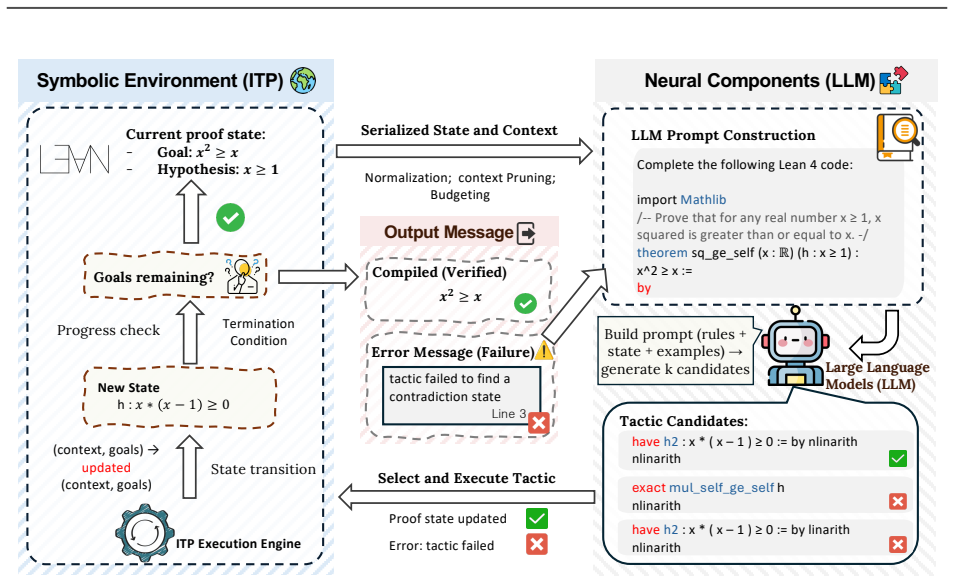
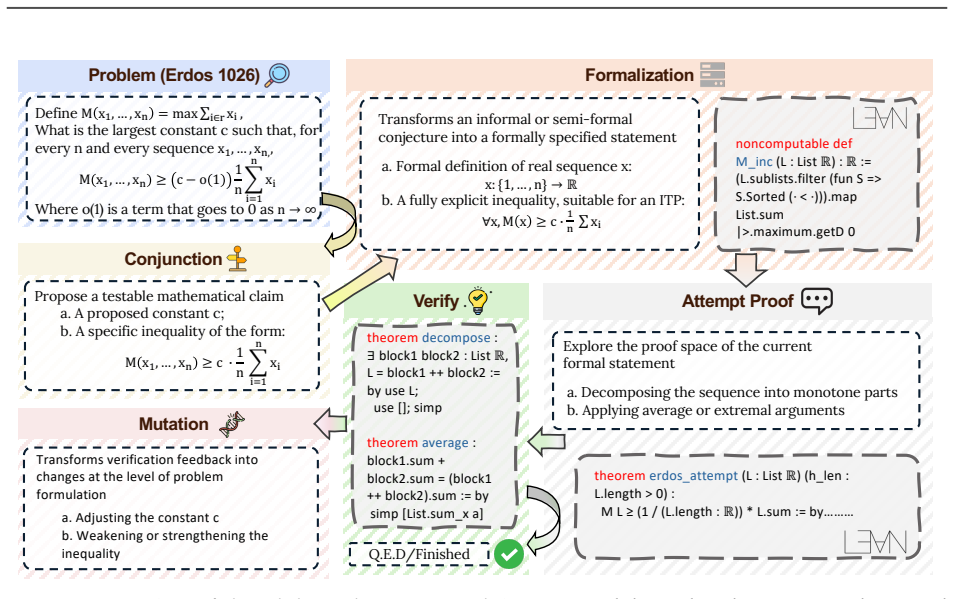
Summary. This position paper argues that LLM-driven formal mathematics has largely produced competition-style solvers and must shift toward research agents capable of open-ended discovery under machine-checked reasoning. It surveys foundations (ITPs, foundation models, autoformalization, standard neuro-symbolic workflows), offers a taxonomy of training, test-time, and agentic methods, and documents the empirical landscape via MiniF2F saturation, IMO-level results, a categorized compilation of AI contributions to Erdős problems (Table 6, Figure 6), and canonical open-problem lists (Table 7). It then identifies five barriers—formal data/evaluation fidelity, relational structure, exploration/discovery, tool ecosystems, and human–AI collaboration—and sketches a roadmap including synthetic curricula, knowledge graphs, evolutionary conjecturing, certificate-producing tools, and collaborative interfaces.
Significance. As a position paper the contribution is synthetic and agenda-setting rather than a new theorem or system. Its value lies in a coherent taxonomy that connects datasets, autoformalization, training, search, and agent workflows; a structured, caveat-aware snapshot of AI activity on genuine open Erdős problems (including selection bias, rediscovery, and the Aristotle #124 specification-fidelity failure); and a concrete five-pillar roadmap that is actionable for the community. Strengths include explicit caveats on selection bias and statement fidelity, extensive comparative tables (Tables 1–7), and concrete failure case studies in the appendix. If the field adopts the framing, the paper can usefully reorient evaluation and system design away from saturated competition benchmarks toward research-grade formal agents.
major comments (2)
- §5 opening and the five pillars: the central advocacy claim treats the five barriers as the primary load-bearing obstacles separating solvers from research agents. The manuscript does not provide a comparative argument that these five dominate alternatives (e.g., compute scale, pure informal LRMs, or domain-specific formalization campaigns). A short subsection that either (i) justifies primacy relative to plausible alternatives or (ii) explicitly frames the five as a working agenda rather than a complete causal account would make the roadmap more defensible without changing the paper’s position-paper character.
- §4.3, Table 6 and Figure 6: the Erdős compilation is a major empirical pillar, yet counts are approximate, multi-category, and drawn from a community wiki with ongoing updates. The text already notes selection bias and rediscovery, but the table/figure presentation still risks being read as a success-rate claim. Adding an explicit denominator (attempted vs. reported), a snapshot date, and a short protocol for inclusion/exclusion would make this evidence load-bearing rather than anecdotal while preserving the qualitative shift the authors correctly emphasize.
minor comments (7)
- Abstract and §1: ‘has achieved’ / subject–verb agreement and a few other small grammar issues (e.g., ‘decisiveshift’) should be cleaned for journal style.
- Table 1: ‘samlpes’ typo; also clarify whether pretraining token counts are comparable across formal vs. informal corpora given different tokenization.
- Table 5 / IMO notes: ‘sovled’ typos and inconsistent date/source footnotes; align with the MathArena and system-card citations already used.
- §2.5 vs. §2.6: autoformalization is introduced twice with overlapping content; a single consolidated subsection would improve flow.
- Figure 6 caption cites ‘as of April 14, 2026’ while Table 6 says ‘as of January 2026’; reconcile snapshot dates.
- §5.4 invents ‘Proof Agent Interface Protocol (PAIP)’ without a minimal interface sketch or comparison to existing MCP/LeanDojo-style APIs; a short box or appendix outline would make the proposal less free-floating.
- Appendix C case studies are strong; cross-reference them more explicitly from §5.1 so the specification-fidelity argument is not only in the main text’s Aristotle example.
Circularity Check
No circularity: position paper with no derivation that reduces to its inputs by construction.
full rationale
This is a position paper advocating a shift from competition-style solvers to research agents and surveying datasets, autoformalization, proof synthesis, and five open challenges. It advances no theorem, fitted parameter, uniqueness claim, or first-principles prediction whose validity is forced by its own definitions or by a self-citation chain. Empirical material (MiniF2F saturation, IMO scores, Erdős contribution tallies) is drawn from external systems, public community trackers, and independent reports; the authors themselves flag selection bias and specification-fidelity failures (e.g., Aristotle on a weakened #124). Self-citations appear only as ordinary literature pointers within a broad survey and are not load-bearing for any claimed derivation. There is therefore no circular step to report.
Axiom & Free-Parameter Ledger
axioms (3)
- domain assumption Machine-checkable formal proofs are a prerequisite for trustworthy autonomous mathematical research agents.
- ad hoc to paper The five barriers (data, relational structure, exploration, tools, human–AI collaboration) are the primary obstacles separating competition solvers from research agents.
- domain assumption Current AI ‘solutions’ to many Erdős problems largely rediscover literature results rather than produce genuinely novel mathematics.
invented entities (2)
-
Proof Agent Interface Protocol (PAIP)
no independent evidence
-
Mathematical research agents (as a system class)
no independent evidence
read the original abstract
Recent developments in AI for Mathematics (AI4Math), especially Large Language Model (LLM)-driven theorem provers, has achieved remarkable success in formal proof generation for well-defined mathematical problems through Interactive Theorem Proving (ITP) languages. However, current systems remain fundamentally limited in tackling frontier research mathematics, such as discovering new theorems or resolving open conjectures, which are often open-ended, under-specified, and involve multiple layers of abstraction. We argue that the next leap in AI4Math systems requires a decisive shift from predefined problem-solvers to research agents that can address frontier mathematical challenges with rigorous formal mathematical reasoning. In this position paper, we provide a systematic review of the field, covering datasets, auto-formalization, and proof synthesis. More importantly, we identify core limitations of existing systems in serving as mathematical research agents, examining issues across datasets, relational structure, mathematical exploration, tool ecosystem, and human-AI collaboration, outlining a strategic road-map for the future of AI4Math.
Figures




Reference graph
Works this paper leans on
-
[1]
Ibrahim Abdelaziz, Maxwell Crouse, Bassem Makni, Vernon Austel, Cristina Cornelio, Shajith Ikbal, Pavan Kapanipathi, Ndivhuwo Makondo, Kavitha Srinivas, Michael Witbrock, et al. Learning to guide a saturation-based theorem prover.IEEE Transactions on Pattern Analysis and Machine Intelligence, 45(1): 738–751, 2022
work page 2022
-
[2]
Blumberg, Martin Hairer, Joe Kileel, Tamara G
Mohammed Abouzaid, Andrew J. Blumberg, Martin Hairer, Joe Kileel, Tamara G. Kolda, Paul D. Nelson, Daniel Spielman, Nikhil Srivastava, Rachel Ward, Shmuel Weinberger, and Lauren Williams. First proof.arXiv preprint arXiv:2602.05192, 2026
-
[3]
Josh Achiam, Steven Adler, Sandhini Agarwal, Lama Ahmad, Ilge Akkaya, Florencia Leoni Aleman, Diogo Almeida, Janko Altenschmidt, Sam Altman, Shyamal Anadkat, et al. Gpt-4 technical report. arXiv preprint arXiv:2303.08774, 2023
work page internal anchor Pith review Pith/arXiv arXiv 2023
-
[4]
Aristotle: IMO-level Automated Theorem Proving
Tudor Achim, Alex Best, Alberto Bietti, Kevin Der, Mathïs Fédérico, Sergei Gukov, Daniel Halpern- Leistner, Kirsten Henningsgard, Yury Kudryashov, Alexander Meiburg, et al. Aristotle: Imo-level automated theorem proving.arXiv preprint arXiv:2510.01346, 2025
work page internal anchor Pith review Pith/arXiv arXiv 2025
-
[5]
Improver: Agent-based automated proof optimization
Riyaz Ahuja, Jeremy Avigad, Prasad Tetali, and Sean Welleck. Improver: Agent-based automated proof optimization. InThe Thirteenth International Conference on Learning Representations, ICLR 2025, Singapore, April 24-28, 2025. OpenReview.net, 2025. URLhttps://openreview.net/forum?id=dWsdJAXjQD
work page 2025
-
[6]
Proofnet++: A neuro-symbolic system for formal proof verification with self-correction, 2025
Murari Ambati. Proofnet++: A neuro-symbolic system for formal proof verification with self-correction, 2025
work page 2025
-
[7]
Claude 3.5 sonnet model card addendum
Anthropic. Claude 3.5 sonnet model card addendum. https://www.anthropic.com, 2024. Accessed: November 28, 2024
work page 2024
-
[8]
Claude opus 4 & claude sonnet 4 system card
Anthropic. Claude opus 4 & claude sonnet 4 system card. Anthropic Technical Report, 2025
work page 2025
- [9]
-
[10]
A formally verified proof of the central limit theorem
Jeremy Avigad, Johannes Hölzl, and Luke Serafin. A formally verified proof of the central limit theorem. Journal of Automated Reasoning, 59(4):389–423, 2017
work page 2017
-
[11]
An answer to hellman: Category theory is a framework for mathematical structuralism
Steve Awodey. An answer to hellman: Category theory is a framework for mathematical structuralism. Philosophia Mathematica, 2004
work page 2004
-
[12]
Ayers, Dragomir Radev, and Jeremy Avigad
Zhangir Azerbayev, Bartosz Piotrowski, Hailey Schoelkopf, Edward W. Ayers, Dragomir Radev, and Jeremy Avigad. Proofnet: Autoformalizing and formally proving undergraduate-level mathematics, 2023
work page 2023
-
[13]
Llemma: An Open Language Model For Mathematics
Zhangir Azerbayev, Hailey Schoelkopf, Keiran Paster, Marco Dos Santos, Stephen McAleer, Albert Q Jiang, Jia Deng, Stella Biderman, and Sean Welleck. Llemma: An open language model for mathematics. arXiv preprint arXiv:2310.10631, 2024
work page internal anchor Pith review Pith/arXiv arXiv 2024
-
[14]
Neural operators for accelerating scientific simulations and design.Nature Reviews Physics, 2024
Kamyar Azizzadenesheli, Nikola Kovachki, Zongyi Li, Miguel Liu-Schiaffini, Jean Kossaifi, and Anima Anandkumar. Neural operators for accelerating scientific simulations and design.Nature Reviews Physics, 2024
work page 2024
-
[15]
Kaito Baba, Chaoran Liu, Shuhei Kurita, and Akiyoshi Sannai. Prover agent: An agent-based framework for formal mathematical proofs.arXiv preprint arXiv:2506.19923, 2025
-
[16]
Kimi K2: Open Agentic Intelligence
Yifan Bai, Yiping Bao, Guanduo Chen, et al. Kimi k2: Open agentic intelligence.arXiv preprint arXiv:2507.20534, 2025
work page internal anchor Pith review Pith/arXiv arXiv 2025
-
[17]
Gagan Bansal, Besmira Nushi, Ece Kamar, Daniel S Weld, Walter S Lasecki, and Eric Horvitz. Beyond accuracy: The role of mental models in human-ai team performance.AAAI Conference on Human Computation and Crowdsourcing, 2019
work page 2019
-
[18]
Kshitij Bansal, Sarah M Loos, Markus N Rabe, Christian Szegedy, and Stewart Wilcox. Holist: An environment for machine learning of higher-order theorem proving.International Conference on Machine Learning, pp. 454–463, 2019. 22
work page 2019
-
[19]
Better smt proofs for easier reconstruction
Haniel Barbosa, Jasmin Christian Blanchette, Mathias Fleury, Pascal Fontaine, and Hans-Jörg Schurr. Better smt proofs for easier reconstruction. InAITP 2019-4th Conference on Artificial Intelligence and Theorem Proving, 2019
work page 2019
-
[20]
cvc5: A versatile and industrial-strength smt solver
Haniel Barbosa, Clark Barrett, Martin Brain, Gereon Kremer, Hanna Lachnitt, Makai Mann, Abdal- rhman Mohamed, Mudathir Mohamed, Aina Niemetz, Andres Nötzli, et al. cvc5: A versatile and industrial-strength smt solver. InInternational Conference on Tools and Algorithms for the Construction and Analysis of Systems, 2022
work page 2022
-
[21]
Irrationality of rapidly converging series: a problem of Erd\H{o}s and Graham
Kevin Barreto, Jiwon Kang, Sang-hyun Kim, Vjekoslav Kovaˇ c, and Shengtong Zhang. Irrationality of rapidly converging series: A problem of Erd˝ os and Graham.arXiv preprint arXiv:2601.21442, 2026
work page internal anchor Pith review Pith/arXiv arXiv 2026
-
[22]
Springer Science & Business Media, 2013
Yves Bertot and Pierre Castéran.Interactive Theorem Proving and Program Development: Coq’Art: The Calculus of Inductive Constructions. Springer Science & Business Media, 2013
work page 2013
-
[23]
Graph of thoughts: Solving elaborate problems with large language models.AAAI, 2024
Maciej Besta, Nils Blach, Ales Kubicek, Robert Gerstenberger, Michal Podstawski, Lukas Gianinazzi, Joanna Gajda, Tomasz Lehmann, Hubert Niewiadomski, Piotr Nyczyk, et al. Graph of thoughts: Solving elaborate problems with large language models.AAAI, 2024
work page 2024
-
[24]
Rong Bian, Yu Geng, Zijian Yang, and Bing Cheng. Automathkg: The automated mathematical knowledge graph based on llm and vector database.Computational Intelligence, 41(4):e70096, 2025
work page 2025
-
[25]
Hammering towards qed.Journal of Formalized Reasoning, 9(1):101–148, 2016
Jasmin Christian Blanchette, Cezary Kaliszyk, Lawrence C Paulson, and Josef Urban. Hammering towards qed.Journal of Formalized Reasoning, 9(1):101–148, 2016
work page 2016
- [26]
-
[27]
Steven L Brunton and J Nathan Kutz. Promising directions of machine learning for partial differential equations.Nature Computational Science, 2024
work page 2024
-
[28]
Reviving DSP for Advanced Theorem Proving in the Era of Reasoning Models
Chenrui Cao, Liangcheng Song, Zenan Li, Xinyi Le, Xian Zhang, Hui Xue, and Fan Yang. Reviving dsp for advanced theorem proving in the era of reasoning models.arXiv preprint arXiv:2506.11487, 2025
work page internal anchor Pith review Pith/arXiv arXiv 2025
-
[29]
American Mathematical Society, 2006
James Carlson, Arthur Jaffe, and Andrew Wiles.The Millennium Prize Problems. American Mathematical Society, 2006
work page 2006
-
[30]
Anti-unification and Generalization: A Survey
David M Cerna and Temur Kutsia. Anti-unification and generalization: a survey.arXiv preprint arXiv:2302.00277, 2023
work page internal anchor Pith review Pith/arXiv arXiv 2023
-
[31]
Guoxin Chen, Jing Wu, Xinjie Chen, Wayne Xin Zhao, Ruihua Song, Chengxi Li, Kai Fan, Dayiheng Liu, and Minpeng Liao. Reform: Reflective autoformalization with prospective bounded sequence optimization.arXiv preprint arXiv:2510.24592, 2025
-
[32]
Seed-prover 1.5: Mastering undergraduate-level theorem proving via learning from experience, 2025
Jiangjie Chen, Wenxiang Chen, Jiacheng Du, Jinyi Hu, Zhicheng Jiang, Allan Jie, Xiaoran Jin, Xing Jin, Chenggang Li, Wenlei Shi, Zhihong Wang, Mingxuan Wang, Chenrui Wei, Shufa Wei, Huajian Xin, Fan Yang, Weihao Gao, Zheng Yuan, Tianyang Zhan, Zeyu Zheng, Tianxi Zhou, and Thomas Hanwen Zhu. Seed-prover 1.5: Mastering undergraduate-level theorem proving vi...
work page 2025
-
[33]
Jiaqi Chen, Jianheng Tang, Jinghui Qin, Xiaodan Liang, Lingbo Liu, Eric P Xing, and Liang Lin. Geoqa: A geometric question answering benchmark towards multimodal numerical reasoning.ACL Findings, 2021
work page 2021
-
[34]
Seed-Prover: Deep and Broad Reasoning for Automated Theorem Proving
Luoxin Chen, Jinming Gu, Liankai Huang, Wenhao Huang, Zhicheng Jiang, Allan Jie, Xiaoran Jin, Xing Jin, Chenggang Li, Kaijing Ma, Cheng Ren, Jiawei Shen, Wenlei Shi, Tong Sun, He Sun, Jiahui Wang, Siran Wang, Zhihong Wang, Chenrui Wei, Shufa Wei, Yonghui Wu, Yuchen Wu, Yihang Xia, Huajian Xin, Fan Yang, Huaiyuan Ying, Hongyi Yuan, Zheng Yuan, Tianyang Zha...
work page internal anchor Pith review Pith/arXiv arXiv 2025
-
[35]
Evaluating Large Language Models Trained on Code
Mark Chen, Jerry Tworek, Heewoo Jun, Qiming Yuan, et al. Evaluating large language models trained on code.arXiv preprint arXiv:2107.03374, 2021
work page internal anchor Pith review Pith/arXiv arXiv 2021
-
[36]
Wenhu Chen, Xueguang Ma, Xinyi Wang, and William W Cohen. Program of thoughts prompting: Disentangling computation from reasoning for numerical reasoning tasks.TMLR, 2023. 23
work page 2023
-
[37]
Teaching large language models to self-debug
Xinyun Chen, Maxwell Lin, Nathanael Schärli, and Denny Zhou. Teaching large language models to self-debug. InThe Twelfth International Conference on Learning Representations, 2024
work page 2024
-
[38]
Yuri Chervonyi, Trieu H Trinh, Miroslav Olšák, Xiaomeng Yang, Hoang Nguyen, Marcelo Menegali, Junehyuk Jung, Vikas Verma, Quoc V Le, and Thang Luong. Gold-medalist performance in solving olympiad geometry with alphageometry2.arXiv preprint arXiv:2502.03544, 2025
-
[39]
An introduction to wu’s method for mechanical theorem proving in geometry
Shang-Ching Chou. An introduction to wu’s method for mechanical theorem proving in geometry. Journal of Automated Reasoning, 4(3):237–267, 1988
work page 1988
-
[40]
Automated production of traditional proofs for theorems in euclidean geometry
Shang-Ching Chou, Xiao-Shan Gao, and Jing-Zhong Zhang. Automated production of traditional proofs for theorems in euclidean geometry. InProceedings of Eigth IEEE Symposium on Login in Computer Science, pp. 48–56, 1993
work page 1993
-
[41]
Shang-Ching Chou, Xiao-Shan Gao, and Jing-Zhong Zhang. A deductive database approach to automated geometry theorem proving and discovering.Journal of Automated Reasoning, 25(3):219–246, 2000
work page 2000
-
[42]
Think you have solved question answering? try arc, the ai2 reasoning challenge.arXiv preprint, 2018
Peter Clark, Isaac Cowhey, Oren Etzioni, Tushar Khot, Ashish Sabharwal, Carissa Schoenick, and Oyvind Tafjord. Think you have solved question answering? try arc, the ai2 reasoning challenge.arXiv preprint, 2018
work page 2018
-
[43]
Training verifiers to solve math word problems.arXiv preprint, 2021
Karl Cobbe, Vineet Kosaraju, Mohammad Bavarian, Mark Chen, Heewoo Jun, Lukasz Kaiser, Matthias Plappert, Jerry Tworek, Jacob Hilton, Reiichiro Nakano, et al. Training verifiers to solve math word problems.arXiv preprint, 2021
work page 2021
-
[44]
The smt-libv2 language and tools: A tutorial.Language c, pp
David R Cok et al. The smt-libv2 language and tools: A tutorial.Language c, pp. 2010–2011, 2011
work page 2010
-
[45]
Building machines that learn and think with people.Nature Human Behaviour, 2024
Katherine Collins, Ilia Sucholutsky, Bhatt Umang, et al. Building machines that learn and think with people.Nature Human Behaviour, 2024
work page 2024
-
[46]
Gheorghe Comanici, Eric Bieber, Mike Schaekermann, Ice Pasupat, Noveen Sachdeva, Inderjit Dhillon, Marcel Blistein, Ori Ram, Dan Zhang, Evan Rosen, et al. Gemini 2.5: Pushing the frontier with advanced reasoning, multimodality, long context, and next generation agentic capabilities.arXiv preprint arXiv:2507.06261, 2025
work page internal anchor Pith review Pith/arXiv arXiv 2025
-
[47]
Łukasz Czajka and Cezary Kaliszyk. Hammer for coq: Automation for dependent type theory.Journal of automated reasoning, 61(1):423–453, 2018
work page 2018
-
[48]
Mathematics, word problems, common sense, and artificial intelligence
Ernest Davis. Mathematics, word problems, common sense, and artificial intelligence.Arxiv preprint 2301.09723, 2023
work page internal anchor Pith review Pith/arXiv arXiv 2023
-
[49]
Leonardo De Moura and Nikolaj Bjørner. Z3: An efficient smt solver. InInternational Conference on Tools and Algorithms for the Construction and Analysis of Systems, 2008
work page 2008
-
[50]
The lean 4 theorem prover and programming language
Leonardo de Moura and Sebastian Ullrich. The lean 4 theorem prover and programming language. In Automated Deduction–CADE 28, pp. 625–635. Springer, 2021
work page 2021
-
[51]
The lean theorem prover (system description)
Leonardo de Moura, Soonho Kong, Jeremy Avigad, Floris Van Doorn, and Jakob von Raumer. The lean theorem prover (system description). InInternational Conference on Automated Deduction, pp. 378–388. Springer, 2015
work page 2015
-
[52]
Ai achieves silver-medal standard solving international mathematical olympiad problems
DeepMind. Ai achieves silver-medal standard solving international mathematical olympiad problems. https://deepmind.google/discover/blog/ai-solves-imo-problems-at-silver-medal-level/, 2024
work page 2024
- [53]
-
[54]
Formal Conjectures: A collection of formalized statements of conjectures in Lean
Deepmind. Formal Conjectures: A collection of formalized statements of conjectures in Lean. https: //github.com/google-deepmind/formal-conjectures, 2026. Accessed: 2026-01-22
work page 2026
-
[56]
DeepSeek-AI. Deepseek-v3 technical report.arXiv preprint arXiv:2412.19437, 2024. 24
work page internal anchor Pith review Pith/arXiv arXiv 2024
-
[57]
DeepSeek-R1: Incentivizing Reasoning Capability in LLMs via Reinforcement Learning
DeepSeek-AI. Deepseek-r1: Incentivizing reasoning capability in llms via reinforcement learning.arXiv preprint arXiv:2501.12948, 2025
work page internal anchor Pith review Pith/arXiv arXiv 2025
-
[58]
Metacognitive Capabilities of LLMs: An Exploration in Mathematical Problem Solving
Aniket Didolkar, Anirudh Goyal, Nan Rosemary Ke, Siyuan Guo, Michal Valko, Timothy Lillicrap, Danilo Rezende, Yoshua Bengio, Michael C Mozer, and Sanjeev Arora. Metacognitive capabilities of llms: An exploration in mathematical problem solving.arXiv preprint arXiv:2405.12205, 2024
work page internal anchor Pith review Pith/arXiv arXiv 2024
-
[59]
Ruomeng Ding, Chaoyun Zhang, Lu Wang, Yong Xu, Minghua Ma, Wei Zhang, Si Qin, Saravan Rajmohan, Qingwei Lin, and Dongmei Zhang. Everything of thoughts: Defying the law of penrose triangle for thought generation.arXiv preprint, 2024
work page 2024
- [60]
-
[61]
STP: Self-play LLM Theorem Provers with Iterative Conjecturing and Proving
Kefan Dong and Tengyu Ma. Stp: Self-play llm theorem provers with iterative conjecturing and proving.arXiv preprint arXiv:2502.00212, 2025
work page internal anchor Pith review Pith/arXiv arXiv 2025
-
[62]
Formal Theorem Proving by Rewarding LLMs to Decompose Proofs Hierarchically
Kefan Dong, Adarsh Mahankali, and Tengyu Ma. Formal theorem proving by rewarding llms to decompose proofs hierarchically.arXiv preprint arXiv:2411.01829, 2024
work page internal anchor Pith review Pith/arXiv arXiv 2024
-
[63]
Boyan Duan, Xiao Liang, Shuai Lu, Yaoxiang Wang, Yelong Shen, Kai-Wei Chang, Ying Nian Wu, Mao Yang, Weizhu Chen, and Yeyun Gong. Gold-medal-level olympiad geometry solving with efficient heuristic auxiliary constructions.arXiv preprint arXiv:2512.00097, 2025
-
[64]
Abhimanyu Dubey, Abhinav Jauhri, Abhinav Pandey, Abhishek Kadian, Ahmad Al-Dahle, Aiesha Letman, Akhil Mathur, Alan Schelten, Amy Yang, Angela Fan, et al. The llama 3 herd of models.arXiv preprint arXiv:2407.21783, 2024
work page internal anchor Pith review Pith/arXiv arXiv 2024
-
[65]
Smtcoq: A plug-in for integrating smt solvers into coq
Burak Ekici, Alain Mebsout, Cesare Tinelli, Chantal Keller, Guy Katz, Andrew Reynolds, and Clark Barrett. Smtcoq: A plug-in for integrating smt solvers into coq. InInternational Conference on Computer Aided Verification, pp. 126–133. Springer, 2017
work page 2017
-
[66]
Some unsolved problems.Michigan Mathematical Journal, 4(3):291–300, 1957
Paul Erd˝ os. Some unsolved problems.Michigan Mathematical Journal, 4(3):291–300, 1957
work page 1957
-
[67]
Paul Erd˝ os and Ronald L. Graham.Old and New Problems and Results in Combinatorial Number Theory, volume 28 ofMonographies de L’Enseignement Mathématique. L’Enseignement Mathématique, 1999
work page 1999
-
[68]
Tony Feng, Trieu Trinh, Garrett Bingham, Jiwon Kang, Shengtong Zhang, Sang-hyun Kim, Kevin Bar- reto, Carl Schildkraut, Junehyuk Jung, Jaehyeon Seo, Carlo Pagano, Yuri Chervonyi, Dawsen Hwang, Kaiying Hou, Sergei Gukov, Cheng-Chiang Tsai, Hyunwoo Choi, Youngbeom Jin, Wei-Yuan Li, Hao-An Wu, Ruey-An Shiu, Yu-Sheng Shih, Quoc V Le, and Thang Luong. Semi-aut...
-
[69]
Towards autonomous mathematics research.arXiv preprint arXiv:2602.10177, 2026
Tony Feng, Trieu H. Trinh, Garrett Bingham, et al. Towards autonomous mathematics research.arXiv preprint, arXiv:2602.10177, 2026
-
[70]
Baldur: Whole-Proof Generation and Repair with Large Language Models
Emily First, Markus N Rabe, Talia Ringer, and Yuriy Brun. Baldur: Whole-proof generation and repair with large language models.arXiv preprint arXiv:2303.04910, 2023
work page internal anchor Pith review Pith/arXiv arXiv 2023
-
[71]
Extremal problems on set systems.Random Structures & Algorithms, 1995
Peter Frankl and Vojtˇ ech Rödl. Extremal problems on set systems.Random Structures & Algorithms, 1995
work page 1995
-
[72]
Mathematical capabilities of chatgpt
Simon Frieder, Luca Pinchetti, Ryan-Rhys Griffiths, Tommaso Salvatori, Thomas Lukasiewicz, Philipp Christian Petersen, Alexis Chevalier, and Julius Berner. Mathematical capabilities of chatgpt. NeurIPS, 2023
work page 2023
-
[73]
Complexity-based prompting for multi-step reasoning.ICLR, 2023
Yao Fu, Hao Peng, Ashish Sabharwal, Peter Clark, and Tushar Khot. Complexity-based prompting for multi-step reasoning.ICLR, 2023
work page 2023
-
[74]
Herald: A Natural Language Annotated Lean 4 Dataset
Guoxiong Gao, Yutong Wang, Jiedong Jiang, Qi Gao, Zihan Qin, Tianyi Xu, and Bin Dong. Herald: A natural language annotated lean 4 dataset.arXiv preprint arXiv:2410.10878, 2024
work page internal anchor Pith review Pith/arXiv arXiv 2024
-
[75]
G-llava: Solving geometric problem with multi-modal large language model.ICLR, 2025
Jiahui Gao, Renjie Pi, Jipeng Lin, Shizhe Xu, Yunsheng Zheng, and Tong Zhang. G-llava: Solving geometric problem with multi-modal large language model.ICLR, 2025. 25
work page 2025
-
[76]
Pal: Program-aided language models.ICML, 2023
Luyu Gao, Aman Madaan, Shuyan Zhou, Uri Alon, Pengfei Liu, Yiming Yang, Jamie Callan, and Graham Neubig. Pal: Program-aided language models.ICML, 2023
work page 2023
-
[77]
Yurun Ge, Dominic Yang, and Andrea L. Bertozzi. Iterative active learning strategies for subgraph matching.Pattern Recognition, 158:110797, 2025. ISSN 0031-3203. doi: https://doi.org/10.1016/j.patcog. 2024.110797. URLhttps://www.sciencedirect.com/science/article/pii/S003132032400548X
-
[78]
Gemini: A Family of Highly Capable Multimodal Models
Gemini Team, Rohan Anil, Sebastian Borgeaud, Yonghui Wu, Jean-Baptiste Alayrac, Jiahui Yu, Radu Soricut, Johan Schalkwyk, Andrew M Dai, Anja Hauth, et al. Gemini: A family of highly capable multimodal models.arXiv preprint arXiv:2312.11805, 2023
work page internal anchor Pith review Pith/arXiv arXiv 2023
-
[79]
Mathematical exploration and discovery at scale
Bogdan Georgiev, Javier Gómez-Serrano, Terence Tao, and Adam Zsolt Wagner. Mathematical explo- ration and discovery at scale.arXiv preprint arXiv:2511.02864, 2025
work page internal anchor Pith review Pith/arXiv arXiv 2025
-
[80]
FrontierMath: A Benchmark for Evaluating Advanced Mathematical Reasoning in AI
Elliot Glazer, Ege Erdil, Tamay Besiroglu, Diego Chicharro, Evan Chen, Alex Gunning, Caroline Falk- man Olsson, Jean-Stanislas Denain, Anson Ho, Emily de Oliveira Santos, et al. Frontiermath: A benchmark for evaluating advanced mathematical reasoning in ai.arXiv preprint arXiv:2411.04872, 2024
work page internal anchor Pith review Pith/arXiv arXiv 2024
-
[81]
Fabian Gloeckle, Jannis Limperg, Gabriel Synnaeve, and Amaury Hayat. Abel: Sample efficient online reinforcement learning for neural theorem proving.The 4th Workshop on Mathematical Reasoning and AI at NeurIPS’24, 2024
work page 2024
discussion (0)
Sign in with ORCID, Apple, or X to comment. Anyone can read and Pith papers without signing in.