REVIEW 4 major objections 10 minor 241 references
Reviewed by Pith at T0; open to challenge.
T0 means a machine referee read the full paper against a public rubric. The mark states how deep the mechanical check went, never who wrote it. the ladder, T0–T4 →
T0 review · glm-5.2
Nearby star's magnetic field mapped, faint 7-day signal may hide a planet
2026-07-10 00:57 UTC pith:DDWSJDJF
load-bearing objection Solid magnetic field mapping of a nearby M dwarf; the ~7 d RV signal is almost certainly residual activity, not a planet the 4 major comments →
RedDots: Magnetic field of the nearby active M dwarf GJ 729, and a search for companions
The pith
A machine-rendered reading of the paper's core claim, the machinery that carries it, and where it could break.
Core claim
A periodic radial velocity signal at approximately 7 days and 1.9 m/s amplitude is consistently recovered from GJ 729 after Gaussian Process subtraction of magnetic activity across multiple independent modeling approaches and two spectrographs, but the signal cannot be statistically distinguished from residual stellar activity because its period coincides with an odd multiple of the stellar rotation half-period and the planet model yields only marginal improvement in Bayesian evidence over the activity-only model.
What carries the argument
The central mechanism is the interplay between Zeeman Doppler Imaging of the large-scale magnetic field and Gaussian Process regression of activity-induced radial velocity variations. ZDI reconstructs the global field geometry from circularly polarized spectra, revealing an evolving, non-axisymmetric field. The GP then models the quasi-periodic activity signal using the known 2.848-day rotation period as a recurrence timescale, and any coherent residual periodicity remaining after GP subtraction is tested against a Keplerian planet model using Bayesian evidence comparison. The critical ambiguity arises because the candidate 7-day signal sits at approximately 5 × P_rot/2, a harmonic location,
Load-bearing premise
The quasi-periodic Gaussian Process kernel adequately captures all stellar activity-induced radial velocity variations, so that any coherent residual periodicity at approximately 7 days represents either a genuine planet or a specific, identifiable activity harmonic rather than an unmodeled artifact of incomplete activity subtraction.
What would settle it
Acquiring a longer radial velocity baseline or near-infrared spectroscopy that fails to recover the 7-day signal at consistent amplitude and phase would support a stellar activity origin. Conversely, detection of the signal at the same period and amplitude in independent data sets with improved phase coverage, particularly at wavelengths where activity effects are diminished, would strengthen the planetary interpretation.
If this is right
- If the 7-day signal is planetary, GJ 729 hosts a roughly 1.5–2 Earth-mass planet in a close orbit, making it one of the nearest terrestrial planet candidates for future atmospheric characterization.
- If the signal is residual activity, it demonstrates that Gaussian Process models can leave structured, coherent residuals at harmonics of the rotation period that mimic low-amplitude planetary signals, complicating planet detection around active stars.
- The evolving but non-cyclic magnetic field geometry of this fully convective M dwarf adds to the evidence that fully convective stars may operate dynamos distinct from the solar α-Ω mechanism, potentially without tachocline involvement.
- Detection of planets with radial velocity amplitudes that are a small fraction of activity amplitudes will require either longer temporal baselines, near-infrared spectroscopy where activity effects are reduced, or more sophisticated activity modeling than standard quasi-periodic GPs.
Where Pith is reading between the lines
- The fact that the 7-day signal appears only after GP subtraction and aligns with an odd multiple of the rotation half-period suggests that activity modeling for rapidly rotating M dwarfs may need to explicitly account for higher-order rotational harmonics rather than treating them as absorbed by a single quasi-periodic kernel.
- If future observations confirm the planetary interpretation, the combination of magnetic field mapping and planet detection around the same star would provide a direct test of how stellar magnetic properties correlate with detectable planet signatures in the habitable zone.
- The lack of a clear magnetic cycle despite evidence for chromospheric activity cycles may indicate that the large-scale field and chromospheric emission probe fundamentally different dynamo components or spatial scales in fully convective stars.
Editorial analysis
A structured set of objections, weighed in public.
Referee Report
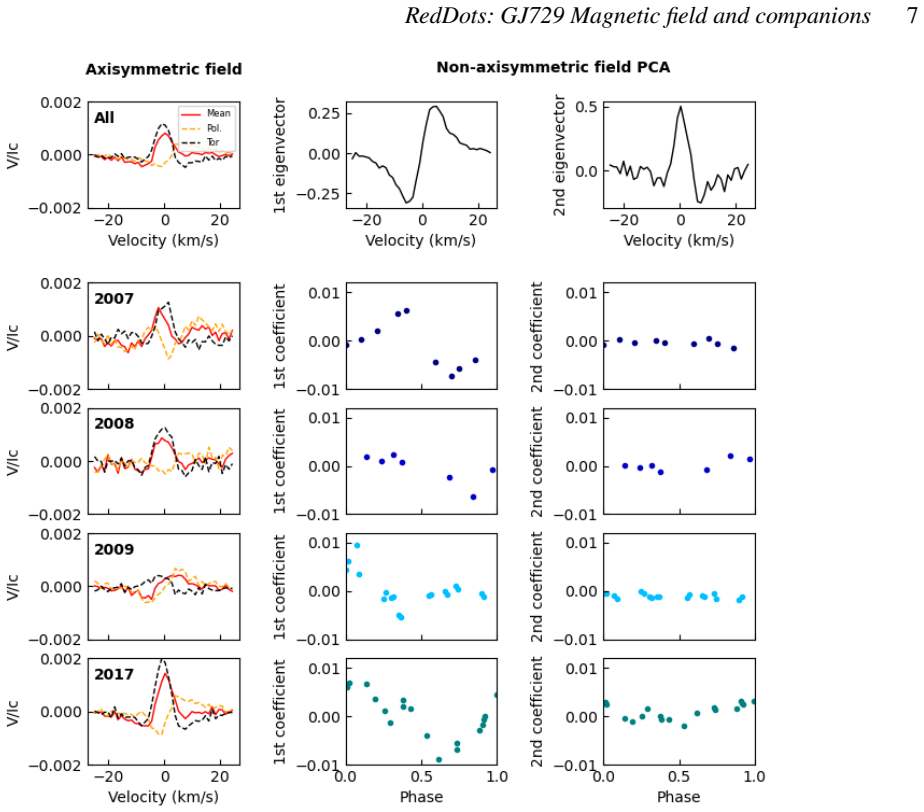
Summary. This paper presents a combined Zeeman Doppler Imaging (ZDI) and radial velocity (RV) analysis of the nearby active M3.5 dwarf GJ 729. The magnetic field reconstruction spans four epochs (2007–2017) and reveals a weak (50–145 G), non-axisymmetric large-scale field that evolves between poloidal-dominated and near-equal poloidal-toroidal configurations. The RV search uses ~90 days of contemporaneous HARPS and CARMENES data, modeled with three independent packages (PyORBIT, Pyaneti, Kima) employing quasi-periodic Gaussian Process (GP) kernels. A ~7 d signal with amplitude ~1.9 m/s is consistently recovered across methods, but the GP+Keplerian model does not statistically outperform a GP-only model (Bayes Factor ΔlnZ ≈ 1 in PyORBIT). The authors transparently note that the signal coincides with 5×P_rot/2 ≈ 7.12 d and may be residual activity rather than a planet.
Significance. The paper is a valuable test case for planet detection around magnetically active, fully convective M dwarfs, where activity amplitudes far exceed planetary signals. The ZDI analysis over a 10-year baseline is a useful contribution to the still-sparse literature on long-term magnetic evolution in fully convective stars, and the application of PCA alongside ZDI is a welcome cross-check. The RV analysis is methodologically careful: the use of three independent modeling codes, multiple GP kernel variants, and joint RV+activity-indicator fits demonstrates thoroughness. The authors are commendably transparent about the ambiguity of the ~7 d signal, explicitly stating that it may be residual activity. The detection limits (ruling out planets ≳3 M⊕ in the habitable zone) are a useful concrete result.
major comments (4)
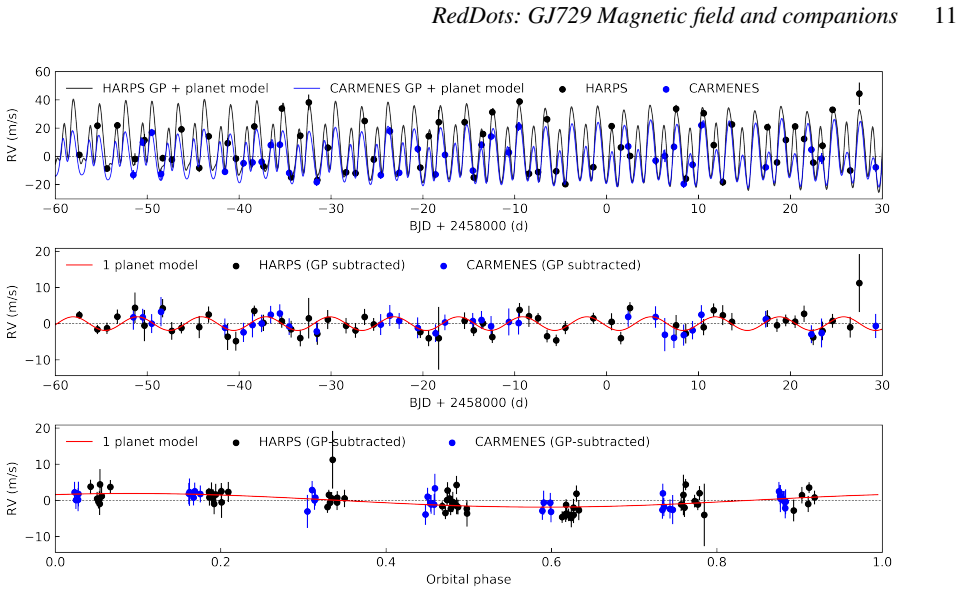
- §6.3.1, Figure 6, and §7.2: The central robustness argument for the ~7 d signal is its persistence across PyORBIT, Pyaneti, and Kima, and across QP and QP+cosine kernels. However, every model tested uses a quasi-periodic kernel with the recurrence timescale pinned to P_rot (Table 5: P prior U[2.84, 2.86] d; Table 6: P_GP prior U[2.84, 2.86] d; Table 7: η_3 prior U[2.84, 2.86] d). If the true activity contains coherent structure at odd multiples of P_rot/2—as the RV power spectrum itself suggests (Figure 5 shows the first harmonic P_rot/2 is stronger than P_rot)—then all QP kernels will fail to capture this structure in the same way, and all will leave a similar residual at 5×P_rot/2 ≈ 7.12 d. Figure 6 makes this explicit: the posterior shows a ladder of signals at odd multiples of P_rot/2, which is the expected signature of incomplete activity modeling rather than an independent planet.
- The cross-method consistency therefore tests the stability of the GP fitting procedure, not the planetary nature of the signal. The authors should explicitly acknowledge this limitation in the discussion (§7.2), rather than framing cross-method consistency as evidence against an activity origin. The current phrasing ('it is not obvious why such a feature would be consistently recovered across multiple modeling approaches') does not adequately address the shared kernel structure. A brief discussion of why the QP+cosine kernel (which does include a cosine term for the first harmonic) would or would not be expected to capture odd-harmonic residuals would strengthen the analysis.
- §6.3.2, Table 6: The Pyaneti Bayes Factor of +8 for HARPS is cited as supporting a Keplerian, but the authors note this is a parametric estimate, not derived from nested sampling. The PyORBIT nested-sampling estimate gives ΔlnZ = +1 (Table 5), and Kima gives 52% probability (Table 7). The discrepancy between the parametric and nested-sampling evidences should be discussed more explicitly. Given that the nested-sampling results are the more robust estimates, the Pyaneti BF of +8 should not be given equal weight in the discussion without qualification.
- §5.3.1, Table 3: The adopted inclination angle of 55° differs from the Reiners et al. (2018) value of 37±18° quoted in Table 1. The text states that ZDI models favored 55°–70°, and 55° was adopted as 'consistent with Reiners et al. (2018) within the uncertainties.' However, 55° is at the upper end of the 1σ range (37+18=55°). The sensitivity analysis (§5.3.2) explores 37°–70°, but the final maps adopt 55°. Given that the ZDI field properties (Table 4) show substantial variation bars, a brief justification for why 55° rather than the central value of 37° was adopted would improve transparency. This is not load-bearing for the RV results but affects the magnetic field interpretation.
minor comments (10)
- §1: 'stellar RV 3variations' appears to contain a stray superscript or formatting artifact.
- Table 1: The log R'_HK value of −4.405±0.510 has a very large uncertainty. Is this a typo for ±0.051? The same applies to log(<L_X>/L_Bol) = −3.28±0.24, which seems reasonable, so the R'_HK uncertainty stands out.
- §5.3.1: The limb-darkening coefficient is listed in Table 3 with units 'km s−1', which is dimensionally incorrect for a limb-darkening coefficient.
- Figure 4: The Pearson correlation coefficients are mentioned in the caption but the values are small and the text states only CARMENES CRX shows 'moderate anti-correlation.' It would help to state the coefficient value in the text.
- §6.3.3: The Kima harmonic complexity parameter η_4 is related to PyORBIT's O and Pyaneti's λ_P as η_4 = 2λ_P = 2O. This relationship is stated but the physical interpretation of the different values recovered (e.g., η_4 = 0.71 for HARPS vs. O = 0.38 in PyORBIT) could be clarified for readers less familiar with the different parameterizations.
- Appendix A, Figure A1: The BLS periodogram shows a weak feature near ~7 d, which the authors note is part of a series of peaks at integer multiples of the rotation half-period. This is relevant to the main text discussion and could be referenced more prominently in §7.2.
- §7.1: The statement 'There is not any clear correlation between chromospheric activity and the large-scale magnetic field properties derived from ZDI' is important but is not supported by a quantitative comparison. A simple correlation coefficient or a brief description of what was compared would strengthen this claim.
- Table 4: The variation bars for some parameters are asymmetric and large (e.g., B_max for 2009: +144/−21 G; poloidal % for 2009: +0/−2). A note clarifying that these represent the range from two extreme parameter combinations, not formal uncertainties, would help readers interpret the table correctly.
- §6.4: The attempt to train the GP on K2 photometry is described but the results are negative. This is fine to include, but the section could be shortened or moved to an appendix, as it does not contribute to the final analysis.
- References: Suárez Mascareño et al. (2016) is cited for activity cycles but the reference list gives only three authors. If this is a paper with more authors, the et al. should be consistent with the journal style.
Circularity Check
No circularity found: the derivation chain is self-contained with independent datasets and transparent about statistical limitations
full rationale
The paper's two main analyses are independently grounded. (1) The magnetic field reconstruction (ZDI/PCA) uses spectropolarimetric Stokes V data from NARVAL/ESPaDOnS, with stellar parameters (v sin i, inclination) constrained by chi-squared minimization to the same data — standard practice, not circular. PCA is applied independently to the same Stokes V profiles as a cross-check on ZDI, not as a derivation from ZDI outputs. (2) The RV planet search uses HARPS/CARMENES data with GP activity modeling. The GP recurrence timescale is pinned to P_rot = 2.848 d, which comes from independent K2 photometry (Ibañez Bustos et al. 2020), not from the RV data being modeled. The ~7 d Keplerian signal is searched for in GP-subtracted residuals and compared via Bayesian evidence to a GP-only model; the paper honestly reports a Bayes Factor of ~1 (statistically equivalent). The skeptic's concern that all tested GP kernels share quasi-periodic structure and thus may fail to capture odd rotation harmonics in the same way is a valid robustness/methodology concern, but it is not circularity — the paper does not define its output in terms of its input, does not rename a fit as a prediction, and does not invoke a self-cited uniqueness theorem. Self-citations (Brown et al. 2022 for LSD/B_l methods, Bellotti et al. 2023b for ZDIpy modifications) are methodological tool references, not load-bearing for the scientific conclusions. The paper is transparent that the ~7 d signal 'could relate to an Earth-mass or Super-Earth planet, or residual stellar activity with power concentrated at a multiple of the rotation half-period.'
Axiom & Free-Parameter Ledger
free parameters (8)
- GP amplitude (A_HARPS, A_CARMENES) =
~17-25 m/s (HARPS), ~14-16 m/s (CARMENES)
- GP recurrence timescale (P) =
2.848 d
- GP decay timescale (P_dec) =
~62-71 d
- GP coherence (O / lambda_P / eta_4) =
~0.38-0.84
- Keplerian orbital period (P_orb) =
~6.99-7.11 d
- Keplerian amplitude (K) =
~1.6-2.2 m/s
- ZDI filling factor (f_V) =
0.09-0.18
- ZDI inclination angle =
55 degrees
axioms (4)
- domain assumption LSD assumption: spectral line asymmetries caused by magnetic activity are equal across all spectral lines
- domain assumption Quasi-periodic GP kernel adequately captures stellar activity covariance structure
- domain assumption Solid-body rotation (no differential rotation)
- standard math Unno-Rachkovsky solutions to polarized radiative transfer in a Milne-Eddington atmosphere
read the original abstract
M dwarfs are prime targets for discovering exoplanets, and the nearest M dwarfs to the Sun provide among the best opportunities for follow-up detailed exoplanet characterization. GJ 729, the seventh closest M dwarf to the Sun, presents significant challenges for exoplanet detection due to its high levels of magnetic activity. To address this, we present a detailed analysis of GJ 729's magnetic field and its variability, followed by a search for exoplanets beneath the activity-induced noise in the stellar radial velocity. The geometry of GJ 729's large-scale magnetic field was reconstructed using new and archival spectropolarimetric data for a total of four epochs spanning 10 years. Results indicate a weak large-scale field ranging from 50 to 145 G, and an evolving non-axisymmetric field geometry that varies from poloidal dominated to a near-equal poloidal-toroidal configuration. We modeled activity-induced radial velocity variations using Gaussian Process Regression and activity diagnostics, and searched for planetary companions using ~90 d of high-cadence spectra taken contemporaneously with the high-precision CARMENES and HARPS spectrographs. Activity-only and activity + Keplerian models offered statistically equivalent fits, with a consistently preferred Keplerian period of ~7 d and amplitude of ~1.9 m/s across a range of activity modeling approaches. This could relate to an Earth-mass or Super-Earth planet, or residual stellar activity with power concentrated at a multiple of the rotation half-period. Our findings provide insight into the magnetic behavior of fully convective M dwarfs, and highlight the potential and challenges of detecting Keplerian RV signatures that are only a fraction of activity amplitudes.
Figures






Reference graph
Works this paper leans on
-
[2]
Auri \`e re M., 2003, in Arnaud J., Meunier N., eds, EAS Publications Series Vol. 9, EAS Publications Series. p. 105
work page 2003
-
[3]
Bailer-Jones C. A. L., Rybizki J., Fouesneau M., Mantelet G., Andrae R., 2018, @doi [ ] 10.3847/1538-3881/aacb21 , https://ui.adsabs.harvard.edu/abs/2018AJ....156...58B 156, 58
-
[4]
Baliunas S. L., et al., 1995, @doi [ ] 10.1086/175072 , https://ui.adsabs.harvard.edu/abs/1995ApJ...438..269B 438, 269
-
[12]
B \"o hm-Vitense E., 2007, @doi [ ] 10.1086/510482 , https://ui.adsabs.harvard.edu/abs/2007ApJ...657..486B 657, 486
-
[13]
Boisse I., Bouchy F., H \'e brard G., Bonfils X., Santos N., Vauclair S., 2011, in Sozzetti A., Lattanzi M. G., Boss A. P., eds, IAU Symposium Vol. 276, The Astrophysics of Planetary Systems: Formation, Structure, and Dynamical Evolution. pp 399--400, @doi 10.1017/S1743921311020515
-
[14]
Boro Saikia S., et al., 2018, @doi [ ] 10.1051/0004-6361/201834347 , https://ui.adsabs.harvard.edu/abs/2018A&A...620L..11B 620, L11
-
[22]
Charbonneau P., 2005, @doi [Living Reviews in Solar Physics] 10.12942/lrsp-2005-2 , https://ui.adsabs.harvard.edu/abs/2005LRSP....2....2C 2, 2
-
[24]
Donati J. F., 2004, in Combes F., Barret D., Contini T., Meynadier F., Pagani L., eds, SF2A-2004: Semaine de l'Astrophysique Francaise. p. 217
work page 2004
-
[25]
Donati J. F., Brown S. F., 1997, , https://ui.adsabs.harvard.edu/abs/1997A&A...326.1135D 326, 1135
work page 1997
-
[26]
Donati J. F., Semel M., Carter B. D., Rees D. E., Collier Cameron A., 1997, @doi [ ] 10.1093/mnras/291.4.658 , https://ui.adsabs.harvard.edu/abs/1997MNRAS.291..658D 291, 658
-
[28]
Donati J. F., Catala C., Landstreet J. D., Petit P., 2006a, in Casini R., Lites B. W., eds, Astronomical Society of the Pacific Conference Series Vol. 358, Solar Polarization 4. p. 362
-
[29]
Donati J.-F., et al., 2006b, @doi [ ] 10.1111/j.1365-2966.2006.10558.x , 370, 629
-
[33]
Folsom C. P., et al., 2018, @doi [ ] 10.1093/mnras/stx3021 , https://ui.adsabs.harvard.edu/abs/2018MNRAS.474.4956F 474, 4956
work page internal anchor Pith review doi:10.1093/mnras/stx3021 2018
-
[36]
Gelman A., Carlin J., Stern H., Dunson D., Vehtari A., Rubin D., 2013, Bayesian Data Analysis. Chapman & Hall/CRC Texts in Statistical Science, CRC Press, https://books.google.com.au/books?id=eSHSBQAAQBAJ
work page 2013
-
[42]
Jeffers S. V., Barnes J. R., Jones H. R. A., Reiners A., Pinfield D. J., Marsden S. C., 2014, @doi [ ] 10.1093/mnras/stt1950 , https://ui.adsabs.harvard.edu/abs/2014MNRAS.438.2717J 438, 2717
-
[43]
Jeffers S. V., et al., 2020, @doi [Science] 10.1126/science.aaz0795 , https://ui.adsabs.harvard.edu/abs/2020Sci...368.1477J 368, 1477
-
[45]
Kitchatinov L. L., Moss D., Sokoloff D., 2014, @doi [ ] 10.1093/mnrasl/slu041 , https://ui.adsabs.harvard.edu/abs/2014MNRAS.442L...1K 442, L1
-
[46]
Kochukhov O., Lavail A., 2017, @doi [ ] 10.3847/2041-8213/835/1/L4 , https://ui.adsabs.harvard.edu/abs/2017ApJ...835L...4K 835, L4
-
[48]
Kochukhov O., Hackman T., Lehtinen J. J., Wehrhahn A., 2020, @doi [ ] 10.1051/0004-6361/201937185 , https://ui.adsabs.harvard.edu/abs/2020A&A...635A.142K 635, A142
-
[49]
Kupka F. G., Ryabchikova T. A., Piskunov N. E., Stempels H. C., Weiss W. W., 2000, @doi [Baltic Astronomy] 10.1515/astro-2000-0420 , https://ui.adsabs.harvard.edu/abs/2000BaltA...9..590K 9, 590
-
[54]
Lightkurve Collaboration et al., 2018, Lightkurve: Kepler and TESS time series analysis in Python , Astrophysics Source Code Library ( @eprint ascl 1812.013 )
work page 2018
-
[55]
Lo Curto G., et al., 2015, The Messenger, https://ui.adsabs.harvard.edu/abs/2015Msngr.162....9L 162, 9
work page 2015
-
[56]
Malavolta L., 2024, in EAS2024, European Astronomical Society Annual Meeting. p. 2155
work page 2024
-
[58]
C., et al., 2014, @doi [ ] 10.1093/mnras/stu1663 , 444, 3517
Marsden S. C., et al., 2014, @doi [ ] 10.1093/mnras/stu1663 , 444, 3517
-
[59]
Mayor M., et al., 2003, The Messenger, https://ui.adsabs.harvard.edu/abs/2003Msngr.114...20M 114, 20
work page 2003
-
[60]
Mengel M. W., Fares R., Marsden S. C., Carter B. D., Jeffers S. V., Petit P., Donati J.-F., Folsom C. P., 2016, @doi [ ] 10.1093/mnras/stw828 , 459, 4325–4342
-
[61]
Morin J., et al., 2008, @doi [ ] 10.1111/j.1365-2966.2008.13809.x , https://ui.adsabs.harvard.edu/abs/2008MNRAS.390..567M 390, 567
-
[62]
Morin J., Donati J. F., Petit P., Delfosse X., Forveille T., Jardine M. M., 2010, @doi [ ] 10.1111/j.1365-2966.2010.17101.x , https://ui.adsabs.harvard.edu/abs/2010MNRAS.407.2269M 407, 2269
-
[63]
Evidence for dynamo bistability among very low mass stars
Morin J., Delfosse X., Donati J. F., Dormy E., Forveille T., Jardine M. M., Petit P., Schrinner M., 2011, in Alecian G., Belkacem K., Samadi R., Valls-Gabaud D., eds, SF2A-2011: Proceedings of the Annual meeting of the French Society of Astronomy and Astrophysics. pp 503--508 ( @eprint arXiv 1208.3341 )
work page internal anchor Pith review Pith/arXiv arXiv 2011
-
[68]
Petit P., Louge T., Th \'e ado S., Paletou F., Manset N., Morin J., Marsden S. C., Jeffers S. V., 2014, @doi [ ] 10.1086/676976 , https://ui.adsabs.harvard.edu/abs/2014PASP..126..469P 126, 469
-
[70]
Quirrenbach A., et al., 2013, in American Astronomical Society Meeting Abstracts \#221. p. 149.05
work page 2013
-
[75]
Rachkovsky D. N., 1967, Izvestiya Ordena Trudovogo Krasnogo Znameni Krymskoj Astrofizicheskoj Observatorii, https://ui.adsabs.harvard.edu/abs/1967IzKry..37...56R 37, 56
work page 1967
-
[77]
Rajpaul V., Aigrain S., Osborne M. A., Reece S., Roberts S., 2015, @doi [ ] 10.1093/mnras/stv1428 , https://ui.adsabs.harvard.edu/abs/2015MNRAS.452.2269R 452, 2269
-
[78]
Reiners A., et al., 2018, @doi [ ] 10.1051/0004-6361/201732054 , https://ui.adsabs.harvard.edu/abs/2018A&A...612A..49R 612, A49
-
[82]
Semel M., 1989, , https://ui.adsabs.harvard.edu/abs/1989A&A...225..456S 225, 456
work page 1989
-
[87]
Unno W., 1956, , https://ui.adsabs.harvard.edu/abs/1956PASJ....8..108U 8, 108
work page 1956
-
[96]
João Gomes da Silva and Pedro Figueira and Nuno C. Santos and João P. Faria , title =. 2018 , publisher =. doi:10.21105/joss.00667 , url =
-
[97]
Stacked Bayesian general Lomb-Scargle periodogram: Identifying stellar activity signals
Stacked Bayesian general Lomb-Scargle periodogram: Identifying stellar activity signals. , keywords =. doi:10.1051/0004-6361/201630201 , archivePrefix =. 1702.03885 , primaryClass =
work page internal anchor Pith review Pith/arXiv arXiv doi:10.1051/0004-6361/201630201
-
[98]
SPIRou reveals unusually strong magnetic fields of slowly rotating M dwarfs
SPIRou reveals unusually strong magnetic fields of slowly rotating M dwarfs. , keywords =. doi:10.1093/mnras/stad3472 , archivePrefix =. 2311.05039 , primaryClass =
work page internal anchor Pith review Pith/arXiv arXiv doi:10.1093/mnras/stad3472
-
[99]
The variable magnetic field of V889 Her and the challenge of detecting exoplanets around young Suns using Gaussian process regression. , keywords =. doi:10.1093/mnras/stae264 , archivePrefix =. 2401.12408 , primaryClass =
work page internal anchor Pith review Pith/arXiv arXiv doi:10.1093/mnras/stae264
-
[100]
BGLS: A Bayesian formalism for the generalised Lomb-Scargle periodogram
BGLS: A Bayesian formalism for the generalised Lomb-Scargle periodogram. , keywords =. doi:10.1051/0004-6361/201424908 , archivePrefix =. 1412.0467 , primaryClass =
work page internal anchor Pith review Pith/arXiv arXiv doi:10.1051/0004-6361/201424908
-
[101]
Unraveling the binary nature of HQ Tau: A brown dwarf companion revealed using multi-variate Gaussian process. , keywords =. doi:10.1051/0004-6361/202348061 , archivePrefix =. 2406.17671 , primaryClass =
work page internal anchor Pith review Pith/arXiv arXiv doi:10.1051/0004-6361/202348061
-
[102]
gaspery: Optimized Scheduling of Radial Velocity Follow-Up Observations for Active Host Stars
Gaspery: Optimized Scheduling of Radial Velocity Follow-up Observations for Active Host Stars. , keywords =. doi:10.3847/1538-3881/ad739b , archivePrefix =. 2408.16830 , primaryClass =
work page internal anchor Pith review Pith/arXiv arXiv doi:10.3847/1538-3881/ad739b
-
[103]
A Search for Faint Companions to Nearby Stars Using the Wide Field Planetary Camera 2. , keywords =. doi:10.1086/301227 , adsurl =
-
[104]
Where Are The M Dwarf Disks Older Than 10 Million Years?
Where Are the M Dwarf Disks Older Than 10 Million Years?. , keywords =. doi:10.1086/432568 , archivePrefix =. astro-ph/0506132 , primaryClass =
work page internal anchor Pith review Pith/arXiv arXiv doi:10.1086/432568
-
[105]
A High Contrast Imaging Survey of SIM Lite Planet Search Targets
A High-Contrast Imaging Survey of SIM Lite Planet Search Targets. , keywords =. doi:10.1086/656481 , archivePrefix =. 1007.4315 , primaryClass =
work page internal anchor Pith review Pith/arXiv arXiv doi:10.1086/656481
-
[106]
RedDots: Limits on habitable and undetected planets orbiting nearby stars GJ 832, GJ 674, and Ross 128. , keywords =. doi:10.1051/0004-6361/202347902 , archivePrefix =. 2409.01173 , primaryClass =
work page internal anchor Pith review Pith/arXiv arXiv doi:10.1051/0004-6361/202347902
-
[107]
Detecting Planets Around Very Low Mass Stars with the Radial Velocity Method
Detecting Planets Around Very Low Mass Stars with the Radial Velocity Method. , keywords =. doi:10.1088/0004-637X/710/1/432 , archivePrefix =. 0909.0002 , primaryClass =
work page internal anchor Pith review Pith/arXiv arXiv doi:10.1088/0004-637x/710/1/432
-
[108]
Diagnosing large-scale stellar magnetic fields using PCA on spectropolarimetric data
Diagnosing large-scale stellar magnetic fields using PCA on spectropolarimetric data. , keywords =. doi:10.1093/mnras/stac1519 , archivePrefix =. 2205.15647 , primaryClass =
work page internal anchor Pith review Pith/arXiv arXiv doi:10.1093/mnras/stac1519
-
[109]
One year of AU Mic with HARPS: I -- measuring the masses of the two transiting planets
One year of AU Mic with HARPS - I. Measuring the masses of the two transiting planets. , keywords =. doi:10.1093/mnras/stac614 , archivePrefix =. 2203.01750 , primaryClass =
work page internal anchor Pith review Pith/arXiv arXiv doi:10.1093/mnras/stac614
-
[110]
doi:10.1007/978-1-4020-2415-3 , adsurl =
Polarization in Spectral Lines. doi:10.1007/978-1-4020-2415-3 , adsurl =
-
[111]
Double Dipping: A New Relation between Stellar Rotation and Starspot Activity , author =. 2018 , month = aug, journal =. doi:10.3847/1538-4357/aad3b6 , issn =
-
[112]
The reduction for anomalous dispersion in the theory of absorption line formation in a magnetic field. Izvestiya Ordena Trudovogo Krasnogo Znameni Krymskoj Astrofizicheskoj Observatorii , year = 1967, month = jan, volume =
work page 1967
-
[113]
, year = 1956, month = jan, volume =
Line Formation of a Normal Zeeman Triplet. , year = 1956, month = jan, volume =
work page 1956
-
[114]
Theoretical Models of Low-Mass Stars and Brown Dwarfs. I. The Lower Main Sequence. , keywords =. doi:10.1086/167658 , adsurl =
-
[115]
Structure and evolution of low-mass stars
Structure and evolution of low-mass stars. , keywords =. doi:10.48550/arXiv.astro-ph/9704118 , archivePrefix =. astro-ph/9704118 , primaryClass =
work page internal anchor Pith review Pith/arXiv arXiv doi:10.48550/arxiv.astro-ph/9704118
-
[116]
A discontinuity in the $T_{\rm eff}$-radius relation of M-dwarfs
A discontinuity in the T _ eff -radius relation of M-dwarfs. , keywords =. doi:10.1093/mnras/sty3430 , archivePrefix =. 1901.08077 , primaryClass =
work page internal anchor Pith review Pith/arXiv arXiv doi:10.1093/mnras/sty3430 1901
-
[117]
Lightkurve: Kepler and TESS time series analysis in Python. ascl:1812.013 , adsurl =
-
[118]
Long-term monitoring of large-scale magnetic fields across optical and near-infrared domains with ESPaDOnS, Narval, and SPIRou. The cases of EV Lac, DS Leo, and CN Leo. , keywords =. doi:10.1051/0004-6361/202348043 , archivePrefix =. 2403.08590 , primaryClass =
work page internal anchor Pith review Pith/arXiv arXiv doi:10.1051/0004-6361/202348043
-
[119]
Living with a Red Dwarf: X-Ray, UV, and Ca ii Activity–Age Relationships of M Dwarfs , author =. 2023 , month = dec, journal =. doi:10.3847/1538-4357/ad0840 , issn =
-
[120]
Bioverse: A Comprehensive Assessment of the Capabilities of Extremely Large Telescopes to Probe Earth-like O2 Levels in Nearby Transiting Habitable-zone Exoplanets , author =. 2023 , month = jun, journal =. doi:10.3847/1538-3881/acd1ec , issn =
-
[121]
A public HARPS radial velocity database corrected for systematic errors
Public HARPS radial velocity database corrected for systematic errors. , keywords =. doi:10.1051/0004-6361/201936686 , archivePrefix =. 2001.05942 , primaryClass =
work page internal anchor Pith review Pith/arXiv arXiv doi:10.1051/0004-6361/201936686 2001
-
[122]
The Messenger , year = 2015, month = dec, volume =
HARPS Gets New Fibres After 12 Years of Operations. The Messenger , year = 2015, month = dec, volume =
work page 2015
-
[123]
Ground-based and Airborne Instrumentation for Astronomy VIII , year = 2020, editor =
The CARMENES M-dwarf planet survey. Ground-based and Airborne Instrumentation for Astronomy VIII , year = 2020, editor =. doi:10.1117/12.2561380 , adsurl =
-
[124]
American Astronomical Society Meeting Abstracts \#221 , year = 2013, series =
Final Design of the CARMENES M-Dwarf Radial-Velocity Survey Instrument. American Astronomical Society Meeting Abstracts \#221 , year = 2013, series =
work page 2013
-
[125]
IEEE Transactions on Pattern Analysis and Machine Intelligence , keywords =
Fast Direct Methods for Gaussian Processes. IEEE Transactions on Pattern Analysis and Machine Intelligence , keywords =. doi:10.1109/TPAMI.2015.2448083 , archivePrefix =. 1403.6015 , primaryClass =
-
[126]
Ground-based and Airborne Instrumentation for Astronomy V , year = 2014, editor =
CARMENES instrument overview. Ground-based and Airborne Instrumentation for Astronomy V , year = 2014, editor =. doi:10.1117/12.2056453 , adsurl =
-
[127]
Formation, Detection, and Characterization of Extrasolar Habitable Planets , year = 2014, editor =
The CARMENES Survey: A Search for Terrestrial Planets in the Habitable Zones of M Dwarfs. Formation, Detection, and Characterization of Extrasolar Habitable Planets , year = 2014, editor =. doi:10.1017/S1743921313012787 , adsurl =
-
[128]
Gaia Data Release 3: Summary of the content and survey properties
Gaia Data Release 3. Summary of the content and survey properties. , keywords =. doi:10.1051/0004-6361/202243940 , archivePrefix =. 2208.00211 , primaryClass =
work page internal anchor Pith review Pith/arXiv arXiv doi:10.1051/0004-6361/202243940
-
[129]
The stellar rotation–activity relationship in fully convective M dwarfs , author =. 2018 , month = jun, journal =. doi:10.1093/mnras/sty1670 , issn =
-
[130]
Solar-type dynamo behaviour in fully convective stars without a tachocline , author =. 2016 , month = jul, journal =. doi:10.1038/nature18638 , issn =
-
[131]
Effects of M dwarf magnetic fields on potentially habitable planets
Effects of M dwarf magnetic fields on potentially habitable planets. , keywords =. doi:10.1051/0004-6361/201321504 , archivePrefix =. 1306.4789 , primaryClass =
work page internal anchor Pith review Pith/arXiv arXiv doi:10.1051/0004-6361/201321504
-
[132]
Diffusive Nested Sampling. arXiv e-prints , keywords =. doi:10.48550/arXiv.0912.2380 , archivePrefix =. 0912.2380 , primaryClass =
work page internal anchor Pith review Pith/arXiv arXiv doi:10.48550/arxiv.0912.2380
-
[133]
Jitter Across 15 yr: Leveraging Precise Photometry from Kepler and TESS to Extract Exoplanets from Radial Velocity Time Series. , keywords =. doi:10.3847/1538-3881/ad9eb0 , archivePrefix =. 2412.11329 , primaryClass =
work page internal anchor Pith review Pith/arXiv arXiv doi:10.3847/1538-3881/ad9eb0
-
[134]
Journal of Open Source Software , issn =
kima: Exoplanet detection in radial velocities , author =. Journal of Open Source Software , issn =. 2018 , month =. doi:10.21105/joss.00487 , url =
-
[135]
EAS2024, European Astronomical Society Annual Meeting , year = 2024, month = jul, eid =
PyORBIT: the ultimate tool for exoplanet characterization. EAS2024, European Astronomical Society Annual Meeting , year = 2024, month = jul, eid =
work page 2024
-
[136]
Stellar Cycles in Fully Convective Stars and a New Interpretation of Dynamo Evolution , author =. 2023 , month = jun, journal =. doi:10.3847/1538-4357/acc468 , issn =
-
[137]
An abrupt change in the stellar spin-down law at the fully convective boundary
An abrupt change in the stellar spin-down law at the fully convective boundary. Nature Astronomy , keywords =. doi:10.1038/s41550-023-02126-2 , archivePrefix =. 2306.09119 , primaryClass =
work page internal anchor Pith review Pith/arXiv arXiv doi:10.1038/s41550-023-02126-2
-
[138]
The Impact of Stellar Activity on the Detection and Characterization of Exoplanets
Cameron, Andrew Collier. The Impact of Stellar Activity on the Detection and Characterization of Exoplanets. Handbook of Exoplanets. 2020. doi:10.1007/978-3-319-30648-3_23-2
-
[139]
Magnetic Fields in a Sample of Planet-hosting M Dwarf Stars from Kepler, K2, and TESS Observed by APOGEE , author =. 2024 , month = oct, journal =. doi:10.3847/1538-4357/ad7959 , issn =
discussion (0)
Sign in with ORCID, Apple, or X to comment. Anyone can read and Pith papers without signing in.