REVIEW 3 major objections 10 minor 34 references
Prefix tokens let one BART model control ad headline length and CTR
Reviewed by Pith at T0; open to challenge. T0 means a machine referee read the full paper against a public rubric. the ladder, T0–T4 →
T0 review · glm-5.2
2026-07-10 00:35 UTC pith:PBVC66ZE
load-bearing objection Solid engineering paper with one load-bearing weakness: all CTR gains are oracle-estimated, never validated against real clicks the 3 major comments →
COBART: Controlled, Optimized, Bidirectional and Auto-Regressive Transformer for Ad Headline Generation
The pith
A machine-rendered reading of the paper's core claim, the machinery that carries it, and where it could break.
Core claim
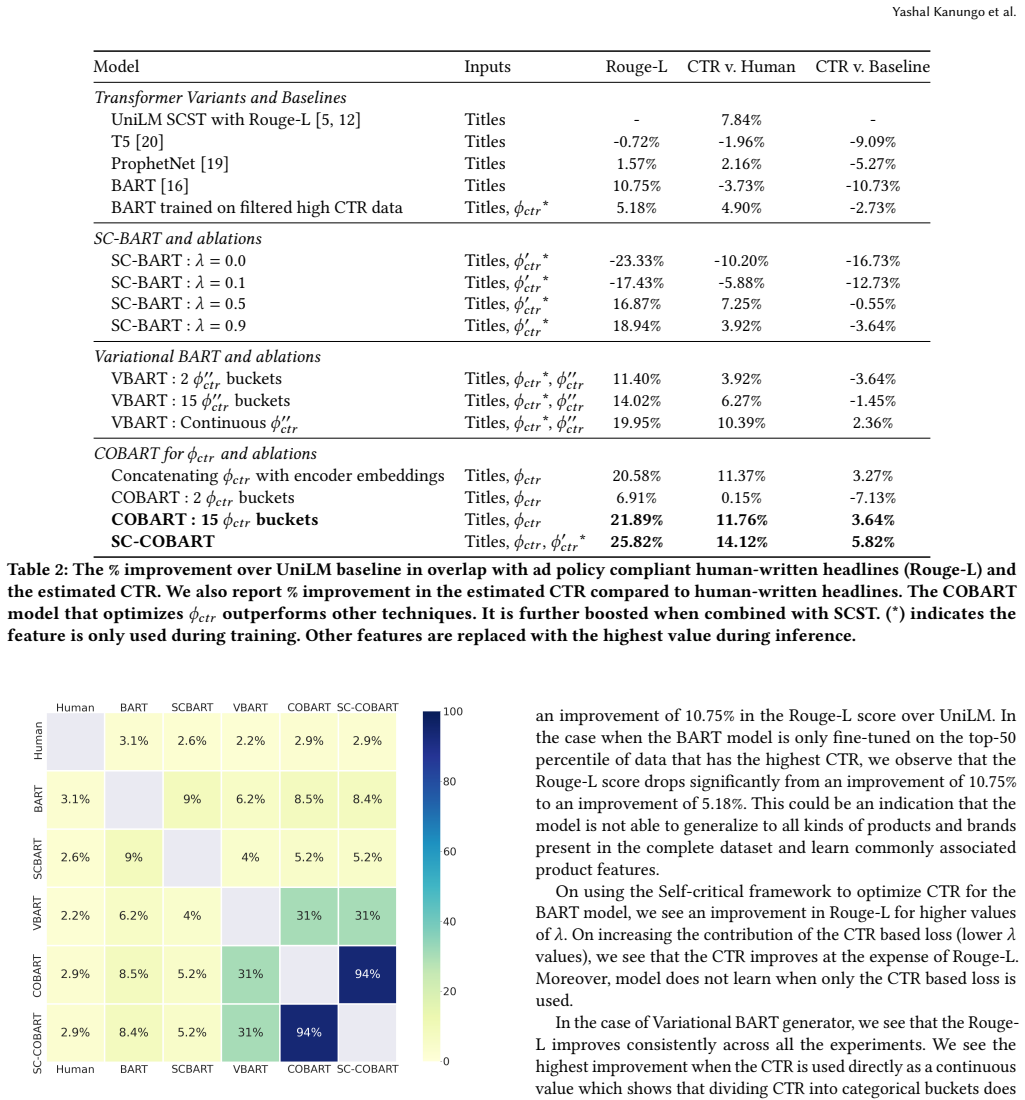
Prepending categorical control tokens as prefixes to the BART encoder input during fine-tuning is sufficient to condition both the encoder and decoder attention to generate headlines with user-specified characteristics—such as target CTR and length—at inference time, without modifying the Transformer architecture or adding inference latency. The approach outperforms variational conditioning (VBART) and reinforcement-learning-only optimization (SCBART) on both headline quality (Rouge-L) and estimated CTR, and the two techniques can be stacked for additive gains.
What carries the argument
The core mechanism is the control-token prefix: a categorical token representing a bucketed characteristic (e.g., CTR percentile bucket 1–15, or length class short/medium/long) is prepended to the product-title input before it enters the BART bidirectional encoder. The Transformer self-attention mechanism propagates the conditioning signal from this prefix through the encoder and into the decoder, shaping generation. This is contrasted with two alternatives: (1) SCBART, which uses an oracle model to estimate CTR as a reinforcement-learning reward via Self-critical Sequence Training, and (2) VBART, which uses a variational encoder and a separate discriminator to predict a CTR estimate that条件s
Load-bearing premise
All reported CTR improvements are estimated by an oracle model (a DeBERTa-based classifier), not measured through live A/B tests with real users. If this oracle's CTR predictions do not faithfully correlate with actual click behavior, the reported CTR gains may not hold in production.
What would settle it
Generate headlines with COBART using the highest CTR bucket token, deploy them in a live advertising system, and measure actual click-through rate against a baseline. If real CTR does not improve by a margin consistent with the oracle's predicted 5.82% gain, the oracle is an unreliable proxy and the optimization target is misaligned with user behavior.
If this is right
- A single fine-tuned language model could serve multiple ad formats (text, image, video) by accepting different length control tokens at inference, eliminating the need for format-specific models.
- The prefix-token approach could extend to other controllable attributes present in training data—season, brand presence, tone—without architectural changes, as long as those attributes can be computed for training examples.
- Combining prefix control with reinforcement-learning rewards (SC-COBART) yields additive improvements, suggesting the two mechanisms operate on somewhat orthogonal axes of optimization.
- The method's architecture-agnostic design means the prefix-token strategy could transfer to other encoder-decoder pre-trained models beyond BART, since it requires no model-internal modifications.
Editorial analysis
A structured set of objections, weighed in public.
Referee Report
Summary. The paper proposes COBART, a method for generating ad headlines by fine-tuning BART with prefix control tokens that condition generation on desired characteristics such as CTR bucket and length. The method is compared against several baselines (UniLM, T5, ProphetNet, BART) and two alternative extensions (Self-critical BART, Variational BART). The central claim is that adding control tokens as encoder input prefixes enables joint control of headline length and CTR optimization at inference time, yielding 25.82% Rouge-L and 5.82% estimated CTR improvements over the UniLM SCST baseline. The approach is simple, architecturally lightweight (no modifications to the Transformer), and practically motivated.
Significance. The method's simplicity is a genuine strength: prefix control tokens require no architectural changes to BART, add no inference latency, and generalize to multiple characteristics simultaneously. The length-control results (Table 3) are particularly convincing, showing clear separation between short/medium/long outputs where the Length Penalty baseline fails. The ablation comparing input-prefix vs. encoder-output concatenation (Table 2) provides useful evidence that conditioning the encoder is better than post-hoc embedding combination. The framework is reproducible with standard HuggingFace tooling, and Appendix A provides a concrete reproduction recipe.
major comments (3)
- Section 4.1 and Section 5.2: All CTR results in Table 2 are estimated by a DeBERTa oracle model, not measured against real user clicks. The paper does not report the oracle's accuracy, calibration, or correlation with held-out real CTR. This is a load-bearing gap because the headline 5.82% CTR improvement claim rests entirely on this oracle. At minimum, the authors should validate the oracle against held-out real CTR data (e.g., reporting rank correlation or AUC on a held-out set). If such validation is not possible, the paper should explicitly state this limitation and frame the CTR results as oracle-estimated rather than empirically validated.
- Table 2, SC-COBART row: The SC-COBART variant uses the DeBERTa oracle as the SCST reward signal during training (Eq. 5, Section 3.2) and then uses the same oracle for evaluation (Section 5.2). This creates a self-referential evaluation loop: the model is optimized to maximize the oracle's score, then evaluated by that same oracle. The COBART variant without SCST is less affected because it trains on observed CTR buckets rather than oracle estimates, but its evaluation still depends on the oracle. The authors should either (a) evaluate SC-COBART using a different metric or held-out real CTR, or (b) explicitly discuss this circularity and argue why the oracle's biases would not inflate SC-COBART's scores relative to COBART. The word-frequency analysis in Section 6.1 (e.g., 'Adventure' 9x, 'Brighten' 8x) could reflect genuine CTR-improving vocabulary or oracle-exploited artifacts; without a
- real-CTR check, this cannot be distinguished.
minor comments (10)
- Abstract: 'one of their core creative component' should be 'one of their core creative components' (grammar).
- Section 1, paragraph 3: 'promote the customers to engage' should be 'prompt the customers to engage' or similar.
- Section 3.1, Eq. (3): The notation uses [SEP] as both a separator between product titles and between control tokens and titles. Clarifying whether the same token is reused or a distinct separator is used would improve reproducibility.
- Section 4.1: The oracle model is described as 'treated as a black-box and is not updated during the training of Language Models.' Stating whether the oracle was trained on the same ad campaigns or a disjoint set would help readers assess potential data leakage.
- Table 2: The 'Inputs' column notation is dense (e.g., 'Titles, φ_ctr, φ'_ctr*'). A footnote or legend explaining which features are training-only (*) vs. used at inference would improve readability.
- Section 5.1: 'All the other commonly used overlap metrics such as CIDEr, BLEU-4, METEOR etc. were in complete agreement with Rouge-L and we thus omit them.' Reporting at least one additional metric in a supplementary table would strengthen this claim.
- Table 3: The BART Length Penalty results show that increasing penalty beyond 2.0 decreases effective length. A brief explanation of why this happens (diminishing relative effects) would help readers.
- Section 6.1: The word-frequency comparison is interesting but lacks statistical testing. A chi-square or similar test on word frequency differences would make the qualitative claims more rigorous.
- Figure 2: The diagram is somewhat small. Enlarging or simplifying the control-token flow would aid readability.
- Reference [12] (Kanungo et al. 2021) appears to be prior work by some of the same authors. This should be disclosed explicitly in Section 1.
Circularity Check
No significant circularity in the core method; the oracle-for-both-training-and-evaluation concern is an evaluation-validity issue, not a derivation-chain circularity.
full rationale
The paper's central methodological contribution—adding characteristic control tokens (CTR buckets, length tags) as prefixes to the BART encoder input—is not circular. COBART trains on real observed CTR buckets (Section 4.1: 'we obtain the observed CTR for all the headlines in the training data and bucketize it into 15 equal sized buckets') and length labels derived from actual headline word counts. The control tokens are not defined in terms of the output they claim to control; they are independently computed from training data. The evaluation of COBART (without SCST) uses an oracle DeBERTa model for CTR estimation, but this is an evaluation-validity concern, not a circularity in the derivation chain—the model is not guaranteed to score well on the oracle by construction. The SC-COBART variant does use the same oracle DeBERTa model as both the SCST training reward (Eq. 5) and the evaluation metric (Section 5.2), which creates a feedback-loop concern. However, this is not one of the enumerated circularity patterns: the oracle is not 'fitted to a subset of data then predicting a closely related quantity' (pattern 2), nor is the result 'forced by definition' (pattern 1). The model could still fail to improve oracle-estimated CTR; the concern is about potential bias, not about the prediction being mathematically forced. The self-citation to [12] (Kanungo et al., 2021, sharing the first author) is used only as a baseline for comparison, not as a load-bearing premise for the method's validity. The control-token approach is independently grounded in prior work (CTRL [13], T5 prefix tuning [20]) that does not share authors with this paper. Score of 2 reflects the minor methodological concern about oracle reuse without being a structural circularity in the derivation.
Axiom & Free-Parameter Ledger
free parameters (4)
- Number of CTR buckets =
15
- Length bucket thresholds =
short<=5, medium=6-8, long>8 words
- SCST lambda =
0.5 (best)
- Beam search parameters =
beam=5, length_penalty=1.5, repetition_penalty=2.0
axioms (4)
- domain assumption BART pre-training provides a useful initialization for headline generation
- ad hoc to paper The oracle DeBERTa model provides faithful CTR estimates
- domain assumption Prefix control tokens can condition encoder attention without architectural modification
- domain assumption Observed historical CTR is a learnable characteristic of headline text
read the original abstract
Online ads are essential to all businesses and ad headlines are one of their core creative component. Existing methods can generate headlines automatically and also optimize their click-through-rate (CTR) and quality. However, evolving ad formats and changing creative requirements make it difficult to generate optimized & customized headlines. We propose a novel method that uses prefix control tokens along with BART fine-tuning. It yields the highest CTR and also allows users to control the length of generated headlines for use across different ad formats. The method is also flexible and can easily be adapted to other architectures, creative requirements and optimization criteria. Our experiments demonstrate a 25.82% increment in Rouge-L and a 5.82% increment in estimated CTR over previously published strong ad headline generation baseline.
Figures



Reference graph
Works this paper leans on
-
[1]
ExT5: Towards Extreme Multi-Task Scaling for Transfer Learning
Vamsi Aribandi, Yi Tay, Tal Schuster, Jinfeng Rao, Huaixiu Steven Zheng, San- ket Vaibhav Mehta, Honglei Zhuang, Vinh Q. Tran, Dara Bahri, Jianmo Ni, Jai Gupta, Kai Hui, Sebastian Ruder, and Donald Metzler. 2021. ExT5: Towards Extreme Multi-Task Scaling for Transfer Learning.arXiv:2111.10952 [cs](Nov. 2021). http://arxiv.org/abs/2111.10952 arXiv: 2111.10952
work page internal anchor Pith review Pith/arXiv arXiv 2021
-
[2]
AWS. [n.d.]. AWS Neuron - Amazon Web Services. https://aws.amazon.com/ machine-learning/neuron/
-
[3]
Tom B. Brown, Benjamin Mann, Nick Ryder, Melanie Subbiah, Jared Kaplan, Prafulla Dhariwal, Arvind Neelakantan, Pranav Shyam, Girish Sastry, Amanda Askell, Sandhini Agarwal, Ariel Herbert-Voss, Gretchen Krueger, Tom Henighan, Rewon Child, Aditya Ramesh, Daniel M. Ziegler, Jeffrey Wu, Clemens Winter, Christopher Hesse, Mark Chen, Eric Sigler, Mateusz Litwin...
work page internal anchor Pith review Pith/arXiv arXiv 2020
-
[4]
Sumanth Dathathri, Andrea Madotto, Janice Lan, Jane Hung, Eric Frank, Piero Molino, Jason Yosinski, and Rosanne Liu. 2020. Plug and Play Language Models: A Simple Approach to Controlled Text Generation.arXiv:1912.02164 [cs](March 2020). http://arxiv.org/abs/1912.02164 arXiv: 1912.02164 version: 4
work page internal anchor Pith review Pith/arXiv arXiv 2020
-
[5]
Li Dong, Nan Yang, Wenhui Wang, Furu Wei, Xiaodong Liu, Yu Wang, Jianfeng Gao, Ming Zhou, and Hsiao-Wuen Hon. 2019. Unified Language Model Pre- training for Natural Language Understanding and Generation.arXiv:1905.03197 [cs](Oct. 2019). http://arxiv.org/abs/1905.03197 arXiv: 1905.03197
work page internal anchor Pith review Pith/arXiv arXiv 2019
-
[6]
Daniil Gavrilov, Pavel Kalaidin, and Valentin Malykh. 2019. Self-attentive Model for Headline Generation. InAdvances in Information Retrieval (Lecture Notes in Computer Science), Leif Azzopardi, Benno Stein, Norbert Fuhr, Philipp Mayr, Claudia Hauff, and Djoerd Hiemstra (Eds.). Springer International Publishing, Cham, 87–93. https://doi.org/10.1007/978-3-...
-
[7]
Pengcheng He, Xiaodong Liu, Jianfeng Gao, and Weizhu Chen. 2021. DeBERTa: Decoding-enhanced BERT with Disentangled Attention.arXiv:2006.03654 [cs] (Oct. 2021). http://arxiv.org/abs/2006.03654 arXiv: 2006.03654
work page internal anchor Pith review Pith/arXiv arXiv 2021
-
[8]
Zhiting Hu, Haoran Shi, Bowen Tan, Wentao Wang, Zichao Yang, Tiancheng Zhao, Junxian He, Lianhui Qin, Di Wang, Xuezhe Ma, Zhengzhong Liu, Xi- aodan Liang, Wangrong Zhu, Devendra Singh Sachan, and Eric P. Xing. 2019. Texar: A Modularized, Versatile, and Extensible Toolkit for Text Generation. arXiv:1809.00794 [cs](July 2019). http://arxiv.org/abs/1809.0079...
work page internal anchor Pith review Pith/arXiv arXiv 2019
-
[9]
Zhiting Hu, Zichao Yang, Xiaodan Liang, Ruslan Salakhutdinov, and Eric P. Xing
-
[10]
Toward Controlled Generation of Text.arXiv:1703.00955 [cs, stat](Sept. 2018). http://arxiv.org/abs/1703.00955 arXiv: 1703.00955
work page internal anchor Pith review Pith/arXiv arXiv 2018
-
[11]
Weston Hughes, Keng-hao Chang, and Ruofei Zhang
J. Weston Hughes, Keng-hao Chang, and Ruofei Zhang. 2019. Generating Bet- ter Search Engine Text Advertisements with Deep Reinforcement Learning. InProceedings of the 25th ACM SIGKDD International Conference on Knowl- edge Discovery & Data Mining. ACM, Anchorage AK USA, 2269–2277. https: //doi.org/10.1145/3292500.3330754
-
[12]
Di Jin, Zhijing Jin, Joey Tianyi Zhou, Lisa Orii, and Peter Szolovits. 2020. Hooks in the Headline: Learning to Generate Headlines with Controlled Styles. arXiv:2004.01980 [cs](May 2020). http://arxiv.org/abs/2004.01980 arXiv: 2004.01980 version: 3
work page internal anchor Pith review Pith/arXiv arXiv 2020
-
[13]
Yashal Shakti Kanungo, Sumit Negi, and Aruna Rajan. 2021. Ad Headline Gen- eration using Self-Critical Masked Language Model. InProceedings of the 2021 Conference of the North American Chapter of the Association for Computational Linguistics: Human Language Technologies: Industry Papers. Association for Com- putational Linguistics, Online, 263–271. https:...
-
[14]
CTRL: A Conditional Transformer Language Model for Controllable Generation
Nitish Shirish Keskar, Bryan McCann, Lav R. Varshney, Caiming Xiong, and Richard Socher. 2019. CTRL: A Conditional Transformer Language Model for Controllable Generation.arXiv:1909.05858 [cs](Sept. 2019). http://arxiv.org/abs/ 1909.05858 arXiv: 1909.05858 version: 2
work page internal anchor Pith review Pith/arXiv arXiv 2019
-
[15]
Adam: A Method for Stochastic Optimization
Diederik P. Kingma and Jimmy Ba. 2017. Adam: A Method for Stochastic Opti- mization.arXiv:1412.6980 [cs](Jan. 2017). http://arxiv.org/abs/1412.6980 arXiv: 1412.6980
work page internal anchor Pith review Pith/arXiv arXiv 2017
-
[16]
Sachin Kumar, Eric Malmi, Aliaksei Severyn, and Yulia Tsvetkov. 2021. Con- trolled Text Generation as Continuous Optimization with Multiple Constraints. arXiv:2108.01850 [cs](Aug. 2021). http://arxiv.org/abs/2108.01850 arXiv: 2108.01850
work page internal anchor Pith review Pith/arXiv arXiv 2021
-
[17]
Mike Lewis, Yinhan Liu, Naman Goyal, Marjan Ghazvininejad, Abdelrahman Mohamed, Omer Levy, Ves Stoyanov, and Luke Zettlemoyer. 2019. BART: Denoising Sequence-to-Sequence Pre-training for Natural Language Genera- tion, Translation, and Comprehension.arXiv:1910.13461 [cs, stat](Oct. 2019). http://arxiv.org/abs/1910.13461 arXiv: 1910.13461
work page internal anchor Pith review Pith/arXiv arXiv 2019
-
[18]
Chin-Yew Lin. 2004. ROUGE: A Package for Automatic Evaluation of Summaries. InText Summarization Branches Out. Association for Computational Linguistics, Barcelona, Spain, 74–81. https://aclanthology.org/W04-1013
work page 2004
-
[19]
Kenton Murray and David Chiang. 2018. Correcting Length Bias in Neural Machine Translation.arXiv:1808.10006 [cs](Aug. 2018). http://arxiv.org/abs/ 1808.10006 arXiv: 1808.10006
work page internal anchor Pith review Pith/arXiv arXiv 2018
-
[20]
Weizhen Qi, Yu Yan, Yeyun Gong, Dayiheng Liu, Nan Duan, Jiusheng Chen, Ruofei Zhang, and Ming Zhou. 2020. ProphetNet: Predicting Future N-gram for Sequence-to-Sequence Pre-training.arXiv:2001.04063 [cs](Oct. 2020). http: //arxiv.org/abs/2001.04063 arXiv: 2001.04063 version: 3
work page internal anchor Pith review Pith/arXiv arXiv 2020
-
[21]
Colin Raffel, Noam Shazeer, Adam Roberts, Katherine Lee, Sharan Narang, Michael Matena, Yanqi Zhou, Wei Li, and Peter J. Liu. 2020. Exploring the Limits of Transfer Learning with a Unified Text-to-Text Transformer.arXiv:1910.10683 [cs, stat](July 2020). http://arxiv.org/abs/1910.10683 arXiv: 1910.10683
work page internal anchor Pith review Pith/arXiv arXiv 2020
-
[22]
Self-critical Sequence Training for Image Captioning
Steven J. Rennie, Etienne Marcheret, Youssef Mroueh, Jarret Ross, and Vaib- hava Goel. 2017. Self-critical Sequence Training for Image Captioning. arXiv:1612.00563 [cs](Nov. 2017). http://arxiv.org/abs/1612.00563 arXiv: 1612.00563
work page internal anchor Pith review Pith/arXiv arXiv 2017
-
[23]
Sascha Rothe, Shashi Narayan, and Aliaksei Severyn. 2020. Leveraging Pre- trained Checkpoints for Sequence Generation Tasks.arXiv:1907.12461 [cs](April 2020). http://arxiv.org/abs/1907.12461 arXiv: 1907.12461
work page internal anchor Pith review Pith/arXiv arXiv 2020
-
[24]
Get To The Point: Summarization with Pointer-Generator Networks
Abigail See, Peter J. Liu, and Christopher D. Manning. 2017. Get To The Point: Summarization with Pointer-Generator Networks.arXiv:1704.04368 [cs](April 2017). http://arxiv.org/abs/1704.04368 arXiv: 1704.04368
work page internal anchor Pith review Pith/arXiv arXiv 2017
-
[25]
Kaitao Song, Xu Tan, Tao Qin, Jianfeng Lu, and Tie-Yan Liu. 2019. MASS: Masked Sequence to Sequence Pre-training for Language Generation.arXiv:1905.02450 [cs](June 2019). http://arxiv.org/abs/1905.02450 arXiv: 1905.02450 version: 5
work page internal anchor Pith review Pith/arXiv arXiv 2019
-
[26]
Yun-Zhu Song, Hong-Han Shuai, Sung-Lin Yeh, Yi-Lun Wu, Lun-Wei Ku, and Wen-Chih Peng. 2020. Attractive or Faithful? Popularity-Reinforced Learning for Inspired Headline Generation.Proceedings of the AAAI Conference on Artificial Intelligence34, 05 (April 2020), 8910–8917. https://doi.org/10.1609/aaai.v34i05. 6421 Number: 05
-
[27]
Ashish Vaswani, Noam Shazeer, Niki Parmar, Jakob Uszkoreit, Llion Jones, Aidan N. Gomez, Lukasz Kaiser, and Illia Polosukhin. 2017. Attention Is All You Need.arXiv:1706.03762 [cs](Dec. 2017). http://arxiv.org/abs/1706.03762 arXiv: 1706.03762
work page internal anchor Pith review Pith/arXiv arXiv 2017
-
[28]
Ronald J. Williams. 1992. Simple statistical gradient-following algorithms for connectionist reinforcement learning.Machine Learning8, 3 (May 1992), 229–256. https://doi.org/10.1007/BF00992696
-
[29]
Thomas Wolf, Lysandre Debut, Victor Sanh, Julien Chaumond, Clement De- langue, Anthony Moi, Pierric Cistac, Tim Rault, Rémi Louf, Morgan Funtowicz, Joe Davison, Sam Shleifer, Patrick von Platen, Clara Ma, Yacine Jernite, Julien Plu, Canwen Xu, Teven Le Scao, Sylvain Gugger, Mariama Drame, Quentin Lhoest, and Alexander M. Rush. 2020. HuggingFace’s Transfor...
work page internal anchor Pith review Pith/arXiv arXiv 2020
-
[30]
Haoran Xu, Sixing Lu, Zhongkai Sun, Chengyuan Ma, and Chenlei Guo
-
[31]
VAE based Text Style Transfer with Pivot Words Enhancement Learn- ing.arXiv:2112.03154 [cs](Dec. 2021). http://arxiv.org/abs/2112.03154 arXiv: 2112.03154
work page internal anchor Pith review Pith/arXiv arXiv 2021
-
[32]
Peng Xu, Chien-Sheng Wu, Andrea Madotto, and Pascale Fung. 2019. Click- bait? Sensational Headline Generation with Auto-tuned Reinforcement Learn- ing.arXiv:1909.03582 [cs](Sept. 2019). http://arxiv.org/abs/1909.03582 arXiv: 1909.03582 version: 1
work page internal anchor Pith review Pith/arXiv arXiv 2019
-
[33]
Kevin Yang and Dan Klein. 2021. FUDGE: Controlled Text Generation With Future Discriminators.Proceedings of the 2021 Conference of the North Ameri- can Chapter of the Association for Computational Linguistics: Human Language Technologies(2021), 3511–3535. https://doi.org/10.18653/v1/2021.naacl-main.276 arXiv: 2104.05218
work page internal anchor Pith review Pith/arXiv arXiv doi:10.18653/v1/2021.naacl-main.276 2021
-
[34]
Ruqing Zhang, Jiafeng Guo, Yixing Fan, Yanyan Lan, and Xueqi Cheng. 2020. Structure Learning for Headline Generation.Proceedings of the AAAI Conference on Artificial Intelligence34, 05 (April 2020), 9555–9562. https://doi.org/10.1609/ aaai.v34i05.6501 Number: 05. Yashal Kanungo et al. A Reproducing Experiments on Your Data (1) Process your data and conver...
work page 2020
discussion (0)
Sign in with ORCID, Apple, or X to comment. Anyone can read and Pith papers without signing in.