REVIEW 2 major objections 5 minor 13 references
Best-of-N TTS verifier rankings reverse across ASR families, revealing a lineage-level evaluation confound that cross-family rank ensembles can fix.
Reviewed by Pith at T0; open to challenge. T0 means a machine referee read the full paper against a public rubric. the ladder, T0–T4 →
T0 review · grok-4.5
2026-07-10 10:30 UTC pith:AKM7SE6P
load-bearing objection Clean empirical finding: BoN TTS verifier rankings reverse by ASR family, with 2–3× same-family oracle recovery that CKA does not explain; solid workshop paper whose main limit is single-backbone scope. the 2 major comments →
Best-of-N TTS Evaluation is Confounded by ASR Family Alignment
The pith
A machine-rendered reading of the paper's core claim, the machinery that carries it, and where it could break.
Core claim
On LibriSpeech-PC test-clean with F5-TTS, BoN verifier rankings reverse across Whisper, wav2vec 2.0, and HuBERT evaluators, and same-family verifier–evaluator pairs recover 2–3× more oracle headroom than cross-family pairs despite near-identical encoder representations (linear CKA 0.978). The pattern is consistent with identity- or lineage-level coupling, not representational overlap.
What carries the argument
Cross-family rank ensembles (rank-averaging and conjunctive max-rank): each verifier ranks the N candidates independently, then the method either averages ranks across families or takes the lowest worst-case rank, so a candidate must do well outside any single ASR lineage.
Load-bearing premise
The confound and the value of cross-family ensembles are assumed to hold beyond the single TTS backbone and single evaluation set used in the study.
What would settle it
Repeat the identical four-way evaluator ablation and oracle-recovery analysis on a different zero-shot TTS backbone and a fourth ASR family; if ranking reversals and the 2–3× same-family recovery advantage disappear, the claimed family-alignment confound is not general.
If this is right
- Any BoN comparison reported under a single ASR evaluator is potentially confounded by family alignment.
- Cross-evaluator triangulation—WER under at least two ASR families with disjoint training lineages—should become default reporting practice.
- Cross-family rank ensembles at N=5–10 yield the most robust mean WER (1.61% at N=10, −12% relative) with no automatic quality loss.
- When the evaluator family is known in advance, a same-family verifier at N=10 still gives the largest single-evaluator gain; otherwise use rank ensembles.
- N=3 oracle WER of 1.42% leaves substantial headroom for verifiers designed to resist in-family inflation.
Where Pith is reading between the lines
- The same lineage-coupling risk likely affects speech preference-optimization and MOS-predictor pipelines that rely on a single automatic judge.
- If identity-level coupling dominates family-level coupling, even an independent checkpoint inside the same family may not fully debias evaluation.
- Adversarial reweighting of verifiers against in-family inflation is a direct next design step suggested by the remaining oracle gap.
- Human listening tests and multi-backbone replications are the cleanest way to decide whether the confound is architectural or dataset-specific.
Editorial analysis
A structured set of objections, weighed in public.
Referee Report
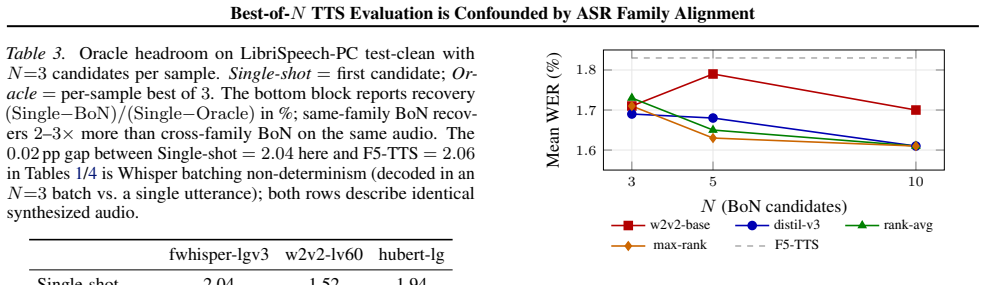
Summary. The paper argues that Best-of-N (BoN) selection for zero-shot TTS is systematically confounded by ASR family alignment between the verifier used for candidate selection and the evaluator used for reporting WER. On LibriSpeech-PC test-clean with F5-TTS, the preferred verifier reverses across Whisper, wav2vec 2.0, and HuBERT evaluators (Table 2), and same-family verifier–evaluator pairs recover substantially more of the N=3 oracle headroom than cross-family pairs (Table 3), even when encoder representations are nearly identical by linear CKA (0.978; Table 5, Figure 2). The authors interpret this as identity- or lineage-level coupling rather than representational overlap, propose two cross-family rank ensembles (rank-avg and max-rank) that achieve the lowest mean WER across three evaluators (1.61% at N=10), and recommend multi-family evaluator triangulation as default reporting practice.
Significance. If the reported confound holds, the paper identifies a concrete and previously under-discussed evaluation risk for a widely used inference-time remedy in modern TTS. The multi-evaluator ablation, oracle-headroom decomposition, and CKA negative control are carefully designed and give the central empirical claim real force within the stated setup. The proposed rank ensembles are simple, reproducible, and improve cross-evaluator robustness without measurable SIM-o/UTMOS cost. Explicit credit is due for the public code/evaluation scripts, paired permutation tests, and the clear analogy to LLM-as-judge self-bias. The main significance is methodological: it changes how BoN TTS results should be reported, even if the absolute WER gains are modest.
major comments (2)
- Abstract and §4.3 (Table 3): the headline “2–3× more oracle headroom” is uneven across evaluators. Under fwhisper-lgv3 the same-family advantage is large (26.0% vs 7.9%), under w2v2-lv60 it is only 1.4× (26.1% vs 18.2%), and under hubert-lg w2v2-base and distil-v3 recover identical fractions (27.1%). The abstract and recovery discussion should report this variation explicitly rather than the rounded 2–3× summary, which currently overstates uniformity of the effect.
- §6 and Limitations: recommending cross-evaluator triangulation as “default reporting practice” is stronger than a single-backbone, single-corpus study can fully underwrite. The empirical confound on F5-TTS/LibriSpeech-PC is well supported; the field-wide prescription is not yet. Either add a second TTS backbone (even a small pilot on CosyVoice 2 or MaskGCT) or reframe the recommendation as provisional and scoped to the evidence presented.
minor comments (5)
- Table 4 / Figure 1: state explicitly that “mean WER” is the unweighted arithmetic mean of the three evaluator WERs, and whether any utterance-level aggregation precedes that average.
- §5 / Figure 2: Pearson(CKA, r) is computed over only six evaluator pairs; note that the trend (and its reversal after removing the same-family point) is underpowered and descriptive rather than confirmatory.
- §3: the joint WER+CER selection score is used throughout but not motivated relative to WER-only or CER-only selection; a one-sentence ablation or justification would help.
- §5.1: SIM-o and UTMOS are near ceiling; the deferred human-MOS / NISQA triangulation is appropriate, but the manuscript should state more clearly that automatic quality metrics cannot currently rule out subtle degradation.
- Presentation: several family names appear with internal spaces in the extracted text (e.g., “CosyV oice”, “V oiceMOS”); verify the camera-ready PDF does not inherit these artifacts. Also fix missing spaces such as “ens3denotes” and “ensembles(rank-averaging” if present in source.
Circularity Check
No significant circularity: empirical WER/CKA measurements and rank-aggregation definitions are independent of the reported claims.
full rationale
The paper is a purely empirical study of BoN selection under multiple ASR evaluators. Verifier rankings, oracle-headroom recovery percentages, and mean-WER tables are obtained by generating fixed F5-TTS candidates, scoring them with independent public ASR checkpoints, and computing ordinary WER/CER; none of these quantities is defined in terms of the ranking-reversal claim or the ensemble superiority claim. The two proposed ensembles (rank-avg, max-rank) are defined by simple rank aggregation rules that do not involve any fitted parameters or target WER values. Linear CKA is measured on encoder states as a negative control and is not used to construct the ensembles. There are no self-citations that supply uniqueness theorems, ansätze, or load-bearing premises; all external references are to prior TTS/ASR systems or evaluation practices. Consequently the derivation chain contains no self-definitional steps, no fitted-input-as-prediction steps, and no circular self-citation chains.
Axiom & Free-Parameter Ledger
free parameters (3)
- N (BoN candidate count) =
3, 5, 10
- CFG scale and ODE steps (F5-TTS inference) =
CFG=2.0, 32 steps
- Joint WER+CER selection score
axioms (5)
- domain assumption WER (and CER) under an ASR model is a valid proxy for content consistency of synthesized speech.
- domain assumption Whisper/Distil-Whisper, wav2vec 2.0, and HuBERT constitute meaningfully distinct ASR families with disjoint training lineages for the purpose of triangulation.
- domain assumption Linear CKA on mean-pooled last hidden states is a sufficient probe of audio-encoder representational overlap for testing the representation-similarity hypothesis.
- domain assumption Automatic SIM-o (WavLM) and UTMOS scores are adequate to claim 'no measurable quality degradation' in the absence of human MOS.
- standard math Standard arithmetic and ranking operations (average rank, max rank) and paired permutation tests are valid for comparing BoN configurations.
invented entities (2)
-
cross-family rank ensembles (rank-avg and max-rank)
independent evidence
-
identity- or lineage-level coupling (speech analog of LLM-as-judge self-bias)
no independent evidence
read the original abstract
Best-of-$N$ (BoN) inference improves content consistency in zero-shot text-to-speech by selecting from $N$ candidates with an automatic speech recognition (ASR) verifier. We identify an underexplored evaluation confound: a verifier's apparent quality depends strongly on which ASR family judges it. On LibriSpeech-PC test-clean~\citep{librispeechpc} with F5-TTS~\citep{f5tts}, verifier rankings reverse across Whisper, wav2vec~2.0, and HuBERT evaluators, and same-family verifier-evaluator pairs recover 2-3$\times$ more oracle headroom than cross-family pairs despite near-identical representations (linear CKA $0.978$) -- a pattern consistent with identity- or lineage-level coupling rather than representational overlap. We propose two \textbf{cross-family rank ensembles} (rank-averaging and conjunctive max-rank) that attain the lowest mean WER across three independent evaluators -- $1.61\%$ at $N{=}10$ ($-12\%$ relative to F5-TTS) -- with no measurable degradation under automatic SIM-o/UTMOS metrics; the best single verifier drives WER from $2.06\%$ to $1.72\%$ ($-16.5\%$) under the official F5-TTS evaluator. We recommend cross-evaluator triangulation as default reporting practice.
Figures

Reference graph
Works this paper leans on
-
[1]
Seed-TTS: A Family of High-Quality Versatile Speech Generation Models
Anastassiou, P., Chen, J., Chen, J., Chen, Y ., Chen, Z., et al. Seed-TTS: A family of high-quality versatile speech Best-of-NTTS Evaluation is Confounded by ASR Family Alignment generation models.arXiv:2406.02430,
work page internal anchor Pith review Pith/arXiv arXiv
-
[2]
Baba, K., Nakata, W., Saito, Y ., and Saruwatari, H. The T05 system for the V oiceMOS challenge 2024: Transfer learning from deep image classifier to naturalness MOS prediction of high-quality synthetic speech. InIEEE Spoken Language Technology Workshop, pp. 818–824,
work page 2024
-
[3]
Baevski, A., Zhou, Y ., Mohamed, A., and Auli, M
doi: 10.1109/SLT61566.2024.10832315. Baevski, A., Zhou, Y ., Mohamed, A., and Auli, M. wav2vec 2.0: A framework for self-supervised learning of speech representations.NeurIPS,
-
[4]
CosyVoice 2: Scalable Streaming Speech Synthesis with Large Language Models
Du, Z., Wang, Y ., Chen, Q., Shi, X., Lv, X., Zhao, T., Gao, Z., Yang, Y ., Gao, C., Wang, H., et al. CosyV oice 2: Scalable streaming speech synthesis with large language models.arXiv:2412.10117,
work page internal anchor Pith review Pith/arXiv arXiv
-
[5]
E2 TTS: Embarrassingly Easy Fully Non-Autoregressive Zero-Shot TTS
Eskimez, S. E., Wang, X., Thakker, M., Li, C., Tsai, C.-H., Xiao, Z., Yang, H., Zhu, Z., Tang, M., Tan, X., Liu, Y ., Zhao, S., and Kanda, N. E2 tts: Embarrassingly easy fully non-autoregressive zero-shot TTS.arXiv:2406.18009,
work page internal anchor Pith review Pith/arXiv arXiv
-
[6]
Gandhi, S., von Platen, P., and Rush, A. M. Distil-Whisper: Robust knowledge distillation via large-scale pseudo la- belling.arXiv:2311.00430,
work page internal anchor Pith review Pith/arXiv arXiv
-
[7]
Classifier-Free Diffusion Guidance
Ho, J. and Salimans, T. Classifier-free diffusion guid- ance.NeurIPS Workshop on Deep Generative Models and Downstream Applications (arXiv:2207.12598),
work page internal anchor Pith review Pith/arXiv arXiv
-
[8]
Robust Zero-Shot Text-to-Speech Synthesis with Reverse Inference Optimization
Hu, Y ., Chen, C., Wang, S., Chng, E. S., and Zhang, C. Robust zero-shot text-to-speech synthesis with reverse inference optimization.arXiv:2407.02243,
work page internal anchor Pith review Pith/arXiv arXiv
-
[9]
Weaver: Foundation Models for Creative Writing
Wang, T., Chen, J., Jia, Q., Wang, S., Fang, R., Wang, H., Gao, Z., Xie, C., Xu, C., Dai, J., Liu, Y ., Wu, J., Ding, S., Li, L., Huang, Z., Deng, X., Yu, T., Ma, G., Xiao, H., Chen, Z., Xiang, D., Wang, Y ., Zhu, Y ., Xiao, Y ., Wang, J., Wang, Y ., Ding, S., Huang, J., Xu, J., Tayier, Y ., Hu, Z., Gao, Y ., Zheng, C., Ye, Y ., Li, Y ., Wan, L., Jiang, X...
work page internal anchor Pith review Pith/arXiv arXiv
-
[10]
Pseudo-Autoregressive Neural Codec Language Models for Efficient Zero-Shot Text-to-Speech Synthesis
Best-of-NTTS Evaluation is Confounded by ASR Family Alignment Yang, Y ., Liu, S., Li, J., Hu, Y ., Wu, H., Wang, H., Yu, J., Meng, L., Sun, H., Liu, Y ., Lu, Y ., Yu, K., and Chen, X. Pseudo-autoregressive neural codec language models for efficient zero-shot text-to-speech synthesis. arXiv:2504.10352,
work page internal anchor Pith review Pith/arXiv arXiv
-
[11]
Scaling Flaws of Verifier-Guided Search in Mathematical Reasoning
Yu, F., Li, Y ., and Wang, B. Scaling flaws of verifier-guided search in mathematical reasoning.arXiv:2502.00271,
work page internal anchor Pith review Pith/arXiv arXiv
-
[12]
SpeechAlign: Aligning Speech Generation to Human Preferences
Zhang, D., Li, Z., Li, S., Zhang, X., Wang, P., Zhou, Y ., and Qiu, X. SpeechAlign: Aligning speech generation to human preferences.NeurIPS (arXiv:2404.05600),
work page internal anchor Pith review Pith/arXiv arXiv
- [13]
discussion (0)
Sign in with ORCID, Apple, or X to comment. Anyone can read and Pith papers without signing in.