REVIEW 2 major objections 5 minor 82 references
A massive fermion around a charged black hole forms quasi-bound states whose late-time signal is a stretched-exponential tail with a chirping phase, not just a pure power law.
Reviewed by Pith at T0; open to challenge. T0 means a machine referee read the full paper against a public rubric. the ladder, T0–T4 →
T0 review · grok-4.5
2026-07-10 10:28 UTC pith:MEDNR4Z5
load-bearing objection Solid, self-contained advance on fermionic QBS spectra and multi-stage late-time tails for RN; improved analytics plus numerics that hold inside the stated weak-coupling window. the 2 major comments →
Quasi-bound states and late-time evolution of a massive fermion around a Reissner-Nordstr\"{o}m black hole
The pith
A machine-rendered reading of the paper's core claim, the machinery that carries it, and where it could break.
Core claim
Under decaying (quasi-bound) boundary conditions at infinity, the branch-cut contribution to the retarded Green's function yields an oscillatory power law controlled by the effective angular momentum in the window 1/m < t < 1/m^{3}M^{2}, and a t^{-5/6} exp(−η t^{1/3}) envelope with chirping phase for t > 1/m^{3}M^{2}; this stretched-exponential piece coexists with the conventional pure t^{-5/6} tail of the outgoing sector.
What carries the argument
The matrix-valued Green's function constructed from the coupled first-order radial system with ingoing horizon and decaying infinity boundary conditions; its Wronskian zeros fix the quasi-bound spectrum via matrix matching, while its branch-cut discontinuity supplies the late-time tails.
Load-bearing premise
The analytic spectrum and the stretched-exponential coefficient both rest on the weak-coupling hierarchy in which mass and charge couplings are much smaller than the angular quantum number, so that a nonempty overlap region exists where near-horizon and far-zone approximations can be matched.
What would settle it
Evolve a massive charged Dirac field with mM of order 0.1–0.4 and extract the late-time envelope at fixed large radius: if the far-late-time signal lacks a t^{-5/6} exp(−η t^{1/3}) component whose η tracks the analytic threshold coupling, or if the intermediate-time power fails to follow the predicted effective-angular-momentum exponent, the central late-time claim is false.
If this is right
- Quasi-bound fermionic clouds around charged black holes relax with a two-stage late-time signature that is observationally distinct from pure power-law tails.
- Fine-structure and hyperfine splittings appear in the real part of the quasi-bound frequencies once higher-order corrections to the effective angular momentum are kept.
- The extremal Reissner-Nordström quasi-bound spectrum is continuously connected to the non-extremal one, so no discontinuous jump in decay widths occurs at |Q|=M.
- The same Green's-function construction supplies both discrete quasi-bound poles and continuum branch-cut tails within a single framework.
Where Pith is reading between the lines
- If the stretched-exponential quasi-bound tail is generic for massive fields under decaying boundary conditions, it should appear for higher-spin massive fields once the corresponding matrix Green's function is constructed.
- The coexistence of QBS and outgoing-sector tails implies that numerical evolutions with artificial outer boundaries will generically mix both components, so pure power-law fits at intermediate times can mask the true asymptotic form.
- The vanishing of the imaginary frequency when the field-to-black-hole charge-to-mass ratios are reciprocal suggests a possible charge-neutralisation channel that could be probed by scanning Q/M at fixed m/q.
Editorial analysis
A structured set of objections, weighed in public.
Referee Report
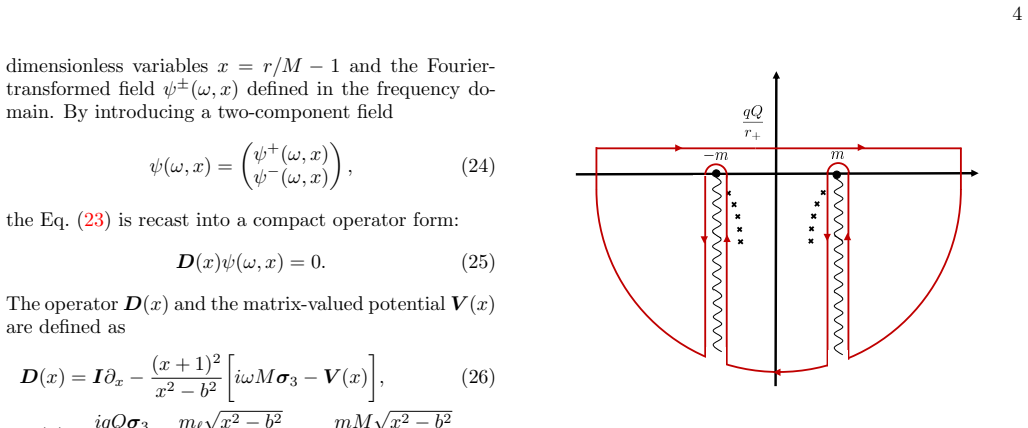
Summary. The paper studies a massive charged Dirac field on a Reissner–Nordström background by writing the radial system as a first-order matrix equation and constructing the Green’s function with ingoing horizon and decaying infinity boundary conditions. In the weak-coupling window |qQ|∼mM≪ℓ a matrix matching of near-horizon hypergeometric and far-zone Whittaker solutions yields an improved analytic QBS spectrum (Eq. 57), including fine-structure corrections from ℓ̃ and more accurate decay widths; the extremal case is treated separately (Eq. 68) and shown to be the smooth limit of the non-extremal result. Branch-cut analysis of the same Green’s function produces a multi-stage late-time picture: an oscillatory power law controlled by ℓ̃₀ for 1/m<t<1/m³M², followed by a stretched-exponential t^{-5/6}exp(−ηt^{1/3}) chirped envelope under the decaying (QBS) boundary condition for t>1/m³M² that coexists with the familiar pure t^{-5/6} outgoing-sector tail. Analytic formulae are cross-checked against matrix continued-fraction and shooting spectra and against direct time-domain simulations (Figs. 2–6).
Significance. The work supplies a controlled analytic improvement of the fermionic QBS spectrum on RN (fine structure plus better widths) and a clean separation of intermediate versus far late-time tails under the decaying boundary condition. The multi-stage claim—intermediate oscillatory power law, then stretched-exponential QBS contribution coexisting with the pure t^{-5/6} component—is falsifiable and is supported by independent numerical spectra and time-domain runs inside the stated weak-coupling window. The matrix formulation and explicit Green’s-function construction give a unified treatment of poles and branch cuts that is useful for subsequent work on fermionic clouds and late-time relaxation.
major comments (2)
- The analytic spectrum (57)/(68) and the saddle coefficient η rest on the hierarchy |qQ|∼mM≪ℓ and a nonempty overlap √(ℓ/mM)<x<ℓ/mM (Sec. III A, Appendix A). The paper already states this scope, and the numerics (Figs. 2–3, 5–6) stay inside it; no load-bearing inconsistency appears. For the published version it would still help to add one short paragraph (or a brief appendix note) quantifying how the relative error in Im ω and in the fitted η grows as mM approaches O(1), so that the domain of controlled validity is explicit rather than left to the reader’s inference from the truncated plots.
- In the far-late-time fits (Fig. 5, Table II, Eq. 91) the mixed form α₁ t^{-5/6}+α₂ t^{-5/6}exp(−η t^{1/3}) is required because the finite-domain evolution does not enforce a pure decaying outer boundary. The paper correctly interprets α₁ as the outgoing-sector piece and α₂ as the QBS piece, but a short quantitative statement of how sensitive α₁/α₂ is to outer-boundary placement (or sponge parameters) would strengthen the claim that the two components truly coexist rather than being an artifact of the numerical truncation.
minor comments (5)
- Table I caption and surrounding text: the hyperfine-splitting discussion is clear, but a one-line remark that the O(δ) real-part correction is not computed explicitly (only estimated by |Im ω|) would avoid any impression that the table already resolves hyperfine structure.
- Fig. 2 lower panels: the relative-error curves for mℓ=±1 become noisy near mM∼0.5; a brief note on numerical resolution or truncation of the continued fraction would help.
- Notation: the same symbol p is used for the asymptotic momentum (34) and occasionally in other contexts; a consistent subscript (e.g. p_∞) would reduce minor ambiguity.
- Typos / style: “eXRN” is introduced without expansion on first use in the abstract/body; “ant −5/6” in the abstract is a line-break artifact; a few missing spaces after commas in the reference list.
- Appendix B: the three-term recurrence matrices U_n are given explicitly; a sentence on the truncation N used for the backward recurrence would aid reproducibility.
Circularity Check
No significant circularity: QBS spectra and multi-stage late-time tails are derived from first-order matching and branch-cut analysis, then checked against independent numerics.
full rationale
The paper constructs the radial Dirac system as a first-order matrix operator, builds the Green function with ingoing horizon and decaying infinity boundary conditions, and obtains the QBS spectrum by asymptotic matching of near-horizon hypergeometric solutions to far-zone Whittaker solutions inside the weak-coupling window |qQ|∼mM≪ℓ (Secs. III A–B, App. A). The resulting analytic formulae (Eqs. 57, 68) are not fitted parameters; they are compared a posteriori to independent numerical root-finding (matrix-valued continued fraction and shooting). The late-time analysis likewise proceeds from the explicit discontinuity of the scattering factor S across the mass-threshold cuts, followed by Laplace and saddle-point evaluation that yields the intermediate oscillatory power law controlled by ℓ̃₀ and the far-late t^{-5/6}exp(-η t^{1/3}) chirped envelope under decaying BCs (Secs. IV B–C). These functional forms are corroborated by direct time-domain integration (Figs. 4–6). Self-citations supply the matrix-matching technique and the GQFT background formalism, but the target RN-Dirac spectra and the multi-stage tails are new outputs, not inputs. No quantity is defined in terms of itself, no parameter is fitted and then re-predicted, and no uniqueness theorem is imported to force the result. The derivation chain is therefore self-contained within the stated approximations.
Axiom & Free-Parameter Ledger
axioms (4)
- domain assumption Classical Reissner-Nordström geometry and electromagnetic potential are fixed backgrounds; back-reaction and quantum gravity corrections are neglected.
- domain assumption Weak-coupling hierarchy |qQ| ∼ mM ≪ ℓ guarantees a nonempty overlap region in which near-horizon and far-zone approximate solutions can be matched.
- domain assumption Retarded Green’s function is defined by pure ingoing waves at the event horizon and exponentially decaying (not outgoing) waves at spatial infinity.
- standard math Branch cuts of the asymptotic momentum p = M √(m^{2} − ω^{2}) are placed parallel to the imaginary axis with Re p > 0, and the late-time integral is dominated by the neighborhoods of the thresholds ω = ±m.
read the original abstract
A massive fermion around a charged black hole provides a gravitational analogue of atomic bound states and their relaxation. In this work, we study this system by formulating the radial equation as a coupled matrix system and constructing the Green's function with ingoing boundary conditions at the horizon and decaying boundary conditions at infinity. In the weak-coupling scenario $|qQ|\sim mM<1$, a matrix matching scheme gives an improved analytic expression of quasi-bound-state spectrum, including fine-structure corrections and more accurate decay widths. The extremal Reissner-Nordstr\"{o}m case ($|Q|=M$) is treated separately and shown to be the smooth limiting result of the non-extremal spectrum. We further analyze the branch-cut contribution to the time-domain Green's function in the late-time limit. We confirm an oscillatory power-law behavior in intermediate late-time regime $1/m < t < 1/m^3M^2$. In the far late-time regime $t>1/m^3M^2$, the activation of the quasi-bound states produces an $t^{-5/6}\exp(-\eta t^{1/3})$ suppression with a chirping phase before the asymptotic $t^{-5/6}$ tail previously found in the limit $t\to\infty$. Direct time-domain simulations support this distinction and show how the quasi-bound contribution coexists with the familiar power-law component.
Figures


Reference graph
Works this paper leans on
- [1]
-
[2]
S. R. Dolan and D. Dempsey, Class. Quant. Grav.32, no.18, 184001 (2015) [arXiv:1504.03190 [gr-qc]]
work page internal anchor Pith review Pith/arXiv arXiv 2015
-
[3]
R. A. Konoplya and A. Zhidenko, Rev. Mod. Phys.83, 793-836 (2011) [arXiv:1102.4014 [gr-qc]]
work page internal anchor Pith review Pith/arXiv arXiv 2011
-
[4]
Quasinormal modes of black holes and black branes
E. Berti, V. Cardoso and A. O. Starinets, Class. Quant. Grav.26, 163001 (2009) [arXiv:0905.2975 [gr-qc]]
work page internal anchor Pith review Pith/arXiv arXiv 2009
-
[5]
V. Gal’tsov D, G. V. Pomerantseva and G. A. Chizhov, Sov. Phys. J.26, 743-745 (1983)
work page 1983
-
[6]
S. L. Detweiler, Phys. Rev. D22, 2323-2326 (1980)
work page 1980
-
[7]
Y. Huang, D. J. Liu, X. h. Zhai and X. z. Li, Phys. Rev. D96, no.6, 065002 (2017) [arXiv:1708.04761 [gr-qc]]
work page internal anchor Pith review Pith/arXiv arXiv 2017
-
[8]
Y. P. Laptev and M. L. Fil’chenkov, Astron. Astrophys. Trans.25, 33 (2006) [arXiv:gr-qc/0606019 [gr-qc]]
work page internal anchor Pith review Pith/arXiv arXiv 2006
-
[9]
Exploring the String Axiverse with Precision Black Hole Physics
A. Arvanitaki and S. Dubovsky, Phys. Rev. D83, 044026 (2011) [arXiv:1004.3558 [hep-th]]
work page internal anchor Pith review Pith/arXiv arXiv 2011
-
[10]
A. B. Gaina and O. B. Zaslavsky, Class. Quant. Grav.9, 667-676 (1992)
work page 1992
-
[11]
E. W. Leaver, Phys. Rev. D41, 2986-2997 (1990)
work page 1990
-
[12]
J. G. Rosa and S. R. Dolan, Phys. Rev. D85, 044043 (2012) [arXiv:1110.4494 [hep-th]]
work page internal anchor Pith review Pith/arXiv arXiv 2012
-
[13]
S. R. Dolan, Phys. Rev. D76, 084001 (2007) [arXiv:0705.2880 [gr-qc]]
work page internal anchor Pith review Pith/arXiv arXiv 2007
-
[14]
S. Bao, Q. Xu and H. Zhang, Phys. Rev. D106, no.6, 064016 (2022) [arXiv:2201.10941 [gr-qc]]
work page internal anchor Pith review Pith/arXiv arXiv 2022
-
[15]
S. S. Bao, Q. X. Xu and H. Zhang, Phys. Rev. D107, no.6, 064037 (2023) [arXiv:2301.05317 [gr-qc]]
work page internal anchor Pith review Pith/arXiv arXiv 2023
-
[16]
X. h. Chu, Y. q. Chu, S. s. Bao and H. Zhang, Phys. Rev. D111, no.4, 043039 (2025) [arXiv:2411.09980 [gr-qc]]
work page internal anchor Pith review Pith/arXiv arXiv 2025
-
[17]
Schwarzschild black holes can wear scalar wigs
J. Barranco, A. Bernal, J. C. Degollado, A. Diez-Tejedor, M. Megevand, M. Alcubierre, D. Nunez and O. Sarbach, Phys. Rev. Lett.109, 081102 (2012) [arXiv:1207.2153 [gr-qc]]
work page internal anchor Pith review Pith/arXiv arXiv 2012
-
[18]
Numerical evolutions of spherical Proca stars
N. Sanchis-Gual, C. Herdeiro, E. Radu, J. C. Degollado and J. A. Font, Phys. Rev. D95, no.10, 104028 (2017) [arXiv:1702.04532 [gr-qc]]
work page internal anchor Pith review Pith/arXiv arXiv 2017
-
[19]
Superradiance -- the 2020 Edition
R. Brito, V. Cardoso and P. Pani, Physics,” Lect. Notes Phys.906, pp.1-237 (2015) 2020, ISBN 978-3- 319-18999-4, 978-3-319-19000-6, 978-3-030-46621-3, 978- 3-030-46622-0 [arXiv:1501.06570 [gr-qc]]
work page internal anchor Pith review Pith/arXiv arXiv 2015
-
[20]
Superradiance in rotating stars and pulsar-timing constraints on dark photons
V. Cardoso, P. Pani and T. T. Yu, Phys. Rev. D95, no.12, 124056 (2017) [arXiv:1704.06151 [gr-qc]]
work page internal anchor Pith review Pith/arXiv arXiv 2017
-
[21]
Black holes, gravitational waves and fundamental physics: a roadmap
L. Barack, V. Cardoso, S. Nissanke, T. P. Sotiriou, A. Askar, C. Belczynski, G. Bertone, E. Bon, D. Blas and R. Brito,et al.Class. Quant. Grav.36, no.14, 143001 15 (2019) [arXiv:1806.05195 [gr-qc]]
work page internal anchor Pith review Pith/arXiv arXiv 2019
-
[22]
Strong cosmic censorship in charged black-hole spacetimes: still subtle
V. Cardoso, J. L. Costa, K. Destounis, P. Hintz and A. Jansen, Phys. Rev. D98, no.10, 104007 (2018) [arXiv:1808.03631 [gr-qc]]
work page internal anchor Pith review Pith/arXiv arXiv 2018
-
[23]
Constraining the mass of dark photons and axion-like particles through black-hole superradiance
V. Cardoso, ´O. J. C. Dias, G. S. Hartnett, M. Middle- ton, P. Pani and J. E. Santos, JCAP03, 043 (2018) [arXiv:1801.01420 [gr-qc]]
work page internal anchor Pith review Pith/arXiv arXiv 2018
-
[24]
T. F. M. Spieksma, E. Cannizzaro, T. Ikeda, V. Cardoso and Y. Chen, Phys. Rev. D108, no.6, 063013 (2023) [arXiv:2306.16447 [gr-qc]]
work page internal anchor Pith review Pith/arXiv arXiv 2023
-
[25]
O. J. C. Dias, G. Lingetti, P. Pani and J. E. Santos, Phys. Rev. D108, no.4, L041502 (2023) [arXiv:2304.01265 [gr- qc]]
work page internal anchor Pith review Pith/arXiv arXiv 2023
-
[26]
T. F. M. Spieksma, V. Cardoso, G. Carullo, M. Della Rocca and F. Duque, Phys. Rev. Lett.134, no.8, 081402 (2025) [arXiv:2409.05950 [gr-qc]]
work page internal anchor Pith review Pith/arXiv arXiv 2025
-
[27]
Black hole spectroscopy: from theory to experiment
E. Berti, V. Cardoso, G. Carullo, J. Abedi, N. Afshordi, S. Albanesi, V. Baibhav, S. Bhagwat, J. L. Bl´ azquez- Salcedo and B. Bonga,et al.Class. Quant. Grav.43, no.12, 123001 (2026) [arXiv:2505.23895 [gr-qc]]
work page internal anchor Pith review Pith/arXiv arXiv 2026
-
[28]
Y. Chen, J. Shu, X. Xue, Q. Yuan and Y. Zhao, Phys. Rev. Lett.124, no.6, 061102 (2020) [arXiv:1905.02213 [hep-ph]]
work page internal anchor Pith review Pith/arXiv arXiv 2020
-
[29]
Y. Chen, R. Roy, S. Vagnozzi and L. Visinelli, Phys. Rev. D106, no.4, 043021 (2022) [arXiv:2205.06238 [astro- ph.HE]]
work page internal anchor Pith review Pith/arXiv arXiv 2022
-
[30]
Y. Chen, X. Xue, R. Brito and V. Cardoso, Phys. Rev. Lett.130, no.11, 111401 (2023) [arXiv:2211.03794 [gr- qc]]
work page internal anchor Pith review Pith/arXiv arXiv 2023
-
[31]
Y. d. Guo, S. s. Bao and H. Zhang, Phys. Rev. D107, no.7, 075009 (2023) [arXiv:2212.07186 [gr-qc]]
work page internal anchor Pith review Pith/arXiv arXiv 2023
-
[32]
Y. D. Guo, N. Jia, S. S. Bao, H. Zhang and X. Zhang, Phys. Rev. D110, no.8, 083029 (2024) [arXiv:2407.00767 [gr-qc]]
work page internal anchor Pith review Pith/arXiv arXiv 2024
- [33]
- [34]
- [35]
- [36]
-
[37]
C. H. Lee, Phys. Lett. B68, 152-156 (1977)
work page 1977
-
[38]
B. R. Iyer and A. Kumar, Phys. Rev. D18, 4799-4801 (1978)
work page 1978
- [39]
- [40]
-
[41]
W. G. Unruh, Phys. Rev. D14, 3251-3259 (1976)
work page 1976
- [42]
-
[43]
I. M. Ternov, A. B. Gaina and G. A. Chizhov, Sov. Phys. J.23, 695-700 (1980)
work page 1980
-
[44]
A. B. Gaina and I. M. Ternov, Sov. Phys. J.31, 830-834 (1988)
work page 1988
-
[45]
S. Aretakis, Commun. Math. Phys.307, 17-63 (2011) [arXiv:1110.2007 [gr-qc]]
work page internal anchor Pith review Pith/arXiv arXiv 2011
-
[46]
S. Aretakis, Annales Henri Poincare12, 1491-1538 (2011) [arXiv:1110.2009 [gr-qc]]
work page internal anchor Pith review Pith/arXiv arXiv 2011
-
[47]
Gravitational instability of an extreme Kerr black hole
J. Lucietti and H. S. Reall, Phys. Rev. D86, 104030 (2012) [arXiv:1208.1437 [gr-qc]]
work page internal anchor Pith review Pith/arXiv arXiv 2012
-
[48]
R. A. Konoplya and A. Zhidenko, Phys. Rev. D97, no.8, 084034 (2018) [arXiv:1712.06667 [gr-qc]]
work page internal anchor Pith review Pith/arXiv arXiv 2018
- [49]
-
[50]
E. W. Leaver, Proc. Roy. Soc. Lond. A402, 285-298 (1985)
work page 1985
-
[51]
H. P. Nollert, Phys. Rev. D47, 5253-5258 (1993)
work page 1993
-
[52]
G. S. Chen, C. B. Yang, S. S. Bao, Y. Tang and Y. L. Wu, Phys. Rev. D111, no.12, 125006 (2025) [arXiv:2501.08881 [gr-qc]]
work page internal anchor Pith review Pith/arXiv arXiv 2025
-
[53]
A. Lasenby, C. Doran, J. Pritchard, A. Caceres and S. Dolan, Phys. Rev. D72, 105014 (2005) [arXiv:gr- qc/0209090 [gr-qc]]
-
[54]
Dirac quasinormal frequencies in Schwarzschild-AdS space-time
M. Giammatteo and J. l. Jing, Phys. Rev. D71, 024007 (2005) [arXiv:gr-qc/0403030 [gr-qc]]
work page internal anchor Pith review Pith/arXiv arXiv 2005
-
[55]
The massive Dirac field on a rotating black hole spacetime: Angular solutions
S. Dolan and J. Gair, Class. Quant. Grav.26, 175020 (2009) [arXiv:0905.2974 [gr-qc]]
work page internal anchor Pith review Pith/arXiv arXiv 2009
-
[56]
E. W. Leaver, Phys. Rev. D34, 384-408 (1986)
work page 1986
-
[57]
H. P. Nollert, Class. Quant. Grav.16, R159-R216 (1999)
work page 1999
-
[58]
N. Andersson, Phys. Rev. D55, 468-479 (1997) [arXiv:gr- qc/9607064 [gr-qc]]
-
[59]
E. S. C. Ching, P. T. Leung, W. M. Suen and K. Young, Phys. Rev. Lett.74, 2414-2417 (1995) [arXiv:gr-qc/9410044 [gr-qc]]
work page internal anchor Pith review Pith/arXiv arXiv 1995
-
[60]
Self-Force and Green Function in Schwarzschild spacetime via Quasinormal Modes and Branch Cut
M. Casals, S. Dolan, A. C. Ottewill and B. Wardell, Phys. Rev. D88, 044022 (2013) [arXiv:1306.0884 [gr-qc]]
work page internal anchor Pith review Pith/arXiv arXiv 2013
-
[61]
Late-Time Behavior of Stellar Collapse and Explosions: I. Linearized Perturbations
C. Gundlach, R. H. Price and J. Pullin, Phys. Rev. D49, 883-889 (1994) [arXiv:gr-qc/9307009 [gr-qc]]
work page internal anchor Pith review Pith/arXiv arXiv 1994
-
[62]
R. H. Price, Phys. Rev. D5, 2419-2438 (1972)
work page 1972
-
[63]
S. Hod and T. Piran, Phys. Rev. D58, 044018 (1998) [arXiv:gr-qc/9801059 [gr-qc]]
work page internal anchor Pith review Pith/arXiv arXiv 1998
-
[64]
Asymptotic tails of massive scalar fields in Schwarzschild background
H. Koyama and A. Tomimatsu, Phys. Rev. D64, 044014 (2001) [arXiv:gr-qc/0103086 [gr-qc]]
work page internal anchor Pith review Pith/arXiv arXiv 2001
- [65]
-
[66]
J. l. Jing and Q. y. Pan, Phys. Rev. D71, 124011 (2005) [arXiv:gr-qc/0502011 [gr-qc]]
work page internal anchor Pith review Pith/arXiv arXiv 2005
-
[67]
Y. L. Wu, Phys. Rev. D93, no.2, 024012 (2016) [arXiv:1506.01807 [hep-th]]
work page internal anchor Pith review Pith/arXiv arXiv 2016
-
[68]
Y. L. Wu, Sci. Bull.62, no.16, 1109-1113 (2017) [arXiv:1705.06365 [hep-th]]
work page internal anchor Pith review Pith/arXiv arXiv 2017
-
[69]
Y. L. Wu, Eur. Phys. J. C78, no.1, 28 (2018) [arXiv:1712.04537 [hep-th]]
work page internal anchor Pith review Pith/arXiv arXiv 2018
-
[70]
Y. L. Wu, Sci. China Phys. Mech. Astron.66, no.6, 260411 (2023) [arXiv:2208.03290 [hep-th]]
work page internal anchor Pith review Pith/arXiv arXiv 2023
-
[71]
Y. L. Wu, World Scientific, 2022, ISBN 978-981-12-5708- 7
work page 2022
-
[72]
Y. L. Wu, Phys. Lett. B868, 139689 (2025) [arXiv:2411.15166 [physics.gen-ph]]
work page internal anchor Pith review Pith/arXiv arXiv 2025
-
[73]
Y. L. Wu, Sci. Bull.70, 1740-1744 (2025) [arXiv:2502.19458 [physics.gen-ph]]
work page internal anchor Pith review Pith/arXiv arXiv 2025
- [74]
-
[75]
Y. K. Gao, D. Huang, Y. L. Ma, Y. Tang, Y. L. Wu and Y. F. Zhou, Phys. Rev. D109, no.6, 064072 (2024) [arXiv:2403.17619 [gr-qc]]
work page internal anchor Pith review Pith/arXiv arXiv 2024
-
[76]
Y. K. Gao, D. Huang and Y. L. Wu, Eur. Phys. J. C85, no.10, 1159 (2025) [arXiv:2506.21225 [gr-qc]]
work page internal anchor Pith review Pith/arXiv arXiv 2025
-
[77]
C. Xu, H. B. Jin and Y. L. Wu, [arXiv:2504.01809 [gr- qc]]
work page internal anchor Pith review Pith/arXiv arXiv
-
[78]
F. Finster, J. Smoller and S. T. Yau, J. Math. Phys.41, 2173-2194 (2000) [arXiv:gr-qc/9805050 [gr-qc]]
work page internal anchor Pith review Pith/arXiv arXiv 2000
-
[79]
Asymptotic power-law tails of massive scalar fields in Reissner-Nordstr\"{o}m background
H. Koyama and A. Tomimatsu, Phys. Rev. D63, 064032 (2001) [arXiv:gr-qc/0012022 [gr-qc]]
work page internal anchor Pith review Pith/arXiv arXiv 2001
-
[80]
Slowly decaying tails of massive scalar fields in spherically symmetric spacetimes
H. Koyama and A. Tomimatsu, Phys. Rev. D65, 084031 (2002) [arXiv:gr-qc/0112075 [gr-qc]]
work page internal anchor Pith review Pith/arXiv arXiv 2002
discussion (0)
Sign in with ORCID, Apple, or X to comment. Anyone can read and Pith papers without signing in.