REVIEW 2 major objections 5 minor 300 references
Temperature scaling on the eigenvalues of LLM answer embeddings turns overconfident density matrices into calibrated uncertainty estimates whose average entropy matches risk.
Reviewed by Pith at T0; open to challenge. T0 means a machine referee read the full paper against a public rubric. the ladder, T0–T4 →
T0 review · grok-4.5
2026-07-10 08:26 UTC pith:APVF2C7O
load-bearing objection Solid theory for eigenvalue calibration of LLM density-matrix predictors; theorems hold and experiments match, with only the expected finite-sample gap. the 2 major comments →
Eigenvalue Calibration for Semantic Embeddings of Large Language Models
The pith
A machine-rendered reading of the paper's core claim, the machinery that carries it, and where it could break.
Core claim
For density-matrix predictors built from LLM answer embeddings, temperature scaling of the eigenvalues is injective; therefore the temperature that minimizes a proper matrix score risk also minimizes the proper matrix calibration error, and at that temperature expected von Neumann entropy converges to risk.
What carries the argument
Proper matrix scores and the associated calibration-sharpness decomposition: an injective post-hoc map (matrix temperature scaling) changes only the calibration term of the risk, so risk minimization is calibration optimization.
Load-bearing premise
That a few dozen sampled answers already give a density-matrix estimate faithful enough for the continuous proper-score identities and the injectivity argument to hold in practice.
What would settle it
On a held-out question-answering set, if the temperature that minimizes the matrix log risk fails to reduce the matrix calibration error (or the eigenvalue reliability gap) relative to the unscaled predictor, the central optimization claim is false.
Editorial analysis
A structured set of objections, weighed in public.
Referee Report
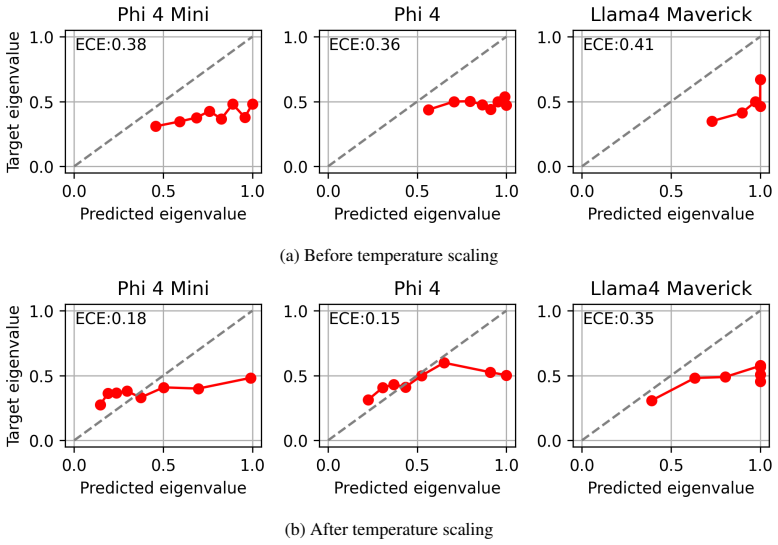
Summary. The paper treats LLMs plus semantic embeddings of sampled answers as density-matrix predictors and defines matrix calibration (predicted density matrix equals the conditional density matrix of the target embeddings) together with a weaker eigenvalue calibration. It introduces proper matrix scores, proves that matrix calibration implies equality of expected von Neumann entropy and proper-score risk (Lemma 1 / Theorem 2), derives an eigenvalue calibration inequality that follows from spectral-norm convexity (Theorem 1), and shows that any injective post-hoc map—in particular matrix temperature scaling of the eigenvalues—changes only the proper calibration error term of the risk (Theorem 3 + Proposition 3). Experiments on TriviaQA and Natural Questions with three open LLMs confirm that risk-optimal temperatures are systematically greater than one, that entropy and risk coincide at that temperature, and that the resulting recalibration reduces eigenvalue ECE and often improves AUROC for answer-correctness detection. Reliability diagrams that condition on the full predicted matrix via hierarchical clustering (Algorithm 1) make the over-confidence visually transparent.
Significance. If the finite-sample gap is accepted as ordinary estimation error, the work supplies the first rigorous calibration theory for the eigenvalue-based uncertainty measures already used in state-of-the-art LLM papers. The entropy–risk equivalence under matrix calibration, the injectivity argument for temperature scaling, and the explicit reliability-diagram procedure are concrete, reusable tools. The consistent empirical finding that modern LLMs are over-confident in their maximum eigenvalues is immediately actionable. Strengths include fully written proofs (Appendix C), public code, and a clear separation of development-set temperature fitting from test-set evaluation.
major comments (2)
- Section 4 and Appendix B.1: all theory is stated for the population density-matrix predictor d, yet every experiment (temperature fitting, risk/entropy curves, Algorithm 1 diagrams) uses the empirical estimator formed from m=20 samples drawn at temperature 0.5. Appendix B.1 already documents a positive bias in the maximum-eigenvalue estimator that only shrinks for m≥20. The continuous proper-score identities and the injectivity argument therefore hold only approximately for the objects that are actually optimized and plotted. A short quantitative bound (or an ablation with m=50–100) on how large this gap remains for the reported ECE and AUROC numbers would make the central claim fully load-bearing rather than asymptotic.
- Definition 1 and Theorem 1: eigenvalue calibration is defined by conditioning only on Λ_X = λ_max(d(X)), yet the paper correctly notes that matrix calibration yields only the inequality λ_max(D_Y|Λ_X) ≤ Λ_X. Algorithm 1 therefore resorts to hierarchical clustering inside bins to approximate conditioning on the full matrix. The resulting diagrams are informative, but the formal link between the plotted quantity E[λ_max(D_Y|d(X))|Λ_X] and the definition of eigenvalue calibration is left somewhat informal; a one-sentence statement that Algorithm 1 estimates the left-hand side of Eq. (11) rather than Eq. (10) would remove any ambiguity.
minor comments (5)
- Figure 3 caption and surrounding text: the grey dashed line at T=1 is helpful, but the optimal temperatures themselves are never tabulated; a small table of the six risk-optimal T values would aid reproducibility.
- Algorithm 1: the hierarchical clustering step uses the correlation matrix of the vectorized density matrices; a brief remark on why correlation (rather than Frobenius distance) is preferred would clarify the design choice.
- Table 1: standard errors are reported from B=20 bootstrap subsets; stating the exact bootstrap procedure (with or without replacement of the 20 answers) would remove a minor ambiguity.
- Notation: the same symbol S is used both for the proper matrix score and for the induced scalar proper score; a subscript or different font would avoid occasional confusion in Appendix C.
- Related-work paragraph: the recent sampling-temperature calibration baseline of Lamb et al. (2025) is correctly compared in Appendix B.6, but a one-sentence pointer in the main text would help readers locate the comparison.
Circularity Check
No significant circularity: proper-score identities and injectivity of matrix temperature scaling are derived self-containedly; T is fitted on held-out risk and validated on separate data.
full rationale
The derivation chain (Defs. 1–2, Props. 1–3, Lemmas 1–2, Thms. 1–3) proceeds from the standard definition of matrix calibration (DY|d(X)=d(X) a.s.) and the definition of a proper matrix score, through the induced Bregman divergence and the calibration-sharpness decomposition, to the claim that any injective post-hoc map (in particular spectral temperature scaling h_TS) changes only the calibration term of the risk. All steps are proved directly in Appendix C from these definitions plus convexity of the spectral norm; they do not redefine calibration in terms of the fitted temperature, nor do they import a uniqueness theorem that forces the result. Temperature is chosen by minimizing the matrix log risk on a development split of 300 examples and then evaluated (entropy–risk match, ECE, AUROC) on held-out test data; the observed coincidence of average entropy and risk at the risk-optimal T is therefore an empirical confirmation of Thm. 2, not a quantity forced by construction. Self-citations to Gruber & Buettner (2022) and Gruber (2024) supply background proper-score facts that are independently published and are re-proved or specialized here; they are not load-bearing for the central claims. The only residual approximation is the finite-sample density-matrix estimator (m=20), already flagged by the reader and not a circularity. Hence score 1 (minor self-citation background only).
Axiom & Free-Parameter Ledger
free parameters (3)
- temperature T = 1/α =
dataset- and model-dependent (e.g. T=2.51 for Phi-4 Mini on TriviaQA)
- number of sampled answers m =
20 (eval) / 100 (dev)
- bin count B and cluster count C in Algorithm 1 =
B=8, C=5 (default)
axioms (4)
- standard math A proper matrix score induces a concave entropy and a Bregman matrix divergence (Proposition 2).
- standard math The spectral norm (maximum eigenvalue) is convex, so Jensen yields the eigenvalue calibration inequality.
- domain assumption An LLM together with a semantic embedding can be identified with the density-matrix predictor d(x)=E[e(a)e(a)⊺] (Eq. 8).
- ad hoc to paper The continuous proper-score identities continue to hold for the finite-sample empirical density matrices used in practice.
invented entities (2)
-
proper matrix score
independent evidence
-
matrix / eigenvalue calibration
independent evidence
read the original abstract
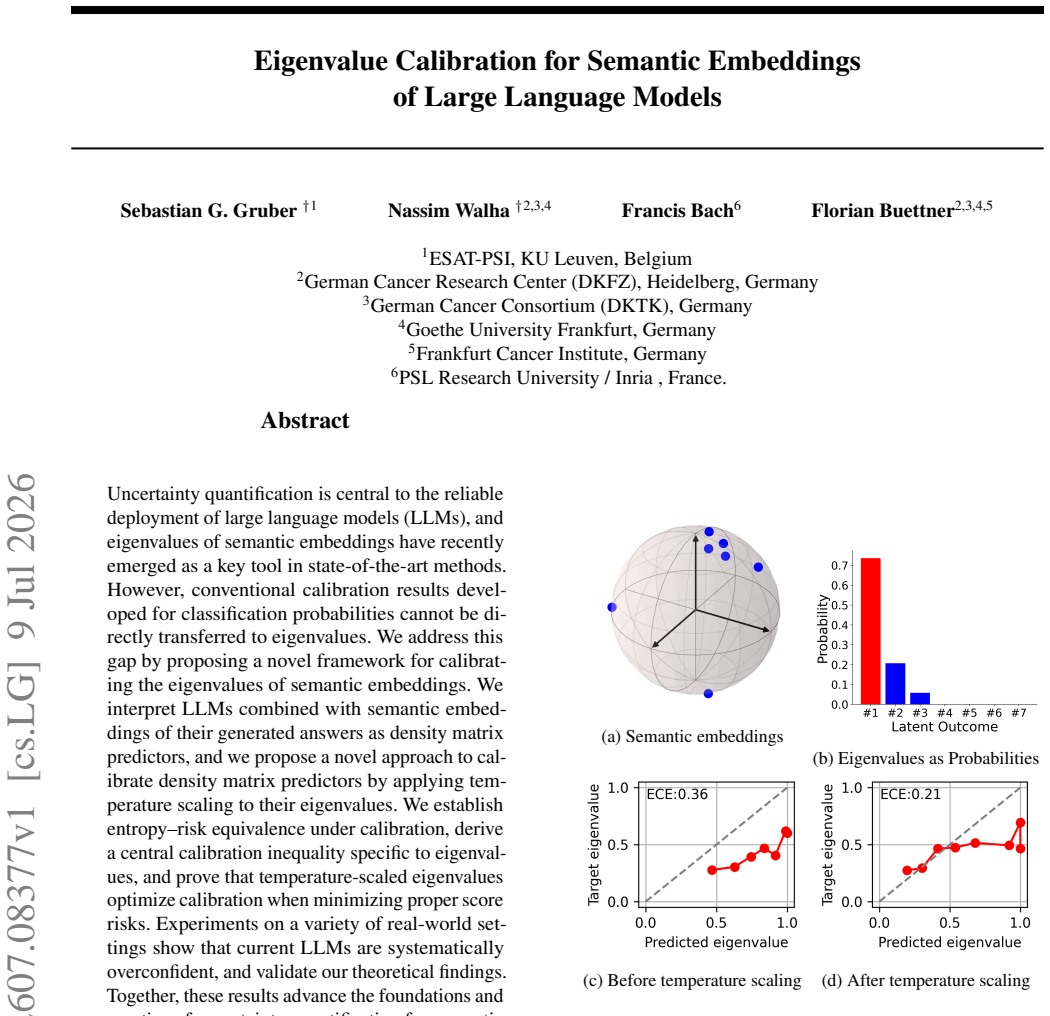
Uncertainty quantification is central to the reliable deployment of large language models (LLMs), and eigenvalues of semantic embeddings have recently emerged as a key tool in state-of-the-art methods. However, conventional calibration results developed for classification probabilities cannot be directly transferred to eigenvalues. We address this gap by proposing a novel framework for calibrating the eigenvalues of semantic embeddings. We interpret LLMs combined with semantic embeddings of their generated answers as density matrix predictors, and we propose a novel approach to calibrate density matrix predictors by applying temperature scaling to their eigenvalues. We establish entropy-risk equivalence under calibration, derive a central calibration inequality specific to eigenvalues, and prove that temperature-scaled eigenvalues optimize calibration when minimizing proper score risks. Experiments on a variety of real-world settings show that current LLMs are systematically overconfident, and validate our theoretical findings. Together, these results advance the foundations and practice of uncertainty quantification for semantic embeddings.
Figures




Reference graph
Works this paper leans on
- [1]
- [2]
-
[3]
Information Processing Equalities and the Information-Risk Bridge
Information Processing Equalities and the Information-Risk Bridge , author=. arXiv preprint arXiv:2207.11987 , year=
work page internal anchor Pith review Pith/arXiv arXiv
-
[4]
On an extension of the notion of f-divergence , journal=. 2008 , publisher=
work page 2008
-
[5]
Periodica Mathematica Hungarica , volume=
A class of measures of informativity of observation channels , author=. Periodica Mathematica Hungarica , volume=. 1972 , publisher=
work page 1972
-
[6]
Conference on Learning Theory , pages=
Divergences and risks for multiclass experiments , author=. Conference on Learning Theory , pages=. 2012 , organization=
work page 2012
-
[7]
IEEE signal processing magazine , volume=
Generative adversarial networks: An overview , author=. IEEE signal processing magazine , volume=. 2018 , publisher=
work page 2018
-
[8]
f-DISSIMILARITY. A GENERALIZATION OF , author=. Ann. Inst. Statist. Math , volume=
-
[9]
The Annals of Statistics , volume=
MULTICLASS CLASSIFICATION, INFORMATION, DIVERGENCE AND SURROGATE RISK , author=. The Annals of Statistics , volume=. 2018 , publisher=
work page 2018
-
[10]
A. Brøndsted and R. T. Rockafellar , journal =. On the Subdifferentiability of Convex Functions , urldate =
-
[11]
Canadian Journal of Mathematics , pages=
On Conjugate Convex Functions , author=. Canadian Journal of Mathematics , pages=. 1949 , publisher=
work page 1949
-
[12]
On a formula for the product-moment coefficient of any order of a normal frequency distribution in any number of variables , author=. Biometrika , volume=. 1918 , publisher=
work page 1918
-
[13]
Bregman, L.M. , description =. USSR Computational Mathematics and Mathematical Physics , keywords =
-
[14]
Stochastic Variational Deep Kernel Learning
Wilson, Andrew Gordon and Hu, Zhiting and Salakhutdinov, Ruslan and Xing, Eric P. , keywords =. Stochastic Variational Deep Kernel Learning , publisher =. 2016 , copyright =. doi:10.48550/ARXIV.1611.00336 , url =
work page internal anchor Pith review Pith/arXiv arXiv doi:10.48550/arxiv.1611.00336 2016
-
[15]
Advances on Neural Information Processing Systems , pages=
Verified uncertainty calibration , author=. Advances on Neural Information Processing Systems , pages=
-
[16]
Reliability, sufficiency, and the decomposition of proper scores , volume=
Bröcker, Jochen , year=. Reliability, sufficiency, and the decomposition of proper scores , volume=. Quarterly Journal of the Royal Meteorological Society , publisher=
-
[17]
Heskes, Tom , title = ". Neural Computation , volume =. 1998 , month =. doi:10.1162/089976698300017232 , url =
-
[18]
Morris H. DeGroot and Stephen E. Fienberg , journal =. The Comparison and Evaluation of Forecasters , volume =
-
[19]
International Conference on Machine Learning , pages =
Trainable Calibration Measures for Neural Networks from Kernel Mean Embeddings , author =. International Conference on Machine Learning , pages =. 2018 , editor =
work page 2018
-
[20]
Estimating reliability and resolution of probability forecasts through decomposition of the empirical score , author=. Climate Dynamics , year=
-
[21]
A survey of autonomous driving: Common practices and emerging technologies , author=. IEEE access , volume=. 2020 , publisher=
work page 2020
-
[22]
Philosophical Transactions of the Royal Society A , volume=
Physics-informed machine learning: case studies for weather and climate modelling , author=. Philosophical Transactions of the Royal Society A , volume=. 2021 , publisher=
work page 2021
- [23]
-
[24]
Journal of the Royal Statistical Society Series B: Statistical Methodology , volume=
Probabilistic forecasts, calibration and sharpness , author=. Journal of the Royal Statistical Society Series B: Statistical Methodology , volume=. 2007 , publisher=
work page 2007
-
[25]
Proceedings of the 2015 Conference on Empirical Methods in Natural Language Processing , pages=
Posterior calibration and exploratory analysis for natural language processing models , author=. Proceedings of the 2015 Conference on Empirical Methods in Natural Language Processing , pages=
work page 2015
-
[26]
Allan H. Murphy and Robert L. Winkler , journal =. Reliability of Subjective Probability Forecasts of Precipitation and Temperature , volume =
-
[27]
Physical Review Research , volume=
Quantum mean embedding of probability distributions , author=. Physical Review Research , volume=. 2019 , publisher=
work page 2019
-
[28]
Journal of Machine Learning Research , volume=
Characteristic and universal tensor product kernels , author=. Journal of Machine Learning Research , volume=
- [29]
-
[30]
Advances in neural information processing systems , volume=
A measure-theoretic approach to kernel conditional mean embeddings , author=. Advances in neural information processing systems , volume=
-
[31]
Learning on Graphs Conference , pages=
A survey on deep graph generation: Methods and applications , author=. Learning on Graphs Conference , pages=. 2022 , organization=
work page 2022
-
[32]
The Twelfth International Conference on Learning Representations , year=
On Bias-Variance Alignment in Deep Models , author=. The Twelfth International Conference on Learning Representations , year=
-
[33]
Quantum extension of conditional probability , author=. Physical Review A , volume=. 1999 , publisher=
work page 1999
-
[34]
International Conference on Machine Learning , pages=
Hilbert space embeddings of conditional distributions with applications to dynamical systems , author=. International Conference on Machine Learning , pages=
-
[35]
IEEE Signal Processing Magazine , volume=
Kernel embeddings of conditional distributions: A unified kernel framework for nonparametric inference in graphical models , author=. IEEE Signal Processing Magazine , volume=. 2013 , publisher=
work page 2013
-
[36]
Warmuth, Manfred KK , journal=. A
-
[37]
Warmuth, Manfred K and Kuzmin, Dima , booktitle=. A
-
[38]
Journal of Artificial Intelligence Research , volume=
From word to sense embeddings: A survey on vector representations of meaning , author=. Journal of Artificial Intelligence Research , volume=
-
[39]
Maddox, Wesley J and Izmailov, Pavel and Garipov, Timur and Vetrov, Dmitry P and Wilson, Andrew Gordon , journal=. A simple baseline for
-
[40]
Logit models from economics and other fields , volume=
The origins and development of the logit model , author=. Logit models from economics and other fields , volume=. 2003 , publisher=
work page 2003
-
[41]
Rajendra Acharya and Vladimir Makarenkov and Saeid Nahavandi , doi =
Moloud Abdar and Farhad Pourpanah and Sadiq Hussain and Dana Rezazadegan and Li Liu and Mohammad Ghavamzadeh and Paul Fieguth and Xiaochun Cao and Abbas Khosravi and U. Rajendra Acharya and Vladimir Makarenkov and Saeid Nahavandi , doi =. A review of uncertainty quantification in deep learning: Techniques, applications and challenges , url =. Information ...
work page 2021
-
[42]
AAAI Conference on Artificial Intelligence , volume=
Towards trustworthy predictions from deep neural networks with fast adversarial calibration , author=. AAAI Conference on Artificial Intelligence , volume=
-
[43]
International Conference on Learning Representations , year=
Score-Based Generative Modeling through Stochastic Differential Equations , author=. International Conference on Learning Representations , year=
-
[44]
and Erdem, Muhammed Ebrar and Cremers, Daniel and Buettner, Florian , title =
Tomani, Christian and Gruber, Sebastian G. and Erdem, Muhammed Ebrar and Cremers, Daniel and Buettner, Florian , title =. Conference on Computer Vision and Pattern Recognition (CVPR) , month =. 2021 , pages =
work page 2021
- [45]
-
[46]
International Conference on Learning Representations , year=
The Deep Bootstrap Framework: Good Online Learners are Good Offline Generalizers , author=. International Conference on Learning Representations , year=
- [47]
-
[48]
Statistical Properties of the log-cosh Loss Function Used in Machine Learning
Saleh, Resve A. and Saleh, A. K. Md. Ehsanes , keywords =. Statistical Properties of the log-cosh Loss Function Used in Machine Learning , publisher =. 2022 , copyright =. doi:10.48550/ARXIV.2208.04564 , url =
work page internal anchor Pith review Pith/arXiv arXiv doi:10.48550/arxiv.2208.04564 2022
-
[49]
Finding hidden-feature depending laws inside a data set and classifying it using Neural Network
Finding hidden-feature depending laws inside a data set and classifying it using Neural Network , author=. arXiv preprint arXiv:2101.10427 , year=
work page internal anchor Pith review Pith/arXiv arXiv
-
[50]
An elementary introduction to information geometry , author=. Entropy , volume=. 2020 , publisher=
work page 2020
- [51]
-
[52]
Bias/variance decompositions for likelihood-based estimators , author=. Neural Computation , volume=. 1998 , publisher=
work page 1998
-
[53]
Game theory, maximum entropy, minimum discrepancy and robust
Gr. Game theory, maximum entropy, minimum discrepancy and robust. the Annals of Statistics , volume=. 2004 , publisher=
work page 2004
-
[54]
Understanding the bias-variance tradeoff of Bregman divergences
Understanding the bias-variance tradeoff of Bregman divergences , author=. arXiv preprint arXiv:2202.04167 , year=
work page internal anchor Pith review Pith/arXiv arXiv
-
[55]
Advances in Neural Information Processing Systems , volume=
Simple and scalable predictive uncertainty estimation using deep ensembles , author=. Advances in Neural Information Processing Systems , volume=
-
[56]
Attention is All you Need , volume =
Vaswani, Ashish and Shazeer, Noam and Parmar, Niki and Uszkoreit, Jakob and Jones, Llion and Gomez, Aidan N and Kaiser, ukasz and Polosukhin, Illia , booktitle =. Attention is All you Need , volume =
-
[57]
Advances in Neural Information Processing Systems , volume=
Minilm: Deep self-attention distillation for task-agnostic compression of pre-trained transformers , author=. Advances in Neural Information Processing Systems , volume=
-
[58]
Song, Kaitao and Tan, Xu and Qin, Tao and Lu, Jianfeng and Liu, Tie-Yan , booktitle=
-
[59]
Towards General Text Embeddings with Multi-stage Contrastive Learning
Towards General Text Embeddings with Multi-stage Contrastive Learning , author=. arXiv preprint arXiv:2308.03281 , year=
work page internal anchor Pith review Pith/arXiv arXiv
-
[60]
Medical Imaging with Deep Learning , year=
Test-time data augmentation for estimation of heteroscedastic aleatoric uncertainty in deep neural networks , author=. Medical Imaging with Deep Learning , year=
-
[61]
Aleatoric uncertainty estimation with test-time augmentation for medical image segmentation with convolutional neural networks , author=. Neurocomputing , volume=. 2019 , publisher=
work page 2019
-
[62]
Proceedings of the International Conference on Knowledge Discovery and Data Mining , pages=
Xgboost: A scalable tree boosting system , author=. Proceedings of the International Conference on Knowledge Discovery and Data Mining , pages=
-
[63]
Random forests , author=. Machine learning , volume=. 2001 , publisher=
work page 2001
-
[64]
Bagging predictors , author=. Machine learning , volume=. 1996 , publisher=
work page 1996
-
[65]
Generalizations of the bias/variance decomposition for prediction error , author=. Dept. Statistics, Stanford Univ., Stanford, CA, Tech. Rep , year=
-
[66]
International Conference on Machine Learning , pages=
A unified bias-variance decomposition , author=. International Conference on Machine Learning , pages=
-
[67]
Variance and bias for general loss functions , author=. Machine learning , volume=. 2003 , publisher=
work page 2003
-
[68]
Transactions on Machine Learning Research , year=
Ensembles of Classifiers: a Bias-Variance Perspective , author=. Transactions on Machine Learning Research , year=
-
[69]
Proceedings of International Conference on Neural Networks (ICNN'96) , volume=
Generalization error of ensemble estimators , author=. Proceedings of International Conference on Neural Networks (ICNN'96) , volume=. 1996 , organization=
work page 1996
-
[70]
Mathematical geology , volume=
Isometric logratio transformations for compositional data analysis , author=. Mathematical geology , volume=. 2003 , publisher=
work page 2003
-
[71]
Advances in Neural Information Processing Systems , volume=
Imagenet classification with deep convolutional neural networks , author=. Advances in Neural Information Processing Systems , volume=
-
[72]
Advances in Neural Information Processing Systems 32 , pages =
PyTorch: An Imperative Style, High-Performance Deep Learning Library , author =. Advances in Neural Information Processing Systems 32 , pages =. 2019 , publisher =
work page 2019
-
[73]
Kim-Celine Kahl and Carsten T. L. Val. International Conference on Learning Representations , year=
-
[74]
IEEE transactions on Information Theory , volume=
General entropy criteria for inverse problems, with applications to data compression, pattern classification, and cluster analysis , author=. IEEE transactions on Information Theory , volume=. 1990 , publisher=
work page 1990
-
[75]
The Annals of Statistics , volume=
Why least squares and maximum entropy? An axiomatic approach to inference for linear inverse problems , author=. The Annals of Statistics , volume=. 1991 , publisher=
work page 1991
-
[76]
Annals of the Institute of Statistical Mathematics , volume=
The geometry of proper scoring rules , author=. Annals of the Institute of Statistical Mathematics , volume=. 2007 , publisher=
work page 2007
-
[77]
Duality and Auxiliary Functions for Bregman Distances (revised) , author=. 2002 , institution=
work page 2002
-
[78]
International Conference on Machine Learning , pages=
Agglomerative bregman clustering , author=. International Conference on Machine Learning , pages=
-
[79]
Brinda, WD and Klusowski, Jason M and Yang, Dana , journal=. H. 2019 , publisher=
work page 2019
-
[80]
A bias-variance decomposition for
Brofos, James and Shu, Rui and Lederman, Roy R , booktitle=. A bias-variance decomposition for
discussion (0)
Sign in with ORCID, Apple, or X to comment. Anyone can read and Pith papers without signing in.