REVIEW 2 major objections 6 minor 36 references
Naive width-aware PLC verification raises 44% false alarms; a small hardware model restores soundness.
Reviewed by Pith at T0; open to challenge. T0 means a machine referee read the full paper against a public rubric. the ladder, T0–T4 →
T0 review · grok-4.5
2026-07-10 05:31 UTC pith:3LLJHR62
load-bearing objection Clean empirical fix for a real soundness failure in width-aware PLC verification: 54 o0 false alarms on third-party code, with automatic bounds from %IW addresses. the 2 major comments →
ESBMC-Arduino: Closing the Deployment Gap for Formal Verification of Open-Hardware PLCs
The pith
A machine-rendered reading of the paper's core claim, the machinery that carries it, and where it could break.
Core claim
The deployment gap between abstract IEC 61131-3 verification and the board artifact makes naive width-aware checking unsound in practice. On 123 real programs, 16-bit overflow checking without an input model yields 54 false alarms (44%) and zero true findings; an automatically derived HAL input model eliminates all of them while preserving the 32 robustness proofs, and detects genuine but rare width-dependent overflows only with physically realizable witnesses.
What carries the argument
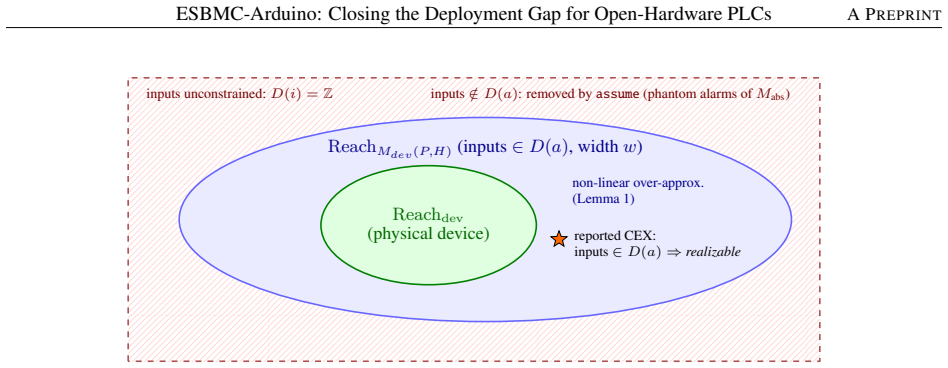
The deployment model Mdev(P,H): a declarative four-field HAL descriptor H together with a faithful lowering that fixes arithmetic at the target word width and injects assume constraints that keep every input inside its hardware-realizable domain D(a).
Load-bearing premise
Soundness rests on the descriptor being faithful: the stated word width matches the board and every input domain covers the true hardware range; the evaluation treats every integer input as a uniform 10-bit ADC source and never executes the witnesses on physical boards.
What would settle it
Run the same 123 programs (or a larger analog-heavy corpus) on a physical AVR board while injecting the reported witnesses; if any of the 54 eliminated alarms actually overflows under real ADC readings, or if a program proved robust under the HAL model overflows on silicon, the soundness claim fails.
Editorial analysis
A structured set of objections, weighed in public.
Referee Report
Summary. The paper identifies a deployment gap between abstract IEC 61131-3 verification (unbounded integers, free inputs) and open-hardware PLC execution (16-bit AVR words, finite-resolution ADC inputs). On 123 third-party programs, naive 16-bit overflow checking without an input model yields a 44% false-alarm rate (54/123) and zero genuine defects. The authors propose a declarative HAL descriptor (word width, ADC/PWM resolution, I/O map) and a sound lowering that interprets arithmetic at target width and constrains inputs to hardware-realizable ranges, instantiated as ESBMC-Arduino via a ~40-line frontend hook. Evaluation shows the HAL annotator eliminates all 54 false alarms while preserving 32 robustness proofs; a controlled taxonomy isolates rare width-dependent defects with realizable witnesses; CBMC and Frama-C reproduce both phantom and genuine cases, including on MATIEC-generated C.
Significance. The work transfers the target-model discipline of Frama-C/Astrée to the PLC domain with a decisive practical advantage: input bounds are recovered automatically from PLCopen %IW/%IX addresses rather than supplied as contracts. The empirical design is strong—same-binary HAL_ANNOTATE toggle, 16-vs-32 control isolating input-driven phantoms, cross-tool replication, and a self-contained artifact with pinned corpora and reproduce scripts. Honesty about rarity of genuine defects in public LD corpora and about k-induction incompleteness is a credit. If the result holds, it makes width-aware verification of open-hardware PLCs usable for assurance and ICS security testbeds, at low engineering cost.
major comments (2)
- [§5.4 Theorem 1; §10] §5.4 Theorem 1 and §10: Soundness is conditional on a faithful HAL H, and the evaluation is model-level only (no hardware-in-the-loop). The thesis is “what you verify must be what runs on the device,” yet the genuine-defect witnesses (e.g., adc=898 in §7.1) are never executed on a physical Uno/Due. A small HIL confirmation of at least one controlled-corpus flip, or a clearer argument why model-level fidelity to the official cores is sufficient for the claim, would strengthen the central deployment argument.
- [§8.2 RQ1; Abstract; §10] §8.2 RQ1 and §10: The prevalence claim that the gap is “rare” is scoped to integer/Boolean LD corpora dominated by Boolean/timer logic; analog-heavy process-control and ICS-testbed programs (where ADC-to-engineering-unit scaling is common) are outside the frontend. The abstract and introduction frame the problem as important for real automation and ICS security research. Either expand the controlled/real corpora with at least one analog-scaling industrial example, or more prominently qualify the prevalence claim in the abstract so the significance is not overstated relative to the evidence.
minor comments (6)
- [Abstract] Abstract names the instantiation “ArduinoTool”; title, body, and keywords use “ESBMC-Arduino.” Align the name throughout.
- [Table 5; §8.4; §10] Table 5 reports 32 safe / 91 unknown / 0 unsafe under HAL-annotated; the text sometimes says “91/123 programs are unknown” (§10) and elsewhere focuses on the 54→0 change. A single consistent accounting of the 37 already-unknown programs would help readers track RQ3 vs RQ4.
- [Listing 1; §7.1] Listing 1 and §7.1 use both “adc ≥ 819” and the counterexample adc=898; a one-line derivation of why 819 is the high-mark threshold (80% of 1023) would make the property fully self-contained.
- [Figure 2; §2.5] Figure 2 and §2.5 correctly locate the gap after MATIEC/cross-compilation; a brief note that the method verifies the pre-compilation model under target ABI assumptions (not the linked binary) would avoid any impression of binary-level verification.
- [Table 1; §3.1] Related-work Table 1 is clear; adding a row or footnote for PLCverif’s recent FRET/monitor extensions (§3.1) would keep the positioning current without changing the claim that none model target word width plus auto-derived input ranges.
- [§2.7; Artifact Availability] Minor typos: “A VR” spacing throughout (should be AVR); “hacked” in §2.7 should be “havocked”; “bun-dled” hyphenation in the artifact paragraph.
Circularity Check
No significant circularity: the 54 o0 false-alarm result is an empirical same-binary before/after on third-party corpora, not a quantity forced by definition or self-citation.
full rationale
The paper's central claim is an empirical measurement: naive 16-bit overflow checking on 123 third-party programs yields 54 false alarms that the HAL input-range model eliminates while preserving 32 robustness proofs. This is produced by toggling HAL_ANNOTATE on the same binary, with independent cross-tool replication on CBMC and Frama-C and on MATIEC-generated C. Theorem 1 is a standard state-set containment argument (Reach_dev ⊆ Reach_Mdev under a faithful descriptor H); it is not defined in terms of the evaluation outcome. Self-citations to the ESBMC-PLC line supply the LD frontend substrate but do not force the 54 o0 result by construction. HAL parameters are taken from official Arduino cores, not fitted to the corpus. The controlled corpus isolates width-dependent flips with realizable witnesses rather than renaming a known pattern. No fitted-input-called-prediction, uniqueness-imported-from-authors, or self-definitional step is present. Score 1 reflects only the ordinary self-citation of the authors' prior frontend work, which is not load-bearing for the soundness or evaluation claims.
Axiom & Free-Parameter Ledger
axioms (5)
- domain assumption PLC scan-cycle model: inputs resampled each scan, held constant during rung evaluation; safety is a per-scan assertion (open-world inputs, no continuous plant dynamics).
- domain assumption Target arithmetic is fixed-width two’s-complement at the board ABI int width (16-bit AVR, 32-bit ARM), with wrap outside [-2^{w-1}, 2^{w-1}).
- ad hoc to paper For a faithful HAL H, Reach_dev ⊆ Reach_Mdev(P,H); non-linear FBs are replaced by nondeterministic outputs in declared ranges (Lemma 1).
- domain assumption ESBMC’s bit-vector BMC/k-induction backend is sound for the encoded overflow VCs under the injected assumes.
- ad hoc to paper In the real-corpus evaluation, every integer input may be modeled as a 10-bit ADC reading in [0,1023] for AVR-class boards.
invented entities (2)
-
HAL descriptor H = ⟨w, b_adc, b_pwm, μ⟩
independent evidence
-
Deployment model Mdev(P,H) vs abstract model Mabs
independent evidence
read the original abstract
OpenPLC, Arduino OPTA, CONTROLLINO, and Industrial Shields M-Duino bring IEC 61131-3 to low-cost microcontrollers used in real automation and industrial control system (ICS) security research. Existing open-source verifiers for IEC 61131-3, including ESBMC-PLC, prove safety over an abstract scan-cycle model with idealized unbounded integers. The board artifact runs on a resource-constrained microcontroller unit (MCU) with 16-bit words (8-bit AVR Arduinos), and sensors are read via a finite-resolution analog-to-digital converter (ADC). We show this deployment gap makes naive width-aware verification unsound: across 123 real programs, checking 16-bit overflow without a hardware input model yields 44% false alarms (54/123) and finds no genuine defects, because it explores sensor values no ADC can produce. Since the gap lies where computation meets the physical process - a bounded sensor reading scaled by finite-width arithmetic into an actuation command - an overflow can silently suppress a safety action, such as a high-level alarm. An unbounded input model fabricates alarms that no environment can trigger. We present hardware-faithful verification for IEC 61131-3 on open hardware: a declarative hardware abstraction layer (HAL) descriptor (width, ADC/PWM resolution, I/O binding) and a sound lowering that interprets arithmetic at target width and constrains inputs to hardware-realizable ranges. We instantiate it for Arduino as ArduinoTool, deriving HAL parameters from official cores and realizing the input-range model in the ESBMC Ladder Diagram (LD) frontend. On the 123-program corpus, the HAL annotator eliminates all 54 false alarms while preserving robustness proofs, and a controlled corpus demonstrates the rare width-dependent defects it detects with realizable witnesses.
Figures


Reference graph
Works this paper leans on
-
[1]
Thiago Alves and Thomas Morris. Openplc: An iec 61131-3 compliant open source industrial controller for cyber security research.Computers & Security, 78:364–379, September 2018. ISSN 0167-4048. doi: 10.1016/j.cose.2018.07.007
-
[2]
Openplc: An open source alternative to automation
Thiago Rodrigues Alves, Mario Buratto, Flavio Mauricio de Souza, and Thelma Virginia Rodrigues. Openplc: An open source alternative to automation. InIEEE Global Humanitarian Technology Conference (GHTC 2014), page 585–589, San Jose, CA, USA, October 2014. IEEE. doi: 10.1109/ghtc.2014.6970342
-
[3]
Arduino OPTA: Micro PLC with industrial IoT
Arduino. Arduino OPTA: Micro PLC with industrial IoT. https://www.arduino.cc/pro/ hardware-arduino-opta/, 2024. Accessed 2026-06-27
work page 2024
-
[4]
Arduino PLC IDE: IEC 61131-3 programming for arduino pro hardware
Arduino. Arduino PLC IDE: IEC 61131-3 programming for arduino pro hardware. https://www.arduino.cc/ pro/software-plc-ide/, 2024. Accessed 2026-06-27
work page 2024
-
[5]
CONTROLLINO: Arduino-compatible industrial PLC
CONTROLLINO. CONTROLLINO: Arduino-compatible industrial PLC. https://www.controllino.com/,
-
[6]
M-Duino arduino-based PLC family
Industrial Shields. M-Duino arduino-based PLC family. https://www.industrialshields.com/, 2024. Accessed 2026-06-27
work page 2024
-
[7]
Pierre Dantas, Lucas C. Cordeiro, and W. S. Silva Júnior. ESBMC-PLC: Formal verification of IEC 61131-3 ladder diagram programs, 2026. TACAS 2027 artefact. Reproducible viabash conformance/run_all.sh
work page 2026
-
[8]
Pierre Dantas, Lucas C. Cordeiro, and W. S. Silva Júnior. ESBMC-GraphPLC: Formal verification of graphical PLCopen XML ladder diagram programs using SMT-based model checking, 2026
work page 2026
-
[9]
Pierre Dantas, Lucas C. Cordeiro, and W. S. Silva Júnior. ESBMC-PLC+: Unified IEC 61131-3 formal verification framework with ST frontend and graphical function block support (pull request #5427). GitHub Pull Request #5427, esbmc/esbmc, 2026. URL https://github.com/esbmc/esbmc/pull/5427. Source code and benchmark suite
work page 2026
-
[10]
Jean-Charles Tournier, Borja Fernández Adiego, and Ignacio D. Lopez-Miguel. PLCverif: Status of a formal verifi- cation tool for programmable logic controller. InProceedings of the 18th International Conference on Accelerator and Large Experimental Physics Control Systems (ICALEPCS’21), page MOPV042, Shanghai, China, October
-
[11]
JACoW Publishing. ISBN 978-3-95450-221-9. doi: 10.18429/JACoW-ICALEPCS2021-MOPV042
-
[12]
Ignacio D. Lopez-Miguel, Borja Fernández Adiego, Matias Salinas, and Christine Betz.Formal Verification of PLCs as a Service: A CERN-GSI Safety-Critical Case Study, pages 227–235. Springer Nature Switzerland, Williamsburg, V A, USA, June 2025. ISBN 9783031937064. doi: 10.1007/978-3-031-93706-4_13
-
[13]
Frama-c: A software analysis perspective.Formal Aspects of Computing, 27(3):573–609, May 2015
Florent Kirchner, Nikolai Kosmatov, Virgile Prevosto, Julien Signoles, and Boris Yakobowski. Frama-c: A software analysis perspective.Formal Aspects of Computing, 27(3):573–609, May 2015. ISSN 1433-299X. doi: 10.1007/s00165-014-0326-7. 19 ESBMC-Arduino: Closing the Deployment Gap for Open-Hardware PLCsA PREPRINT
-
[14]
Patrick Cousot, Radhia Cousot, Jêrome Feret, Laurent Mauborgne, Antoine Miné, David Monniaux, and Xavier Rival. The astreÉ analyzer. InProgramming Languages and Systems, page 21–30, Edinburgh, UK, 2005. Springer Berlin Heidelberg. ISBN 9783540319870. doi: 10.1007/978-3-540-31987-0_3
-
[15]
ArduinoCore-avr: the official arduino avr core
Arduino. ArduinoCore-avr: the official arduino avr core. https://github.com/arduino/ArduinoCore-avr,
-
[16]
ADC 10-bit, analogWrite/PWM 8-bit; A VR-GCCint= 16-bit. Accessed 2026-06-28
work page 2026
-
[17]
An open source iec 61131-3 integrated development environment, July 2007
Edouard Tisserant, Laurent Bessard, and Mario de Sousa. An open source iec 61131-3 integrated development environment, July 2007. ISSN 1935-4576
work page 2007
-
[18]
Lucas Cordeiro, Bernd Fischer, and Joao Marques-Silva. Smt-based bounded model checking for embedded ansi-c software.IEEE Transactions on Software Engineering, 38(4):957–974, July 2012. ISSN 0098-5589. doi: 10.1109/tse.2011.59
-
[19]
Mikhail R. Gadelha, Rafael S. Menezes, and Lucas C. Cordeiro. ESBMC 6.1: Automated Test Case Generation Using Bounded Model Checking.International Journal on Software Tools for Technology Transfer, 23(6):857–861, May 2020. doi: 10.1007/s10009-020-00571-2
-
[20]
Checking safety properties using induction and a sat-solver
Mary Sheeran, Satnam Singh, and Gunnar Stålmarck. Checking safety properties using induction and a sat-solver. InFormal Methods in Computer-Aided Design, page 127–144, Berlin, 2000. Springer Berlin Heidelberg. ISBN 9783540409229. doi: 10.1007/3-540-40922-x_8
-
[21]
Towards establishing formal verification and inductive code synthesis in the PLC domain
Matthias Weis, Philipp Marks, Benjamin Maschler, Dustin White, Pascal Kesseli, and Michael Weyrich. Towards establishing formal verification and inductive code synthesis in the PLC domain. In2021 IEEE 19th International Conference on Industrial Informatics (INDIN), pages 1–8, Palma de Mallorca, Spain, July 2021. IEEE. doi: 10.1109/INDIN45523.2021.9557423
-
[22]
The nuXmv symbolic model checker
Roberto Cavada, Alessandro Cimatti, Marco Dorigatti, Alberto Griggio, Alessandro Mariotti, Andrea Micheli, Sergio Mover, Marco Roveri, and Stefano Tonetta. The nuXmv symbolic model checker. InComputer Aided Verification (CAV 2014), volume 8559 ofLecture Notes in Computer Science, pages 334–345, Vienna, Austria,
work page 2014
-
[23]
doi: 10.1007/978-3-319-08867-9_22
Springer. doi: 10.1007/978-3-319-08867-9_22
-
[24]
Poskitt, Xiangxiang Chen, Jun Sun, and Peng Cheng
Kun Wang, Jingyi Wang, Christopher M. Poskitt, Xiangxiang Chen, Jun Sun, and Peng Cheng. K-st: A formal executable semantics of the structured text language for plcs.IEEE Transactions on Software Engineering, 49 (10):4796–4813, October 2023. ISSN 2326-3881. doi: 10.1109/tse.2023.3315292
-
[25]
Springer Nature Switzerland, Milan, Italy, September 2024
Jaeseo Lee and Kyungmin Bae.Formal Semantics and Analysis of Multitask PLC ST Programs with Preemption, pages 425–442. Springer Nature Switzerland, Milan, Italy, September 2024. ISBN 9783031711626. doi: 10.1007/978-3-031-71162-6_22
-
[26]
Springer Nature Switzerland, Singapore, Singapore, October 2025
Jaeseo Lee and Kyungmin Bae.Formal Analysis of Networked PLC Controllers Interacting with Physical Environments, pages 328–356. Springer Nature Switzerland, Singapore, Singapore, October 2025. ISBN 9783032071064. doi: 10.1007/978-3-032-07106-4_14
-
[27]
Springer Nature Switzerland, Moffett Field, CA, USA, 2024
Xaver Fink, Anastasia Mavridou, Andreas Katis, and Borja Fernández Adiego.Verifying PLC Programs via Monitors: Extending the Integration of FRET and PLCverif, page 427–435. Springer Nature Switzerland, Moffett Field, CA, USA, 2024. ISBN 9783031606984. doi: 10.1007/978-3-031-60698-4_26
-
[28]
Chibuzo Ukegbu and Hoda Mehrpouyan. Cooperative verification of PLC programs using CoVeriTeam: Towards a reliable and secure industrial control systems. InProceedings of Cyber-Physical Systems and Internet of Things Week 2023, CPS-IoT Week ’23, pages 37–42, San Antonio, TX, USA, May 2023. ACM. doi: 10.1145/3576914. 3587490
-
[29]
Ali Ebnenasir. Formalizing ladder logic programs and timing charts for fault impact analysis and verification of fault tolerance. Technical Report CS-TR-23-01, Michigan Technological University, Department of Computer Science, 2023. URL https://www.mtu.edu/cs/research/papers/pdfs/ formalizing-ladder-logic-ali-ebnenasir-tech-rpt-010623-rev.pdf
work page 2023
-
[30]
Method for automatic translation of ladder logic to a SMT-based model checker in a network
Roberto Bruttomesso, Alessandro Di Pinto, Moreno Carullo, and Andrea Carcano. Method for automatic translation of ladder logic to a SMT-based model checker in a network. US Patent 11,906,943. Assignee: Nozomi Networks SAGL, 2024. Filed: 2021-08-12. Granted: 2024-02-20
work page 2024
-
[31]
Formal verification of a realistic compiler.Communications of the ACM, 52(7):107–115, July 2009
Xavier Leroy. Formal verification of a realistic compiler.Communications of the ACM, 52(7):107–115, July 2009. ISSN 1557-7317. doi: 10.1145/1538788.1538814
-
[32]
Springer Berlin Heidelberg, Berlin, 2004
Edmund Clarke, Daniel Kroening, and Flavio Lerda.A Tool for Checking ANSI-C Programs, page 168–176. Springer Berlin Heidelberg, Berlin, 2004. ISBN 9783540247302. doi: 10.1007/978-3-540-24730-2_15
-
[33]
Antonio Iacobelli, Lorenzo Rinieri, Andrea Melis, Amir Al Sadi, Marco Prandini, and Franco Callegati. Detection of ladder logic bombs in PLC control programs: An architecture based on formal verification. In2024 IEEE 7th 20 ESBMC-Arduino: Closing the Deployment Gap for Open-Hardware PLCsA PREPRINT International Conference on Industrial Cyber-Physical Syst...
-
[34]
IEEE. doi: 10.1109/ICPS59941.2024.10639995
-
[35]
IEC 61131-3 clone detection dataset (plcopen xml / structured text)
Kamil Rosiak et al. IEC 61131-3 clone detection dataset (plcopen xml / structured text). https://github.com/ KamilRosiak/IEC_61131_3_Clone_Detection, 2022. Accessed 2026-06-28
work page 2022
-
[36]
Gadelha, Norbert Tihanyi, Konstantin Korovin, and Lucas C
Rafael Sá Menezes, Mohannad Aldughaim, Bruno Farias, Xianzhiyu Li, Edoardo Manino, Fedor Shmarov, Kunjian Song, Franz Brauße, Mikhail R. Gadelha, Norbert Tihanyi, Konstantin Korovin, and Lucas C. Cordeiro. ESBMC v7.4: Harnessing the Power of Intervals: (Competition Contribution). InTools and Algorithms for the Construction and Analysis of Systems (TACAS 2...
discussion (0)
Sign in with ORCID, Apple, or X to comment. Anyone can read and Pith papers without signing in.