REVIEW 3 major objections 6 minor 56 references
Gradient signals replace camera frustums for panoramic 3D scene partitioning
Reviewed by Pith at T0; open to challenge. T0 means a machine referee read the full paper against a public rubric. the ladder, T0–T4 →
T0 review · glm-5.2
2026-07-10 01:28 UTC pith:YT53P7WI
load-bearing objection G2PS is a solid panoramic partitioning strategy, but the paper never proves it actually reduces cameras-per-block — the scalability claim is under-evidenced. the 3 major comments →
Geometry and Gradient-based Partitioning for Panoramic Outdoor Reconstruction
The pith
A machine-rendered reading of the paper's core claim, the machinery that carries it, and where it could break.
Core claim
The central mechanism is the substitution of gradient magnitude for geometric frustum visibility as the camera-block assignment criterion. The rendering loss gradient with respect to Gaussian positions naturally reflects how much a given viewpoint contributes to a spatial region: regions with large contributions exhibit large gradients, while distant or occluded regions produce near-zero gradients. This proxy works even when every camera technically observes every region, because gradient magnitude captures effective observational contribution rather than mere visibility. The paper shows that this single substitution, combined with a parallax-driven bounding volume and frozen sky Gaussians,恢
What carries the argument
Gradient-based camera-block allocation (Eq. 10–11): after coarse training, a single forward-backward pass over all training views collects per-camera, per-block gradient magnitudes. A camera is assigned to a block if either it is geometrically located within that block or its normalized gradient score exceeds a threshold (τ_grad = 0.8).
Load-bearing premise
The gradient-based allocation assumes that rendering loss gradients with respect to Gaussian positions reliably measure a camera's actual contribution to a spatial block. If gradients are noisy, dominated by a few outlier Gaussians, or fail to capture true geometric importance, the camera-block assignments will be suboptimal.
What would settle it
If replacing frustum-based allocation with gradient-based allocation produced no improvement over naive global training (i.e., all cameras assigned to all blocks) on panoramic scenes, the core mechanism would be falsified.
Editorial analysis
A structured set of objections, weighed in public.
Referee Report
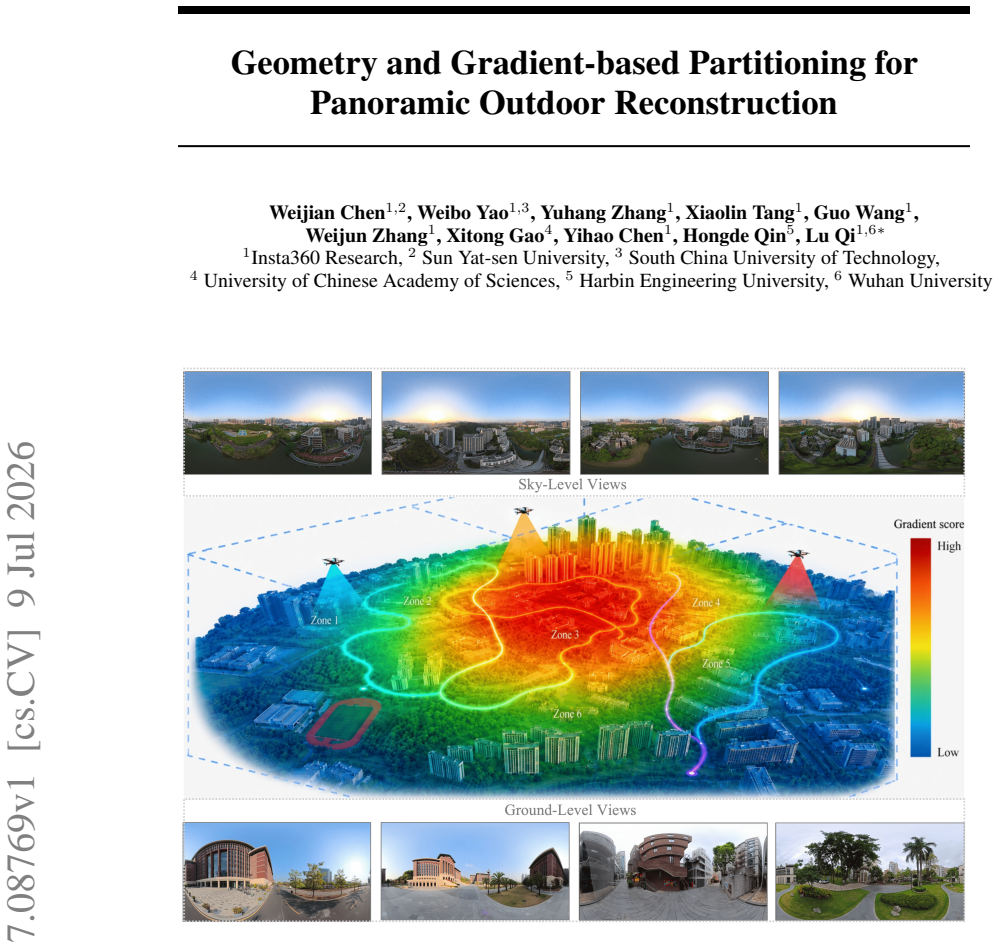
Summary. The manuscript presents PanoLOG, a two-stage coarse-to-fine framework for large-scale outdoor 3D Gaussian Splatting (3DGS) using panoramic (equirectangular projection, ERP) images. The core contribution is G2PS, a Geometry and Gradient-based Partitioning Strategy that addresses the 'omnipresent visibility' problem: because 360-degree cameras observe all directions, conventional frustum-based scene partitioning degenerates into global training. G2PS constructs an adaptive bounding volume via parallax-driven uncertainty and assigns cameras to spatial blocks using gradient-based importance scoring. The paper also introduces Pano360, a new large-scale panoramic outdoor dataset (5,637 images across four scenes). Experiments on Pano360 and public benchmarks (Ricoh360, 360Roam) show state-of-the-art rendering quality with smaller model sizes compared to baselines like H3DGS and CityGaussian.
Significance. The paper addresses a genuine technical gap: existing large-scale 3DGS partitioning methods rely on pinhole camera frustums, which are ill-suited for panoramic images. The proposed gradient-based camera-block allocation is a reasonable and novel mechanism to resolve this mismatch. The release of Pano360, a large-scale panoramic benchmark, and the public availability of code/models/dataset are significant assets that enhance reproducibility and enable future benchmarking. The ERP projection derivations (Appendix B) are mathematically sound. The experimental gains over strong baselines are notable, particularly the model size reductions (2.2-7.5x smaller than H3DGS).
major comments (3)
- The central claim that G2PS enables 'scalable, block-parallel training' and prevents degeneration to global training is not fully substantiated by the reported experiments. The paper does not report camera-per-block statistics (e.g., average number of cameras assigned per block relative to total camera count). In panoramic scenes, a camera may have significant gradient contributions to many blocks simultaneously. If the gradient score (Eq. 11) exceeds the threshold for multiple blocks, each block could still receive the majority of cameras, making the 'block-wise' training barely distinguishable from global training. The authors should report these statistics to verify that the partitioning actually reduces per-block camera counts. (§3.2.2, Eq. 11)
- The ablation study (Table 4) shows only a 0.51 dB PSNR drop when G2PS is removed entirely (replaced by position-only partitioning), which is surprisingly small given that G2PS is the central contribution. This modest gain is consistent with the hypothesis that the main quality improvements come from the sky sphere, depth supervision, and ERP-native rendering rather than the partitioning strategy itself. The authors should provide a more detailed analysis justifying the necessity of G2PS for scalability (e.g., memory usage, training time, or performance on larger scenes where global training is infeasible). (Table 4, §4.3)
- The gradient-based camera-block allocation (Eq. 11) assumes that the rendering loss gradient with respect to Gaussian positions is a reliable proxy for a camera's actual contribution to a spatial block. However, gradients can be noisy or influenced by factors unrelated to geometric contribution (e.g., texture density, lighting). The paper does not provide analysis or evidence that the gradient scores correlate with true geometric contribution. A visualization or quantitative analysis of the gradient scores would strengthen the validity of this assumption. (§3.2.2, Eq. 10-11)
minor comments (6)
- The threshold τ_grad = 0.8 is a hand-tuned hyperparameter. While Table 5 provides a sensitivity analysis, it would be beneficial to discuss how this value might need adjustment for scenes with different scales or camera densities. (Table 5, §4.4)
- In Table 1, the model sizes for baselines vary significantly (e.g., H3DGS 1002.1 MB vs. CityGaussian 523.7 MB on NSC). It would be helpful to clarify whether all baselines were trained under comparable computational budgets or if differences in model size reflect methodological choices. (Table 1, §4.1)
- The paper mentions that H3DGS uses eight partitions on BAX and NSN due to GPU memory limitations (§4.1), but it is unclear how many partitions PanoLOG uses on these scenes. This information should be explicitly stated for fair comparison. (§4.1)
- Figure 3 is mentioned to show qualitative comparisons, but the resolution and clarity of the figure in the PDF make it difficult to discern the claimed improvements in distant regions and glass facades. Higher-quality figures would aid evaluation. (Figure 3)
- The depth weight schedule (Eq. 17) uses an exponential decay from w_0 = 0.5 to w_T = 0.01. The rationale for these specific values is not discussed. A brief justification or reference to prior work would be helpful. (Appendix C, Eq. 17)
- The paper states that 'sky Gaussian position gradients are zeroed' during Stage I (§3.2.1), but it is unclear whether this affects the optimization of appearance parameters (color, rotation, opacity) for sky Gaussians. The text later clarifies that appearance parameters are optimized normally, but this could be stated more clearly upfront. (§3.2.1)
Circularity Check
No circularity found: G2PS derivation is self-contained, evaluated against external benchmarks
full rationale
The paper's derivation chain is self-contained and does not reduce to its inputs by construction. The gradient-based camera-block allocation (Eq. 10-11) computes rendering loss gradients from a coarse-stage model and uses them to assign cameras to blocks — this is a forward computation from trained weights, not a fit to evaluation data. The geometry-based spatial partitioning (Eq. 7-9) derives bounding volume margins from camera baselines and triangulation uncertainty, which are independent geometric quantities. The depth supervision uses an external monocular depth estimator (DAP), not a circular fit. The sky sphere initialization (Eq. 3) is a geometric construction from SfM point cloud extent. The ablation in Table 4 independently varies each component, showing non-trivial contributions. Results are validated on both the newly introduced Pano360 and external public benchmarks (Ricoh360, 360Roam). The skeptic's concern about whether G2PS actually reduces camera-per-block counts enough to avoid degenerate global training is a correctness/empirical-validation concern, not a circularity issue — the method's equations do not force their own conclusions by definition. No self-citation chain is load-bearing for the central claim. The paper scores 0 on circularity.
Axiom & Free-Parameter Ledger
free parameters (7)
- κ (sky sphere multiplier) =
10
- N_sky (number of sky Gaussians) =
100000
- ρ_tri (triangulation range factor) =
5
- τ_grad (gradient ratio threshold) =
0.8
- w_0, w_T (depth loss weights) =
0.5, 0.01
- o_reset (opacity reset value)
- o_min (pruning threshold)
axioms (3)
- domain assumption Rendering loss gradient w.r.t. Gaussian positions reflects a camera's contribution to a spatial block.
- domain assumption Monocular depth estimates from DAP are sufficiently accurate for geometric supervision.
- domain assumption Small-parallax approximation is valid for panoramic feature triangulation.
read the original abstract
Scaling 3D Gaussian Splatting (3DGS) to large outdoor scenes is costly in both data acquisition and computation. Adopting panoramic images with equirectangular projection (ERP) can reduce capture effort via their full $360^{\circ}$ field of view, yet the resulting omnipresent visibility invalidates existing partitioning strategies that rely on local camera frustums, causing block-wise optimization to degenerate into global training. Thus, we propose PanoLOG, a two-stage coarse-to-fine framework equipped with a Geometry and Gradient-based Partitioning Strategy tailored for large-scale panoramic 3DGS reconstruction. In the global coarse stage, PanoLOG leverages sky-sphere modeling and panoramic monocular depth supervision for reliable geometry, while in the refinement stage, G$^2$PS builds adaptive bounding volumes via parallax-driven uncertainty and assigns cameras via gradient-based importance scoring. Furthermore, we construct Pano360, the first benchmark on large-scale panoramic dataset for outdoor scene reconstruction. Extensive experiments demonstrate that G$^2$PS achieves state-of-the-art rendering quality while maintaining scalable, block-parallel training. Our models, training code, and dataset are publicly available.
Figures


Reference graph
Works this paper leans on
- [1]
-
[2]
Taming 3dgs: High-quality radiance fields with limited resources , author=. SIGGRAPH Asia , year=
-
[3]
Improving Densification in 3D Gaussian Splatting for High-Fidelity Rendering , author=. CVPR , year=
-
[4]
FastGS: Training 3D Gaussian Splatting in 100 Seconds , author=. CVPR , year=
-
[5]
Mega-nerf: Scalable construction of large-scale nerfs for virtual fly-throughs , author=. CVPR , year=
-
[6]
Capturing, reconstructing, and simulating: the urbanscene3d dataset , author=. ECCV , year=
-
[7]
Dogs: Distributed-oriented gaussian splatting for large-scale 3d reconstruction via gaussian consensus , author=. NeurIPS , year=
-
[8]
ACM Transactions on Graphics (TOG) , year=
A hierarchical 3d gaussian representation for real-time rendering of very large datasets , author=. ACM Transactions on Graphics (TOG) , year=
-
[9]
Citygaussian: Real-time high-quality large-scale scene rendering with gaussians , author=. ECCV , year=
-
[10]
IEEE transactions on image processing , year=
Image quality assessment: from error visibility to structural similarity , author=. IEEE transactions on image processing , year=
-
[11]
The unreasonable effectiveness of deep features as a perceptual metric , author=. CVPR , year=
-
[12]
Momentum-gs: Momentum gaussian self-distillation for high-quality large scene reconstruction , author=. ICCV , year=
- [13]
-
[14]
Odgs: 3d scene reconstruction from omnidirectional images with 3d gaussian splattings , author=. NeurIPS , year=
-
[15]
OmniGS: Fast radiance field reconstruction using omnidirectional gaussian splatting , author=. WACV , year=
-
[16]
ErpGS: Equirectangular Image Rendering enhanced with 3D Gaussian Regularization , author=. ICIP , year=
-
[17]
SC-OmniGS: Self-Calibrating Omnidirectional Gaussian Splatting , author=. ICLR , year=
-
[18]
Seam360GS: Seamless 360deg Gaussian Splatting from Real-World Omnidirectional Images , author=. ICCV , year=
-
[19]
OmniSplat: Taming Feed-Forward 3D Gaussian Splatting for Omnidirectional Images with Editable Capabilities , author=. CVPR , year=
-
[20]
Splatter-360: Generalizable 360 Gaussian Splatting for Wide-baseline Panoramic Images , author=. CVPR , year=
-
[21]
Vastgaussian: Vast 3d gaussians for large scene reconstruction , author=. CVPR , year=
-
[22]
Horizon-GS: Unified 3D Gaussian Splatting for Large-Scale Aerial-to-Ground Scenes , author=. CVPR , year=
- [23]
-
[24]
Decomposing Densification in Gaussian Splatting for Faster 3D Scene Reconstruction
Decomposing Densification in Gaussian Splatting for Faster 3D Scene Reconstruction , author=. arXiv preprint arXiv:2507.20239 , year=
work page internal anchor Pith review Pith/arXiv arXiv
-
[25]
Efficient Density Control for 3D Gaussian Splatting
Efficient density control for 3d gaussian splatting , author=. arXiv preprint arXiv:2411.10133 , year=
work page internal anchor Pith review Pith/arXiv arXiv
-
[26]
Color-cued efficient densification method for 3d gaussian splatting , author=. CVPR , year=
-
[27]
Perceptual-GS: Scene-adaptive Perceptual Densification for Gaussian Splatting , author=. ICML , year=
-
[28]
Fastscene: Text-driven fast 3d indoor scene generation via panoramic gaussian splatting , author=. IJCAI , year=
-
[29]
Scene4U: Hierarchical Layered 3D Scene Reconstruction from Single Panoramic Image for Your Immerse Exploration , author=. CVPR , year=
-
[30]
Dreamscene360: Unconstrained text-to-3d scene generation with panoramic gaussian splatting , author=. ECCV , year=
-
[31]
3R-GS: Best Practice in Optimizing Camera Poses Along with 3DGS
3R-GS: Best Practice in Optimizing Camera Poses Along with 3DGS , author=. arXiv preprint arXiv:2504.04294 , year=
work page internal anchor Pith review Pith/arXiv arXiv
-
[32]
LODGE: Level-of-Detail Large-Scale Gaussian Splatting with Efficient Rendering , author=. NeurIPS , year=
-
[33]
Gigags: Scaling up planar-based 3d gaussians for large scene surface reconstruction , author=. AAAI , year=
-
[34]
IEEE Transactions on Visualization and Computer Graphics , year=
Luciddreamer: Domain-free generation of 3d gaussian splatting scenes , author=. IEEE Transactions on Visualization and Computer Graphics , year=
-
[35]
Gala3d: Towards text-to-3d complex scene generation via layout-guided generative gaussian splatting. arXiv 2024 , author=. ICML , year=
work page 2024
-
[36]
Unigs: Modeling unitary 3d gaussians for novel view synthesis from sparse-view images , author=. ICCV , year=
-
[37]
4d gaussian splatting for real-time dynamic scene rendering , author=. CVPR , year=
-
[38]
360-gs: Layout-guided panoramic gaussian splatting for indoor roaming , author=. 3DV , year=
-
[39]
Street gaussians: Modeling dynamic urban scenes with gaussian splatting , author=. ECCV , year=
-
[40]
Scaffold-gs: Structured 3d gaussians for view-adaptive rendering , author=. CVPR , year=
-
[41]
Communications of the ACM , year=
Nerf: Representing scenes as neural radiance fields for view synthesis , author=. Communications of the ACM , year=
-
[42]
3DGEER: 3D Gaussian Rendering Made Exact and Efficient for Generic Cameras , author=. ICLR , year=
-
[43]
Pansplat: 4k panorama synthesis with feed-forward gaussian splatting , author=. CVPR , year=
-
[44]
arXiv preprint arXiv:2603.05882 , year=
CylinderSplat: 3D Gaussian Splatting with Cylindrical Triplanes for Panoramic Novel View Synthesis , author=. arXiv preprint arXiv:2603.05882 , year=
-
[45]
Faster-gs: Analyzing and improving gaussian splatting optimization , author=. CVPR , year=
-
[46]
Mobile-GS: Real-time Gaussian Splatting for Mobile Devices , author=. ICLR , year=
-
[47]
CityGaussianV2: Efficient and Geometrically Accurate Reconstruction for Large-Scale Scenes
Citygaussianv2: Efficient and geometrically accurate reconstruction for large-scale scenes , author=. arXiv preprint arXiv:2411.00771 , year=
work page internal anchor Pith review Pith/arXiv arXiv
-
[48]
Depth Any Panoramas: A Foundation Model for Panoramic Depth Estimation , author=. CVPR , year=
-
[49]
Computer Graphics Forum , year=
SPaGS: Fast and Accurate 3D Gaussian Splatting for Spherical Panoramas , author=. Computer Graphics Forum , year=
-
[50]
Balanced spherical grid for egocentric view synthesis , author=. CVPR , year=
-
[51]
360Roam: Real-Time Indoor Roaming Using Geometry-Aware 360$^\circ$ Radiance Fields
360roam: Real-time indoor roaming using geometry-aware 360◦ radiance fields , author=. arXiv preprint arXiv:2208.02705 , year=
work page internal anchor Pith review Pith/arXiv arXiv
-
[52]
One Flight Over the Gap: A Survey from Perspective to Panoramic Vision
One flight over the gap: A survey from perspective to panoramic vision , author=. arXiv preprint arXiv:2509.04444 , year=
work page internal anchor Pith review Pith/arXiv arXiv
-
[53]
Airsim360: A panoramic simulation platform within drone view , author=. CVPR , year=
-
[54]
Dit360: High-fidelity panoramic image generation via hybrid training , author=. CVPR , year=
-
[55]
Song, Meixi and Lin, Xin and Zhang, Dizhe and Li, Haodong and Li, Xiangtai and Du, Bo and Qi, Lu , booktitle=. D \^
-
[56]
UniSHARP: Universal Sharp Monocular View Synthesis
UniSHARP: Universal Sharp Monocular View Synthesis , author=. arXiv preprint arXiv:2606.07514 , year=
work page internal anchor Pith review Pith/arXiv arXiv
discussion (0)
Sign in with ORCID, Apple, or X to comment. Anyone can read and Pith papers without signing in.