REVIEW 5 minor 79 references
Neglecting first post-adiabatic gravity terms biases binary parameters but leaves scalar-charge recovery largely intact for LISA EMRIs.
Reviewed by Pith at T0; open to challenge. T0 means a machine referee read the full paper against a public rubric. the ladder, T0–T4 →
T0 review · grok-4.5
2026-07-13 03:58 UTC pith:WSFOMV62
load-bearing objection Solid first 1PA+scalar SF waveform for LISA scalar-charge inference; bias patterns are cleanly quantified and the secondary-spin correction of prior work is useful, all inside a clearly scoped quasi-circular Schwarzschild domain.
The significance of first post-adiabatic contributions for scalar charge measurements with intermediate and extreme mass ratio inspirals
The pith
A machine-rendered reading of the paper's core claim, the machinery that carries it, and where it could break.
Core claim
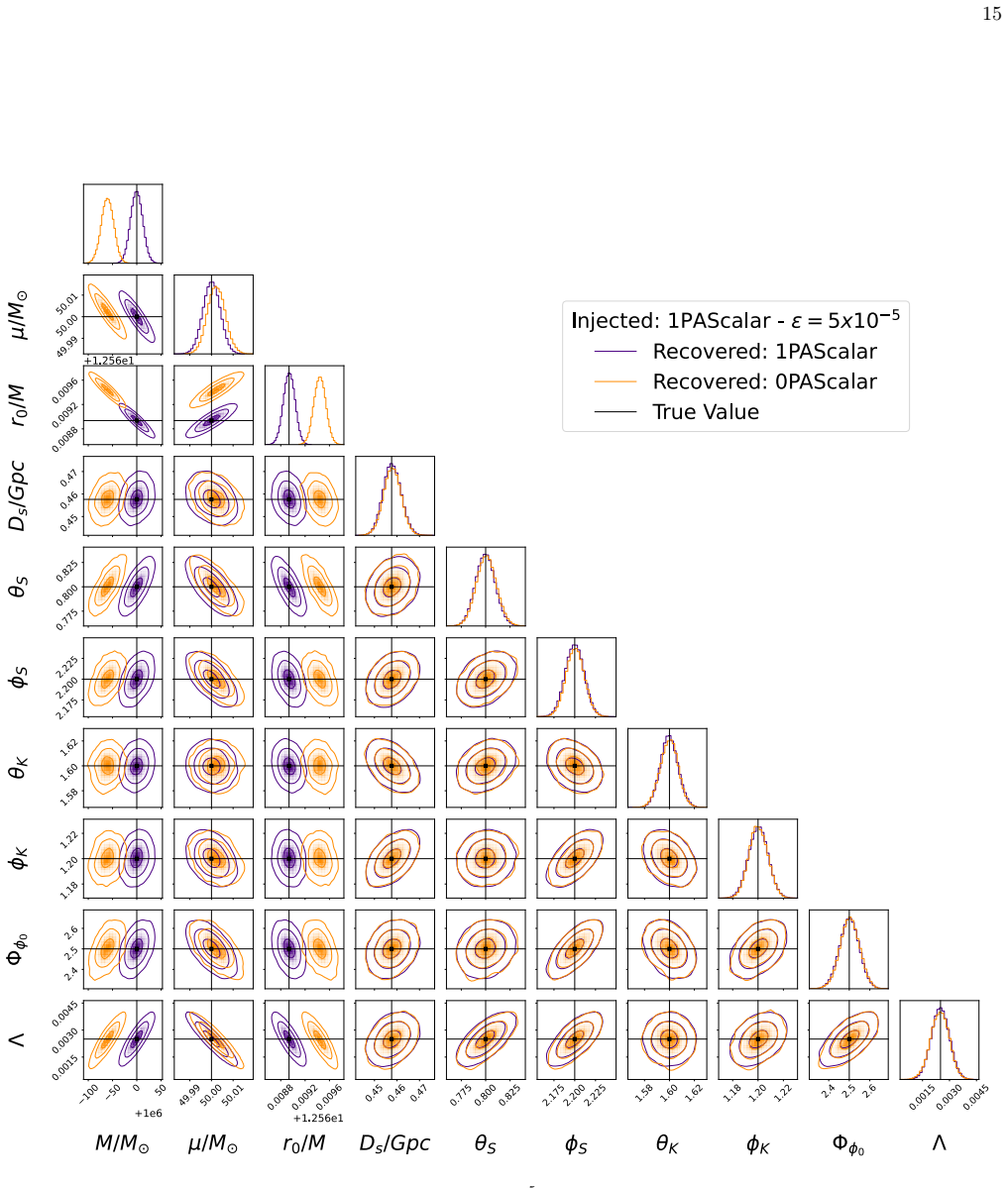
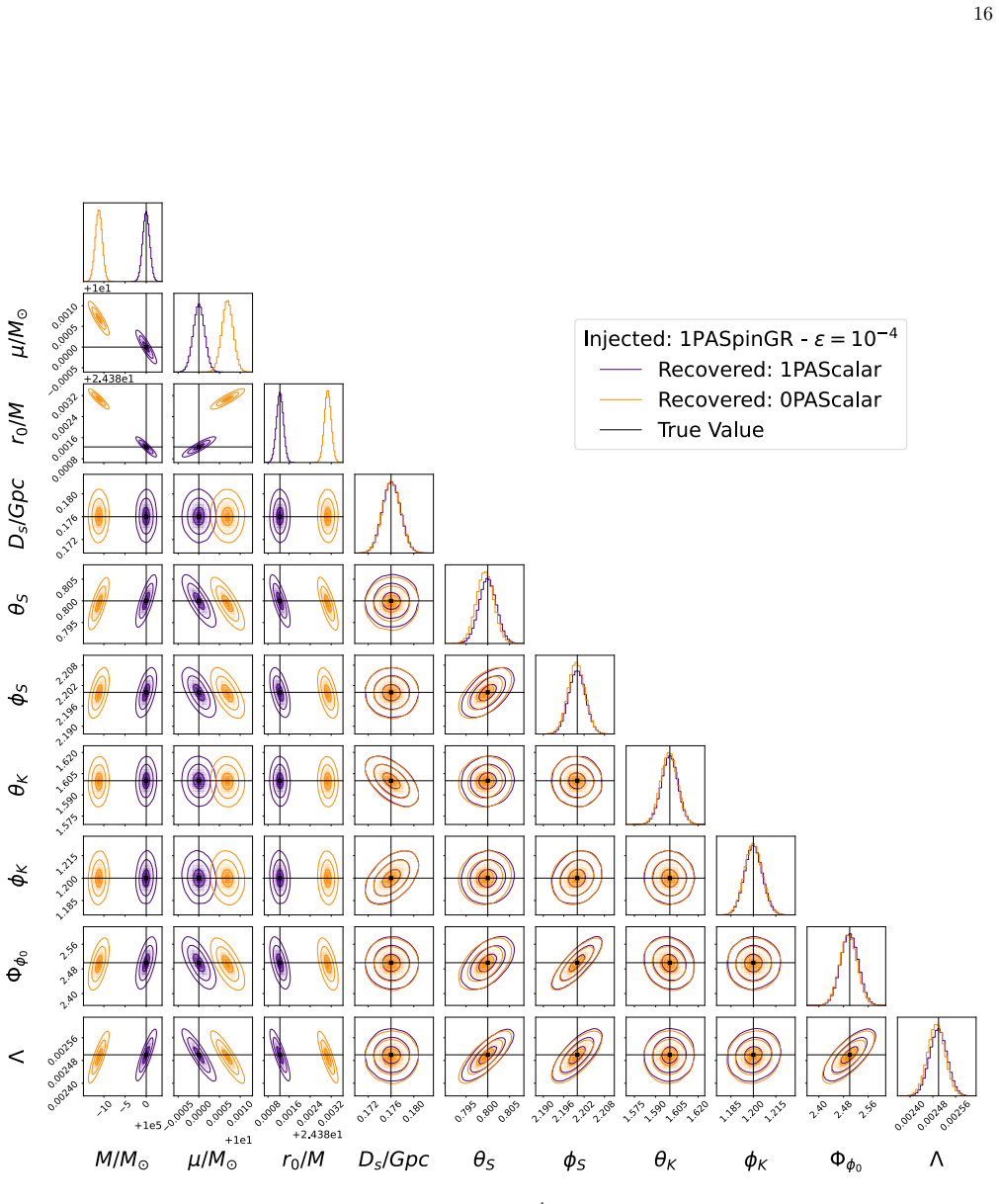
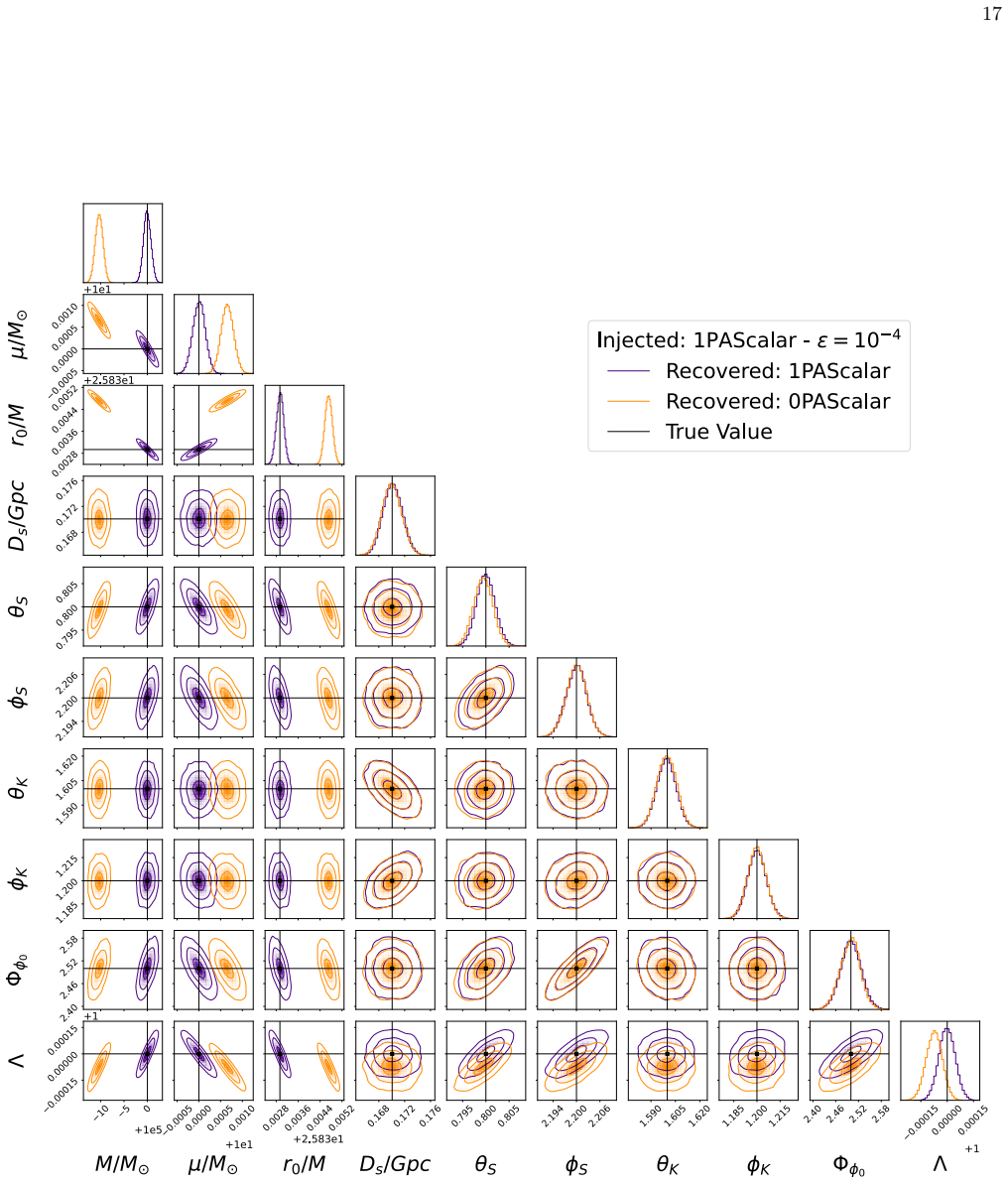
For quasi-circular EMRIs and IMRIs into a Schwarzschild primary, gravitational first-post-adiabatic corrections are required to avoid multi-sigma biases on the intrinsic binary parameters, while the secondary scalar charge can still be recovered robustly from templates that keep only adiabatic scalar fluxes; pure-GR templates on charged signals fail because of unmodelled correlations, and secondary spin remains unconstrained up to mass ratio 10^{-4}.
What carries the argument
A modular two-timescale forcing-function decomposition that superposes a first-post-adiabatic gravitational self-force trajectory (including secondary spin) with a leading-order adiabatic scalar flux, implemented as interchangeable waveform models for Bayesian injection-recovery.
Load-bearing premise
The analysis assumes that every first-post-adiabatic correction involving the scalar field can be neglected and that the primary is non-spinning with a strictly circular equatorial orbit.
What would settle it
Repeat the injection-recovery campaign with a waveform that includes the omitted scalar 1PA terms (or a spinning primary) and check whether the recovered scalar-charge posterior then develops multi-sigma biases comparable to those already seen for the binary masses and radius.
Editorial analysis
A structured set of objections, weighed in public.
Referee Report
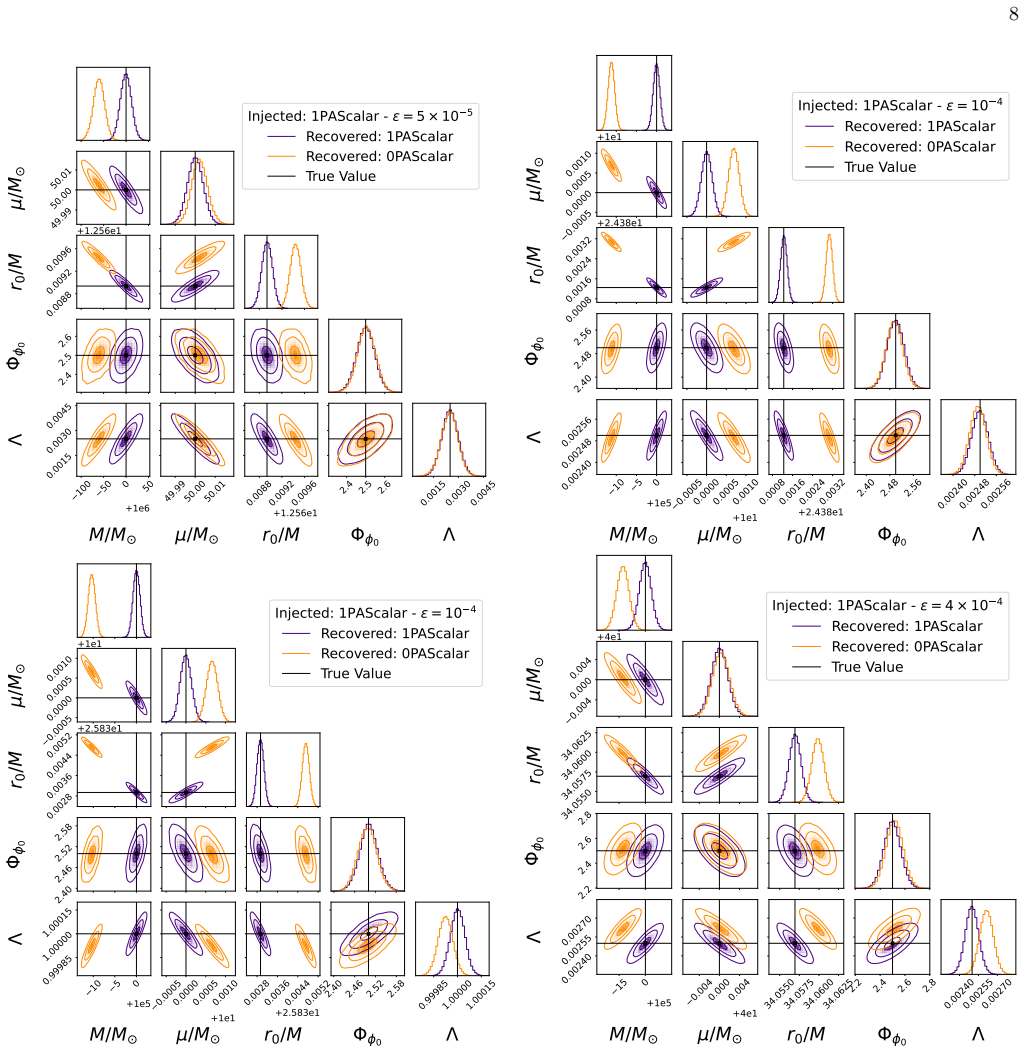
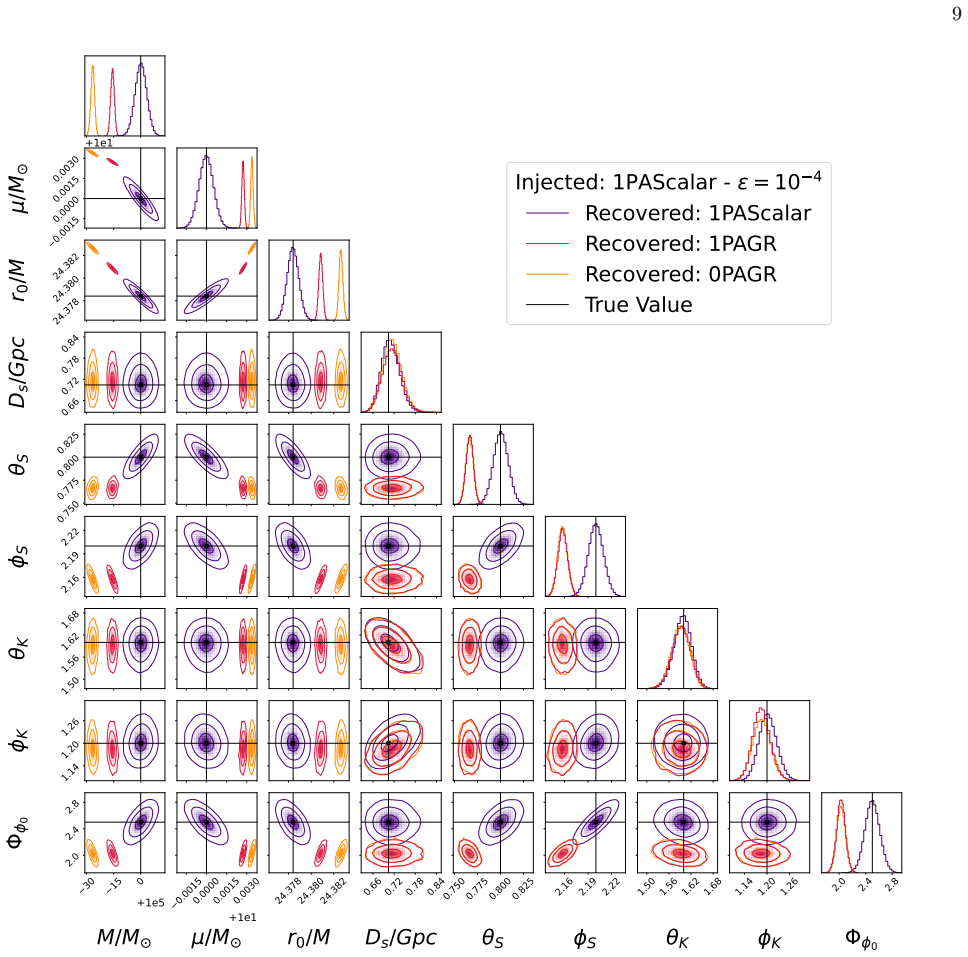
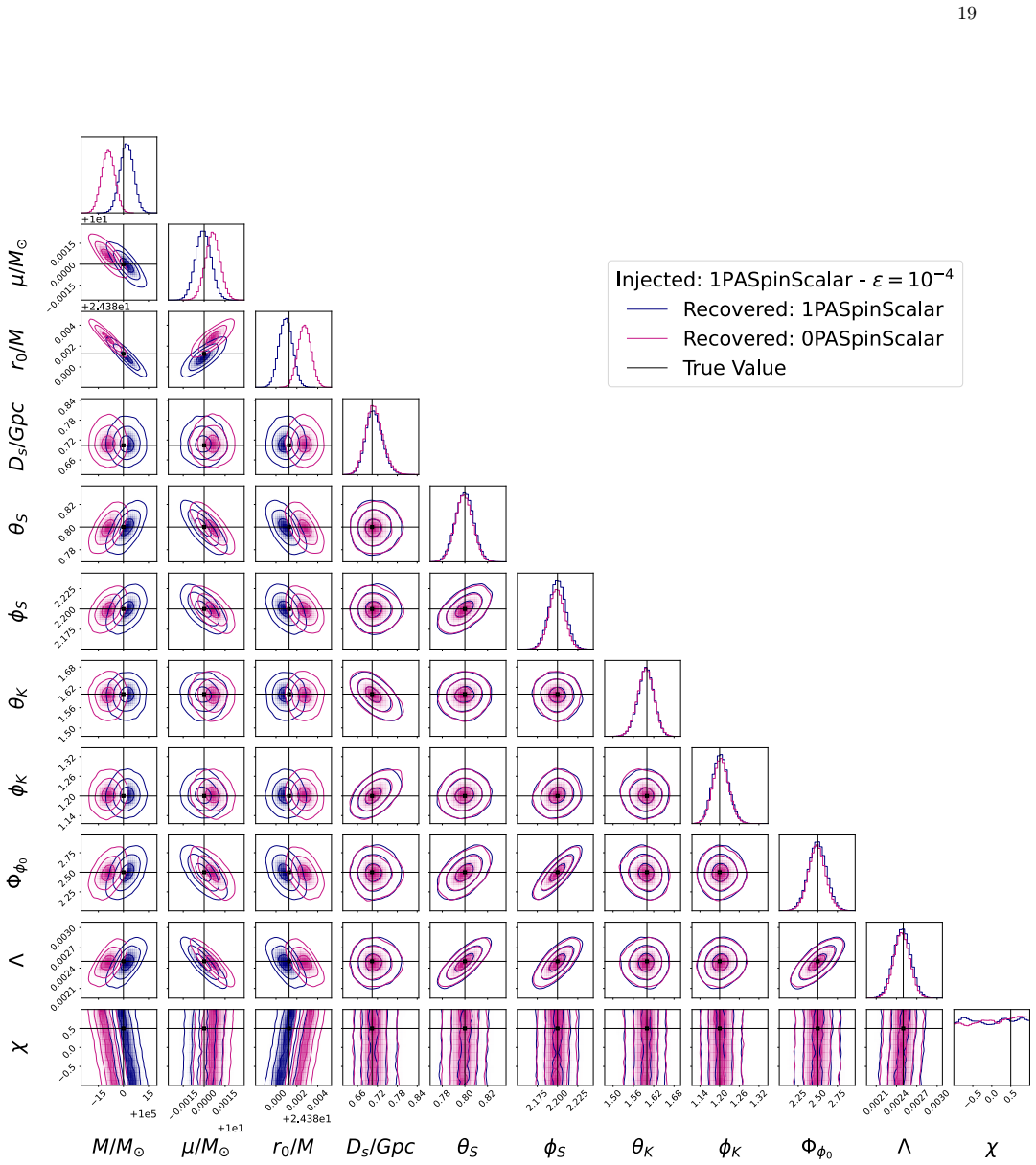
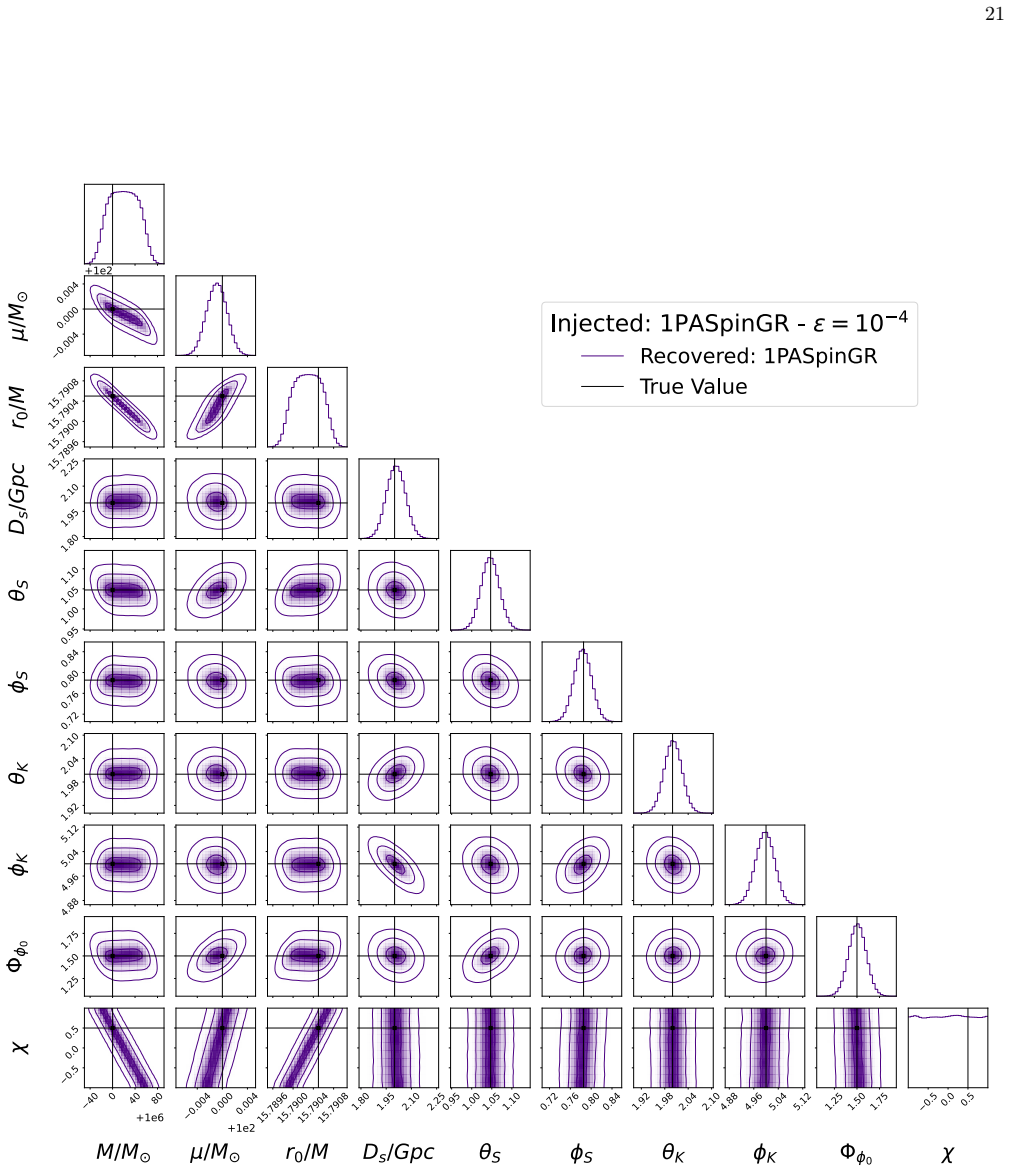
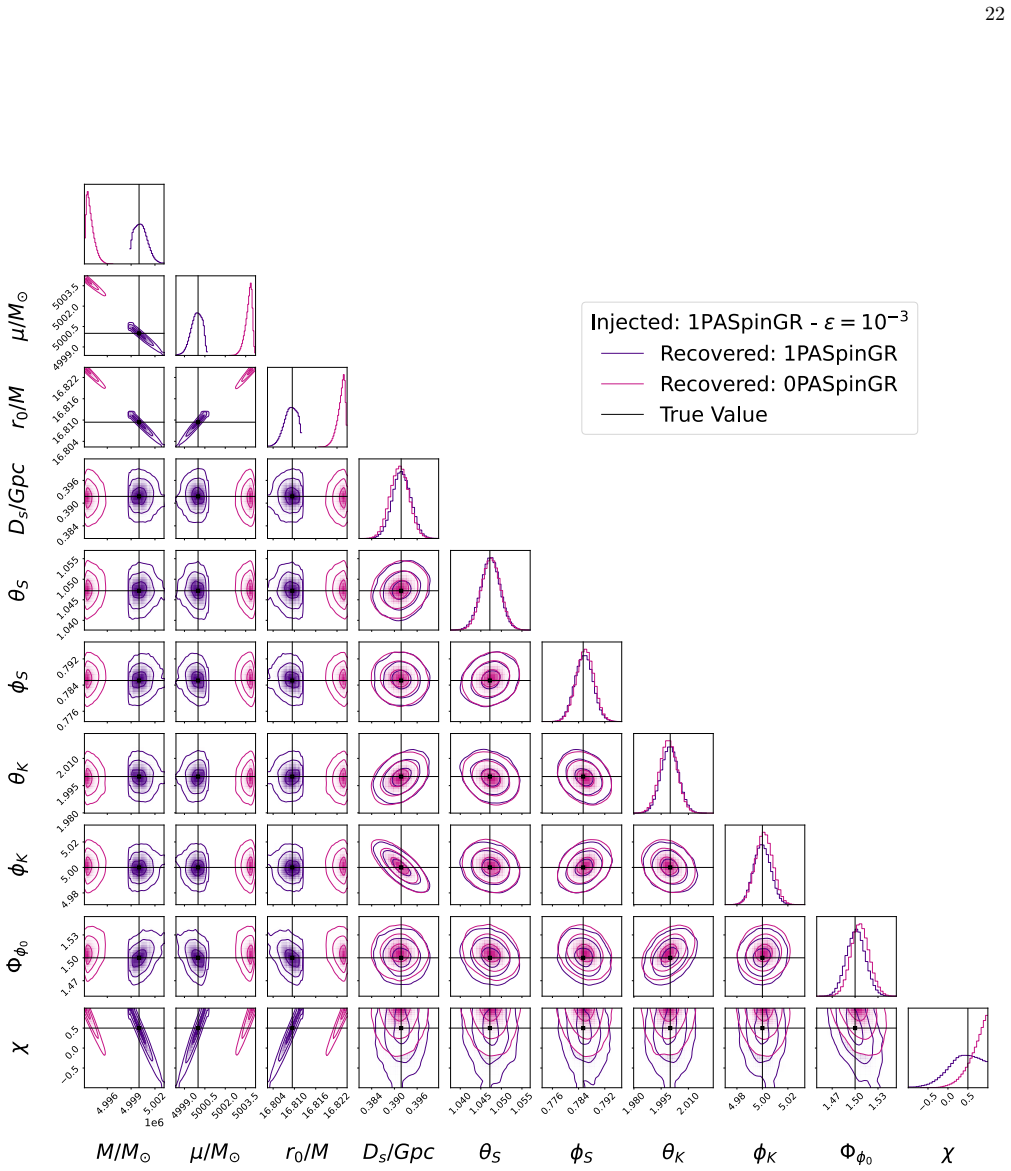
Summary. The paper constructs the first self-force waveform model for intermediate- and extreme-mass-ratio inspirals that combines a first post-adiabatic (1PA) gravitational sector with leading-order scalar-field effects, restricted to quasi-circular equatorial orbits about a non-spinning primary. Using Bayesian injection–recovery studies with LISA TDI channels, the authors quantify waveform systematics for scalar-charge inference. They report that omitting gravitational 1PA corrections biases the intrinsic parameters (M, µ, r̂0) by several σ while the scalar charge Λ remains largely unbiased over mass ratios 5×10^{-5}–4×10^{-4}; pure-GR templates applied to charged signals produce large biases and underestimated uncertainties through unmodelled correlations; secondary spin is unconstrained up to ε=10^{-4} (even in pure GR) and does not correlate with Λ; and a leading-order dipolar (-1PN) scalar flux introduces negligible systematics relative to fully relativistic fluxes for non-spinning primaries.
Significance. If the reported bias patterns hold, the work supplies concrete modelling guidance for LISA analyses of scalar-tensor EMRIs/IMRIs: adiabatic scalar fluxes plus 1PA gravitational self-force appear sufficient for unbiased scalar-charge recovery within the stated domain, while pure-GR templates are inadequate. The modular construction that re-uses existing second-order GR results, the systematic four-case injection–recovery campaign (Table II), the full MCMC posteriors, and the explicit re-analysis that identifies a waveform-model bug in earlier pure-GR secondary-spin claims are genuine strengths. The paper therefore advances both the beyond-GR self-force programme and the practical requirements for LISA parameter estimation.
minor comments (5)
- In §II after Eq. (12) and again in the Discussion the authors correctly flag the systematic neglect of all 1PA scalar contributions; a single sentence quantifying the expected size of those terms (or citing the forthcoming calculation [61]) would help readers gauge residual risk without altering the central claim.
- Table II lists dephasing, log-likelihoods and biases for all four cases; adding a column for the recovered SNR or the mismatch between injection and best-fit recovery would make the diagnostics self-contained.
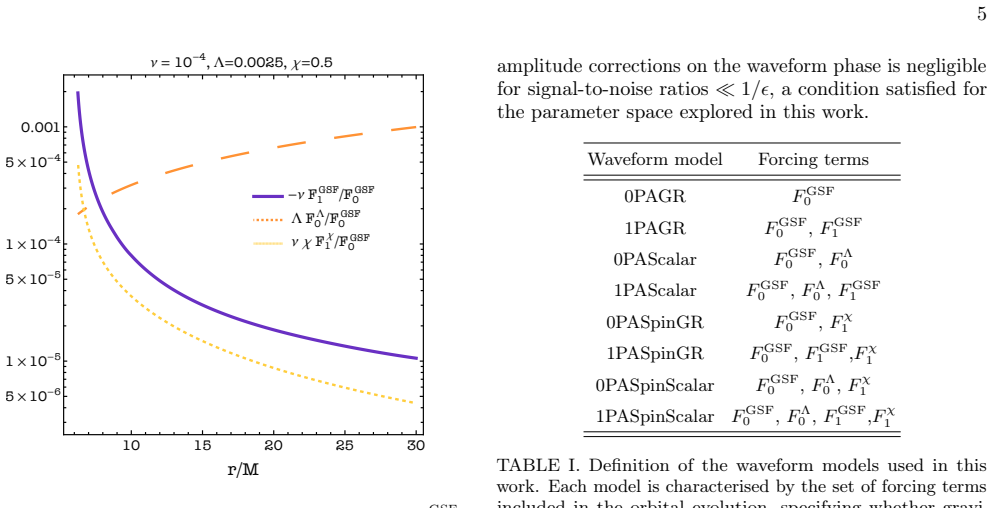
- Fig. 1 normalises sub-leading forcing terms to F_GSF_0 at a single (ν,Λ,χ) point; a brief remark on how the relative importance of Λ F_0^Λ scales with mass ratio would clarify the domain of the robustness claim.
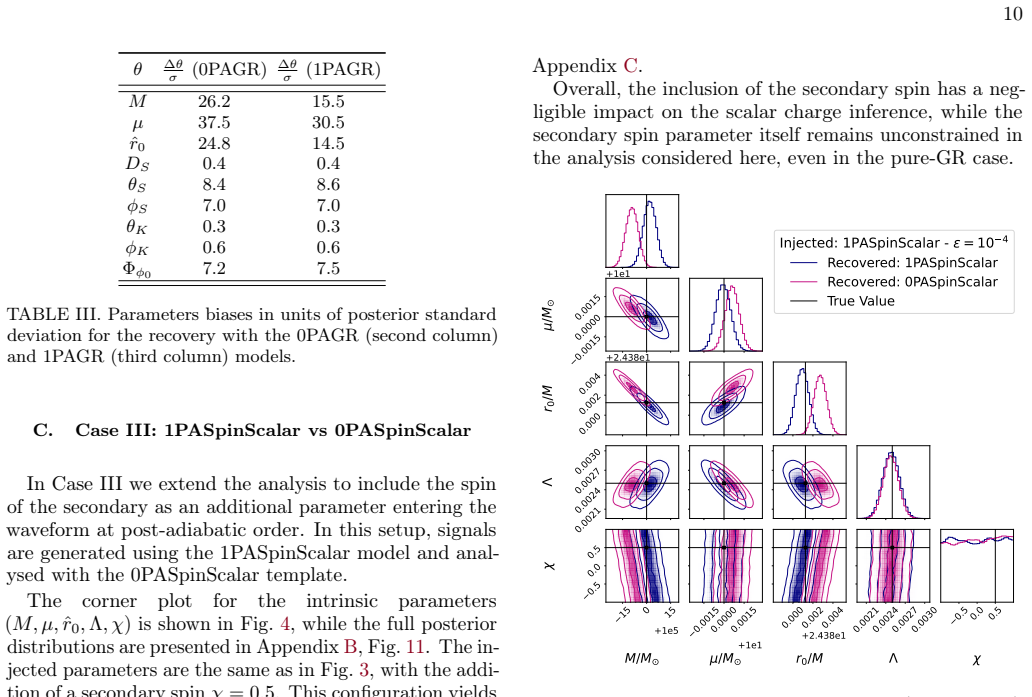
- Appendix C re-analyses the pure-GR secondary-spin results of Ref. [34] and attributes the discrepancy to a bug in FastSchwarzschildEccentricFlux. A short statement of which higher-mode content was spuriously present would strengthen the correction for future users of FEW.
- Notation: the scalar charge is introduced as d^{(0)} then used as d or Λ=d^{2}; a consistent symbol after Eq. (9) would improve readability.
Circularity Check
No significant circularity: claims are empirical injection-recovery biases from independently generated waveforms, not tautological redefinitions or fitted predictions.
specific steps
-
self citation load bearing
[Section IVC and Appendix C (comparison with Ref. [34])]
"We can compare our result with those reported in [34] (see Fig. 4), in which, for the same mass ratio ϵ=10^{-4}, the secondary spin was found to be constrained. However, when repeating the same analysis using the latest FastKerrEccentricEquatorialFlux waveform model, the secondary spin is no longer constrained. ... We believe that this discrepancy originates from a bug in the FastSchwarzschildEccentricFlux waveform model ..."
The claim that secondary spin remains unconstrained up to ϵ=10^{-4} (even in pure GR) rests on re-running the authors' own earlier analysis with a corrected waveform model. While the numerical re-assessment is transparent and falsifiable, the contrast with 'previous claims in the literature' is load-bearing only against a self-citation; no independent external benchmark is used for that particular statement. This is a minor, non-central circularity (score contribution ~1).
full rationale
The paper's central results (Table II, Figs. 2-6, Cases I-IV) are numerical statements about parameter biases obtained by injecting one waveform model and recovering with another that systematically omits selected forcing terms. The orbital evolution (Eqs. 14-18), phase expansion (Eq. 17), and waveform construction (Eq. 19 + FEW) are assembled from external SF fluxes and known GR 1PA results; the scalar charge Λ and secondary spin χ enter as free parameters that are either injected or sampled, not fitted to produce a 'prediction'. Self-citations supply modular building blocks (scalar fluxes, 1PA GR trajectories, secondary-spin MPD terms) that are used as inputs rather than as the quantities being claimed. The only mild self-referential element is the re-assessment of secondary-spin measurability against the authors' own prior work [34], which is presented as a correction of a bug rather than a load-bearing uniqueness claim. Within the openly stated domain (quasi-circular, non-spinning primary, neglect of scalar 1PA terms), the derivation chain does not reduce by construction to its inputs.
Axiom & Free-Parameter Ledger
free parameters (3)
- injected scalar charge d (or Λ=d²)
- injected mass ratios ε
- SNR and T_obs
axioms (4)
- domain assumption Background geometry remains Schwarzschild to leading order in mass ratio because the dimensionless coupling ζ=α/M^n is O(ε^n)≪1
- ad hoc to paper All 1PA contributions that involve the scalar field (including slow-time derivatives of the scalar and scalar stress-energy at second order) may be neglected
- domain assumption Secondary spin effects can be imported from the GR Mathisson–Papapetrou–Dixon equations without scalar corrections
- domain assumption 1PA corrections to waveform amplitudes are negligible for the SNRs considered
read the original abstract
We present the first self-force-based beyond-GR waveform model incorporating post-adiabatic orbital evolution for intermediate- and extreme-mass-ratio inspirals in theories of gravity with additional scalar fields. Focusing on quasi-circular inspirals into a non-spinning primary, we combine a first post-adiabatic (1PA) gravitational sector with leading-order scalar field effects and use Bayesian injection-recovery studies to assess the impact of waveform systematics on the inference of scalar charges with LISA. We find that neglecting 1PA effects in the gravitational sector can bias the inference of intrinsic binary parameters, while scalar-charge measurements remain robust across a wide range of mass ratios. In contrast, analysing signals from binaries in which the secondary carries a scalar charge using pure-GR templates leads to significant biases and underestimated uncertainties due to unmodelled correlations between the scalar charge and the binary parameters. We also investigate the role of secondary spin and find no significant correlation between the secondary spin and the scalar charge. Notably, up to a mass ratio of $10^{-4}$, the secondary spin itself remains unconstrained even in the pure-GR case, in contrast with previous claims in the literature. Finally, we show that modelling scalar emission with a leading-order dipolar post-Newtonian approximation -- for quasi-circular inspirals into a non-spinning primary -- introduces negligible systematic errors relative to fully relativistic scalar fluxes.
Figures




Reference graph
Works this paper leans on
-
[1]
Testing Gravity with Extreme-Mass-Ratio Inspirals,
A. Cárdenas-Avendaño and C. F. Sopuerta, “Testing Gravity with Extreme-Mass-Ratio Inspirals,” (2024) arXiv:2401.08085 [gr-qc]
Pith/arXiv arXiv 2024
-
[2]
L. Baracket al., Class. Quant. Grav.36, 143001 (2019), arXiv:1806.05195 [gr-qc]
Pith/arXiv arXiv 2019
-
[3]
E. Barausseet al., Gen. Rel. Grav.52, 81 (2020), arXiv:2001.09793 [gr-qc]
Pith/arXiv arXiv 2020
-
[4]
E. Barausse, N. Yunes, and K. Chamberlain, Phys. Rev. Lett.116, 241104 (2016), arXiv:1603.04075 [gr-qc]
Pith/arXiv arXiv 2016
-
[5]
J. L. Blázquez-Salcedo, C. F. B. Macedo, V. Cardoso, V. Ferrari, L. Gualtieri, F. S. Khoo, J. Kunz, and P. Pani, Phys. Rev. D94, 104024 (2016), arXiv:1609.01286 [gr-qc]
Pith/arXiv arXiv 2016
-
[6]
K. Glampedakis and S. Babak, Class. Quant. Grav.23, 4167 (2006), arXiv:gr-qc/0510057
Pith/arXiv arXiv 2006
-
[7]
L. Barack and C. Cutler, Phys. Rev. D75, 042003 (2007), arXiv:gr-qc/0612029
Pith/arXiv arXiv 2007
-
[8]
V. Cardoso, G. Castro, and A. Maselli, Phys. Rev. Lett. 121, 251103 (2018), arXiv:1809.00673 [gr-qc]
Pith/arXiv arXiv 2018
-
[9]
S. Datta, R. Brito, S. Bose, P. Pani, and S. A. Hughes, Phys. Rev. D101, 044004 (2020), arXiv:1910.07841 [gr- qc]
Pith/arXiv arXiv 2020
-
[10]
P. Pani and A. Maselli, Int. J. Mod. Phys. D28, 1944001 (2019), arXiv:1905.03947 [gr-qc]
Pith/arXiv arXiv 2019
-
[11]
E. Maggio, M. van de Meent, and P. Pani, Phys. Rev. D 104, 104026 (2021), arXiv:2106.07195 [gr-qc]
Pith/arXiv arXiv 2021
-
[12]
K. Destounis, A. G. Suvorov, and K. D. Kokkotas, Phys. Rev. D102, 064041 (2020), arXiv:2009.00028 [gr-qc]
Pith/arXiv arXiv 2020
-
[13]
G. A. Piovano, A. Maselli, and P. Pani, Phys. Lett. B 811, 135860 (2020), arXiv:2003.08448 [gr-qc]
Pith/arXiv arXiv 2020
-
[14]
N. Sago and T. Tanaka, Phys. Rev. D104, 064009 (2021), arXiv:2106.07123 [gr-qc]
Pith/arXiv arXiv 2021
-
[15]
G. A. Piovano, A. Maselli, and P. Pani, Phys. Rev. D 107, 024021 (2023), arXiv:2207.07452 [gr-qc]
Pith/arXiv arXiv 2023
-
[16]
L. G. Collodel, D. D. Doneva, and S. S. Yazadjiev, Phys. Rev. D105, 044036 (2022), arXiv:2108.11658 [gr-qc]
Pith/arXiv arXiv 2022
-
[17]
S. Babak, J. Gair, A. Sesana, E. Barausse, C. F. Sop- uerta, C. P. L. Berry, E. Berti, P. Amaro-Seoane, A. Pe- titeau, and A. Klein, Phys. Rev. D95, 103012 (2017), arXiv:1703.09722 [gr-qc]
Pith/arXiv arXiv 2017
- [18]
-
[19]
A. G. Abacet al.(LIGO Scientific, VIRGO, KAGRA), (2026), arXiv:2603.19019 [gr-qc]
Pith/arXiv arXiv 2026
-
[20]
A. G. Abacet al.(LIGO Scientific, VIRGO, KAGRA), (2026), arXiv:2603.19020 [gr-qc]
Pith/arXiv arXiv 2026
-
[21]
A. G. Abacet al.(LIGO Scientific, Virgo, KAGRA), Phys. Rev. Lett.136, 041403 (2026), arXiv:2509.08099 [gr-qc]
Pith/arXiv arXiv 2026
-
[22]
E. M. Sängeret al., (2024), arXiv:2406.03568 [gr-qc]
Pith/arXiv arXiv 2024
- [23]
-
[24]
B. Wardell, A. Pound, N. Warburton, J. Miller, L. Durkan, and A. Le Tiec, Phys. Rev. Lett.130, 241402 (2023), arXiv:2112.12265 [gr-qc]
Pith/arXiv arXiv 2023
-
[25]
J. Mathews, B. Wardell, A. Pound, and N. Warburton, Phys. Rev. D113, 064034 (2026), arXiv:2510.16113 [gr- qc]
Pith/arXiv arXiv 2026
- [26]
-
[27]
L. Küchler, G. Compère, L. Durkan, and A. Pound, SciPost Phys.17, 056 (2024), arXiv:2405.00170 [gr-qc]
Pith/arXiv arXiv 2024
-
[28]
L. Küchler, G. Compère, and A. Pound, Class. Quant. Grav.43, 015018 (2026), arXiv:2506.02189 [gr-qc]
Pith/arXiv arXiv 2026
-
[29]
G. Compère and L. Küchler, Phys. Rev. Lett.126, 241106 (2021), arXiv:2102.12747 [gr-qc]
Pith/arXiv arXiv 2021
- [30]
- [31]
-
[32]
J. Miller and A. Pound, Phys. Rev. D103, 064048 (2021), arXiv:2006.11263 [gr-qc]
Pith/arXiv arXiv 2021
-
[33]
A. Pound and B. Wardell, (2021), 10.1007/978-981-15- 4702-7_38-1, arXiv:2101.04592 [gr-qc]
-
[34]
O. Burke, G. A. Piovano, N. Warburton, P. Lynch, L. Speri, C. Kavanagh, B. Wardell, A. Pound, L. Durkan, and J. Miller, Phys. Rev. D109, 124048 (2024), arXiv:2310.08927 [gr-qc]
Pith/arXiv arXiv 2024
-
[35]
A. Maselli, N. Franchini, L. Gualtieri, and T. P. Sotiriou, Phys. Rev. Lett.125, 141101 (2020), arXiv:2004.11895 [gr-qc]
Pith/arXiv arXiv 2020
-
[36]
A. Spiers, A. Maselli, and T. P. Sotiriou, Phys. Rev. D 109, 064022 (2024), arXiv:2310.02315 [gr-qc]
Pith/arXiv arXiv 2024
-
[37]
S. Barsanti, N. Franchini, L. Gualtieri, A. Maselli, and T. P. Sotiriou, Phys. Rev. D106, 044029 (2022), arXiv:2203.05003 [gr-qc]
Pith/arXiv arXiv 2022
-
[38]
C. Zhang, Y. Gong, D. Liang, and B. Wang, JCAP06, 054 (2023), arXiv:2210.11121 [gr-qc]
Pith/arXiv arXiv 2023
-
[39]
M. Della Rocca, S. Barsanti, L. Gualtieri, and A. Maselli, Phys. Rev. D109, 104079 (2024), arXiv:2401.09542 [gr- qc]
Pith/arXiv arXiv 2024
- [40]
-
[41]
S. Gliorio, M. Della Rocca, S. Barsanti, L. Gualtieri, A. Maselli, and T. P. Sotiriou, (2026), arXiv:2603.10116 [gr-qc]
arXiv 2026
-
[42]
S. Barsanti, A. Maselli, T. P. Sotiriou, and L. Gualtieri, Phys. Rev. Lett.131, 051401 (2023), arXiv:2212.03888 [gr-qc]
Pith/arXiv arXiv 2023
-
[43]
A. Maselli, N. Franchini, L. Gualtieri, T. P. Sotiriou, S. Barsanti, and P. Pani, Nature Astron.6, 464 (2022), arXiv:2106.11325 [gr-qc]
Pith/arXiv arXiv 2022
- [44]
-
[45]
T. P. Sotiriou and V. Faraoni, Phys. Rev. Lett.108, 081103 (2012), arXiv:1109.6324 [gr-qc]
Pith/arXiv arXiv 2012
-
[46]
S. W. Hawking, Commun. Math. Phys.25, 167 (1972)
1972
-
[47]
D. M. Eardley, Astrophys. J.196(1975), 10.1086/181744
doi:10.1086/181744 1975
-
[48]
Damour and G
T. Damour and G. Esposito-Farese, Class. Quant. Grav. 9, 2093 (1992)
2093
-
[49]
F.-L. Julié, Phys. Rev. D97, 024047 (2018), arXiv:1709.09742 [gr-qc]
Pith/arXiv arXiv 2018
-
[50]
Julié, JCAP01, 026 (2018), arXiv:1711.10769 [gr- qc]
F.-L. Julié, JCAP01, 026 (2018), arXiv:1711.10769 [gr- qc]
Pith/arXiv arXiv 2018
-
[51]
S. L. Detweiler and B. F. Whiting, Phys. Rev. D67, 024025 (2003), arXiv:gr-qc/0202086
Pith/arXiv arXiv 2003
-
[52]
A. Pound, B. Wardell, N. Warburton, and J. Miller, Phys. Rev. Lett.124, 021101 (2020), arXiv:1908.07419 [gr-qc]
Pith/arXiv arXiv 2020
-
[53]
N. Warburton, A. Pound, B. Wardell, J. Miller, and L. Durkan, Phys. Rev. Lett.127, 151102 (2021), arXiv:2107.01298 [gr-qc]. 25
Pith/arXiv arXiv 2021
-
[54]
W. Schmidt, Class. Quant. Grav.19, 2743 (2002), arXiv:gr-qc/0202090
Pith/arXiv arXiv 2002
-
[55]
C. E. A. Chapman-Birdet al., Phys. Rev. D112, 104023 (2025), arXiv:2506.09470 [gr-qc]
Pith/arXiv arXiv 2025
-
[56]
A. Albertini, A. Nagar, A. Pound, N. Warburton, B. Wardell, L. Durkan, and J. Miller, Phys. Rev. D 106, 084061 (2022), arXiv:2208.01049 [gr-qc]
Pith/arXiv arXiv 2022
- [57]
-
[58]
S. A. Hughes, Phys. Rev. D100, 064001 (2019), arXiv:1806.09022 [gr-qc]
Pith/arXiv arXiv 2019
-
[59]
A. I. Harte, Class. Quant. Grav.29, 055012 (2012), arXiv:1103.0543 [gr-qc]
Pith/arXiv arXiv 2012
-
[60]
E. Poisson, A. Pound, and I. Vega, Living Rev. Rel.14, 7 (2011), arXiv:1102.0529 [gr-qc]
Pith/arXiv arXiv 2011
-
[61]
Lestingi, A
J. Lestingi, A. Maselli, T. P. Sotoriou, and A. Spiers, “ t.b.c.” in preparation
-
[62]
J. Mathews, A. Pound, and B. Wardell, Phys. Rev. D 105, 084031 (2022), arXiv:2112.13069 [gr-qc]
Pith/arXiv arXiv 2022
-
[63]
Mathisson, Gen
M. Mathisson, Gen. Rel. Grav.42, 1011 (2010)
2010
-
[64]
Papapetrou, Proc
A. Papapetrou, Proc. Roy. Soc. Lond. A209, 248 (1951)
1951
-
[65]
W. G. Dixon, Proc. Roy. Soc. Lond. A314, 499 (1970)
1970
-
[66]
M. Rahman, M. Shahzadi, A. Pound, and J. Mathews, (2026), arXiv:2606.28937 [gr-qc]
Pith/arXiv arXiv 2026
-
[67]
M. van de Meent, A. Buonanno, D. P. Mihaylov, S. Os- sokine, L. Pompili, N. Warburton, A. Pound, B. Wardell, L. Durkan, and J. Miller, Phys. Rev. D108, 124038 (2023), arXiv:2303.18026 [gr-qc]
Pith/arXiv arXiv 2023
-
[68]
P. I. Jefremov, O. Y. Tsupko, and G. S. Bisnovatyi-Kogan, Phys. Rev. D91, 124030 (2015), arXiv:1503.07060 [gr-qc]
Pith/arXiv arXiv 2015
-
[69]
A. Le Tiec, E. Barausse, and A. Buonanno, Phys. Rev. Lett.108, 131103 (2012), arXiv:1111.5609 [gr-qc]
Pith/arXiv arXiv 2012
-
[70]
Fastemriwaveforms,
C. Chapman-Bird, A. J. K. Chua, S. Hughes, M. Katz, Z. Nasipak, M. Pigou, L. Speri, and N. Warburton, “Fastemriwaveforms,” (2025)
2025
-
[71]
M. L. Katz, J.-B. Bayle, A. J. K. Chua, and M. Vallisneri, Phys. Rev. D106, 103001 (2022), arXiv:2204.06633 [gr- qc]
Pith/arXiv arXiv 2022
-
[72]
mikekatz04/eryn: first full release,
M. Katz, N. Karnesis, and N. Korsakova, “mikekatz04/eryn: first full release,” (2023)
2023
-
[73]
Foreman-Mackey, D
D. Foreman-Mackey, D. W. Hogg, D. Lang, and J. Good- man, Publications of the Astronomical Society of the Pacific125, 306–312 (2013)
2013
-
[74]
Whittle, Journal of the Royal Statistical Society: Series B (Statistical Methodology)19, 38 (1957)
P. Whittle, Journal of the Royal Statistical Society: Series B (Statistical Methodology)19, 38 (1957)
1957
-
[75]
L. S. Finn, Phys. Rev. D46, 5236 (1992), arXiv:gr- qc/9209010
arXiv 1992
-
[76]
Technical Report 1.0, Tech
LISA Science Study Team,LISA Science Requirements Document, ESA-L3-EST-SCI-RS-001. Technical Report 1.0, Tech. Rep. (ESA, 2018)
2018
-
[77]
F.-L. Julié and E. Berti, Phys. Rev. D100, 104061 (2019), arXiv:1909.05258 [gr-qc]
Pith/arXiv arXiv 2019
-
[78]
Ohashi, H
A. Ohashi, H. Tagoshi, and M. Sasaki, Prog. Theor. Phys. 96, 713 (1996)
1996
-
[79]
J. C. Castillo, C. R. Evans, C. Kavanagh, J. Neef, B. Wardell, and A. Ottewill, Phys. Rev. D112, 104001 (2025), arXiv:2507.07303 [gr-qc]
arXiv 2025
discussion (0)
Sign in with ORCID, Apple, or X to comment. Anyone can read and Pith papers without signing in.