REVIEW 3 major objections 27 references
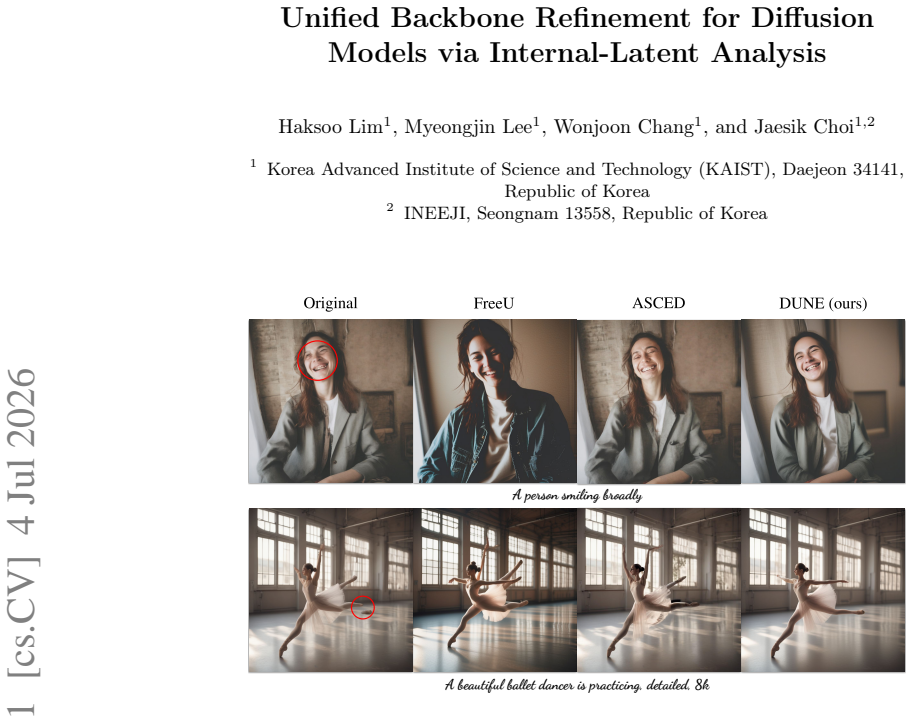
Abrupt early swings in deep diffusion latents drive artifacts; a shared EMA detect-suppress step removes them without training.
Reviewed by Pith at T0; open to challenge. T0 means a machine referee read the full paper against a public rubric. the ladder, T0–T4 →
T0 review · grok-4.5
2026-07-14 16:27 UTC pith:HZQ3N7F7
load-bearing objection Solid training-free artifact fix with real multi-backbone evidence; the causal story for the detector is the soft spot, not the results. the 3 major comments →
Unified Backbone Refinement for Diffusion Models via Internal-Latent Analysis
The pith
A machine-rendered reading of the paper's core claim, the machinery that carries it, and where it could break.
Core claim
Artifact-associated dynamics concentrate in early denoising stages and appear as abrupt deviations inside deep low-noise internal latents (U-Net h-space and mid-to-deep Transformer self-attention). Detecting those deviations with a shared EMA criterion on score-normalized latents and applying masked backbone-specific suppression improves FID and HADM while preserving semantic content across multiple high-resolution models.
What carries the argument
DUNE: a shared EMA detector on score-normalized deep latents that selects the top-percentile log-ratio deviations, followed by a gated suppress operator—channel-aware scaling for U-Net h-space, EMA blending for Transformer self-attention latents—applied only in the early detect phase.
Load-bearing premise
A fixed top-percentile log-ratio of score-normalized latents versus a fixed EMA truly isolates the residuals that cause artifacts rather than merely high-variance but harmless structure.
What would settle it
Replace the EMA detector mask with a density-matched random mask of the same size and apply identical suppression; if FID and HADM improve by the same amount or more, the claimed selective association fails.
If this is right
- Training-free refinement can raise both overall fidelity and anatomical correctness on U-Net and Transformer diffusion models at once.
- Control should target deep low-noise latents early in sampling rather than shallow features or the final score output.
- The same detect-suppress principle transfers from convolutional to attention backbones because both form noise-attenuated semantic spaces.
- Optional late-phase scaling of skip and upsampling paths can adjust tone and detail without undoing the early correction.
- Random suppression of the same fraction of deep entries degrades quality, so the gain is detector-selective rather than a generic regularizer.
Where Pith is reading between the lines
- If early deep-latent spikes are causal, similar EMA monitors could flag failure modes in video or multi-modal diffusion without architecture-specific redesign.
- The fixed percentile may still act partly as a soft regularizer; causal tests that deliberately inject spikes would separate correlation from correction.
- Production samplers could expose a lightweight deep-latent diagnostic layer as a standard, model-agnostic quality gate.
Editorial analysis
A structured set of objections, weighed in public.
Referee Report
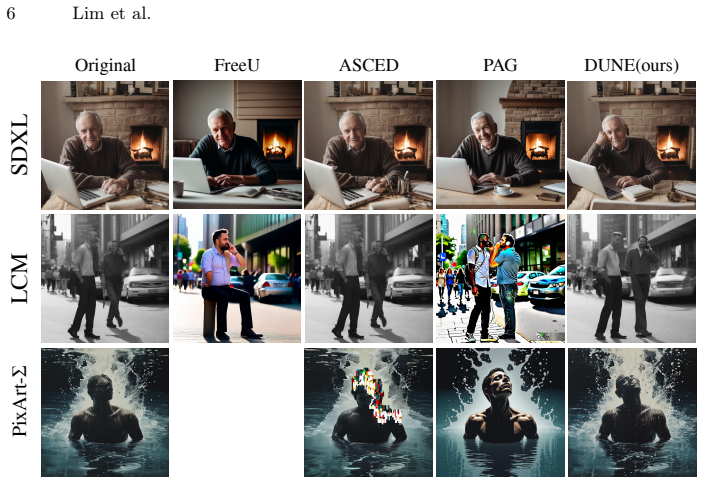
Summary. The paper analyzes phase- and component-wise behavior of diffusion backbones and argues that abrupt early-stage fluctuations in deep low-noise latents (U-Net h-space; mid-to-deep Transformer self-attention) are strongly associated with visual artifacts. From this, it proposes DUNE, a training-free detect–suppress method: an EMA log-ratio detector on score-normalized deep latents (p=0.9, γ=0.7) selects entries, which are then corrected by backbone-specific operators (channel-aware scaling for U-Net; EMA blending for Transformers) during an early detect phase. Optional later-phase FreeU-style reweighting is excluded from quantitative tables. Theory (Props. 1–2, SNR theorems, Lemma 1) motivates deep intervention and bounds suppressor stability. Experiments on SDXL, LCM, Kandinsky 3, PixArt-Σ, and Hunyuan-DiT report modest FID gains, large HADM drops, high original-to-refined CLIP similarity, acceleration diagnostics (NAA/EAGR), layer/random-mask ablations, and a user study.
Significance. If the association and intervention claims hold, the work offers a practical, architecture-spanning, training-free refinement recipe and a useful operational principle—control deep, early, low-noise latents rather than score outputs or shallow branches. Strengths include multi-backbone coverage (U-Net and DiT-style models), external metrics (FID, HADM, CLIP similarity), user preference, intervention-location ablations (h-space vs skip/up; Transformer depth table), random-mask controls, and explicit separation of the optional detail phase from quantitative claims. The theoretical material usefully motivates why deep latents are quieter intervention points, even if it does not fully establish causal selection of artifact residuals. The contribution is incremental but relevant to training-free diffusion refinement and internal-latent analysis.
major comments (3)
- §4.1–4.2 and the central claim: the manuscript treats the fixed top-percentile EMA log-ratio Δ=log|z_t/z̄_{t+1}| (p=0.9, γ=0.7) as isolating artifact-causing residuals. Fig. 4/9 show spatial alignment with acceleration spikes and Table 5 shows random h-space suppression degrades FID, which is necessary but not sufficient for causality. The detector may still flag high-variance structure that co-occurs with hallucinations; shrinking it can improve HADM without proving the claimed pathway. Please strengthen causal identification (e.g., controlled injection of known artifacts, counterfactual mask swaps, or correlation of mask mass with HADM boxes beyond acceleration alignment) or restate the claim as association plus effective regularizer rather than causal residual correction.
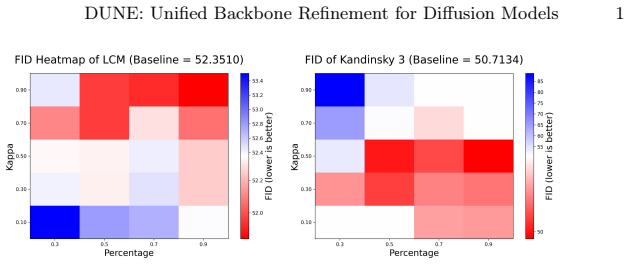
- Table 1 and Table 3: FID improvements are very small (e.g., SDXL 18.86→18.75) while HADM drops are large, and κ is chosen per backbone after a grid search that optimizes FID (App. 7.1). This leaves open whether gains are robust or partly hyperparameter-tuned regularization. Report sensitivity of HADM (not only FID) to (p,κ), a single fixed-κ protocol across backbones where possible, and confidence intervals or multi-seed variance for the ~0.1 FID deltas so the fidelity claim is not overstated relative to the hallucination claim.
- §3–4 and App. 16: Props. 1–2 and the SNR theorems justify that deep latents are noise-attenuated and that a given mask’s suppression can raise SNR / bound score perturbation (Corollary 1, Lemma 1). They do not show that the EMA detector selects the noise-dominant subset η_t > ρ_t required by the theorems. Either provide empirical estimates of η_t, ρ_t, and ε_t on detector masks versus random masks, or clearly separate “intervention location is stable” from “this detector finds the right entries.”
Circularity Check
No significant circularity: detect–suppress and SNR claims are independent of the external quality metrics they are evaluated against.
full rationale
The derivation chain is self-contained and non-circular. Component-wise phase analysis (§2) and noise-contraction propositions for CNN downsampling and self-attention (Props. 1–2 / 3–4) motivate deep latents as intervention points without defining those points in terms of FID/HADM. Detection (§4.1) uses an EMA log-ratio Δ = log |z_t / z̄_{t+1}| on score-normalized latents with fixed γ = 0.7; the mask is a percentile threshold, not a quantity fitted to the reported metrics. Suppression operators and the SNR theorems (Thm. 3/5, Cor. 1, Lem. 1/2) are conditional implications: if the mask concentrates noise relative to signal (or EMA error is small), post-suppression SNR rises and score perturbation is Lipschitz-bounded. These do not tautologically equal the quality claims. Hyperparameters p and κ are chosen by FID sweeps on two backbones then frozen (App. 7.1, Table 3); that is ordinary selection, not a fitted input renamed as prediction of the same quantity. No load-bearing uniqueness theorem or ansatz is imported solely from overlapping authors; external baselines and metrics (FID, HADM-L, CLIP similarity) are independent. Random-mask ablation (Table 5) further shows the detector is not vacuous. Score 0 is therefore warranted.
Axiom & Free-Parameter Ledger
free parameters (5)
- detection percentile p
- suppression strength κ (per backbone)
- EMA coefficient γ
- detect-phase boundary (≈0.6T) and warm-up steps
- Transformer target depth (3/4 stack)
axioms (5)
- domain assumption DDPM/score-matching formulation: ϵ_θ estimates noise/score of the reverse process.
- standard math Downsampling convolutions scale isotropic noise by the kernel Frobenius norm (Prop. 1 / App. Prop. 3).
- standard math Self-attention averages token noise by √(Σ w_j²) for fixed weights (Prop. 2).
- ad hoc to paper Scaled latent z_t = s_t + n_t with slowly varying s_t and zero-mean n_t (Assumptions 1–2).
- domain assumption Artifact regions exhibit abnormal temporal score acceleration, so latent log-ratio outliers track them.
invented entities (2)
-
DUNE detect–suppress operator (shared EMA criterion + backbone-specific S_bb)
no independent evidence
-
NAA and EAGR acceleration diagnostics
no independent evidence
read the original abstract
Diffusion models have achieved remarkable success across diverse domains, with performance closely related to the denoising backbones that parameterize the score function. In this paper, we present a systematic, phase-aware analysis of diffusion components and show that abrupt, early-stage fluctuations in deep latents are strongly associated with artifacts. Guided by these findings, we introduce DUNE (Diffusion Unified Network refiNEr), a training-free refinement framework that detects abrupt deviations in deep low-noise internal latents using a shared EMA-based criterion, and applies backbone-specific suppression to the detector-selected entries. Although derived from U-Net, the same detect-suppress principle extends naturally to Transformer-based diffusion models by acting on the latents of deep self-attention blocks. Extensive experiments across multiple backbones indicate that DUNE improves fidelity while reducing hallucinations, offering new insight into where and when diffusion backbones should be controlled.
Figures






Reference graph
Works this paper leans on
-
[1]
Ahn, D., Cho, H., Min, J., Jang, W., Kim, J., Kim, S., Park, H.H., Jin, K.H., Kim, S.: Self-rectifying diffusion sampling with perturbed-attention guidance (2025), https://arxiv.org/abs/2403.17377
Pith/arXiv arXiv 2025
-
[2]
Advances in Neural Information Pro- cessing Systems37, 134614–134644 (2024)
Aithal, S.K., Maini, P., Lipton, Z., Kolter, J.Z.: Understanding hallucinations in diffusion models through mode interpolation. Advances in Neural Information Pro- cessing Systems37, 134614–134644 (2024)
2024
-
[3]
arXiv preprint arXiv:2410.21061 (2024)
Arkhipkin, V., Vasilev, V., Filatov, A., Pavlov, I., Agafonova, J., Gerasimenko, N., Averchenkova, A., Mironova, E., Bukashkin, A., Kulikov, K., et al.: Kandinsky 3: Text-to-image synthesis for multifunctional generative framework. arXiv preprint arXiv:2410.21061 (2024)
Pith/arXiv arXiv 2024
-
[4]
arXiv preprint arXiv:2503.16218 (2025)
Cao, Y., Zhao, Z., Patras, I., Gong, S.: Temporal score analysis for understanding and correcting diffusion artifacts. arXiv preprint arXiv:2503.16218 (2025)
Pith/arXiv arXiv 2025
-
[5]
Chen, J., Ge, C., Xie, E., Wu, Y., Yao, L., Ren, X., Wang, Z., Luo, P., Lu, H., Li, Z.: Pixart-σ: Weak-to-strong training of diffusion transformer for 4k text-to-image generation (2024),https://arxiv.org/abs/2403.04692
Pith/arXiv arXiv 2024
-
[6]
Cho, H., Ahn, D., Hong, S., Kim, J.E., Kim, S., Jin, K.H.: TAG: Tangential am- plifying guidance for hallucination-resistant diffusion sampling (2025)
2025
-
[7]
In: Proceedings of the IEEE/CVF Conference on Computer Vision and Pattern Recognition
Choi, J., Lee, J., Shin, C., Kim, S., Kim, H., Yoon, S.: Perception prioritized training of diffusion models. In: Proceedings of the IEEE/CVF Conference on Computer Vision and Pattern Recognition. pp. 11472–11481 (2022)
2022
-
[8]
Advances in neural information processing systems33, 6840–6851 (2020)
Ho, J., Jain, A., Abbeel, P.: Denoising diffusion probabilistic models. Advances in neural information processing systems33, 6840–6851 (2020)
2020
-
[9]
In: WACV (2024)
Jeong, J., et al.: Training-free content injection usingh-space in diffusion models. In: WACV (2024)
2024
-
[10]
arXiv preprint arXiv:2210.10960 (2022)
Kwon, M., Jeong, J., Uh, Y.: Diffusion models already have a semantic latent space. arXiv preprint arXiv:2210.10960 (2022)
Pith/arXiv arXiv 2022
-
[11]
Neurocomputing 479, 47–59 (2022)
Li, H., Yang, Y., Chang, M., Chen, S., Feng, H., Xu, Z., Li, Q., Chen, Y.: Srdiff: Single image super-resolution with diffusion probabilistic models. Neurocomputing 479, 47–59 (2022)
2022
-
[12]
arXiv e-prints pp
Li, S., Hu, T., Shahbaz Khan, F., Li, L., Yang, S., Wang, Y., Cheng, M.M., Yang, J.: Faster diffusion: Rethinking the role of unet encoder in diffusion models. arXiv e-prints pp. arXiv–2312 (2023)
2023
-
[13]
Li, Z., Zhang, J., Lin, Q., Xiong, J., Long, Y., Deng, X., Zhang, Y., Liu, X., Huang, M., Xiao, Z., Chen, D., He, J., Li, J., Li, W., Zhang, C., Quan, R., Lu, J., Huang, J., Yuan, X., Zheng, X., Li, Y., Zhang, J., Zhang, C., Chen, M., Liu, J., Fang, Z., Wang, W., Xue, J., Tao, Y., Zhu, J., Liu, K., Lin, S., Sun, Y., Li, Y., Wang, D., Chen, M., Hu, Z., Xia...
Pith/arXiv arXiv 2024
-
[14]
CoRRabs/1405.0312(2014),http://arxiv.org/abs/1405.0312
Lin, T., Maire, M., Belongie, S.J., Bourdev, L.D., Girshick, R.B., Hays, J., Perona, P., Ramanan, D., Dollár, P., Zitnick, C.L.: Microsoft COCO: common objects in context. CoRRabs/1405.0312(2014),http://arxiv.org/abs/1405.0312
Pith/arXiv arXiv 2014
-
[15]
Luo, S., Tan, Y., Huang, L., Li, J., Zhao, H.: Latent consistency models: Synthe- sizing high-resolution images with few-step inference (2023),https://arxiv.org/ abs/2310.04378
Pith/arXiv arXiv 2023
-
[16]
arXiv preprint arXiv:2502.16872 (2025) DUNE: Unified Backbone Refinement for Diffusion Models 17
Ozbulak, U., et al.: Mitigating hallucinations in diffusion models through adaptive attention modulation. arXiv preprint arXiv:2502.16872 (2025) DUNE: Unified Backbone Refinement for Diffusion Models 17
Pith/arXiv arXiv 2025
-
[17]
Peebles, W., Xie, S.: Scalable diffusion models with transformers (2023),https: //arxiv.org/abs/2212.09748
Pith/arXiv arXiv 2023
-
[18]
arXiv preprint arXiv:2307.01952 (2023)
Podell, D., English, Z., Lacey, K., Blattmann, A., Dockhorn, T., Müller, J., Penna, J., Rombach, R.: Sdxl: Improving latent diffusion models for high-resolution image synthesis. arXiv preprint arXiv:2307.01952 (2023)
Pith/arXiv arXiv 2023
-
[19]
In: Proceedings of the IEEE/CVF conference on computer vision and pattern recognition
Rombach, R., Blattmann, A., Lorenz, D., Esser, P., Ommer, B.: High-resolution image synthesis with latent diffusion models. In: Proceedings of the IEEE/CVF conference on computer vision and pattern recognition. pp. 10684–10695 (2022)
2022
-
[20]
In: Medical image computing and computer-assisted intervention–MICCAI 2015: 18th international conference, Munich, Germany, Oc- tober 5-9, 2015, proceedings, part III 18
Ronneberger, O., Fischer, P., Brox, T.: U-net: Convolutional networks for biomed- ical image segmentation. In: Medical image computing and computer-assisted intervention–MICCAI 2015: 18th international conference, Munich, Germany, Oc- tober 5-9, 2015, proceedings, part III 18. pp. 234–241. Springer (2015)
2015
-
[21]
In: Pro- ceedings of the IEEE/CVF Conference on Computer Vision and Pattern Recogni- tion
Si, C., Huang, Z., Jiang, Y., Liu, Z.: Freeu: Free lunch in diffusion u-net. In: Pro- ceedings of the IEEE/CVF Conference on Computer Vision and Pattern Recogni- tion. pp. 4733–4743 (2024)
2024
-
[22]
Advances in neural information processing systems32(2019)
Song, Y., Ermon, S.: Generative modeling by estimating gradients of the data distribution. Advances in neural information processing systems32(2019)
2019
-
[23]
Song, Y., Sohl-Dickstein, J., Kingma, D.P., Kumar, A., Ermon, S., Poole, B.: Score- based generative modeling through stochastic differential equations (2021),https: //arxiv.org/abs/2011.13456
Pith/arXiv arXiv 2021
-
[24]
arXiv preprint arXiv:2510.05356 (2025)
Triaridis, K., Graikos, A., Chatziagapi, A., Chrysos, G.G., Samaras, D.: Mit- igating diffusion model hallucinations with dynamic guidance. arXiv preprint arXiv:2510.05356 (2025)
Pith/arXiv arXiv 2025
-
[25]
Wang, K., Zhang, L., Zhang, J.: Detecting human artifacts from text-to-image models (2025),https://arxiv.org/abs/2411.13842
Pith/arXiv arXiv 2025
-
[26]
Yang, L., Zhang, Z., Song, Y., Hong, S., Xu, R., Zhao, Y., Zhang, W., Cui, B., Yang,M.H.:Diffusionmodels:Acomprehensivesurveyofmethodsandapplications (2023)
2023
-
[27]
A person jumping with arms raised
Yang, X., Zhou, D., Feng, J., Wang, X.: Diffusion probabilistic model made slim. In: Proceedings of the IEEE/CVF Conference on computer vision and pattern recognition. pp. 22552–22562 (2023) DUNE: Unified Backbone Refinement for Diffusion Models 1 Fig. 10:Heatmap of FID across different percentages and kappas. 7 Hyperparameter Setting and Miscellaneous en...
2023
discussion (0)
Sign in with ORCID, Apple, or X to comment. Anyone can read and Pith papers without signing in.