REVIEW 2 major objections 6 minor 31 references
Exact diagonalization of a Gauss-law-reduced Z2 two-form model shows high-flux cap states discharge 20–37% of occupied area while low-flux tube states stay pinned, with a dynamical crossover near m/ε_E ≈ 1.89.
Reviewed by Pith at T0; open to challenge. T0 means a machine referee read the full paper against a public rubric. the ladder, T0–T4 →
T0 review · grok-4.5
2026-07-14 08:06 UTC pith:2FX4SVIO
load-bearing objection Clean exact reduction and usable tube–cap ED for Z2 two-form dynamics; the headline (m/ε_E)_c≃1.89 is a single-volume initial-rate zero-crossing, not controlled finite-size scaling. the 2 major comments →
p-Form Gauge Dynamics and Digital Quantum Simulation -- Flux and Cosmological Constant Neutralization
The pith
A machine-rendered reading of the paper's core claim, the machinery that carries it, and where it could break.
Core claim
On the Gauss-law-projected Z2 two-form Hamiltonian, exact diagonalization of the tube–cap quench on 4×4, 6×4 and 5×5 tori shows that the cap loses 20–37% of its occupied-flux area while the tube remains nearly pinned; a finite-size m/ε_E sweep locates a dynamical tension-to-density crossover near (m/ε_E)_c ≃ 1.89. The identical cellular structure yields both the reduced Ising-type plaquette Hamiltonian used for the benchmark and the unreduced plaquette-plus-link encoding that supplies local Gauss-law checks for digital implementation, placing top-form flux discharge inside a general higher-form Hamiltonian and coding framework.
What carries the argument
Exact Gauss-law reduction: every physical state is parameterized solely by plaquette electric-flux qubits, with link occupations reconstructed as τ^x_ℓ = σ^x_pL σ^x_pR. This identity converts the boundary-dressed Wilson operator into a single-site plaquette flip and produces the Ising-type reduced Hamiltonian whose transverse-field term is the physical image of σ^z_p ∏_{ℓ∈∂p} τ^z_ℓ.
Load-bearing premise
The 20–37% discharge fractions and the 1.89 crossover measured on lattices of at most 25 plaquettes already represent the intended continuum flux-discharge physics, even though aspect-ratio control is incomplete and the late-time state is only a finite-volume energy-shell plateau.
What would settle it
Run matched-aspect-ratio sequences (4×4, 6×6, 8×8) at fixed initial energy density; if the cap discharge fraction collapses toward zero or the fitted crossover (m/ε_E)_c moves outside roughly [1.5, 2.5], the finite-volume dynamical claim does not survive continuum scaling.
If this is right
- Hardware demonstration of the cap-versus-tube asymmetry would realize real-time microscopic simulation of top-form electric-flux discharge.
- The unreduced plaquette-plus-link encoding supplies sparse local Gauss-law syndromes usable for post-selection and gauge-sector verification on digital quantum devices.
- When both Gauss and magnetic checks are present (d ≥ p+1), the same cellular complex becomes a CSS/qLDPC check algebra whose rate and distance are controlled by homology.
- Enlarging Z2 to Z_k or integer link bosons recovers oriented multi-occupancy string sectors and the continuum string-Higgs regimes.
- The finite-volume crossover at (m/ε_E)_c ≃ 1.89 separates a light-boundary proliferation regime from a heavy-boundary confined regime inside the same lattice Hamiltonian.
Where Pith is reading between the lines
- The 5×5 trajectory already fails to collapse with the 4×4/6×4 envelope, so the quoted 1.89 value is likely to shift once true aspect-ratio-controlled thermodynamic scaling is available.
- Because the late-time plateau is only a dephasing shell inside a fixed-energy sector, entanglement or diagonal-ensemble diagnostics could distinguish genuine flux fragmentation from mere redistribution among Hamiltonian terms.
- The five-body Wilson circuit and per-link Gauss post-selection map onto the same heavy-hex and Rydberg platforms already used for one-form string breaking, offering a near-term higher-form counterpart experiment.
- Embedding the same flux-discharge Hamiltonian in a discrete (2+1)D gravity sector would give a lattice test of Brown–Teitelboim neutralization with back-reaction, without continuum gravity.
Editorial analysis
A structured set of objections, weighed in public.
Referee Report
Summary. The paper constructs a Hamiltonian for Z_k p-form gauge fields on oriented cell complexes, with Gauss-law generators from ∂_p, magnetic checks from ∂_{p+1}, and local dressed Wilson operators; at k=2 this yields a CSS check complex. Specializing to p=d=2, k=2, the magnetic term vanishes and the one-form Gauss law is solved exactly, so the physical Hilbert space is parameterized by plaquette electric fluxes with links reconstructed as domain walls (τ^x_ℓ=σ^x_pL σ^x_pR). The reduced dynamics is an Ising-type plaquette Hamiltonian whose transverse-field term is the image of the boundary-dressed Wilson operator. A tube–cap quench with shared initial boundary loops is evolved by exact diagonalization on 4×4, 6×4, and 5×5 tori: the cap loses 20–37% of occupied-flux area while the tube stays nearly pinned. An m/ε_E sweep on 4×4 places a dynamical crossover near (m/ε_E)_c ≃ 1.89. Unreduced plaquette-plus-link circuits supply local Gauss checks for digital simulation; the reduced model is the exact benchmark. The construction is framed as a lower-dimensional Hamiltonian analog of top-form flux discharge / Brown–Teitelboim neutralization without gravity.
Significance. If the Gauss-law reduction, reduced Hamiltonian, and multi-lattice ED phenomenology hold, the work supplies a clean, exactly solvable Z_2 two-form lattice model with a concrete digital circuit realization and a falsifiable tube–cap discharge signal. Strengths include the exact reduction (Eqs. 11–12, 15), energy conservation to ~10^{-12}, degeneracy-point symmetry check, multi-lattice consistency of the discharge/pinning contrast at fixed m/ε_E=1, and an explicit resource table for Strang–Trotter circuits with Gauss post-selection. Placing the top-form discharge calculation inside a general higher-form Hamiltonian and coding framework is a useful organizational contribution for quantum simulation of higher-form gauge theories. The continuum/string-Higgs and cosmological-constant language is interpretive and secondary to the lattice results.
major comments (2)
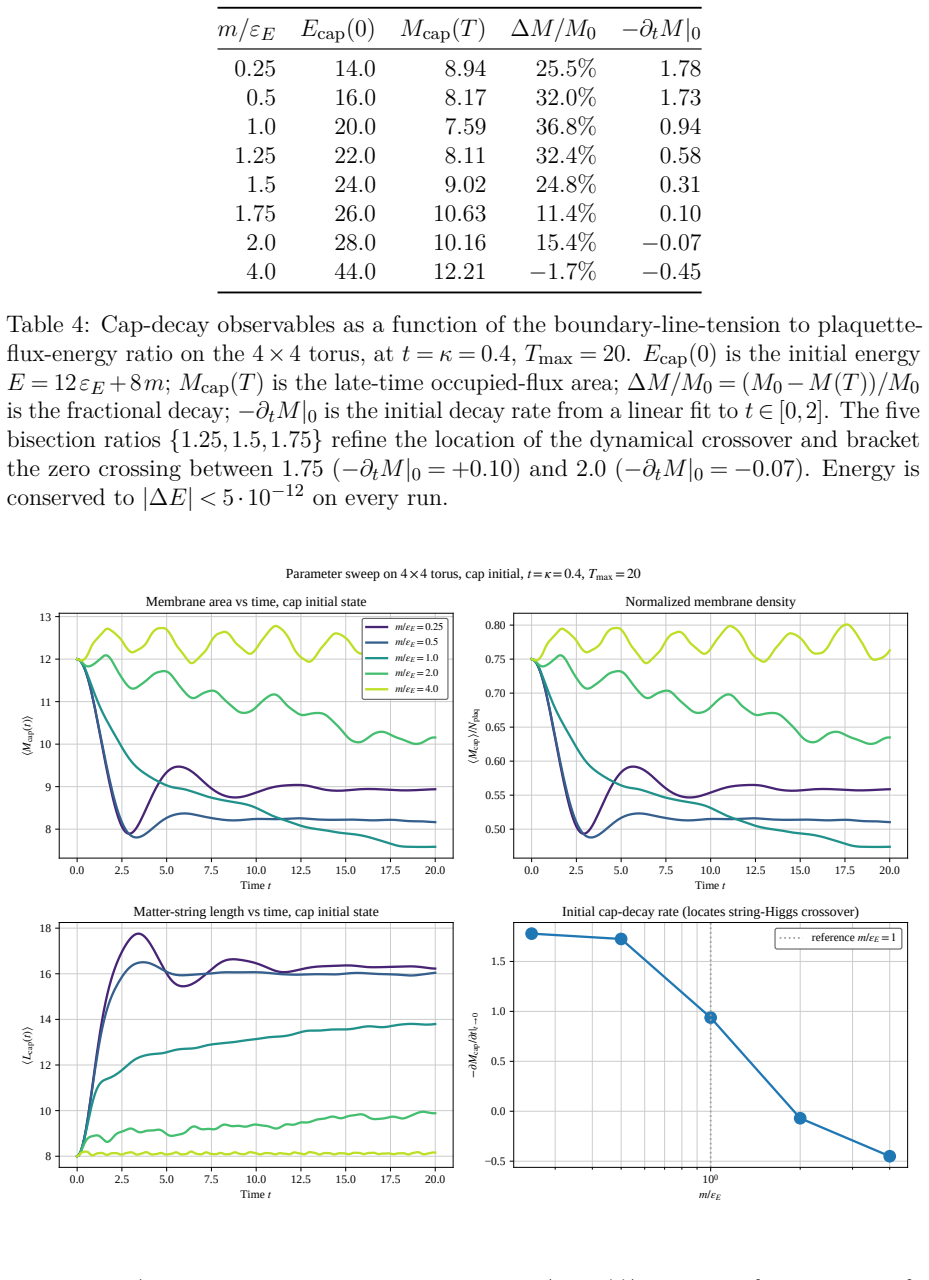
- Abstract and Sec. 5.2 claim that “a finite-size scaling locates a dynamical crossover … near (m/ε_E)_c ≃ 1.89.” The number is obtained only on the 4×4 torus (Table 4, Fig. 9) by linear interpolation in log(m/ε_E) of the initial decay rate -∂_t M_cap |_{t o0} between the bracket points 1.75 (+0.10) and 2.0 (-0.07). No rate-zero is reported for 6×4 or 5×5; those lattices appear only in a single-parameter (m/ε_E=1) comparison of M(t) and L(t) (Sec. 5.1, Fig. 8, Table 3). The paper itself notes that 5×5 fails to collapse with the rectangular runs and that matched-aspect larger volumes are still required. The multi-lattice discharge/pinning phenomenology at fixed m/ε_E=1 is supported; the precise 1.89 figure is a single-volume early-time diagnostic and should be labeled as such (or the sweep repeated on at least one larger lattice).
- Sec. 5 (“Late-time plateau” / “Finite-size interpretation”) and the abstract present the 20–37% cap-area loss and late-time plateaus as evidence of flux-domain discharge relevant to continuum string-Higgs / top-form neutralization. The same sections correctly note that the plateau is a finite-volume dephasing plateau on the E=20 shell, not proven microcanonical, and that aspect-ratio control is incomplete. The central claim should be restricted to the controlled lattice statement (tube pinned, cap sheds area on the studied tori) unless additional matched-aspect or eigenstate-resolved diagnostics are supplied.
minor comments (6)
- Abstract wording “finite-size scaling locates … (m/ε_E)_c ≃ 1.89” should be aligned with the body (single-volume rate zero-crossing on 4×4).
- Fig. 1 caption anticipates a recursive nested-island structure; the ED data (Figs. 6–7) show in-place fragmentation but do not resolve multi-scale nesting. Soften the caption or mark it as schematic.
- Eq. (5) vs. specialized H (14)/(15): the continuum parent and the hard-core Z_2 truncation are clear, but a one-sentence statement that the numerical model is not yet second-quantized string field theory (already in Sec. 1.3) would help readers who jump to the ED section.
- Table 2 / Sec. 4.6: path-native vs. routed-star H_κ CNOT counts are useful; a short note that heavy-hex routing is compiler-dependent (already mentioned) could be repeated next to the table for implementers.
- Typographical consistency: “Gaus-law” vs. “Gauss-law” appears in a few places (e.g. Sec. 6); standardize.
- References [1–4] supply continuum motivation; a brief pointer to which continuum observables (if any) are expected to survive the Z_2 truncation would reduce over-reading of the cosmological-constant language.
Circularity Check
No load-bearing circularity: ED quench fractions and (m/ε_E)_c are independent Krylov outputs of a stated reduced Hamiltonian; self-citations supply only continuum motivation.
specific steps
-
self citation load bearing
[Sec. 1.1 / Sec. 5.2 (and Refs. [2,3])]
"These are the finite-Z2, finite-volume precursors of the continuum string-Higgs and confining regimes of the Kalb–Ramond construction [2,3]."
The continuum phase language is imported from the author’s prior works, but the numerical location of the dynamical crossover and the cap-discharge fractions are computed independently on the lattice model; the citation is motivational, not a uniqueness or forcing premise for the ED results. Minor and non-load-bearing.
full rationale
The derivation chain is self-contained. The general p-form Hamiltonian (Eq. 5) is specialized by setting p=d=k=2 (magnetic term absent), the one-form Gauss law G_ℓ=τ^x_ℓ∏_p∋ℓ σ^x_p is solved exactly to eliminate links (τ^x_ℓ=σ^x_pL σ^x_pR), and the reduced Ising-type plaquette Hamiltonian (Eq. 15) is obtained by direct substitution; this is algebraic reduction, not circular. Tube/cap product states are prepared by the same Wilson-surface operator W[R,γ] on complementary regions with identical boundary loops; their subsequent evolution under H_phys is performed by matrix-free Krylov/ED on 2^{16}–2^{25} spaces. The reported 20–37% cap-area loss, tube pinning, and the 4×4 initial-rate zero-crossing (m/ε_E)_c≃1.89 (linear interpolation of −∂_t M_cap between brackets 1.75 and 2.0) are therefore numerical outputs of a fixed Hamiltonian, not tautologies of a fit or of a self-defined quantity. Self-citations [1–4] motivate the continuum Kalb–Ramond parent and the string-Higgs/confining language; they do not force the lattice numbers or the crossover location. Brown–Teitelboim is invoked only as a kinematic analogy for top-form discharge, not as a uniqueness theorem that selects the model. No parameter is fitted to data and then re-predicted; free couplings (ε_E=m=1, t=κ=0.4) are simply scanned. The abstract’s phrase “finite-size scaling” overstates the multi-lattice control of the 1.89 figure (only 4×4 is swept), but that is an accuracy/overclaim issue, not circularity. Score 1 reflects only the ordinary, non-load-bearing self-reference burden.
Axiom & Free-Parameter Ledger
free parameters (5)
- ε_E (plaquette electric energy density)
- m (boundary line tension)
- t (Wilson-surface / transverse-field strength)
- κ (diagonal four-link / plaquette interaction)
- lattice sizes and string separation (4×4, 6×4, 5×5; y2−y1=1)
axioms (4)
- standard math Oriented cell-complex boundary maps satisfy ∂_p ∂_{p+1}=0 and define Gauss generators and magnetic checks.
- domain assumption Physical states obey G_ℓ|ψ⟩=|ψ⟩ with G_ℓ=τ^x_ℓ ∏_{p∋ℓ} σ^x_p, and each G_ℓ contains a unique link operator so dim H_phys=2^{N_p}.
- domain assumption Hard-core Z2 truncation of continuum U(1) Kalb–Ramond two-form theory captures the intended flux-domain and boundary-proliferation dynamics.
- ad hoc to paper Top-form flux discharge in this (2+1)D Z2 model is a meaningful lower-dimensional Hamiltonian analog of Brown–Teitelboim neutralization without gravity.
invented entities (1)
-
Tube–cap same-boundary quench pair on the torus
no independent evidence
read the original abstract
I develop a Hamiltonian framework for ${\mathbb Z}_k$ $p$-form gauge fields on arbitrary oriented cell complexes in arbitrary dimensions. Gauge qudits are defined by $p$-cells, charged boundary qudits by $(p-1)$-cells, Gauss-law generators by boundary map $\partial_p$, and magnetic checks by $\partial_{p+1}$. The same cellular structure produces local dressed Wilson operators, and at $k=2$ a Calderbank-Shor-Steane check complex relevant to quantum error correction. I then specialize to $p=2, k=2$, where the magnetic 3-cell term is absent and the one-form Gauss-law can be solved exactly. The physical Hilbert space is parameterized by plaquette electric-flux variables, while the link configuration is reconstructed as the dynamical boundary of the evolving flux domains. The reduced Hamiltonian is an Ising-type plaquette model, where its local transverse-field term is the physical image of the boundary-dressed Wilson operator $\sigma_p^z\prod_{\ell\in\partial p}\tau_\ell^z$. A tube-cap quench compares two initial flux fillings with the same initial boundary loops. Exact diagonalization on $4\times4$, $6\times4$, and $5\times5$ tori finds that the cap loses $20$-$37\%$ of its occupied-flux area, while the tube remains nearly pinned. A finite-size scaling locates a dynamical crossover of tension-to-density ratio near $(m/\varepsilon_E)_c\simeq1.89$. The unreduced plaquette-plus-link encoding provides local Gauss-law checks and a direct digital implementation, while the reduced plaquette-only Hamiltonian supplies the exact benchmark. The result places the specific top-form discharge and the cosmological constant neutralization calculation inside a general higher-form Hamiltonian and coding framework.
Figures


Reference graph
Works this paper leans on
-
[1]
Kalb and P
M. Kalb and P. Ramond,Classical direct interstring action, Phys. Rev. D9, 2273 (1974)
1974
-
[2]
Rey,Higgs mechanism for Kalb–Ramond gauge field, Phys
S.-J. Rey,Higgs mechanism for Kalb–Ramond gauge field, Phys. Rev. D40, 3396 (1989)
1989
-
[3]
Rey,Confining phase of superstrings and axionic strings, Phys
S.-J. Rey,Confining phase of superstrings and axionic strings, Phys. Rev. D43, 526 (1991)
1991
-
[4]
S.-J. Rey and F. Sugino,A nonperturbative proposal for nonabelian tensor gauge theory and dynamical quantum Yang–Baxter maps, arXiv:1002.4636 [hep-th] (2010)
Pith/arXiv arXiv 2010
-
[5]
Rajput, A
A. Rajput, A. Roggero, and N. Wiebe,Quantum error correction with gauge symme- tries,npj Quant. Info.9, 41 (2023)
2023
-
[6]
Spagnoli, A
L. Spagnoli, A. Roggero, and N. Wiebe,Fault-tolerant simulation of Lattice Gauge Theories with gauge covariant codes, Quantum10, 1968 (2026)
1968
-
[7]
J. D. Brown and C. Teitelboim,Dynamical neutralization of the cosmological constant, Phys. Lett. B195, 177 (1987)
1987
-
[8]
J. D. Brown and C. Teitelboim,Neutralization of the cosmological constant by mem- brane creation, Nucl. Phys. B297, 787 (1988)
1988
-
[9]
M. C. Bañulset al.,Simulating lattice gauge theories within quantum technologies, Eur. Phys. J. D74, 165 (2020), arXiv:1911.00003. 31
Pith/arXiv arXiv 2020
-
[10]
Di Meglioet al.,Quantum computing for high-energy physics: State of the art and challenges, PRX Quantum5, 037001 (2024)
A. Di Meglioet al.,Quantum computing for high-energy physics: State of the art and challenges, PRX Quantum5, 037001 (2024)
2024
-
[11]
F. Hebenstreit, J. Berges, and D. Gelfand,Real-time dynamics of string breaking, Phys. Rev. Lett.111, 201601 (2013), arXiv:1307.4619
Pith/arXiv arXiv 2013
-
[12]
T. Pichler, M. Dalmonte, E. Rico, P. Zoller, and S. Montangero,Real-time dynamics in U(1)lattice gauge theories with tensor networks, Phys. Rev. X6, 011023 (2016), arXiv:1505.04440
Pith/arXiv arXiv 2016
-
[13]
M. Rigobello, S. Notarnicola, G. Magnifico, and S. Montangero,Entanglement gen- eration in (1+1)D QED scattering processes, Phys. Rev. D104, 114501 (2021), arXiv:2105.03445
Pith/arXiv arXiv 2021
-
[14]
I. Papaefstathiou, J. Knolle, and M. C. Bañuls,Real-time scattering in the lattice Schwinger model, Phys. Rev. D111, 014504 (2025), arXiv:2402.18429
Pith/arXiv arXiv 2025
-
[15]
R. Belyansky, S. Whitsitt, N. Mueller, A. Fahimniya, E. R. Bennewitz, Z. Davoudi, and A. V. Gorshkov,High-energy collision of quarks and mesons in the Schwinger model: From tensor networks to circuit QED, Phys. Rev. Lett.132, 091903 (2024), arXiv:2307.02522
Pith/arXiv arXiv 2024
-
[16]
J. Lin, D. Luo, X. Yao, and P.E. Shanahan,Real-time dynamics of the Schwinger model as an open quantum system with Neural Density Operators, J. High Energy Phys.2024, 1 (2024)
2024
-
[17]
V. Ale, T. Rainaldi, E. Rico, F. Ringer, and G. Siopsis.Simulating quantum electrody- namics in 2+ 1 dimensions with qubits and qumodes, J. High Energy Phys.2026, 122 (2026)
2026
-
[18]
N. H. Nguyen, M. C. Tran, Y. Zhu, A. M. Green, C. H. Alderete, Z. Davoudi, and N. M. Linke,Digital quantum simulation of the Schwinger model and symmetry protection with trapped ions, PRX Quantum3, 020324 (2022), arXiv:2112.14262
Pith/arXiv arXiv 2022
-
[19]
Z. Davoudi, C.-C. Hsieh, and S. V. Kadam,Scattering wave packets of hadrons in gauge theories: Preparation on a quantum computer, Quantum8, 1520 (2024), arXiv:2402.00840
Pith/arXiv arXiv 2024
-
[20]
Z. Davoudi, C.-C. Hsieh, and S. V. Kadam,Quantum computation of hadron scattering in a lattice gauge theory, arXiv:2505.20408 (2025)
Pith/arXiv arXiv 2025
-
[21]
E. R. Bennewitz, B. Ware, A. Schuckert, A. Lerose, F. M. Surace, R. Belyansky, W. Morong, D. Luo, A. De, K. S. Collins, O. Katz, C. Monroe, Z. Davoudi, and A. V. Gorshkov,Simulating meson scattering on spin quantum simulators, Quantum9, 1773 (2025), arXiv:2403.07061
Pith/arXiv arXiv 2025
-
[22]
J. Schuhmacher, G.-X. Su, J. J. Osborne, A. Gandon, J. C. Halimeh, and I. Tavernelli, Observation of hadron scattering in a lattice gauge theory on a quantum computer, arXiv:2505.20387 [quant-ph] (2025)
Pith/arXiv arXiv 2025
-
[23]
J. Cobos, J. Fraxanet, C. Benito, F. di Marcantonio, P. Rivero, K. Kapás, M. A. Werner, Ö. Legeza, A. Bermudez, and E. Rico,Real-time dynamics in a(2+1)-D gauge theory: The stringy nature on a superconducting quantum simulator, arXiv:2507.08088 [quant-ph] (2025). 32
Pith/arXiv arXiv 2025
-
[24]
T. A. Cochran, B. Jobst, E. Rosenberg, Y. D. Lensky, G. Gyawali, N. Eassa, M. Will, D. Abanin, R. Acharya, L. A. Beniet al.,Visualizing dynamics of charges and strings in (2+1)D lattice gauge theories, Nature642, 315 (2025), arXiv:2409.17142
Pith/arXiv arXiv 2025
-
[25]
González-Cuadraet al.,Observation of string breaking on a(2 + 1)D Rydberg quantum simulator, Nature642, 321 (2025)
D. González-Cuadraet al.,Observation of string breaking on a(2 + 1)D Rydberg quantum simulator, Nature642, 321 (2025)
2025
-
[26]
R. Bousso and J. Polchinski,Quantization of four-form fluxes and dynamical neutral- ization of the cosmological constant, JHEP06, 006 (2000), hep-th/0004134
Pith/arXiv arXiv 2000
-
[27]
Henneaux and C
M. Henneaux and C. Teitelboim,The cosmological constant as a canonical variable, Phys. Lett. B143, 415 (1984)
1984
-
[28]
Huang, R
H.-Y. Huang, R. Kueng, and J. Preskill,Predicting many properties of a quantum system from very few measurements, Nat. Phys.16, 1050 (2020)
2020
-
[29]
M. A. Nielsen and I. L. Chuang,Quantum computation and quantum information, Cambridge Univ. Press (2010)
2010
-
[30]
M. Meth, J. Zhang, J. F. Haase, C. Edmunds, L. Postler, A. Steiner, A. Jena, L. Dellantonio, R. Blatt, P. Zoller, T. Monz, P. Schindler, C. Muschik, and M. Ringbauer, Simulating two-dimensional lattice gauge theories on a qudit quantum computer, Nat. Phys.21, 570 (2025)
2025
-
[31]
R. Joshi, J. C. Louw, M. Meth, J. J. Osborne, K. Mato, G.-X. Su, M. Ringbauer, and J. C. Halimeh,Probing hadron scattering in lattice gauge theories on qudit quantum computers, arXiv:2507.12614 [quant-ph] (2025). 33
Pith/arXiv arXiv 2025
discussion (0)
Sign in with ORCID, Apple, or X to comment. Anyone can read and Pith papers without signing in.