REVIEW 2 major objections 1 cited by
Layer-Resolved Topological Metals in the Bilayer Lieb Lattice
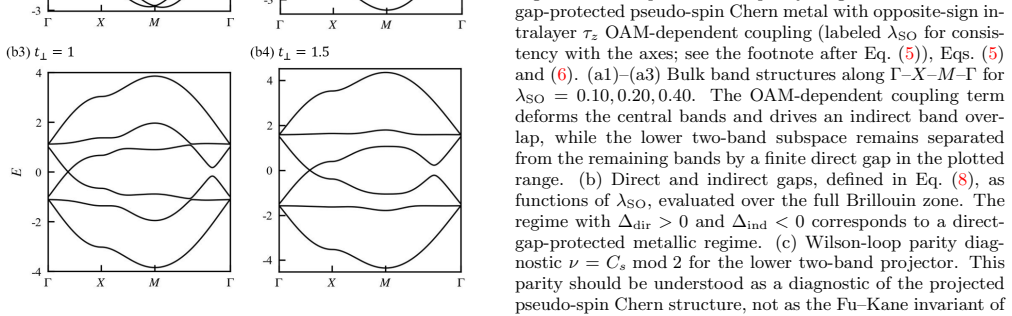
T0 review · 2 major / 0 minor · reviewed 2026-07-14 · grok-4.5
Pith's one-line read A bilayer Lieb lattice can host a time-reversal-invariant metal whose layer-resolved pseudo-spin Chern number stays quantized as long as local gaps remain open.
desk verdict Solid, incremental tight-binding construction: a TR-invariant pseudo-spin Chern metal on bilayer Lieb with independently tunable asymmetric edges; math is clean, novelty is real but modest. read the letter →
The pith
A machine-rendered reading of the paper's core claim, the machinery that carries it, and where it could break.
The reading
What carries the argument
The layer-resolved pseudo-spin Chern number Cs = (C+ − C−)/2, obtained from the positive and negative sectors of the projected operator P τz P on the locally separated occupied subspace; it stays quantized across the semimetal-to-metal transition provided those two gaps remain open.
What would settle it
Close the direct gap or the projected pseudo-spin gap (for example by raising the OAM coupling past the critical value near λ SO ≃ 0.6) and check whether Cs drops from 1 and the asymmetric edge modes disappear; or change the ribbon termination and verify whether the flat-versus-dispersive edge asymmetry is lost.
Extended reading notes
Core claim
Opposite-sign intralayer OAM-dependent coupling converts the zero-indirect-gap pseudo-spin Chern semimetal into a metal while the layer-resolved pseudo-spin Chern number Cs remains quantized and well defined, so long as the direct gap at each k and the projected pseudo-spin gap of P τz P stay open.
Load-bearing premise
That a direct-gap-protected projected Chern marker remains a meaningful bulk-boundary diagnostic for a metal with a residual Fermi surface, even though it is not a quantized transport coefficient and edge character depends on termination choice.
Editorial extensions
If this is right
- A zero-indirect-gap pseudo-spin Chern semimetal can be continuously tuned into a metal without immediately losing its layer-resolved topological marker.
- Asymmetric edges (flat band on one side, gappable Dirac cone on the other) become a designable feature of layer-resolved gapless phases.
- Synthetic platforms that control hoppings and local interlayer terms can host and spectroscopically resolve these metallic topological states.
- The same direct-gap criterion supplies a practical diagnostic for other metallic spectra that retain a locally separated occupied subspace.
Reading between the lines
- Because the marker is only a local band-geometric diagnostic, residual Fermi-surface transport will not show a quantized Hall response; experiments must target spectral gaps and edge localization rather than DC conductance.
- The termination dependence of the flat edge implies that cold-atom or solid-state realizations will need boundary-resolved spectroscopy, while photonic and circuit platforms can hard-wire the desired termination.
- Non-Hermitian or interaction terms that act differently on the flat versus dispersive edges could produce skin accumulation or correlated flat-band physics without immediately destroying the bulk marker.
Editorial analysis
A structured set of objections, weighed in public.
Referee Report
Summary. The manuscript constructs a time-reversal-invariant bilayer Lieb-lattice model that realizes a zero-indirect-gap pseudo-spin Chern semimetal (parent Hamiltonian H0, Eqs. 1–2) and, upon adding opposite-sign intralayer OAM-dependent coupling HSOC (Eqs. 5–7), a metallic phase in which the global spectrum has a negative indirect gap while a layer-resolved pseudo-spin Chern number Cs remains quantized. Topology is diagnosed by the Fukui lattice Chern number of the projected sectors of P τz P, by Wilson-loop parity, and by a hybrid cylinder marker (SM Sec. S1). Ribbon spectra show asymmetric edges: one flat-band edge and one counter-propagating Dirac edge that can be selectively gapped by an edge-localized interlayer mass HB (Eq. 9), while OAM coupling bends the flat edge into a dispersive mode. The authors emphasize that Cs is a direct-gap-protected band-geometric marker rather than a quantized transport coefficient.
Significance. If the bulk–boundary correspondence holds in the metallic regime, the work supplies a concrete, tunable lattice realization of a layer-resolved topological metal with controllable asymmetric edges, of clear interest for photonic, topolectrical, and cold-atom platforms. Strengths include an explicit TR- and chiral-symmetric Hamiltonian, standard and reproducible diagnostics (Fukui Chern number, Wilson-loop parity, hybrid cylinder marker), clear direct/indirect gap definitions (Eq. 8), and a transparent edge-mass construction. The distinction between a residual Fermi surface and a locally gapped occupied subspace is carefully stated. The result sits usefully between Chern semimetals and feature/orbital-resolved topology and is a natural target for synthetic-matter experiments.
major comments (2)
- SM Sec. S1, Eqs. (S1)–(S9) and main-text Figs. 2 and 4: the hybrid cylinder marker and the colored ribbon branches rely on the projector P(kx) built from the lowest Nocc eigenvalues of the open-y ribbon. In the metallic regime (Δind < 0) this coincides with the bulk lower two-band subspace only if, for every kx, the 1D continua do not overlap, i.e. δ(kx) ≡ min_ky E3(kx,ky) − max_ky E2(kx,ky) > 0. The manuscript reports only the global Δind and the local Δdir; it never shows δ(kx). If δ(kx) < 0 on a positive-measure set of kx, the hybrid marker and edge coloring no longer diagnose the same subspace that carries bulk Cs, weakening the claimed bulk–boundary link in the metal. A plot or statement that δ(kx) > 0 throughout the Cs = 1 plateau (or an alternative projector that does not rely on energy ordering) is needed.
- Discussion and SM Sec. S3: the authors correctly note that Cs is not a quantized transport coefficient and that edge character depends on termination. The central claim of a “topological metal” with bulk–boundary correspondence therefore rests on the persistence of in-gap (or near-gap) boundary modes associated with the locally gapped subspace. The ribbon spectra in Fig. 4 show colored branches, but it is not quantified how much spectral weight remains inside the residual Fermi-surface continuum versus how much is pushed into true gaps by mB. A short quantitative statement (e.g., participation ratio or energy window relative to the Fermi surface) would make the diagnostic content of the edge modes in the metallic regime clearer.
Circularity Check
No significant circularity: Cs and the metal phase are computed from an explicit Hamiltonian and projectors, not forced by fit or self-definition.
full rationale
The derivation chain is model-first and numerical, not definitional. The parent block h(k;M) is written out in Eq. (1), the bilayer H0 in Eq. (2), and HSOC in Eqs. (5)–(6); Cs is then obtained from the Fukui lattice formula on the ± sectors of P τz P (Eq. (4)), with well-definedness conditioned on the independently evaluated direct gap Δdir and projected-pseudo-spin gap Δmin_τ (Eq. (8), SM Eqs. (S1)–(S9)). That condition is the standard requirement for a Chern marker to exist; the paper does not define Cs so that the metal is automatic, nor does it fit a parameter and re-label it as a prediction. Self-citations ([15] for the Chern-semimetal block; [38,39] for projected-spin Chern markers; feature-spectrum refs [44–46]) supply background constructions that are restated and re-used, not a uniqueness theorem or ansatz that forces the metallic-phase claim. The asymmetric edge phenomenology (flat vs Dirac, HB mass, OAM bending) is exhibited in ribbon spectra (Figs. 3–4) rather than deduced by renaming a known result. Concerns about whether the hybrid cylinder projector coincides with the bulk lower-two-band subspace when δ(kx)<0 are correctness/validity issues about bulk-boundary diagnostics in a metal; they do not make any step reduce to its inputs by construction. Score 0 with empty steps is therefore the honest finding.
Assumptions & free parameters
free parameters (4)
- Nearest-neighbor hoppings J, K and imaginary A–C coupling M =
J=-1, K=1, M=0.5i (representative)
- Interlayer coupling t_⊥ =
0.01–1.5 (scan)
- OAM-coupling strength λ_SO =
0.10–0.80 (scan)
- Edge mass m_B =
0–1 (scan); 0.5 used with Cs marker
assumptions (5)
- domain assumption Non-interacting spinless fermions on a tight-binding bilayer Lieb lattice adequately capture the targeted topological metal and edge physics.
- domain assumption The lattice Chern number formula and Wilson-loop parity applied to spectral projectors of P τz P define a quantized layer-resolved invariant when the projected pseudo-spin gap is open.
- domain assumption Time-reversal is implemented as T=τx K with T²=+1, and complex conjugation maps M→−M so the two layers form a TR pair.
- standard math Standard linear algebra and Brillouin-zone discretization suffice to evaluate spectra, projectors, and hybrid Chern markers.
- ad hoc to paper The specific forms of H_SOC (opposite-sign intralayer A–C OAM coupling) and H_B (edge-localized τx on B sites) are the physically relevant deformations that convert the phase and gap one edge.
invented entities (2)
-
Pseudo-spin Chern metal (layer-resolved topological metal on bilayer Lieb lattice)
-
Hybrid cylinder projected pseudo-spin Chern marker C_s^hyb
Cite this review
Pith. "Pith review of Layer-Resolved Topological Metals in the Bilayer Lieb Lattice." pith.science (2026). https://pith.science/paper/236HWUQ6
@misc{pith2026260711009,
  author       = {Pith},
  title        = {Pith review of: Layer-Resolved Topological Metals in the Bilayer Lieb Lattice},
  year         = {2026},
  howpublished = {\url{https://pith.science/paper/236HWUQ6}},
  note         = {Machine review of arXiv:2607.11009}
}
read the original abstract
We identify a two-dimensional time-reversal-invariant topological metallic phase on a bilayer Lieb lattice, characterized by a quantized layer--resolved pseudo-spin Chern number. Without the orbital-angular-momentum-dependent (OAM-dependent) coupling, the system gives rise to a time-reversal-invariant topological semimetal with a zero indirect gap and quantized pseudo-spin Chern number. Opposite-sign intralayer OAM-dependent coupling immediately converts the zero-indirect-gap semimetal into a metal, in which the global spectrum is metallic while the layer--resolved pseudo-spin Chern number remains well defined as long as the direct gap at each crystal momentum and the pseudo-spin gap remain open. The model also exhibits asymmetric boundary states: in the semimetallic regime, one edge hosts perfectly flat bands, whereas the opposite edge supports gapless counter-propagating modes forming a one-dimensional Dirac cone. An edge-localized interlayer coupling gaps only the counter-propagating edge states, leaving the flat-band edge essentially intact, while intralayer OAM-dependent coupling bends the exact flat band into a dispersive boundary mode without affecting the gapped Dirac edge. These results open a route toward the controlled engineering of layer--resolved topological gapless phases in synthetic and quantum materials.
Figures


Figures from the paper (1 more)

Forward citations
Cited by 1 Pith paper
-
Time reversal symmetry broken quantum spin hall effect in pseudospin-1 Dirac-Rashba system
The α-T3 lattice hosts TRS-broken QSH, valley-polarized C=1 and C=2 QAH, and α-tunable corner-mode SOTI phases.
Reference graph
Works this paper leans on
-
[1]
Thus, the full Hamiltonian H(k) =H 0(k) +H SOC(k) (7) preserves the time-reversal symmetry in Eq
whereh AC only couples theAandCsublattices, [hAC(k)]AC =g(k), [hAC(k)]CA =g ∗(k), (6) g(k) =−i(1−e ikx)(1−e −iky).The form factor obeys g∗(k) =−g(−k), and hence the full sublattice matrix satisfiesh ∗ AC(k) =−h AC(−k).Using this relation to- gether withτ xτzτx =−τ z, one obtainsTH SOC(k)T −1 = λSO(τxτzτx)⊗h ∗ AC(k) =λ SOτz ⊗h AC(−k) =H SOC(−k). Thus, the ...
-
[2]
The regime ∆ dir >0 and ∆ ind <0 is metallic at the level of the global spectrum, yet the occupied sub- space is still separated locally in momentum. Because the lower and middle bands do not touch each other, the values ofC s in the semimetallic phase are preserved 4 Figure 3. Edge states for the Hamiltonian in Eq. (2) atλ SO = 0. (a1)m B = 0. Energy spe...
-
[3]
N. P. Armitage, E. J. Mele, and A. Vishwanath, Rev. Mod. Phys.90, 015001 (2018)
2018
-
[4]
H. Gao, J. W. Venderbos, Y. Kim, and A. M. Rappe, 6 Annual Review of Materials Research49, 153 (2019)
2019
-
[5]
B. Q. Lv, T. Qian, and H. Ding, Rev. Mod. Phys.93, 025002 (2021)
2021
-
[6]
X. Wan, A. M. Turner, A. Vishwanath, and S. Y. Savrasov, Phys. Rev. B83, 205101 (2011)
2011
-
[7]
G. Xu, H. Weng, Z. Wang, X. Dai, and Z. Fang, Phys. Rev. Lett.107, 186806 (2011)
2011
-
[8]
A. A. Burkov and L. Balents, Phys. Rev. Lett.107, 127205 (2011)
2011
Show all 78 references
-
[9]
Bouhon, Q
A. Bouhon, Q. Wu, R.-J. Slager, H. Weng, O. V. Yazyev, and T. Bzduˇ sek, Nature Physics16, 1137 (2020)
2020
-
[10]
S. M. Young, S. Zaheer, J. C. Y. Teo, C. L. Kane, E. J. Mele, and A. M. Rappe, Phys. Rev. Lett.108, 140405 (2012)
2012
-
[11]
B. J. Wieder, Y. Kim, A. M. Rappe, and C. L. Kane, Phys. Rev. Lett.116, 186402 (2016)
2016
-
[12]
Palumbo, Phys
G. Palumbo, Phys. Rev. Lett.126, 246801 (2021)
2021
-
[13]
C. Fang, H. Weng, X. Dai, and Z. Fang, Chinese Physics B25, 117106 (2016)
2016
-
[14]
Z. Wang, B. J. Wieder, J. Li, B. Yan, and B. A. Bernevig, Phys. Rev. Lett.123, 186401 (2019)
2019
-
[15]
W. Wu, Y. Liu, S. Li, C. Zhong, Z.-M. Yu, X.-L. Sheng, Y. X. Zhao, and S. A. Yang, Phys. Rev. B97, 115125 (2018)
2018
-
[16]
Salerno, N
G. Salerno, N. Goldman, and G. Palumbo, Phys. Rev. Res.2, 013224 (2020)
2020
-
[17]
Palumbo and K
G. Palumbo and K. Meichanetzidis, Physical Review B 92, 235106 (2015)
2015
-
[18]
Andrijauskas, E
T. Andrijauskas, E. Anisimovas, M. Raˇ ci¯ unas, A. Mekys, V. Kudriaˇ sov, I. B. Spielman, and G. Juzeli¯ unas, Phys. Rev. A92, 033617 (2015)
2015
-
[19]
Palumbo, Journal of Physics: Condensed Matter36, 26LT01 (2024)
G. Palumbo, Journal of Physics: Condensed Matter36, 26LT01 (2024)
2024
-
[20]
Rahul and G
S. Rahul and G. Palumbo, Journal of Applied Physics 139, 054302 (2026)
2026
-
[21]
J. Chen, Y. Zheng, S. Yang, A. Al` u, Z.-Y. Li, and C.-W. Qiu, Phys. Rev. Lett.134, 223806 (2025)
2025
-
[22]
Beitlberger, M
J. Beitlberger, M. Martin, M. Scheele, M. Matas, C. P. Romao, M. Str¨ obele, and H. J. Meyer, Zero indirect band gap and flat bands in a niobium oxyiodide cluster mate- rial (2026), arXiv:2602.16011 [cond-mat.str-el]
2026
-
[23]
X. Hu, Z. Zhong, and G. A. Fiete, Scientific Reports5, 11072 (2015)
2015
-
[24]
Ying and A
X. Ying and A. Kamenev, Phys. Rev. Lett.121, 086810 (2018)
2018
-
[25]
Bahari and M
M. Bahari and M. V. Hosseini, Phys. Rev. B99, 155128 (2019)
2019
-
[26]
G. G. Pyrialakos, A. Apostolidis, M. Khajavikhan, N. V. Kantartzis, and D. N. Christodoulides, Phys. Rev. B107, 174313 (2023)
2023
-
[27]
J.-W. Dong, Z. Wang, and S. Zhou, Phys. Rev. B107, 045127 (2023)
2023
-
[28]
Zhou, Z.-Q
Y.-C. Zhou, Z.-Q. Sun, H.-S. Lai, X.-C. Sun, C. He, and Y.-F. Chen, Laser & Photonics Reviews18, 2400826 (2024)
2024
-
[29]
W. Zhao, Z. Tao, Y. Zhang, B. Shen, Z. Han, P. Kn¨ uppel, Y. Zeng, Z. Xia, K. Watanabe, T. Taniguchi, J. Shan, and K. F. Mak, Emergence of chern metal in a moir´ e kondo lattice (2025), arXiv:2506.14063 [cond-mat.str-el]
2025 arXiv
-
[30]
Cerjan and T
A. Cerjan and T. A. Loring, Phys. Rev. B106, 064109 (2022)
2022
-
[31]
Cheng, A
W. Cheng, A. Cerjan, S.-Y. Chen, E. Prodan, T. A. Lor- ing, and C. Prodan, Nature Communications14, 3071 (2023)
2023
-
[32]
H. Pan, X. Li, Z. Qiao, C.-C. Liu, Y. Yao, and S. A. Yang, New Journal of Physics16, 123015 (2014)
2014
-
[33]
S. S. Krishtopenko, I. Yahniuk, D. B. But, V. I. Gavrilenko, W. Knap, and F. Teppe, Phys. Rev. B94, 245402 (2016)
2016
-
[34]
L. C. Xie, H. C. Wu, L. Jin, and Z. Song, Phys. Rev. B 104, 165422 (2021)
2021
-
[35]
L. Xie, L. Jin, and Z. Song, Science Bulletin68, 255 (2023)
2023
-
[36]
Z. Cui, X. Zhang, M. Peng, Q. Wei, M. Yan, and G. Chen, Applied Physics Letters126, 021702 (2025)
2025
-
[37]
Y. Liu, H. Wang, H. Liu, P. Lai, Y. Tang, H. Cheng, and S. Chen, Phys. Rev. B113, 075307 (2026)
2026
-
[38]
W. Deng, X. Huang, J. Lu, V. Peri, F. Li, S. D. Huber, and Z. Liu, Nature Communications11, 3227 (2020)
2020
-
[39]
Sheng, Z
D. Sheng, Z. Weng, L. Sheng, and F. Haldane, Physical review letters97, 036808 (2006)
2006
-
[40]
Prodan, Physical Review B—Condensed Matter and Materials Physics80, 125327 (2009)
E. Prodan, Physical Review B—Condensed Matter and Materials Physics80, 125327 (2009)
2009
-
[41]
K.-S. Lin, G. Palumbo, Z. Guo, Y. Hwang, J. Blackburn, D. P. Shoemaker, F. Mahmood, Z. Wang, G. A. Fiete, B. J. Wieder, and B. Bradlyn, Nature Communications 15, 550 (2024)
2024
-
[42]
W. A. Benalcazar, B. A. Bernevig, and T. L. Hughes, Science357, 61 (2017)
2017
-
[43]
Schindler, A
F. Schindler, A. M. Cook, M. G. Vergniory, Z. Wang, S. S. P. Parkin, B. A. Bernevig, and T. Neupert, Science Advances4, eaat0346 (2018)
2018
-
[44]
F. K. Kunst, G. van Miert, and E. J. Bergholtz, Phys. Rev. B97, 241405 (2018)
2018
-
[45]
Liu, C.-M
L. Liu, C.-M. Miao, Q.-F. Sun, and Y.-T. Zhang, Physical Review B110, 205415 (2024)
2024
-
[46]
Wang, Y.-C
B. Wang, Y.-C. Hung, X. Zhou, T. Ong, and H. Lin, Fea- ture spectrum topology (2023), arXiv:2310.14832 [cond- mat.mtrl-sci]
2023 arXiv
-
[47]
Y.-T. Yao, X. Zhou, Y.-C. Hung, H. Lin, A. Bansil, and T.-R. Chang, Phys. Rev. B109, 155143 (2024)
2024
-
[48]
Wang, Y.-C
B. Wang, Y.-C. Hung, H. Lin, S. Li, R.-H. He, and A. Bansil, Phys. Rev. B111, 195102 (2025)
2025
-
[49]
Fukui, Y
T. Fukui, Y. Hatsugai, and H. Suzuki, Journal of the Physical Society of Japan74, 1674 (2005)
2005
-
[50]
We retain the subscript “SO” inH SOC andλ SO as a label for consistency with all figures. Physically, this term is an orbital-angular-momentum-dependent (OAM- dependent) sublattice coupling rather than genuine spin– orbit coupling, sinceτ z labels a layer/orbital pseudospin, n...
-
[51]
See supplemental material
-
[52]
Beugeling, J
W. Beugeling, J. C. Everts, and C. Morais Smith, Phys. Rev. B86, 195129 (2012)
2012
-
[53]
F. K. Kunst, G. van Miert, and E. J. Bergholtz, Phys. Rev. B99, 085426 (2019)
2019
-
[54]
S. H. Kooi, G. van Miert, and C. Ortix, Physical Review B102, 041122 (2020)
2020
-
[55]
Y. Yang, J. Lu, M. Yan, X. Huang, W. Deng, and Z. Liu, Physical Review Letters126, 156801 (2021)
2021
-
[56]
Y.-Q. Zhu, Z. Zheng, G. Palumbo, and Z. D. Wang, Phys- ical Review B111, 195107 (2025)
2025
-
[57]
D.-S. Ma, Y. Xu, C. S. Chiu, N. Regnault, A. A. Houck, Z. Song, and B. A. Bernevig, Phys. Rev. Lett.125, 266403 (2020)
2020
-
[58]
Yao and Z
S. Yao and Z. Wang, Physical Review Letters121, 086803 (2018)
2018
-
[59]
R. Lin, T. Tai, M. Yang, L. Li, and C. H. Lee, Frontiers 7 of Physics18, 53605 (2023)
2023
-
[60]
Okuma and M
N. Okuma and M. Sato, Annual Review of Condensed Matter Physics14, 83 (2023)
2023
- [61]
-
[62]
Yang and C
M. Yang and C. H. Lee, Communications Physics9, 210 (2026)
2026
-
[63]
Yang and C
M. Yang and C. H. Lee, Physical Review Letters133, 136602 (2024)
2024
-
[64]
Yang and C
M. Yang and C. H. Lee, arXiv preprint arXiv:2507.17295 10.48550/arXiv.2507.17295 (2025), arXiv:2507.17295 [cond-mat.mes-hall]
2025 doi
-
[65]
C. Wu, B. A. Bernevig, and S.-C. Zhang, Physical Review Letters96, 106401 (2006)
2006
-
[66]
Peotta and P
S. Peotta and P. T¨ orm¨ a, Nature Communications6, 8944 (2015)
2015
-
[67]
T¨ orm¨ a, Physical Review Letters131, 240001 (2023)
P. T¨ orm¨ a, Physical Review Letters131, 240001 (2023)
2023
-
[68]
M. Yang, L. Yuan, and C. H. Lee, Communications Physics8, 388 (2025)
2025
-
[69]
Mukherjee, A
S. Mukherjee, A. Spracklen, D. Choudhury, N. Goldman, P. ¨Ohberg, E. Andersson, and R. R. Thomson, Physical Review Letters114, 245504 (2015)
2015
-
[70]
K. Fang, Z. Yu, and S. Fan, Nature Photonics6, 782 (2012)
2012
-
[71]
A. Dutt, M. Minkov, Q. Lin, L. Yuan, D. A. Miller, and S. Fan, Nature communications10, 3122 (2019)
2019
-
[72]
A. Dutt, Q. Lin, L. Yuan, M. Minkov, M. Xiao, and S. Fan, Science367, 59 (2020)
2020
-
[73]
W. Zhu, S. Hou, Y. Long, H. Chen, and J. Ren, Physical Review B97, 075310 (2018)
2018
-
[74]
X. Zhou, W. Zhang, H. Sun, and X. Zhang, Physical Review B107, 035152 (2023)
2023
-
[75]
S. Taie, H. Ozawa, T. Ichinose, T. Nishio, S. Nakajima, and Y. Takahashi, Science Advances1, e1500854 (2015)
2015
-
[76]
Goldman, D
N. Goldman, D. F. Urban, and D. Bercioux, Physical Review A83, 063601 (2011)
2011
-
[77]
Lv, Y.-X
Q.-X. Lv, Y.-X. Du, Z.-T. Liang, H.-Z. Liu, J.-H. Liang, L.-Q. Chen, L.-M. Zhou, S.-C. Zhang, D.-W. Zhang, B.- Q. Ai, H. Yan, and S.-L. Zhu, Physical Review Letters 127, 136802 (2021)
2021
-
[78]
Layer-Resolved Topological Metals in the Bilayer Lieb Lattice
M. R. Slot, T. S. Gardenier, P. H. Jacobse, G. C. P. van Miert, S. N. Kempkes, S. J. M. Zevenhuizen, C. M. Smith, D. Vanmaekelbergh, and I. Swart, Nature Physics 13, 672 (2017). S1 Supplemental Material for “Layer-Resolved Topological Metals in the Bilayer Lieb Lattice” Mengji...
2017
Reviewed July 14, 2026 · model on record in the stance chip above.
Discussion (0). Sign in to comment.