REVIEW 5 major objections 6 minor 1 cited by
Skill edits that do not commute can be screened with microsecond Lie-bracket tests, recovering full ordered-pair repair quality while cutting expensive model validations by nearly an order of magnitude.
Reviewed by Pith at T0; open to challenge. T0 means a machine referee read the full paper against a public rubric. the ladder, T0–T4 →
T0 review · grok-4.5
2026-07-14 05:13 UTC pith:3NZIYCEX
load-bearing objection Real systems idea (screen noncommuting skill edits before LLM validation) wrapped in heavy algebroid language; speedups are concrete on controlled tasks but the screen mostly re-ranks planted dependency metadata. the 5 major comments →
Agentic Skill Optimization over Lie Algebroids
The pith
A machine-rendered reading of the paper's core claim, the machinery that carries it, and where it could break.
Core claim
When skill repairs are order-dependent, modeling available edit policies as sections of a controlled Lie algebroid over typed Markdown workflows lets a static noncommutation (bracket) screen select a small validation budget that still matches exhaustive ordered-pair search, because most of the combinatorial cost is replaced by microsecond algebraic probes before any large language model is run.
What carries the argument
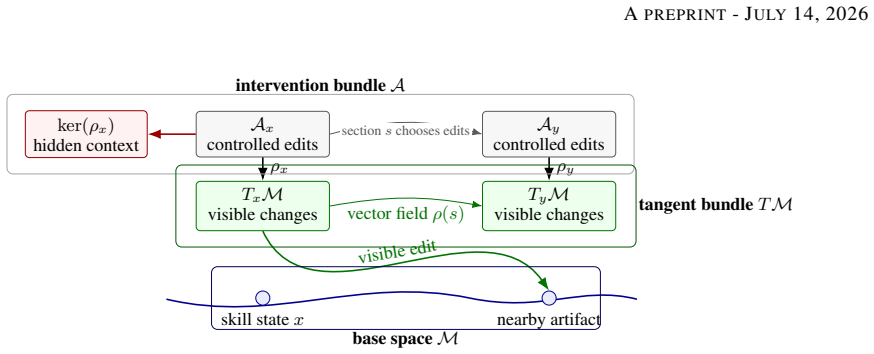
LASKO: a controlled Lie algebroid A → Md with anchor ρ, so that sections are edit policies, ρ(s) is the visible Markdown or workflow effect, ker(ρ) is latent template/routing structure, and the algebroid bracket [s,t]_A screens noncommuting edit composition before expensive validation.
Load-bearing premise
The cheap, application-specific noncommutation proxies (shared anchors, read/write overlap, residual overlap, scenario-local dependencies) must actually rank the ordered pairs that matter for later validation, rather than only echoing structure already written into the benchmark graphs.
What would settle it
On a live skill-optimization task whose productive ordered edges are not already encoded in the same metadata the proxy reads, run LASKO’s bracket screen plus a fixed small validation budget against exhaustive ordered-pair validation with the same served model: if LASKO fails to recover the exhaustive score while random same-budget pairs do no better either, the screening claim fails for that setting.
If this is right
- Short-horizon single-edit skill loops will systematically miss productive ordered repair chains that a bracket screen can still surface within a linear validation budget.
- Validation economics for self-editing agents can be reorganized into a two-layer queue: microsecond static noncommutation probes first, then focused served-model checks only on high-bracket pairs.
- Hidden kernel directions (routing, templates, unfilled slots) become first-class objects to monitor when two edits leave the document looking the same but change future composition.
- The same anchor/bracket accounting transfers from schematic ten-anchor chains to agent workflow contracts, financial research workflows, and predictive-state causal manifolds built from real run traces.
Where Pith is reading between the lines
- If the proxy remains faithful outside hand-designed graphs, production skill optimizers could treat noncommuting pairs as a first-class search primitive rather than as an after-the-fact debugging story.
- The kernel residual is a natural place to look for brittleness when a skill “works” on held-out scores yet still fails to compose with later edits or tools.
- A natural next stress test is whether bracket screening still concentrates value when the productive order is discovered only from noisy live rollouts, not from a pre-written edge catalog.
Editorial analysis
A structured set of objections, weighed in public.
Referee Report
Summary. The paper proposes LASKO (Lie Algebroid SKill Optimization), framing agentic skill editing as optimization over a controlled Lie algebroid A → Md of edit policies above a tangent category of typed, anchored Markdown workflows. The anchor ρ maps controlled edit sections to visible artifact changes, ker(ρ) is interpreted as latent template/routing structure, and algebroid brackets are proposed as diagnostics of noncommuting edit composition. Empirically, the paper reports that inexpensive static “bracket” screens (microseconds) can prioritize ordered edit pairs so that a small number of expensive served-LLM validations recover the exhaustive ordered-pair score on controlled multi-anchor, agent-workflow, 10-K, Democritus, and PSR-LASKO tasks, with a reported peak wall-clock speedup of ~14.85× versus brute-force validation on DeepSeek V3.1 4-bit for a WaPo coffee PSR-LASKO run.
Significance. If the geometric and empirical claims hold beyond hand-designed graphs, the paper would supply a useful validation-economics primitive for self-improving agents: treat noncommuting skill repairs as first-class objects and spend expensive rollouts only on high-interaction pairs. Strengths that should be credited include (i) a clear operational separation of cheap static probes from served validation (Appendix A), (ii) multi-model wall-clock accounting rather than only probe counts, and (iii) an explicit attempt to connect skill optimization to Lie-algebroid and tangent-category structure rather than flat prompt search. Even if the full algebroid story is only partially realized, the prioritization-of-ordered-repairs idea is practically relevant to SKILLOPT-style systems.
major comments (5)
- §10.3–10.5 and Appendix A.1: the central speedup claim is load-bearing on application-specific static noncommutation proxies (read/write anchor overlap, residual-component overlap, scenario-local ordered dependencies, etc.). In the ten-anchor, agent-workflow, and 10-K benchmarks, productive ordered pairs are hand-specified (e.g., schema→normalization, table extraction before numeric gate), and the proxy is built from the same anchor/read-write and scenario-dependency metadata that encodes those edges. Later Democritus/PSR cases reuse the same architecture. As written, the screen largely re-ranks a known noncommutative edit graph rather than independently estimating an algebroid bracket [s,t]_A or discovering order-sensitivity without planted structure. Please either (a) provide a benchmark where productive order is not encoded in the proxy features, or (b) reframe the empirical claim as
- Abstract and §1 vs Appendix A.1: the abstract states that LASKO “substitutes inexpensive Lie-bracket screening tests that run in microseconds.” Appendix A.1 then defines the operational object as an application-specific static noncommutation proxy, not a computed Lie algebroid bracket on sections of A. This is a load-bearing terminology gap: readers will take “Lie-bracket screening” as evidence for the geometric formalism, whereas the measured object is a hand-crafted compatibility score. Align the abstract, introduction, and experimental claims with what is actually computed, or report an actual bracket estimator (order-contrast of finite differences / residual vectors) that does not hard-code the answer graph.
- Proposition 1 (§6) and the experimental base: Proposition 1 is explicitly conditional on edit fibers being modules and rewrites having compatible pushforwards. The experiments never verify these hypotheses for the Markdown/workflow objects used (skill cards, Democritus traces, PSR manifolds). Without that, the claim that the base is a tangent category—and therefore that involution-algebroid closure is the right workflow condition—remains formal scaffolding rather than an established property of the systems under study. Either supply a concrete verification for one experimental base, or demote the tangent-category claim to a modeling hypothesis and state what would falsify it.
- §9 Conjecture 1 and the LASKO loss: the combined loss L_LASKO with weights λ_IC, λ_ker, λ_DB, λ_A and the low-curvature fixed-point conjecture are presented as the optimization principle, but the reported experiments do not optimize this loss; they rank ordered pairs by a static proxy and validate. The free parameters (top-k after screen, λ weights, proxy scoring weights) are not ablated. For the central claim to rest on LASKO-as-optimization rather than LASKO-as-prioritizer, show that the residual terms (R_Md, R_ker, R_DB) predict repair stability on held-out or non-planted tasks, or clearly separate the prioritization algorithm from the untested optimality conjecture.
- Native baselines (§10.8–10.9): SearchQA and ALFWorld are correctly labeled micro-benchmarks, but they do not yet support the abstract’s order-of-magnitude claim. SearchQA shows a gated accept/reject with a suggestive fiber-level soft-score signal; ALFWorld closes one ordered repair edge with a hand-written navigation rule. Neither demonstrates that algebroid screening reduces validation cost relative to SKILLOPT on a live environment. Either expand these to a quantitative LASKO-vs-exhaustive comparison, or confine the speedup claim strictly to the controlled/PSR served-validation tables and state the live-environment status as preliminary.
minor comments (6)
- Figure 1 and Figure 2 are helpful but dense; label ρ, ker(ρ), and [s,t]_A more explicitly in the figure captions so the geometric vocabulary is self-contained without §3.
- Notation drift: Md, WfMd, TWfMd, A_psr, and M_psr appear with slightly different roles; a single notation table early in §6–7 would help.
- Several related works are the author’s own 2026 manuscripts (IC, BRIDGE/SKFM, Categories for AGI, Odyssey). Brief one-sentence contrasts of what is new here versus those would help non-specialist readers.
- Typographical/formatting issues: title casing in headers (“AGENTICSKILLOPTIMIZATION”), missing spaces in compound names (SKILLOPT, LASKO), and occasional double spaces in the preprint body.
- Table-like method comparisons in §10.3–10.7 would be clearer as numbered tables with standard captions rather than inline monospace blocks.
- Clarify whether the DeepSeek V3.1 “671B parameters” figure in the abstract is the full model size or the served 4-bit local instance actually timed; the appendix table is the authoritative source and should be cross-referenced.
Circularity Check
Empirical speedup is largely by construction: productive ordered edges are planted in the benchmarks, and the 'Lie-bracket' screen ranks pairs from the same read/write and scenario-dependency metadata that defines those edges.
specific steps
-
self definitional
[§10.3 Ten-anchor controlled benchmark; §10.4 Agent-workflow controlled benchmark]
"Five ordered pairs are productive: schema→normalization, evidence→citation, abstention→format, tool contract→routing, validator→final answer. ... The LASKO-prioritized method first computes a cheap bracket proxy from the anchor/order structure and then validates only the ten highest-bracket ordered pairs. ... The bracket proxy is computed from cheap workflow metadata. Each edit section has read and write anchors; a pair receives high bracket score when the first edit writes an anchor read by the second, when the reverse order is also plausible, or when the pair appears as a scenario-local orde"
Productive ordered pairs are defined by construction as specific ordered dependencies on the anchor chain / scenario graph. The 'bracket' score is then defined to be high precisely when a pair exhibits that same read/write or scenario-local ordered dependency. Recovering exhaustive score 1.000 by validating the top-bracket pairs is therefore verifying the planted graph by reading the planted graph, not an independent measurement of noncommuting edit composition.
-
fitted input called prediction
[Appendix A.1 Application-specific bracket proxies; §10.7 PSR-LASKO; abstract speedup claim]
"Operationally, however, the proxy used to rank section pairs depends on the artifact being optimized. In PSR-LASKO, the proxy combines read/write dependencies between PSR sections, overlap in residual components (RH, Rres, RW, Rcausal, Rscope, RDB), context-chart interactions, witness dependencies, Hankel row/column effects, and drift pressure induced by off-query clusters. ... Thus the invariant idea is not a single universal formula for the cheap probe. It is the architecture: application-specific static noncommutation proxy ⇒ focused expensive validation. ... LASKO achieved a speedup of alm"
The abstract presents microsecond 'Lie-bracket screening' as the reason expensive LLM validations can be cut by ~15×. Operationally the probe is an application-specific static ranking built from the same residual families, read/write fields, and ordered-edge catalog later used as the validation target. Selecting high-proxy pairs and then reporting that those pairs close the catalog edges is a forced recovery of the input dependency structure, not a prediction of noncommutation outside that structure.
-
renaming known result
[§10.3–10.5 method tables; Appendix A architecture statement]
"Method Bracket probes Validation probes Score ... LASKO-prioritized 90 10 1.000 ... Exhaustive ordered pairs 0 90 1.000 ... application-specific static noncommutation proxy ⇒ focused expensive validation."
What is demonstrated is dependency-aware prioritization of a known noncommutative edit graph (validate high-dependency ordered pairs first), a standard engineering pattern. The paper renames that static prioritization as 'Lie-algebroid bracket screening' and presents the resulting validation reduction as evidence for algebroid geometry of skill edits, without an independent bracket estimator that would discover order-sensitivity when the answer is not already in the metadata.
-
self citation load bearing
[§1–2 geometric lineage; citations Mahadevan 2026b,d,c]
"Infinitesimal Causality (IC) (Mahadevan, 2026d) supplies the first piece of this algebra. ... Earlier work proposed Lie-algebraic methods for latent-confounded causal discovery, specifically BRIDGE ... and SKFM ... (Mahadevan, 2026b). ... The motivating agent-system examples are BASKET and ROCKET, introduced in the broader diagrammatic agent-systems program of Categories for AGI (Mahadevan, 2026c)."
The claim that skill optimization 'needs' controlled Lie algebroids, anchors ρ, ker(ρ), and bracket residuals as the right geometry is justified almost entirely by concurrent manuscripts by the same author (IC, BRIDGE/SKFM, Categories for AGI). Those citations are not machine-checked or externally fixed uniqueness results; they are the same research program. The empirical tables do not independently establish that algebroid structure (as opposed to ordinary dependency metadata) is what buys the speedup.
full rationale
The paper's central empirical claim—that microsecond 'Lie-bracket' probes recover exhaustive ordered-pair score 1.000 while cutting expensive served validations by an order of magnitude (peak ~14.85× on DeepSeek V3.1 4-bit)—is not an independent first-principles prediction of noncommutation. In the controlled suites that carry the claim (§10.3–10.5 and the later Democritus/PSR graphs that reuse the same architecture), productive ordered pairs are hand-specified, and Appendix A.1 / §10.4 define the cheap proxy from exactly the anchor read/write overlap and 'scenario-local ordered dependency' structure that encodes those pairs. Validating the top-scoring pairs therefore re-reads a planted dependency graph rather than estimating an algebroid bracket [s,t]_A or ker(ρ) from rollout dynamics. The geometric vocabulary (IC, BRIDGE/SKFM, Categories for AGI) is load-bearing only via concurrent self-citations and does not independently force the validation economics. SearchQA/ALFWorld/Odyssey traces are smaller diagnostics and do not rescue the main speedup tables. This is partial circularity of the empirical core (score 7), not a total definitional collapse of every claim: the paper does honestly label the suites as controlled and does run real served validators on selected sequences.
Axiom & Free-Parameter Ledger
free parameters (3)
- validation_budget_after_screen (top-k / top-2k pairs, focused final chunks) =
task-specific (e.g. 10, 17, 19, 21, 2k)
- LLASKO weights λ_IC, λ_ker, λ_DB, λ_A =
unspecified / not systematically fit
- application-specific bracket proxy scoring weights =
unspecified heuristic combination
axioms (6)
- ad hoc to paper Typed anchored Markdown / workflow objects form a tangent category once edit fibers are modules and rewrites have compatible pushforwards (Proposition 1).
- domain assumption Available skill-edit policies form (or are well approximated by) sections of a Lie algebroid A→WfMd with anchor ρ preserving brackets.
- ad hoc to paper Static noncommutation proxies estimate the pairs with large algebroid brackets well enough to replace most semantic validations.
- ad hoc to paper Low-curvature fixed points of the forward-backward repair operator are locally optimal stable skills (Conjecture 1).
- standard math Standard Lie algebroid Leibniz rule, anchor-bracket intertwining, and involutive-closure ideas from Mackenzie/Crainic-Fernandes/Burke-MacAdam apply after the Markdown lift.
- domain assumption SkillOpt-style propose/rollout/validate loops and BASKET/ROCKET/Democritus workflow stages are the right empirical substrate for testing the geometry.
invented entities (5)
-
LASKO (Lie Algebroid SKill Optimization)
no independent evidence
-
Typed Markdown tangent category Md / workflow category WfMd
no independent evidence
-
Controlled intervention algebroid of skill-edit policies with ker(ρ) latent procedural state
no independent evidence
-
LASKO residuals RMd, Rker, RDB and diagrammatic backpropagation curvature CurvD
no independent evidence
-
PSR-LASKO causal manifold Mpsr and repair sections
no independent evidence
read the original abstract
Agentic systems increasingly improve themselves by editing skills: prompts, rubrics, plans, tool contracts, examples, validators, and traces. Skill edits are not independent coordinates in a vector space: they are local repairs to structured artifacts whose effects are observed only after rollout, validation, and critique. Distinct edits can have the same immediate visible effect while differing in routing context, template state, guardrail scope, or future composability. The order of edits can matter as well: repairing a schema before a normalization rule need not be equivalent to applying the same edits in the reverse order. This paper introduces a new framework for skill optimization called LASKO, for Lie Algebroid SKill Optimization. LASKO models typed, anchored Markdown skills as the base category and available edit policies as sections of a controlled Lie algebroid with anchor $\rho$. The anchor maps an edit policy to its visible Markdown effect; the kernel $\ker(\rho)$ represents latent template, routing, or implementation structure; and the algebroid bracket measures noncommuting edit composition. As shown in the paper, LASKO achieves order-of-magnitude speedups in skill optimization in our preliminary benchmark results, primarily because it substitutes inexpensive Lie-bracket screening tests that run in microseconds, before investing in expensive validations that require running large language models. On a causal extraction from natural language task, LASKO achieved a speedup of almost $15 \times$ compared to a brute-force approach that validated all edits by running them through a DeepSeek V3.1 4-bit model with 671B parameters.
Figures

Forward citations
Cited by 1 Pith paper
-
Learning in Infinitesimal Non-Compositional Sketches
The paper defines infinitesimal non-compositionality as the tangent-lift of factorization failures in learning sketches, and proposes learning as converging to a final coalgebra of iterated tangent lifts.
Reference graph
Works this paper leans on
-
[1]
Matthew Burke and Rory B. B. MacAdam. Involution algebroids: a generalisation of Lie algebroids for tangent categories, 2019. URL https://arxiv.org/abs/1904.06594
Pith/arXiv arXiv 2019
-
[2]
J. R. B. Cockett and G. S. H. Cruttwell. Differential structure, tangent structure, and SDG . Applied Categorical Structures, 22 0 (2): 0 331--417, 2014
2014
-
[3]
Integrability of lie brackets
Marius Crainic and Rui Loja Fernandes. Integrability of lie brackets. Annals of Mathematics, 157 0 (2): 0 575--620, 2003
2003
-
[4]
Hu, Yelong Shen, Phillip Wallis, Zeyuan Allen-Zhu, Yuanzhi Li, Shean Wang, Lu Wang, and Weizhu Chen
Edward J. Hu, Yelong Shen, Phillip Wallis, Zeyuan Allen-Zhu, Yuanzhi Li, Shean Wang, Lu Wang, and Weizhu Chen. LoRA : Low-rank adaptation of large language models. International Conference on Learning Representations, 2022. URL https://openreview.net/forum?id=nZeVKeeFYf9
2022
-
[5]
Kirill C. H. Mackenzie. General Theory of Lie Groupoids and Lie Algebroids, volume 213 of London Mathematical Society Lecture Note Series. Cambridge University Press, 2005
2005
-
[6]
ALLORA : A lie-algebraic LoRA method for composable neural adapters, 2026 a
Sridhar Mahadevan. ALLORA : A lie-algebraic LoRA method for composable neural adapters, 2026 a . Manuscript
2026
-
[7]
Latent-confounded causal discovery via lie-bracket geometry, 2026 b
Sridhar Mahadevan. Latent-confounded causal discovery via lie-bracket geometry, 2026 b . URL https://arxiv.org/abs/2606.19610
Pith/arXiv arXiv 2026
-
[8]
Categories for AGI , 2026 c
Sridhar Mahadevan. Categories for AGI , 2026 c . URL https://people.cs.umass.edu/ mahadeva/papers/catagi.pdf. Textbook manuscript
2026
-
[9]
Infinitesimal causality, 2026 d
Sridhar Mahadevan. Infinitesimal causality, 2026 d . URL https://arxiv.org/abs/2606.24621
Pith/arXiv arXiv 2026
-
[10]
Odyssey: Constructing verifiable local truth-preserving foundation models, 2026 e
Sridhar Mahadevan. Odyssey: Constructing verifiable local truth-preserving foundation models, 2026 e . URL https://arxiv.org/abs/2606.27593
Pith/arXiv arXiv 2026
-
[11]
Causality: Models, Reasoning, and Inference
Judea Pearl. Causality: Models, Reasoning, and Inference. Cambridge University Press, 2 edition, 2009
2009
-
[12]
Donald B. Rubin. Causal inference using potential outcomes: Design, modeling, decisions. Journal of the American Statistical Association, 100 0 (469): 0 322--331, 2005
2005
-
[13]
Causation, Prediction, and Search
Peter Spirtes, Clark Glymour, and Richard Scheines. Causation, Prediction, and Search. MIT Press, 2 edition, 2000
2000
-
[14]
SkillOpt : Executive strategy for self-evolving agent skills, 2026
Yifan Yang, Ziyang Gong, Weiquan Huang, Qihao Yang, Ziwei Zhou, Zisu Huang, Yan Li, Xuemei Gao, Qi Dai, Bei Liu, Kai Qiu, Yuqing Yang, Dongdong Chen, Xue Yang, and Chong Luo. SkillOpt : Executive strategy for self-evolving agent skills, 2026. URL https://arxiv.org/abs/2605.23904
Pith/arXiv arXiv 2026
discussion (0)
Sign in with ORCID, Apple, or X to comment. Anyone can read and Pith papers without signing in.