REVIEW 4 major objections 6 minor 2 cited by
Causal sufficiency is, at the infinitesimal level, a single closure condition on vector fields: interventions must preserve the structure of what can be copied and discarded, and their brackets must stay within the visible span.
Reviewed by Pith at T0; open to challenge. T0 means a machine referee read the full paper against a public rubric. the ladder, T0–T4 →
T0 review · deepseek-v4-flash
2026-08-02 10:18 UTC pith:ILUDS3XV
load-bearing objection A genuinely new categorical synthesis with honest self-assessment, but the central theorem is stipulated rather than proved, so it is a programmatic framework, not a foundation. the 4 major comments →
Infinitesimal Causality
The pith
A machine-rendered reading of the paper's core claim, the machinery that carries it, and where it could break.
Core claim
The paper introduces a category Stat∞ of regular finite-dimensional statistical models with specified sufficient statistics, and a structural subcategory StatSCM_∞ in which randomness is exogenous and visible stochastic kernels are pushforwards of deterministic mechanisms. Its central claim, Theorem 4.7, is that on a locally separated visible stratum, categorical causal sufficiency is equivalent to tangent Frobenius commutativity: every visible intervention field preserves the Frobenius copy/discard structure, and the visible intervention distribution is involutive. The proof defines causal sufficiency as exactly these two conditions, so the equivalence holds by construction; the paper itsel
What carries the argument
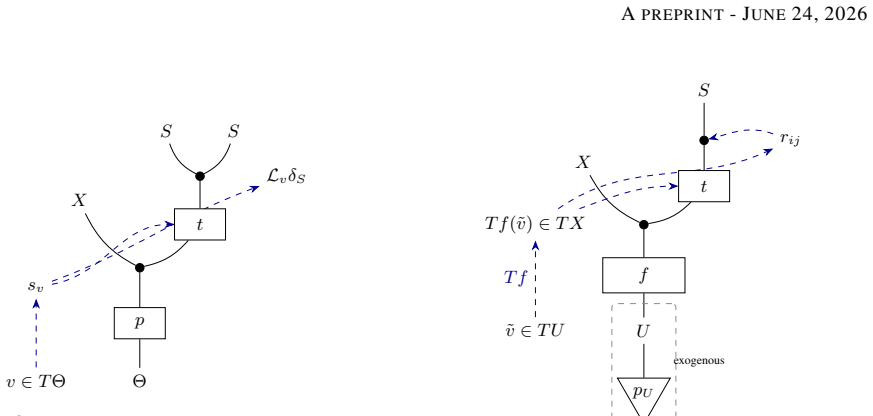
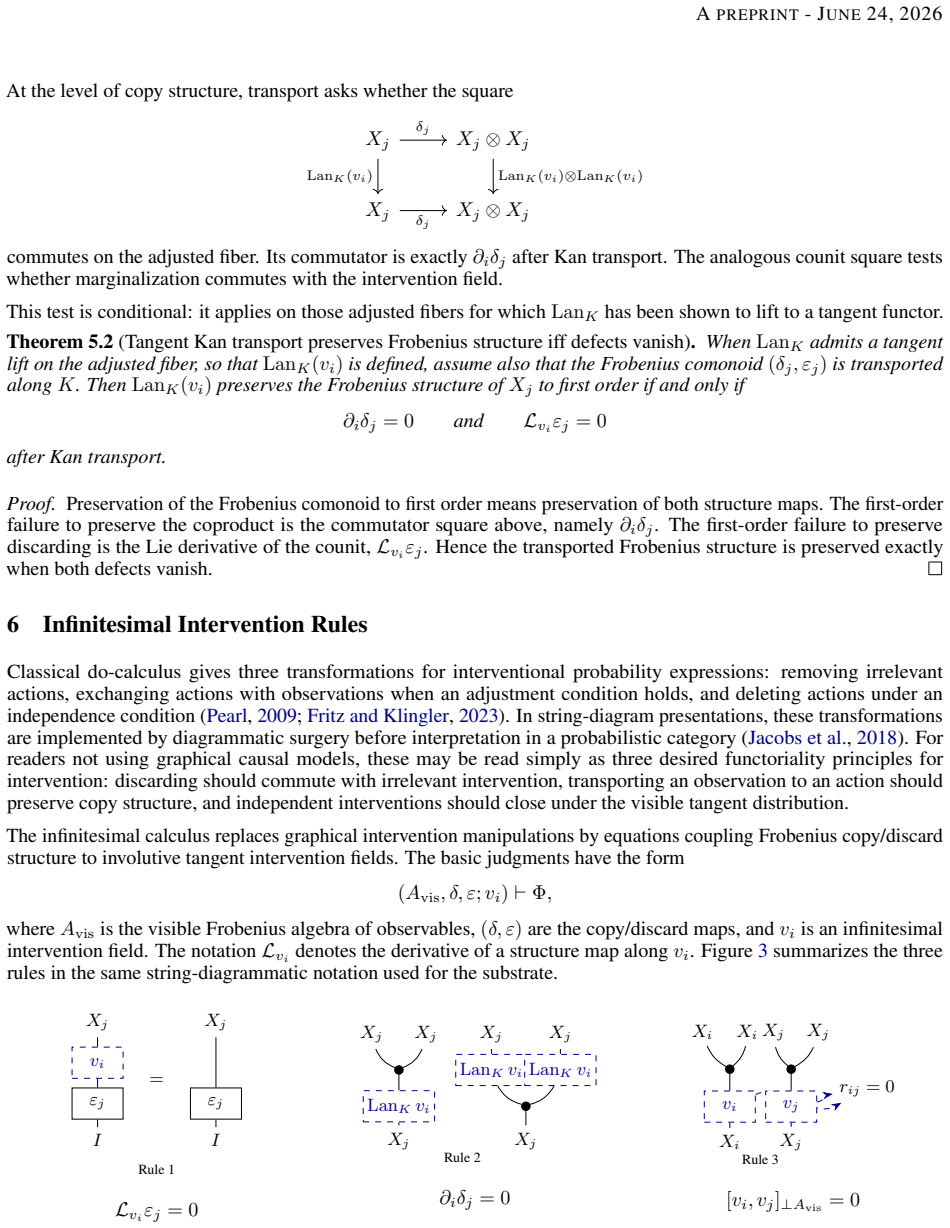
The argument is carried by two invariants: the Frobenius derivative defect ∂iδj = (vi⊗id + id⊗vi)∘δj − δj∘vi, which measures whether an intervention field vi preserves the copy map of variable Xj, and the Lie-bracket residual rij = [vi,vj] − Σ_k c^k_ij vk, which is the part of a bracket that leaves the visible span. The supporting structure is the category Stat∞, whose tangent vectors are identified with centered score functions via the score embedding, and the structural subcategory StatSCM_∞, where intervention fields are defined on the exogenous tangent bundle and pushed forward deterministically before any visible projection. Vanishing of the defect family and of the residuals is what th
Load-bearing premise
The entire edifice rests on the unproven claim that statistical models with sufficient statistics form a tangent category via the score embedding; if the standard tangent-bundle axioms fail for this class, the intervention fields, brackets, and defects lose their categorical foundation.
What would settle it
Run the score tangent construction on a two-parameter exponential family and check the vertical-lift universal property and the naturality of the canonical flip; a failure would falsify the foundational Proposition 2.2. Alternatively, exhibit a separated visible stratum whose intervention distribution is involutive and whose Frobenius defects vanish, yet whose integrated interventional laws cannot be realized by any structural model with the same sufficient statistic—that would falsify Theorem 4.7's sufficiency claim.
If this is right
- If the central claim holds, latent confounding becomes a geometric signature—a nonzero bracket residual outside the visible span—so hidden common causes can be detected without first selecting a graph.
- Causal sufficiency becomes a local, checkable property of a distribution of vector fields, not a property inherent to a particular DAG; graphs become one presentation among many.
- The three infinitesimal intervention rules provide a calculus for first-order causal reasoning that, in the flat case, reduces to the classical do-calculus transformations.
- If the score tangent structure is verified against the full tangent-category axioms, a wide class of exponential-family models would inherit a categorical causality theory directly from their Fisher geometry.
Where Pith is reading between the lines
- Extension: One could turn the framework into a statistical test—estimate intervention fields from smooth perturbation experiments, compute pairwise brackets, and check whether residuals are negligible in the Fisher metric; a positive residual would flag an unrepresented common cause without enumerating latent-variable graphs.
- Extension: The triangular filtration condition, in which brackets of visible fields point only forward in the presentation order, is a Lie-algebraic analogue of acyclicity; combined with the separated-stratum margin, it might yield new identifiability results for causal order from tangent data alone.
- Extension: In exchangeable models, the de Finetti example suggests that integrating out a latent mixing variable creates bracket residuals along posterior-sensitivity directions, so a geometric test could be built to decide whether an exchangeable sequence needs a hidden common cause.
Editorial analysis
A structured set of objections, weighed in public.
Referee Report
Summary. The paper proposes a categorical framework, 'infinitesimal causality' (IDC), combining Markov categories, Frobenius algebras, and tangent-category semantics to study first-order (infinitesimal) interventions on smooth statistical models. It introduces the category Stat∞ of statistical models presented by sufficient statistics, a structural subcategory StatSCM∞ with exogenous noise, and defines intervention fields, Frobenius-derivative defects, and three infinitesimal analogues of Pearl's do-calculus rules. The central claim, Theorem 4.7, is that categorical causal sufficiency is equivalent to tangent Frobenius commutativity on a separated visible stratum, with Corollaries 6.7 and 6.8 deriving the three rules from this equivalence. The paper explicitly lists several foundational steps—verification of the tangent-category axioms, invariance of obstruction classes, and a nontrivial Frobenius-acyclicity theorem—as future work.
Significance. If the framework were fully realized, it could offer a geometric handle on latent confounding: Lie-bracket residuals and Frobenius-derivative defects would serve as coordinate-free signatures of hidden variables. The paper is honest about its limitations; Section 8 spells out many open problems, and the examples illustrate the intended constructions. However, the current manuscript does not establish a substantive theorem. Theorem 4.7 is a restatement of a definition, Proposition 2.2 (the tangent structure) is unproved, and the advertised coordinate-invariance result is absent from the body. The paper is closer to a research proposal with definitions and examples than to a completed theory; its central claims are therefore not yet a reliable foundation for causal diagnostics.
major comments (4)
- [Theorem 4.7 and Section 8.4] The central equivalence is terminological. The proof of Theorem 4.7 opens 'By definition, categorical causal sufficiency in Stat∞ means...' and unpacks that definition as exactly involutive closure of the visible intervention distribution plus vanishing of Frobenius-derivative defects and counit derivatives—the two clauses of 'tangent Frobenius commutativity.' No independent definition of categorical causal sufficiency precedes the theorem. Section 8.4 concedes that the next task is to make Frobenius-acyclicity 'a substantive theorem rather than a restatement of causal sufficiency.' Therefore Theorem 4.7, and the results depending on it (Theorems 6.7 and Corollary 6.8), do not yet establish a substantive equivalence.
- [Proposition 2.2 and Section 8.9] The claimed tangent-category structure on Stat∞ is asserted without proof. Proposition 2.2 states that Stat∞ inherits tangent structure via the score embedding, but no verification of the Cockett–Cruttwell axioms is given. Section 8.9 says this 'should be verified' and lists the vertical lift's universal property as open; Section 8.2 likewise questions the functoriality of the score tangent lift. Since every later construction (intervention fields, Lie brackets, Frobenius-derivative defects, bracket residuals) presupposes this tangent structure, the categorical layer currently rests on an unproved assertion. This is load-bearing, not a routine technicality.
- [Abstract vs. body] The submitted abstract advertises: 'We establish the coordinate invariance of the zero-residual property and characterize its dependence on the intervention protocol, visible span, and metric.' The body contains no theorem proving coordinate invariance of the zero-residual property or of the bracket residuals rij. Instead, Section 8.8 states that invariance under changes of visible generators, adjustment coordinates, and equivalent presentations remains to be proven, so obstruction classes are 'useful diagnostics but not yet canonical categorical invariants.' The advertised result is therefore missing; the abstract must be corrected to match the content.
- [Theorem 5.2 and Section 8.6] Theorem 5.2 ('Tangent Kan transport preserves Frobenius structure iff defects vanish') is conditional and definitional. It assumes 'LanK admits a tangent lift on the adjusted fiber,' an existence result that Section 8.6 lists as an open problem. The proof then defines first-order preservation of the Frobenius comonoid by the vanishing of the commutator ∂iδj and the Lie derivative Lviεj, making the iff true by construction. Until the tangent lift is shown to exist for a nontrivial class of kernels and the commutative square is derived from independent hypotheses, this theorem provides no substantive information.
minor comments (6)
- [Title/Abstract consistency] The full-text abstract introduces 'infinitesimal do-calculus (IDC)' while the title is 'Infinitesimal Causality'; the metadata abstract differs from the full-text abstract. The terminology should be aligned so readers know whether IDC and IC are the same framework.
- [Section 2.4] The paragraph after Definition 2.4 refers to 'Theorem 2.2' when it means Proposition 2.2. Please correct the cross-reference.
- [Section 8.5] Section 8.5 calls Conjecture 7.5 'Theorem 7.5.' Since Conjecture 7.5 is stated as a conjecture, the cross-reference should say 'Conjecture 7.5.'
- [Example 3.3] The multivariate Gaussian natural parameters are stated imprecisely as 'Σ^{-1}μ and -1/2 Σ^{-1}'; as written this omits the vectorization/ symmetry constraints for the covariance parameter. The example would be clearer with the standard exponential-family parameterization.
- [Definition 4.4] The expression (vi⊗id + id⊗vi)∘δj assumes a vector field can act on a morphism such as δj, but in the categorical setup this action is not formally defined. A tangent-categorical semantics for differentiating morphisms is needed before ∂iδj is well-typed; this is more than a notation issue.
- [Figure 3] The three infinitesimal rules are presented in string-diagrammatic equations, but no formal syntax for tangent string diagrams is defined. Without such a syntax, the diagrams are heuristic illustrations rather than derivations.
Circularity Check
Theorem 4.7 defines causal sufficiency as tangent Frobenius commutativity, so the stated equivalence is a restatement; §8.4 admits it.
specific steps
-
self definitional
[Theorem 4.7 and its proof, Section 4]
"By definition, categorical causal sufficiency in Stat∞ means that no extra tangent direction is needed to close the visible intervention distribution and no extra visible generator is needed to make copy/discard operations stable under intervention. The first condition is involutive closure of the visible fields; the second is vanishing of all Frobenius derivative defects ∂iδj and counit derivatives Lvi εj. Together these are precisely tangent Frobenius commutativity."
The theorem claims an equivalence between 'categorical causal sufficiency' and 'tangent Frobenius commutativity', but the proof defines categorical causal sufficiency as exactly the two conditions that constitute tangent Frobenius commutativity. No independent characterization of causal sufficiency precedes the theorem, so the iff is true by construction.
-
self definitional
[Theorem 6.7, Section 6]
"Rule 1 says that irrelevant intervention fields preserve counits, hence discarding and marginalization. Rule 2 says that action–observation transport preserves coproducts after LanK. Rule 3 says that visible intervention brackets close and that independent factors have product Frobenius structure. Together these are exactly preservation of copy/discard maps plus involutive closure of the visible intervention distribution. By Theorem 4.7, this is categorical causal sufficiency."
Rules 1–3 are defined as the vanishing of counit derivatives, Frobenius derivative defects, and bracket residuals—precisely the two components of tangent Frobenius commutativity. The theorem then derives the equivalence with causal sufficiency by invoking Theorem 4.7, which is already definitional. The claim is a restatement of the definitions.
-
self definitional
[Section 8.4]
"The next task is to replace this local formulation by intrinsic hypotheses under which Frobenius-acyclicity becomes a substantive theorem rather than a restatement of causal sufficiency."
The paper itself acknowledges that Theorem 4.7, the central result, is currently a restatement of causal sufficiency rather than a derived theorem. This admission confirms the circular nature of the main claimed equivalence.
full rationale
The central claim of the paper—Theorem 4.7—is not a derived equivalence: categorical causal sufficiency is defined as exactly the conjunction of involutive closure of the visible intervention distribution and vanishing of Frobenius derivative defects/counit derivatives, which is precisely what 'tangent Frobenius commutativity' says. The proof opens 'By definition...' and the paper's own Section 8.4 calls for intrinsic hypotheses to make it 'a substantive theorem rather than a restatement'. Theorem 6.7 inherits this, since Rules 1–3 are defined as the same conditions. This is a clear case of self-definitional circularity. The self-citations to Mahadevan 2026a/b (Kan adjunctions and the BRIDGE/SKFM implementation) are not load-bearing for the main equivalence: they describe companions and heuristics, and the KDC transport is explicitly left as future work. Unverified tangent-category axioms (Prop 2.2, §8.9) are a foundational gap, not circularity. Therefore the score reflects that the primary theoretical result reduces by definition, while the paper still contains independent examples and framework construction.
Axiom & Free-Parameter Ledger
axioms (6)
- domain assumption Stat∞ is a tangent category via the score embedding (Prop. 2.2)
- ad hoc to paper Causal sufficiency is defined as compatibility of algebraic Frobenius copying with involutive closure (Def. 2.3 and §4)
- domain assumption Sufficient statistics and positive-definite Fisher information exist for every model in Stat∞ (Def. 2.1)
- ad hoc to paper LanK admits a tangent lift on the adjusted fiber (Thm. 5.2)
- ad hoc to paper The visible stratum is γ-separated (Def. 4.3)
- standard math Classical Frobenius theorem for constant-rank distributions
invented entities (2)
-
Frobenius-derivative defect family ∂δ = {∂iδj}
no independent evidence
-
Normal Lie-bracket residual r_ij
no independent evidence
read the original abstract
Interventions can be varied continuously in many causal models. Differentiating a specified smooth intervention protocol produces vector fields on a statistical model, and their Lie brackets describe the noncommutativity of the corresponding local perturbations. We formulate this differential geometry of interventions on smooth statistical models and call the resulting framework infinitesimal causality (IC). Given a constant-rank distribution spanned by visible intervention fields, we define the normal Lie-bracket residual and show that its vanishing is exactly the involutivity condition in the classical Frobenius theorem. We establish the coordinate invariance of the zero-residual property and characterize its dependence on the intervention protocol, visible span, and metric. Fully observed and latent-variable examples delineate the additional structural assumptions needed to interpret bracket residuals causally. We also distinguish tangent vectors on a statistical parameter manifold from derivatives of stochastic kernels. In the finite-state linearization of a Markov category, normalization and copy compatibility yield well-typed first-order defects. Normalization is automatic for differentiable paths of stochastic kernels, whereas copy compatibility characterizes a more restrictive deterministic or comonoid-preserving perturbation. Together, the geometric and kernel-level constructions make IC a precise foundation for Lie-bracket-based causal diagnostics and identify the assumptions required to pass from local intervention geometry to causal conclusions.
Figures
Forward citations
Cited by 2 Pith papers
-
Agentic Skill Optimization over Lie Algebroids
LASKO screens noncommuting skill-edit pairs with microsecond bracket proxies, cutting expensive LLM validation by up to ~15× on controlled agent-skill benchmarks.
-
Learning in Infinitesimal Non-Compositional Sketches
The paper defines infinitesimal non-compositionality as the tangent-lift of factorization failures in learning sketches, and proposes learning as converging to a final coalgebra of iterated tangent lifts.
Reference graph
Works this paper leans on
-
[1]
K. Cho and B. Jacobs. Disintegration and Bayesian inversion via string diagrams. Mathematical Structures in Computer Science, 29 0 (7): 0 938--971, 2019. doi:10.1017/S0960129518000488. URL https://arxiv.org/abs/1709.00322
Pith/arXiv arXiv 2019
-
[2]
J. R. B. Cockett and G. S. H. Cruttwell. Differential structure, tangent structure, and SDG . Applied Categorical Structures, 22: 0 331--417, 2014. doi:10.1007/s10485-013-9312-0
-
[3]
T. Fritz. A synthetic approach to Markov kernels, conditional independence and theorems on sufficient statistics. Advances in Mathematics, 370: 0 107239, 2020. doi:10.1016/j.aim.2020.107239. URL https://arxiv.org/abs/1908.07021
arXiv 2020
-
[4]
Fritz and A
T. Fritz and A. Klingler. The d-Separation criterion in categorical probability. Journal of Machine Learning Research, 24 0 (46): 0 1--49, 2023. URL https://jmlr.org/papers/v24/22-0916.html
2023
-
[5]
S. B. Gillispie and M. D. Perlman. Enumerating Markov equivalence classes of acyclic digraph models. In Proceedings of the Seventeenth Conference on Uncertainty in Artificial Intelligence, pages 171--177, 2001. URL https://arxiv.org/abs/1301.2272
Pith/arXiv arXiv 2001
-
[6]
S. Guo, V. T \'o th, B. Sch \"o lkopf, and F. Husz \'a r. Causal de Finetti : On the identification of invariant causal structure in exchangeable data. In Advances in Neural Information Processing Systems, 2022. URL https://arxiv.org/abs/2203.15756
Pith/arXiv arXiv 2022
-
[7]
S. Guo, C. Zhang, K. Mohan, F. Husz \'a r, and B. Sch \"o lkopf. Do Finetti : On causal effects for exchangeable data. In Advances in Neural Information Processing Systems, 2024. URL https://arxiv.org/abs/2405.18836
Pith/arXiv arXiv 2024
-
[8]
B. Jacobs, A. Kissinger, and F. Zanasi. Causal inference by string diagram surgery. arXiv preprint arXiv:1811.08338, 2018. URL https://arxiv.org/abs/1811.08338
Pith/arXiv arXiv 2018
-
[9]
S. Mahadevan. Causal density functions, 2026 a . URL https://arxiv.org/abs/2606.00754
Pith/arXiv arXiv 2026
-
[10]
S. Mahadevan. Latent Confounded Causal Discovery via Lie Bracket Geometry , 2026 b . URL https://arxiv.org/abs/2606.19610
Pith/arXiv arXiv 2026
-
[11]
J. Pearl. Causality: Models, Reasoning, and Inference. Cambridge University Press, 2 edition, 2009
2009
-
[12]
T. Richardson and P. Spirtes. Ancestral graph Markov models. The Annals of Statistics, 30 0 (4): 0 962--1030, 2002. doi:10.1214/aos/1031689015
arXiv 2002
-
[13]
Rosick \'y
J. Rosick \'y . Abstract tangent functors. Diagrammes, 12: 0 JR1--JR11, 1984
1984
-
[14]
D. B. Rubin. Causal inference using potential outcomes: Design, modeling, decisions. Journal of the American Statistical Association, 100 0 (469): 0 322--331, 2005. doi:10.1198/016214504000001880
-
[15]
D. Schmid and A. Sly. On the number and size of Markov equivalence classes of random directed acyclic graphs, 2022. URL https://arxiv.org/abs/2209.04395
Pith/arXiv arXiv 2022
-
[16]
Spirtes, C
P. Spirtes, C. Glymour, and R. Scheines. Causation, Prediction, and Search. MIT Press, 2 edition, 2000
2000
-
[17]
M. Studen \'y . Probabilistic Conditional Independence Structures. Information Science and Statistics. Springer London, 2005. ISBN 978-1-85233-891-6. doi:10.1007/b138557. URL https://link.springer.com/book/10.1007/b138557. Softcover ISBN 978-1-84996-948-2, published 2010
doi:10.1007/b138557 2005
-
[18]
J. Zhang. On the completeness of orientation rules for causal discovery in the presence of latent confounders and selection bias. Artificial Intelligence, 172 0 (16--17): 0 1873--1896, 2008. doi:10.1016/j.artint.2008.08.001
discussion (0)
Sign in with ORCID, Apple, or X to comment. Anyone can read and Pith papers without signing in.