REVIEW 2 major objections 5 minor
Enlarging the valence space for 48Ca brings the two-neutrino double-beta matrix element into agreement with experiment and roughly doubles the neutrinoless one.
Reviewed by Pith at T0; open to challenge. T0 means a machine referee read the full paper against a public rubric. the ladder, T0–T4 →
T0 review · grok-4.5
2026-07-14 03:32 UTC pith:X4BGEFLW
load-bearing objection Enlarging the valence space from pf to d3/2pf restores the experimental 2νββ NME of 48Ca without quenching and roughly doubles the 0νββ NME; the result is clean, well-checked, and worth taking seriously. the 2 major comments →
Ab initio calculations of two-neutrino and neutrinoless double-boldsymbol{β} decay of ⁴⁸Ca and related Gamow-Teller strength distributions
The pith
A machine-rendered reading of the paper's core claim, the machinery that carries it, and where it could break.
Core claim
When the valence space used in VS-IMSRG calculations of 48Ca is enlarged from the pf shell to the d3/2 pf shell, the two-neutrino nuclear matrix element rises into agreement with the experimental value for both chiral interactions studied, once leading two-body currents are included; the same enlargement multiplies the neutrinoless matrix element by approximately two relative to the pf-shell result.
What carries the argument
The valence-space in-medium similarity renormalization group (VS-IMSRG) evolution of chiral Hamiltonians and electroweak currents into an enlarged d3/2 pf model space, which effectively incorporates correlations that the truncated pf-shell calculation misses.
Load-bearing premise
That the normal-ordered two-body truncation of the VS-IMSRG, together with a modest energy cut in the multi-shell diagonalization, already captures the dominant missing correlations once the d3/2 orbital is added, so further three-body operators would not reverse the factor-of-two increase.
What would settle it
A full VS-IMSRG calculation that retains explicit three-body operators (or a completely independent ab initio method) performed in the same d3/2 pf space that yields a two-neutrino matrix element far from experiment or a neutrinoless matrix element close to the original pf-shell value.
Editorial analysis
A structured set of objections, weighed in public.
Referee Report
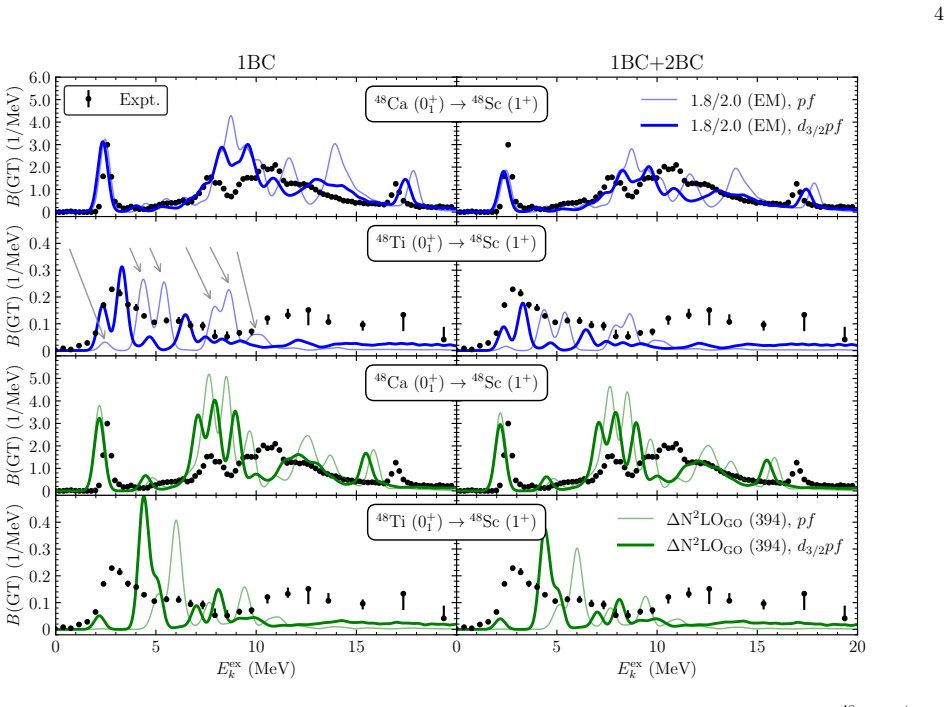
Summary. The manuscript reports valence-space IMSRG(2) calculations of the 2νββ nuclear matrix element of 48Ca and the related Gamow-Teller strength distributions in 48Sc, starting from two chiral NN+3N interactions (1.8/2.0 EM and ΔN2LOGO(394)) and including leading N2LO two-body currents. In the conventional pf valence space the 2νββ NME is substantially smaller than the experimental value; enlarging the space to d3/2 pf restores agreement with experiment for both interactions without phenomenological adjustments. The improvement is traced to a redistribution of GT strength that better matches charge-exchange data. The same enlarged space roughly doubles the 0νββ NME (long-range and long-range plus short-range contact) relative to the pf-shell result, with implications for ab initio assessments of heavier ββ candidates.
Significance. If the valence-space dependence survives further many-body truncations, the work supplies a concrete, experimentally anchored diagnostic (GT distributions and the 2νββ NME) that can be used to assess ab initio 0νββ matrix elements. The simultaneous use of two independent chiral interactions, consistent inclusion of leading two-body currents, direct comparison to charge-exchange GT strengths, and the robustness panel in Fig. 2 are genuine strengths. The factor-of-two increase in the 0νββ NME for the lightest ββ emitter is a falsifiable prediction that immediately motivates analogous multi-shell studies for 76Ge, 100Mo, 130Te and 136Xe.
major comments (2)
- [Implications for 0νββ decay / Fig. 4] Results for 0νββ decay / Fig. 4 and Table II: The central implication is that the d3/2 pf space roughly doubles M0ν relative to the pf shell. While emax and reference-nucleus variations are shown, the manuscript attributes the pf-shell underestimation of M2ν to missing correlations that VS-IMSRG(2) does not capture. A quantitative estimate (or at least a clearer discussion) of residual three-body operator effects on the factor-of-two increase in M0ν is needed before the result can be taken as a firm benchmark for heavier candidates; the authors themselves flag IMSRG(3) as future work, so the present claim should be more carefully caveated.
- [GT strengths and charge-exchange reactions / Fig. 3] GT strengths and charge-exchange reactions / Fig. 3: The improved agreement of the d3/2 pf GT distributions with the (p,n) and (n,p) data is used to justify the enlarged space. Both interactions still under-predict strength in the 10–12 MeV region for 48Ca→48Sc and above ~10 MeV for 48Ti→48Sc. Because the 2νββ running sum is dominated by lower-lying strength, this residual discrepancy does not spoil the M2ν agreement, but its possible impact on the short-range part of M0ν (and on the claimed correlation between the two NMEs) should be quantified or at least bounded.
minor comments (5)
- [Fig. 1] Fig. 1: The experimental gray band is essential; please state explicitly in the caption (or main text) which half-life compilation and which phase-space factor were used to extract the experimental M2ν, so that the comparison is fully reproducible.
- [Theoretical framework] Theoretical framework: The values β = 2 and Δ = 5 MeV for the multi-shell calculation are stated, and Fig. 2 shows limited sensitivity. A brief sentence on how these defaults were chosen (or a reference to the earlier multi-shell VS-IMSRG literature) would help non-specialist readers.
- [End Matter / Table I] Table I (End Matter): The absolute values |M2ν| are given; for the ΔN2LOGO pf-shell case the running sum becomes negative (Fig. 1). Please indicate the signed NME (or note the sign change) so that the table is consistent with the figure.
- Throughout: Notation for the two interactions (1.8/2.0 (EM) vs ΔN2LOGO (394)) is clear but occasionally switches between “1.8/2.0” and “1.8/2.0 (EM)”. Standardize for readability.
- [Introduction] Introduction / final paragraph: The call for multi-shell studies of heavier candidates is well taken; a short remark on the computational feasibility (or the expected valence-space truncations) for 76Ge or 136Xe would make the outlook more concrete.
Circularity Check
No significant circularity: 2νββ NME and GT strengths are parameter-free predictions compared to independent experiment; 0νββ uses external short-range matching.
full rationale
The derivation chain starts from two fixed χEFT NN+3N interactions (LECs set by scattering/few-body data, not by ββ observables) and leading 2BCs, evolved via VS-IMSRG(2) into either the pf or d3/2 pf valence space. The 2νββ NME of Eq. (1) is then obtained by direct summation over intermediate 1+ states with no free parameters adjusted to the experimental half-life; agreement appears only after the valence-space enlargement and is corroborated by independent GT strength distributions extracted from charge-exchange reactions. The 0νββ NME likewise uses the same Hamiltonian plus an external short-range contact taken from a non-overlapping matching calculation; no quantity is fitted to the target NMEs themselves. Self-citations are exclusively to methodological tools (VS-IMSRG codes, generator choices, c.m. removal) whose results are used as black-box machinery, not as the claimed prediction. Residual truncation risk (VS-IMSRG(2) and 4 ħω) is acknowledged by the authors but does not constitute circularity. The calculation is therefore self-contained against external benchmarks.
Axiom & Free-Parameter Ledger
free parameters (3)
- β (center-of-mass Hamiltonian coefficient) =
2 (default)
- Δ (IMSRG generator energy shift) =
5 MeV (default)
- short-range 0νββ contact coupling =
from Ref. [77]
axioms (4)
- domain assumption Chiral EFT NN+3N interactions (1.8/2.0 EM and ΔN2LOGO(394)) and leading N2LO two-body currents provide a systematically improvable description of nuclear structure and weak transitions.
- domain assumption VS-IMSRG truncated at the normal-ordered two-body level (VS-IMSRG(2)) captures the dominant correlations once the valence space is enlarged.
- ad hoc to paper A 4 ħω truncation in the multi-shell diagonalization is sufficient for the 2νβeta running sum.
- domain assumption Fermi contribution to the 2νβeta NME can be neglected for the ground-state-to-ground-state transition of 48Ca.
read the original abstract
We present ab initio calculations of two-neutrino double-beta ($2\nu\beta\beta$) decay of $^{48}$Ca and the related Gamow-Teller (GT) strength functions in $^{48}$Sc using the valence-space in-medium similarity renormalization group (VS-IMSRG) with nuclear interactions and electroweak currents based on chiral effective field theory. We find that the usual $pf$-shell valence space significantly underestimates the nuclear matrix element (NME) of $2\nu\beta\beta$ decay compared to experiment, while an enlarged $d_{3/2}pf$ valence space yields very good agreement with the experimental value without any adjustments. We trace this to an improved description of the involved GT strength distributions, so that the enlarged valence space captures important correlations. The enlarged $d_{3/2}pf$ valence space leads to neutrinoless $\beta\beta$ NMEs of $^{48}$Ca that are twice as large compared to the $pf$-shell calculation. Our findings suggest that studies with different valence spaces and related GT strengths are important for assessing ab initio NME calculations of heavier $\beta\beta$ decays.
Figures



discussion (0)
Sign in with ORCID, Apple, or X to comment. Anyone can read and Pith papers without signing in.