Computation and Language · arXiv:2607.12625 v2 · submitted 14 Jul 2026 · 14 references
KnowAct-GUIClaw: Know Deeply, Act Perfectly, Personal GUI Assistant with Self-Evolving Memory and Skill
The paper says
“OpenClaw has emerged as a leading agent framework for complex task automation, yet it faces insufficient cross-platform GUI interaction support and a well-built self-evolution mechanism.”
more of the abstract
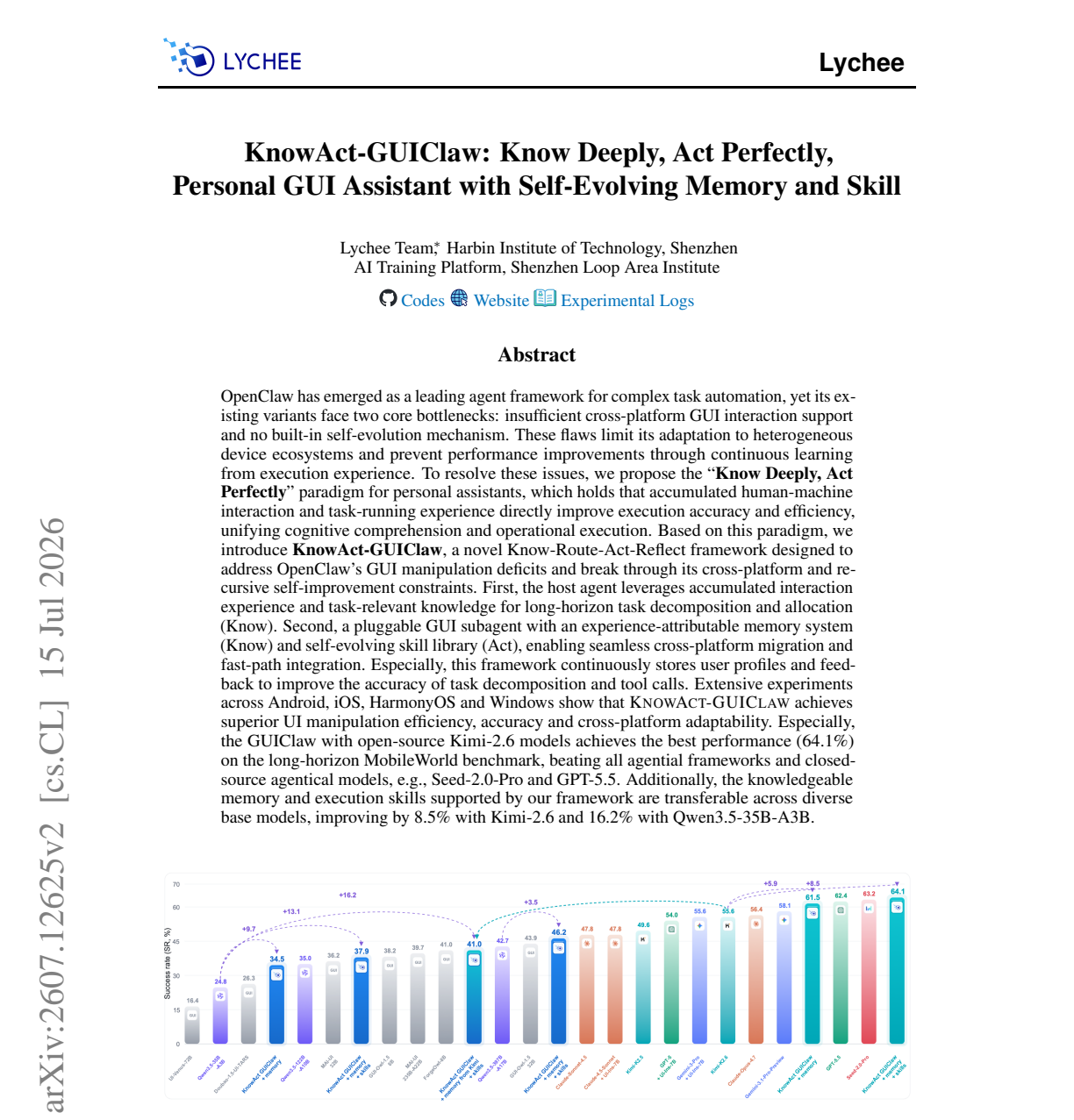
These flaws limit its adaptation to diverse device ecosystems and prevent performance improvements through continuous learning from execution experience. To resolve these issues, we propose the Know Deeply, Act Perfectly paradigm for personal assistants, which holds that accumulated user interaction and task-running experience directly improve execution accuracy and efficiency, unifying cognitive comprehension and operational execution. Based on this paradigm, we introduce KnowAct-GUIClaw, a novel Know-Route-Act-Reflect framework designed to address OpenClaw's GUI manipulation deficits and break through its cross-platform and recursive self-improvement constraints. First, the host agent leverages accumulated interaction experience and task-relevant knowledge for long-horizon task decomposition and allocation (Know). Second, a pluggable GUI subagent with an experience-attributable memory system (Know) and self-evolving skill library (Act), enabling seamless cross-platform migration and fast-path integration. Especially, this framework continuously stores user profiles and feedback to improve the accuracy of task decomposition and tool calls. Extensive experiments across Android, iOS, HarmonyOS and Windows show that KnowAct-GUIClaw achieves superior efficiency, accuracy and cross-platform adaptability. Especially, the GUIClaw with open-source Kimi-2.6 models achieves the best performance (64.1%) on the long-horizon MobileWorld benchmark, beating all agentical frameworks and closed-source agentical models, e.g., Seed-2.0-Pro and GPT-5.5. Additionally, the knowledgeable memory and execution skills supported by our framework are transferable across diverse base models, improving by 8.5% with Kimi-2.6.
from the abstract
Pith says
Machine review · deepseek-v4-flash · 2 Aug 2026 · what was read was not recorded · not checked by a person
It can be wrong. Challenge this review or reply to it.
Holds up, with conditions. Solid systems paper with a genuinely new host–executor integration; the self-evolution numbers are only as good as the undisclosed task provenance of the memory/skill store. This line is wrong
3 major objections · 5 minor
How often objections from reviews like this one are right: not yet measured
Not checked: figures, code, what the 14 references say.
The paper says, at §4.5, §5.1, Table 1
The review did not quote this passage.
Pith says: Objection 1 of 3 · major
The paper never states whether the trajectories used to distill the experience memory and skill library are disjoint from the 117 MobileWorld GUI-Only test tasks. §5.1 says only that the Kimi-to-Qwen transfer uses memory and skills 'distilled from trajectories generated by the Kimi-K2.6 host–executor configuration', and §4.5 describes reflection and offline extraction without specifying the task set.
more of objection 1
If the distillation trajectories were collected on the same 117 tasks, then the +8.5 (Kimi) and +16.2 (Qwen) gains measure test-set memorization rather than transferable self-evolution, and the paper's central contribution collapses. A precise statement of the exact task split, the number of development/held-out tasks used for distillation, and ideally an experiment with a clearly disjoint distillation set are required.
The paper says, at Table 1, §5.1
The review did not quote this passage.
Pith says: Objection 2 of 3 · major
The headline 64.1% pass@1 is a single run of a stochastic LLM agent, with no error bars, seeds, or repeat statistics. The margin over Seed-2.0-Pro is only 0.9 points, and Table 5 shows large gaps between 'any of 3' and 'all 3' pass@3 (e.g., 34.2 vs 15.4 for configuration A; 59.8 vs 32.5 for F), indicating substantial run-to-run variability.
more of objection 2
The authors should report mean ± std (or per-task variance) over at least three seeds for the main MobileWorld configurations, and state whether the reported numbers are the best, median, or representative run. Without this, the SOTA claim is not statistically supported.
The paper says, at §5.4, Table 4
The review did not quote this passage.
Pith says: Objection 3 of 3 · major
The AndroidDaily evaluation is described as 'conducted on iOS devices', which is confusing given the benchmark name and the GUI-only baselines compared in the same table. It is not clear whether AndroidDaily is in fact an iOS benchmark, or why an 'Android' benchmark is evaluated on iOS.
more of objection 3
Additionally, the GUI-only subset is scored by qwen3.5-flash as an LLM judge without reported human agreement or validation of judge reliability. Please clarify the benchmark/evaluation mismatch and provide evidence of judge reliability (e.g., agreement on a sample) or use deterministic evaluators where possible.
5 minor objections
The paper says, at Throughout
Pith says: minor objection 1 of 5
Model naming is inconsistent: the abstract says 'Kimi-2.6' while the rest of the paper uses 'Kimi-K2.6'; similarly, 'qwen3.5-flash' and 'Qwen3.5-flash' appear in different forms. Please unify.
The paper says, at §2.3
Pith says: minor objection 2 of 5
Typo: 'V oyager' should be 'Voyager'. Also, 'agential' is used in several places when 'agentic' would be the standard term.
show 3 more
The paper says, at §5.1
Pith says: minor objection 3 of 5
The sentence 'The AndroidDaily evaluation uses iOS devices' should appear earlier and be explained in the setup. As written, it seems contradictory to the benchmark name and the surrounding discussion of Android GUI agents.
The paper says, at §5.5, Figure 5
Pith says: minor objection 4 of 5
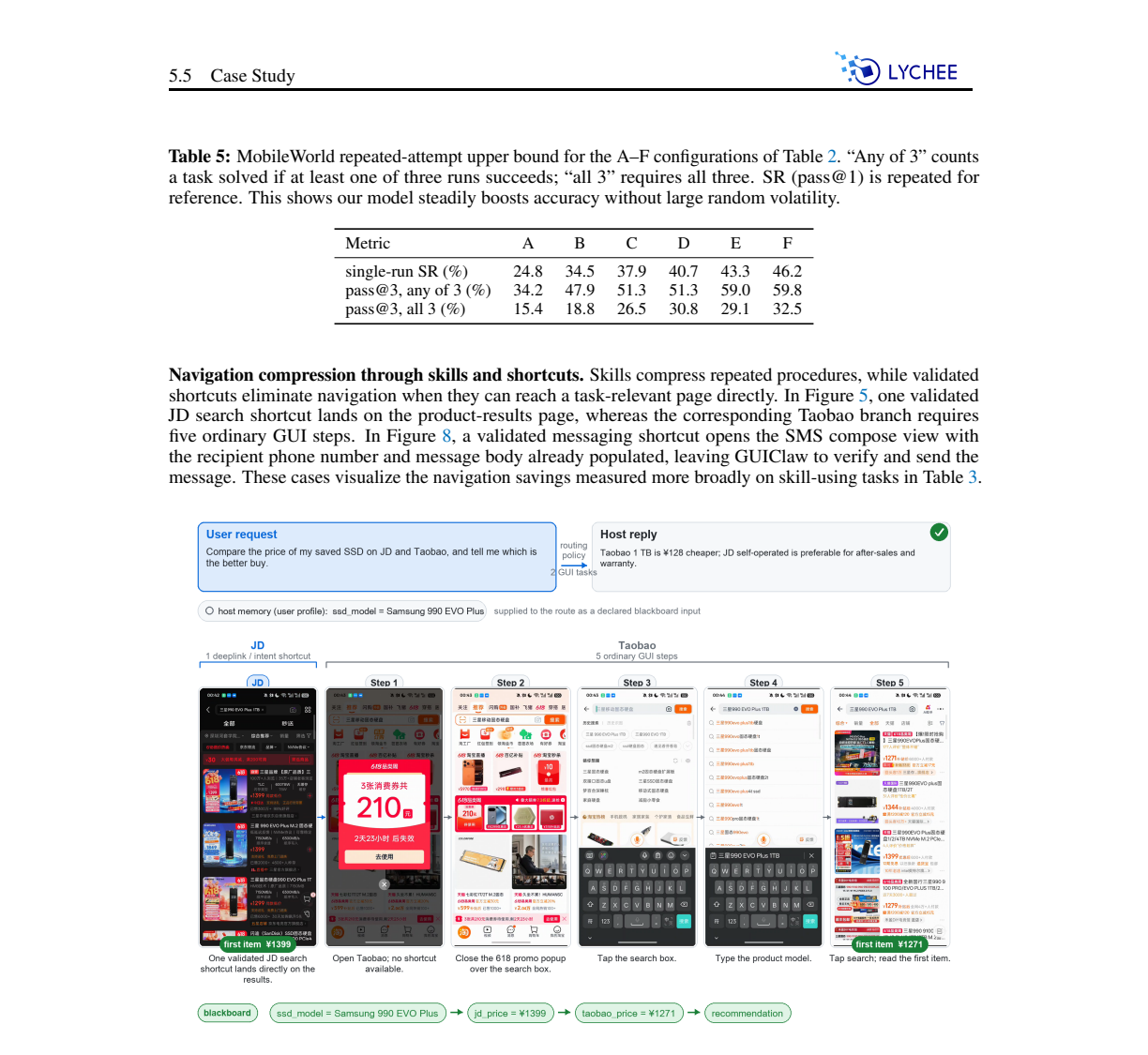
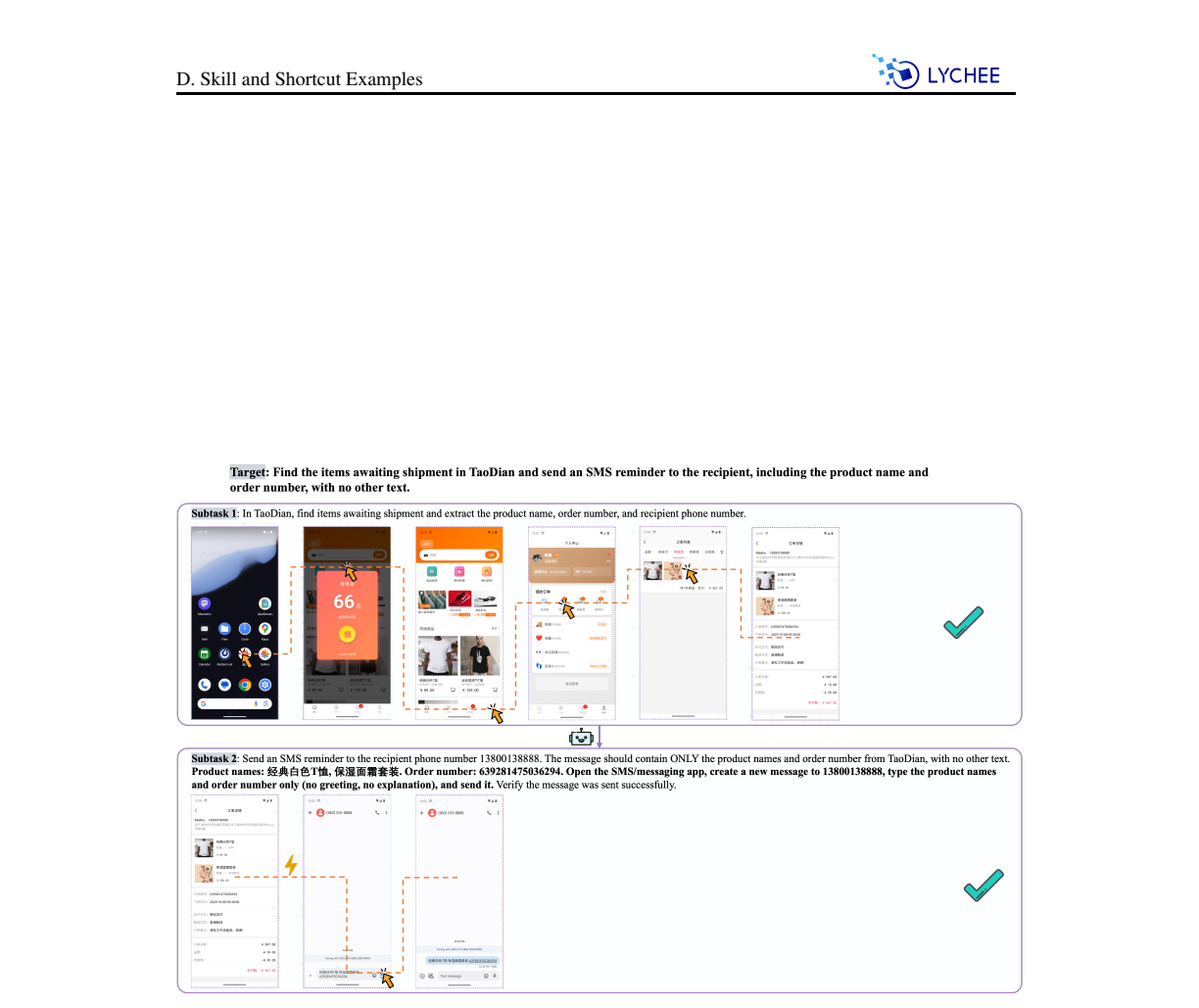
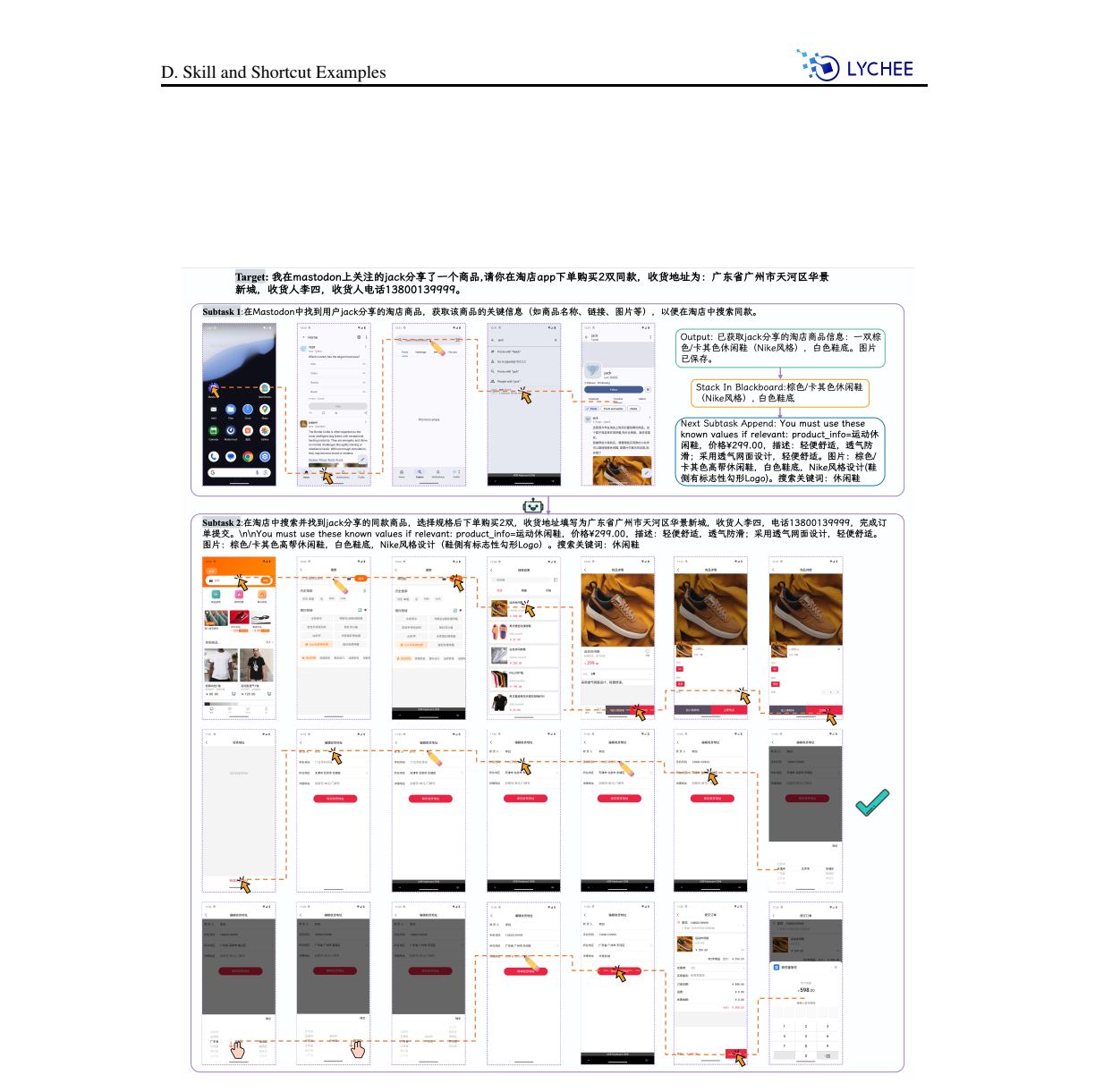
The JD shortcut entry in Appendix D uses an intent action SEND with a SearchBridgeActivity component; this is unusual and worth a sentence explaining why this is a valid search shortcut, since it may appear to be a spurious manifest constant to readers.
The paper says, at §5.7
Pith says: minor objection 5 of 5
The reproducibility section gives the URL for experimental logs; for completeness, the skill/memory store contents (or a schema/sample) should also be released or described in detail, so reviewers can check provenance directly.
What would settle it
Open the released experimental logs at the §5.7 GitHub link and extract the task IDs/instruction hashes of all trajectories used in the Reflect stage (the Kimi-K2.6 runs that produced the memory and skill store for the transfer row and the +host/memory/+skills rows). Compare these against the 117 MobileWorld GUI-Only evaluation tasks in Table 1. If any of the 117 appear in the distillation set, the self-evolution gains are contaminated. To further settle it, rebuild the store from a held-out set (e.g., the other 84 MobileWorld tasks or AndroidDaily) and re-run the Kimi +host/memory/skills and Kimi-to-Qwen transfer configurations; if the gains do not persist, the self-evolution claim fails.
from the skeptic's reading
How the review went
4 readings by deepseek-v4-flash · 2 Aug 2026
- Reader holds up, with conditions
- Skeptic agrees
- Editor wrote the verdict above
- Referee major revision: 3 major objections, 5 minor
Not run on this paper: the simulated authors' defence.
Pith did not check this review's objections against the paper.
The review in full
The review in brief, machine-written
X,
The one thing to know: this is a serious, well-built GUI-agent framework, and the integration is genuinely new — typed blackboard contracts between host and executor with fail-closed value passing, state-validated skill extraction, and a shared action surface across mobile and desktop. The ablations are internally consistent and the authors release logs. But the central self-evolution claim has an unstated provenance gap that you need to resolve before trusting the transfer numbers.
What they do well: the host/executor split with structured handoffs is a real architectural contribution — it's not just Reflexion+Voyager bolted together. The blackboard contract, where each subtask declares typed inputs/outputs and fails closed if a value is missing, is a clean solution to cross-app data loss. The skill library with per-step state contracts and validated deeplinks is thoughtfully designed. I also credit the cross-platform checks on HarmonyOS and Windows, including honest failure analysis.
The soft spots: first, the paper never states whether the trajectories used to distill the experience memory and skill store were collected on the same 117 MobileWorld GUI-Only tasks being evaluated. Section 5.1 says the transfer configuration uses 'trajectories generated by the Kimi-K2.6 host-executor configuration' and that all MobileWorld configs use the same 117-task subset, but it doesn't say the distillation tasks were disjoint from the test set. Section 4.5 describes extraction but no split. If the store came from those same 117 tasks, the +8.5/+16.2 gains are memorization, not learning. This is the load-bearing gap. Second, the headline 64.1 is a single pass@1 run; the 0.9-point margin over Seed-2.0-Pro is within noise for a stochastic agent. Third, the AndroidDaily section repeatedly says 'evaluation is conducted on iOS devices' — that looks like an error and makes me question the benchmark handling.
None of this kills the paper, but the first issue needs a clear answer. If the authors can show the stores were built from disjoint trajectories, this is a solid contribution worth serious attention. As it stands, I'd want that clarification before citing the self-evolution numbers.
Recommendation: send to peer review. The architecture and the reproducible logs outweigh the missing provenance statement; a referee can demand the split be made explicit.
The strongest objection
The central claim is that the self-evolution loop—experience memory plus validated skills—drives the improvements in Table 1 (Qwen 24.8→37.9, Kimi 55.6→64.1) and transfers across models (Qwen +16.2 with Kimi-derived stores). For that claim to be true, the stores must be constructed from trajectories that are disjoint from the 117 MobileWorld GUI-Only tasks being scored. The paper never says this. §5.1 states only that 'the Kimi-to-Qwen transfer configuration ... uses a joint set of experience memory and skills distilled from trajectories generated by the Kimi-K2.6 host–executor configuration' and that 'All MobileWorld configurations use the same 117-task GUI-Only subset.' §4.5 describes the Reflect stage and 'offline extraction' but does not identify the task set used for distillation. If the Kimi-K2.6 trajectories were collected on the same 117 tasks, then the memory/skill store contains per-task answers, and the +8.5/+16.2 gains are memorization. The reproducibility link (§5.7) provides logs but no explicit train/test split. This is the load-bearing gap: it is structural, not a numerical quibble, and it applies to the paper's headline contributions.
The reader's weakest assumption is exactly the most load-bearing concern: the paper never states whether the experience memory and skills were distilled from the same 117 MobileWorld GUI-Only tasks used for evaluation. I agree with this assessment. The framework description is coherent and the ablations are internally consistent, but the central claims of self-evolution and cross-model transfer depend on the stores being built from trajectories outside the test set. Without that separation, Table 1's improvements cannot be attributed to learning from experience; they could be due to retrieval of test-task-specific solutions. The other concerns noted by the reader (single-run pass@1 without error bars, the unexplained AndroidDaily/iOS statement) are secondary and do not by themselves undermine the main MobileWorld result as directly as this provenance gap does. My concrete check would compare task identities between the distillation logs and the evaluation set, or re-run with a held-out distillation set. If the check shows overlap, the verdict should move to REJECT; if it shows disjointness, the concern is resolved and the paper's self-evolution claims become credible. Until then, CONDITIONAL remains the appropriate verdict, so I do not change the reader's recommendation.
The referee's report
If the main claims hold, the paper would make a useful contribution: a clean host–executor decomposition, typed blackboard information transfer, and evidence that memory and skills can improve performance over a base executor at two model scales. The paper has real strengths: the MobileWorld evaluation uses a public benchmark with deterministic native evaluators; the ablations in Table 2 are consistent and isolate host/memory and skill effects at both executor scales; Table 3 measures the skill-reuse effect on skill-invoking tasks; Table 5 reports repeated-attempt pass@3 upper bounds; and the authors provide experimental logs and prompt contracts in the appendix. However, the central self-evolution and transfer claims rest on a provenance assumption that is never stated, and the headline pass@1 is a single run with no repeatability statistics. These issues must be addressed before the claims can be accepted.
Pith's reading of the paper (a machine's summary, not the authors')
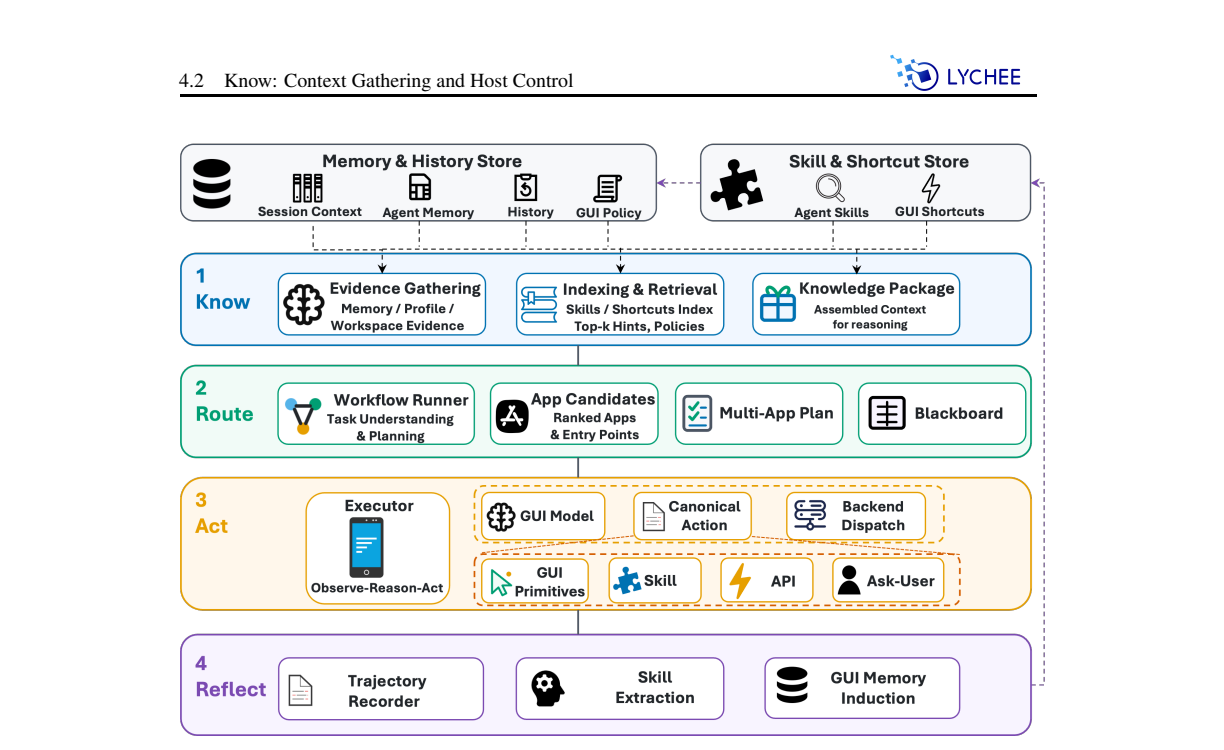
The paper argues that a personal GUI assistant improves most when past interaction experience is preserved in two reusable forms: textual lessons distilled from successes and failures, and executable skills whose steps are validated against live screen state. It packages this into a Know–Route–Act–Reflect loop in which a host agent decomposes long-horizon tasks, a separate GUI executor carries them out, and reflection turns each trajectory into memory and skills that feed future runs. On the 117-task MobileWorld GUI-Only benchmark, the design reaches a single-run success rate of 64.1 percent with an open-source Kimi model as host and executor, the highest in the comparison table. The same memory and skills, distilled from Kimi trajectories, transfer to a smaller Qwen executor and raise it from 24.8 to 41.0 percent, suggesting the learned knowledge is not tied to the model that generated it. The authors' central claim is that this two-tier architecture with state-validated skill reuse is what drives both the accuracy gain and the measured efficiency savings.
What carries the argument. The load-bearing mechanism is the pair of persistent stores and the single skill abstraction that feeds them. Experience memory stores textual policies distilled from trajectories (a few actionable lessons per run, deduplicated), while the skill library stores parameterized procedures—click-then-type patterns, multi-step navigation, and Android deeplink or intent shortcuts—in one skill format with fixed fields, placeholder parameters, reliability counters, and per-step state contracts, guards that check the expected screen elements before each step. Skills are advisory: the executor retrieves top candidates, applies one only if it matches, and otherwise falls back to ordinary actions; on fai
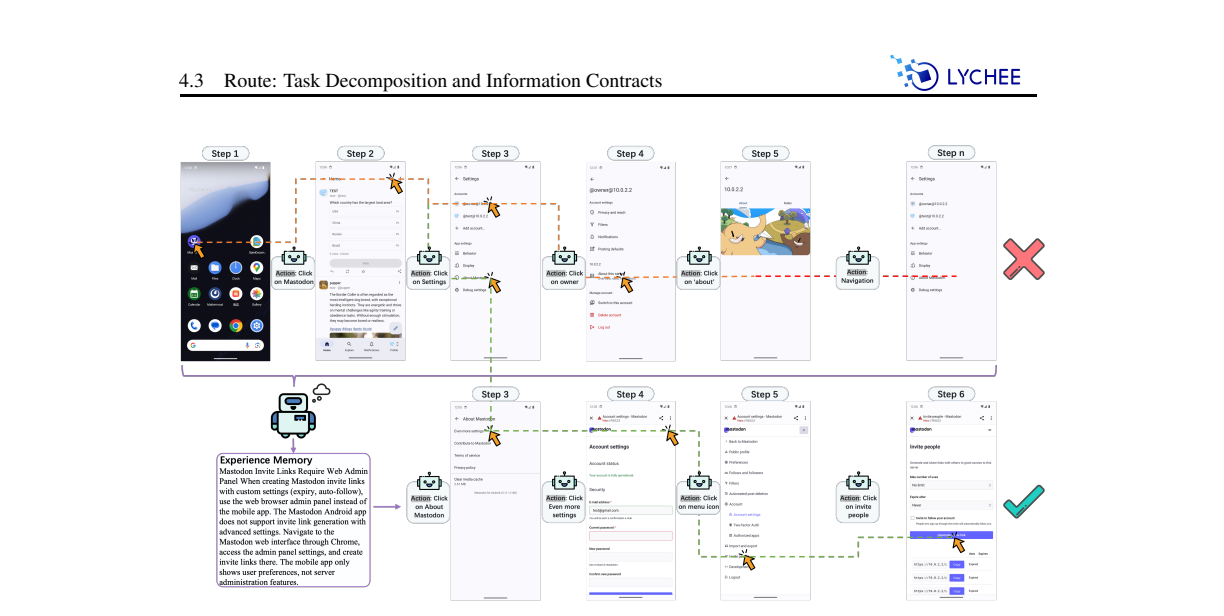
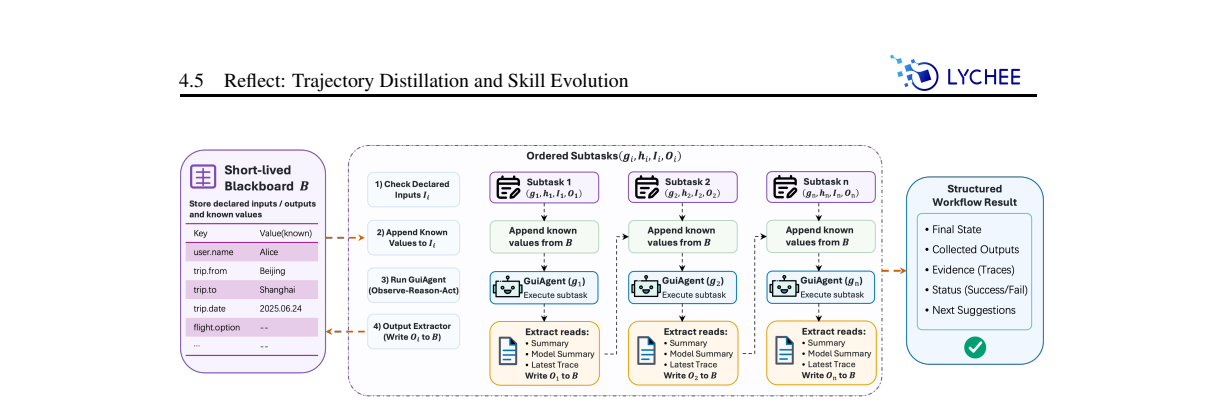
Core claim. The central claim is that separating long-horizon thinking from low-level screen control, and then closing the loop with experience memory and a self-evolving skill library, makes GUI assistants both more accurate and cheaper to run. The host handles task decomposition, user profile, tools, and cross-app data transfer through a typed blackboard where each subtask declares its inputs and outputs and fails closed if a value is missing. The GUI executor runs a grounded observe-reason-act loop over a hybrid action space of ordinary UI primitives, distilled skills, and validated deeplink and intent shortcuts. Reflection converts successful and failed trajectories into, respectively, parameterized
The premise it rests on. The paper never states whether the trajectories used to build the experience memory and skill library were collected on the same MobileWorld tasks used for evaluation; if they overlap, the reported gains measure memorization of the test set rather than transferable self-improvement.
If the paper is right (Pith's inferences, not the authors')
With the Kimi-K2.6 base, adding host and memory raises MobileWorld GUI-Only success from 55.6 to 61.5 percent; enabling skills raises it to 64.1, the highest single-run score in the comparison table.
The same memory and skills distilled from Kimi trajectories lift a smaller Qwen3.5-35B executor from 24.8 to 41.0 percent, a 16.2-point gain, showing the knowledge carries across model families.
Host and memory gains come without growing GUI-trace tokens (flat for the 35B executor), indicating the improvement is from task organization rather than a larger execution budget.
Skills cut about 3.3 GUI steps and roughly six percent of tokens on the tasks that use them, while raising success rate, because screenshot-heavy observations are replaced by validated action prefixes.
Partial or blocked tasks are summarized into resumable checkpoints, so a failed run contributes to future runs instead of being discarded.
If the transfer result is right, a practical recipe follows: distill memory and skills once with a strong model, then serve them to much smaller on-device executors, potentially making high-end GUI competence available without running a large model locally.
The paper reports static gains; an untested but natural extension is to measure a learning curve—whether the same store keeps improving with more runs on a fixed task distribution, and where it saturates.
Because the skill benefit is computed only on tasks that actually retrieve a skill, the framework's ceiling may depend on retrieval precision; measuring retrieval hit-rate separately from execution success would isolate skill extraction from skill selection.
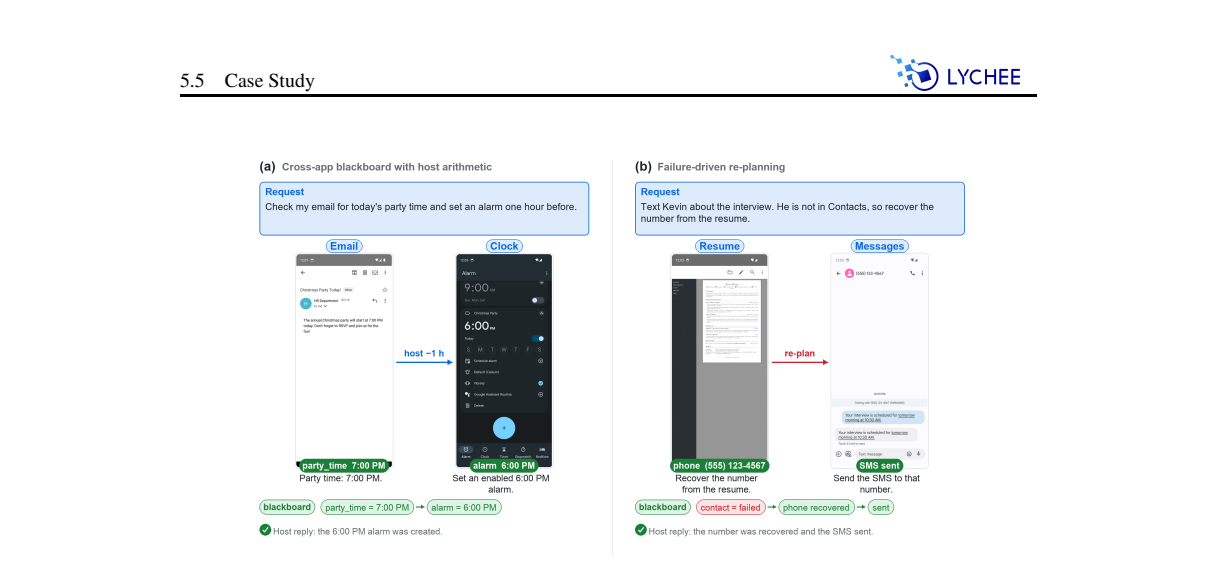
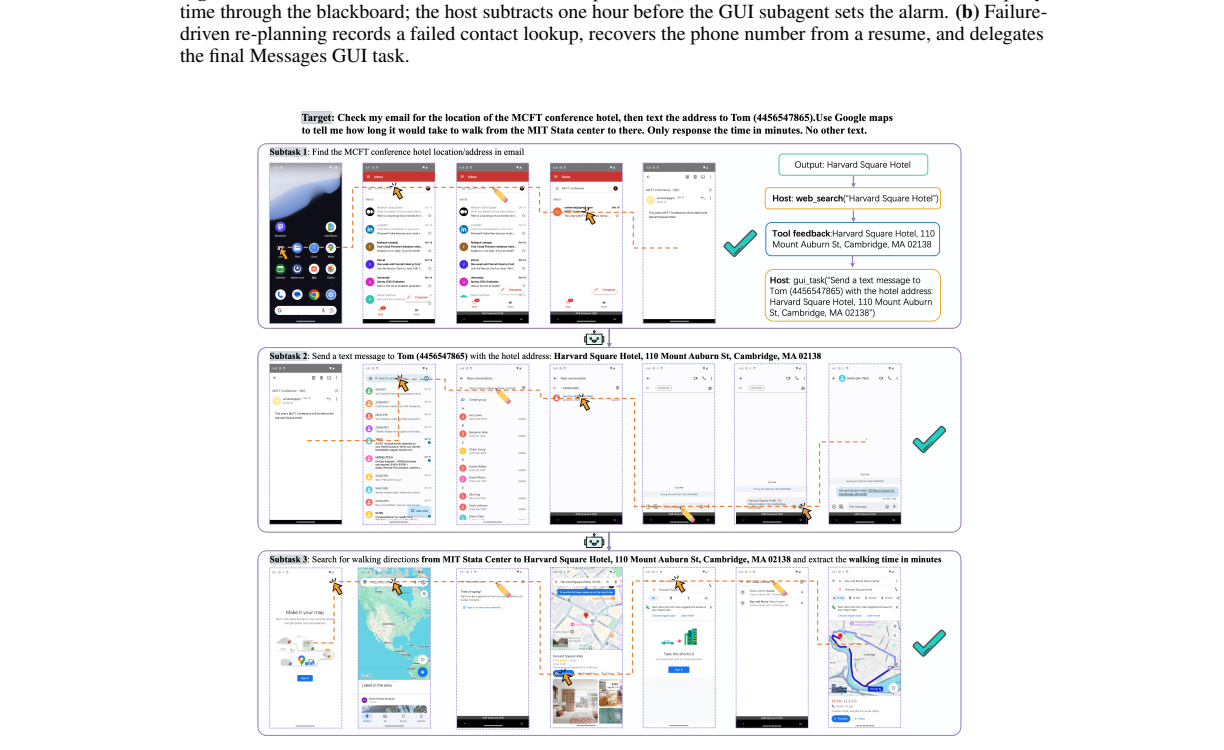
The typed blackboard contract is a generalizable idea: applying the same fail-closed input and output declarations to tool calls and desktop workflows, which the paper only sketches, could reduce fuzzy state loss beyond mobile GUI tasks.
Check this review
Pith stored no record of this review's passes and took no fingerprint of it. Reviews made by code from 13 Nov 2026 on carry both.
How often reviews like this one are right
Reviews like this one: written by deepseek-v4-flash, where what was read was not recorded.
How often objections from reviews like this one are right: not yet measured
Reviews by people
This review was written by a machine. No person has reviewed this paper on Pith yet. A scientist listed on Pith can review it for a fee, and their review is published here whatever it concludes.
How Pith checks papers · The full audit of this paper · Review history (2 versions)
The paper
Abstract
OpenClaw has emerged as a leading agent framework for complex task automation, yet it faces insufficient cross-platform GUI interaction support and a well-built self-evolution mechanism. These flaws limit its adaptation to diverse device ecosystems and prevent performance improvements through continuous learning from execution experience. To resolve these issues, we propose the Know Deeply, Act Perfectly paradigm for personal assistants, which holds that accumulated user interaction and task-running experience directly improve execution accuracy and efficiency, unifying cognitive comprehension and operational execution. Based on this paradigm, we introduce KnowAct-GUIClaw, a novel Know-Route-Act-Reflect framework designed to address OpenClaw's GUI manipulation deficits and break through its cross-platform and recursive self-improvement constraints. First, the host agent leverages accumulated interaction experience and task-relevant knowledge for long-horizon task decomposition and allocation (Know). Second, a pluggable GUI subagent with an experience-attributable memory system (Know) and self-evolving skill library (Act), enabling seamless cross-platform migration and fast-path integration. Especially, this framework continuously stores user profiles and feedback to improve the accuracy of task decomposition and tool calls. Extensive experiments across Android, iOS, HarmonyOS and Windows show that KnowAct-GUIClaw achieves superior efficiency, accuracy and cross-platform adaptability. Especially, the GUIClaw with open-source Kimi-2.6 models achieves the best performance (64.1%) on the long-horizon MobileWorld benchmark, beating all agentical frameworks and closed-source agentical models, e.g., Seed-2.0-Pro and GPT-5.5. Additionally, the knowledgeable memory and execution skills supported by our framework are transferable across diverse base models, improving by 8.5% with Kimi-2.6.
The paper's own sentences, arranged, kept beside the review and separate from it. Each label is drawn from a closed vocabulary; the number beside it is the probability the classifier gave that label. No sentence in this record was written by a model.
abstract compiled · 2026-09-23
The authors' main claim, as the classifier picked it out 0.95
“Extensive experiments across Android, iOS, HarmonyOS and Windows show that KnowAct-GUIClaw achieves superior efficiency, accuracy and cross-platform adaptability.”
How the main claim is stated: asserted 1.00
What the abstract itself states, as probabilities: claims first 0.11 · states limitation 0.10 · human participants 0.19 · controlled comparison 0.60 · randomized assignment 0.01 · states quantitative result 0.99 · compares with prior results 0.97 · mentions code or data availability 0.17
The abstract, sentence by sentence
This table labels the abstract only (arXiv listing abstract v2). The number is the probability the classifier gave the label.
| Sentence | Role | The authors' own work | States the main conclusion | Strength |
|---|---|---|---|---|
| OpenClaw has emerged as a leading agent framework for complex task automation, yet it faces insufficient cross-platform GUI interaction support and a well-built self-evolution mechanism. | background 0.64 | 0.08 | 0.03 | asserted 1.00 |
| These flaws limit its adaptation to diverse device ecosystems and prevent performance improvements through continuous learning from execution experience. | background 0.59 | 0.07 | 0.02 | asserted 1.00 |
| To resolve these issues, we propose the Know Deeply, Act Perfectly paradigm for personal assistants, which holds that accumulated user interaction and task-running experience directly improve execution accuracy and efficiency, unifying cognitive comprehension and operational execution. | contribution 0.74 | 0.17 | 0.17 | asserted 0.99 |
| Based on this paradigm, we introduce KnowAct-GUIClaw, a novel Know-Route-Act-Reflect framework designed to address OpenClaw's GUI manipulation deficits and break through its cross-platform and recursive self-improvement constraints. | contribution 0.98 | 0.80 | 0.10 | asserted 0.97 |
| First, the host agent leverages accumulated interaction experience and task-relevant knowledge for long-horizon task decomposition and allocation (Know). | method 0.98 | 0.50 | 0.04 | asserted 0.99 |
| Second, a pluggable GUI subagent with an experience-attributable memory system (Know) and self-evolving skill library (Act), enabling seamless cross-platform migration and fast-path integration. | method 0.92 | 0.72 | 0.05 | asserted 0.99 |
| Especially, this framework continuously stores user profiles and feedback to improve the accuracy of task decomposition and tool calls. | method 0.93 | 0.65 | 0.06 | asserted 1.00 |
| Extensive experiments across Android, iOS, HarmonyOS and Windows show that KnowAct-GUIClaw achieves superior efficiency, accuracy and cross-platform adaptability. | result 1.00 | 0.95 | 0.57 | asserted 1.00 |
| Especially, the GUIClaw with open-source Kimi-2.6 models achieves the best performance (64.1%) on the long-horizon MobileWorld benchmark, beating all agentical frameworks and closed-source agentical models, e.g., Seed-2.0-Pro and GPT-5.5. | result 1.00 | 0.94 | 0.36 | asserted 1.00 |
| Additionally, the knowledgeable memory and execution skills supported by our framework are transferable across diverse base models, improving by 8.5% with Kimi-2.6. | result 0.96 | 0.92 | 0.10 | asserted 1.00 |
What kind of paper the classifier reports this is: method or tool 1.00 · evidence from observation or experiment 1.00
What was examined, and what was not
Sources read
- arXiv listing abstract v2
Not examined
- full text
- figures and tables
- references and citing sentences
- relations to other papers
Levels run
- P abstract
Not run
- S sections
- T body sentences
- C citations
- R cross-paper relations
How the labels were made
Compiled by classifier-1.13.0 via TypeSafe API, question bank abstract-p1-20260923, 2026-09-23: 1 request, 7,853 input tokens.
Every quoted sentence on this record is the authors'. Every label is from Pith's closed vocabulary, with the probability shown beside it. This record as JSON
Figures (9)
Figures are the authors', reproduced from the paper.
References (14)
- [1] Communication Rule: - ALWAYS use ’answer’ action to reply to users - never assume on-screen text is sufficient - Please follow the user instruction strictly to answer the question, e.g., only return a single number, only return True/False, only return items separated by comma.... on Pith
- [2] Efficiency First: - Choose simplest path to complete tasks - If action fails twice, try alternatives (e.g., long_press instead of click) on Pith
- [3] Smart Navigation: - Gather information when needed (e.g., open Calendar to check schedule) - For scrolling: * Scroll direction is INVERSE to swipe (scroll down to see lower content) * If scroll fails, try opposite direction on Pith
- [4] Text Operations: - You MUST first click the input box to activate it before typing the text. - When a text field is visible, prefer ‘click_then_type‘ (one action) over separate ‘click‘+‘ input_text‘ to activate and type known text. - For text manipulation: on Pith
- [5] Long-press to select on Pith
- [6] Use selection bar options (Copy/Paste/Select All) on Pith
- [7] Delete by selecting then cutting on Pith
- [8] Ask User: - If you think you have no enough information to complete the task, you should use ‘ask_user‘ action to ask the user to get more information. # Decision Process on Pith
- [9] Before a manual GUI action, check the compact skill list; if one clearly matches the requested app/workflow, choose ‘use_skill‘ (it may open the target app internally, so do not open it manually first). 0a. Use listed composite actions only when they exactly match the next loc... on Pith
- [10] Analyze goal, history, and current screen on Pith
- [11] Determine if task is already complete (use ‘status‘ if true) on Pith
- [12] If not, choose the most appropriate action to complete the task on Pith
- [13] Output in exact format below, and ensure the Action is a valid JSON string: on Pith
- [14] The action output format is different for GUI actions and MCP tool actions. Note only one tool call is allowed in one action. # Optional Compact GUI Skills Optionally pick ONE listed compact skill as a single action when it clearly matches the task. If none clearly matches, ke... on Pith
Cited by 1 Pith paper
Reviewed papers on Pith that cite this one. The full citation record
How the literature uses it
What this paper does with the arXiv papers it cites
What it cites · 29 sentences without a confident label
Uses data or values from 1 paper
-
AndroidDaily [ref] is a complementary end-to-end benchmark that groups tasks by type, complexity, and ambiguity; many of its tasks require returning an explicit answer rather than only manipulating the UI.
2512.15431 · Benchmarks and Metrics · 0.91
Cites as support 3 papers
-
Recent mobile-agent systems and benchmarks point to three requirements: hybrid GUI–shortcut action spaces improve efficiency when shortcuts are available [ref] ; perception, memory, and action work as one execution stack [ref] ; and a GUI-agent framework should learn from the execution trajectories [ref] . organizes new long-horizon task execution as a four-stage loop: Know, Route, Act, and Reflect.
MAS-Bench: A Unified Benchmark for Shortcut-Augmented Hybrid Mobile GUI Agents · Overview: A Know–Route–Act–Reflect Stack · 0.97
-
Recent mobile-agent systems and benchmarks point to three requirements: hybrid GUI–shortcut action spaces improve efficiency when shortcuts are available [ref] ; perception, memory, and action work as one execution stack [ref] ; and a GUI-agent framework should learn from the execution trajectories [ref] . organizes new long-horizon task execution as a four-stage loop: Know, Route, Act, and Reflect.
ClawGUI: A Unified Framework for Training, Evaluating, and Deploying GUI Agents · Overview: A Know–Route–Act–Reflect Stack · 0.97
-
Recent mobile-agent systems and benchmarks point to three requirements: hybrid GUI–shortcut action spaces improve efficiency when shortcuts are available [ref] ; perception, memory, and action work as one execution stack [ref] ; and a GUI-agent framework should learn from the execution trajectories [ref] . organizes new long-horizon task execution as a four-stage loop: Know, Route, Act, and Reflect.
X-OmniClaw Technical Report: A Unified Mobile Agent for Multimodal Understanding and Interaction · Overview: A Know–Route–Act–Reflect Stack · 0.97
Cites as background 12 papers
-
On the web, Mind2Web and WebArena expose long-horizon navigation across realistic sites through HTML and accessibility-tree observations [ref] , while VisualWebArena adds visually grounded decision making over rendered pages [ref] , and SeeAct and WebVoyager explore screenshot- and page-structure-based control [ref] .
VisualWebArena: Evaluating Multimodal Agents on Realistic Visual Web Tasks · GUI Agents · 0.83
-
On the web, Mind2Web and WebArena expose long-horizon navigation across realistic sites through HTML and accessibility-tree observations [ref] , while VisualWebArena adds visually grounded decision making over rendered pages [ref] , and SeeAct and WebVoyager explore screenshot- and page-structure-based control [ref] .
WebVoyager: Building an End-to-End Web Agent with Large Multimodal Models · GUI Agents · 0.83
-
On the web, Mind2Web and WebArena expose long-horizon navigation across realistic sites through HTML and accessibility-tree observations [ref] , while VisualWebArena adds visually grounded decision making over rendered pages [ref] , and SeeAct and WebVoyager explore screenshot- and page-structure-based control [ref] .
WebArena: A Realistic Web Environment for Building Autonomous Agents · GUI Agents · 0.83
Challenges and discussion
Disagree with the review, or know something it missed? Leave a comment, or challenge this review formally: a challenge becomes a permanent entry in this paper's record, and its decision is published here.
Come back by email
A short list of the week's newly reviewed papers. Nothing is sent until you confirm from your inbox, and every email has a link that stops it. No account.
No comments yet.
Sign in to comment