Artificial Intelligence · arXiv:2609.30887 v1 · submitted 25 Sep 2026 · 87 references
From Tapping to Hopping: Augmenting Mobile GUI Agents with App-Native Deeplinks
The paper says
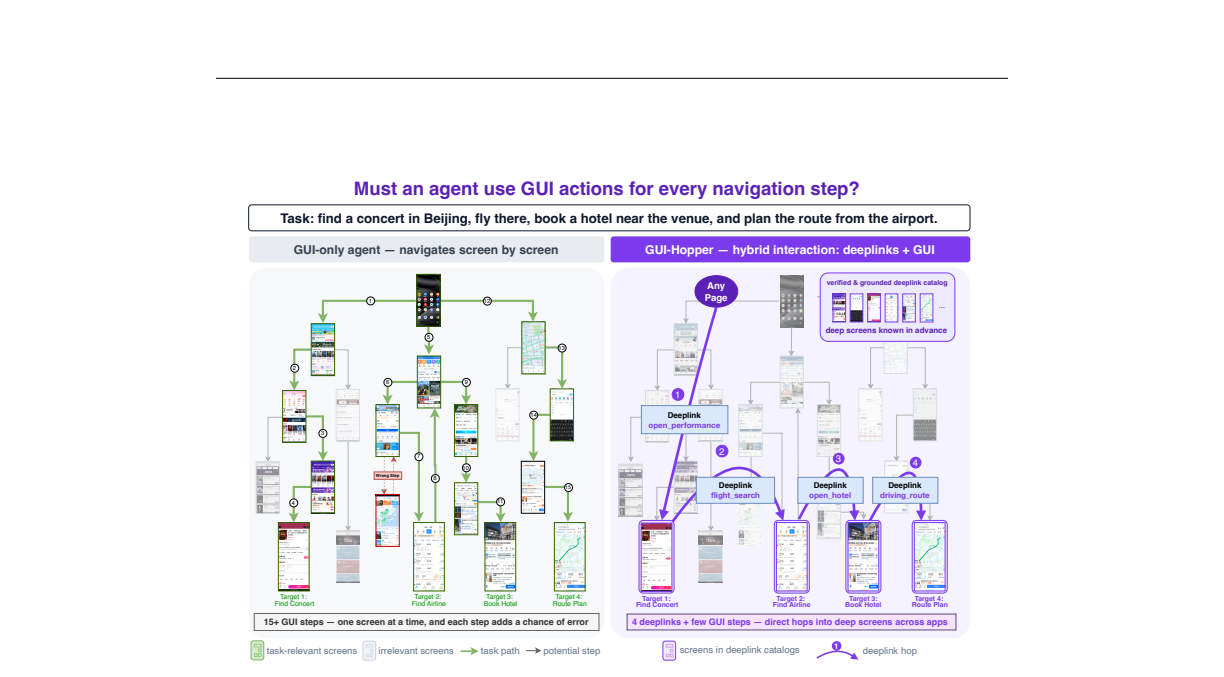
“Mobile GUI agents complete tasks using GUI actions like taps and swipes. These actions are broadly applicable across applications, but reaching a navigation interface. A single deeplink call can replace a sequence of screen-by-screen GUI actions.”
more of the abstract
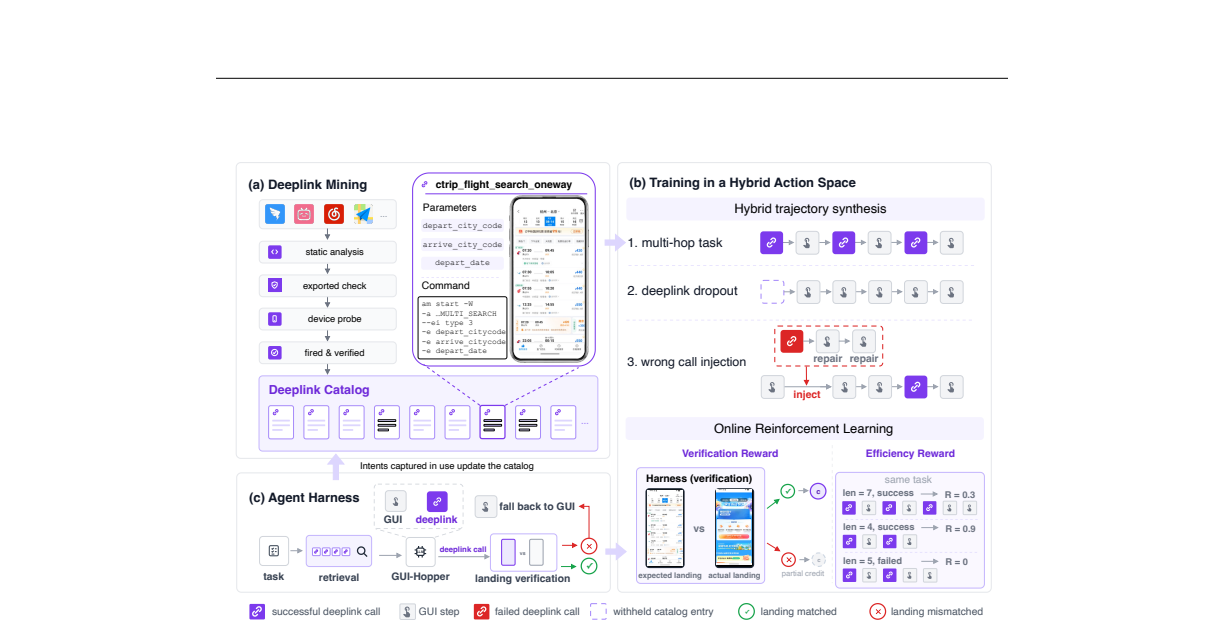
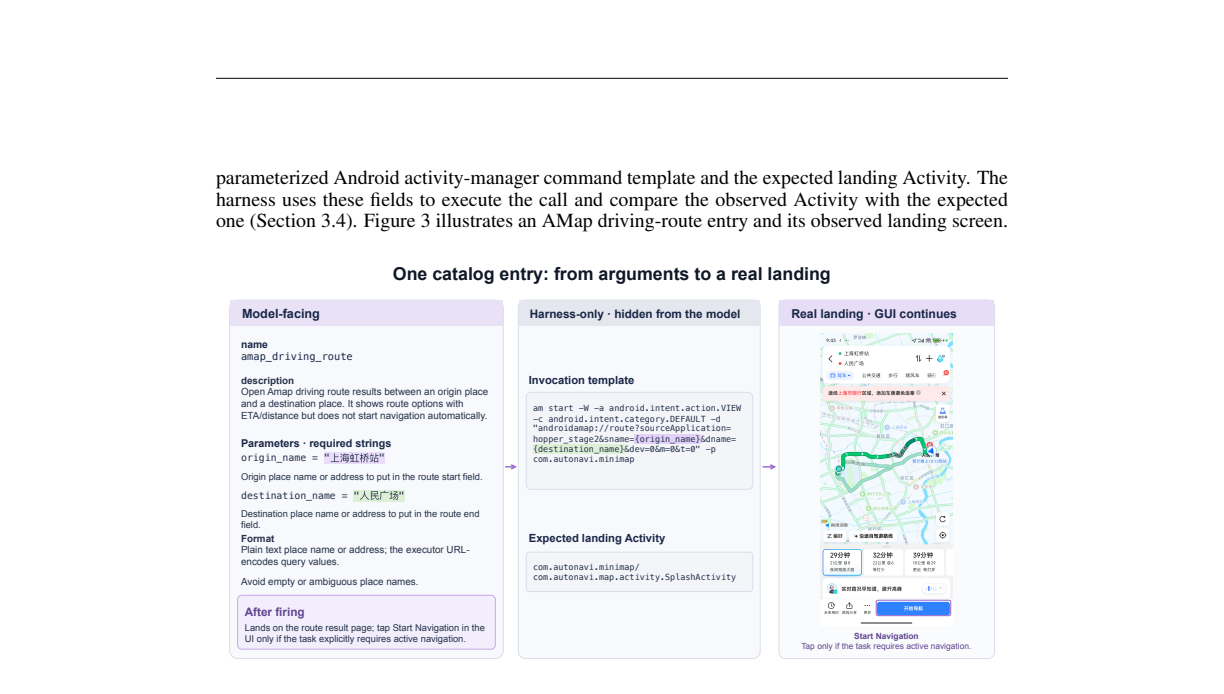
We therefore introduce hybrid interaction, using deeplinks for direct navigation and GUI actions for other on-screen operations and fallback. To enable this, we discover candidate deeplinks through static analysis, validate them on real devices, and describe their observed landing screens. This process creates a verified and grounded deeplink catalog that pairs each working deeplink with a description of its landing screen. Using this catalog, we introduce GUI-Hopper, a improves task success in commercial applications on real devices, further demonstrating the benefits of hybrid interaction.
from the abstract
Pith says
Machine review · deepseek-v4-flash · 28 Sep 2026 · what was read was not recorded · not checked by a person
It can be wrong. Challenge this review or reply to it.
Holds up, with conditions. The controlled with-deeplink result is solid and worth refereeing; the no-deeplink generalization claim, the Activity-match verification, and the 'paradigm shift' framing all need trimming, and Figure 7 is the paper's own best counterexample. This line is wrong
3 major objections · 6 minor
How often objections from reviews like this one are right: not yet measured
Not checked: figures, code, what the 87 references say.
The paper says, at Section 3.1, Eq. (1), Section 3.4, Figure 7
The review did not quote this passage.
A classifier read this sentence of the paper as acknowledging the concern (probability 0.83):
“Reaching the expected screen therefore does not establish that the supplied parameters satisfy the task: the model must also check the screen’s task-relevant contents.”
Pith says: Objection 1 of 3 · major
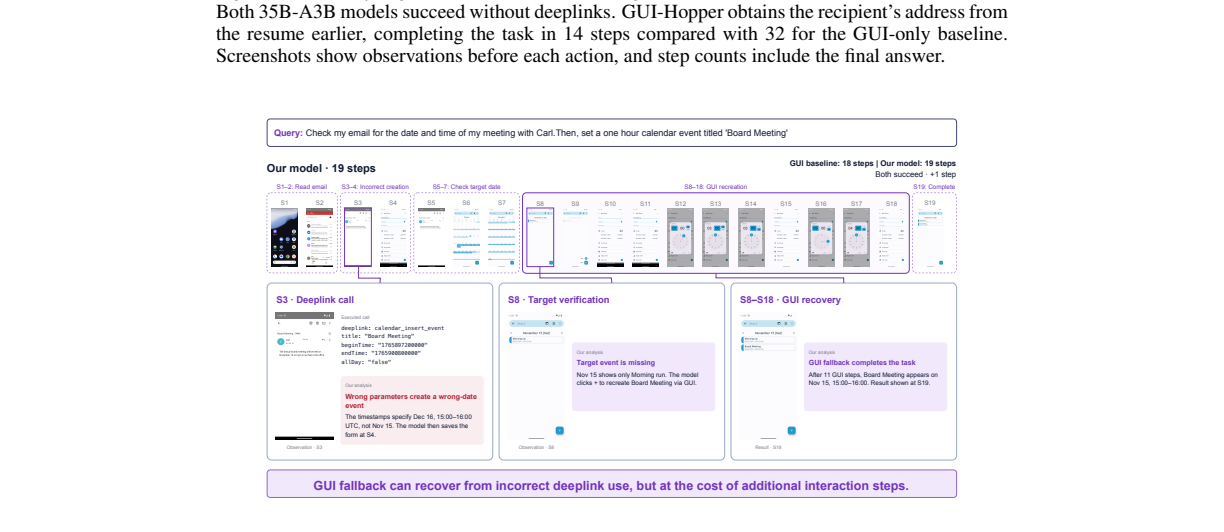
Landing verification at Activity granularity is the load-bearing premise of both the training signal and the inference-time check, and the paper's own Figure 7 contradicts it. The reward c(tau) in Eq. (1) grants full credit when a task-relevant deeplink is invoked and reaches its expected landing, and the harness feedback f_t (Sections 3.1 and 3.4) reports success when the observed Activity matches the catalog's expected Activity.
more of objection 1
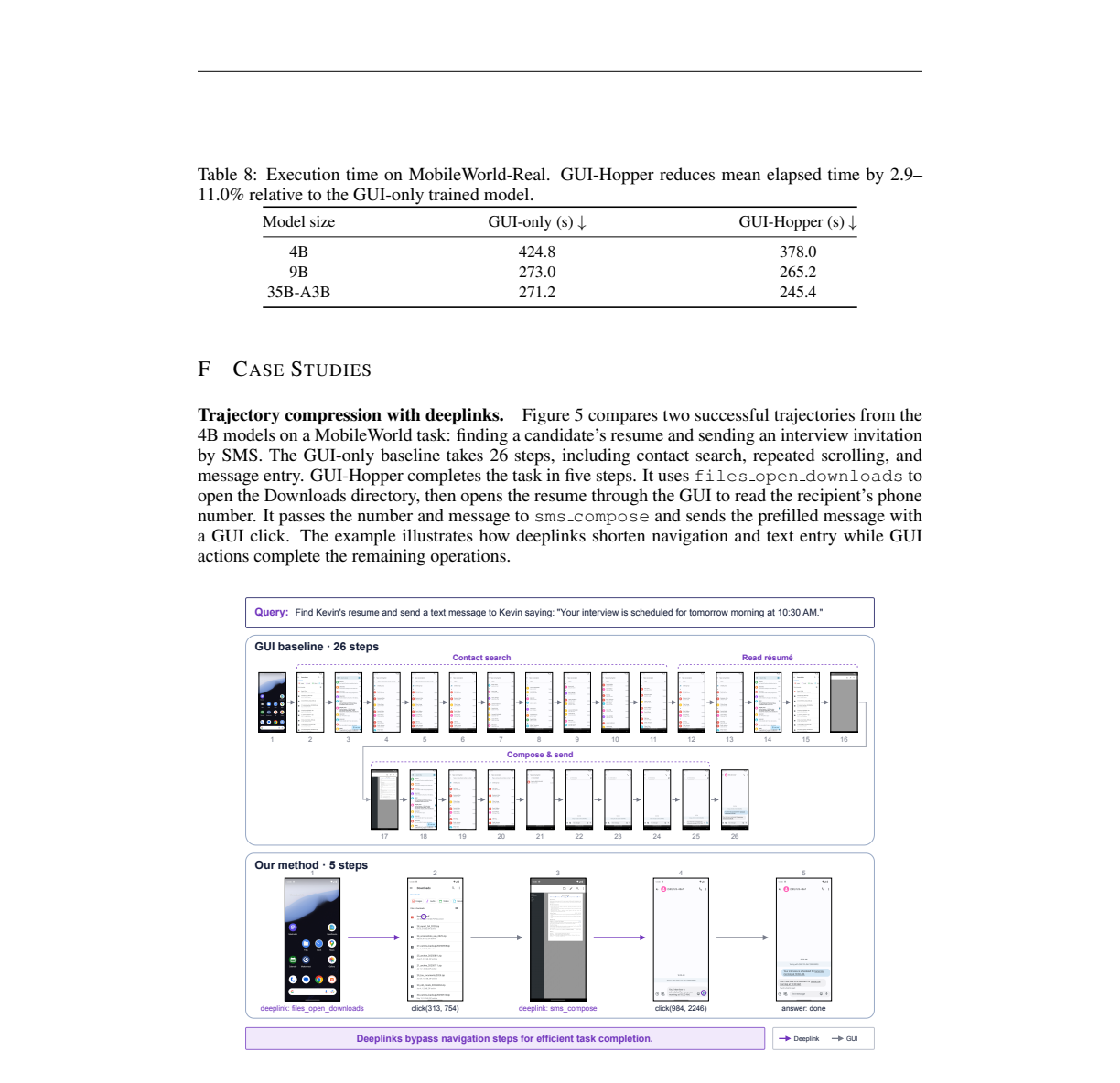
Figure 7 shows a calendar_insert_event call carrying December 16 timestamps for a November 15 task passing this check because it reaches the expected Calendar Activity; the wrong event is saved, its removal is not shown (b514), and the paper concedes at b520 that reaching the expected screen does not establish that the supplied parameters satisfy the task. Because s(tau) gates the reward, a wrong prefill corrected by GUI fallback can still yield a successful trajectory whose deeplink call c(tau) fully credits, so the RL objective can reinforce incorrect parameter calls and reported 'success' can include trajectories containing unremoved artifacts. Acknowledging the failure in prose (b520) does not fix the reward or the harness. I request: (a) a measurement over the evaluation trajectories of how often a deeplink passes Activity verification while supplying wrong parameters, given that Figure 7 shows the rate is nonzero; (b) a statement of how many reported successful hybrid trajectories contain such artifacts; and (c) either content-level verification in f_t and c(tau), or a concrete argument for why the demonstrated counterexample cannot affect the reported gains.
This review says the paper's mathematics is wrong. Pith did not check that against the paper's source.
The paper says, at Section 3.3, Eq. (1), Sections 4.2 and 5
The review did not quote this passage.
Pith says: Objection 2 of 3 · major
Part of the efficiency gain is solicited by construction rather than emergent. Training trajectories are synthesized from tasks constructed around the mined catalog (Section 3.3), so the deeplinks are near-optimally matched to the MobileWorld task distribution, and Eq. (1) explicitly pays alpha*c(tau) for deeplink invocation and beta*e(tau) for short trajectories; a successful hybrid trajectory's step reduction relative to GUI-only therefore reflects the reward design as well as the navigation shortcut.
more of objection 2
The controlled comparison still establishes that deeplink availability causes the difference, so the with-deeplink result should be framed as an engineered objective. The weaker claim is the 'gains persist without deeplinks' result (b169) that supports the 'enhanced task-planning capabilities' and 'paradigm shift' conclusions (b41, Section 5): Table 1 shows 52.7 to 53.0 at 4B (a 0.3-point difference, plausibly within noise), 54.4 to 56.7 at 9B, and 57.8 to 61.8 at 35B, with Figure 6 as a single illustrative case. I request that the planning-generalization claim be tempered or supported by a systematic analysis (for example, per-task paired differences under GUI-only evaluation), and that the scale dependence of the effect be discussed explicitly.
The paper says, at Section 4.1, Tables 1-3
The review did not quote this passage.
Pith says: Objection 3 of 3 · major
The primary quantitative claims are point estimates without uncertainty quantification. Each MobileWorld task is executed three times per setting (Section 4.1), yet no variance, confidence interval, or significance test is reported anywhere in Tables 1-3, 6-8, or the text. Several headline gaps are small: 60.1 vs 52.7 at 4B on MobileWorld, and especially the without-deeplink rows where the 4B comparison is 53.0 vs 52.7.
more of objection 3
Because the two trained variants use paired trajectories from the same tasks, a paired test or bootstrap over tasks is cheap and would materially strengthen the claims. I request standard errors or per-task paired differences for the main comparisons in Tables 1 and 2, and a statement of how many tasks change outcome between the variants.
6 minor objections
The paper says, at Abstract
Pith says: minor objection 1 of 6
The abstract contains broken sentences ('we introduce GUI-Hopper, a improves task success in commercial applications' and 'but reaching a navigation interface.'); it appears truncated or corrupted and should be rewritten before resubmission.
This objection may describe the copy Pith gave the reviewer, not the paper.
The paper says, at Figure 2 (b)
Pith says: minor objection 2 of 6
Figure 2 labels successful trajectories with R=0.3 (len=7) and R=0.9 (len=4), but Eq. (1) with s(tau)=1 gives R(tau)>=1 for any successful trajectory regardless of alpha, beta, and S_ref, and the stated hyperparameters alpha=0.15, beta=0.10, S_ref=25 do not reproduce these values. Please recompute the example reward values or label them as illustrative with the equations that do produce them.
show 4 more
The paper says, at Table 1 vs Table 3
Pith says: minor objection 3 of 6
The relationship between Table 1 and the training-stage ablation is unclear. Table 3 reports hybrid SFT at 57.8% and online RL at 60.1% at 4B with deeplink supply, while Table 1's 4B hybrid row evaluates to 53.0 (without deeplinks) and 60.1 (with deeplinks).
more of objection 3
This is consistent if the without-deeplink rows use SFT checkpoints and the with-deeplink rows use RL checkpoints, but the paper never states this; please clarify which checkpoint and evaluation supply each row uses, and whether sentence b169 refers to the SFT checkpoint.
The paper says, at Appendix D, Table 4
Pith says: minor objection 4 of 6
The dependence of the system on retrieval (COMP@10 of 98.3%, Appendix D) is stated and its robustness to candidate-set expansion is well demonstrated in Table 4. I would add a short discussion of behavior when the relevant deeplink is absent from the catalog entirely, or when retrieval excludes it, since the NA row of Table 4 is the only such condition and it is a positive one (56.7% at 9B).
The paper says, at Section 4.2, Tables 1-2
Pith says: minor objection 5 of 6
An oracle-deeplink condition (correct deeplink and parameters supplied externally) would help contextualize how much of the hybrid gain comes from catalog and retrieval quality versus policy selection; consider adding such a bound.
The paper says, at Reproducibility Statement
Pith says: minor objection 6 of 6
The reproducibility statement should state whether the synthesized hybrid training trajectories will be released, since these data determine the deeplink-selection and fallback behaviors that the paper attributes to planning in Section 5.
What would settle it
Take a random sample of at least 50 successful MobileWorld trajectories where GUI-Hopper invoked a parameterized deeplink (calendar, clock, compose, contacts) and run a content-level oracle: does the final saved or created object use exactly the values required by the task, and are no extraneous objects created? Recompute Table 1 success and c(tau), treating Activity match as necessary but not sufficient and awarding partial credit unless the content also matches. If the GUI-Hopper minus GUI-only success gap shrinks by more than about 2 percentage points at any model scale, or if any scale flips direction, the headline gains depend on Activity-only verification rather than robust task completion. The same oracle should be applied to MobileWorld-Real final screens before teardown.
from the skeptic's reading
How the review went
4 readings by deepseek-v4-flash · 28 Sep 2026
- Reader holds up, with conditions
- Skeptic agrees
- Editor wrote the verdict above
- Referee major revision: 3 major objections, 6 minor
Not run on this paper: the simulated authors' defence.
Pith did not check this review's objections against the paper.
The review in full
The review in brief, machine-written
The central claim holds up; the peripheral ones fray. GUI-Hopper, a GUI agent trained to choose between verified app deeplinks and taps/swipes, beats a matched GUI-only twin by roughly 7-14 points in success and 15-21% fewer steps across three model scales on MobileWorld, with similar gains on real devices in MobileWorld-Real. The comparison is properly controlled: paired trajectories, identical training configs, differing only in deeplink availability. That part is solid and it is the real contribution.
What is new: the automatic pipeline that mines deeplinks, validates them on physical devices, grounds each in a landing-screen description, and trains the model to invoke or decline them. Prior work (MAS-Bench) handed agents manually curated shortcuts at inference. That tightening is genuine, and the 1,251-entry verified catalog is real work.
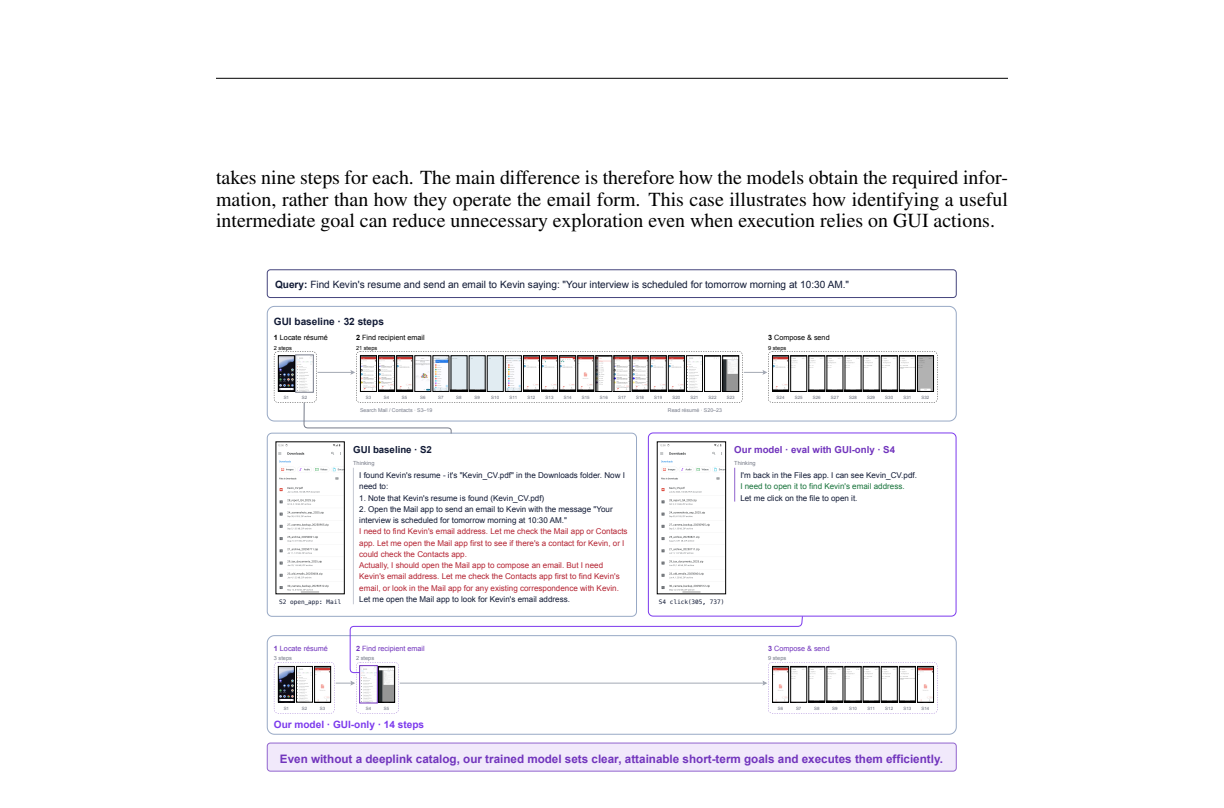
Where it softens. First, every task runs three times with no variance reporting. For the 0.3-2.3 pp persistence gaps that is not load-bearing evidence; three runs is thin even by this subfield's norms. Second, the "gains persist without deeplinks" narrative is weaker than advertised: Table 4 shows a strong general VLM (Qwen3.7-plus at 61.5%) beating the trained agent (56.7%) with no deeplinks, and the paper never squarely faces that. Third, and the one I would push in review: landing verification is Activity match, and the paper's own Figure 7 breaks that premise. calendar_insert_event reaches the expected Calendar Activity while prefilling a December date for a November task; b520 concedes reaching the expected screen does not establish the parameters are right. But the reward c(tau) in Eq. 1 and the harness feedback ft both treat Activity match as full credit, so the RL signal can reinforce wrong parameter calls and the inference check can pass while content is wrong. s(tau) gates task success and GUI fallback corrects some of this, as Figure 7 shows, but the mechanism is weaker than claimed. The authors acknowledge it; they do not fix it. A content-level check, or at minimum a mandated step re-reading the landing screen, belongs in the paper. Efficiency is also partly solicited by design: the reward explicitly credits deeplink invocation and shorter trajectories, and trajectories come from tasks built around the catalog. So the b41 "paradigm shift" language is out of proportion to a few-point gain. The abstract is also garbled in places ("a improves task success", "reaching a navigation interface").
Recommendation: send it to review. The controlled with-deeplink result is a real step forward for the subfield, and the conditions — significance reporting, a fair no-deeplink baseline, content-level verification — are all addressable in revision.
The strongest objection
The central with-deeplink result depends on the call-level signals used in training and inference: the reward c(tau) in Eq. (1) assigns full credit when a task-relevant deeplink reaches its expected landing, and the harness feedback f_t in Sections 3.1 and 3.4 reports success when the observed Activity matches the catalog's expected Activity. Figure 7 is the paper's own counterexample: calendar_insert_event is called with December 16 timestamps for a November 15 task; the call reaches the expected Calendar Activity, the model saves the wrong event, and the wrong event is not removed (b514). The paper acknowledges in b520 that reaching the expected screen does not establish that the supplied parameters satisfy the task, but neither the reward nor the harness is changed to check content. The final task-success number is gated by s(tau), so a wrong prefill can still be corrected by GUI fallback, but that means Activity-verified deeplink use is a weaker guarantee than claimed, the RL reward can reinforce wrong parameter calls, and reported success can include extraneous artifacts. This is the least secure assumption because it sits inside the training signal and the inference-time verification loop, not just in a benchmark metric.
The reader's weakest_assumption matches the concern I find most load-bearing: Activity match is used both as the RL reward signal and as inference-time feedback, and the paper itself supplies a concrete failure case. The no-deeplink persistence claim is also under-supported because it is evaluated only at the hybrid-SFT checkpoint, but it is secondary to the hybrid-interaction result, which is what the verification gap most directly threatens. The paper is transparent about the wrong-date case, so this is not a hidden flaw; what remains unresolved is that the formal reward and harness still encode Activity match as full correctness. The rest of the with-deeplink comparison is genuinely strong: matched GUI-only training, three model scales, and real-device deployment all support the main improvement. I do not see an error that would overturn the primary with-deeplink result outright, so the reader's CONDITIONAL verdict remains appropriate. The condition should be explicit: verify content-level task correctness, not only Activity arrival, and report how often Activity match coexists with wrong parameters. A content-level oracle on sampled trajectories would settle whether this concern actually changes the reported numbers.
The referee's report
If the with-deeplink results hold, the paper makes a practical and reproducible contribution: a complete mining-to-deployment pipeline for giving mobile agents a verified navigation shortcut, validated on physical devices. The strengths are genuine. The hybrid-vs-GUI-only comparison is controlled: paired trajectories, identical training configurations, differing only in deeplink availability (Section 4.1). Gains are consistent across three model scales and two benchmarks, and MobileWorld-Real provides a real-device check with commercial applications. The authors also deserve credit for disclosing their own failure case in Figure 7 (sentences b514 and b520) rather than suppressing it, and for committing to release models and the catalog. The defensible core is the with-deeplink improvement. The extrapolations that hybrid training improves planning without deeplinks (b41, b169, Section 5) rest on smaller, scale-dependent point differences and a single case study, and should be either supported or tempered.
Pith's reading of the paper (a machine's summary, not the authors')
The paper claims that mobile GUI agents do not have to navigate every screen by tapping through the interface. It introduces hybrid interaction: verified app deeplinks for direct navigation into deep screens, with ordinary tap-and-swipe actions kept for on-screen work and for recovery when a deeplink fails. The trained agent, GUI-Hopper, learns when to hop and when to tap. On MobileWorld and on real devices in MobileWorld-Real, its success rate exceeds a matched GUI-only agent's at every model scale tested, while its trajectories are shorter. The authors further claim the success-rate gain survives even when deeplinks are withheld at inference, which they attribute to task-decomposition habits learned during hybrid training.
What carries the argument. The load-bearing object is the verified and grounded deeplink catalog: raw candidate entry points from static analysis are executed on real devices, failures and duplicates discarded, and each retained entry paired with a natural-language landing-screen description plus the expected Activity on the harness side. Hybrid training teaches selection and recovery through negative augmentation—deeplink dropout and wrong-call injection—and online reinforcement learning with the reward $R(\tau) = s(\tau)\bigl(1 + \alpha c(\tau) + \beta e(\tau)\bigr)$, where $c(\tau)$ credits correct deeplink use and $e(\tau)$ rewards trajectories shorter than the reference length $S_{ref} = 25$. At inference, a harness retrieves at most ten task-relevant entries, invokes one, and verifies that the observed Activity matches the expected one, falling back to GUI actions on any mismatch.
Core claim. On the paper's own terms, the discovery is that a mobile agent trained in a hybrid action space—deeplink calls for high-level navigation plus GUI actions for fine-grained control and fallback—completes more tasks in fewer interaction steps than an otherwise identical GUI-only agent. This holds on MobileWorld across three model scales (4B, 9B, 35B-A3B) and on physical devices across 26 commercial applications in MobileWorld-Real. The authors also report that hybrid training does not sacrifice GUI ability: when evaluated with deeplinks removed, GUI-Hopper still outperforms the GUI-only agent, and online reinforcement learning after supervised fine-tuning pushes success from 57.8 percent to 60.1 percent while shortening trajectories.
The premise it rests on. The whole scheme rests on taking 'the call reached the app's expected screen' as proof that the deeplink was used correctly, and on the right deeplink appearing in the retrieved top ten, both of which the paper itself shows can fail.
If the paper is right (Pith's inferences, not the authors')
App-native deeplinks, mined and verified once, become a reusable high-level navigation channel that any trained agent can invoke without new per-app APIs.
Hybrid action training yields a policy that picks the right deeplink from a noisy candidate pool: success stays near the oracle-matched level whether entries are matched by ground truth, by top-10 retrieval, or from the full catalog.
The success-rate gain persists under GUI-only evaluation, meaning the approach improves planning behavior beyond directly using the shortcuts.
Multi-app tasks benefit most on trajectory length, with an 18.4 percent step reduction reported on cross-application tasks, suggesting the mechanism is strongest where navigation dominates.
The whole pipeline—mining, grounding, training, and inference harness—carries over from a simulated Android environment to commercial apps on physical devices.
The catalog-plus-verification harness should transfer beyond Android: developer-integrated equivalents such as Apple App Intents and Google App Actions could mount the same retrieve-verify-fallback machinery without the mining step, which is my extension, not the paper's claim.
The paper's own Figure 7 shows that Activity-level landing checks cannot catch parameter errors that land on the right screen with wrong values, so a production variant would need to check screen contents (for example, the pre-filled date) before treating a hop as a success.
Parameter capture during ordinary use suggests the catalog can grow with user-specific values such as order IDs and saved addresses without re-running the mining pipeline, pointing toward a self-enriching tool library over time.
Check this review
Pith stored no record of this review's passes and took no fingerprint of it. Reviews made by code from 13 Nov 2026 on carry both.
How often reviews like this one are right
Reviews like this one: written by deepseek-v4-flash, where what was read was not recorded.
How often objections from reviews like this one are right: not yet measured
Reviews by people
This review was written by a machine. No person has reviewed this paper on Pith yet. A scientist listed on Pith can review it for a fee, and their review is published here whatever it concludes.
The paper
Abstract
Mobile GUI agents complete tasks using GUI actions like taps and swipes. These actions are broadly applicable across applications, but reaching a navigation interface. A single deeplink call can replace a sequence of screen-by-screen GUI actions. We therefore introduce hybrid interaction, using deeplinks for direct navigation and GUI actions for other on-screen operations and fallback. To enable this, we discover candidate deeplinks through static analysis, validate them on real devices, and describe their observed landing screens. This process creates a verified and grounded deeplink catalog that pairs each working deeplink with a description of its landing screen. Using this catalog, we introduce GUI-Hopper, a improves task success in commercial applications on real devices, further demonstrating the benefits of hybrid interaction.
The paper's own sentences, arranged, kept beside the review and separate from it. Each label is drawn from a closed vocabulary; the number beside it is the probability the classifier gave that label. No sentence in this record was written by a model.
abstract compiled · 2026-09-28
The authors' main claim, as the classifier picked it out 0.99
“Using this catalog, we introduce GUI-Hopper, a improves task success in commercial applications on real devices, further demonstrating the benefits of hybrid interaction.”
How the main claim is stated: asserted 1.00
What the abstract itself states, as probabilities: claims first 0.06 · states limitation 0.15 · human participants 0.07 · controlled comparison 0.13 · randomized assignment 0.01 · states quantitative result 0.05 · compares with prior results 0.29 · mentions code or data availability 0.05
The abstract, sentence by sentence
This table labels the abstract only (arXiv listing abstract v1). The number is the probability the classifier gave the label.
| Sentence | Role | The authors' own work | States the main conclusion | Strength |
|---|---|---|---|---|
| Mobile GUI agents complete tasks using GUI actions like taps and swipes. | background 1.00 | 0.05 | 0.02 | asserted 1.00 |
| These actions are broadly applicable across applications, but reaching a navigation interface. | background 0.65 | 0.08 | 0.03 | asserted 0.62 |
| A single deeplink call can replace a sequence of screen-by-screen GUI actions. | background 0.90 | 0.14 | 0.15 | asserted 0.98 |
| We therefore introduce hybrid interaction, using deeplinks for direct navigation and GUI actions for other on-screen operations and fallback. | contribution 0.88 | 0.67 | 0.29 | asserted 0.97 |
| To enable this, we discover candidate deeplinks through static analysis, validate them on real devices, and describe their observed landing screens. | method 0.99 | 0.94 | 0.05 | asserted 0.98 |
| This process creates a verified and grounded deeplink catalog that pairs each working deeplink with a description of its landing screen. | method 0.46 | 0.91 | 0.09 | asserted 1.00 |
| Using this catalog, we introduce GUI-Hopper, a improves task success in commercial applications on real devices, further demonstrating the benefits of hybrid interaction. | result 0.72 | 0.90 | 0.64 | asserted 1.00 |
What kind of paper the classifier reports this is: method or tool 0.99 · evidence from observation or experiment 1.00
What was examined, and what was not
Sources read
- arXiv listing abstract v1
Not examined
- full text
- figures and tables
- references and citing sentences
- relations to other papers
Levels run
- P abstract
Not run
- S sections
- T body sentences
- C citations
- R cross-paper relations
How the labels were made
Compiled by classifier-1.13.0 via TypeSafe API, question bank abstract-p1-20260923, 2026-09-28: 1 request, 5,404 input tokens.
Every quoted sentence on this record is the authors'. Every label is from Pith's closed vocabulary, with the probability shown beside it. This record as JSON
Figures (7)
Figures are the authors', reproduced from the paper.
References (87)
- [3] Zhou, Hanzhang and Zhang, Xu and Tong, Panrong and Zhang, Jianan and Chen, Liangyu and Kong, Quyu and Cai, Chenglin and Liu, Chen and Wang, Yue and Zhou, Jingren and Hoi, Steven , journal =. 2025 , eprint = on Pith
- [4] Gao, Changlong and Gu, Zhangxuan and Liu, Yulin and Qiu, Xinyu and Shen, Shuheng and Wen, Yue and Xia, Tianyu and Xu, Zhenyu and Zeng, Zhengwen and Zhou, Beitong and Zhou, Xingran and Chen, Weizhi and Dai, Sunhao and Dou, Jingya and Gong, Yichen and Guo, Yuan and Guo, Zhenlin ... on Pith
- [8] AndroidWorld: A Dynamic Benchmarking Environment for Autonomous Agents , author=. 2024 , eprint= on Pith
- [9] Mobileworld: Benchmarking autonomous mobile agents in agent-user interactive and mcp-augmented environments , author=. Proceedings of the 64th Annual Meeting of the Association for Computational Linguistics (Volume 1: Long Papers) , pages= on Pith
- [11] Kaixin Li and Meng Ziyang and Hongzhan Lin and Ziyang Luo and Yuchen Tian and Jing Ma and Zhiyong Huang and Tat-Seng Chua , booktitle=. ScreenSpot-Pro:. 2025 , url= on Pith
- [14] Androidlab: Training and systematic benchmarking of android autonomous agents , author=. Proceedings of the 63rd Annual Meeting of the Association for Computational Linguistics (Volume 1: Long Papers) , pages= on Pith
- [16] Yao, Shunyu and Zhao, Jeffrey and Yu, Dian and Du, Nan and Shafran, Izhak and Narasimhan, Karthik and Cao, Yuan , booktitle= on Pith
- [17] Toolformer: Language Models Can Teach Themselves to Use Tools , author=. Advances in Neural Information Processing Systems (NeurIPS) , year= on Pith
- [18] Patil, Shishir G. and Zhang, Tianjun and Wang, Xin and Gonzalez, Joseph E. , booktitle=. Gorilla: Large Language Model Connected with Massive on Pith
- [19] Qin, Yujia and others , booktitle= on Pith
- [20] Feng, Jiazhan and others , journal= on Pith
- [21] Qian, Cheng and others , booktitle= on Pith
- [22] Zhang, Chi and others , journal= on Pith
- [23] Wang, Zhenhailong and others , journal= on Pith
- [24] Jiang, Wenjia and Zhuang, Yangyang and Song, Chenxi and Yang, Xu and Zhou, Joey Tianyi and Zhang, Chi , journal=. 2025 , url= on Pith
- [25] Hu, Xuhao and Zhang, Xi and Xu, Haiyang and Qiao, Kyle and Yang, Jingyi and Huang, Xuanjing and Shao, Jing and Yan, Ming and Ye, Jieping , journal=. 2026 , url= on Pith
- [26] Xie, Weikai and Zhang, Li and Wang, Shihe and Yi, Rongjie and Xu, Mengwei , booktitle= on Pith
- [27] Zhao, Pengxiang and others , booktitle=. 2026 , note= on Pith
- [29] Azim, Tanzirul and Riva, Oriana and Nath, Suman , booktitle= on Pith
- [30] Ma, Yun and Hu, Ziniu and Liu, Yunxin and Xie, Tao and Liu, Xuanzhe , booktitle=. Aladdin: Automating Release of Deep-Link on Pith
show 67 more
- [31] Hu, Han and Wang, Han and Dong, Ruiqi and Chen, Xiao and Chen, Chunyang , journal=. Enhancing. 2024 , url= on Pith
- [32] Liu, Fang and Wang, Chun and Pico, Andres and Yao, Danfeng and Wang, Gang , booktitle=. Measuring the Insecurity of Mobile Deep Links of on Pith
- [33] All Your App Links Are Belong to Us: Understanding the Threats of Instant Apps Based Attacks , author=. Proceedings of the ACM Joint Meeting on European Software Engineering Conference and Symposium on the Foundations of Software Engineering (ESEC/FSE) , year= on Pith
- [34] Wu, Liangxuan and others , journal=. From Assistants to Adversaries: Exploring the Security Risks of Mobile on Pith
- [35] App Intents , author= on Pith
- [36] App Actions Overview , author= on Pith
- [37] About Deep Links , author= on Pith
- [38] Deep Linking: The Ultimate Guide , author= on Pith
- [39] Zhou, Hanzhang and Tong, Panrong and Zhang, Xu and Kong, Quyu and Cai, Chenglin and Xia, Tianyu and Zhang, Gongjie and Zhang, Jianan and Li, Long and Chen, Long and Wang, Lei and Dai, Gaole and Li, Pengxiang and Chen, Liangyu and Wang, Yue and Hoi, Steven , journal=. 2026 , url= on Pith
- [40] 2026 , howpublished= on Pith
- [41] Introducing. 2026 , howpublished= on Pith
- [42] 2025 , howpublished= on Pith
- [43] Liu, Guangyi and Zhao, Pengxiang and Wu, Gao and Yin, Yiwen and Li, Mading and Liu, Liang and Liu, Congxiao and Qi, Zhang and Wang, Mengyan and Guo, Liang and Zhang, Jiangning and Liu, Yong , journal=. 2026 , url= on Pith
- [44] Liu, Xiao and Qin, Bo and Liang, Dongzhu and Dong, Guang and Lai, Hanyu and Zhang, Hanchen and Zhao, Hanlin and Iong, Iat Long and Sun, Jiadai and Wang, Jiaqi and others , journal=. 2024 , url= on Pith
- [45] Xu, Yifan and Liu, Xiao and Liu, Xinghan and Fu, Jiaqi and Zhang, Hanchen and Jing, Bohao and Zhang, Shudan and Wang, Yuting and Zhao, Wenyi and Dong, Yuxiao , journal=. 2025 , url= on Pith
- [46] Intents and Intent Filters , author=. 2026 , howpublished= on Pith
- [47] Create Shortcuts , author=. 2026 , howpublished= on Pith
- [48] Planning and Acting in Partially Observable Stochastic Domains , author=. Artificial Intelligence , volume=. 1998 , doi= on Pith
- [49] Shao, Zhihong and Wang, Peiyi and Zhu, Qihao and Xu, Runxin and Song, Junxiao and Bi, Xiao and Zhang, Haowei and Zhang, Mingchuan and Li, Y. K. and Wu, Y. and Guo, Daya , journal=. 2024 , url= on Pith
- [51] Tang, Zhengyang and Lai, Xin and Lyu, Pengyuan and Wang, Xinyuan and Bai, Tianyi and Li, Chenxin and Guo, Yiduo and Shen, Huawen and Liu, Yuxuan and Li, Junyi and Fang, Zhengyao and Ding, Yang and Zhang, Yi and Wang, Weinong and Zhou, Xingran and Wu, Liang and Tang, Fei and Fa... on Pith
- [52] Anthropic . Introducing Claude Opus 4.6 . https://www.anthropic.com/news/claude-opus-4-6, 2026 on Pith
- [53] Apple Inc. App intents. https://developer.apple.com/documentation/appintents, 2024 on Pith
- [54] Tanzirul Azim, Oriana Riva, and Suman Nath. uLink : Enabling user-defined deep linking to app content. In Proceedings of the International Conference on Mobile Systems, Applications, and Services (MobiSys), 2016 on Pith
- [55] ByteDance Seed . UI-TARS-1.5 . https://seed-tars.com/1.5/, 2025 on Pith
- [56] ByteDance Seed . Seed 2.0 official launch. https://seed.bytedance.com/en/blog/seed-2-0-official-launch, 2026 a on Pith
- [57] ByteDance Seed . Seed2.1 officially released: Advancing AI productivity. https://seed.bytedance.com/en/blog/seed2-1-officially-released-advancing-ai-productivity, 2026 b on Pith
- [58] Wanxia Cao, Chengzhen Duan, Pei Fu, Pengzhi Gao, Niu Lian, Fazhan Liu, Hui Liu, Heng Qu, Qinzhuo Wu, Zhehao Yu, et al. Xiaomi-gui-0 technical report. arXiv preprint arXiv:2606.31410, 2026 on PithPith's reviewarXiv
- [59] Changlong Gao, Zhangxuan Gu, Yulin Liu, Xinyu Qiu, Shuheng Shen, Yue Wen, Tianyu Xia, Zhenyu Xu, Zhengwen Zeng, Beitong Zhou, Xingran Zhou, Weizhi Chen, Sunhao Dai, Jingya Dou, Yichen Gong, Yuan Guo, Zhenlin Guo, Feng Li, Qian Li, Jinzhen Lin, Yuqi Zhou, Linchao Zhu, Liang Che... on PitharXiv
- [60] Google . App actions overview. https://developer.android.com/develop/devices/assistant/overview, 2024 on Pith
- [61] Google . About deep links. https://developer.android.com/training/app-links, 2026 a on Pith
- [62] Google . Intents and intent filters. https://developer.android.com/guide/components/intents-filters, 2026 b on Pith
- [63] Google . Create shortcuts. https://developer.android.com/develop/ui/compose/system/shortcuts/creating-shortcuts, 2026 c on Pith
- [64] Google DeepMind . Gemini 3.1 Pro model card. https://deepmind.google/models/model-cards/gemini-3-1-pro/, 2026 on Pith
- [65] Han Hu, Han Wang, Ruiqi Dong, Xiao Chen, and Chunyang Chen. Enhancing GUI exploration coverage of Android apps with deep link-integrated monkey. arXiv preprint arXiv:2404.19307, 2024. URL https://arxiv.org/abs/2404.19307 on PithPith's reviewarXiv
- [66] Xuhao Hu, Xi Zhang, Haiyang Xu, Kyle Qiao, Jingyi Yang, Xuanjing Huang, Jing Shao, Ming Yan, and Jieping Ye. ToolCUA : Towards optimal GUI -tool path orchestration for computer use agents. arXiv preprint arXiv:2605.12481, 2026. URL https://arxiv.org/abs/2605.12481 on PithPith's reviewarXiv
- [67] Lawrence Keunho Jang, Jing Yu Koh, Daniel Fried, and Ruslan Salakhutdinov. Odysseys: Benchmarking web agents on realistic long horizon tasks. arXiv preprint arXiv:2604.24964, 2026 on PithPith's reviewarXiv
- [68] Wenjia Jiang, Yangyang Zhuang, Chenxi Song, Xu Yang, Joey Tianyi Zhou, and Chi Zhang. AppAgentX : Evolving GUI agents as proficient smartphone users. arXiv preprint arXiv:2503.02268, 2025. URL https://arxiv.org/abs/2503.02268 on PithPith's reviewarXiv
- [69] Leslie Pack Kaelbling, Michael L. Littman, and Anthony R. Cassandra. Planning and acting in partially observable stochastic domains. Artificial Intelligence, 101 0 (1--2): 0 99--134, 1998. doi:10.1016/S0004-3702(98)00023-X on Pithdoi:10.1016/s0004-3702(98)00023-x
- [70] Quyu Kong, Xu Zhang, Zhenyu Yang, Nolan Gao, Chen Liu, Panrong Tong, Chenglin Cai, Hanzhang Zhou, Jianan Zhang, Liangyu Chen, et al. Mobileworld: Benchmarking autonomous mobile agents in agent-user interactive and mcp-augmented environments. In Proceedings of the 64th Annual M... on Pith
- [71] Fang Liu, Chun Wang, Andres Pico, Danfeng Yao, and Gang Wang. Measuring the insecurity of mobile deep links of Android . In USENIX Security Symposium, 2017 on Pith
- [72] Guangyi Liu, Pengxiang Zhao, Gao Wu, Yiwen Yin, Mading Li, Liang Liu, Congxiao Liu, Zhang Qi, Mengyan Wang, Liang Guo, Jiangning Zhang, and Yong Liu. MobileForge : Annotation-free adaptation for mobile GUI agents with hierarchical feedback-guided policy optimization. arXiv pre... on PithPith's reviewarXiv
- [73] Xiao Liu, Bo Qin, Dongzhu Liang, Guang Dong, Hanyu Lai, Hanchen Zhang, Hanlin Zhao, Iat Long Iong, Jiadai Sun, Jiaqi Wang, et al. AutoGLM : Autonomous foundation agents for GUIs . arXiv preprint arXiv:2411.00820, 2024. URL https://arxiv.org/abs/2411.00820 on PithPith's reviewarXiv
- [74] Lychee Team . KnowAct-GUIClaw : Know deeply, act perfectly, personal GUI assistant with self-evolving memory and skill. arXiv preprint arXiv:2607.12625, 2026 on PithPith's reviewarXiv
- [75] Yun Ma, Ziniu Hu, Yunxin Liu, Tao Xie, and Xuanzhe Liu. Aladdin: Automating release of deep-link APIs on Android . In Proceedings of the Web Conference (WWW), 2018 on Pith
- [76] Moonshot AI . Kimi K2.6 : Advancing open-source coding. https://www.kimi.ai/blog/kimi-k2-6, 2026 on Pith
- [77] OpenAI . GPT-5.6 : Frontier intelligence that scales with your ambition. https://openai.com/index/gpt-5-6/, 2026 on Pith
- [78] Yujia Qin, Yining Ye, Junjie Fang, Haoming Wang, Shihao Liang, Shizuo Tian, Junda Zhang, Jiahao Li, Yunxin Li, Shijue Huang, et al. Ui-tars: Pioneering automated gui interaction with native agents. arXiv preprint arXiv:2501.12326, 2025 on PithPith's reviewarXiv
- [79] Qwen Team . Qwen3.5 : Towards native multimodal agents. https://qwen.ai/blog?id=qwen3.5, 2026 a on Pith
- [80] Qwen Team . Qwen3.7-Plus : Multimodal agent intelligence. https://qwen.ai/blog?id=qwen3.7-plus, 2026 b on Pith
- [81] Zhihong Shao, Peiyi Wang, Qihao Zhu, Runxin Xu, Junxiao Song, Xiao Bi, Haowei Zhang, Mingchuan Zhang, Y. K. Li, Y. Wu, and Daya Guo. DeepSeekMath : Pushing the limits of mathematical reasoning in open language models. arXiv preprint arXiv:2402.03300, 2024. URL https://arxiv.or... on PithPith's reviewarXiv
- [82] Yifan Sui, Xin Huang, Hongbing Li, Fang Xu, Jiahe Lv, Haolong Yan, Yeqing Shen, Litao Liu, Zhimin Fan, Ziyang Meng, et al. Androiddaily: A verifiable benchmark for mobile gui agents on real-world closed-source applications. arXiv preprint arXiv:2605.27761, 2026 on PithPith's reviewarXiv
- [83] Yutian Tang, Yulei Sui, Haoyu Wang, Xiapu Luo, Hao Zhou, and Zhou Xu. All your app links are belong to us: Understanding the threats of instant apps based attacks. In Proceedings of the ACM Joint Meeting on European Software Engineering Conference and Symposium on the Foundati... on Pith
- [84] Zhengyang Tang, Xin Lai, Pengyuan Lyu, Xinyuan Wang, Tianyi Bai, Chenxin Li, Yiduo Guo, Huawen Shen, Yuxuan Liu, Junyi Li, Zhengyao Fang, Yang Ding, Yi Zhang, Weinong Wang, Xingran Zhou, Liang Wu, Fei Tang, Sunqi Fan, Shangpin Peng, Zheng Ruan, Anran Zhang, Benyou Wang, Ji-Ron... on PithPith's reviewarXiv
- [85] Venus Team , Zhuohan Cai, Haoxing Chen, Jiaxuan Chen, Weizhi Chen, Changlong Gao, Zhangxuan Gu, Yuan Guo, Yusong Hu, Jianrong Jiang, Jianguo Li, Runze Li, Jinzhen Lin, Zhenyu Ma, Changhua Meng, Han Peng, Xinyu Qiu, Shuheng Shen, Zhongyi Shui, Weiqiang Wang, Ming Wen, Zhuoer Xu... on PithPith's reviewarXiv
- [86] Haoming Wang, Haoyang Zou, Huatong Song, Jiazhan Feng, Junjie Fang, Junting Lu, Longxiang Liu, Qinyu Luo, Shihao Liang, Shijue Huang, et al. Ui-tars-2 technical report: Advancing gui agent with multi-turn reinforcement learning. arXiv preprint arXiv:2509.02544, 2025 a on PithPith's reviewarXiv
- [87] Junyang Wang, Haiyang Xu, Jiabo Ye, Ming Yan, Weizhou Shen, Ji Zhang, Fei Huang, and Jitao Sang. Mobile-agent: Autonomous multi-modal mobile device agent with visual perception. arXiv preprint arXiv:2401.16158, 2024 on PithPith's reviewarXiv
- [88] Zhenhailong Wang et al. Mobile-Agent-E : Self-evolving mobile assistant for complex tasks. arXiv preprint arXiv:2501.11733, 2025 b on PithPith's reviewarXiv
- [89] Liangxuan Wu et al. From assistants to adversaries: Exploring the security risks of mobile LLM agents. arXiv preprint arXiv:2505.12981, 2025 on PithPith's reviewarXiv
- [90] Weikai Xie, Li Zhang, Shihe Wang, Rongjie Yi, and Mengwei Xu. DroidCall : A dataset for LLM -powered Android intent invocation. In Findings of the Association for Computational Linguistics: EMNLP, 2025 on Pith
- [91] Haiyang Xu, Xi Zhang, Haowei Liu, Junyang Wang, Zhaozai Zhu, Shengjie Zhou, Xuhao Hu, Feiyu Gao, Junjie Cao, Zihua Wang, Zhiyuan Chen, Jitong Liao, Qi Zheng, Jiahui Zeng, Ze Xu, Shuai Bai, Junyang Lin, Jingren Zhou, and Ming Yan. Mobile-agent-v3.5: Multi-platform fundamental g... on PitharXiv
- [92] Yifan Xu, Xiao Liu, Xueqiao Sun, Siyi Cheng, Hao Yu, Hanyu Lai, Shudan Zhang, Dan Zhang, Jie Tang, and Yuxiao Dong. Androidlab: Training and systematic benchmarking of android autonomous agents. In Proceedings of the 63rd Annual Meeting of the Association for Computational Lin... on Pith
- [93] Haolong Yan, Jia Wang, Xin Huang, Yeqing Shen, Ziyang Meng, Zhimin Fan, Kaijun Tan, Jin Gao, Lieyu Shi, Mi Yang, et al. Step-gui technical report. arXiv preprint arXiv:2512.15431, 2025 on PitharXiv
- [94] Yuhao Yang, Zhen Yang, Zi-Yi Dou, Anh Nguyen, Keen You, Omar Attia, Andrew Szot, Michael Feng, Ram Ramrakhya, Alexander Toshev, et al. Ultracua: A foundation model for computer use agents with hybrid action. arXiv preprint arXiv:2510.17790, 2025 on PithPith's reviewarXiv
- [95] Chi Zhang et al. AppAgent : Multimodal agents as smartphone users. arXiv preprint arXiv:2312.13771, 2023 on PithPith's reviewarXiv
- [96] Pengxiang Zhao et al. MAS-Bench : A unified benchmark for shortcut-augmented hybrid mobile GUI agents. In Proceedings of the Annual Meeting of the Association for Computational Linguistics (ACL), 2026. arXiv:2509.06477 on PithPith's reviewarXiv
- [97] Hanzhang Zhou, Xu Zhang, Panrong Tong, Jianan Zhang, Liangyu Chen, Quyu Kong, Chenglin Cai, Chen Liu, Yue Wang, Jingren Zhou, and Steven Hoi. MAI-UI Technical Report: Real-World Centric Foundation GUI Agents . arXiv preprint arXiv:2512.22047, 2025. URL https://arxiv.org/abs/2512.22047 on PitharXiv
- [98] Hanzhang Zhou, Panrong Tong, Xu Zhang, Quyu Kong, Chenglin Cai, Tianyu Xia, Gongjie Zhang, Jianan Zhang, Long Li, Long Chen, Lei Wang, Gaole Dai, Pengxiang Li, Liangyu Chen, Yue Wang, and Steven Hoi. Qwen-UI-Agent technical report: Toward next-generation real-world centric fou... on PithPith's reviewarXiv
Challenges and discussion
Disagree with the review, or know something it missed? Leave a comment, or challenge this review formally: a challenge becomes a permanent entry in this paper's record, and its decision is published here.
Come back by email
A short list of the week's newly reviewed papers. Nothing is sent until you confirm from your inbox, and every email has a link that stops it. No account.
No comments yet.
Sign in to comment