REVIEW 3 major objections 5 minor 55 references
This paper claims that turning visual place recognition into an interactive dialogue, with a questioner that asks clarifying questions and a retriever that re-ranks candidates each round, markedly improves accuracy on ambiguous natural-lang
Reviewed by Pith at T0; open to challenge. T0 means a machine referee read the full paper against a public rubric. the ladder, T0–T4 →
T0 review · deepseek-v4-flash
2026-08-02 14:34 UTC pith:YVQPA72V
load-bearing objection New task and dataset for dialogue-based place recognition, but the evaluation hinges on a synthetic oracle user; the framework is plausible, the numbers are unproven. the 3 major comments →
DialogueVPR: Towards Conversational Visual Place Recognition
The pith
A machine-rendered reading of the paper's core claim, the machinery that carries it, and where it could break.
Core claim
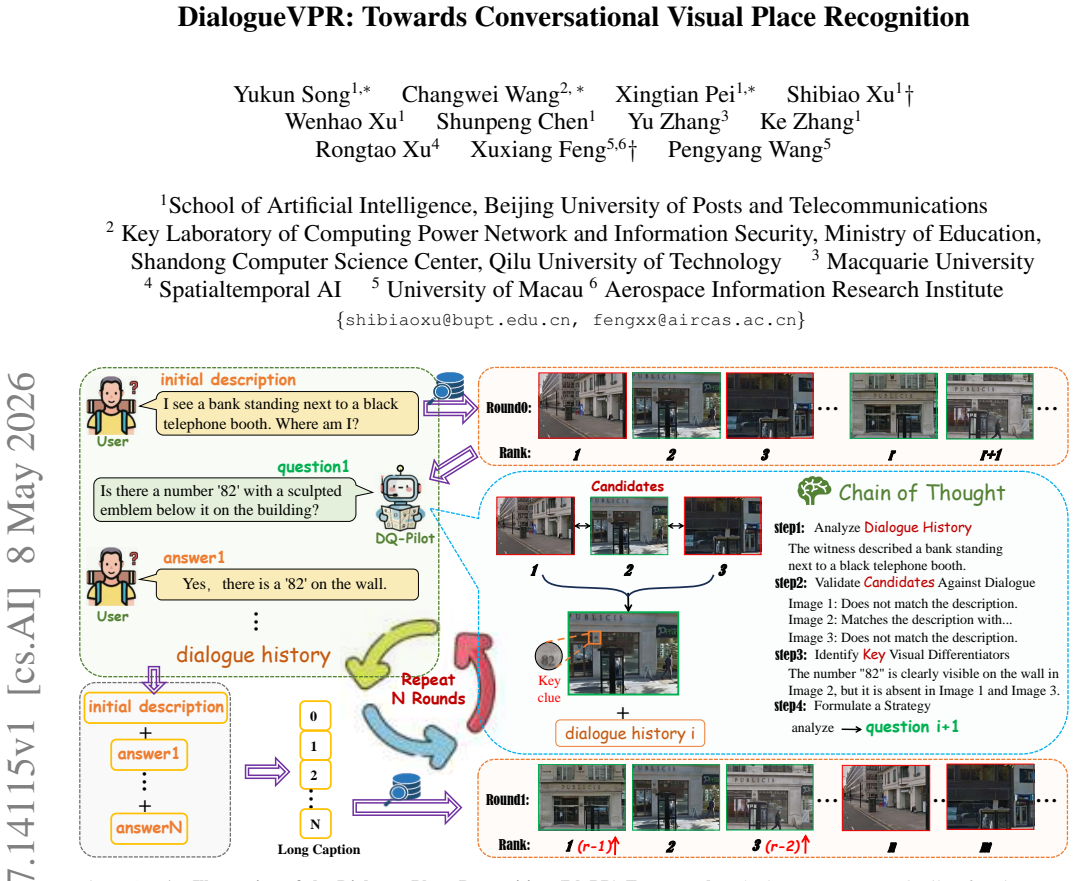
The paper's central claim is that asking questions helps: casting place recognition as a dialogue, where the system reasons about what it cannot yet distinguish and asks the user for the missing evidence, leads to substantially better localization than any single static query. The framework pairs a cross-modal multi-level retriever (CMPL) with an intelligent questioner (DQ-pilot). DQ-pilot is trained in two stages—supervised fine-tuning on low-difficulty dialogues followed by reinforcement learning on high-difficulty ones—using a reward, the Positional Retrieval Gain (PRG), that scores how much a question improves the rank of the correct location. On DlgQuest-Cities, the full method reaches
What carries the argument
The central mechanism is the 'analysis–questioning–optimization' loop. At each round, DQ-pilot executes a four-step chain-of-thought: summarize what the dialogue has confirmed or ruled out, validate the candidate images against that summary, identify visual differentiators among remaining candidates, and phrase one question targeting the most decisive cue. The user's answer is appended to the dialogue history, and CMPL re-retrieves. Two task-aligned metrics carry the learning: the Discriminative Difficulty Index (DDI), a weighted combination of semantic ambiguity and retriever-informed difficulty used to sample easy then hard training dialogues, and the Positional Retrieval Gain (PRG), an nD
Load-bearing premise
The benchmark's scripted, machine-generated user answers are assumed to behave like real human clarifications during evaluation; if human users answer differently, the reported recall gains may not transfer to practice.
What would settle it
Run the trained system in a live study where human users, who have not seen the candidate images, answer DQ-pilot's questions about a held-out set of places, and compare top-1/top-5 recall against the synthetic-answer evaluation on the same queries.
If this is right
- If the results hold, language-guided geo-localization can tolerate vague or incomplete initial descriptions by letting the system ask one or two targeted questions instead of requiring a complete description upfront.
- The questioner–retriever loop is a general pattern: the same 'ask to disambiguate' mechanism could improve other retrieval tasks, such as person re-identification or image search from partial queries.
- The PRG reward gives a concrete, measurable objective for training agents to ask useful questions, tied directly to retrieval performance rather than to surrogate heuristics.
- A 7-billion-parameter model trained for interactive questioning can outperform a 72-billion-parameter model that is not, suggesting interaction can substitute for model scale in spatial-language reasoning.
- The benchmark and curriculum (DDI-based sampling, then GRPO refinement) provide a reusable training recipe for dialogue-driven retrieval systems.
Where Pith is reading between the lines
- The evaluation uses scripted, machine-generated user answers produced by the same teacher model that created the training dialogues; a human study where real users answer the system's questions on held-out places would test whether the reported gains transfer to genuine conversational behavior.
- Part of the gain may come from the questioner exploiting simple, highly discriminative cues (like sign text) that the retriever is already good at matching; an adversarially constructed test set could bound this effect.
- The retriever and questioner are trained separately here; co-training them so the questioner learns to ask about features the retriever is currently worst at could yield further gains.
- A minimal control—asking the same number of generic or random questions instead of strategically chosen ones—would isolate how much of the improvement is due to question selection versus mere additional text.
Editorial analysis
A structured set of objections, weighed in public.
Referee Report
Summary. The paper proposes Dialogue Place Recognition (DlgPR), a new task in which a system iteratively asks a user questions to refine visual place retrieval. The authors construct DQ-cities, a large benchmark built on GSV-Cities with synthetic initial captions, fine-grained descriptions, region-level bounding-box annotations, and five-round GPT-4o-generated dialogues. They also propose a framework composed of a cross-modal progressive retriever (CMPL) and a questioner (DQ-pilot) trained with SFT followed by GRPO, guided by a Discriminative Difficulty Index (DDI) and a Positional Retrieval Gain (PRG) reward. Experiments on DQ-cities report large R@1/R@5 improvements over zero-shot baselines and over one-shot retrieval.
Significance. If the results hold, this is a genuinely novel contribution to interactive language-driven geo-localization. The benchmark construction, the curriculum based on DDI, and the coupling of a retriever with a reinforcement-learned questioner are all reasonable and potentially valuable. The release of code and model is a strength that should aid reproducibility. However, the central claim that interactive questioning materially improves localization is currently supported only by evaluations against a synthetic, oracle-like user, and the training and evaluation metrics are partly entangled. The contribution is solid in conception but its empirical validation is not yet convincing.
major comments (3)
- [§3.2 Step 3 and §5.2] The evaluation protocol uses synthetic user answers generated by GPT-4o from the same evidence base (fine-grained descriptions and bounding boxes, E_i) that was used to generate DQ-pilot's training dialogues. Table 1's gains (e.g., DQ-pilot R@1 from 35.9 at round 0 to 58.4 at round 5) therefore assume that real users answer with the same region-grounded, oracle-like content. No human evaluation, no real-user simulation, and no sensitivity analysis to answer noise or incorrect answers are provided. This is the load-bearing assumption for the central claim. Please add a human evaluation subset or, at minimum, simulate answer noise, partial answers, and refusals to show the method degrades gracefully.
- [§4.3 Eq. (8)-(9), §3.2 Eq. (2)-(3), Table 1] PRG is used in three places: the DDI curriculum filter (Eq. 3), the GRPO retrieval reward (Eq. 8, combined in Eq. 9), and the evaluation metric reported in Table 1's PRG column. This means the reported PRG improvements are directly optimized for the same CMPL retriever and the same candidate distribution used at evaluation; they are not an independent measure of question quality. While R@1/R@5 are not directly the training objective, the reward shaping and data selection are aligned with the exact protocol later used to measure success. The paper should decouple this, e.g., evaluate with a retriever not used during reward computation, or report R@1/R@5 with fixed candidate sets independent of CMPL.
- [§5.1, Table 1] The main baselines (Qwen2.5-VL-7B/72B, PlugIR) are used zero-shot, while DQ-pilot is fine-tuned on 30k DQ-cities dialogues. The large gains in Table 1 thus conflate task adaptation with the benefit of interactive reasoning. A same-data trained baseline (e.g., fine-tuning Qwen2.5-VL-7B or PlugIR on the same curriculum splits) is necessary to isolate the contribution. In addition, no error bars or significance tests are reported; Table 1 appears to be a single run. The claim 'significantly outperforms baselines' (Abstract) is not fully supported without variance estimates across seeds or test splits.
minor comments (5)
- [Eq. (1)] The text says SA is computed from 'positive and negative textual embeddings ... and their corresponding visual embeddings,' but the equation uses only the text encoder φ_T. Please clarify whether visual embeddings are intended and, if so, correct the equation.
- [Table 1] The PRG column is not defined: is it PRG at round 5, average over rounds, or across regions? BRI is mentioned as from PlugIR but never defined. Please add definitions.
- [§5.2] The sentence 'Compared to its 7B backbone, our model improves R@1 by 9.2% and 13.4% after 3 and 5 dialogue rounds' does not match Table 1. For example, round-3 R@1 is 52.1 vs 42.4 (an absolute difference of 9.7 points), and round-5 is 58.4 vs 43.2 (15.2 points). Please correct the numbers or state what comparison is being reported.
- [Figure 2] Typo: 'Chain of Thought promot' should be 'prompt'.
- [General] The paper repeatedly refers to an Appendix, but the preprint text provided does not include one. Please ensure the appendix is present in the final version and that all referenced details are available.
Circularity Check
No load-bearing circularity; one minor self-referential metric (PRG as both GRPO reward and reported evaluation column) and a synthetic-user external-validity risk, but the R@1 comparison is an independent empirical result.
specific steps
-
other
[Sec. 4.3, Eq. (8); Table 1]
"We reuse the Positional Retrieval Gain (PRG) from Sec 3.2 as a task-aligned measure ... the retrieval reward is defined as Rprg = PRGt, (8)"
The same PRG scalar optimized by GRPO is also reported as an evaluation column in Table 1. Consequently the PRG improvement shown for DQ-pilot is the training objective itself, not an independent measurement of question quality. The headline R@1/R@5 gains are computed separately and are not forced by this identity, so the circularity is minor and non-load-bearing.
full rationale
The paper's derivation chain is otherwise self-contained. CMPL is trained from scratch with image-text alignment losses (Eq. 6); DQ-pilot is initialized by SFT on GPT-4o-generated dialogues and refined by GRPO with a verifiable reward. No central premise rests on a self-citation: the authors' earlier works [7,8,41] appear only in related-work lists, no uniqueness theorem is imported, and no ansatz is smuggled in by citation. The strongest concern is external validity rather than circularity: the DQ-cities dialogues and evaluation answers are synthesized by GPT-4o from the same CMPL candidate sets and evidence base (Sec. 3.2 Step 3), so Table 1 may measure fit to a synthetic oracle rather than human clarification behavior. That is an evaluation-protocol limitation, not an equation-level reduction of the claimed result. Hence score 2 for the minor PRG reward-metric overlap; the central R@1/R@5 claim has independent content.
Axiom & Free-Parameter Ledger
free parameters (6)
- SA mixing weight α (Eq. 1) =
not reported
- DDI weights w_sa, w_rid (Eq. 3) =
not reported
- PRG filtering threshold τ1 =
not reported
- GRPO reward weights α, β (Eq. 9) =
not reported
- CMPL loss weights λ_gs, λ_h and margin α (Eq. 6) =
not reported
- SDM temperature τ (Eq. 5) =
not reported
axioms (5)
- domain assumption GPT-4o-generated long descriptions are factually accurate and sufficient for place-level retrieval.
- domain assumption Scripted user answers in DQ-cities behave like real human clarification behavior.
- ad hoc to paper Hard-negative candidate sets produced by CMPL during data generation represent the difficulty distribution at test time.
- ad hoc to paper DDI and PRG correctly quantify dialogue difficulty and retrieval gain.
- domain assumption GSV-Cities place labels are correct and a valid foundation for the benchmark.
invented entities (3)
-
DlgQuest-Cities benchmark
no independent evidence
-
Discriminative Difficulty Index (DDI)
no independent evidence
-
Positional Retrieval Gain (PRG)
no independent evidence
read the original abstract
Inspired by how humans communicate spatial information, language-guided geo-localization has gained significant traction for its intuitive and practical value. Despite this progress, most methods still rely on a static, one-shot retrieval paradigm, which fails to handle the ambiguity and incompleteness inherent in real-world natural language descriptions. We propose a paradigm shift to reasoning retrieval and introduce Dialogue Place Recognition (DlgPR), which casts localization as an interactive, dialogue-driven reasoning process. To support this new task, we present DlgQuest-Cities, the first large-scale dialogue-based benchmark for place recognition, and a unified reasoning framework that couples a cross-modal multi-level retriever with an intelligent questioner, DQ-pilot. DQ-pilot is trained in a curriculum: supervised fine-tuning on a curated DQ-cities-20k subset followed by reinforcement refinement on a harder DQ-cities-10k split via GRPO. Two task-aligned metrics guide learning: a Discriminative Difficulty Index (DDI) for curriculum sampling and a Positional Retrieval Gain (PRG) reward that directly measures retrieval improvement induced by a question. Experiments show this reasoning-based approach significantly outperforms baselines. The code and model are available at https://github.com/Graysonggg/DlgPR.
Figures


Reference graph
Works this paper leans on
-
[1]
Gsv-cities: Toward appropriate supervised visual place recognition.Neurocomputing, 513:194–203, 2022
Amar Ali-bey, Brahim Chaib-draa, and Philippe Gigu `ere. Gsv-cities: Toward appropriate supervised visual place recognition.Neurocomputing, 513:194–203, 2022. 3
2022
-
[2]
Global proxy-based hard mining for visual place recognition
Amar Ali-Bey, Brahim Chaib-draa, and Philippe Gigu `ere. Global proxy-based hard mining for visual place recognition. arXiv preprint arXiv:2302.14217, 2023. 2
Pith/arXiv arXiv 2023
-
[3]
BoQ: A place is worth a bag of learnable queries
Amar Ali-bey, Brahim Chaib-draa, and Philippe Gigu `ere. BoQ: A place is worth a bag of learnable queries. InPro- ceedings of the IEEE/CVF Conference on Computer Vision and Pattern Recognition, pages 17794–17803, 2024
2024
-
[4]
Netvlad: Cnn architecture for weakly supervised place recognition
Relja Arandjelovic, Petr Gronat, Akihiko Torii, Tomas Pa- jdla, and Josef Sivic. Netvlad: Cnn architecture for weakly supervised place recognition. InProceedings of the IEEE conference on computer vision and pattern recognition, pages 5297–5307, 2016. 2
2016
-
[5]
Ask&confirm: active detail enriching for cross-modal retrieval with partial query
Guanyu Cai, Jun Zhang, Xinyang Jiang, Yifei Gong, Lianghua He, Fufu Yu, Pai Peng, Xiaowei Guo, Feiyue Huang, and Xing Sun. Ask&confirm: active detail enriching for cross-modal retrieval with partial query. InProceedings of the IEEE/CVF International Conference on Computer Vi- sion, pages 1835–1844, 2021. 3
2021
-
[6]
where am i?
Jiaqi Chen, Daniel Barath, Iro Armeni, Marc Pollefeys, and Hermann Blum. “where am i?” scene retrieval with lan- guage. InEuropean Conference on Computer Vision, pages 201–220. Springer, 2024. 2
2024
-
[7]
Shunpeng Chen, Yukun Song, Changwei Wang, Rong- tao Xu, Kexue Fu, Longxiang Gao, Li Guo, Ruisheng Wang, and Shibiao Xu. Region matters: Efficient and re- liable region-aware visual place recognition.arXiv preprint arXiv:2604.22390, 2026. 2
Pith/arXiv arXiv 2026
-
[8]
SAGE: Spatial-visual adaptive graph exploration for efficient visual place recognition
Shunpeng Chen, Changwei Wang, Rongtao Xu, Xingtian Pei, Yukun Song, Jinzhou Lin, Wenhao Xu, Jingyi Zhang, Li Guo, and Shibiao Xu. SAGE: Spatial-visual adaptive graph exploration for efficient visual place recognition. In The Fourteenth International Conference on Learning Rep- resentations, 2026. 2
2026
-
[9]
Towards natural language-guided drones: Geotext-1652 benchmark with spatial relation matching
Meng Chu, Zhedong Zheng, Wei Ji, Tingyu Wang, and Tat-Seng Chua. Towards natural language-guided drones: Geotext-1652 benchmark with spatial relation matching. In European Conference on Computer Vision, pages 213–231. Springer, 2024. 3
2024
-
[10]
Sam- ple4geo: Hard negative sampling for cross-view geo- localisation
Fabian Deuser, Konrad Habel, and Norbert Oswald. Sam- ple4geo: Hard negative sampling for cross-view geo- localisation. InProceedings of the IEEE/CVF International Conference on Computer Vision, pages 16847–16856, 2023. 2
2023
-
[11]
Seq- matchnet: Contrastive learning with sequence matching for place recognition & relocalization
Sourav Garg, Madhu Vankadari, and Michael Milford. Seq- matchnet: Contrastive learning with sequence matching for place recognition & relocalization. InConference on Robot Learning, pages 429–443. PMLR, 2022. 2
2022
-
[12]
Daya Guo, Dejian Yang, Haowei Zhang, Junxiao Song, Ruoyu Zhang, Runxin Xu, Qihao Zhu, Shirong Ma, Peiyi Wang, Xiao Bi, et al. Deepseek-r1: Incentivizing reasoning capability in llms via reinforcement learning.arXiv preprint arXiv:2501.12948, 2025. 3
Pith/arXiv arXiv 2025
-
[13]
Textplace: Visual place recognition and topolog- ical localization through reading scene texts
Ziyang Hong, Yvan Petillot, David Lane, Yishu Miao, and Sen Wang. Textplace: Visual place recognition and topolog- ical localization through reading scene texts. InProceedings of the IEEE/CVF International Conference on Computer Vi- sion, pages 2861–2870, 2019. 3
2019
-
[14]
Progeo: Generating prompts through image- text contrastive learning for visual geo-localization
Jingqi Hu, Chen Mao, Chong Tan, Hui Li, Hong Liu, and Min Zheng. Progeo: Generating prompts through image- text contrastive learning for visual geo-localization. InIn- ternational Conference on Artificial Neural Networks, pages 448–462. Springer, 2024. 2, 3
2024
-
[15]
Optimal transport ag- gregation for visual place recognition
Sergio Izquierdo and Javier Civera. Optimal transport ag- gregation for visual place recognition. InProceedings of the IEEE/CVF Conference on Computer Vision and Pattern Recognition (CVPR), 2024. 2
2024
-
[16]
Close, but not there: Boosting geographic distance sensitivity in visual place recognition
Sergio Izquierdo and Javier Civera. Close, but not there: Boosting geographic distance sensitivity in visual place recognition. InComputer Vision – ECCV 2024, pages 240– 257, Cham, 2025. Springer Nature Switzerland. 2
2024
-
[17]
Openai o1 system card.arXiv preprint arXiv:2412.16720, 2024
Aaron Jaech, Adam Kalai, Adam Lerer, Adam Richard- son, Ahmed El-Kishky, Aiden Low, Alec Helyar, Aleksander Madry, Alex Beutel, Alex Carney, et al. Openai o1 system card.arXiv preprint arXiv:2412.16720, 2024. 3
Pith/arXiv arXiv 2024
-
[18]
Cross-modal implicit relation rea- soning and aligning for text-to-image person retrieval
Ding Jiang and Mang Ye. Cross-modal implicit relation rea- soning and aligning for text-to-image person retrieval. In Proceedings of the IEEE/CVF conference on computer vi- sion and pattern recognition, pages 2787–2797, 2023. 5
2023
-
[19]
Text2pos: Text-to-point-cloud cross-modal localiza- tion
Manuel Kolmet, Qunjie Zhou, Aljo ˇsa Oˇsep, and Laura Leal- Taix´e. Text2pos: Text-to-point-cloud cross-modal localiza- tion. InProceedings of the IEEE/CVF Conference on Com- puter Vision and Pattern Recognition, pages 6687–6696,
-
[20]
Whittlesearch: Interactive image search with relative at- tribute feedback.International Journal of Computer Vision, 115(2):185–210, 2015
Adriana Kovashka, Devi Parikh, and Kristen Grauman. Whittlesearch: Interactive image search with relative at- tribute feedback.International Journal of Computer Vision, 115(2):185–210, 2015. 3
2015
-
[21]
Cosmo: Content-style modulation for image retrieval with text feed- back
Seungmin Lee, Dongwan Kim, and Bohyung Han. Cosmo: Content-style modulation for image retrieval with text feed- back. InProceedings of the IEEE/CVF Conference on Com- puter Vision and Pattern Recognition, pages 802–812, 2021. 3
2021
-
[22]
Saehyung Lee, Sangwon Yu, Junsung Park, Jihun Yi, and Sungroh Yoon. Interactive text-to-image retrieval with large language models: A plug-and-play approach.arXiv preprint arXiv:2406.03411, 2024. 3, 7, 8
Pith/arXiv arXiv 2024
-
[23]
Chatting makes perfect: Chat-based image retrieval
Matan Levy, Rami Ben-Ari, Nir Darshan, and Dani Lischin- ski. Chatting makes perfect: Chat-based image retrieval. Advances in Neural Information Processing Systems, 36: 61437–61449, 2023. 3
2023
-
[24]
Omnicity: Omnipotent city understanding with multi-level and multi- view images
Weijia Li, Yawen Lai, Linning Xu, Yuanbo Xiangli, Jinhua Yu, Conghui He, Gui-Song Xia, and Dahua Lin. Omnicity: Omnipotent city understanding with multi-level and multi- view images. InProceedings of the IEEE/CVF Conference on Computer Vision and Pattern Recognition, pages 17397– 17407, 2023. 2
2023
-
[25]
Simple baselines for interactive video retrieval with questions and answers
Kaiqu Liang and Samuel Albanie. Simple baselines for interactive video retrieval with questions and answers. In Proceedings of the IEEE/CVF International Conference on Computer Vision, pages 11091–11101, 2023. 3
2023
-
[26]
Visual- rft: Visual reinforcement fine-tuning.arXiv preprint arXiv:2503.01785, 2025
Ziyu Liu, Zeyi Sun, Yuhang Zang, Xiaoyi Dong, Yuhang Cao, Haodong Duan, Dahua Lin, and Jiaqi Wang. Visual- rft: Visual reinforcement fine-tuning.arXiv preprint arXiv:2503.01785, 2025. 3
Pith/arXiv arXiv 2025
-
[27]
Towards seamless adapta- tion of pre-trained models for visual place recognition
Feng Lu, Lijun Zhang, Xiangyuan Lan, Shuting Dong, Yaowei Wang, and Chun Yuan. Towards seamless adapta- tion of pre-trained models for visual place recognition. In The Twelfth International Conference on Learning Represen- tations, 2024. 2
2024
-
[28]
Supervlad: Com- pact and robust image descriptors for visual place recogni- tion.Advances in Neural Information Processing Systems, 37:5789–5816, 2024
Feng Lu, Xinyao Zhang, Canming Ye, Shuting Dong, Lijun Zhang, Xiangyuan Lan, and Chun Yuan. Supervlad: Com- pact and robust image descriptors for visual place recogni- tion.Advances in Neural Information Processing Systems, 37:5789–5816, 2024. 2
2024
-
[29]
Yiding Lu, Mouxing Yang, Dezhong Peng, Peng Hu, Yijie Lin, and Xi Peng. Llava-reid: Selective multi-image ques- tioner for interactive person re-identification.arXiv preprint arXiv:2504.10174, 2025. 3
Pith/arXiv arXiv 2025
-
[30]
Tell me where you are: Multimodal llms meet place recognition.arXiv preprint arXiv:2406.17520, 2024
Zonglin Lyu, Juexiao Zhang, Mingxuan Lu, Yiming Li, and Chen Feng. Tell me where you are: Multimodal llms meet place recognition.arXiv preprint arXiv:2406.17520, 2024. 2, 3
Pith/arXiv arXiv 2024
-
[31]
Learn- ing to retrieve videos by asking questions
Avinash Madasu, Junier Oliva, and Gedas Bertasius. Learn- ing to retrieve videos by asking questions. InProceedings of the 30th ACM International Conference on Multimedia, pages 356–365, 2022. 3
2022
-
[32]
Emvp: Em- bracing visual foundation model for visual place recognition with centroid-free probing.Advances in Neural Information Processing Systems, 37:120928–120950, 2024
Qibo Qiu, Shun Zhang, Haiming Gao, Honghui Yang, Haochao Ying, Wenxiao Wang, and Xiaofei He. Emvp: Em- bracing visual foundation model for visual place recognition with centroid-free probing.Advances in Neural Information Processing Systems, 37:120928–120950, 2024. 2
2024
-
[33]
Learning transferable visual models from natural language supervi- sion
Alec Radford, Jong Wook Kim, Chris Hallacy, Aditya Ramesh, Gabriel Goh, Sandhini Agarwal, Girish Sastry, Amanda Askell, Pamela Mishkin, Jack Clark, et al. Learning transferable visual models from natural language supervi- sion. InInternational conference on machine learning, pages 8748–8763. PmLR, 2021. 8
2021
-
[34]
From coarse to fine: Robust hierarchical localization at large scale
Paul-Edouard Sarlin, Cesar Cadena, Roland Siegwart, and Marcin Dymczyk. From coarse to fine: Robust hierarchical localization at large scale. InProceedings of the IEEE/CVF conference on computer vision and pattern recognition, pages 12716–12725, 2019. 2
2019
-
[35]
Tianyi Shang, Zhenyu Li, Pengjie Xu, Jinwei Qiao, Gang Chen, Zihan Ruan, and Weijun Hu. Bridging text and vision: A multi-view text-vision registration approach for cross- modal place recognition.arXiv preprint arXiv:2502.14195,
-
[36]
Zhihong Shao, Peiyi Wang, Qihao Zhu, Runxin Xu, Junxiao Song, Xiao Bi, Haowei Zhang, Mingchuan Zhang, YK Li, Yang Wu, et al. Deepseekmath: Pushing the limits of math- ematical reasoning in open language models.arXiv preprint arXiv:2402.03300, 2024. 3
Pith/arXiv arXiv 2024
-
[37]
Haozhan Shen, Peng Liu, Jingcheng Li, Chunxin Fang, Yibo Ma, Jiajia Liao, Qiaoli Shen, Zilun Zhang, Kangjia Zhao, Qianqian Zhang, et al. Vlm-r1: A stable and generaliz- able r1-style large vision-language model.arXiv preprint arXiv:2504.07615, 2025. 3
Pith/arXiv arXiv 2025
-
[38]
Where am i looking at? joint location and orientation es- timation by cross-view matching
Yujiao Shi, Xin Yu, Dylan Campbell, and Hongdong Li. Where am i looking at? joint location and orientation es- timation by cross-view matching. InProceedings of the IEEE/CVF Conference on Computer Vision and Pattern Recognition, pages 4064–4072, 2020. 2
2020
-
[39]
Huaqi Tao, Bingxi Liu, Calvin Chen, Tingjun Huang, He Li, Jinqiang Cui, and Hong Zhang. Textinplace: Indoor vi- sual place recognition in repetitive structures with scene text spotting and verification.arXiv preprint arXiv:2503.06501,
-
[40]
Loc4plan: Locating be- fore planning for outdoor vision and language navigation
Huilin Tian, Jingke Meng, Wei-Shi Zheng, Yuan-Ming Li, Junkai Yan, and Yunong Zhang. Loc4plan: Locating be- fore planning for outdoor vision and language navigation. In Proceedings of the 32nd ACM International Conference on Multimedia, pages 4073–4081, 2024. 2
2024
-
[41]
Focus on local: Finding reliable discriminative regions for visual place recognition
Changwei Wang, Shunpeng Chen, Yukun Song, Rongtao Xu, Zherui Zhang, Jiguang Zhang, Haoran Yang, Yu Zhang, Kexue Fu, Shide Du, et al. Focus on local: Finding reliable discriminative regions for visual place recognition. InPro- ceedings of the AAAI Conference on Artificial Intelligence, pages 7536–7544, 2025. 2
2025
-
[42]
Teng Wang, Lingquan Meng, Lei Cheng, and Changyin Sun. Lvlm-empowered multi-modal representation learning for visual place recognition.arXiv preprint arXiv:2407.06730,
-
[43]
Multi-similarity loss with general pair weighting for deep metric learning
Xun Wang, Xintong Han, Weilin Huang, Dengke Dong, and Matthew R Scott. Multi-similarity loss with general pair weighting for deep metric learning. InProceedings of the IEEE/CVF conference on computer vision and pattern recognition, pages 5022–5030, 2019. 5
2019
-
[44]
Fine-grained cross-view geo-localization using a correlation-aware homography estimator.Advances in Neu- ral Information Processing Systems, 36:5301–5319, 2023
Xiaolong Wang, Runsen Xu, Zhuofan Cui, Zeyu Wan, and Yu Zhang. Fine-grained cross-view geo-localization using a correlation-aware homography estimator.Advances in Neu- ral Information Processing Systems, 36:5301–5319, 2023. 2
2023
-
[45]
A theoretical analysis of ndcg type ranking measures
Yining Wang, Liwei Wang, Yuanzhi Li, Di He, and Tie-Yan Liu. A theoretical analysis of ndcg type ranking measures. In Conference on learning theory, pages 25–54. PMLR, 2013. 5
2013
-
[46]
Text2loc: 3d point cloud localization from natural language
Yan Xia, Letian Shi, Zifeng Ding, Joao F Henriques, and Daniel Cremers. Text2loc: 3d point cloud localization from natural language. InProceedings of the IEEE/CVF con- ference on computer vision and pattern recognition, pages 14958–14967, 2024. 2, 3
2024
-
[47]
Adapting fine-grained cross-view localization to areas with- out fine ground truth
Zimin Xia, Yujiao Shi, Hongdong Li, and Julian FP Kooij. Adapting fine-grained cross-view localization to areas with- out fine ground truth. InEuropean Conference on Computer Vision, pages 397–415. Springer, 2024. 2
2024
-
[48]
Flair: Vlm with fine- grained language-informed image representations
Rui Xiao, Sanghwan Kim, Mariana-Iuliana Georgescu, Zeynep Akata, and Stephan Alaniz. Flair: Vlm with fine- grained language-informed image representations. InPro- ceedings of the Computer Vision and Pattern Recognition Conference, pages 24884–24894, 2025. 8
2025
-
[49]
Fg- clip: Fine-grained visual and textual alignment.arXiv preprint arXiv:2505.05071, 2025
Chunyu Xie, Bin Wang, Fanjing Kong, Jincheng Li, Dawei Liang, Gengshen Zhang, Dawei Leng, and Yuhui Yin. Fg- clip: Fine-grained visual and textual alignment.arXiv preprint arXiv:2505.05071, 2025. 4, 8
Pith/arXiv arXiv 2025
-
[50]
Skydiffusion: Street-to-satellite im- age synthesis with diffusion models and bev paradigm.arXiv e-prints, pages arXiv–2408, 2024
Junyan Ye, Jun He, Weijia Li, Zhutao Lv, Jinhua Yu, Haote Yang, and Conghui He. Skydiffusion: Street-to-satellite im- age synthesis with diffusion models and bev paradigm.arXiv e-prints, pages arXiv–2408, 2024. 2
2024
-
[51]
Cross-view image geo- localization with panorama-bev co-retrieval network
Junyan Ye, Zhutao Lv, Weijia Li, Jinhua Yu, Haote Yang, Huaping Zhong, and Conghui He. Cross-view image geo- localization with panorama-bev co-retrieval network. In European Conference on Computer Vision, pages 74–90. Springer, 2024. 2
2024
-
[52]
Where am i? cross-view geo-localization with natural language descrip- tions
Junyan Ye, Honglin Lin, Leyan Ou, Dairong Chen, Zihao Wang, Qi Zhu, Conghui He, and Weijia Li. Where am i? cross-view geo-localization with natural language descrip- tions. InProceedings of the IEEE/CVF International Con- ference on Computer Vision, pages 5890–5900, 2025. 2, 3
2025
-
[53]
Long-clip: Unlocking the long-text capability of clip
Beichen Zhang, Pan Zhang, Xiaoyi Dong, Yuhang Zang, and Jiaqi Wang. Long-clip: Unlocking the long-text capability of clip. InEuropean conference on computer vision, pages 310–325. Springer, 2024. 8
2024
-
[54]
Jiazhao Zhang, Kunyu Wang, Rongtao Xu, Gengze Zhou, Yicong Hong, Xiaomeng Fang, Qi Wu, Zhizheng Zhang, and He Wang. Navid: Video-based vlm plans the next step for vision-and-language navigation.arXiv preprint arXiv:2402.15852, 2024. 2
Pith/arXiv arXiv 2024
-
[55]
Enhancing interactive image retrieval with query rewriting using large language models and vision lan- guage models
Hongyi Zhu, Jia-Hong Huang, Stevan Rudinac, and Evan- gelos Kanoulas. Enhancing interactive image retrieval with query rewriting using large language models and vision lan- guage models. InProceedings of the 2024 International Conference on Multimedia Retrieval, pages 978–987, 2024. 3
2024
discussion (0)
Sign in with ORCID, Apple, or X to comment. Anyone can read and Pith papers without signing in.