REVIEW 3 major objections 3 minor 29 references
LIFT shows that a pretrained vision-language-action policy can gain contact reactivity by injecting recent 6D force through a zero-initialized reactive action expert, learning faster and reaching higher success than vision-only post-trainin
Reviewed by Pith at T0; open to challenge. T0 means a machine referee read the full paper against a public rubric. the ladder, T0–T4 →
T0 review · deepseek-v4-flash
2026-08-02 02:40 UTC pith:DGK2PXLE
load-bearing objection Clever initialization-equivalent architecture for adding force to a VLA, but the empirics don't yet isolate force from the reactive branch. the 3 major comments →
Never Too Late for Force: Accelerating VLA Post-Training with Reactive Force Injection
The pith
A machine-rendered reading of the paper's core claim, the machinery that carries it, and where it could break.
Core claim
The central claim is that force-aware post-training does not need to start from a force-trained model: a reactive action expert copied from a pretrained VLA's action head, combined with a causal force memory and zero-initialized cross attention, can refresh individual actions within an action chunk as new 6D wrench measurements arrive, without disturbing the pretrained prior at initialization. On the three evaluated tasks, LIFT reaches peak scores of 0.825, 0.6, and 0.6 against 0.725, 0.4, and 0.3 for vision-only online DAgger, while using fewer or comparable samples. The author's way of putting it is that force injection accelerates post-training, and that reactive force memory — not single
What carries the argument
The load-bearing object is the reactive action expert: a second action-denoising stream that shares the pretrained weights but uses shifted causal attention, so each action token can see earlier reactive tokens and later base-action tokens without seeing past base tokens. A causal GRU encodes the recent 6D wrench into a force memory, and zero-initialized cross attention lets that memory add a residual update that is exactly zero before training. The latency-aligned causal mask (offset L in the paper) ensures each action can only use force that would actually be available when inference finishes. Together these pieces make the augmented policy output-equivalent to the original VLA at step zer
Load-bearing premise
The hand-set latency-alignment offset L=3 is assumed to exactly match the robot's inference delay, so the force memory is neither stale nor future when an action is generated; the paper reports no sensitivity analysis over L, and a wrong offset would break the very reactivity LIFT is designed for.
What would settle it
Vary L over 0, 1, 2, 3, 4, 5 on the same three tasks while keeping everything else fixed; if success does not degrade sharply at the wrong offsets, the latency-alignment assumption is not load-bearing. A direct check is to measure the actual network inference delay and confirm that L=3 aligns the force measurement time with the action execution time.
If this is right
- Force can be injected into a VLA late in post-training; a pretrained visual prior does not have to be discarded to gain contact reactivity.
- Reactive force memory outperforms single-frame force inputs, because contact-phase decisions like 'still inserting vs. already bottomed out' require a short force history.
- Online DAgger is necessary: the same reactive model trained offline only drops to zero success on book insertion, showing that on-policy contact data cannot be replaced by offline demonstrations.
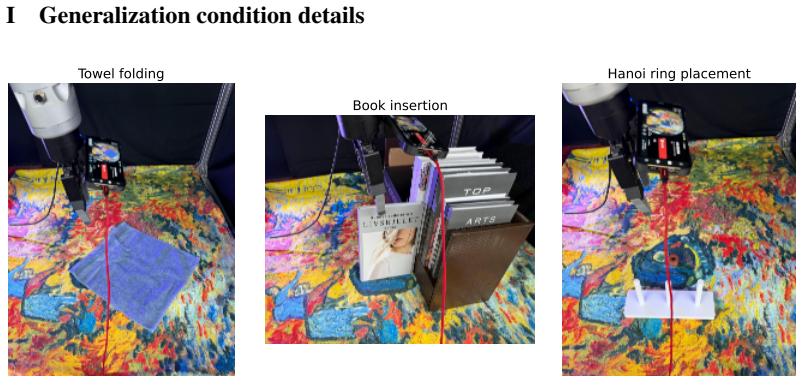
- The augmented policy retains the base VLA's generalization: performance holds under object, tablecloth, and lighting changes.
- Because the force path starts at zero output, the method adds force capability without requiring an additional force-pretraining stage.
Where Pith is reading between the lines
- If the reported gains hold up, the same residual-injection pattern could be reused for other high-frequency, low-dimensional signals that are expensive to precollect — joint torques, tactile arrays, or contact microphones — turning LIFT into a general 'add a sensor late' recipe.
- The heavy reliance on the hand-set latency offset L=3 suggests that deployment on a different arm or policy speed would require either a principled way to set L from measured inference latency or a mechanism that self-corrects misalignment; this is a testable engineering question the paper leaves open.
- Because the method trains on a 1:1 mix of offline vision data and online force corrections, it implicitly argues that platform-specific force data can be scarce if paired with abundant visual demonstrations; an interesting test would be sweeping the online-data fraction to find the minimum correction count per task.
- One unstated consequence is that force sensing can remain a post-training-only hardware requirement: the same pretrained checkpoint can be deployed on force-equipped and non-force arms, with the latter falling back to the base action stream.
Editorial analysis
A structured set of objections, weighed in public.
Referee Report
Summary. The paper introduces LIFT, a post-training framework that adds reactive 6D force feedback to a pretrained vision-language-action (VLA) policy. A reactive action expert is grafted beside the original action expert, initialized by copying the pretrained action weights, with force injected through a causal GRU-based force memory and zero-initialized cross attention. Shifted causal attention is designed so that the reactive stream is output-equivalent to the original policy at initialization. Post-training uses a mixture of vision-only offline data and force-enabled online DAgger corrections. The empirical evaluation covers three real-robot tasks (towel folding, book insertion, Hanoi ring placement), comparing LIFT against vision-only online DAgger, a single-frame-force variant, an offline-only variant, and an offline handheld baseline. The paper reports faster learning and higher final success rates for LIFT on all three tasks, with ablations showing the importance of reactive force memory and online DAgger.
Significance. If the central empirical claim held, LIFT would be a useful contribution: it gives a concrete, architecture-level recipe for adding contact reactivity to a general VLA without destroying the pretrained prior. The initialization-equivalence construction (shifted causal attention plus zero-initialized cross attention, Section 3.2) is elegant and, as described, plausible; this is a genuine conceptual strength. The online DAgger post-training loop with mixed offline/online sampling is practical and the evaluation on three real-robot contact-rich tasks is valuable. However, the paper's headline conclusion—that force accelerates and improves VLA post-training—is not yet established because the main comparison confounds force injection with a major architectural change, and the statistical support is weak (10 rollouts/checkpoint, no error bars). The contributions are therefore significant but provisional.
major comments (3)
- [Section 4.1/4.2] The primary comparison does not isolate the effect of force. 'π0.5 w/ Online DAgger' is described as 'the same online DAgger loop without force input,' but it is the original π0.5 policy; it lacks the reactive action expert (O1.1), the shifted causal attention (O2.1), the cached vision-language prefix (O1.3), and the zero-initialized cross attention. Thus the headline 'LIFT learns faster and reaches higher performance than vision-only post-training' compares force+reactive architecture against a non-reactive open-loop architecture. The ablation 'LIFT w/o Reactive Force Injection' retains the reactive expert but uses single-frame force, so it does not remove force. On towel folding (Section 4.2) this ablation reaches 0.95 versus LIFT's 0.825, indicating that non-force reactive components alone can be highly effective. Without a no-force reactive control—i.e., a variant that keeps the reac
- [Appendix G / Figure 5] All performance numbers are means over 10 autonomous rollouts per checkpoint, with no variance, confidence intervals, or significance tests. With n=10, the reported differences such as 0.6 vs 0.4 (book insertion) are within ordinary binomial sampling noise; e.g., 6/10 vs 4/10 have overlapping 95% confidence intervals. The same concern applies to the Hanoi numbers (0.6 vs 0.3) and towel folding (0.825 vs 0.725). Please report per-rollout scores, include error bars or CIs on the curves, and provide a statistical test (e.g., bootstrap or exact binomial) for the key comparisons. Without this, the central claim of higher final performance is not supported at the stated sample size.
- [Eq. (3) / Table 2] The latency-alignment offset L=3 is load-bearing for the reactivity claim: it determines which force measurements are available to each reactive action token. The paper states only that it is 'chosen to match the network inference delay' but gives no measurement procedure and no sensitivity analysis. If L is mis-set, the force memory is either stale or uses force that is not yet available, defeating the purpose of the causal mask. Please report how L was estimated (e.g., end-to-end inference latency profiling on the Flexiv Rizon 4S), and vary L (e.g., 1, 2, 3, 4) on at least one task to show that performance is not highly sensitive to this hand-set value.
minor comments (3)
- [Section 4.4 / Figure 6] The generalization claim ('no clear drop') is qualitative. Please provide the numerical success rates for each shifted condition and, ideally, confidence intervals, so readers can verify that the differences are not just within noise.
- [Section 3.2 / Appendix B] The output-equivalence argument is stated informally. Since it is central to the prior-preservation claim, consider stating it as a short formal proposition (with the attention masking pattern of Figure 3) and proving it in the appendix. This would make the argument easier to audit.
- [Algorithm 1 / O1.2] The paper consistently refers to 'causal force memory,' but Algorithm 1 clears the force history at the start of each chunk (line 6) and Eq. (2) encodes only F_{t:t+H}. Clarify whether memory spans only the current chunk or a longer history; the term 'memory' suggests longer persistence.
Circularity Check
No significant circularity: LIFT's headline claims are empirically measured; its initialization guarantee is a construction, not a fitted prediction.
full rationale
The paper does not offer a derivation that could reduce to its own inputs. The headline result—LIFT learns faster and reaches higher performance than vision-only DAgger—is an empirical comparison on real-robot rollouts (§4.2, Figure 5); success rates are measured in the world, not manufactured by normalization or by a fitted equation. The load-bearing initialization claim (Section 3.2) is an architectural construction: copying base action-expert weights into the reactive expert and zero-initializing the cross-attention output projection. Even if the output-equivalence argument were imperfect, it is not a circular use of the experimental outcome; it is an initial-condition design. Equation (1) is a standard flow-matching objective over both streams, and Eq. (3) introduces a latency-alignment offset L=3 with no fitted relation to the reported success rates. Many references are from the same group (e.g., [7]–[13], [16], [21]), but they are used as related work or as architectural/system inspiration (e.g., SOP's adaptive sampler [15]), not as the source of the measured gains. The stated limitations (human corrections, single-arm experiments) do not assert any circular step. A possible confound—comparing LIFT to a vision-only baseline that lacks the reactive action branch—is an experimental design issue, not a circularity under the requested definition. Therefore no circular step can be quoted, and the score is 0.
Axiom & Free-Parameter Ledger
free parameters (3)
- latency-alignment offset L =
3
- DAgger adaptive sampling exponent alpha =
1.5
- force encoder widths =
d_h=512, d_m=1024
axioms (5)
- standard math Softmax attention with a zero-initialized output projection adds exactly zero residual at initialization.
- ad hoc to paper Under the copied weights and shifted causal attention, the reactive token r_i is context-equivalent to base token a_i at initialization, making the two streams output-equivalent.
- domain assumption The pretrained pi0.5 VLA provides a useful general manipulation prior worth preserving during post-training.
- domain assumption 6D wrench sampled at 10 Hz is sufficiently informative and correctly synchronized with the action stream for contact reactivity.
- domain assumption Online DAgger corrections collected on learner-distribution states improve the policy and mitigate covariate shift.
read the original abstract
Pretrained vision-language-action (VLA) policies provide strong language-conditioned manipulation knowledge, but they remain largely vision-driven and can struggle once manipulation enters contact states where the scene is occluded, depth is ambiguous, or small force errors push execution off the offline demonstration distribution. We present LIFT (Late Reactive Injection of Force for VLA Post-Training), a force-aware post-training framework that adds contact reactivity to a pretrained VLA policy while preserving its general manipulation knowledge. LIFT grafts a reactive action expert beside the original action expert, initializes it from pretrained action weights, and injects recent 6D end-effector force through causal force memory and zero-initialized cross attention, enabling actions to be refreshed during execution. To address the policy-dependent distribution shift of contact feedback, LIFT further couples reactive force injection with an online DAgger loop that trains on a mixture of offline task-alignment data and human-corrected online rollouts. Across towel folding, book insertion, and Hanoi ring placement, LIFT learns faster and reaches higher performance than vision-only post-training, while ablations show that reactive force memory and online corrective data are both important for robust contact-rich manipulation. Our code and data will be publicly available.
Figures


Reference graph
Works this paper leans on
-
[1]
Zitkovich, T
B. Zitkovich, T. Yu, S. Xu, P. Xu, T. Xiao, F. Xia, J. Wu, P. Wohlhart, S. Welker, A. Wahid, et al. Rt-2: Vision-language-action models transfer web knowledge to robotic control. In Conference on Robot Learning, pages 2165–2183. PMLR, 2023
2023
-
[2]
O. M. Team, D. Ghosh, H. Walke, K. Pertsch, K. Black, O. Mees, S. Dasari, J. Hejna, T. Kreiman, C. Xu, et al. Octo: An open-source generalist robot policy.arXiv preprint arXiv:2405.12213, 2024
Pith/arXiv arXiv 2024
-
[3]
M. J. Kim, K. Pertsch, S. Karamcheti, T. Xiao, A. Balakrishna, S. Nair, R. Rafailov, E. Foster, G. Lam, P. Sanketi, et al. Openvla: An open-source vision-language-action model.arXiv preprint arXiv:2406.09246, 2024
Pith/arXiv arXiv 2024
-
[4]
K. Black, N. Brown, D. Driess, A. Esmail, M. Equi, C. Finn, N. Fusai, L. Groom, K. Hausman, B. Ichter, et al.π 0: A vision-language-action flow model for general robot control.arXiv preprint arXiv:2410.24164, 2024
Pith/arXiv arXiv 2024
-
[5]
P. Intelligence, K. Black, N. Brown, J. Darpinian, K. Dhabalia, D. Driess, A. Esmail, M. Equi, C. Finn, N. Fusai, et al.π 0.5: a vision-language-action model with open-world generalization. arXiv preprint arXiv:2504.16054, 2025
Pith/arXiv arXiv 2025
-
[6]
G. A. Team. Gen-1: Scaling embodied foundation models to mastery.Generalist AI Blog,
-
[7]
Z. He, H. Fang, J. Chen, H.-S. Fang, and C. Lu. Foar: Force-aware reactive policy for contact- rich robotic manipulation.IEEE Robotics and Automation Letters, 2025
2025
-
[8]
W. Liu, J. Wang, Y . Wang, W. Wang, and C. Lu. Forcemimic: Force-centric imitation learning with force-motion capture system for contact-rich manipulation. In2025 IEEE International Conference on Robotics and Automation (ICRA), pages 1105–1112. IEEE, 2025
2025
-
[9]
Y . Hou, Z. Liu, C. Chi, E. Cousineau, N. Kuppuswamy, S. Feng, B. Burchfiel, and S. Song. Adaptive compliance policy: Learning approximate compliance for diffusion guided control. In2025 IEEE International Conference on Robotics and Automation (ICRA), pages 4829–
-
[10]
H. Xue, J. Ren, W. Chen, G. Zhang, Y . Fang, G. Gu, H. Xu, and C. Lu. Reactive diffusion policy: Slow-fast visual-tactile policy learning for contact-rich manipulation.arXiv preprint arXiv:2503.02881, 2025
Pith/arXiv arXiv 2025
-
[11]
W. Chen, H. Xue, Y . Wang, F. Zhou, J. Lv, Y . Jin, S. Tang, C. Wen, and C. Lu. Implicitrdp: An end-to-end visual-force diffusion policy with structural slow-fast learning.arXiv preprint arXiv:2512.10946, 2025
Pith/arXiv arXiv 2025
-
[12]
H. Yuan, W. Yi, Z. Zhang, W. Chen, Y . Mo, J. Yin, X. Li, X. Zeng, C. Wen, C. Lu, K. Driggs- Campbell, and I. Lourentzou. Vtam: Video-tactile-action models for complex physical inter- action beyond vlas.arXiv preprint arXiv:2603.23481, 2026
arXiv 2026
-
[13]
C. Yuan, Z. Zhang, M. Zhou, W. Chen, Y . Wang, Z. Liu, D. Niu, S. Wang, H. Zhang, W. Zhang, Y . Hu, Y . Gong, W. Xing, C. Wen, C. Lu, K. Zhang, and Y . Gao. Ftp-1: A generalist foundation tactile policy across tactile sensors for contact-rich manipulation.arXiv preprint arXiv:2606.13102, 2026
Pith/arXiv arXiv 2026
-
[14]
P. J. Ball, L. Smith, I. Kostrikov, and S. Levine. Efficient online reinforcement learning with offline data. InInternational Conference on Machine Learning, pages 1577–1594. PMLR, 2023. 9
2023
-
[15]
M. Pan, S. Feng, Q. Zhang, X. Li, J. Song, C. Qu, Y . Wang, C. Li, Z. Xiong, Z. Chen, et al. Sop: A scalable online post-training system for vision-language-action models.arXiv preprint arXiv:2601.03044, 2026
arXiv 2026
-
[16]
J. Fang, W. Chen, H. Xue, F. Zhou, T. Le, Y . Wang, Y . Zhang, J. Lv, C. Wen, and C. Lu. Robopocket: Improve robot policies instantly with your phone.arXiv preprint arXiv:2603.05504, 2026
arXiv 2026
-
[17]
Flexiv TDK: Teleoperation development kit for flexiv robots.https:// github.com/flexivrobotics/flexiv_tdk, 2026
Flexiv Robotics. Flexiv TDK: Teleoperation development kit for flexiv robots.https:// github.com/flexivrobotics/flexiv_tdk, 2026. GitHub repository
2026
-
[18]
J. J. Liu, Y . Li, K. Shaw, T. Tao, R. Salakhutdinov, and D. Pathak. Factr: Force-attending curriculum training for contact-rich policy learning.arXiv preprint arXiv:2502.17432, 2025
Pith/arXiv arXiv 2025
-
[19]
C. Chen, Z. Yu, H. Choi, M. Cutkosky, and J. Bohg. Dexforce: Extracting force-informed actions from kinesthetic demonstrations for dexterous manipulation.IEEE Robotics and Au- tomation Letters, 2025
2025
-
[20]
Z. Zhang, H. Xu, Z. Yang, C. Yue, Z. Lin, H.-a. Gao, Z. Wang, and H. Zhao. Ta-vla: Elu- cidating the design space of torque-aware vision-language-action models.arXiv preprint arXiv:2509.07962, 2025
Pith/arXiv arXiv 2025
-
[21]
H. Fang, S. Tang, M. Mei, H. Qin, Z. He, J. Chen, Y . Feng, C. Wang, W. Liu, Z. He, C. Lu, and S. Wang. Force policy: Learning hybrid force-position control policy under interaction frame for contact-rich manipulation.arXiv preprint arXiv:2602.22088, 2026
Pith/arXiv arXiv 2026
-
[22]
J. Yu, H. Liu, Q. Yu, J. Ren, C. Hao, H. Ding, G. Huang, G. Huang, Y . Song, P. Cai, et al. Forcevla: Enhancing vla models with a force-aware moe for contact-rich manipulation.Ad- vances in Neural Information Processing Systems, 38:93409–93439, 2026
2026
-
[23]
Y . Li, H. Jiang, J. Xia, H. Zhang, J. Du, Y . Zhou, J. Zeng, C. Hao, J. Ren, Q. Yu, et al. Forcevla2: Unleashing hybrid force-position control with force awareness for contact-rich ma- nipulation.arXiv preprint arXiv:2603.15169, 2026
arXiv 2026
-
[24]
S. Ross, G. Gordon, and D. Bagnell. A reduction of imitation learning and structured predic- tion to no-regret online learning. InProceedings of the fourteenth international conference on artificial intelligence and statistics, pages 627–635. JMLR Workshop and Conference Pro- ceedings, 2011
2011
-
[25]
Kelly, C
M. Kelly, C. Sidrane, K. Driggs-Campbell, and M. J. Kochenderfer. Hg-dagger: Interactive imitation learning with human experts. In2019 International Conference on Robotics and Automation (ICRA), pages 8077–8083. IEEE, 2019
2019
-
[26]
H. Liu, S. Nasiriany, L. Zhang, Z. Bao, and Y . Zhu. Robot learning on the job: Human-in- the-loop autonomy and learning during deployment.The International Journal of Robotics Research, 44(10-11):1727–1742, 2025
2025
-
[27]
H. Liu, Y . Zhang, V . Betala, E. Zhang, J. Liu, C. Ding, and Y . Zhu. Multi-task interactive robot fleet learning with visual world models.arXiv preprint arXiv:2410.22689, 2024
Pith/arXiv arXiv 2024
-
[28]
X. Xu, Y . Hou, Z. Liu, and S. Song. Compliant residual dagger: Improving real-world contact- rich manipulation with human corrections.Advances in Neural Information Processing Sys- tems, 38:139559–139581, 2026. 10 A Full Related Work Force-augmented policies.Contact-rich manipulation work increasingly models force and torque explicitly rather than relyin...
2026
-
[2026]
https://generalistai.com/blog/apr-02-2026-GEN-1
2026
discussion (0)
Sign in with ORCID, Apple, or X to comment. Anyone can read and Pith papers without signing in.