REVIEW 4 major objections 6 minor 45 references
The paper computes the O(v²) correction to the high-energy resummed coefficient function for exclusive heavy quarkonium photoproduction and finds that, expressed in the physical-mass scheme, the correction is numerically small at μ_F=M_V wh
Reviewed by Pith at T0; open to challenge. T0 means a machine referee read the full paper against a public rubric. the ladder, T0–T4 →
T0 review · deepseek-v4-flash
2026-08-02 00:31 UTC pith:77ZZZQJN
load-bearing objection A careful, genuinely new O(v^2) DLA-HEF resummed coefficient function for exclusive quarkonium photoproduction; the mu_F-cancellation payoff is asserted more than demonstrated, but the central calculation holds. the 4 major comments →
Relativistic corrections and high-energy resummation for exclusive heavy quarkonium photoproduction
The pith
A machine-rendered reading of the paper's core claim, the machinery that carries it, and where it could break.
Core claim
The paper's central claim is that the O(v²) correction to the DLA-HEF resummed coefficient function can be computed from a one-loop impact factor, and that it is both computable and small in the physical-mass scheme. The velocity expansion of the resummed coefficient function factorises in Mellin space, with the O(v²) piece proportional to the O(v⁰) piece through coefficients b0, b1 and b2, which are fixed by the transverse-momentum shape of the O(v²) impact factor. In the PM scheme the relevant combination equals −1/6, so at small ρ the O(v²) resummed correction amounts to a downward shift of the O(v⁰) resummed coefficient by the factor 1−⟨v²⟩/6. Numerically, at μ_F=M_J/ψ and ⟨v²⟩≈0.25, the
What carries the argument
The load-bearing object is the DLA-HEF resummed coefficient function in Mellin space, whose O(v²) correction factorises as (b0+b1 γ_N+b2 γ_N²) times the O(v⁰) resummed coefficient, where γ_N is the standard DLA anomalous dimension. The coefficients b0, b1 and b2 are not fitted: they are computed from the O(v²) correction to the process-dependent impact factor h(v2)(q_T²), with b0 equal to h(v2) at q_T²=0 and b1, b2 given by moment integrals over q_T². Because of this derivative structure, the O(v²) resummed correction can also be written as a second-order differential operator in ln μ_F² acting on the O(v⁰) resummed coefficient, which is what makes the partial μ_F cancellation explicit.
Load-bearing premise
The calculation assumes that the double-logarithmic high-energy resummation of the hard coefficient is consistent with using standard fixed-order evolution of generalized parton distributions; if that consistency fails in the low-ρ region, the partial μ_F cancellation claimed here could be partly an artifact of the mismatch.
What would settle it
Perform a full O(α_s v²) fixed-order calculation of the same coefficient function and compare its small-ρ asymptotics with the expansion derived in the paper; the resummation predicts specific α_s and α_s² log coefficients through b1 and b2, so a discrepancy at that order would show the v² resummation is incomplete. Concretely, evaluating the ratio of the O(v²) to O(v⁰) resummed coefficients at ρ=10⁻³ in the PM scheme should approach −1/6; a different value from an explicit one-loop computation would refute the claim.
If this is right
- Existing NLO collinear-factorisation predictions for J/ψ and Υ photoproduction can be supplemented with the O(v²) resummed piece without introducing new free parameters, since the PM scheme uses only M_V and ⟨v²⟩.
- At small ρ the O(v²) correction acts as a simple 1−⟨v²⟩/6 multiplicative factor on the resummed coefficient, making the dominant high-energy contribution easy to estimate.
- The μ_F dependence of the O(v²) correction to the LO coefficient function is partially cancelled, so cross-section predictions become less sensitive to the choice of factorisation scale.
- No double counting arises when matching the O(v²) resummed piece to the current fixed-order result, because the O(α_s v²) fixed-order correction has not yet been computed; double counting would only appear once that correction is included.
- The matching formula proposed in the paper offers a practical scheme for including these terms in future phenomenological analyses, with alternative matching prescriptions available to assess the residual matching uncertainty.
Where Pith is reading between the lines
- If the pattern persists at next order, the O(α_s v²) fixed-order correction—once computed—may itself exhibit a similar partial cancellation, and the combined scale dependence could be even flatter than either piece alone; this is an inference, not shown in the paper.
- A similar smallness in the PM scheme may hold for related exclusive processes, such as deeply virtual vector-meson production, where the same DLA-HEF machinery applies; this is an extension the paper does not make.
- The concentration of h(v2,PM)(q_T²) at low q_T² suggests that the size of the correction is tied to the typical gluon transverse momentum in the hard scattering; a dipole- or CGC-based calculation that tracks the same low-q_T region should reproduce the −1/6 factor, providing a cross-check between formalisms.
- The paper's all-order-in-v² appendix formula indicates that kinematic v² corrections at O(v⁴) are negligible for v²≲0.5, but genuine dynamical many-body effects could behave differently; quantifying them would require the O(α_s v²) computation.
Editorial analysis
A structured set of objections, weighed in public.
Referee Report
Summary. The manuscript computes the O(v^2) correction to the doubly-logarithmic high-energy-factorisation (DLA-HEF) resummed coefficient function for exclusive vector heavy-quarkonium photoproduction, extending the O(v^0) resummation of Ref. [27]. The calculation uses NRQCD velocity expansion and the Gremm-Kapustin relation to express results in a "physical mass" (PM) scheme in terms of M_V and the external parameter ⟨v^2⟩. The main new results are the one-loop impact factor h^(v2)(q_T^2) in Eqs. (34)-(41), the Mellin-space resummed coefficient in Eqs. (47)-(49), the inverse-Mellin representation via scale derivatives, Eq. (56), and a subtractive matching formula, Eq. (65). In the ρ=ξ/|x|≪1 limit the PM-scheme resummed correction reduces to a factor (1−⟨v^2⟩/6) times the O(v^0) resummed coefficient, Eq. (64), implying numerical smallness at μ_F=M_V. The paper further claims that this term partially cancels the μ_F dependence of the O(v^2) LO correction, improving the robustness of predictions. The Appendix independently rederives the O(v^2) LO coefficient of Ref. [16] and provides an all-order-in-v^2 formula for the LO CF coefficient.
Significance. If correct, the computation provides the first O(v^2 α_s^n ln^{n-1}(x/ξ)) correction to exclusive quarkonium photoproduction in the HEF framework, a quantity relevant for high-energy J/ψ and Υ phenomenology at the LHC and EIC. The PM-scheme smallness of the correction is a non-trivial dynamical result that follows from the q_T dependence of the impact factor. The Appendix's independent reproduction of the known O(v^2) LO result of Ref. [16] is a valuable check. The central new resummed coefficient and the associated matching formula are internally consistent and are not obtained by fitting any target result; ⟨v^2⟩ is an external input. However, the practical motivation stated in the abstract — that the new correction partially cancels the μ_F dependence of the O(v^2) LO contribution — is not actually demonstrated by the calculations presented; this weakens, but does not invalidate, the technical result.
major comments (4)
- [Abstract and Sec. IV C, Eq. (65)] The claimed partial cancellation of μ_F dependence is not demonstrated. The only quantitative evidence is the asymptotic relation (64), valid for ρ≪1, together with an analogy to the O(v^0) case. The physical amplitude is the convolution (14), and the matched coefficient (65) contains the full O(v^2) HEF term whose moderate-ρ behaviour (0.1≲ρ<1) the paper itself says is "not necessarily numerically small". To support the abstract claim, the authors should either show a numerical μ_F scan (e.g. around M_V) of the matched amplitude or of the μ_F derivative of the coefficient in Eq. (65) with and without the new HEF v^2 term, or soften the claim to a plausible expectation. As written, the central practical motivation is an unverified inference.
- [Footnote [44] and Sec. IV C] The consistency between the DLA-HEF resummation and the use of fixed-order (LO/NLO) GPD evolution is acknowledged to be an approximation; full low-x LLA-resummed GPD evolution would be required for complete consistency. This is exactly the regime in which the claimed μ_F cancellation is supposed to operate. Since the paper uses conventional GPD evolution, the partial cancellation may be partly an artefact of this inconsistency. The manuscript should quantify this uncertainty or at minimum state in the abstract that the cancellation claim is made within the DLA/fixed-order-evolution framework. As it stands, the abstract presents the cancellation as a robust property of the computed correction.
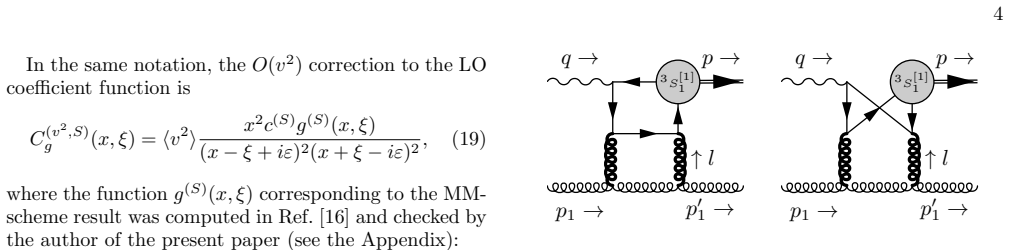
- [Sec. IV A, Eq. (34)] The one-loop impact factor result in Eq. (34) is the central new technical input, but it is presented only as the final output of a FeynCalc computation. No intermediate algebra, diagram-by-diagram decomposition, or notebook is provided. The Appendix's check of the O(v^2) LO coefficient function is not a check of this one-loop impact factor. For reproducibility, the authors should either include a derivation sketch (e.g. the decomposition of the diagrams, the treatment of Glauber regions, and the k^2 expansion before l_+ integration) or make the FeynCalc notebook available as supplemental material. This is a load-bearing point because all subsequent results, including the b_1,b_2 coefficients and the cancellation claim, depend on Eq. (34).
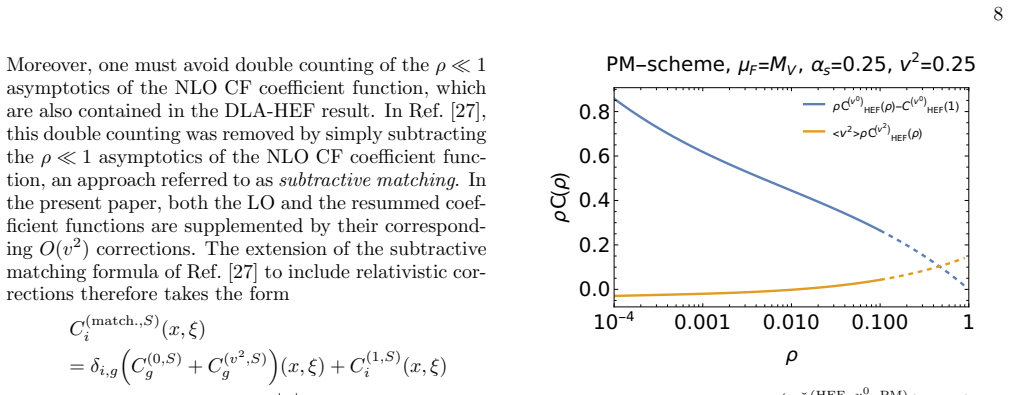
- [Sec. IV C, after Eq. (65)] The subtractive matching in Eq. (65) includes the O(v^2) HEF resummed term ˇC^(HEF,v2)_i(ρ) over the whole range 0<ρ<1, while the paper notes that the moderate-ρ region is unphysical and may have a non-negligible contribution to the convolution. No matching uncertainty or alternative prescription (e.g. InEW matching, mentioned only as planned) is used to estimate the effect of this region. Since the polynomial (b0+b1 γ+b2 γ^2) in Eq. (49) has different behaviour away from ρ≪1, the factor (1−⟨v^2⟩/6) in Eq. (64) is not representative of the matched amplitude. The robustness claim therefore needs either an explicit assessment of the moderate-ρ region or a clear statement that the cancellation is an asymptotic, not a matched-amplitude, property.
minor comments (6)
- [Abstract and Sec. III] The abstract says the new HEF term cancels the μ_F dependence of the O(v^2) correction to the LO coefficient function. Strictly, the LO coefficient function C^(v2)_g in Eq. (19) has no explicit μ_F dependence; the μ_F dependence enters through the GPD in the convolution (14). Please clarify this wording in the abstract and Sec. IV C.
- [Eq. (56) and Eq. (65)] The notation ˇC is introduced only for the O(v^0) resummed coefficient in Eq. (57), but Eq. (65) uses ˇC^(HEF,v2)_i without definition. State explicitly that this is the inverse Mellin transform of Eq. (49) with the δ(1−ρ) term (the b_0 term) removed, consistent with the check notation.
- [Fig. 3 and Sec. IV C] The figure is plotted only at μ_F=M_V. Since the entire motivation concerns μ_F dependence, a second panel at e.g. μ_F=2M_V and μ_F=M_V/2 would be much more informative than the single-scale plot. This is related to the major comment about the cancellation claim.
- [Appendix A] Minor typos: "can not write-down" should be "cannot write down"; "to it's v^2=0 limit" should be "to its"; "funci ton" should be "function". Also, the sentence after Eq. (A8) is incomplete and should be rephrased.
- [Eq. (54) and Fig. 2] The function θ(q_T^2 < M_V^2/4) is a sharp step; the dotted line in Fig. 2 appears as a plateau. Consider adding a label or a comment that the step is schematic, to avoid confusion with a smooth fall-off.
- [General] The dependence of Eq. (65) on the NLO coefficient C^(1,S)_i is not given explicitly (it is taken from Ref. [15]). For a self-contained presentation, at least the small-ρ asymptotics of C^(1,S)_i that are subtracted in the matching should be quoted or briefly summarised.
Circularity Check
No significant circularity: the O(v^2) resummed coefficient is derived from an independent diagrammatic calculation and external inputs; reliance on the author's prior DLA-HEF paper is not a circular reduction.
full rationale
The paper's derivation chain is self-contained for the new O(v^2) result. The impact factors h^(v2,MM) and h^(v2,PM) (Eqs. 39 and 41) are obtained from a one-loop diagrammatic calculation (Sec. IV A), not fitted or inferred from the final resummed coefficient. The Mellin-space resummed expressions (Eqs. 48-49) follow from the convolution (43) with the standard DLA-HEF resummation function (45); the coefficients b0, b1, b2 in Eq. 49 are fixed analytic moments (Eqs. 54-55) of the computed impact factor. The smallness in the PM scheme and the ρ→0 factor (1−⟨v^2⟩/6) (Eq. 64) are consequences of the explicit values b0^(PM)+b1^(PM)+b2^(PM)=−1/6, which are not assumed but obtained from the calculation. External inputs (⟨v^2⟩ from potential/lattice, the Gremm–Kapustin relation Eq. 4) are not fitted to the target prediction. The only reliance on the author's prior Ref. [27] is for the O(v^0) DLA-HEF framework; that prior work is published, parameter-free, and does not contain the O(v^2) result, so it provides independent support. Footnote [44] acknowledges a consistency limitation regarding GPD evolution, but this is an assumption/limitation of the framework, not a circular reduction of the new result to its inputs. The skeptic concern about moderate-ρ contributions is a correctness/robustness issue, not circularity.
Axiom & Free-Parameter Ledger
free parameters (1)
- ⟨v²⟩ =
~0.25 for J/ψ (external, not fitted)
axioms (6)
- domain assumption NRQCD factorization for exclusive quarkonium photoproduction
- domain assumption DLA-HEF resummation factor C_gg(N,q_T²)=γ_N/q_T² (q_T²/μ_F²)^{γ_N} captures LLA/next-to-LLA high-energy corrections
- domain assumption Glauber-region dominance and Gribov propagator replacement
- domain assumption Gremm-Kapustin relation between ⟨v²⟩ and quarkonium mass
- domain assumption Conventional GPD evolution is adequate alongside DLA-HEF resummation
- domain assumption GPD smoothness at x=±ξ for the real part of the amplitude
read the original abstract
The $O(v^2)$ correction to the high-energy resummed coefficient function for the exclusive photoproduction of vector ($1^{--}$) heavy quarkonia off hadrons is computed, thereby taking into account corrections of $O(v^2 \alpha_s^n \ln^{n-1}(x/\xi))$. When expressed in terms of the physical vector-meson mass ($M_V$) and the relative heavy-quark velocity ($\langle v^2 \rangle$) using the Gremm-Kapustin relation, the computed correction turns out to be negligible at the scale $\mu_F=M_V$. However, it partially cancels the $\mu_F$ dependence of the $O(v^2)$ correction to the LO coefficient function in $\alpha_s$, thereby improving the robustness of the predictions.
Figures


Reference graph
Works this paper leans on
-
[1]
Diffractive J / psi electroproduc- tion in LLA QCD,
M. G. Ryskin, “Diffractive J / psi electroproduc- tion in LLA QCD,” Z. Phys. C57, 89-92 (1993) doi:10.1007/BF01555742
-
[2]
ExclusiveJ/ψand Υ photoproduction and the lowxgluon,
S. P. Jones, A. D. Martin, M. G. Ryskin and T. Teub- ner, “ExclusiveJ/ψand Υ photoproduction and the lowxgluon,” J. Phys. G43, no.3, 035002 (2016) doi:10.1088/0954-3899/43/3/035002 [arXiv:1507.06942 [hep-ph]]
Pith/arXiv arXiv 2016
-
[3]
The exclusiveJ/ψprocess at the LHC tamed to probe the lowxgluon,
S. P. Jones, A. D. Martin, M. G. Ryskin and T. Teub- ner, “The exclusiveJ/ψprocess at the LHC tamed to probe the lowxgluon,” Eur. Phys. J. C76, no.11, 633 (2016) doi:10.1140/epjc/s10052-016-4493-y [arXiv:1610.02272 [hep-ph]]
Pith/arXiv arXiv 2016
-
[4]
How to include exclusiveJ/ψproduc- tion data in global PDF analyses,
C. A. Flett, S. P. Jones, A. D. Martin, M. G. Ryskin and T. Teubner, “How to include exclusiveJ/ψproduc- tion data in global PDF analyses,” Phys. Rev. D101, no.9, 094011 (2020) doi:10.1103/PhysRevD.101.094011 [arXiv:1908.08398 [hep-ph]]
Pith/arXiv arXiv 2020
-
[5]
V. Guzey, E. Kryshen, M. Strikman and M. Zhalov, “Evidence for nuclear gluon shadowing from the AL- ICE measurements of PbPb ultraperipheral exclusive J/ψproduction,” Phys. Lett. B726, 290-295 (2013) doi:10.1016/j.physletb.2013.08.043 [arXiv:1305.1724 [hep-ph]]
Pith/arXiv arXiv 2013
-
[6]
V. Guzey and M. Zhalov, “ExclusiveJ/ψproduction in ultraperipheral collisions at the LHC: constrains on the gluon distributions in the proton and nuclei,” JHEP10, 207 (2013) doi:10.1007/JHEP10(2013)207 [arXiv:1307.4526 [hep-ph]]
Pith/arXiv arXiv 2013
-
[7]
K. J. Eskola, C. A. Flett, V. Guzey, T. L¨ oyt¨ ainen and H. Paukkunen, “Predictions for exclusiveΥpho- toproduction in ultraperipheral Pb + Pb collisions at the LHC at next-to-leading order in perturba- tive QCD,” Eur. Phys. J. C83, no.8, 758 (2023) doi:10.1140/epjc/s10052-023-11927-8 [arXiv:2303.03007 [hep-ph]]
Pith/arXiv arXiv 2023
-
[8]
K. J. Eskola, C. A. Flett, V. Guzey, T. L¨ oyt¨ ainen and H. Paukkunen, “Next-to-leading order perturbative QCD predictions for exclusive J/ψphotoproduction in oxygen-oxygen and lead-lead collisions at energies avail- able at the CERN Large Hadron Collider,” Phys. Rev. C107, no.4, 044912 (2023) [erratum: Phys. Rev. C108, no.6, 069901 (2023)] doi:10.1103/P...
Pith/arXiv arXiv 2023
-
[9]
K. J. Eskola, C. A. Flett, V. Guzey, T. L¨ oyt¨ ainen and H. Paukkunen, “Exclusive J/ψphotoproduc- tion in ultraperipheral Pb+Pb collisions at the CERN Large Hadron Collider calculated at next-to- leading order perturbative QCD,” Phys. Rev. C106, no.3, 035202 (2022) doi:10.1103/PhysRevC.106.035202 [arXiv:2203.11613 [hep-ph]]
Pith/arXiv arXiv 2022
-
[10]
Physics case for quarkonium studies at the Electron Ion Collider,
D. Boer, C. A. Flett, C. Flore, D. Kiko la, J. P. Lansberg, M. Nefedov, C. Van Hulse, S. Bhattacharya, J. Bor and M. Butenschoen,et al.“Physics case for quarkonium studies at the Electron Ion Collider,” Prog. Part. Nucl. Phys. 142, 104162 (2025) doi:10.1016/j.ppnp.2025.104162 [arXiv:2409.03691 [hep-ph]]
arXiv 2025
-
[11]
Physics of ultra-peripheral nuclear colli- sions,
C. A. Bertulani, S. R. Klein and J. Nys- trand, “Physics of ultra-peripheral nuclear colli- sions,” Ann. Rev. Nucl. Part. Sci.55, 271-310 (2005) doi:10.1146/annurev.nucl.55.090704.151526 [arXiv:nucl-ex/0502005 [nucl-ex]]
arXiv 2005
-
[12]
The Physics of Ultraperipheral Collisions at the LHC,
A. J. Baltz, G. Baur, D. d’Enterria, L. Frank- furt, F. Gelis, V. Guzey, K. Hencken, Y. Kharlov, M. Klasen and S. R. Klein,et al.“The Physics of Ultraperipheral Collisions at the LHC,” Phys. Rept. 458, 1-171 (2008) doi:10.1016/j.physrep.2007.12.001 [arXiv:0706.3356 [nucl-ex]]
Pith/arXiv arXiv 2008
-
[13]
Ultra- 11 peripheral heavy-ion collisions at the LHC,
J. G. Contreras and J. D. Tapia Takaki, “Ultra- 11 peripheral heavy-ion collisions at the LHC,” Int. J. Mod. Phys. A30, 1542012 (2015) doi:10.1142/S0217751X15420129
-
[14]
Imaging the nu- cleus with high-energy photons,
S. R. Klein and H. M¨ antysaari, “Imaging the nu- cleus with high-energy photons,” Nature Rev. Phys. 1, no.11, 662-674 (2019) doi:10.1038/s42254-019-0107- 6 [arXiv:1910.10858 [hep-ex]]
Pith/arXiv arXiv 2019
-
[15]
Exclusive photoproduction of a heavy vector meson in QCD,
D. Y. Ivanov, A. Schafer, L. Szymanowski and G. Kras- nikov, “Exclusive photoproduction of a heavy vector meson in QCD,” Eur. Phys. J. C34, no.3, 297-316 (2004) [erratum: Eur. Phys. J. C75, no.2, 75 (2015)] doi:10.1140/epjc/s2004-01712-x [arXiv:hep-ph/0401131 [hep-ph]]
Pith/arXiv arXiv 2004
-
[16]
Relativistic corrections to exclu- sive photoproduction of Quarkonia near-threshold,
S. K. Blask, S. Fleming, T. Mehen, J. Roy, I. W. Stew- art and F. Zhao, “Relativistic corrections to exclu- sive photoproduction of Quarkonia near-threshold,” JHEP06, 250 (2026) doi:10.1007/JHEP06(2026)250 [arXiv:2506.18905 [hep-ph]]
Pith/arXiv arXiv 2026
-
[17]
Rigor- ous QCD analysis of inclusive annihilation and produc- tion of heavy quarkonium,
G. T. Bodwin, E. Braaten and G. P. Lepage, “Rigor- ous QCD analysis of inclusive annihilation and produc- tion of heavy quarkonium,” Phys. Rev. D51, 1125- 1171 (1995) [erratum: Phys. Rev. D55, 5853 (1997)] doi:10.1103/PhysRevD.55.5853 [arXiv:hep-ph/9407339 [hep-ph]]
Pith/arXiv arXiv 1995
-
[18]
H. M¨ antysaari and J. Penttala, “Complete cal- culation of exclusive heavy vector meson produc- tion at next-to-leading order in the dipole picture,” JHEP08, 247 (2022) doi:10.1007/JHEP08(2022)247 [arXiv:2204.14031 [hep-ph]]
Pith/arXiv arXiv 2022
-
[19]
Parton distributions in the shockwave formalism,
S. Bhattacharya, C. Q. He, Z. B. Kang, D. Padilla and J. Penttala, “Parton distributions in the shockwave formalism,” JHEP04, 079 (2026) doi:10.1007/JHEP04(2026)079 [arXiv:2510.02254 [hep-ph]]
Pith/arXiv arXiv 2026
-
[20]
Exclusive vector meson electroproduc- tion,
D. Y. Ivanov, “Exclusive vector meson electroproduc- tion,” [arXiv:0712.3193 [hep-ph]]
-
[21]
J. P. Lansberg, M. Nefedov and M. A. Ozcelik, “Matching next-to-leading-order and high-energy- resummed calculations of heavy-quarkonium- hadroproduction cross sections,” JHEP05, 083 (2022) doi:10.1007/JHEP05(2022)083 [arXiv:2112.06789 [hep-ph]]
Pith/arXiv arXiv 2022
-
[22]
J. P. Lansberg, M. Nefedov and M. A. Ozcelik, “Cur- ing the high-energy perturbative instability of vector- quarkonium-photoproduction cross sections at order αα3 s with high-energy factorisation,” Eur. Phys. J. C84, no.4, 351 (2024) doi:10.1140/epjc/s10052-024-12588-x [arXiv:2306.02425 [hep-ph]]
Pith/arXiv arXiv 2024
-
[23]
Probing GPDs in photoproduction processes at hadron colliders,
D. Y. Ivanov, B. Pire, L. Szymanowski and J. Wagner, “Probing GPDs in photoproduction processes at hadron colliders,” [arXiv:1510.06710 [hep-ph]]
-
[24]
Heavy Quark Production in Very High-Energy Hadron Collisions,
J. C. Collins and R. K. Ellis, “Heavy Quark Production in Very High-Energy Hadron Collisions,” Nucl. Phys. B 360, 3-30 (1991) doi:10.1016/0550-3213(91)90288-9
-
[25]
GLUON CONTRIBUTIONS TO SMALL x HEA VY FLA VOR PRODUCTION,
S. Catani, M. Ciafaloni and F. Hautmann, “GLUON CONTRIBUTIONS TO SMALL x HEA VY FLA VOR PRODUCTION,” Phys. Lett. B242, 97-102 (1990) doi:10.1016/0370-2693(90)91601-7
-
[26]
High-energy factorization and small x heavy flavor production,
S. Catani, M. Ciafaloni and F. Hautmann, “High-energy factorization and small x heavy flavor production,” Nucl. Phys. B366, 135-188 (1991) doi:10.1016/0550- 3213(91)90055-3
doi:10.1016/0550- 1991
-
[27]
C. A. Flett, J. P. Lansberg, S. Nabeebaccus, M. Nefedov, P. Sznajder and J. Wagner, “Exclu- sive vector-quarkonium photoproduction at NLO in αs in collinear factorisation with evolution of the generalised parton distributions and high-energy resummation,” Phys. Lett. B859, 139117 (2024) doi:10.1016/j.physletb.2024.139117 [arXiv:2409.05738 [hep-ph]]
arXiv 2024
-
[28]
Annihilation of S wave quarkonia and the measurement of alpha-s,
M. Gremm and A. Kapustin, “Annihilation of S wave quarkonia and the measurement of alpha-s,” Phys. Lett. B407, 323-330 (1997) doi:10.1016/S0370- 2693(97)00744-2 [arXiv:hep-ph/9701353 [hep-ph]]
Pith/arXiv arXiv 1997
-
[29]
Potential- model calculation of an order-v(2) NRQCD ma- trix element,
G. T. Bodwin, D. Kang and J. Lee, “Potential- model calculation of an order-v(2) NRQCD ma- trix element,” Phys. Rev. D74, 014014 (2006) doi:10.1103/PhysRevD.74.014014 [arXiv:hep- ph/0603186 [hep-ph]]
arXiv 2006
-
[30]
M Srenormalization ofS-wave quarko- nium wavefunctions at the origin,
H. S. Chung, “ M Srenormalization ofS-wave quarko- nium wavefunctions at the origin,” JHEP12, 065 (2020) doi:10.1007/JHEP12(2020)065 [arXiv:2007.01737 [hep- ph]]
Pith/arXiv arXiv 2020
-
[31]
Quarkonium decay matrix elements from quenched lattice QCD,
G. T. Bodwin, D. K. Sinclair and S. Kim, “Quarkonium decay matrix elements from quenched lattice QCD,” Phys. Rev. Lett.77, 2376-2379 (1996) doi:10.1103/PhysRevLett.77.2376 [arXiv:hep- lat/9605023 [hep-lat]]
arXiv 1996
-
[32]
Bot- tomonium decay matrix elements from lattice QCD with two light quarks,
G. T. Bodwin, D. K. Sinclair and S. Kim, “Bot- tomonium decay matrix elements from lattice QCD with two light quarks,” Phys. Rev. D65, 054504 (2002) doi:10.1103/PhysRevD.65.054504 [arXiv:hep- lat/0107011 [hep-lat]]
arXiv 2002
-
[33]
P. Hoodbhoy, “Wave function corrections and off for- ward gluon distributions in diffractive J / psi elec- troproduction,” Phys. Rev. D56, 388-393 (1997) doi:10.1103/PhysRevD.56.388 [arXiv:hep-ph/9611207 [hep-ph]]
Pith/arXiv arXiv 1997
-
[34]
Vector meson elec- troproduction at small Bjorken-x and generalized par- ton distributions,
S. V. Goloskokov and P. Kroll, “Vector meson elec- troproduction at small Bjorken-x and generalized par- ton distributions,” Eur. Phys. J. C42, 281-301 (2005) doi:10.1140/epjc/s2005-02298-5 [arXiv:hep-ph/0501242 [hep-ph]]
Pith/arXiv arXiv 2005
-
[35]
Matching factorization the- orems with an inverse-error weighting,
M. G. Echevarria, T. Kasemets, J. P. Lansberg, C. Pisano and A. Signori, “Matching factorization the- orems with an inverse-error weighting,” Phys. Lett. B 781, 161-168 (2018) doi:10.1016/j.physletb.2018.03.075 [arXiv:1801.01480 [hep-ph]]
Pith/arXiv arXiv 2018
-
[36]
Order-v 4 corrections to S-wave quarkonium decay,
G. T. Bodwin and A. Petrelli, “Order-v 4 corrections to S-wave quarkonium decay,” Phys. Rev. D66, 094011 (2002) [erratum: Phys. Rev. D87, no.3, 039902 (2013)] doi:10.1103/PhysRevD.66.094011 [arXiv:hep- ph/0205210 [hep-ph]]
arXiv 2002
-
[37]
Exclusive two-vector-meson production from e+ e- annihilation,
G. T. Bodwin, E. Braaten, J. Lee and C. Yu, “Exclusive two-vector-meson production from e+ e- annihilation,” Phys. Rev. D74, 074014 (2006) doi:10.1103/PhysRevD.74.074014 [arXiv:hep- ph/0608200 [hep-ph]]
arXiv 2006
-
[38]
FEYN CALC: Computer algebraic calculation of Feynman ampli- tudes,
R. Mertig, M. Bohm and A. Denner, “FEYN CALC: Computer algebraic calculation of Feynman ampli- tudes,” Comput. Phys. Commun.64, 345-359 (1991) doi:10.1016/0010-4655(91)90130-D
-
[39]
New De- velopments in FeynCalc 9.0,
V. Shtabovenko, R. Mertig and F. Orellana, “New De- velopments in FeynCalc 9.0,” Comput. Phys. Com- mun.207, 432-444 (2016) doi:10.1016/j.cpc.2016.06.008 [arXiv:1601.01167 [hep-ph]]
Pith/arXiv arXiv 2016
-
[40]
FeynCalc 9.3: New features and improvements,
V. Shtabovenko, R. Mertig and F. Orellana, “FeynCalc 9.3: New features and improvements,” 12 Comput. Phys. Commun.256, 107478 (2020) doi:10.1016/j.cpc.2020.107478 [arXiv:2001.04407 [hep-ph]]
arXiv 2020
-
[41]
Feyn- Calc 10: Do multiloop integrals dream of computer codes?,
V. Shtabovenko, R. Mertig and F. Orellana, “Feyn- Calc 10: Do multiloop integrals dream of computer codes?,” Comput. Phys. Commun.306, 109357 (2025) doi:10.1016/j.cpc.2024.109357 [arXiv:2312.14089 [hep- ph]]
arXiv 2025
-
[42]
Drawing Feynman diagrams with Latex and Metafont,
T. Ohl, “Drawing Feynman diagrams with Latex and Metafont,” Comput. Phys. Commun.90, 340-354 (1995) doi:10.1016/0010-4655(95)90137-S [arXiv:hep- ph/9505351 [hep-ph]]
arXiv 1995
-
[43]
[21, 22]
Similar effects in inclusive heavy-quarkonium produc- tion have been studied in Refs. [21, 22]
-
[44]
The DLA resolves this in- consistency, allowing one to use the conventional GPDs extracted from global fits
In principle, consistency with the complete LLA com- putation of the coefficient function would require the GPDs to evolve withµ F according to low-xLLA- resummed evolution kernels. The DLA resolves this in- consistency, allowing one to use the conventional GPDs extracted from global fits
-
[45]
However, these inclusive LDMEs are related to eqn
Note that in the case of inclusive production or decays, the matrix elementswithoutprojectors 0 0 in the middle appear in the definition of⟨v 2⟩(incl.). However, these inclusive LDMEs are related to eqn. (3) through the vacuum-saturation approximation, which is believed to be accurate up to higher-order corrections inv 2
discussion (0)
Sign in with ORCID, Apple, or X to comment. Anyone can read and Pith papers without signing in.