REVIEW 4 major objections 4 minor 35 references
A quantum battery made from 57Fe nuclei in a hard X-ray waveguide stores energy superlinearly in density: peak stored excitation scales as n^1.37.
Reviewed by Pith at T0; open to challenge. T0 means a machine referee read the full paper against a public rubric. the ladder, T0–T4 →
T0 review · deepseek-v4-flash
2026-08-02 01:48 UTC pith:UMB2ZBWH
load-bearing objection A serious theoretical proposal with a plausible new mechanism (collectively enhanced nuclear absorption in a waveguide), but the headline numbers rest on an undisclosed optimization and an unexamined two-level truncation. the 4 major comments →
Collective Enhancement of Nuclear Excitation for a Nuclear Quantum Battery
The pith
A machine-rendered reading of the paper's core claim, the machinery that carries it, and where it could break.
Core claim
The central claim is that a continuous ensemble of 57Fe nuclei embedded in a planar hard X-ray waveguide, driven by a self-consistently shaped resonant 14.4 keV pulse, charges superextensively: a log-log regression of peak stored excitation ne,max versus nuclear density n gives ne,max ∝ n^1.37. The mechanism is the destructive interference of the incident drive with the local radiative self-term—the field each nucleus re-emits into the guided mode during preparation—so that radiative leakage is suppressed and absorption is redirected into collective nuclear-exciton manifolds. The paper reports an enhancement factor up to η ≈ 56 relative to an identical drive in free space, identifies the sup
What carries the argument
The enabling mechanism is the self-consistent waveform condition (Eq. 10): the incident field is replaced by B_in+ → B_in+ + (1/2) γ_loc ρ_N σ_ge, so the drive everywhere cancels the locally re-radiated field generated by the coherence it induces. This suppresses the local radiative decay term γ_loc in the decomposition Γ_rad = γ_loc δ + Γ̃, allowing the nonlocal guided-mode Green function Γ̃ to build long-range couplings between spatial slices of the nuclear layer. The dynamics are solved as a Maxwell-Bloch system over 100 slices, with the guided field at each slice given by the incident field plus retarded scattering from all other slices.
Load-bearing premise
The protocol assumes the self-consistent drive exists and can be generated—an incident pulse whose spatial shape everywhere cancels the field that it itself makes the nuclei re-emit—and that the 57Fe transition can be treated as a two-level system despite its eight magnetic sublevels.
What would settle it
Measure peak stored excitation for two densities n and 2n in identical waveguides, with the same optimized drive envelope and the same energy per nucleus: the n^1.37 scaling predicts a ratio of about 2^1.37 ≈ 2.6. A ratio at or below 2, or an enhancement factor over the free-space benchmark at or below 1, would falsify the collective-superlinear claim.
If this is right
- If the scaling holds, ~30% excitation of 57Fe stores roughly two orders of magnitude more energy density than molecular-exciton quantum batteries.
- Denser ensembles store more per nucleus and charge faster, since collective coupling shortens the time to reach peak stored energy.
- The required peak intensity, ~10^10 W/cm^2, is far below the ~10^22 W/cm^2 available with focused hard X-ray sources, so the experiment is within reach of existing component demonstrations.
- The waveform-matching principle extends to long-lived nuclear isomers such as 99mTc, offering a path to batteries with storage times set by isomer half-lives, from hours to years.
- After the drive ends, the stored excitation relaxes near the natural 57Fe decay rate, so retention is not sacrificed by the collective charging advantage.
Where Pith is reading between the lines
- The exponent 1.37 is a curve fit over the simulated density range; extrapolating it to much higher densities, where saturation and inhomogeneous effects take over, is not guaranteed by the paper.
- Because the waveform is spatially structured and depends on the coherence it creates, the practical bottleneck is the pulse shaper, not the source intensity; the achievable exponent in a real device may be set by how closely the implemented envelope matches the self-consistent one.
- The two-level truncation of the eight magnetic sublevels of the 57Fe I=3/2 manifold is untested; multi-level interference could either enhance or degrade the collective charging, and should be checked in a full multilevel simulation.
- If the protocol transfers to isomers, an analogous time-reversed waveform could be used for controlled discharge, effectively making the charger and load impedance-matched; the paper gestures at retrieval via isomer triggering but does not analyze the discharge efficiency.
Editorial analysis
A structured set of objections, weighed in public.
Referee Report
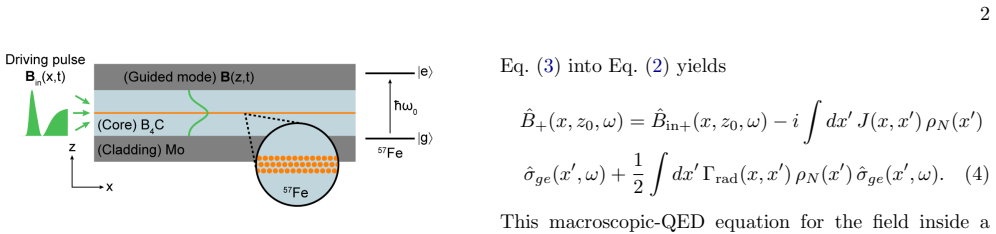
Summary. The paper proposes a nuclear quantum battery based on a dense ensemble of 57Fe Mössbauer nuclei embedded in a planar hard X-ray waveguide. Using macroscopic QED and a Green-function waveguide-QED formalism, the authors derive a Maxwell–Bloch model for the nuclei as effective two-level systems, and introduce a self-consistent waveform-engineering protocol in which the incident guided field is shaped to cancel the locally re-radiated field (Eq. 10). They report superlinear charging, with peak stored excitation scaling as n_e,max ∝ n^1.37, and an enhancement of up to η≃56 relative to a free-space benchmark with the same drive. The paper also discusses feasibility using contemporary X-ray sources and extension to long-lived nuclear isomers.
Significance. If robust, this is a significant contribution: it identifies a concrete mechanism—waveguide-mediated collective absorption beyond linear response—through which hard X-ray nuclear ensembles could store energy with high density and long retention. The manuscript's strengths include a careful macroscopic-QED derivation in the SI, a 1D waveguide reduction with explicit approximations, a numerical convergence check for the spatial slicing, a self-consistent drive protocol, and a free-space benchmark. The quantitative claims, however, rest on model reductions and fitting procedures that are not yet fully justified; the n^1.37 exponent and η≃56 are central to the paper's thesis and need stronger support.
major comments (4)
- [Superextensive charging, Fig. 3(a)] The central quantitative claim, n_e,max ∝ n^1.37, is supported only by an unlabeled log–log regression. No R², error bars, density range, or number of points are given, and the abstract states 'approximately like n√n' (exponent 1.5) while the main text reports 1.37. The fit diagnostics and the discrepancy between the abstract and the fitted exponent must be resolved; without them, the superlinear exponent is not established to the standard claimed.
- [Waveguide nuclear QB, Eq. (10)] The 57Fe M1 transition (I_g=1/2 → I_e=3/2) is truncated to a scalar two-level system with the parenthetical 'we ignore the dynamics of the 2I+1 projective sublevels.' This truncation is load-bearing: Eq. (10) cancels a scalar local self-term ½γ_loc ρ σ_ge, but in the degenerate multilevel system the local radiative self-term is a matrix with different Clebsch–Gordan weights for each driven transition. No argument is given that a single waveguide polarization can simultaneously cancel all local self-fields, or that the symmetric collective manifold and the n^1.37 scaling survive the multilevel structure. The SI convergence checks (Sec. II.A) address spatial slicing only.
- [Eq. (10) and self-consistent waveform] The protocol requires the incident field to satisfy a fixed-point condition that depends on the coherence it generates. The paper does not give an existence, uniqueness, or convergence argument for this fixed point, nor a robustness analysis against imperfect or bandwidth-limited pulse shaping. Since the authors state that generating the extended structured envelope is the main experimental challenge, the physical realizability of the protocol hinges on this missing analysis. A numerical iteration or a stability criterion should be provided.
- [Free-space benchmark, η≃56] The enhancement factor η=n_e,max/n^fs_e,max compares the waveguide system against free space using 'the identical engineered drive envelope.' But that drive envelope was optimized for the waveguide self-consistent condition, so it may be far from optimal in free space. The claim that the enhancement 'originates from the waveguide-mediated environment rather than waveform choice' is therefore not established. A fair comparison would optimize the free-space drive under the same fixed-resource constraint, or otherwise show that the free-space result is insensitive to waveform shaping.
minor comments (4)
- [Abstract vs. main text] The abstract states the scaling is 'approximately like n√n' (exponent 3/2), while the main text and conclusion report n^1.37. These should be reconciled, with the fitted exponent and its uncertainty stated consistently.
- [Fig. 2 and Fig. 3] The axis labels and units are not fully specified in the figure captions; for example, the time axis in Fig. 2 and the density axis in Fig. 3 should be explicitly labeled with physical units. The shaded 'optimized incident waveform' curves should also state whether they show Ω_in(t) or |Ω_in(t)|.
- [Main text, waveguide parameters] The dimensionless coupling coefficient ζ is introduced without definition; define it in the main text (or refer explicitly to the SI equation). The notation also switches between σ_ge and σ̂_ge and between B_in+ and B_in^+; please unify.
- [SI Sec. II.B] When discussing earlier linear-response treatments, the text says 'the optical Bloch equations are solved under the assumption of a prescribed driving field.' This could be misread as a critique; clarify that the present work goes beyond that by including back-action self-consistently.
Circularity Check
No significant circularity: n_e,max ∝ n^1.37 and η≃56 are model outputs, not inputs; Eq. (10) is a protocol definition.
full rationale
The paper's central claims are produced by solving the Maxwell–Bloch equations (Eq. 8) with the guided-mode field (Eq. 5) under a self-consistent drive defined by Eq. (10). The only step that is literally 'by construction' is the cancellation of the local radiative self-term: Eq. (10) defines the incident field to include the term ½γ_loc ρ_N σ_ge, so the statement that the protocol suppresses local radiative leakage is a property of the definition rather than a derived prediction. However, the paper does not present that suppression as the headline discovery; it presents it as the engineering intervention. The headline results — superlinear scaling n_e,max ∝ n^1.37, the decline of charging time with n, and η up to 56 relative to the free-space benchmark — are numerical outputs of the model, not parameters fitted to data or imposed by the resource constraint ∫|Ω_in|²dt/n = const. No uniqueness theorem is imported from the authors' prior work, and no load-bearing step is justified solely by a self-citation. The manuscript's explicit limitations — the truncation of the 2I+1 projective sublevels ('we ignore the dynamics of the 2I+1 projective sublevels of each manifold') and the experimental challenge of generating the structured temporal envelope — are validity/feasibility concerns, not circularity: the reported exponent is a property of the stated two-level model, and the absence of an existence/uniqueness proof for the Eq. (10) fixed point does not make the computed scaling equivalent to an input. Therefore no circularity is found.
Axiom & Free-Parameter Ledger
free parameters (5)
- Optimized incident waveform Ω_in(t) per density =
undisclosed (optimized function of time at each n)
- Peak-excitation scaling exponent =
1.37
- Driving window t_End =
100/γ_nr
- Waveguide geometric/material parameters =
δ_core=0.8e-6, δ_clad=3.5e-6, β_core=0.5e-8, β_clad=2.0e-8; d_core=18 nm; ζ=W_y L u(z0)^2 ≈ 1
- Discretization =
N_x=100 slices, Δx=0.5 μm
axioms (6)
- standard math Macroscopic QED input-output form of the field with medium-assisted Green tensor (Eq. 2)
- domain assumption Rotating-wave approximation and Markov approximation for the radiative reservoir
- domain assumption Single guided TE mode; 1D propagation; uniform envelope across the thin 57Fe layer
- ad hoc to paper 57Fe M1 transition treated as effective two-level system (sublevel dynamics ignored)
- domain assumption Negligible Bragg scattering; polycrystalline continuum ensemble with a single resonance frequency
- domain assumption Negligible retardation |x-x'|/v_g << T1
read the original abstract
Current implementations of quantum batteries are constrained by limited energy density and short retention times associated with the electronic or molecular excitations. Here we propose a nuclear quantum battery based on collective excitation of the $^{57}$Fe nuclei of density $n$ embedded in a planar hard X-ray waveguide. Using a Green function waveguide-QED description, we study charging via excitation beyond linear response, where saturation and drive back-action reshape the incident pulse. We introduce a self-consistent waveform-engineering protocol that inhibits local radiative decay in the waveguide thus promoting absorption into high-lying collective nuclear excitation manifolds. We show an enhanced excitation cross section of the nuclear ensemble which yields superlinear charging, with maximum studied energy density scaling approximately like $n \sqrt{n}$. Our results provide a route to high-energy-density quantum charging at hard X-ray energies using contemporary X-ray sources and waveguide architectures by identifying nonlinear, collectively enhanced absorption as a key mechanism for nuclear quantum battery operation.
Figures


Reference graph
Works this paper leans on
-
[1]
F. Campaioli, S. Gherardini, J. Q. Quach, M. Polini, and G. M. Andolina, Rev. Mod. Phys.96, 031001 (2024), arXiv:2308.02277 [quant-ph]. 6
Pith/arXiv arXiv 2024
-
[2]
J. Q. Quach, K. E. McGhee, L. Ganzer, D. M. Rouse, B. W. Lovett, E. M. Gauger, J. Keeling, G. Cerullo, D. G. Lidzey, and T. Virgili, Sci. Adv.8, abk3160 (2021), arXiv:2012.06026 [quant-ph]
Pith/arXiv arXiv 2021
-
[3]
R. Alicki and M. Fannes, Phys. Rev. E87, 042123 (2013), arXiv:1211.1209 [quant-ph]
Pith/arXiv arXiv 2013
-
[4]
F. Campaioli, F. A. Pollock, F. C. Binder, L. C. C´ eleri, J. Goold, S. Vinjanampathy, and K. Modi, Phys. Rev. Lett.118, 150601 (2017), arXiv:1612.04991 [quant-ph]
Pith/arXiv arXiv 2017
-
[5]
D. Ferraro, M. Campisi, G. M. Andolina, V. Pellegrini, and M. Polini, Phys. Rev. Lett.120, 117702 (2018), arXiv:1707.04930 [cond-mat.mes-hall]
Pith/arXiv arXiv 2018
-
[6]
D. Yang, S.-h. Oh, J. Han, G. Son, J. Kim, J. Kim, M. Lee, and K. An, Nature Photon.15, 272 (2021), arXiv:1906.06477 [quant-ph]
Pith/arXiv arXiv 2021
-
[7]
K. Hymas, J. B. Muir, D. Tibben, J. van Embden, T. Hi- rai, C. J. Dunn, D. E. G´ omez, J. A. Hutchison, T. A. Smith, and J. Q. Quach, Light: Science & Applications 15, 168 (2026), arXiv:2501.16541 [quant-ph]
Pith/arXiv arXiv 2026
-
[8]
R¨ ohlsberger and J
R. R¨ ohlsberger and J. Evers, Quantum optical phenomena in nuclear resonant scattering, inModern M¨ ossbauer Spec- troscopy: New Challenges Based on Cutting-Edge Tech- niques, edited by Y. Yoshida and G. Langouche (Springer Singapore, Singapore, 2021) pp. 105–171
2021
-
[9]
Bergmann, L
B. Bergmann, L. Javora, and P. Smolyanskiy, Eur. Phys. J. A61, 189 (2025)
2025
-
[10]
K. P. Heeg, A. Kaldun, C. Strohm, C. Ott, R. Subra- manian, D. Lentrodt, J. Haber, H.-C. Wille, S. Goerttler, R. R¨ uffer, C. H. Keitel, R. R¨ ohlsberger, T. Pfeifer, and J. Evers, Nature (London)590, 401 (2021)
2021
-
[11]
D. Lentrodt, C. H. Keitel, and J. Evers, Phys. Rev. Lett. 135, 033801 (2025), arXiv:2405.12773 [quant-ph]
Pith/arXiv arXiv 2025
-
[12]
R¨ ohlsberger, J
R. R¨ ohlsberger, J. Evers, and S. Shwartz, Quantum and nonlinear optics with hard x-rays, inSynchrotron Light Sources and Free-Electron Lasers: Accelerator Physics, In- strumentation and Science Applications, edited by E. J. Jaeschke, S. Khan, J. R. Schneider, and J. B. Hast- ings (Springer International Publishing, Cham, 2016) pp. 1197–1229
2016
-
[13]
L. Wolff and J. Evers, Phys. Rev. A108, 043714 (2023), arXiv:2308.07644 [quant-ph]
Pith/arXiv arXiv 2023
-
[14]
L. M. Lohseet al., Phys. Rev. Lett.135, 053601 (2025), arXiv:2403.06508 [quant-ph]
arXiv 2025
-
[16]
K. Lalumi` ere, B. C. Sanders, A. F. van Loo, A. Fedorov, A. Wallraff, and A. Blais, Phys. Rev. A88, 043806 (2013), arXiv:1305.7135 [quant-ph]
Pith/arXiv arXiv 2013
-
[17]
A. S. Sheremet, M. I. Petrov, I. V. Iorsh, A. V. Poshakin- skiy, and A. N. Poddubny, Rev. Mod. Phys.95, 015002 (2023), arXiv:2103.06824 [quant-ph]
Pith/arXiv arXiv 2023
-
[18]
Gruner and D.-G
T. Gruner and D.-G. Welsch, Physical Review A53, 1818 (1996)
1996
-
[19]
H. T. Dung, L. Knoll, and D.-G. Welsch, Phys. Rev. A 57, 3931 (1998), arXiv:quant-ph/9711039
Pith/arXiv arXiv 1998
-
[20]
A. Asenjo-Garcia, J. D. Hood, D. E. Chang, and H. J. Kimble, Phys. Rev. A95, 033818 (2017), arXiv:1606.04977 [quant-ph]
Pith/arXiv arXiv 2017
-
[21]
S. Scheel and S. Y. Buhmann, Acta Phys. Slov.58, 675 (2008), arXiv:0902.3586 [quant-ph]
Pith/arXiv arXiv 2008
-
[22]
K. D. B. Higgins, S. C. Benjamin, T. M. Stace, G. J. Milburn, B. W. Lovett, and E. M. Gauger, Nature Com- munications5, 4705 (2014), arXiv:1306.1483 [quant-ph]
Pith/arXiv arXiv 2014
-
[23]
J. Shan, Y. Chang, L. Zhang, F. Wang, J. Yuan, X. Kong, and Y.-G. Ma, Phys. Rev. Lett.136, 113601 (2026)
2026
-
[24]
M. Stobi´ nska, G. Alber, and G. Leuchs, EPL86, 14007 (2009), arXiv:0808.1666 [quant-ph]
Pith/arXiv arXiv 2009
-
[25]
V. Leong, M. A. Seidler, M. Steiner, A. Cer` e, and C. Kurtsiefer, Nature Communications7, 13716 (2016), arXiv:1604.08020 [quant-ph]
Pith/arXiv arXiv 2016
-
[26]
Y. Chen, M. Wubs, J. Mørk, and A. Femius Koen- derink, New Journal of Physics13, 103010 (2011), arXiv:1107.0120 [physics.optics]
Pith/arXiv arXiv 2011
-
[27]
Yamada, S
J. Yamada, S. Matsuyama, I. Inoue, T. Osaka, T. In- oue, N. Nakamura, Y. Tanaka, Y. Inubushi, T. Yabu- uchi, K. Tono, K. Tamasaku, H. Yumoto, T. Koyama, H. Ohashi, M. Yabashi, and K. Yamauchi, Nature Pho- tonics18, 685 (2024)
2024
-
[28]
J. P. Sutter, S. G. Alcock, Y. Kashyap, I. Nistea, H. Wang, and K. Sawhney, Journal of synchrotron radia- tion23, 1333 (2016)
2016
-
[29]
D. Schmidt, D. V. Stetten, M. Agthe, A. R. Pear- son, G. . S. Beddard, B. A. Yorke, F. Tellkamp, and P. Gaal, arXiv e-prints , arXiv:2505.08502 (2025), arXiv:2505.08502 [cond-mat.mtrl-sci]
Pith/arXiv arXiv 2025
-
[30]
Walker and G
P. Walker and G. Dracoulis, Nature (London)399, 35 (1999)
1999
-
[31]
P. M. Walker and Z. Podoly´ ak, Nuclear isomers, inHand- book of Nuclear Physics, edited by I. Tanihata, H. Toki, and T. Kajino (Springer Nature Singapore, Singapore,
-
[32]
Lestinsky, V
M. Lestinsky, V. Andrianov, and B. Aurand et al, The European Physical Journal Special Topics225, 797 (2016)
2016
-
[33]
Matsuzaki and H
T. Matsuzaki and H. Sakurai, Journal of Radioanalytical and Nuclear Chemistry333, 6007–6014 (2024)
2024
-
[34]
W.-T. Liao, A. P´ alffy, and C. H. Keitel, Physics Letters B705, 134 (2011)
2011
-
[35]
Y.-B. Gao and F.-Q. Dou, arXiv e-prints (2026), arXiv:2605.24935 [quant-ph]
Pith/arXiv arXiv 2026
-
[36]
Y. Wu, C. H. Keitel, and A. P´ alffy, Phys. Rev. Lett.122, 212501 (2019). 1 Supplementary Information: Collective Enhancement of Nuclear Excitation for a Nuclear Quantum Battery I. EFFECTIVE A TOM-A TOM HAMIL TONIAN We consider polycrystalline nuclear ensemble, where the contributions from the Bragg scattering is negligible. This allows us to model the nu...
Pith/arXiv arXiv 2019
discussion (0)
Sign in with ORCID, Apple, or X to comment. Anyone can read and Pith papers without signing in.