REVIEW 3 major objections 5 minor 21 references
A pre-training information score picked the strongest two-input MRI configuration before segmentation training, and the choice held up on an independent test set.
Reviewed by Pith at T0; open to challenge. T0 means a machine referee read the full paper against a public rubric. the ladder, T0–T4 →
T0 review · deepseek-v4-flash
2026-08-01 23:29 UTC pith:PPYJEGKK
load-bearing objection A competent, honestly reported proof of concept that picks T1c+T2-FLAIR as the best two-input MRI set before training, though the predictive claim is statistically weak and the compression surrogate is unvalidated. the 3 major comments →
Partial Information Decomposition as a Multi-Contrast 3D MRI Selection Strategy for Resource-Constrained Deep Neural Network Training in Brain Tumor Segmentation
The pith
A machine-rendered reading of the paper's core claim, the machinery that carries it, and where it could break.
Core claim
The central claim is that a region-aware MMI-PID score, defined on quantized autoencoder latents and discretized regional tumor burden, selects the strongest two-input configuration before segmentation training. In the four-contrast experiment, the score selected T1c+T2-FLAIR, which on the independent test cohort was the best-performing two-input model (Dice 0.676) and ranked second only to the full four-input model (Dice 0.687), retaining 98.5% of the full model's mean Dice. Post-hoc Shapley attribution on the full-input model independently identified T2-FLAIR and T1c as the top two contributing inputs and their interaction as the largest, corroborating the pre-training selection. The paper
What carries the argument
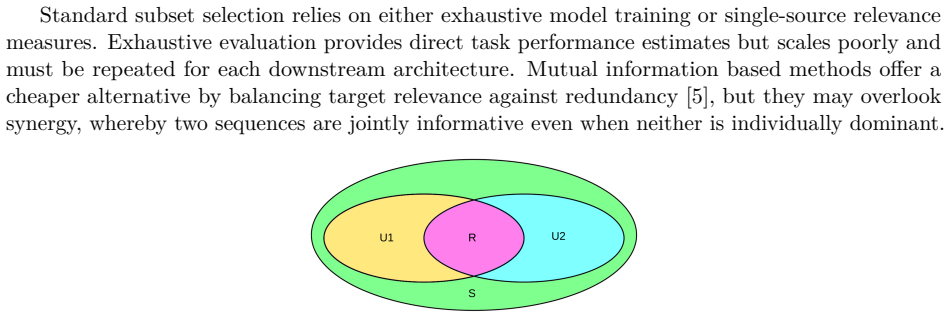
The central mechanism is a region-aware minimal-mutual-information partial information decomposition (MMI-PID) score. For each pair of MRI sequences, shallow 3D autoencoders compress aligned 32x32x32 patches to 32-dimensional latents, which are quantized with K-means (K=16) into discrete source codes; tumor burden per region is discretized into four classes. The PID framework splits the mutual information that the two sources provide about each tumor region into redundant, unique, and synergistic components using the MMI proxy, and an aggregate score weights joint information plus unique and synergistic terms relative to redundancy. This score ranks all n-choose-2 pairs before any segmentati
Load-bearing premise
The ranking is trustworthy only if the compressed, quantized autoencoder representations preserve the relative information that each MRI sequence, and each pair of sequences, carries about tumor burden; no reconstruction-fidelity or quantization-stability check is provided, so uneven information loss across contrasts could make the PID scores say something different from what a full segmentation model would use.
What would settle it
A direct test: run the same selection on a dataset with more than four contrasts (or vary the autoencoder's latent size and K-means K) and evaluate all pairs with the same lightweight U-Net. If a pair other than the PID top scorer achieves the best test Dice, or if the PID ranking's Spearman correlation with Dice falls near zero or negative, the claim that the score selects the strongest pair before training is refuted.
If this is right
- If the ranking is reliable, a team can spend compute on one pair of contrasts instead of all pairs or all four, cutting storage, transfer, preprocessing, and training costs in 3D pipelines.
- With n input contrasts, the method requires training only n shallow autoencoders and evaluating n(n-1)/2 pair scores, avoiding a full segmentation model per candidate pair.
- The agreement with Shapley attribution on the full model suggests the pre-training score tracks how a trained network actually uses its inputs, making PID selection a plausible stand-in for post-hoc explainability.
- For segmentation targets with multiple tumor regions, the region-weighted score lets the selected pair cover distinct tissue components—here, T1c's enhancing-tumor signal and T2-FLAIR's edema signal.
- The selected pair's test-set performance (Dice 0.676 vs 0.687, retention 98.5%) gives a concrete benchmark for what a two-input model can lose relative to a four-input model in this setting.
Where Pith is reading between the lines
- Because only six pairs were compared, the reported Spearman coefficient (0.6) has wide uncertainty; a natural extension is to run the same PID ranking and downstream training on a dataset with, say, eight to ten contrasts, where the correlation between score and Dice can be tested with adequate power.
- The paper does not check whether the ranking is stable to compression choices—latent dimension, K-means cluster count K, or autoencoder reconstruction quality. A reader could test this by re-running the selection with K = 8, 32, 64 and asking whether T1c+T2-FLAIR remains top-ranked.
- The same selection logic could transfer to any multi-modal segmentation or classification task where target classes have a spatial component—e.g., multi-modal CT/MRI or PET/MRI fusion—by defining the target in terms of regional burden per structure.
- The Shapley-PID agreement hints at a more general principle: input-pair information about a coarse target may predict deep-network performance when both are driven by the same discriminative signal, but the paper demonstrates this only for one dataset and architecture family.
Editorial analysis
A structured set of objections, weighed in public.
Referee Report
Summary. The paper proposes a pre-training input-selection framework for multi-contrast 3D MRI brain tumor segmentation. Each MRI sequence is compressed by a shallow 3D autoencoder into 32-d latents, which are quantized with K-means into discrete codes; a region-aware MMI-PID score then ranks all two-sequence pairs by their redundant/unique/synergistic information about a discretized patch-level tumor-burden target. On the CoRe-BT dataset, the framework selects T1c+T2-FLAIR. The authors train eleven lightweight 3D U-Nets (one four-input, six two-input, four single-input models) and report held-out Dice/HD95 with bootstrap and multiple-testing corrections. T1c+T2-FLAIR achieves the highest Dice among the two-input models (0.676 vs. 0.687 for the full model) and is second overall; a post-hoc Shapley analysis of the full model also ranks T2-FLAIR and T1c as the most influential inputs. The paper is explicitly framed as a proof of concept and includes honest reporting of non-significant comparisons.
Significance. If the proposed PID-based pre-training ranking reliably predicts downstream segmentation performance, it would be practically valuable for resource-constrained medical imaging settings, because selection happens before expensive 3D model training and is reusable across architectures. The paper has concrete strengths: it ships a reproducible pipeline with specified architectural and training details, a clearly bounded compute budget, patient-level statistical testing with bootstrap and Holm correction, and an independent Shapley audit. The authors also disclose the principal limitations of the study — small pair-level sample, non-significant rank correlation, and failure to establish non-inferiority. However, the central predictive claim currently rests on a single selected pair and a statistically underpowered correlation, and the lossy autoencoder/quantization surrogate is not validated as information-preserving for the tumor-segmentation task. Those issues are load-bearing for the claim that the framework can select the strongest input pair before training.
major comments (3)
- [§2.1, Eq. (1)–(2), Table 1] The selection pipeline replaces raw 32^3 patches with 32-d autoencoder latents quantized to K=16 clusters before estimating mutual information. No reconstruction error, no check that the latent codes retain tumor-relevant signal, and no sensitivity analysis with respect to K, autoencoder initialization, or K-means seeds are reported. Since the central claim is that the PID score ranks MRI pairs by their usefulness for segmentation, the surrogate must be shown to preserve the relevant information ordering across sequences; otherwise the scores in Table 1 could reflect compression artifacts or background intensity rather than discriminative tumor content. Please add: (i) per-sequence reconstruction fidelity, (ii) PID rankings under several K values and repeated fits, and (iii) a comparison of single-sequence MI with tumor burden computed from raw patches versus from quantized latents to co
- [§4.1 and §5.1] The predictive evidence is statistically weak. The Spearman correlation between PID score and test Dice is 0.600 with p=0.208 over six pairs, so the ranking–Dice association is not distinguishable from zero. The selected pair's 0.026 Dice advantage over T1c+T2w is not significant after Holm correction, and non-inferiority to the full model was explicitly not established. The Discussion's statement that 'the MMI-PID score selected the strongest two-input configuration' is therefore stronger than the results support. Please rephrase the central claim as a proof-of-concept with point estimates only, or provide additional evidence (e.g., a pre-specified decision rule, external validation, or a permutation test over configurations) that would justify the predictive wording.
- [§2.1 target and §4.1] The target used for PID is a coarse regional tumor-burden fraction (positive burdens divided into three training-set quantile classes), not the voxel-wise multi-region segmentation target of the downstream U-Net. While this is a reasonable proxy, it introduces a possible mismatch: an input pair that is informative about patch-level burden fractions may not be the pair that maximizes voxel Dice. The paper should discuss and ideally empirically test this gap, for example by computing PID scores under alternative target discretizations and reporting whether the resulting pair ranking and agreement with Dice are stable.
minor comments (5)
- [§4.1] The text says 'negative HD95 (ρ = 0.600, p = 0.208)', but the reported Spearman rho is positive. Presumably the intended value is negative; please correct the sign.
- [Table 2] Formatting issue: 'All four 416.09 0.687' should be 'All four 4 16.09 0.687' — the channel count and HD95 value run together.
- [§4.1] Typo: 'a−0.03Dice non-inferiority margin' should read 'a −0.03 Dice non-inferiority margin'.
- [§5.1] The sentence 'Paired tests did not provide clear evidence of differences in Dice, HD95, sensitivity, a larger study is required to reliably draw conclusions' is grammatically incomplete; a period or semicolon is needed after 'sensitivity'.
- [§2.1] The description of target discretization says 'positive burdens were divided into three training-set quantile classes' but does not specify whether quantiles are computed per region or globally, or how ties or zero-inflated distributions are handled. A brief clarification would improve reproducibility.
Circularity Check
No significant circularity: PID selection is pre-computed and tested on a held-out cohort; self-citations are corroborative, not load-bearing.
full rationale
The central derivation chain is not circular. The MMI-PID score (Eq. 2) is computed entirely from training-set patches and tumor masks before any downstream model is trained; the selected pair T1c+T2-FLAIR is then evaluated on an independent 28-subject test cohort. The test Dice comparison is therefore not an input to the selection. The Shapley audit is described as 'independent' and uses an attribution method from the authors' prior work [13], but this is corroborative rather than load-bearing: the primary evidence is the 11-model Dice evaluation, and Shapley values are standard game-theoretic quantities, not a uniqueness theorem or a fitted result. References to the authors' own SFL-Net [10] motivate the pipeline but are not used to derive the ranking, which relies on Barrett's MMI [14] and standard MI estimation. The main weaknesses—unvalidated lossy latents, hand-picked λ and K, and non-significant Spearman ρ=0.600 with only six pairs—are robustness/correctness concerns, not circularity. No equation reduces to its inputs by construction, and no fitted parameter is renamed as a prediction.
Axiom & Free-Parameter Ledger
free parameters (4)
- λ (PID score weight) =
0.5
- K (number of source-code clusters) =
16
- Tumor burden discretization =
zero + 3 training-set quantile classes
- Autoencoder latent dimension =
32
axioms (4)
- domain assumption MMI-PID (Barrett) is a valid proxy for the true bivariate PID decomposition.
- domain assumption Quantized latent codes preserve the relative information content of each MRI sequence about tumor burden.
- domain assumption Discretized regional tumor burden is a sufficient target for selecting inputs for voxelwise segmentation.
- standard math Empirical mutual information estimates from finite training patches are stable enough to rank pairs.
read the original abstract
Multi-contrast 3D MRI segmentation can be computationally demanding when all available sequences are used. We evaluate a pre-training Partial Information Decomposition framework that ranks input pairs according to their redundant, unique, and synergistic information about regional tumor burden and selects the highest-ranked pair for downstream training. Applied to T1n, T1c, T2w, and T2-FLAIR MRI, the framework selected T1c+T2-FLAIR. We then trained eleven architecturally identical lightweight 3D U-Nets using different input configurations. On an independent test cohort, T1c+T2-FLAIR was the strongest two-input configuration and ranked second overall in mean Dice (0.676 versus 0.687 for all four inputs). Independent Shapley analysis on the full-input model also identified T2-FLAIR and T1c as the most influential inputs and their pairwise interaction as the strongest. These findings demonstrate the practical value of PID based pre-training selection for identifying compact, informative MRI input sets before costly 3D model development.
Figures


Reference graph
Works this paper leans on
-
[1]
Menze et al
Bjoern H. Menze et al. The multimodal brain tumor image segmentation benchmark (BRATS). IEEE Transactions on Medical Imaging, 34(10):1993–2024, 2015
1993
-
[2]
Juampablo E. Heras Rivera, Daniel K. Low, Xavier Xiong, Jacob J. Ruzevick, Daniel D. Child, Wen-wai Yim, Mehmet Kurt, and Asma Ben Abacha. CoRe-BT: A multimodal radiology- pathology-text benchmark for robust brain tumor typing.arXiv preprint arXiv:2603.03618, 2026
arXiv 2026
-
[3]
Lienkamp, Thomas Brox, and Olaf Ronneberger
Özgün Çiçek, Ahmed Abdulkadir, Sören S. Lienkamp, Thomas Brox, and Olaf Ronneberger. 3d U-Net: Learning dense volumetric segmentation from sparse annotation. InMedical Image Computing and Computer-Assisted Intervention – MICCAI 2016, volume 9901 ofLecture Notes in Computer Science, pages 424–432. Springer, 2016
2016
-
[4]
Jaeger, Simon A
Fabian Isensee, Paul F. Jaeger, Simon A. A. Kohl, Jens Petersen, and Klaus H. Maier-Hein. nnU-Net: A self-configuring method for deep learning-based biomedical image segmentation. Nature Methods, 18:203–211, 2021
2021
-
[5]
Hanchuan Peng, Fuhui Long, and Chris Ding. Feature selection based on mutual information: Criteria of max-dependency, max-relevance, and min-redundancy.IEEE Transactions on Pattern Analysis and Machine Intelligence, 27(8):1226–1238, 2005
2005
-
[6]
Paul L. Williams and Randall D. Beer. Nonnegative decomposition of multivariate information. arXiv preprint arXiv:1004.2515, 2010
Pith/arXiv arXiv 2010
-
[7]
Quantifying unique information.Entropy, 16(4):2161–2183, 2014
Nils Bertschinger, Johannes Rauh, Eckehard Olbrich, Jürgen Jost, and Nihat Ay. Quantifying unique information.Entropy, 16(4):2161–2183, 2014
2014
-
[8]
Patricia Wollstadt, Sebastian Schmitt, and Michael Wibral. A rigorous information-theoretic definition of redundancy and relevancy in feature selection based on (partial) information decomposition.Journal of Machine Learning Research, 24(131):1–44, 2023
2023
-
[9]
Partial information decomposition for data interpretability and feature selection
Charles Westphal, Stephen Hailes, and Mirco Musolesi. Partial information decomposition for data interpretability and feature selection. In Yingzhen Li, Stephan Mandt, Shipra Agrawal, and Emtiyaz Khan, editors,Proceedings of the 28th International Conference on Artificial Intelligence and Statistics, volume 258 ofProceedings of Machine Learning Research, ...
2025
-
[10]
Chopra, Caitlin Neher, Tianyi Ren, Juampablo E
Agamdeep S. Chopra, Caitlin Neher, Tianyi Ren, Juampablo E. Heras Rivera, Hesamoddin Jahanian, and Mehmet Kurt. SFL-Net: Source-factorized latent representation learning for multi-contrast MRI to tau-PET synthesis.arXiv preprint arXiv:2602.22545, 2026
Pith/arXiv arXiv 2026
-
[11]
Feature-enhanced generation and multi-modality fusion based deep neural network for brain tumor segmentation with missing MR modalities.Neurocomputing, 466:102–112, 2021
Tongxue Zhou, Stéphane Canu, Pierre Vera, and Su Ruan. Feature-enhanced generation and multi-modality fusion based deep neural network for brain tumor segmentation with missing MR modalities.Neurocomputing, 466:102–112, 2021
2021
-
[12]
Segmentation of brain metastases in MRI: A two-stage deep learning approach with modality impact study
Yousef Sadegheih and Dorit Merhof. Segmentation of brain metastases in MRI: A two-stage deep learning approach with modality impact study. In Islem Rekik, Ehsan Adeli, Sang Hyun Park, and Celia Cintas, editors,Predictive Intelligence in Medicine, volume 15155 ofLecture Notes in Computer Science, pages 196–206. Springer, 2024. 7
2024
-
[13]
Heras Rivera, Hitender Oswal, Yutong Pan, Agamdeep S
Tianyi Ren, Juampablo E. Heras Rivera, Hitender Oswal, Yutong Pan, Agamdeep S. Chopra, Jacob J. Ruzevick, and Mehmet Kurt. Here comes the explanation: A shapley perspective on multi-contrast medical image segmentation. InJoint Proceedings of the xAI 2025 Late-Breaking Work, Demos and Doctoral Consortium, volume 4017 ofCEUR Workshop Proceedings, pages 185–...
2025
-
[14]
Adam B. Barrett. Exploration of synergistic and redundant information sharing in static and dynamical gaussian systems.Physical Review E, 91(5):052802, 2015
2015
-
[15]
Hinton and Ruslan R
Geoffrey E. Hinton and Ruslan R. Salakhutdinov. Reducing the dimensionality of data with neural networks.Science, 313(5786):504–507, 2006
2006
-
[16]
Least squares quantization in PCM.IEEE Transactions on Information Theory, 28(2):129–137, 1982
Stuart Lloyd. Least squares quantization in PCM.IEEE Transactions on Information Theory, 28(2):129–137, 1982
1982
-
[17]
Cover and Joy A
Thomas M. Cover and Joy A. Thomas.Elements of Information Theory. John Wiley & Sons, Hoboken, NJ, 2 edition, 2006
2006
-
[18]
Decoupled weight decay regularization
Ilya Loshchilov and Frank Hutter. Decoupled weight decay regularization. InInternational Conference on Learning Representations, 2019
2019
-
[19]
SGDR: Stochastic gradient descent with warm restarts
Ilya Loshchilov and Frank Hutter. SGDR: Stochastic gradient descent with warm restarts. In International Conference on Learning Representations, 2017
2017
-
[20]
A simple sequentially rejective multiple test procedure.Scandinavian Journal of Statistics, 6(2):65–70, 1979
Sture Holm. A simple sequentially rejective multiple test procedure.Scandinavian Journal of Statistics, 6(2):65–70, 1979
1979
-
[21]
Lloyd S. Shapley. A value forn-person games. In Harold W. Kuhn and Albert W. Tucker, editors,Contributions to the Theory of Games II, number 28 in Annals of Mathematics Studies, pages 307–317. Princeton University Press, Princeton, NJ, 1953. 8
1953
discussion (0)
Sign in with ORCID, Apple, or X to comment. Anyone can read and Pith papers without signing in.